Vesna Spasojevic Brkic, Mirjana Misita, Neda Papic, Aleksandar Brkic, Martina Perišić (2024). Ergonomic Adjustment Needs of Transport and Mining Machines: A Preliminary Study of Operators' Attitudes in Serbia. In: Human Factors and Systems Interaction. AHFE Open Access, vol. 154, pp. 1–11. https://doi.org/10.54941/ahfe1005347
Previous studies suggests that accidents and/or incidents involving heavy machinery are unanticipated and unfortunate occurrences most frequently caused by human error. Therefore, the primary objective of this research was to conduct a preliminary investigation into the views held by operators of transport and mining machinery towards the ergonomic adjustment of their work environment to accommodate their specific needs. Namely, the aim of this paper is to analyze the various factors that contribute to the degradation of working conditions, leading to the emergence of occupational diseases and to the likelihood of accidents and incidents. In this research, the factors that influence the possibility of human error due to unfavorable workplace conditions, ergonomic characteristics of the cabin, the physical condition of the operator, job satisfaction and management commitment were analysed, as those factors are recognized by previous research.The research utilized a questionnaire tool to gather data from individuals operating machinery in the transportation and mining industries. There were 93 operators of transport and mining machines willing to participate in this survey, of which 65 were operators of various mining machines, while 28 operators worked on cranes. All surveyed crane operators have an average height in the range of 165-182 cm and a weight of 70-102 kg. Surveyed operators of mining machines have an average height in the range of 166-190 cm, but there are high deviations from the average weight, i.e. 9.23% of them have a weight of over 110 kg, that is, the weight is in the range of 60-150 kg. The examined machines included cranes with a span from 9 to 25 m and its load capacity from 10 to 160 tons, as well as excavators, bulldozers, drills, dumpers, backhoe loaders, bucket wheel excavators and loaders. The data was subsequently subjected to further analysis using descriptive statistics, cluster and principal component analysis. The study's results have provided evidence to support the initial premise, suggesting that human error is the primary cause of accidents and incidents involving transportation and mining machinery. The main cause factor, as perceived by a considerable majority of mining operators (79.9%) and crane operators (40%) is human error. The results suggest that there are differences in the ergonomic adjustment of workplaces of mining and transport machinery operators in manner that mining industry workplaces are better adjusted then transport industry workplaces.Cluster and principal components analysis led to the following conclusions. The key factors affecting the reduction of the quality of the working conditions of operators on mining machines are related to the seat rotation, absence from work due to poor working conditions (sick leave), nonadjustable armrests or non-existing armrests or armrests which are not set at the right height. The key factors that affect the quality of the crane operator's working conditions, are connected to characteristics of armrests (no armrests, armrests not at the right height, armrests are not adjustable), seat characteristics (seat height is not adjustable, seat is not adjustable horizontally, seat has not lumbar support, seat cannot recline, seat cannot be rotated), controls adjustment issues, the temperature in cabin regulation, visibility issues and to the absence of management commitment.A general recommendation as a measure to improve working conditions for operators of mining and transport machines is the usage of ergonomically adjusted seats with armrests. A proposal to introduce cameras that provide operators with better side and rear visibility could be considered, too, in aim to reduce the burden on the operator during reversing movements. In terms of management commitment, further focus on ergonomics climate is necessary to enable better working conditions for mining and transport machinery operators.Sample size enlargement is proposed as the future research avenue.
Mining accidents and/or incidents are unplanned and unwanted events. Iso- lated factors that contribute to the occurrence of accidents and/or incidents when working with mining machinery are: human factor (human error), envi- ronmental factors (influence of natural forces, storms, earthquakes etc.), and factors originating from the mining vehicle (Spasojevic Brkic et al., 2023). The most often cause is human error (Milazzo et al., 2016). In the previous literature, it is stated that over 80% of all unwanted events related to mining
machinery are caused by human error (Mirzaei Aliabadi et al., 2020; Kirin et al., 2021). Also, with transport machinery, human error is the primary cause of accidents and/or incidents (McCann, 2006; Spasojevi´c Brki´c et al., 2015; Bedi et al., 2021; Duarte et al., 2021). The human error is a key and the most complex cause, when working with mining and transport machines. Possible causes of human error are: physical condition of the operator/driver, inadequate speed, overloading the vehicle with cargo, blind spots, aggressive operation/driving, adherence to safety procedures, keeping a distance from other objects/vehicles, fatigue, stress, mental effort due to working in a confined space, underground or at height conditions, dust, various gases, polluted air, and visibility (during daylight, when working at night, when working in conditions of reduced visibility), and ergonomics climate, which have not been enough researched till now (McCann, 2006; Seo and Kim, 2008; Patterson and Shappell, 2010; Cheng et al., 2013; Chaudhary et al., 2015; Stemn, 2019; Duarte et al., 2021; Hoffmeister et al., 2015).
Therefore, the goal of this paper is to investigate the factors that influence the occurrence of human error, which originate from the ergonomic adjust- ment of the workplace to the needs of operators of mining and transport machinery, which would contribute to the prevention of accidents and/or incidents as well as to the improvement of the quality of working condi- tions. After the description of the previous research, which indicates the actuality and insufficient research of the topic of the paper, the methodology used is described, and then conclusions are drawn on the basis of obtained results.
PREVIOUS RESEARCH A number of studies in terms of research into the ergonomic adjustment of the workplace for transport and mining machines point to the actuality of the research (Lin et al., 2008; Milijic et al., 2013; Horberry et al., 2016; Spasojevi´c et al., 2022; Spasojevi´c Brki´c et al., 2023), but also to insuffi- ciently researched factors of ergonomic adjustment (Spasojevi´c Brki´c et al., 2015; Essdai et al., 2018). Horberry et al. (2013) demonstrate how human factors and ergonomics contribute to risk reduction in the mining industry. Spasojevi´c Brki´c et al. (2023) come to the conclusion that it is necessary to pay special attention to the following characteristics in order to improve ergonomic adjustment: the seat’s capacity to be tilted back, its ability to be adjusted both vertically and horizontally, and its lumbar support; armrests must be present, adjustable, and set at the proper height; the controls or levers should be in a convenient place that is both adjustable and movable; the interior of the cab should be spacious enough to allow for an adequate view from within in all directions, and the entrance and departure into the cab must both be properly thought out; to avoid the operators’ absence from work, the design of the cab must take into account the operators’ working circumstances, particularly exhaust gases and dust. The ability to raise the percentage of the population accommodated by the corresponding mining jobs is an advantage of the smart technologies outlined in Dempsey et al.
Ergonomic Adjustment Needs of Transport and Mining Machines 3
(2018). The papers of Milijic et al. (2013), Haas and Yorio (2021), Spaso- jevi´c et al. (2022) refer to recommendations for safety climate measurements and research in the transport and mining sectors. Thus Spasojevi´c et al. (2022) state that in terms of absence caused by unfavorable working circum- stances, the climate of collaboration and togetherness, and the methods in which managers encourage and reward their employees, there are no statisti- cally significant variations in the views of operators of transport and mining equipment. There are also no statistical variations between the numbers of workplace injuries caused by the two different machine types. Hofmeister et al. (2015) introduce a framework for ergonomics climate, and recognize management commitment as important factor to maximize both performance and well-being outcomes.
METHODOLOGY
In this research, the factors that influence the possibility of human error due to unfavorable workplace conditions, ergonomic characteristics of the cabin, the physical condition of the operator, job satisfaction and management com- mitment were analysed, as those factors are recognized by previous research. The instrument used is the survey presented in Spasojevi´c Brki´c et al. (2023). There were 93 operators of transport and mining machines willing to partici- pate in the research, of which 65 were operators of various mining machines, while 28 operators worked on cranes. All surveyed crane operators have an average height in the range of 165–182 cm and a weight of 70–102 kg. Surveyed operators of mining machines have an average height in the range of 166–190 cm, but there are high deviations from the average weight, i.e. 9.23% of them have a weight of over 110 kg, that is, the weight is in the range of 60–150 kg, as in Table 1.
Table 1. Descriptive statistics for mining machine operators and crane operators.
Table available in the original PDF paper.
Mining Machines Operators Transport Machines Operators Statistic Age (years) Height (cm) Weight (cm)
The examined machines included cranes with a span from 9 to 25 m and its load capacity from 10 to 160 tons, as well as excavators, bulldozers, drills, dumpers, backhoe loaders, bucket wheel excavators and loaders.
4 Brki´c et al.
Regarding the seat the following is observed: 96.43% of crane operators answered that the seat is not adjustable in height (the answers are none at all and bad); 96.43% of crane operators answered that the seat cannot be adjusted horizontally; 57.14% of crane operators answered that the seat was not set at the appropriate height; 15.38% of mining machine operators answered that the seat is not adjustable in height; 10.77% of mining machine operators answered that the seat can be adjusted horizontally; 9.23% of min- ing machine operators answered that the seat was not set at the appropriate height. Considering the average age of cranes (35.11 years) and the average age of other mining machines (5.71), it is clear that there are no options for adjusting the seat for the operator in older machines, so differences there are expected.
In terms of back support the following is noticed: 82.14% of crane oper- ators answered that the seat does not have lumbar support, while all crane operators answered that there is back support; 50.77% of operators on other mining machines answered that the seat does not have lumbar support, while 15.38% of them answered that there is no back support. Regarding the armrests the following is observed: 100%, i.e. all crane oper- ators stated that there are no armrests (thus they are not adjustable and not at the appropriate height); 58.46% of mining machine operators stated that there are no armrests; 60% of mining machine operators had an unfavorable opinion regarding the adjustment of hand rests; 56.92% of mining machine operators said they had an unfavorable opinion regarding the appropriate height of the armrests.
Also, neither the crane operators nor the operators of the mining machines have rated unfavourably the following: vibrations through the seat, through the floor or through the control devices, easily accessible pedal, cabin size, noise in the cabin, thresholds and handrails, easy entry and exit from the cabin, visibility in the work area, and cabin window reflection.
Factors that also were evaluated unfavourably are the impossibility of con- trolling the temperature in the cabin for crane operators, as many as 85.71% of crane operators said they were unfavorable regarding the possibility of regulating the temperature in the cabin and both crane operators and mining machinery operators stated that their view was obstructed by obstacles (89% of crane operators and 70% of mining machinery operators).
As many as 82.14% of crane operators assessed that the management does not motivate and reward them, while 21.43% of crane operators believe that workplace risks are most often caused by factors other than human and orga- nizational factors. Operators of mining machinery do not share this opinion regarding the management’s motivation (only 38.46% believe that manage- ment does not motivate and reward them), while 52.61% of operators of mining machines believe that workplace risks are caused by a factor other than human or organizational factors.
Table 2 shows all examined factors, while Table 3 gives the ranking of key factors that affect the reduction of the quality of working conditions for mining machines and crane operators.
Ergonomic Adjustment Needs of Transport and Mining Machines 5
The analysis indicates that much more unfavorable factors of working con- ditions were noted among crane operators than among operators of mining machines, which is expected due to work at height.
By grouping the unfavorably rated factors of working conditions for min- ing machinery operators, as given in Table 3, two groups of factors were distinguished: 1. seat (impossibility of adjustment and absence of armrests), and 2. absence from work due to poor working conditions.
Table 2. List of questions.
Table available in the original PDF paper.
No. Question No. Question
28 Can you get in/out of the cabin easily?
1 Is the seat height adjustable? 21 Do you have sufficient visibility in all directions? 2 Can the seat be adjusted horizontally? 22 Is your view of the ongoing operation obstructed by obstacles? 3 Is the seat set at the correct height? 23 Do you have the feeling that the cabin is noisy? 4 Does the seat have back support? 24 Can you control the temperature in the cabin? 5 Does the seat have lumbar support? 25 Does the equipment in the cabin have thresholds? 6 Are there armrests? 26 Does the equipment have handrails? 7 Are the armrests adjustable? 27 Can you open/close the cabin door easily? 8 Are the armrests placed at the appropriate height?
9 Do you feel vibrations through the seat? 29 Do you have the appropriate equipment to enter the cabin? 10 Do you feel vibrations from the equipment through the floor?
30 Do you have the right equipment to get out of the cabin? 11 Do you feel vibrations from the equipment through the control devices?
31 Do you have good visibility and a general view of the work zone? 12 Is the seat firmly attached to the floor? 32 Are the cabin windows free of distracting reflections? 13 Can the seat be reclined? 33 Is there a device that allows better visibility of the work field? 14 Can the seat rotate? 34 Due to poor working conditions, you often miss work (sick leave) 15 The controls or handles could be adjusted? 35 You don’t mind the exhaust gases of the machine you operate 16 Can you easily reach controls or handles? 36 You don’t mind the pollution that is part of the working conditions 17 Can you easily operate controls or handles? 37 There is an atmosphere of cooperation and togetherness among machinery operators 18 Can you easily reach the pedal? 38 Managers motivate and reward us 19 Can you use the pedal easily? 39 Failures of the machine are very often caused by human and organizational factors 20 Is the cabin big enough for you (space that does not constrain you)?
By listing the unfavorable assessment factors of working conditions for crane operators, as in Table 3, four main factors can be distinguished: 1. seat including armrests (impossibility of adjustment and absence of arm- rests), 2. cabin temperature, 3. location of the controls or handles and 4. management commitment.
The analysis indicates that much more unfavorable factors of working con- ditions were noted among crane operators than among operators of mining
6 Brki´c et al.
machines, which is expected due to work at height. Significant improvements in working conditions for all mining machinery operators can be achieved by implementing ergonomic seats and more adequate management commitment, while with transport machinery, beside recommendations as with mining machinery, it is necessary to consider the issues of cabin air conditioning and location of controls or handles.
Furthermore, for the analysis of factors that influence the quality of work- ing conditions for operators of mining and transport machines, Principal Components Analysis (PCA) analysis was conducted. PCA enables the anal- ysis of data sets with the explanation of the variance-covariance structure of a set of similar variables through several linear combinations of these ran- dom variables (Houle et al., 2002). PCA reduces the dimensionality of a data set that contains a large number of interconnected data by calculating a new set of correlated variables - principal components that represent linear com- binations of the original variables (Houle et al., 2002; Abdi and Williams, 2010).
Table 3. Ranking of key factors that affect the quality of working conditions of mining operators and transport machines operators.
Table available in the original PDF paper.
Mining Machine Operators Transport Machines Operators
Cause % of unfavorable grades
Cause % of unfavorable grades
87.69%
The seat cannot be rotated
83.08%
Absence from work due to poor working conditions (sick leave)
60.00%
The armrests are not adjustable
56.92%
There are no armrests 58.46% The armrests are not at the right height
75.00%
There are no armrests 100.00% The armrests are not at the right height 100.00% There is no device that provides better visibility 100.00% The armrests are not adjustable 96.43% The seat height is not adjustable 96.43% The seat is not adjustable horizontally 96.43% The cabin temperature cannot be adjusted 85.71% The seat has no lumbar support 82.14% Managers do not motivate or reward 82.14% The seat cannot recline 78.57% Absence from work due to poor working conditions
67.86%
The seat cannot be rotated 71.43% The location of the controls or handles cannot be adjusted
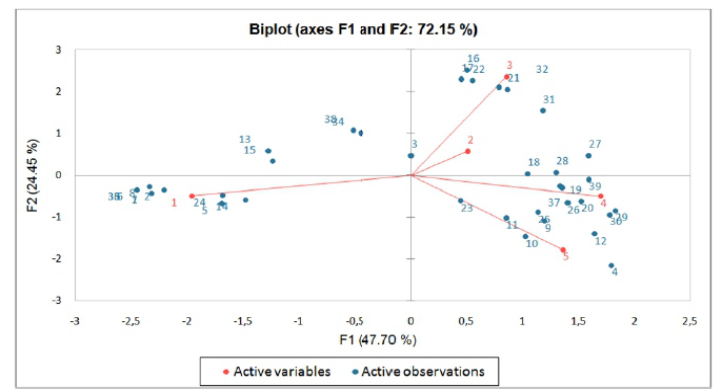
Principal component analysis (PCA) for mining machinery operators indi- cates that: questions 14, 34, 6, 7, 8, 33 are correlated and grouped around a score of 1; questions 39, 35, 5, 36, 38, 22, 23, 21, 32 are correlated and grouped around a score of 2; questions 31, 27, 37, 28, 29, 30, 4 are cor- related and grouped around a score of 4; questions 18, 17, 16, 19, 13, 20, 2 are correlated and grouped around a score of 5. PCA analysis for mining machinery operators confirms that seat factors (unable to rotate - question 14, armrest adjustment - questions 6, 7, 8), and absence due to poor working conditions – question 34 are key factors affecting reduction in the quality of working conditions.
Ergonomic Adjustment Needs of Transport and Mining Machines 7
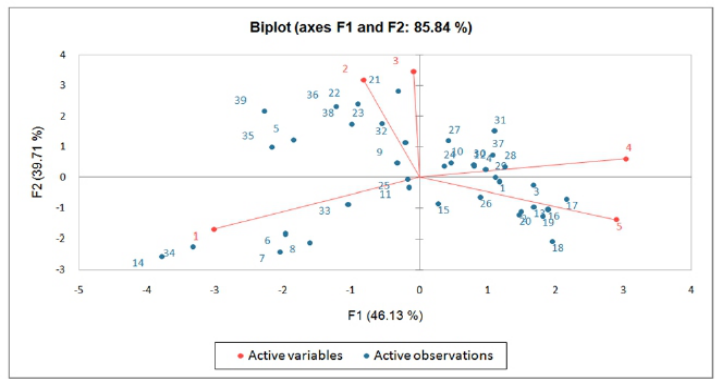
PCA analysis for crane operators indicates that: questions 38, 6, 7, 1, 8, 2, 24, 5, 14 are correlated and grouped around the grade 1; questions 16, 17 22, 32, 31 are correlated and grouped around grade 3; questions 29, 30, 12, 20, 26, 19, 37 are correlated and grouped around grade 4; questions 4, 10, 11, 23 are correlated and grouped around a score of 5. PCA analysis for crane opera- tors confirms that seat factors (questions 1, 2, 5, 6, 7, 8, 14) have the primary influence on the quality of working conditions, followed by management commitment factors (question 38), cabin temperature (question 24).
Figure 1: PCA analysis for factors that affect the quality of working conditions of mining machinery operators.Figure 2: PCA analysis for factors that affect the quality of working conditions of crane operators.
8 Brki´c et al.
Furthermore, cluster analysis was carried out in order to see which issues can be grouped by similarities into clusters for mining machinery operators and crane operators.
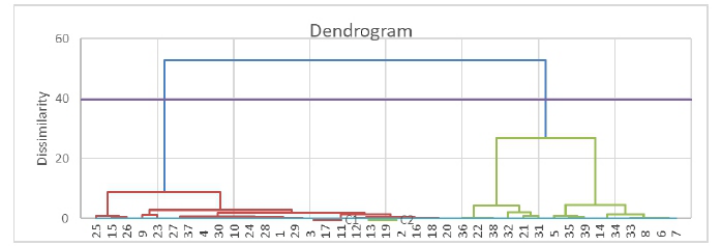
Cluster analysis of mining machinery operators indicates the existence of 2 clusters. A great similarity of questions (6, 8, 33), then (35, 39), then (21 and 31), (36, 22, 38) was recorded in the first cluster, that is, in this cluster there are questions that were evaluated unfavorably. In the second cluster (18, 16, 2), (13, 12) then (10, 24, 28 and 1) further (27 and 37), (9 and 23), (15 and 26), i.e. in this cluster there are questions which were evaluated favorably.
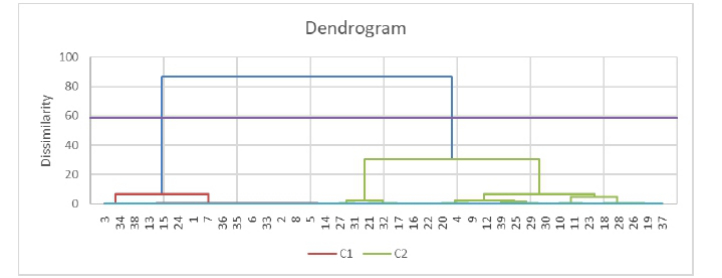
Figure 3: Cluster analysis for factors that affect the quality of working conditions of mining machinery operators.Figure 4: Cluster analysis for factors that affect the quality of working conditions of crane operators.
Cluster analysis for crane operators indicates the existence of 2 clusters in which great similarity is recorded in questions (18, 28, 26), (20, 4, 9), (39, 25, 29), (27 and 31), (21, 32, 17) in the first cluster, i.e. questions that were evaluated favorably.
In the second cluster, similarity was recorded in questions (3 and 34), (13, 15), (7, 26, 25, 6, 33, 2, 8, 5), since those questions were evaluated unfavorably.
Ergonomic Adjustment Needs of Transport and Mining Machines 9
CONCLUSION
This paper presents a preliminary investigation of the attitudes of operators of mining and transport machines in Serbia regarding the ergonomic adjustment of their workplaces.
In the research, an instrument for surveying operators on transport and mining machines was used in order to obtain a database on which principal components and cluster analysis were carried out.
The research confirmed the initial hypothesis that the occurrence of acci- dents and/or incidents with both transport and mining machines is most often caused by human error (79.9% of operators and 40% of crane operators believe that human error is the cause).
The key factors affecting the reduction of the quality of the working condi- tions of operators on mining machines are related to the seat rotation, absence from work due to poor working conditions (sick leave), nonadjustable arm- rests or non-existing armrests or armrests which are not set at the right height.
The key factors that affect the quality of the crane operator’s working conditions, are connected to characteristics of armrests (no armrests, arm- rests not at the right height, armrests are not adjustable), seat characteristics (seat height is not adjustable, seat is not adjustable horizontally, seat has not lumbar support, seat cannot recline, seat cannot be rotated), controls adjust- ment issues, temperature in the cabin, visibility issues and to the absence of management commitment.
A general recommendation as a measure to improve working conditions for operators of mining and transport machines is the usage of ergonomically adjusted seats with armrests. A proposal to introduce cameras that provide operators with better side and rear visibility could be considered, too, in aim to reduce the burden on the operator during reversing movements.
In terms of management commitment, further focus on ergonomics climate is necessary to enable better working conditions for mining and transport machinery operators.
Sample size enlargement is expected in future research.
ACKNOWLEDGMENT
This research was supported by the Science Fund of the Republic of Serbia, #GRANT No. 5151, Support Systems for Smart, Ergonomic and Sustainable Mining Machinery Workplaces – SmartMiner and the Ministry of Science, Technological Development and Innovations contract no. 451-03-47/2023- 01/200105 from 03.02.2023. The authors also thank the respondents who filled out the questionnaires for their kind cooperation.
REFERENCES
Abdi, H. and Williams, L. J. (2010) Principal component analysis, Wiley Interdisciplinary Reviews: Computational Statistics, Volume 2, No. 4, pp. 433–459. Bedi, J. K. Rahman, R. A. and Din, Z. (2021) Heavy Machinery Operators: Necessary
Competencies to Reduce Construction Accidents, IOP Conference Series: Earth and Environmental Science, Volume 641, No. 1, p. 012007.
10 Brki´c et al.
Chaudhary, Dhanjee Kumar. Bhattacherjee, Ashis. Patra, Aditya Kumar and Chau, Nearkasen (2015) Whole-body Vibration Exposure of Drill Operators in Iron Ore Mines and Role of Machine-Related, Individual, and Rock-Related Factors, Safety and Health at Work, Volume 6, No. 4, pp. 268–278. Cheng, Ching-Wu. Yao, Hong-Qing and Wu, Tsung-Chih. (2013) Applying data
mining techniques to analyze the causes of major occupational accidents in the petrochemical industry, Journal of Loss Prevention in the Process Industries, Volume 26, No. 6, pp. 1269–1278. Dempsey, Patrick G. Kocher, Lydia M. Nasarwanji, Mahiyar F. Pollard, Jonisha P.
and Whitson, Ashley E. (2018) Emerging Ergonomics Issues and Opportunities in Mining, International Journal of Environmental Research and Public Health, Volume 15, No. 11, p. 2449. Duarte, J. Marques, A. Torres and Santos Baptista, J. (2021) Occupational Accidents Related to Heavy Machinery: A Systematic Review, Safety, Volume 7, No. 1, p. 21. Essdai, Ahmed. Spasojevi´c Brki´c, Vesna K. Golubovi´c, Tamara. Brki´c, Aleksan-
dar and Popovi´c, Vladimir. (2018) Crane cabins’ interior space multivariate anthropometric modeling, Work, Volume 59, No. 4, pp. 557–570. Haas, Emily J. and Yorio, Patrick L. (2021) Exploring the Differences in Safety Climate Among Mining Sectors, Mining, Metallurgy & Exploration, Volume 38, No. 1, pp. 655–668. Hoffmeister, Krista. Gibbons, Allysa. Schwatka, Natalie. and Rosecrance, John.
(2015). Ergonomics Climate Assessment: A measure of operational performance and employee well-being. Applied Ergonomics, Volume 50, pp. 160–169. Horberry, Tim. Burgess-Limerick, Robin. Cooke, Tristan and Steiner, Lisa. (2016) Improving Mining Equipment Safety Through Human-Centered Design, Ergonomics in Design, Volume 24, No. 3, pp. 29–34. Horberry, Tim. Burgess-Limerick, Robin and Fuller, Ruth. (2013) The contributions of human factors and ergonomics to a sustainable minerals industry, Ergonomics, Volume 56, No. 3, pp. 556–564. Houle, David. Jason Mezey. and Paul Galpern. (2002) Interpretation of the results
of common principal components analyses. Evolution, Volume 56, No. 3, pp. 433–440. Kirin, Snežana. Sedmak, Aleksandar. Li, Wei. Brzakovi´c, Miodrag. Miljanovi´c, Igor.
Petrovi´c, Ana and Sedmak, Simon. (2021) Human factor risk management proce- dures applied in the case of open pit mine, Engineering Failure Analysis, Volume 126, p. 105456. Lin, Si-Hao. Tang, Wen-Juan. Jian-Ying, Miao. Wang. Zhi-Ming and Wang, Pei- Xi. (2008) Safety climate measurement at workplace in China: A validity and reliability assessment, Safety Science, Volume 46, No. 7, pp. 1037–1046. McCann, Michael. (2006) Heavy equipment and truck-related deaths on excavation
work sites, Journal of Safety Research, Volume 37, No. 5, pp. 511–517. Milazzo, M. F., Ancione, G., Spasojevi´c-Brki´c, V., Vališ, D. (2016) “Investigation of crane operation safety by analysing main accident causes”, in Risk, Reliability and Safety: Innovating Theory and Practice, Lesley Walls, Matthew Revie, Tim Bedford (Ed.). pp. 74–80. Milijic, Nenad. Mihajlovic, Ivan. Strbac, Nada and Zivkovic Zivan. (2013) Devel-
oping a Questionnaire for Measuring Safety Climate in the Workplace in Serbia, International Journal of Occupational Safety and Ergonomics, Volume 19, No. 4, pp. 631–645. Mirzaei Aliabadi, Mostafa. Aghaei Hamed. Kalatpour, Omid. Soltanian Ali Reza and Nikravesh Asghar. (2020) Analysis of human and organizational factors that influence mining accidents based on Bayesian network, International Journal of Occupational Safety and Ergonomics, Volume 26, No. 4, pp. 670–677.
Ergonomic Adjustment Needs of Transport and Mining Machines 11
Patterson, Jessica M. and Shappell, Scott A. (2010) Operator error and system deficiencies: Analysis of 508 mining incidents and accidents from Queensland, Australia using HFACS, Accident Analysis & Prevention, Volume 42, No. 4, pp. 1379–1385. Seo, Jong-Min and Kim, Sun-Kuk. (2008) The Study on Measures for Reduc-
ing Safety Accidents of Excavator, Journal of the Korea Institute of Building Construction, Volume 8, No. 3. pp. 127–133. Spasojevi´c Brki´c, Vesna. Misita, Mirjana. Periši´c, Martina. Brki´c, Aleksandar. and Veljkovi´c, Zorica. (2023) Validating Measurement Structure of Checklist for Evaluating Ergonomics Risks in Heavy Mobile Machinery Cabs, Mathematics, Volume 11, No. 1, p. 23. Spasojevi´c Brki´c, V. K. Klarin, M. M. and Brki´c, A. Dj. (2015) Ergonomic design
of crane cabin interior: The path to improved safety, Safety Science, Volume 73, pp. 43–51. Spasojevi´c Brki´c, Vesna. Veljkovi´c, Zorica. Brki´c, Aleksandar. Misita, Mirjana. Periši´c, Martina and Papi´c, Neda. (2022) Transport and mining machines operators’ behavioral attitudes in safety climate context, Journal of Applied Engineering Science, Volume 20, No. 4, pp. 1196–1202. Stemn, Eric. (2019) Analysis of Injuries in the Ghanaian Mining Industry and Priority
Areas for Research’, Safety and Health at Work, Volume 10, No. 2, pp. 151–165.
LISTED IN THE AHFE DIGITAL BOOKSTORE CATALOGUE
Explore the complete digital volume
Human Factors and Systems Interaction
Read this individual research paper free through the original publisher, or explore the full digital proceedings book.
ISBN 978-1-964867-30-4
Explore this ISBN in the AHFE Bookstore ↗Listed in the July 2026 bookstore catalogue; search by ISBN to confirm current availability · Digital book purchase optional