Emanuel Silva, Isabel Lisboa, Tiago Matias, Rui Gomes, Adriano Carvalho, Paulo Cardoso, Nelson Costa (2024). Hand Vibration Threshold Mapper (HaViThreMa): a Haptic Vibration System. In: Human Factors and Systems Interaction. AHFE Open Access, vol. 154, pp. 93–102. https://doi.org/10.54941/ahfe1005357
This paper describes the design aspects of a system created to assess vibration perception thresholds (VPT). i.e., the minimum thresholds of mechanical vibration that humans can perceive on their hands. The system can carry out these assessments on various areas of the hand, such as the fingertips and the palm, and assessments are conducted according to pre-established psychophysical protocols. The technical specifications of this system, referred to as Hand Vibration Threshold Mapper (HaViThreMa), are discussed throughout this paper, as well as its advantages and disadvantages when compared with similar systems that have already been used in other studies. The HaViThreMa uses piezoelectric actuators to produce vibration stimulus, and can acquire VPT data from one area while, at the same time, also delivering stimuli to one or more other areas. When carrying out assessments on multiple areas of the hand, this platform allows these areas to be tested in a randomized order, reducing subjects’ expectations regarding the location in which the next stimulus will be actuated, and increasing data consistency. By making use of these capabilities to design and carry out psychophysical studies, the information obtained from the gathered VPTs can help elaborate guidelines on how to better use piezoelectric actuators to design more effective Human-Machine Interfaces (HMIs).
As the number of new devices and technologies increases, so to increases the need for better interfaces through which to interact with them. In recent years, a growing trend has been the use of interactive displays as HMIs (Human Machine Interfaces), leading to most—if not all—information about the device being presented visually. However, presenting information to users through the visual channel can be problematic, as there is a limit to how much visual information users can comfortably and reliably process. Thus, other communication channels are now being employed to transmit infor- mation from machines to humans, such as the audio and tactile channels, so that information that might be overlooked due to a high amount of visual
information can be picked up by other, less loaded, channels (Lisboa et al., 2024). Devices capable of generating vibrations have a substantial presence in people’s daily routines. As these vibrations are usually spaced out through- out the day, and since people have already become accustomed to them, the impact of vibration goes almost unnoticed in our daily lives. Over the course of a single day, a person might interact with a vast number of devices that generate vibrations. These vibrations might be generated by the device’s nor- mal functioning mechanisms, such as those coming from a working washing machine. Alternatively, they might be intentionally generated using haptic actuators, serving various purposes, such as signalling a notification to cap- ture the user’s attention. However, when vibrations are intentionally used, they are usually set to work following a basic on-off state (Culbertson et al., 2018), which is the most basic approach regarding how to use them to transmit information.
To develop systems that properly make use of haptic feedback, developers and researchers need access to proper tools whit which to study it. To bypass the limitations found on commercial devices, and to expand the range of possible studies they can carry out, many researchers end up developing their own haptic devices (Culbertson et al., 2018).
The following section covers some of the existing vibration threshold data acquisition devices and the context in which they were developed. We end by presenting the Hand Vibration Threshold Mapper (HaViThreMa) data acquisition platform, as well as its most important specifications, advantages, and disadvantages, in comparison to other devices used in the literature.
STATE OF THE ART To provide some standardization to haptic feedback studies, the interna- tional standards for mechanical vibration have provided recommendations regarding the components that vibrometers should have to study Vibration Perception Thresholds (VPT) on the fingertip. These components are a stim- ulator, through which a vibration stimulus is created, and a probe object, which transmits the generated stimulus to the subject’s finger. Additionally, albeit optionally, a firm flat surface surrounding the probe, a finger and/or hand support structure, and a sensor to accurately determine the position of the probe, may also be included. As for the procedure through which VPTs should be assessed, these standards inform that either the Staircase algorithm, using intermittent stimulation, or the von Békésy algorithm, using continuous stimulation, should be used. However, according to the standards, preference should be given to the Staircase algorithm, seeing as intermittent stimulation can help prevent a temporary threshold shift (International Organization for Standardization, 2001, 2003).
In recent literature regarding VPTs on the human hand, many different instruments have been used across several studies. Some of these studies used custom-made apparatuses (e.g., Hopkins et al., 2016; Labbé, Meftah and Chapman, 2016; Pra et al., 2022), while others used commercial devices specifically designed to test a subject’s VPTs, either for research or medical
Hand Vibration Threshold Mapper (HaViThreMa): A Haptic Vibration System 95
purposes, such as the HVLab Vibrotactile Perception Meter (VPM, University of Southampton) (e.g., Gu and Griffin, 2013; Tamrin, Zali and Karuppiah, 2016; Ye and Griffin, 2016), the Rion Type AU-06 (Rion Inc., Tokyo, Japan) (e.g., Shibata, 2022, 2023), and the VibroSense Meter® I and II (Vibrosense Dynamics, Malmö, Sweden) (e.g., Dahlin et al., 2015; Ekman et al., 2021; Witte et al., 2022). Something that most of these devices have in common is that they can carry out assessments using either the Staircase of the von Békésy algorithms, as recommended by ISO 13091–1 (International Orga- nization for Standardization, 2001). However, when looking at the studies in which they have been used, it can be noted that commercial devices are most often used to gather data using the von Békésy algorithm. Furthermore, some commercial devices seem to have a limit regarding at which frequencies they can assess VPTs, pre-defined by the manufacturer. On the other hand, authors that make use of custom-made apparatuses have a more varied choice regarding which methods and frequencies to employ. In general, these devices provide more flexibility, allowing users the freedom to tailor their creations according to their specific research objectives.
HAND VIBRATION THRESHOLD MAPPER (HAVITHREMA) This section discusses the technical aspects of the HaViThreMa, namely the selected vibration actuator, vibration sensor (accelerometer), and the mechan- ical design for a Piezo Cradle, a mechanical holder specially designed to keep the piezo actuator and the vibration sensor in contact.
The HaViThreMa was created in the context of a research project collabo- ration between the University of Minho and Bosch Car Multimedia. The aim was to study the implementation of haptic feedback on interactive interfaces. To this end, a device following various requirements was needed, namely: a) it had to be capable of delivering vibrations to one or more locations of the human hand, both individually and simultaneously; b) it had to be capa- ble of adapting to different hand sizes; c) it had to be programmed in such a way that different experimental protocols and conditions could be imple- mented and/or adapted when needed, including a variety of skin locations and vibration frequencies; d) it had to be portable; e) it had to be upgradable, both in terms of actuators and accelerometers, but also other components as well; and f) the actuators selected had to be compact enough to be included in/under interactive interfaces and/or surfaces.
The discussion around which actuators to include on the HaViThreMa mainly revolved around 3 categories: Eccentric Rotating Mass Motors (ERM), Linear resonant Actuators (LRA), and Piezoelectric actuators (Piezo). Comparing their advantages and disadvantages in relation to one another— namely their output, response time, and size—, as well as the intended use case of the HaViThreMa, we decided to use Piezoelectric actuators, due to their ability to reproduce different vibration frequencies and amplitudes inde- pendently, while also bolstering high response times, at a very small size. For the development of the proposed apparatus, the TDK 0904H014V060 model, driven by the BOS 1901 Boréas piezo driver, was selected.
The MEMS accelerometer ADXL 355 was selected to measure the acceler- ations generated by the Piezo due to its low noise (around 0.7mGRMS) and its ability to measure accelerations in 3 axes (x, y, and z). A direct comparison with the calibrated commercial Quest VI-400 Pro vibration analyser proved it to be an appropriate sensor to be used in the context we intended. The hardware setup to support the comparison included a vibration exciter (Type 4809 | Brüel & Kjær) with constant amplitude and frequency ranging from 50Hz to 650Hz, i.e., the frequency range of interest, with both accelerometers attached on the vibration membrane.
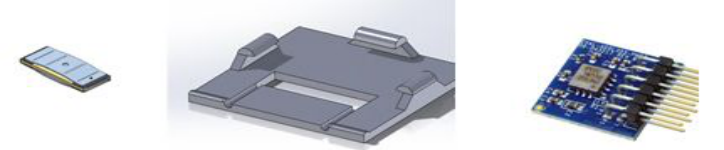
A Piezo Cradle structure (Figure 1, centre) was designed to lodge both the actuator and the accelerometer. The central hole is where the piezo actuator (Figure 1, left) sits, laying beneath the accelerometer (Figure 1, right). Each cradle is placed between the subject’s skin (e.g., the tip of each finger) and a metallic heavy plate (base plate), 2 cm thick. The main objective of this placement is to transmit the vibration energy from the base plate, which has enough inertia to reflect the vibration energy to the accelerometer and skin above it as efficiently as possible, using the cradle structure as a medium. The assembly of all components stacked together is shown in Figure 2.
Figure 1: Piezo cradle design 3D view (centre), piezo actuator (left) and MEMS accelerometer ADXL 355 (right).Figure 2: Piezo cradle design assembly with the piezo actuator and accelerometer board stacked together (front view).
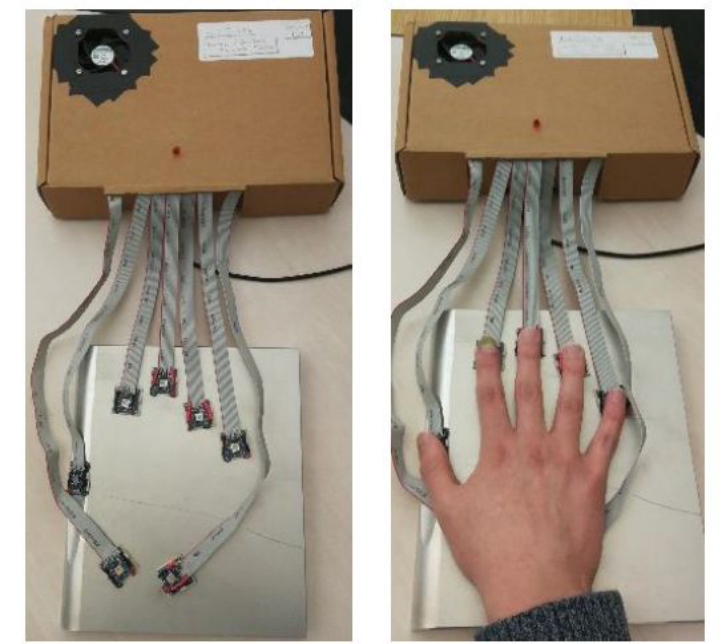
The current version of the HaViThreMa platform includes the full assem- bly of seven vibration and measurement units for all five fingertips, and 2 zones of the palm of the hand (e.g., thenar eminence and hypothenar emi- nence). The developed hardware includes a Raspberry Pi 4B as the main computational system, running Linux OS, and a I2C multiplexer, which com- municates with all vibration and measurement units. A basic user interface has also been designed using Python code language, which allows users to run psychophysical experiments using previously defined parameters, such
Hand Vibration Threshold Mapper (HaViThreMa): A Haptic Vibration System 97
as frequency, algorithm, and amplitude increase/decrease rules. The files con- taining these parameters can be modified and stored in the Raspberry Pi, and can also be exported to other operating systems for storage or modifica- tion. Users with more advanced knowledge of Python can modify the already existing user interface further, or create their own as well. The platform, in its current state, is shown in Figure 3.
Figure 3: Final version of the HaViThreMa platform prototype (top view), without a hand (left) and with a hand (on the right) placed on it.
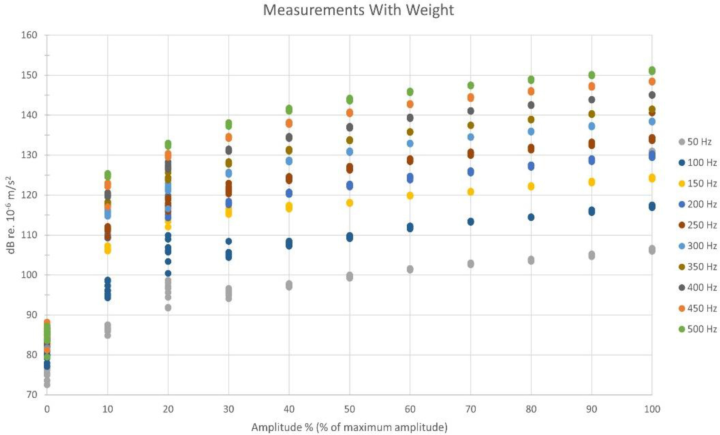
The frequency response of each Cradle system was also evaluated. To this end, several vibrations measurements were taken at different Piezo frequen- cies and actuation levels (% or maximum amplitude for each frequency). Measurements were carried out at the Piezo Cradle corresponding to the index finger. A small object, with a measured weight of 36.1 grams—a small zip-lock bag filled with small metal paperclips, which was heavy enough to not slide from the Piezo Cradle during measurements, but also malleable enough to fully cover the top of the Cradle— was placed on top of the cra- dle. These measurements were carried out at frequencies between 50 Hz and 500 Hz, in intervals of 50 Hz between them, in amplitude % increments of 10%. Data was recorded using the cradle’s respective accelerometer. It should
be noted that the values measured at 0% amplitude are noise gathered from the accelerometer, seeing as, at 0%, no vibration is being actuated. Figure 4 shows the produced vibrations’ amplitude as a function of the Piezo actuation and frequency, with amplitude converted to dB relative to 10-6 m/s2. It also shows that vibrations with lower frequencies tend to produce lower vibration amplitudes. Conversely, higher frequencies give rise to higher amplitudes. The maximum amplitudes delivered for 500 Hz vibrations are around 150 dB, while from those delivered by 50 Hz vibrations are around 105 dB. From these differences, one can conclude that the targeted human points of mea- surement will struggle to sense these lower amplitudes, which hinders the process of assessing VPT below a certain frequency, one of the most impor- tant disadvantages of the HaViThreMa. However, and since the purpose of this instrument is, for now, to mainly assess VPT for different frequencies, it still allows for measurements to be conducted on a wide range of frequencies.
Figure 4: Piezo Cradle frequency response (measurements with weight).
DISCUSSION
When comparing the HaViThreMa platform, in its current state, with the instruments mentioned previously in the literature, its advantages and limi- tations can be quickly noted. Most instruments used in VPT literature make use of a single, flat-headed, moving probe, which protrudes through a hole on a rigid plate of the device, to deliver vibrations to the intended location. In some instruments, a surrounding gap is found between the head of the probe and the rigid surface, to prevent vibrations from spreading through the skin to areas further than the intended actuation location. To deliver the vibratory stimulus, the probe is moved vertically, according to the intended frequency and amplitude of the stimulus. Contrary to these instruments, the
Hand Vibration Threshold Mapper (HaViThreMa): A Haptic Vibration System 99
HaViThreMa platform generates vibrations through piezoelectric actuators. Each piezo actuator is placed inside a Piezo Cradle, which is then placed between the base plate and the user’s skin. When the actuator is activated, the vibrations are passed through the Piezo Cradle, which acts as the probe object.
Due to the nature of these actuators, the design of the HaViThreMa is more compact than some of the other instruments used in the literature, which allows for an easier transportation, setting up, and storing. Due to having multiple of these actuators, which act independently from each other, and are each nested in its own Piezo Cradle, vibrotactile stimuli can be delivered to several points of the human hand, either individually or simultaneously, without the subject having to reposition their hand on the device between measurements. While the current design of the platform employs up to 7 Piezo Cradles, each corresponding to a different location of the human hand, more actuators and hand locations can be added, with relatively minor adjust- ments, to adapt to different use cases and purposes. In a similar vein, the number of Piezo Cradles can also be reduced, or, alternatively, all current 7 Cradles can be kept as is, with only some of them being used to carry out assessments, which is defined in the user interface’s code.
The HaViThreMa platform is controlled through a user interface software, constructed using Python language, that can be customized and adapted to fit different purposes, such as other experimental protocols of interest. Thus, the platform can be made to run either of the two psychophysical algorithms defined by ISO 13091–1 (International Organization for Standardization, 2001), as well as other experimental protocols, such as 2-Answer Forced Choice Tasks, making it very customizable. In a previous study (Silva et al., 2022), VPT assessments were carried out, using this platform and the Stair- case algorithm, with the initial amplitude of each experimental condition being set to either 0% or 100%.
Despite the advantages made possible due to the use of piezoelectric actu- ators, it should be noted that these also carry their own limitations. In comparison to instruments that make use of a flat headed moving probe, piezoelectric actuators have a smaller frequency and amplitude range in which they can operate without risk of damage to their components. There- fore, TDK, the manufacturer of the actuators currently being used on the HaViThreMa platform, do not recommend using said actuators at frequen- cies above 500 Hz, as frequencies higher than this might cause permanent damage to the actuators. Additionally, as demonstrated in the previous sec- tion, lower frequencies cannot produce maximum amplitudes as high as higher frequencies. While other instruments might not face this issue due to using a moving probe which can be set to move higher even at lower fre- quencies, a single piezo actuator is limited in the amount of displacement it can generate for a given frequency. Even with these limitations, however, two things should be noted: firstly, many studies regarding VPT assessments make use of frequencies equal to or below 500Hz (e.g., Ekman et al., 2021; Lundström et al., 2018; Tateno et al., 2011). Secondly, Gandhi et al. (2011) suggest that most VPT studies select their testing frequencies more on the
basis of hardware limitations and restrictions, rather than on specific scien- tific reasons. For these reasons, we do not foresee the limitation of frequency posing much of a hindrance to conducting the types of studies commonly carried out in VPT literature. Additionally, as technology progresses, it is expected that newer, more advanced, and stronger piezoelectric actuators will become available on the market, which can be used to upgrade the HaViThreMa, making it possible to deliver higher amplitude vibrations at lower frequencies. Another alternative, in turn, would be the use of stacked piezoelectric actuators, instead of a single piezo actuator per each Piezo Cra- dle, but this alternative would require further adjustments to the cradle’s design and further testing, which has not been carried out at this moment.
Another of the HaviThreMa’s current limitations is that its design does not possess a means to monitor nor regulate the temperature of neither the entire hand, nor each hand location. Therefore, these temperatures must be measured and/or controlled through external methods. Note, however, that temperature monitoring and controlling features were not included on the initial plans for the development of this platform, nor are they part of the components suggested by the international standards for mechani- cal vibration regarding vibrometers, although they are useful for research purposes.
Another feature that the current design of the HaViThreMa does not pos- sess is a means to monitor the pressure each hand point is exerting on each actuator. While the piezoelectric actuators that were initially acquired can somewhat measure the pressure exerted on them, this measurement is not as precise as we first expected it to be, which posed a problem since the pres- sures we intend to measure are very light, and we do not expect them to vary greatly between the trials of a study. As data regarding the pressure on the vibration point is deemed important on the VPT literature, means of col- lecting this information through either the addition of other components, or instruments external to the HaViThreMa, are under internal discussion.
CONCLUSION
This paper presents a new innovative apparatus to measure VPT on the human hand. The apparatus can generate vibrations with different ampli- tudes and frequencies to properly characterize vibration sensitivities on different locations of the hand, such as the fingertips. The frequency range of the tool ranges from 50Hz to 700Hz, albeit 500Hz is the maximum frequency suggested by the employed actuator’s manufacturer, to prevent damage to their components. The HaViThreMa allows for cross-finger studies and can use random finger actuation to enhance data consistency by managing par- ticipants’ expectations about the next assessment location. Additionally, the platform can be set to carry out assessments using a variety of experimental procedures. Among other advantages, the platform has proved to be a low weighted and compact solution, such that its main components, i.e., the base plate, Piezo Cradles, and box containing the computational components, can be carried in a shoe box. Other platforms tend to be somewhat bulky and heavy, due to the use of general-purpose equipment and bigger and bulkier
Hand Vibration Threshold Mapper (HaViThreMa): A Haptic Vibration System 101
components. The HaViThreMa was specially designed with small off-the- shelf components and crafted taking these and other aspects into account. This tool proved to be appropriate to acquire data for VPT studies. An exper- imental study assessing VPTs at the fingertips was already conducted using this instrument (Silva et al., 2022), with other experimental studies being planned as well. Further ways to improve the instrument have also been discussed internally and are being considered.
ACKNOWLEDGMENT
This work has been supported by Bial Foundation (PT/FB/BL-2022-231) and FCT – Fundação para a Ciência e Tecnologia within the R&D Units Project Scope: UIDB/00319/2020; ES was supported by BIAL (PT/FB/BL- 2022-231) and IL (in part) by the Center of Technology and Systems (CTS) UIDB/00066/2020, and by an FCT funded project (PTDC/PSI- GER/2463/2021). The authors would also like to thank the European Structural and Investment Funds in the FEDER component, through the Operational Competitiveness and Internationalization Programme (COM- PETE 2020) [Project n
Culbertson, H., Schorr, S. B., & Okamura, A. M. (2018). Haptics: The Present and Future of Artificial Touch Sensation. Annual Review of Control, Robotics, and Autonomous Systems, 1(1), 385–409. https://doi.org/10.1146/annurev-control- 060117-105043 Dahlin, L. B., Güner, N., Larsson, H. E., & Speidel, T. (2015). Vibrotactile Perception
in Finger Pulps and in the Sole of the Foot in Healthy Subjects among Children or Adolescents. PLOS ONE, 10(4), e0119753. https://doi.org/10.1371/journal.pone .0119753 Ekman, L., Lindholm, E., Brogren, E., & Dahlin, L. B. (2021). Normative values of the vibration perception thresholds at finger pulps and metatarsal heads in healthy adults. PLOS ONE, 16(4), e0249461. https://doi.org/10.1371/journal.po ne.0249461 Gandhi, M. S., Sesek, R., Tuckett, R., & Bamberg, S. J. M. M. (2011). Progress
in Vibrotactile Threshold Evaluation Techniques: A Review. Journal of Hand Therapy, 24(3), 240–256. https://doi.org/10.1016/j.jht.2011.01.001 Gu, C., & Griffin, M. J. (2013). Spatial summation of vibrotactile sen- sations at the foot. Medical Engineering and Physics, 35(8), 1221–1227. https://doi.org/10.1016/J. MEDENGPHY.2012.12.011 Hopkins, C., Maté-Cid, S., Fulford, R., Seiffert, G., & Ginsborg, J. (2016). Vibrotactile Presentation of Musical Notes to the Glabrous Skin for Adults with Normal Hearing or a Hearing Impairment: Thresholds, Dynamic Range and High-Frequency Perception. PLOS ONE, 11(5), e0155807. https://doi.org/10. 1371/journal.pone.0155807 International Organization for Standardization. (2001). Mechanical vibration -
vibrotactile perception thresholds for the assessment of nerve dysfunction - Part 1: Method of measurement at the fingertips (ISO Standard No. 13091-1 : 2001). International Organization for Standardization. (2003). Mechanical vibration - Vibrotactile perception thresholds for the assessment of nerve dysfunction - Part 2: Analysis and interpretation of measurements at the fingertips (ISO Standard No. 13091-2 : 2003).
Labbé, S., Meftah, E. M., & Chapman, C. E. (2016). Effects of transcranial direct current stimulation of primary somatosensory cortex on vibrotactile detection and discrimination. Journal of Neurophysiology, 115(4), 1978–1987. https://doi.org/ 10.1152/jn.00506.2015 Lisboa, I. C., Lourenço, V., Silva, E., Pereira, E., Carvalho, A., Pessoa, R., & Costa,
N. (2024). Haptic warnings for a motorcycle jacket and gloves. Transportation Research Part F: Traffic Psychology and Behaviour, 100(October 2023), 197–210. https://doi.org/10.1016/j.trf.2023.11.017 Lundström, R., Dahlqvist, H., Hagberg, M., & Nilsson, T. (2018). Vibrotactile and thermal perception and its relation to finger skin thickness. Clinical Neurophysiology Practice, 3, 33–39. https://doi.org/10.1016/j.cnp.2018.01.001 Pra, Y. De, Papetti, S., Jarvelainen, H., Bianchi, M., & Fontana, F. (2022). Effects
of vibration direction and pressing force on finger vibrotactile perception and force control. IEEE Transactions on Haptics. https://doi.org/10.1109/TOH.2022. 3225714 Shibata, N. (2022). Vibrotactile Perception Thresholds following Short-Term Exposure to Hand–Arm Vibration: Application for Identifying Potential Workers at Risk of Neurosensory Disorders. Vibration 2022, Vol. 5, Pages 803-816, 5(4), 803–816. https://doi.org/10.3390/VIBRATION5040047 Shibata, N. (2023). Residual Shift of Vibrotactile Perception Thresholds Following
Repeated Hand-Arm Vibration Exposure: Screening Parameter for Early Signs of Neurosensory Disorders. Vibration, 6(3), 599–609. https://doi.org/10.3390/vibr ation6030037 Silva, E., Sampaio, R., Teixeira, L., & Costa, N. (2022). Vibration Perception Thresholds on the five fingers of the Human Right Hand among an adult pop- ulation. Human Factors and Systems Interaction, 52(2011), 165–173. https: //doi.org/10.54941/ahfe1002152 Tamrin, S. B. M., Zali, N. A., & Karuppiah, K. (2016). The Relationship between
Vibrotactile Perception and Chemical Exposure among Vehicle Service Techni- cians in Klang Valley, Malaysia. Iranian Journal of Public Health, 45(Supple 1), 25–34. https://ijph.tums.ac.ir/index.php/ijph/article/view/6151 Tateno, M., Nakajima, R., Yoshikawa, K., Fukumoto, J., Takemura, S., Yoshimasu, K., Miyashita, K., Miyai, N., Nasu, Y., & Maeda, S. (2011). Fundamental Study of Vibrotactie Perception Threshold on Japanese-Vibrotactile Perception Thresholds Using New Measurement Equipment. Canadian Acoustics, 39(2), 64–65. https: //jcaa.caa-aca.ca/index.php/jcaa/article/view/2359 Witte, J., Corominas, A., Ernst, B., Kaulbars, U., Wendlandt, R., Lindell, H., & Ochs-
mann, E. (2022). Acute physiological and functional effects of repetitive shocks on the hand–arm system: A pilot study on healthy subjects. International Journal of Occupational Safety and Ergonomics, 1–10. https://doi.org/10.1080/10803548. 2022.2110358 Ye, Y., & Griffin, M. J. (2016). Reductions in finger blood flow induced by 125- Hz vibration: effect of location of contact with vibration. International Archives of Occupational and Environmental Health, 89(3), 425–433. https://doi.org/10. 1007/S00420-015-1081-7
LISTED IN THE AHFE DIGITAL BOOKSTORE CATALOGUE
Explore the complete digital volume
Human Factors and Systems Interaction
Read this individual research paper free through the original publisher, or explore the full digital proceedings book.
ISBN 978-1-964867-30-4
Explore this ISBN in the AHFE Bookstore ↗Listed in the July 2026 bookstore catalogue; search by ISBN to confirm current availability · Digital book purchase optional