Diogo Carvalho, Luis Silva, Miguel Carvalho, Mariana Dias, Nelson Costa, Duarte Folgado, Maria Lua, Hugo Gamboa, Elazer Edelman (2023). Heart rate variability during repetitive work in the presence of fatigue. In: Ergonomics In Design. AHFE Open Access, vol. 77, pp. 727–735. https://doi.org/10.54941/ahfe1003433
1 Faculty of Medicine, Riga Stradins University (RSU), 16 Dzirciema iela, LV-1007 Riga, Latvia ↗
2 Laboratório de Instrumentação, Engenharia Biomédica e Física da Radiação (LIBPhys-UNL), Departamento de Física, Faculdade de Ciências e Tecnologia Universidade Nova de Lisboa, 2829–516 Caparica, Portugal ↗
3 School of Engineering, University of Minho, Campus de Azurém, 4800–058, Guimarães, Portugal ↗
4 Laboratório de Instrumentação, Engenharia Biomédica e Física da Radiação (LIBPhys-UNL), Departamento de Física, Faculdade de Ciências e Tecnologia Universidade Nova de Lisboa, 2829–516 Caparica, Portugal; Associação Fraunhofer Portugal Research, Rua Alfredo Allen 455/461, 4200–135 Porto Portugal ↗
5 Institute for Medical Engineering and Science, Massachusetts Institute of Technology Cambridge, MA 02139, USA; Brigham and Women’s Hospital, Cardiovascular Division, 75 Francis Street, Boston MA 02115, USA ↗↗↗
Fatigue has been demonstrated to have a direct negative effect on the productivity of the worker and a marked rise in the long-term occupational risk. The measures being presently applied mainly target the muscular activity directly, that together with subjective understandings of one’s own fatigue levels make up an inaccurate cumulative evaluation of fatigue. “Industry 4.0” wearable devices allows for a more complete and continuous measurement of variables related to fatigue, and thus represent a more accurate value of the worker’s fatigue level.Aim: To analyse the structure of heart rate variability, as a measure of cardiovascular responsiveness, during repetitive work when muscular fatigue is present. Tasks: A protocol was developed to simulate a real-life workplace scenario with a set of low-intensity repetitive tasks that are commonly practiced. The signals obtained were then processed, and heart rate variability was calculated using multifractal analysis and frequency domain variables.Hypothesis: It was hypothesized that the structure of variability will change during repetitive work in the presence of fatigue.Methodology: Participants were asked to perform three 10-minute trials of a repetitive task involving a specific set of movements commonly required for work. Between each trial, a fatigue protocol was carried out, targeting the main agonist muscle. An ECG was collected through a wearable band placed on the level of the xiphoid appendix during the three trials denominated: Baseline, Fatigue 1, and Fatigue 2. Results: Significant differences were found in Very Low Frequency and Low Frequency in the Baseline and Fatigue 2 conditions. However, there were no significant differences in High Frequency. The results of the fractal analysis did not show any significant differences for any q-order, indicating that the fractal of HRV is maintained.Conclusions: These results are enthusiastic for applying algorithms that use heart rate variability to quantify cardiovascular responsiveness to fatigue during repetitive work. These results suggest that fatigue alters the variability structure of HRV, but the fractal structure of HRV remains unchanged.
Fatigue has been intrinsically associated with increased occupational risk, demotivation and a higher incidence of cardiovascular diseases. This is par- ticularly true when referring to workstations that require repetitive motions, even if performed at low intensity. Additionally, when such movements must be carried out in a static posture and with the hands above the level of the head, this phenomenon becomes evident sooner. The relationship between occupational stress and cardiovascular diseases has been explored as a result of how the cardiovascular system reacts to external stressors during the work shift. Therefore, metrics such as heart rate variability can be used to investi- gate the stress-related cardiovascular changes that are described as part of the long-term sympathetic and reduced parasympathetic activation.
Currently, the measures being studied include mostly subjective interpre- tations of the worker’s fatigue levels, either by themselves or by the person responsible to evaluate the workstation. This creates a very huge gap between the perceived fatigue and the real fatigue level of the worker. Furthermore, this interpretative method is usually done only once and after the task has been fully completed, as otherwise this would be too time consuming and distract the worker, making it impossible for work to be done, which in turn makes a continuous monitoring of fatigue unachievable. On the other hand, once direct measures have been applied to muscular fatigue through the use of electromyography technology, the main goal has been more focused on occupational risk evaluation and further stratification, used then cumulati- vely with the subjective interpretations. Consequently, this invites for the use of an advanced technology to address the above-presented issues. The pro- posal presented in this study is “Industry 4.0” technology, which allows for a continuous monitoring of low-intensity repetitive tasks through the use of wearables.
In order to simulate as accurately as possible a workplace scenario, a pro- tocol was developed with a specific set of low-intensity repetitive motions which are usually required to practice work. These include reaching, grab- bing, moving and positioning, all while in a static posture. In this case, a standing position was chosen as the neutral static pose, to which the subject must return to between each predefined motion. Three trials compose this study, denominated in order of occurrence as Baseline, Fatigue 1 and Fatigue 2. Each of these trials had a duration of 10 minutes and the number of cycle repeats was self-paced by the subject. Once the baseline values were esta- blished, the subjects were submitted to a fatigue protocol which took place before every Fatigue trial. This protocol targeted the main agonist muscle required for the repetitive task, ensuring the presence of muscular fatigue. Data was then collected during the trials via an electrocardiogram (ECG), which collected the signals from a wearable band placed on the level of the xiphoid appendix.
It was hypothesized that the examination of the structure of heart rate variability will present with changes during repetitive work in the presence of fatigue.
Heart Rate Variability During Repetitive Work in the Presence of Fatigue 729
The remainder of this work is organized in the following order: Materials and methods, describing the subjects, the methodology, and the statistical analysis carried out in this study; followed by the results obtained; their discussion with a description of the study limitations and future recommen- dations; and finally, the conclusions taken, with the due acknowledgments and sources.
MATERIALS AND METHODS
Study Population 22 healthy individuals were selected for this study (11 females, 11 males; age 27.0 ± 8.3 years; height: 1.72 ± 0.09 m; mass: 63.4 ± 12.9 kg), who were previously informed and were accepting of the protocol that was fully explained before the trials started. Every individual signed an informed con- sent to be part of this study’s population. It was carried out in conformity with the Declaration of Helsinki, and consented by the Ethics Committee of the University of Porto.
Methodology
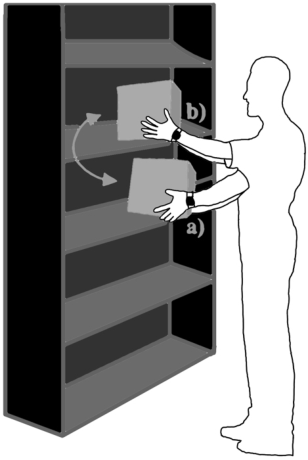
A set of three trials, denominated “Baseline”, “Fatigue 1”, and “Fatigue 2”, each with a duration of 10 minutes, was developed. During each trial, the participants performed a predefined set of repetitive movements at their own pace without interruptions. The trials consisted of starting in a neutral posi- tion with arms fully relaxed, picking up a box from a low shelf, and placing it on a higher shelf in one continuous motion, then returning to the neutral position after releasing the box. The same set of movements was then repea- ted to return the box to the low shelf. This cycle was repeated as many times as possible within the 10-minute time-frame. The cycle was therefore com- prised of two phases, an ascending phase (from lower to higher shelf) and a descending phase (from higher to lower shelf).
Fatigue Sequence: three consecutive trials of biceps curl until muscular failure is achieved before every Fatigue trial.
When adjusting the shelf heights for the task, the subjects’ individual phy- sical characteristics were taken into consideration. The height of the upper shelf was set at a height where the middle of the box was at eye level during the neutral pose, while the lower shelf was adjusted to be at the level of the middle finger, equally during the neutral pose. To ensure consistency, the weight of the box was calculated as 5% of the subject’s total mass.
Before each “Fatigue” trial, a fatigue protocol was carried out, consisting of three trials with 10 to 15 bicep curls per trial, performed until muscle fai- lure was reached. The weight on the bar was initially set at 65–75% of the subject’s maximum force, estimated based on their body mass. To ensure muscle failure within the prescribed number of repetitions, precautionary measures were taken. If the participant reached muscle failure before comple- ting 10 repetitions, the load was adjusted based on the number of repetitions already performed. Conversely, if the participant did not reach muscle fai- lure after 15 repetitions, the load was increased accordingly, and the trial
Figure 1: Visual representation of the sequence of the trials: starting from a neutral position, a) grab box from lower shelf; place box on upper shelf; return to neutral position; b) grab box from upper shelf; place box on lower shelf; return to neutral position.
was repeated. Additionally, to remove psychological biases and ensure true physiological muscle failure, the researcher encouraged the participant to per- form one last repetition at the end of every trial upon the subjective muscle failure assessed by the subject.
Statistical Analysis The statistical analysis of the results involved several tests to ensure accuracy. First, the Shapiro-Wilk test was used to verify the normality of the data. When the data met this assumption, the differences among the three trials (Baseline, Fatigue 1, and Fatigue 2) were assessed using repeated measures ANOVA. To check the sphericity assumption, Mauchly’s test was performed. If the test was not valid, Greenhouse-Geisser correction was applied. If the data did not follow a normal distribution, Friedman’s test was used instead. If differences were found, pairwise comparisons were conducted using either the t-test or Wilcoxon’s test depending on whether the data was parametric or non-parametric. Bonferroni’s correction was applied to adjust the p values. The level of significance was set at 5%.
RESULTS
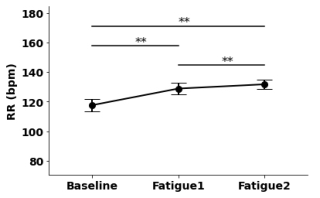
To quantify the amount of variability, two variables were used: mean RR (HR), and the RMSSD. Both these variables showed significant differe- nces (p < 0.001) when comparing the three trials (Baseline, Fatigue 1, and Fatigue 2). The variables significantly differed from Baseline to Fatigue 1
Heart Rate Variability During Repetitive Work in the Presence of Fatigue 731
(pRR < 0.001; pRMSSD < 0.002) and to Fatigue 2 (pRR < 0.001; pRMSSD < 0.005). The mean RR also showed significant differences between Fatigue 1 and Fatigue 2 trials (pRR < 0.013). Figure 2 shows the results of these linear measures.
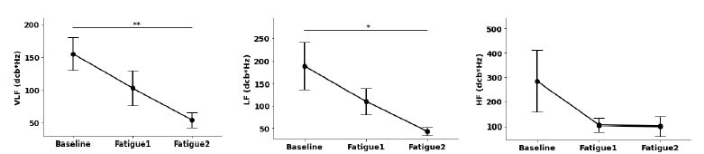
Examining the structure of variability showed significant differences for Very Low Frequency (VLF): (ξˆ2 (12) = 8.667; p = 0.0131); and Low Fre- quency (LF): (ξˆ2 (12) = 7.167; p = 0.028). The HF did not show significant differences (ξˆ2 (12) = 0.500; p = 0.779). In both cases, Baseline and Fati- gue 2 conditions were responsible for these differences (p_VLF = 0.004; p_VLF = 0.048). Figure 3 illustrates these differences.
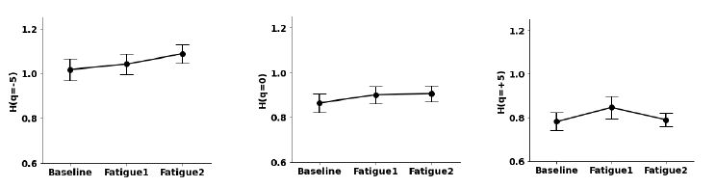
Significant differences were not found for any q-order of fractal analy- sis (F(2. 30) ∈[1.275; 1.569] ; p ∈[0.225; 0.294]), showing that the fractal of HRV is maintained. Figure 4 confirms that there were no significant differences in any q-order of the fractal analysis.
Figure 2: Linear measures for heart rate variability (mean RR, RMSSD).Figure 3: Measures of the frequency domain on the structure of variability (VLF, LF, HF).Figure 4: Nonlinear measures on the fractal analysis of variability.
DISCUSSION
This study aimed to investigate the effects of fatigue on the structure of vari- ability in heart rate variability (HRV) and the fractal of HRV. Heart rate variability has been shown to be a powerful instrument and is also considered one of the greatest biomarkers because of its association with changes that may represent states of cardiovascular disease (Malik et al., 1996). The results showed significant differences in very low frequency (VLF) and low freque- ncy (LF) variability, but not high frequency (HF) variability. The Baseline and Fatigue 2 conditions were responsible for these differences in both cases. According to Maisel (Maisel et al., 2021), fatigue is a multi-dimensional complaint that can be present in both healthy individuals and those with a wide range of diseases. Its causes can vary greatly, ranging from biological to psychosocial factors, making it difficult to pinpoint a specific etiology in most cases. Despite this, Yamada (Yamada et al., 2019) has found that fati- gue symptoms are significantly associated with pain-related disability and depression.
The findings on the fractal of HRV indicate that there were no significant differences in any q-order of the fractal analysis. This may suggest that the fractal of heart rate variability is maintained even in the presence of fatigue. Others have also found decreased HRV with the presence of fatigue, nota- bly in individuals with chronic fatigue syndrome (Escorihuela et al., 2020), drowsy drivers (Burlacu et al., 2021), mental stress (Melo et al., 2017; Zeng et al., 2021), and by comparing elite athletes in a fatigued state by Schmitt (Schmitt et al., 2013). This is an important finding as it suggests that the self- similarity of HRV, which is indicative of its adaptability and resilience, is not directly affected by fatigue. This may have implications for the assessment of cardiac health and stress in individuals who engage in repetitive work or experience chronic fatigue.
Therefore, repetitive work and particularly the presence of fatigue can have a significant impact on the structure of HRV, with the VLF and LF compo- nents being particularly affected. This is consistent with previous studies that have shown that fatigue can lead to increased sympathetic activity and decre- ased parasympathetic activity, resulting in changes in HRV. These studies, and others like them, provide evidence that fatigue can have a significant impact on HRV and autonomic nervous system activity. The maintenance of the fra- ctal of HRV in the presence of fatigue is an important finding as it suggests that the self-similarity of HRV is maintained, despite the impact of fatigue on the structure of variability. Previously studies, such as Goldenberg (Gol- denberg et al., 2019) and Naschitz (Naschitz et al., 2003) showed that this fractal structure represents a healthy condition, and its breakdown is a con- sequence of disease, where there is a disruption of the intrinsic mechanisms of the heart rate. This may have important implications for the assessment of cardiac health and stress in individuals who engage in repetitive work or experience chronic fatigue.
In sum, the results of this study suggest that fatigue can have a significant impact on the structure of HRV, with the VLF and LF components being particularly affected. However, the fractal of HRV is maintained even in the
Heart Rate Variability During Repetitive Work in the Presence of Fatigue 733
presence of fatigue, suggesting that the self-similarity of HRV is not affe- cted. These findings may have important implications for the assessment of cardiac health and stress in individuals who engage in repetitive work or experience chronic fatigue, specifically workers whose job position requires these conditions in a daily basis.
Study Limitations and Recommendations The primary limitation of this study was the artificial induction of fatigue through a fatigue protocol exercise. As this does not represent the natural process of fatigue experienced during a typical workday, further investigation directly in the workplace is required to obtain a more accurate representation of the real fatigue experienced by workers. Another limitation was the short record time of 10 minutes per trial, which is only a small sample of a worker’s shift. To support the conclusions made and substantiate the results obtai- ned, further analysis of HRV during a full shift, preferably a 24-hour HRV, is necessary. Additionally, a larger pool of subjects is required to verify the results obtained, and the intra-subject variability should also be interpreted further.
It is therefore recommended to conduct further research on the impact of fatigue on HRV, ideally in real workplace settings, for longer periods. Such studies would help identify additional variability or adaptation mechanisms that may not have been observed during the 10-minute trials in this study. Moreover, future studies on this matter should consider increasing the num- ber of subjects to improve statistical power and generalize the results to a wider population.
CONCLUSION
The study aimed to investigate the potential of heart rate variability (HRV) algorithms to assess physical fatigue during repetitive work by measuring cardiovascular responsiveness to fatigue. The findings revealed significant differences in time-domain measurements of HRV between baseline and fati- gue trials, indicating that time-domain algorithms could be used in real-time to evaluate physiological changes caused by fatigue in a repetitive worksta- tion. Additionally the structure of HRV was also analysed using the available frequency variables given the time-frame of the data gathered in this study. The results obtained show the maintenance of the fractal structure, thus supporting with the idea that while fatigue can have significant impact on the amount of cardiovascular responsiveness, the structure of the HRV is maintained, even during the second Fatigue trial.
Therefore, HRV exhibited clear adaptation during the state of fatigue while maintaining its structure. Real-time gathering and analytical interpretation of such fatigue indicators can possibly help prevent the development of cardio- vascular pathologies caused by fatigue in the working population, which is a well-known risk factor.
ACKNOWLEDGMENT
This work was supported by Project OPERATOR (NORTE01-0247-FEDER- 045910), co-financed by the ERDF-European Regional Development Fund through the North Portugal Regional Operational Program and Lisbon Regi- onal Operational Program and by the Portuguese Foundation for Science and Technology, under the MIT Portugal Program (2019 Open Call for Flagship projects) and FEDER funds through the Competitive Factors Operational Program (COMPETE) POCI-01-0145-FEDER-007136, by national funds through the FCT-Portuguese Foundation for Science and Technology under the project UID/CTM/000264.
REFERENCES
Burlacu, A., Brinza, C., Brezulianu, A., & Covic, A. (2021). Accurate and early detection of sleepiness, fatigue and stress levels in drivers through heart rate variability parameters: A systematic review. Reviews in Cardiovascular Medicine, 22(3), 845. https://doi.org/10.31083/j.rcm2203090 Government of Canada, C. C. for O. H. and S. (2022, November 9). Fatigue :
Osh answers. Canadian Centre for Occupational Health and Safety. Retrieved September 21, 2022, from https://www.ccohs.ca/oshanswers/psychosocial/fatigue .html Hansen, C., Wei, Q., Shieh, J.-S., Fourcade, P., Isableu, B., & Majed, L. (2017). Sample entropy, univariate, and multivariate multi-scale entropy in comparison with classical postural sway parameters in young healthy adults. Frontiers in Human Neuroscience, 11. https://doi.org/10.3389/fnhum.2017.00206 Harvard Health Publishing. (2020, July 6). Understanding the stress response -
Harvard Health. STAYING HEALTHY. Retrieved September 27, 2022, from http s://www.health.harvard.edu/staying-healthy/understanding-the-stress-response Järvelin-Pasanen, S., Sinikallio, S., & Tarvainen, M. P. (2018). Heart rate variability and occupational stress—systematic review. Industrial Health, 56(6), 500–511. https://doi.org/10.2486/indhealth.2017-0190 Kivimäki, M., & Kawachi, I. (2015). Work stress as a risk factor for cardiovascular
disease. Current Cardiology Reports, 17(9). https://doi.org/10.1007/s11886-015- 0630-8 Maisel, P., Baum, E., & Donner-Banzhoff, N. (2021). Fatigue as the chief complaint.
Deutsches Ärzteblatt International. https://doi.org/10.3238/arztebl.m2021.0192 Malik, M., Bigger, J. T., Camm, A. J., Kleiger, R. E., Malliani, A., Moss, A. J., & Schwartz, P. J. (1996). Heart rate variability: Standards of measurement, physio- logical interpretation, and clinical use. European Heart Journal, 17(3), 354–381. https://doi.org/10.1093/oxfordjournals.eurheartj.a014868 Manser, P., Thalmann, M., Adcock, M., Knols, R. H., & de Bruin, E. D. (2021). Can
reactivity of heart rate variability be a potential biomarker and monitoring tool to promote healthy aging? A systematic review with Meta-analyses. Frontiers in Physiology, 12. https://doi.org/10.3389/fphys.2021.686129 Melo, H. M., Nascimento, L. M., & Takase, E. (2017). Mental fatigue and heart rate variability (HRV): The time-on-task effect. Psychology & Neuroscience, 10(4), 428–436. https://doi.org/10.1037/pne0000110 Naim, R., Goodwin, M. S., Dombek, K., Revzina, O., Agorsor, C., Lee, K., Zapp, C.,
Freitag, G. F., Haller, S. P., Cardinale, E., Jangraw, D., & Brotman, M. A. (2021). Cardiovascular reactivity as a measure of irritability in a transdiagnostic sample of
Heart Rate Variability During Repetitive Work in the Presence of Fatigue 735
youth: Preliminary associations. International Journal of Methods in Psychiatric Research, 30(4). https://doi.org/10.1002/mpr.1890 Obrist, P. A., Light, K. C., Sherwood, A., Allen, M. T., Langer, A. W., & Koepke, J. P. (1986). Some working hypotheses on the significance of behaviorally evoked cardiovascular reactivity to pathophysiology. Biological and Psychological Factors in Cardiovascular Disease, 406–417. https://doi.org/10.1007/978-3-642-71234- 0_25 Pizzo, E., Berrettoni, S., Kaul, R., Cervantes, D. O., Di Stefano, V., Jain, S., Jacobson,
J. T., & Rota, M. (2022). Heart rate variability reveals altered autonomic regu- lation in response to myocardial infarction in experimental animals. Frontiers in Cardiovascular Medicine, 9. https://doi.org/10.3389/fcvm.2022.843144 Salcedo-Martínez, A., Pérez-López, N. G., Zamora-Justo, J. A., Gálvez-Coyt, G., & Muñoz-Diosdado, A. (2019). The detrended fluctuation analysis of heartbeat intervals in time series during stress tests. AIP Conference Proceedings. https://do i.org/10.1063/1.5095928 Schmitt, L., Regnard, J., & Millet, G. P. (2015). Monitoring Fatigue Status with HRV
measures in elite athletes: An avenue beyond RMSSD? Frontiers in Physiology, 6. https://doi.org/10.3389/fphys.2015.00343 Shaffer, F., & Ginsberg, J. P. (2017). An overview of heart rate variability metrics and norms. Frontiers in Public Health, 5. https://doi.org/10.3389/fpubh.2017.00258 Silva, L., Dias, M., Folgado, D., Nunes, M., Namburi, P., Anthony, B., Carvalho,
D., Carvalho, M., Edelman, E., & Gamboa, H. (2022). Respiratory inductance plethysmography to assess fatigability during repetitive work. Sensors, 22(11), 4247. https://doi.org/10.3390/s22114247 Thayer, J. F., Hansen, A. L., Saus-Rose, E., & Johnsen, B. H. (2009). Heart rate variability, prefrontal neural function, and cognitive performance: The neurovi- sceral integration perspective on self-regulation, adaptation, and health. Annals of Behavioral Medicine, 37(2), 141–153. https://doi.org/10.1007/s12160-009- 9101-z van der Wal, R. A. B., Wallage, J., & Bucx, M. J. L. (2018). Occupational stress,
Burnout and personality in anesthesiologists. Current Opinion in Anaesthesiology, 31(3), 351–356. https://doi.org/10.1097/aco.0000000000000587 Yamada, K., Adams, H., Ellis, T., Clark, R., Sully, C., & Sullivan, M. J. (2019).
Reductions in fatigue predict occupational re-engagement in individuals with work-related musculoskeletal disorders. Journal of Occupational Rehabilitation, 30(1), 135–145. https://doi.org/10.1007/s10926-019-09856-z Zeng, C., Wang, W., Chen, C., Zhang, C., & Cheng, B. (2020). Sex differences in time-domain and frequency-domain heart rate variability measures of fatigued dri- vers. International Journal of Environmental Research and Public Health, 17(22), 8499. https://doi.org/10.3390/ijerph17228499
LISTED IN THE AHFE DIGITAL BOOKSTORE CATALOGUE
Explore the complete digital volume
Ergonomics In Design
Read this individual research paper free through the original publisher, or explore the full digital proceedings book.
ISBN 978-1-958651-53-7
Explore this ISBN in the AHFE Bookstore ↗Listed in the July 2026 bookstore catalogue; search by ISBN to confirm current availability · Digital book purchase optional