Diogo Carvalho, Luis Silva, Miguel Carvalho, Mariana Dias, Nélson Costa, Duarte Folgado, Maria Lua Nunes, Hugo Gamboa, Kristine Andza, Elazer Edelman (2023). Cardiovascular Reactivity (CVR) During Repetitive Work in the Presence of Fatigue. In: Intelligent Human Systems Integration (IHSI 2023): Integrating People and Intelligent Systems. AHFE Open Access, vol. 69, pp. 159–167. https://doi.org/10.54941/ahfe1002833
1 Faculty of Medicine, Riga Stradins University (RSU), 16 Dzirciema iela, LV-1007 Riga, Latvia ↗
2 Laboratório de Instrumentação, Engenharia Biomédica e Física da Radiação (LIBPhys-UNL), Departamento de Física, Faculdade de Ciências e Tecnologia Universidade Nova de Lisboa, 2829–516 Caparica, Portugal ↗
3 School of Engineering, University of Minho, Campus de Azurém, 4800–058, Guimarães, Portugal ↗
4 Laboratório de Instrumentação, Engenharia Biomédica e Física da Radiação (LIBPhys-UNL), Departamento de Física, Faculdade de Ciências e Tecnologia Universidade Nova de Lisboa, 2829–516 Caparica, Portugal; Associação Fraunhofer Portugal Research, Rua Alfredo Allen 455/461, 4200–135 Porto Portugal ↗
5 Associação Fraunhofer Portugal Research, Rua Alfredo Allen 455/461, 4200–135 Porto Portugal ↗
6 Faculty of Medicine, Riga Stradins University (RSU), 16 Dzirciema iela, LV-1007 Riga Latvia ↗
7 Institute for Medical Engineering and Science, Massachusetts Institute of Technology Cambridge, MA 02139, USA; Brigham and Women’s Hospital, Cardiovascular Division, 75 Francis Street, Boston MA 02115, USA ↗↗↗
Fatigue during repetitive tasks in the workplace has been intrinsically connected with occupational risk and a reduction in productivity. Currently, the measures taken are based on subjective interpretations of fatigue by the workers or on direct muscular activity, which then make up for a cumulative evaluation of fatigue. The concept of “Industry 4.0” wearable devices would allow a continuous monitoring and thus, a more realistic representation of their fatigue levels.Aim: To quantify heart rate variability, measuring cardiovascular responsiveness, during repetitive work when fatigue is present. Tasks: A protocol was developed to simulate a real-life workplace scenario with a set of low-intensity repetitive tasks that are commonly practiced. The signals obtained were then processed, and heart rate variability was calculated using fractal analysis and time domain variables. Hypothesis: It was hypothesized that 1) the amount of variability and 2) the structure of variability will change during repetitive work in the presence of fatigue.Methodology: Participants were asked to perform three 10-minute trials of a repetitive task. Between each trial, a muscular fatigue protocol was carried out, targeting the main agonist muscle. An ECG was collected during the trials (Baseline, Fatigue 1, and Fatigue 2) through a wearable band placed on the level of the xiphoid appendix. Results: The nonlinearity of the heart rate variability showed no statistically significant changes, unlike the time domain measures that significantly differentiated the baseline trial from the fatigue trials, namely the Standard Deviation of NN intervals, the Root Mean Square of successive RR interval differences, Coefficient of Variation, and Heart Rate itself. Conclusions: These results are enthusiastic for applying algorithms that use heart rate variability to quantify cardiovascular responsiveness to fatigue during repetitive work. They show that with information in the time domain, it is possible to verify physiological changes that the worker is undergoing. Additionally, these changes are also related to the amount of variability and not to the fractal structure of heart rate variability.
Occupational stress has been associated with depression and fatigue scena- rios, regardless of the intensity at which work is performed. Especially in tasks involving repetitive work, despite being performed at low intensity, accumu- lated fatigue translates into increased occupational risk, demotivation, and incidence of cardiovascular diseases. One of the correlations described betw- een occupational stress and the development of cardiovascular diseases is based upon how much the cardiovascular system reacts to external stressors in the work environment. Interestingly, this theory has changed the world’s perspective from considering only the increase in reactivity associated with cardiovascular disease to also considering its lack of response. Occupatio- nal stress-related cardiovascular changes have been described as long-term sympathetic and reduced parasympathetic activation, which has been proven to be detected through a parameter known as heart rate variability. Despite this, the measures currently applied in the work context tend to be majorly subjective, depending merely on the experience of the person who evalua- tes the workstation. Additionally, they do not allow continuous monitoring. However, when direct measures are applied, such as local muscular fati- gue through electromyography, the main aim has been mostly directed only towards occupational risk assessment and consequent stratification. The pro- posal presented explores the concept of “Industry 4.0”, proposing the use of wearables for continuous monitoring during low-intensity repetitive work.
A protocol was developed to simulate a real-life workplace scenario where a set of low-intensity repetitive tasks are commonly practiced during a work shift. These were specifically chosen to include the most basic motions requi- red to practice work, such as reaching, grabbing, moving and positioning, and releasing an object. This protocol includes three trials (Baseline, Fati- gue 1, Fatigue 2) of 10 minutes each, with a maximum number of cycle repeats, self-paced by the subject. Between each trial, a fatigue protocol was performed on the main agonist muscle.
An electrocardiogram (ECG) was collected during the three trials through a wearable band placed on the level of the xiphoid appendix.
It was hypothesized that 1) the amount of variability and 2) the structure of variability will change during repetitive work in the presence of fatigue.
The remainder of this work is organized in the following order: Mate- rials and methods, describing the subjects in this study, the methodology used, and the statistical analysis carried out; followed by the results obtai- ned; their discussion with a description of the study limitations and future recommendations; and the final remarks in the conclusion section.
MATERIALS AND METHODS
Study Population This study was composed of 22 healthy individuals (11 females, 11 males; age 27.0 ± 8.3 years; height: 1.72 ± 0.09 m; mass: 63.4 ± 12.9 kg), fully infor- med and accepting of the protocol which was plainly explained before the trials took place. All subjects provided their signatures as informed consent
Cardiovascular Reactivity (CVR) During Repetitive Work in the Presence of Fatigue 161
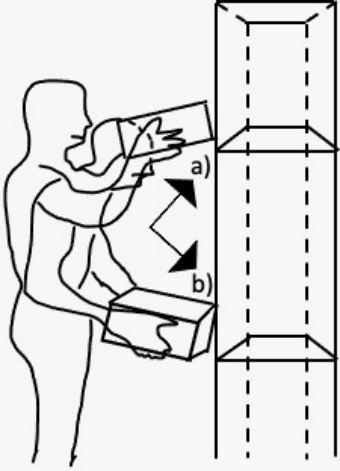
Figure 1: Trial cycle sequence: starting from a neutral pose, a) grabbing box from lower shelf; placing box on upper shelf; return to neutral pose; b) grabbing box from upper shelf; placing box on lower shelf; return to neutral pose. Fatigue Sequence: three consecutive trials of biceps curl until muscular failure in every trial.
to be part of the study population. The study was carried out in accordance with the Declaration of Helsinki, and the protocol pre-approved by the Ethics Committee of the University of Porto.
Methodology
The protocol was composed of three trials, denominated “Baseline”, “Fatigue 1” and “Fatigue 2”, each with a duration of 10 minutes. During each 10-minute trial, the same repetitive motions were performed uninter- rupted and self-paced by the subjects. These trials involve an initial neutral pose, where the subject is standing up straight with the arms fully relaxed, then a box is grabbed from a lower shelf and placed on a higher shelf in a continuous motion, with an immediate return to the neutral pose upon rele- ase of the box. Then this same set of motions is repeated to return the box from the higher shelf back to the lower shelf. This cycle is repeated as many times as possible until the 10 minutes are over. The aforementioned cycle can therefore be divided into two reversed phases, with an ascending phase (from lower shelf to upper shelf) and a descending phase (from upper shelf to lower shelf).
Each subject’s morphology was taken into account when adjusting the hei- ght of the shelves. The higher shelf was adjusted to the level where the middle of the box was at eye level during the neutral pose. The lower shelf was adju- sted to the level where the shelf was at the level of the middle finger during the neutral pose. The weight of the box for each participant was set to a pre-calculated value of 5% of their current total mass.
The fatigue protocol was performed before each Fatigue trial and was com- prised of three trials, each with 10 to 15 biceps curl repetitions until muscle failure was reached. The weights on the bar were set at 65-75% of the sub- ject’s maximal force, which was initially estimated with reference to their body mass. In order to guarantee that muscle failure occurred within the 10 to 15 repetitions, the following countermeasures were implemented: in case the participant reached muscle failure before reaching 10 repetitions, the load was reduced based on the number of repetitions performed; in case the par- ticipant had not reached muscle failure within a maximum of 15 repetitions, the load was increased accordingly. In both these scenarios, this particular Fatigue trial had to be repeated. Additionally, at the end of every fatigue trial, upon reaching muscle failure, the participant was encouraged by the researcher to perform one last repetition, in order to remove psychological bias and ensure physiological muscle failure.
Statistical Analysis Regarding the statistical analysis of the results obtained, normality was verified through the Shapiro-Wilk test. When this assumption was present, differences among the three trials (Baseline, Fatigue 1, and Fatigue 2) were checked by applying repeated measures of ANOVA. Mauchly’s test was used for sphericity assumption analysis and when it was not valid, Greenhouse- Geisser correction was performed. When it was not possible to have a normal distribution of data, the differences among the three trials were verified through Friedman’s test. When differences were found, pairwise comparisons were done using the t-test or Wilcoxon’s test, depending on the parametric or non-parametric choice, respectively. Bonferroni’s correction was used to adjust the p values. The significance was set at 5%.
RESULTS
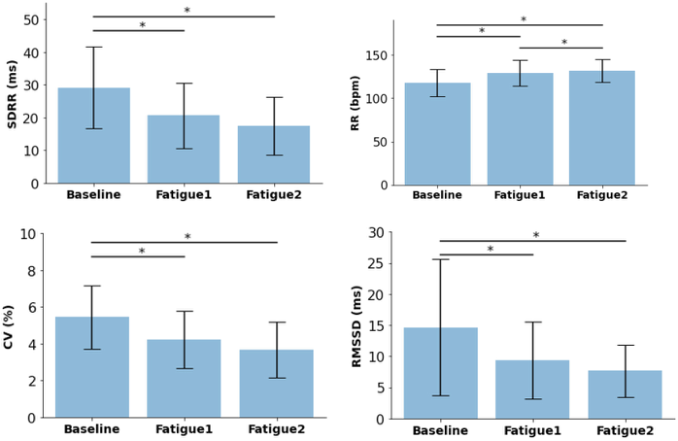
To quantify the amount of variability, four variables were used: SDRR, mean RR (HR), CVRR, and the RMSSD. All these variables showed significant dif- ferences (p < 0.001) when comparing the three trials (Baseline, Fatigue 1, and Fatigue 2). The variables significantly differed from Baseline to Fati- gue 1 (pSDRR < 0.001; pRR < 0.001; pCVRR < 0.010; pRMSSD < 0.002) and to Fatigue 2 (pSDRR < 0.001; pRR < 0.001; pCVRR < 0.001; pRMSSD < 0.005).
The mean RR also showed significant differences between Fatigue 1 and Fatigue 2 trials (pRR < 0.013). Figure 2 shows the results for the measures of these linear measures.
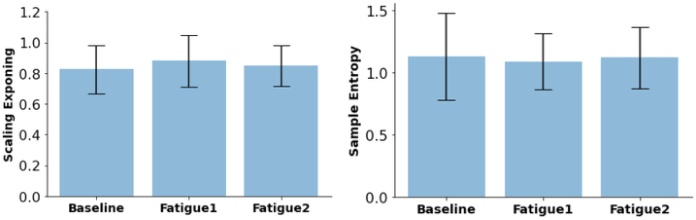
Regarding the structure of variability, DFA and Sample entropy were used. Figure 3 shows the results for these two metrics. There were no significant differences for both nonlinear measures (p < 0.050).
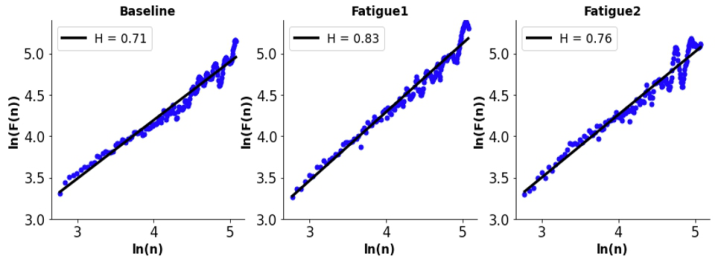
Although no significant differences were found (p < 0.050), Figure 4 shows an DFA example for a subject with values close to the trial’s means.
DISCUSSION
The main objective of this study was to realize whether heart rate variability response changes accordingly the presence of fatigue during repetitive work.
Cardiovascular Reactivity (CVR) During Repetitive Work in the Presence of Fatigue 163
Figure 2: Linear measures for heart rate variability (SDRR, mean RR, CV, RMSSD).Figure 3: Nonlinear measures on the structure of variability (DFA and Sample Entropy).Figure 4: DFA example for Baseline, Fatigue 1, and Fatigue 2 trials of a participant.
To achieve this purpose, two dimensions were studied; 1) the amount of vari- ability through time domain linear measures; 2) structure of variability using nonlinear analysis. Our results showed that parasympathetic neural system
modulates heart rate variability during repetitive work through the amount of variability, keeping the fractal structure of the RR intervals.
The three trials from which the data was gathered included a Baseline trial, where the subject’s ECG was taken during the repetitive activity without any previous muscle exhaustion protocol, where it was assumed that no state of muscular fatigue was present in the agonist muscles. The later trials, denomi- nated Fatigue 1 and Fatigue 2, were carried-out after a fatigue protocol on the agonist muscle (biceps brachii) to ensure that the state of muscular fatigue was present during the repetitive task. This muscle exhaustion protocol had the purpose of simulating, in a shorter period of time, a long work shift where the worker is required to carry out this repetitive task. The duration of data gathering was set at 10 minutes per trial. This arguably short period of time taken for each trail was chosen specifically for the maximum preservation of the state of muscular fatigue, enabling a truer representation of the HRV in the presence of fatigue.
Fatigue is defined as “the state of feeling very tired, or sleepy resulting from insufficient recovery time, prolonged mental or physical work, or extended periods of stress or anxiety. Boring or repetitive tasks can intensify feelings of fatigue.” (Government of Canada, 2022). Noteworthy is the fact that fatigue is a multidimensional chief complaint of a broad spectrum of diseases, but can equally be identified in healthy individuals, and has been proven to have a very wide variety of aetiologies, from biological to psychosocial causes. Thus, in most cases, a concrete aetiology becomes impossible to be clearly established (Maisel et al., 2021). Although this is the case, it has been iden- tified that these symptoms of fatigue correlate significantly with pain-related disability and depression (Yamada et al., 2019).
Amount of Variability The amount of HRV tends to be measured using linear measures, such as the standard deviation of RR intervals and the coefficient of variation. Through the analysis of the data gathered it was possible to establish that there is a significant variation in the amount of heart rate variability given the presence of fatigue. This was shown through the interpretation of the variables SDRR, mean RR (HR), CVRR, and the RMSSD, which all indicated a statistically significant difference between the fatigue trails to the Baseline. Others have also found decreased HRV with the presence of fatigue, notably in individu- als with chronic fatigue syndrome (Escorihuela et al., 2020), drowsy drivers (Burlacu et al., 2021), mental stress (Melo et al., 2017; Zeng et al., 2021), and by comparing elite athletes in a fatigued state by Schmitt (Schmitt et al., 2013). Fatigue influences both the sympathetic and parasympathetic nervous systems, increasing heart rate, which in turn it is associated with shorter RR intervals. In the presence of fatigue, the HRV is significantly inhibited (vagus nerve activity was weakened) while the cardiac sympathetic function is enhanced (Chen et al., 2020).
Structure of Variability Interestingly, the measurements obtained also show that while the amount of variability changes significantly, the structure of the HRV is maintained.
Cardiovascular Reactivity (CVR) During Repetitive Work in the Presence of Fatigue 165
The events of this structure showed a fractal pattern. That is, these events are neither equal but nor independent of each other. This indicates that although the worker is experiencing fatigue, the physiological mechanisms of heart rate generation by the sinoatrial node are maintained, similar to non-fatigued healthy individuals. Previously studies, such as Goldenberg (Goldenberg et al., 2019) and Naschitz (Naschitz et al., 2003) showed that this fractal structure represents a healthy condition, and its breakdown is a consequence of disease, where there is a disruption of the intrinsic mechanisms of the heart rate.
It is therefore possible, with the results obtained, to observe that although there is a clear adaptation process happening due to the presence of fatigue, this will not ultimately result in a change of the physiological processes of the cardiovascular system.
Study Limitations and Recommendations The main limitation of this study was the fact that the fatigue experienced by the subjects was induced artificially by the fatigue protocol exercises. Since this does not represent the natural process of fatigue that a worker goes through during his workday, the results obtained require further investiga- tion directly at the workplace. Therefore, obtaining a more natural sample of the real fatigue experienced by the worker.
The short record time was an additional limitation identified in this study. These short trials of 10 minutes each, represent only a small sample of a worker’s shift, which usually lasts much longer. Further analysis of HRV during a full shift, perhaps even a 24h HRV, is required to substantiate the results obtained and support the conclusions made. Additionally, the results obtained should be verified with a larger pool of subjects.
A deeper investigation into the impact of fatigue on the heart rate variabi- lity is recommended. This would ideally be tested in the field, testing real workers at their workplace during their shifts. Also, these studies should gather data for longer periods of time. This would help identify any addi- tional variability or adaptation mechanisms that were not seen during the 10-minute trials of this study. Additionally, a larger number of subjects should be taken for future studies on this matter, and the intra-subject variability should also be interpreted further.
CONCLUSION
The application of heart rate variability algorithms in physical fatigue asses- sment by quantification of the cardiovascular responsiveness to fatigue during repetitive work was studied. The time-domain measurements of HRV showed significant differences from the baseline to the fatigue trials. These results demonstrate the feasibility of using time-domain algorithms of quan- tification of HRV to assess in real-time physiological changes that the worker is experiencing in a repetitive workstation in regard to fatigue.
The lack of statistically significant changes to the nonlinearity of HRV also verifies the understanding that the structure of the variability only shows significant changes when a cardiovascular pathology is present, which was
not the case in any subject in this study. During fatigue, we can therefore observe a clear adaptation of the heart rate variability, despite its structure being maintained. With real-time analysis of these fatigue indicators, it is possible to drastically reduce the development of cardiovascular pathologies arising from the presence of fatigue, a well-known risk factor.
ACKNOWLEDGMENT
This work was supported by Project OPERATOR (NORTE01-0247-FEDER- 045910), co-financed by the ERDF-European Regional Development Fund through the North Portugal Regional Operational Program and Lisbon Regi- onal Operational Program and by the Portuguese Foundation for Science and Technology, under the MIT Portugal Program (2019 Open Call for Flagship projects) and FEDER funds through the Competitive Factors Operational Program (COMPETE) POCI-01-0145-FEDER-007136, by national funds through the FCT-Portuguese Foundation for Science and Technology under the project UID/CTM/000264.
REFERENCES
Burlacu, A., Brinza, C., Brezulianu, A., & Covic, A. (2021). Accurate and early detection of sleepiness, fatigue and stress levels in drivers through heart rate variability parameters: A systematic review. Reviews in Cardiovascular Medicine, 22(3), 845. https://doi.org/10.31083/j.rcm2203090. Government of Canada, C. C. for O. H. and S. (2022, November 9). Fatigue: Osh
answers. Canadian Centre for Occupational Health and Safety. Retrieved Septem- ber 21, 2022, from https://www.ccohs.ca/oshanswers/psychosocial/fatigue.html. Hansen, C., Wei, Q., Shieh, J.-S., Fourcade, P., Isableu, B., & Majed, L. (2017). Sample entropy, univariate, and multivariate multi-scale entropy in comparison with classical postural sway parameters in young healthy adults. Frontiers in Human Neuroscience, 11. https://doi.org/10.3389/fnhum.2017.00206. Harvard Health Publishing. (2020, July 6). Understanding the stress response
- Harvard Health. STAYING HEALTHY. Retrieved September 27, 2022, from https://www.health.harvard.edu/staying-healthy/understanding-the-stress- response. JÄRVELIN-PASANEN, S., SINIKALLIO, S., & TARVAINEN, M. P. (2018). Heart rate variability and occupational stress—systematic review. Industrial Health, 56(6), 500–511. https://doi.org/10.2486/indhealth. 2017–0190. Kivimäki, M., & Kawachi, I. (2015). Work stress as a risk factor for cardiovascular disease. Current Cardiology Reports, 17(9). https://doi.org/10.1007/s11886-015-0630-8. Maisel, P., Baum, E., & Donner-Banzhoff, N. (2021). Fatigue as the chief complaint.
Deutsches Ärzteblatt International. https://doi.org/10.3238/arztebl.m2021.0192. Manser, P., Thalmann, M., Adcock, M., Knols, R. H., & de Bruin, E. D. (2021). Can reactivity of heart rate variability be a potential biomarker and monitoring tool to promote healthy aging? A systematic review with Meta-analyses. Frontiers in Physiology, 12. https://doi.org/10.3389/fphys.2021.686129. Melo, H. M., Nascimento, L. M., & Takase, E. (2017). Mental fatigue and heart rate
Cardiovascular Reactivity (CVR) During Repetitive Work in the Presence of Fatigue 167
Naim, R., Goodwin, M. S., Dombek, K., Revzina, O., Agorsor, C., Lee, K., Zapp, C., Freitag, G. F., Haller, S. P., Cardinale, E., Jangraw, D., & Brotman, M. A. (2021). Cardiovascular reactivity as a measure of irritability in a transdiagnostic sample of youth: Preliminary associations. International Journal of Methods in Psychiatric Research, 30(4). https://doi.org/10.1002/mpr.1890. Obrist, P. A., Light, K. C., Sherwood, A., Allen, M. T., Langer, A. W., & Koepke,
J. P. (1986). Some working hypotheses on the significance of behaviorally evoked cardiovascular reactivity to pathophysiology. Biological and Psychological Factors in Cardiovascular Disease, 406–417. https://doi.org/10.1007/978-3-642-71234- 0_25. Pizzo, E., Berrettoni, S., Kaul, R., Cervantes, D. O., Di Stefano, V., Jain, S., Jacobson, J. T., & Rota, M. (2022). Heart rate variability reveals altered autonomic regu- lation in response to myocardial infarction in experimental animals. Frontiers in Cardiovascular Medicine, 9. https://doi.org/10.3389/fcvm.2022.843144. Salcedo-Martínez, A., Pérez-López, N. G., Zamora-Justo, J. A., Gálvez-Coyt, G.,
& Muñoz-Diosdado, A. (2019). The detrended fluctuation analysis of heart- beat intervals in time series during stress tests. AIP Conference Proceedings. https://doi.org/10.1063/1.5095928. Schmitt, L., Regnard, J., & Millet, G. P. (2015). Monitoring Fatigue Status with HRV measures in elite athletes: An avenue beyond RMSSD? Frontiers in Physiology, 6. https://doi.org/10.3389/fphys.2015.00343. Shaffer, F., & Ginsberg, J. P. (2017). An overview of heart rate variability metrics and
norms. Frontiers in Public Health, 5. https://doi.org/10.3389/fpubh.2017.00258. Silva, L., Dias, M., Folgado, D., Nunes, M., Namburi, P., Anthony, B., Carvalho, D., Carvalho, M., Edelman, E., & Gamboa, H. (2022). Respiratory inductance plethysmography to assess fatigability during repetitive work. Sensors, 22(11), 4247. https://doi.org/10.3390/s22114247. Thayer, J. F., Hansen, A. L., Saus-Rose, E., & Johnsen, B. H. (2009). Heart rate vari-
ability, prefrontal neural function, and cognitive performance: The neurovisceral integration perspective on self-regulation, adaptation, and health. Annals of Beh- avioral Medicine, 37(2), 141–153. https://doi.org/10.1007/s12160-009-9101-z. van der Wal, R. A. B., Wallage, J., & Bucx, M. J. L. (2018). Occupational stress, Burnout and personality in anesthesiologists. Current Opinion in Anaesthesiology, 31(3), 351–356. https://doi.org/10.1097/aco.0000000000000587. Yamada, K., Adams, H., Ellis, T., Clark, R., Sully, C., & Sullivan, M. J. (2019).
Reductions in fatigue predict occupational re-engagement in individuals with work-related musculoskeletal disorders. Journal of Occupational Rehabilitation, 30(1), 135–145. https://doi.org/10.1007/s10926-019-09856-z. Zeng, C., Wang, W., Chen, C., Zhang, C., & Cheng, B. (2020). Sex differences in time-domain and frequency-domain heart rate variability measures of fatigued dri- vers. International Journal of Environmental Research and Public Health, 17(22), 8499. https://doi.org/10.3390/ijerph17228499.
LISTED IN THE AHFE DIGITAL BOOKSTORE CATALOGUE
Explore the complete digital volume
Intelligent Human Systems Integration (IHSI 2023): Integrating People and Intelligent Systems
Read this individual research paper free through the original publisher, or explore the full digital proceedings book.
ISBN 978-1-958651-45-2
Explore this ISBN in the AHFE Bookstore ↗Listed in the July 2026 bookstore catalogue; search by ISBN to confirm current availability · Digital book purchase optional