André Cardoso, Ana Colim, Estela Bicho, Ana Braga, Débora Pereira, Sergio Monteiro, Paula Carneiro, Nélson Costa, Pedro Arezes (2024). Enhancing Worker Well-Being: A Study on Assistive Assembly to Mitigate Work-Related Musculoskeletal Disorders and Modulate Cobot Assistive Behavior. In: Human Systems Engineering and Design (IHSED2024): Future Trends and Applications. AHFE Open Access, vol. 158, pp. 53–62. https://doi.org/10.54941/ahfe1005528
Industry 5.0 emphasizes human-centric approaches in manufacturing, aiming to prioritize worker well-being and productivity. Assembly lines are crucial in manufacturing, demand understanding, and improvement to enhance production performance and worker safety. This study addresses the importance of Assistive Assembly in improving working conditions, particularly at preventing Work-Related Musculoskeletal Disorders (WMSD). In this context, integrating collaborative robots (cobots) is a promising solution to ease workers’ burdens. However, its deployment in the assembly line requires further research to achieve better results. This research employs a human-centric approach in a laboratory setting to further explore the dynamics of assistive assembly to modulate a cobot's assistive behaviour. A proof-of-concept where participants assemble windows’ frames under Non-Assistive (NA) and Assistive (A) conditions was conducted, with real-time guidance provided in the latter. Perceived physical effort, kinematic analysis of upper limb movements, and electromyographic (EMG) analysis of muscle activity were performed. Results indicate significant reductions in perceived physical effort under the A condition compared to NA. Kinematic and EMG analyses reveal joint angles and muscle activation improvements, suggesting reduced physical strain in A condition. The study highlights the potential of assistive technologies, particularly cobots, in enhancing ergonomics and reducing physical strain in assembly processes, laying the groundwork for future advancements in Human-Robot Collaboration in industrial assembly lines.
Within the context of the Industrial Revolution, Industry 5.0 has emerged as a paradigm shift that transcends its predecessor, Industry 4.0. This evolution emphasizes the impact on workers within manufacturing systems. Characterized by its human-centric approach, Industry 5.0 aims to create manufacturing environments that prioritize human well-being and promote sustainability and productivity (European Commission, 2022).
Assembly lines, integral to the manufacturing process, require substantial investment and employ a significant portion of a company’s workforce. Therefore, comprehending and enhancing assembly systems is crucial for boosting companies’ production performance, which in turn can have positive effects on the global economy and the health and safety of workers (Finco et al., 2021).
The performance diversity among assembly line workers poses a significant challenge for companies, especially those dealing with high turnover rates and manual processes that involve heavy physical workloads (Battini et al., 2022). These disparities, often linked to age, gender, skills, and physical attributes (Katiraee et al., 2023), are further complicated by the occupational hazards faced by these workers. Work-Related Musculoskeletal Disorders (WMSD), a common issue stemming from repetitive tasks and uncomfortable postures, pose significant risks (Guimarães et al., 2015). According to EU- OSHA statistics (EU-OSHA, 2019), poor ergonomic work conditions lead to one in seven individuals in Europe being affected by WMSD, resulting in reduced productivity, increased error rates, injuries, and higher rates of absenteeism (Abdous et al., 2023).
Recognizing the potential to alleviate worker burdens and enhance working conditions, integrating collaborative robots (cobots) in assembly processes has emerged as a promising solution (Gualtieri et al., 2020). Moreover, as manufacturing industries traverse an increasingly competitive global landscape (Jamwal et al., 2021), the adoption of cobots becomes paramount for companies transitioning from mass production to tailored customization, advancing their market positioning (Giallanza et al., 2024). However, the growing utilization of intelligent cobots within industrial settings necessitates meticulous design considerations for human-robot collaboration (HRC). Central to this integration are elements such as interaction levels, role comprehension, communication interfaces, and safety control modes, deemed pivotal for effective HRC (Weidemann et al., 2023).
For cobots to effectively support assembly workers, they must possess the ability to discern the worker’s state and adapt their behaviors (Lorenzini et al., 2022). This study explores the concept of assistive assembly, to investigate behaviors that cobots should adopt to minimize the WMSD risk. Through an experimental proof-of-concept scenario, this research aims to establish the dynamics of assisted assembly for HRC. Specifically, it aims to simulate the assistive behavior of a cobot engaged in human-human interactions. This endeavor is crucial for developing robust designs and implementations conducive to effective collaboration while also facilitating the refinement of cobot assistive behavior.
Enhancing Worker Well-Being: A Study on Assistive Assembly 55
MATERIAL AND METHODS Experimental Setup
The research sample comprised 6 volunteers, all right-handed. This group consisted of 3 women and 3 men, with a mean age of 27.5 (± 4,5) years old. Participants were selected based on specific criteria, including the absence of musculoskeletal complaints or pain and being within working age. Before starting the experimental trials, all participants were provided with detailed information about the study’s goals, nature, and potential risks. Each participant voluntarily provided their consent by signing an Informed Consent Document, in alignment with the Research Ethics Committee for Social and Human Sciences at the University of Minho (approval reference: CEICSH 038/2020), following the principles of the Declaration of Helsinki.
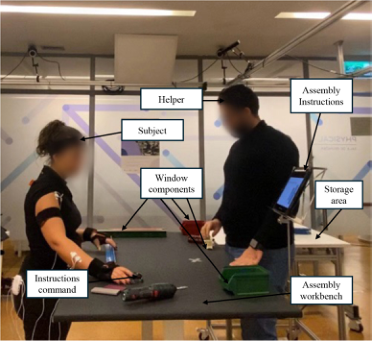
In the pursuit of advancing the concept of assistive assembly processes, this research framework employed a human-centric approach tailored to assembly tasks. Throughout the experimental trials, the configuration of the workbench was structured to ensure that specific assembly components were positioned within the normal reach of the participants, considering pertinent anthropometric measurements (Filho et al., 2023). Supplementary components were handed over to participants by a human assistant located directly opposite them across the workbench. A display screen presenting sequential assembly instructions was positioned in front of the participants. Notably, the participants entirely controlled the visualization of these instructions through a user-initiated command interface (refer to Figure 1).
Figure 1: Experimental setup.
In a laboratory setting, within a window frame assembly task, a Non- Assistive (NA) and Assistive (A) conditions were defined. These terms denote two distinct types of guidance or support provided to assemblers. In the NA condition, the parts were delivered to the worker in a pre-established orientation upon request, within their normal reach. Conversely, the A condition entailed delivering components in the correct assembly orientation,
synchronized with the worker’s requirements and on the respective mounting side. In this condition, unlike the previous one, the assistant provides real-time guidance and feedback to assemblers throughout the assembly procedure.
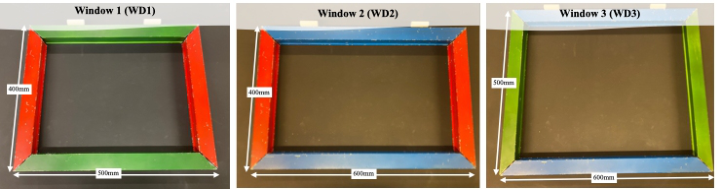
The tasks consisted of assembling three different window dimensions (400x500mm, 400x600m, and 500x600mm) per condition, as shown in Figure 2.
Figure 2: Type of window frames dimensions.
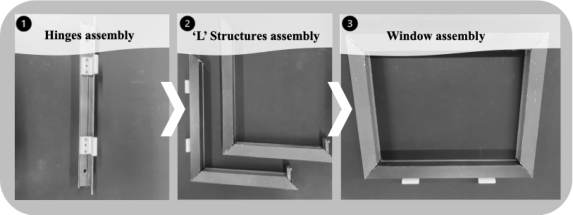
To successfully assemble a window, the participants were asked to first assemble the hinges in the more oversized window frame. After that, they were asked to assemble two “L” structures assembling two frames using a merging bracket. In the last step, the participants were asked to assemble both “L” structures, shaping a square. Figure 3 presents a simplified version of a window assembly process.
Figure 3: Windows’ frame assembly process.
Ergonomic Assessment This research entailed both qualitative and quantitative data collection. The Borg Category Rate 10 (Borg CR-10)(Borg, 1990) scale was employed to evaluate and compare the perceived physical effort experienced under both conditions. Concurrently, kinematic and electromyographic (EMG) data of the upper limbs were also recorded and analyzed compare NA and A assembly conditions. Kinematic analysis utilizes Inertial Measurement Units (IMU) worn by participants during the assembly work cycles. IMU, comprising 3D accelerometers, gyroscopes, and magnetometers, were placed
Enhancing Worker Well-Being: A Study on Assistive Assembly 57
on various body landmarks, with data collected at a frequency of 60 Hz. Considering the high prevalence of upper limb disorders among assembly workers (Zare et al., 2020), our study was only focused on the kinematic analysis of the upper limb, including the arm, elbow, and wrist. Therefore, the .xlsx outputs corresponding to the angular variation of these body segments were analyzed. The kinematic analysis was exclusively conducted on the dominant side of the workers. The functional movements of the upper limb as well as the segment orientation considered were performed as applied in the study developed by Colim et al. (2023).
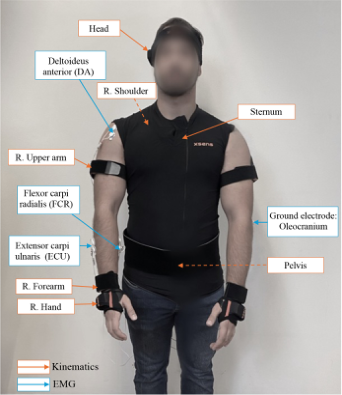
Electromyographic signals from specific upper limb muscles were recorded using an 8-channel biosignals device, adhering to the established Surface ElectroMyoGraphy for the Non-Invasive Assessment of Muscles (SENIAM) guidelines (SENIAM.org, n.d.). The electrodes were placed on the arm of the subject’s dominant side, on a selected set of muscles, namely Deltoideus anterior (DA), Extensor carpi ulnaris (ECU), and Flexor carpi radialis (FCR). A reference electrode was placed on the olecranon. The rationale for choosing these specific muscles was rooted in their function. Specifically, the DA muscle is involved in mobilizing the glenohumeral joint, scapular abduction, and arm abduction (Colim et al., 2021a). Meanwhile, the ECU and FCR muscles are respectively accountable for wrist extension with ulnar deviation and wrist flexion with radial deviation (Colim et al., 2023). Before conducting experiments on each subject, the Maximum Voluntary Contraction (MVC) values for each muscle were obtained. Subjects were instructed to perform three-second contractions for each muscle, with three-second rest intervals between contractions. The locations of the EMG electrodes and the right side IMU are shown in Figure 4.
Figure 4: Placement of the EMG electrodes and IMU (note that dashed arrows represent IMU on the posterior side of the body).
Statistical Analysis For all variables studied a descriptive analysis was performed using SPSS (version 29.0.1.0). The mean was applied as the measure of the central tendency and the standard deviation for the data dispersion, except for scores related to perceived physical effort (for these, we used the median). To assess the statistical significance difference between conditions, we first tested the normality of the data distributions, using Shapiro-Wilk test. To test pairwise mean differences between conditions, if normality was met, a more robust parametric test was conducted (paired t-test); otherwise, a non-parametric test (Wilcoxon signed-rank test) was used (Colim et al., 2023). All tests were conducted in SPSS (version 29.0.1.0).
RESULTS AND DISCUSSION
The results of the ergonomic assessment that was conducted are presented below. We considered 6 participants, except for the electromyographic study, where only 5 were considered due to one participant’s results showing disparate values, due to signal noise.
Perceived Physical Effort The perceived physical effort experienced by participants under both conditions was assessed using the Borg CR-10 scale. The results presented in Table 1 indicate a statistically significant difference in the median perceived physical effort between the two conditions (p = 0.041*). Participants reported a median perceived physical effort of 4.0 (ranging from 0.0 to 8.0) for the NA condition, whereas under the A condition, the median perceived physical effort decreased to 2.5 (ranging from 0.0 to 4.0). This methodological approach relies on psychophysical assessment, a methodology that holds significance and is commonly employed in analogous ergonomic investigations that aim to assess the perceived physical exertion between different conditions (Luger et al., 2017). Therefore, the reduction found in our results suggests that real-time guidance and feedback provided by the assistant during the assembly task effectively alleviated the physical strain experienced by the participants compared to NA condition. Nevertheless, as noted earlier, several objective data were collected to complement this evaluation, including kinematics and EMG data, as shown subsequently.
Table 1. Median (min., max.) perceived physical effort for the two conditions (* denotes statistical significance).
Table available in the original PDF paper.
C1: NA C2: A Median (min., max.) 4.0 (0.0; 8.0) 2.5 (0.0; 4.0) Wilcoxon Signed Rank Assymp. Sig (2-tailed) 0.041*
Enhancing Worker Well-Being: A Study on Assistive Assembly 59
Kinematic Analysis of Upper Limb The kinematic analysis focused on evaluating the wrist, elbow, and arm joint angles across different window dimensions (W1, W2, W3) assembly under both conditions. As presented in Table 2, significant differences were observed in the joint angles between the two conditions across all window dimensions (p < 0.001* for all comparisons).
Table 2. Mean joint angles (in degrees) of the wrist, elbow, and arm across the three window types (* denotes statistical significance).
C1:NA 57.63±22.36 57.30±23.28 55.32±23.46 C2: A 58.21±19.90 58.67±20.37 57.53±20.94 T-test two-sided P <.001* <.001* <.001*
Wrist Ulnar/ Radial Deviation (
)
C1:NA 10.53±11.84 10.05±13.13 10.02±12.62 C2: A 12.16±11.80 12.96±12.28 14.21±12.26 T-test two-sided P <.001* <.001* <.001*
Wrist Flexion/ Extension (
)
C1:NA -19.58±12.71 -20.84±13.23 -19.79±13.2 C2: A -21.70±13.13 -22.53±12.85 -20.43±13.18 T-test two-sided P <.001* <.001* <.001*
Arm Flexion/ Extension (
)
C1:NA 18.63±14.72 18.40±16.47 20.47±15.53 C2: A 14.48±11.90 16.76±9.56 17.24±9.511 T-test two-sided P <.001* <.001* <.001*
The results are similar between window dimensions assembly. Relatively to the conditions under analysis, the findings show a slightly higher deviation from the neutral posture of the joint (joint angle ∼0
) of the wrist (radial/ulnar deviations and flexion/extension) in the A condition. Conversely, regarding the joint angles of the elbow, better results were found in the A condition since the level of flexion/extension, although not optimal, is closer to the acceptable ergonomic range (∼60
to 100
). Related to arm flexion/extension, despite the results not being ideal (∼0
), the values are lower in condition A than in condition NA (McAtamney and Corlett, 1993).
EMG Analysis of the Upper Limb EMG analysis aimed to assess muscle activity in the upper limb during assembly tasks under both conditions. The results in Table 3 indicate statistically significant differences in the average RMS values of the EMG signal for all muscles studied across window types and conditions (p < 0.001* for all comparisons).
Under the A condition, participants exhibited lower RMS values for DA and FCR compared to the NA condition. Conversely, a slightly increase of ECU muscle activity was found in the A condition. These findings are consistent with kinematic analysis. On the one hand, they corroborate the decrease in arm flexion, which is also evident in the reduced activity of the DA muscle. On the other hand, they denote new evidence. Specifically, according to kinematic analysis, wrist flexion/extension movement was superior in the
A condition compared to the NA condition. However, it is observed that the mean value was negative, indicating wrist extension (Colim et al., 2021b). The EMG results further clarify that the A condition is only inferior to the NA condition in terms of wrist extension (supported by the EMG results of the ECU muscle). Improvements are observed in wrist flexion, as demonstrated by the decrease in muscular activation of the FCR muscle in condition A. In addition, these results align with the perceived physical effort results, indicating that the assistance provided effectively reduced the muscular demands associated with the assembly process.
Table 3. Average RMS values of the EMG signal, normalized by MVC (%) of the three muscles studied segmented by window type (* denotes statistical significance).
DA C1: NA 1.60 ±2.50 1.58 ±2.29 1.67 ±2.36 C2: A 1.15 ±1.65 1.06 ±1.53 1.14 ±1.68 T-test two-sided P <.001* <.001* <.001* FCR C1: NA 3.09 ±3.87 3.18 ±3.50 2.81 ±3.29 C2: A 2.69 ±3.23 2.65 ±3.18 2.71 ±3.19 T-test two-sided P <.001* <.001* <.001*
ECU C1: NA 0.95 ±1.59 0.96 ±1.52 0.95 ±1.49 C2: A 1.03 ±1.67 1.00 ±1.66 1.03 ±1.80 T-test two-sided P <.001* <.001* <.001*
Conclusions, Limitations and Future Work In a previous study (Cardoso et al., 2024), we had already demonstrated the importance of assistive assembly in reducing cognitive overload and the number of errors. Similarly, other previous studies have also shown the effectiveness of assistive assembly in improving cognitive parameters (Funk et al., 2016; Vanneste et al., 2020). The current study provides new evidence regarding physical overload. Notably, our results also highlight the importance of assistive assembly in reducing physical overload, both in terms of participants’ perception and in kinematic and EMG terms. Although these results do not show improvements in all evaluated metrics, they hinder progress in this direction. The findings underscore the potential of employing assistive technologies to enhance ergonomics and reduce physical strain in assembly processes.
The major limitation of this study pertains to the assistant being a human, who, despite considering the assembler’s needs in terms of assembly sequence, provides parts according to the required assembly side, thereby reducing some unnecessary joint displacement (also through the orientation in which the parts were delivered). This limitation prompts us to propose future work. It is expected that the assistant will be a cobot powered by a vision system (based on a real-time ergonomic assessment framework), which will be able to discern not only the partner’s needs in terms of assembly sequence but also recognize their postures and intelligently deliver parts that allow for
Enhancing Worker Well-Being: A Study on Assistive Assembly 61
the reduction of the partner’s joint displacement and eventually decrease the WMSD risk. This ability will be merged with close temporal coordination of actions (Wojtak et al., 2023) and collision-free trajectories with human-like characteristics (Gulletta et al., 2021). Moreover, the importance of further evaluation of cobot-simulated behavior cannot be overstated. Specifically, an examination of identical metrics across a larger sample size and the disaggregation of task elements (e.g., assessment of the assembly process of hinges) is necessary. This approach is crucial for identifying assistance requirements for future cobot assistants. Additionally, bilateral assessment is essential and should be conducted.
ACKNOWLEDGMENT
This work was supported by FCT within Project I-CATER: Intelligent Robotic Coworker Assistant for industrial Tasks with an Ergonomics Rationale, DOI 10.54499/PTDC/EEI-ROB/3488/2021; and by the PhD Grant DOI 10.54499/SFRH/BD/151365/2021 financed by the Portuguese FCT, and with funds from state budgets, under the MIT Portugal Program.
REFERENCES
Anacleto Filho, P. C., da Silva, L., Mattos, D., Pombeiro, A., Castellucci, H. I., Colim, A., Carneiro, P., Arezes, P., 2023. Establishing an anthropometric database: A case for the Portuguese working population. Int J Ind Ergon 97. https://doi.or g/10.1016/j.ergon.2023.103473 Borg, G., 1990. Psychophysical scaling with applications in physical work and the
perception of exertion. Scand J Work Environ Health 16, 55–58. https://doi.org/ 10.5271/sjweh.1815 Cardoso, A., Bicho, E., Braga, A., Alves, C., Louro, L., Fernandes, D., Arezes, P., Colim, A., 2024. Enhancing Worker Efficiency and Reducing Cognitive Workload Through Assistive Assembly: A Proof-of-Concept, in: Human Interaction and Emerging Technologies (IHIET-AI 2024): Artificial Intelligence and Future Applications. AHFE International. https://doi.org/10.54941/ahfe1004557 Colim, A., Arezes, P., Flores, P., Monteiro, P. R. R., Mesquita, I., Braga, A. C.,
2021a. Obesity effects on muscular activity during lifting and lowering tasks. International Journal of Occupational Safety and Ergonomics 27, 217–225. https: //doi.org/10.1080/10803548.2019.1587223 Colim, A., Cardoso, A., Arezes, P., Braga, A. C., Peixoto, A. C., Peixoto, V., Wolbert, F., Carneiro, P., Costa, N., Sousa, N., 2021b. Digitalization of Musculoskeletal Risk Assessment in a Robotic-Assisted Assembly Workstation. https://doi.org/10.3390/safety Colim, A., Pereira, D., Lima, P., Cardoso, A., Almeida, R., Fernandes, D., Mould, S.,
Arezes, P., 2023. Designing a User-Centered Inspection Device’s Handle for the Aircraft Manufacturing Industry. Applied Sciences 13, 11584. https://doi.org/10. 3390/app132011584 Funk, M., Kosch, T., Schmidt, A., 2016. Interactive worker assistance: Comparing the effects of in-situ projection, head-mounted displays, tablet, and paper instructions, in: UbiComp 2016 - Proceedings of the 2016 ACM International Joint Conference on Pervasive and Ubiquitous Computing. Association for Computing Machinery, Inc, pp. 934–939. https://doi.org/10.1145/2971648. 2971706 Gulletta, G., Silva, E. C. E., Erlhagen, W., Meulenbroek, R., Costa, M. F. P., Bicho,
E., 2021. A Human-like Upper-limb Motion Planner: Generating naturalistic
movements for humanoid robots. Int J Adv Robot Syst 18. https://doi.org/10. 1177/1729881421998585 Luger, T., Mathiassen, S. E., Bosch, T., Hoozemans, M., Douwes, M., Veeger, D., de Looze, M., 2017. Influence of Posture Variation on Shoulder Muscle Activity, Heart Rate, and Perceived Exertion in a Repetitive Manual Task. IISE Trans Occup Ergon Hum Factors 5, 47–64. https://doi.org/10.1080/24725838.2017.1303655 McAtamney, L., Nigel Corlett, E., 1993. RULA: A survey method for the
investigation of work-related upper limb disorders. Appl Ergon 24, 91–99. https://doi.org/10.1016/0003-6870(93)90080-S SENIAM.org, n.d. Enschede: Surface Electromyography for the Non-invasive Assessment of Muscles Project [WWW Document]. URL www.seniam.org (accessed 4.4.22). Vanneste, P., Huang, Y., Park, J. Y., Cornillie, F., Decloedt, B., Van den Noortgate,
W., 2020. Cognitive support for assembly operations by means of augmented reality: an exploratory study. International Journal of Human Computer Studies 143. https://doi.org/10.1016/j.ijhcs.2020.102480 Wojtak, W., Ferreira, F., Louro, L., Bicho, E., Erlhagen, W., 2023. Adaptive timing in a dynamic field architecture for natural human–robot interactions. Cogn Syst Res 82. https://doi.org/10.1016/j.cogsys.2023.101148 Zare, M., Bodin, J., Sagot, J. C., Roquelaure, Y., 2020. Quantification of exposure
to risk postures in truck assembly operators: Neck, back, arms and wrists. Int J Environ Res Public Health 17, 1–15. https://doi.org/10.3390/ijerph17176062
LISTED IN THE AHFE DIGITAL BOOKSTORE CATALOGUE
Explore the complete digital volume
Human Systems Engineering and Design (IHSED2024): Future Trends and Applications
Read this individual research paper free through the original publisher, or explore the full digital proceedings book.
ISBN 978-1-964867-34-2
Explore this ISBN in the AHFE Bookstore ↗Listed in the July 2026 bookstore catalogue; search by ISBN to confirm current availability · Digital book purchase optional