Carla Sofia Alves, Luís Louro, Ana Colim, André Cardoso, Débora Pereira, Duarte Fernandes, Mohammadamin Salimi, João Oliveira, Estela Bicho (2024). Building a Multicamera and Multimodal 3D Skeleton-based Pose Estimation Dataset to Enhanced Human-Robot Collaboration. In: Human Systems Engineering and Design (IHSED2024): Future Trends and Applications. AHFE Open Access, vol. 158, pp. 33–42. https://doi.org/10.54941/ahfe1005526
Human Pose Estimation (HPE) is an essential computer vision task that plays a significant role in ergonomics, human-centered design of workplaces, and collaborative robotics, particularly in providing a safe, adaptive, and valuable human-robot collaboration (HRC). Nevertheless, the need for a concise and practical approach to setting up a multicamera and multimodal system for HPE dataset generation remains an open issue in the literature.The main goal of this work is to describe in concise steps a protocol that serves as a guide in the exploratory stage of the approach to construct an extensive multicamera and multimodal dataset used to enhance HRC. In this paper, the proposed protocol specifically addresses the challenge of designing a biomechanical model that can consistently reproduce complex and variable human motion analyses in an assembly task while considering ergonomic factors. Furthermore, the resulting work led to the definition of a marker set for one single-person future pipeline involving the placement of thirty-two reflective markers for 3D motion analysis, specifically emphasizing the upper segments of the human body, including the hands. The future generation of this dataset will hold significant promise for advancing the study of HRC. It will introduce reliable and precise multimodal data collection, such as human kinematics and video data, including depth data, which will then be used for posture metrics analysis. Finally, the dataset will be a valuable resource for the research community, enabling the training of machine learning models. These models will empower collaborative robots (cobots) to learn from human demonstrations, enhancing their efficiency and ergonomic performance in assembly tasks.
Industry 4.0 marked the beginning of a new era of manufacturing that utilizes digital technologies, including cobots, to create production setups that are both efficient and flexible (Colim et al., 2021a; Demir et al., 2019). However,
the focus on system-centered design in Industry 4.0 sometimes reduces human workers’ significance, prioritizing automation over human-centered approaches (Cunha et al., 2020; Lu et al., 2022). Hence, the paradigm of Industry 5.0 originated and developed to highlight the significance of human well-being and environmental sustainability in industrial operations (Breque et al., 2021).
In the Industry 5.0 domain, robots are perceived as ideal coworkers, capable of collaborating with human workers to accomplish shared objectives to achieve common goals (Cunha et al., 2020). However, the cobots’ capacity to autonomously improve workers’ physical and cognitive well-being during collaboration is restricted because current methods frequently regard ergonomic criteria as an outcome rather than an input to cobot controllers (Gualtieri et al., 2021). Human-robot collaboration (HRC) in manufacturing tasks is becoming more widely recognized as an automated solution for developing more ergonomic workstations (Colim et al., 2021b; Olivas-Padilla et al., 2022). However, the cobot’s capacity to autonomously improve workers’ physical and cognitive well-being during collaboration is restricted because current methods frequently treat ergonomic criteria as an outcome rather than an input to robot controllers (Gualtieri et al., 2021).
Work-related musculoskeletal disorders (WMSD) continue to be a major issue in industrial manufacturing, frequently caused by repetitive handling tasks and awkward postures at the workstations (Chen et al., 2018; Colim et al., 2023). A solid understanding of human movements and postures is necessary to address these issues, especially in tasks involving cobots and humans. Cardoso et al. (2021) emphasized the significance of including ergonomic requirements in designing cobots workstations to ensure safety and efficiency. The high occurrence of WMSD highlights the need for implementing ergonomic interventions and designing collaborative workstations that focus on human well-being. To overcome these difficulties, sophisticated human pose estimation methods, and extensive datasets are essential. These resources are vital for advancing more intelligent and adaptable HRC systems.
Recent progress in human pose estimation (HPE) has demonstrated encouraging outcomes in many fields, such as robotics and computer vision (Toshpulatov et al., 2022). However, there is a notable gap in the existence and accessibility of datasets designed to improve HRC in industrial environments, especially those that include ergonomic factors and multi-modal data. For instance, Yang et al. (2018) demonstrated the advantages of integrating multiple camera views with depth data and motion capture systems. Robinson et al. (2023) conducted an extensive survey of robotic vision for human-robot coworkers within the framework of HRC. Their research highlighted the need for precise human pose assessment in facilitating effective collaboration. Additionally, the authors indicated the necessity for more tailored datasets in industrial environments. Maurice et al. (2019) introduced a dataset designed for cobots in industry environments. The dataset primarily emphasizes human movement and ergonomics. Although their work provided useful insights, it failed to comprehensively address the intricacies of collecting multi-modal data for the difficulties
Building a Multicamera and Multimodal 3D Skeleton-Based Pose Estimation Dataset 35
associated with assembly tasks. Angleraud et al. (2024) investigated the use of sensor-based human-robot collaboration in industrial tasks, emphasizing the advantages of employing multi-modal sensing methods. Nevertheless, their research did not offer a thorough set of guidelines for creating datasets integrating both posture assessment and ergonomic factors. Cimolin et al. (2012) introduced a marker set methodology for quantitatively analyzing upper limb movements during gait. Although their research provided the groundwork for analyzing upper body motion, it did not specifically consider the need for HRC in industrial environments. Hansen et al. (2024) confirmed the accuracy of upper extremity motions by utilizing markerless motion capture, highlighting the capabilities of innovative technologies in investigating human motion. Nevertheless, their methodology failed to consider the distinct requirements of HRC or the incorporation of multiple data modalities. Fernandes et al. (2016) performed a study in the field of biomechanical modeling. They examined the three- dimensional multi-segmental trunk kinematics and kinetics during gait. The study aimed to gain insights into the reproducibility of test-retest results and the most minor detectable change. Although this work provides critical methodological considerations, it does not mainly handle the issues of HRC in industrial contexts.
Despite these advancements, there is still a notable lack of complete methods for creating multi-modal datasets explicitly intended to improve HRC in industrial environments. Current methodologies frequently fail to address the complex connection between HPE, ergonomic factors, and the specific requirements for assembly activities in collaborative settings. To fill this gap, this paper presents a procedure summarizing the necessary steps to generate a dataset that focuses on constructing a multicamera and multimodal for 3D skeleton-based pose estimation, improving HRC. The method introduced focuses in a particular way on the difficulty of creating a biomechanical model that can accurately replicate complex and diverse human motion analyses during assembly activities while considering ergonomic variables.
The proposed protocol includes the definition of a marker set for a single-person pipeline, which requires the placement of thirty-two reflective markers for 3D motion analysis. This marker set focuses on the upper segments of the human body, which are crucial for most assembly tasks in industrial settings. Subsequent sections will explain the presented protocol, including a concise description of the procedures for setting up a multicamera and multimodal acquisition vision system, data collection, processing, and organization of data recording, defining the marker set, and constructing the biomechanical model.
PROTOCOL TO GENERATE A MULTICAMERA DATASET TO APPLY IN HRC WORKSTATIONS This section presents a strategy for generating a dataset that includes several cameras and multiple data modes for HRC while considering ergonomic factors for the upper body. This protocol contains several phases, described
in a concise guide in the following sections: 1. subjects selection criteria; 2. experimental description of tasks; 3. acquisition setup; 4. data recording and organization; 5. technical validation; and 6. biomechanical protocol creation. The protocol also integrates the utilization of diverse RGB-D cameras, motion capture systems, and associated software applications.
Participants Selection Criteria The selection criteria for participants should prioritize diversity, including various age groups, genders, and physical characteristics. This will enable the collection of a comprehensive range of ergonomic data (Maurice et al., 2019). All participants must provide informed consent, which should include a detailed explanation of the data collection procedure and the purpose of the study (as defended by Gualtieri et al., 2022), respecting the Declaration of Helsinki. It should be noted that the current study is inserted in a research project approved by the Committee of Ethics for Research in Social and Human Sciences of the University of Minho (approval number CEICSH 038/2020).
Task Selection Tasks should replicate authentic industrial operations, such as assembly, lifting, and tool handling, that require extensive upper-body movements. More precisely, in the current study, the assigned duties involve the assembly of a window by a human and a cobot within an industrial scenario, simulating a typical assembly workstation.
Acquisition Setup Hardware and Software Systems For the Optical Motion Capture System (MoCap), Qualisys, Vicon, and OptiTrack are examples of high-precision optical motion capture systems. The Qualisys system employs the Qualisys Track Manager (QTM) software to record and process data (Qualisys, 2024a). Vicon systems utilize Vicon Nexus software, while OptiTrack systems employ Motive software (Fernandes et al., 2016; OptiTrack, 2024; Vicon, 2024).
In this context, the reflective markers should be strategically positioned on anatomical landmarks of the human upper body to capture precise motion data accurately (Qualisys, 2024b).
Relatively to RGB-D Cameras, multiple high-definition video cameras, such as the StereoLabs ZED, Microsoft Kinect, and Intel RealSense, should be strategically positioned around the workstation to record various perspectives of the participants’ movements (Newman et al., 2022; StereoLabs, 2024a; Zhang et al., 2019).
In the current study, RGB-D cameras like the Stereolabs ZED 2i are viable options due to their high resolutions at considerable frame rates (frames per second (fps)), of up to 2208x1242 at 15 fps and 1920x1080 at 30 fps, wide-angle field of view (FOV) of 120o, and robust environmental resistance (StereoLabs, 2024b).
Building a Multicamera and Multimodal 3D Skeleton-Based Pose Estimation Dataset 37
Calibration In this domain, each motion capture camera must be calibrated to correct lens distortions and to establish the appropriate spatial relationship between cameras, ensuring precise 3D reconstruction (Franjcic and Wozniak, 2014). For this stage, it is essential to perform both intrinsic and extrinsic calibration for each video camera (Zhang et al., 2019).
Data Pre-Processing and Synchronization The raw motion capture data must be collected from the MoCap system and processed using noise reduction filters to remove any additional noise (Menolotto et al., 2020).
Regarding motion capture and video cross-synchronization, various techniques can synchronize motion capture and video data in space and time. These methods include hardware synchronization, such as dedicated sync units, or software-based alignment, which indicates the beginning of recording on both systems (Qualisys, 2024c, 2024d; Yoon et al., 2021).
Data Records and Data Organization The raw data should be structured with separate folders for motion capture and video data. Newman et al. (2022) suggest providing metadata, such as participant ID, task description, and timestamp. The objective is to convert unprocessed data into processed data by accurately recognizing and separating significant attributes, such as joint angles and ergonomic metrics. To simplify analysis, processed data should be stored in a standardized format such as CSV or JSON (Lorenzini et al., 2023).
Technical Validation The dataset should be validated by comparing the acquired data with specified standards (data acquired from the MoCap system) or benchmarks (Colyer et al., 2018). For ergonomic assessment, established methods, such as the Rapid Upper Limb Assessment (RULA) (McAtamney and Corlett, 1993) and the Rapid Entire Body Assessment (REBA) (Hignett and Ergonomist, 2000), are recommended to assess human postures regarding the captured movements (Alberto et al., 2018).
Biomechanical Protocol Design and Marker Set Definition This section presents the biomechanical protocol designed to standardize the data collection process for the human upper-body, considering the principal motions and actions to assemble a window.
First, considering the macro-actions to be analyzed in this specific dataset, such as pointing, hand-approach, grasping type, handover, hand-approach- me, and screwing, a description of the functional movements and joints in this particular task is presented in Table 1.
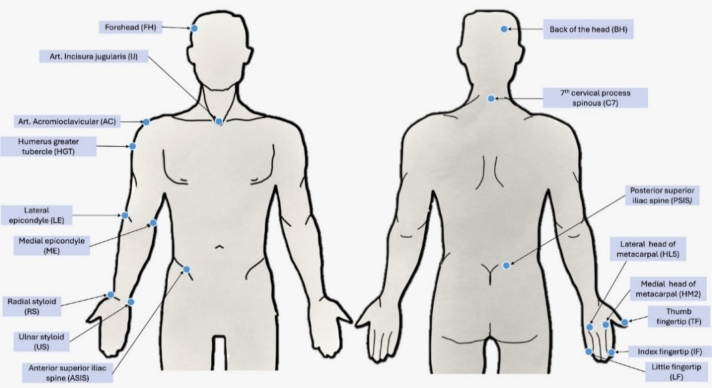
Table 2 presents the protocol for accurately and consistently repeatable placement of reflective markers on anatomical landmarks in each trial necessary for generating the dataset. The final configuration of the personalized marker set comprises thirty-two reflective markers for both the right and left parts of the human skeleton.
Table 1. Description of the functional movements (Hecht, 2020; Physiopedia, 2024; Sukari et al., 2021; Tor, 2001; Zwerus et al., 2019).
Table available in the original PDF paper.
Joints Description of the functional movements executed Shoulder/upper arm Flexion, extension, abduction, adduction, internal rotation, external rotation. Elbow/lower arm Flexion, extension, pronation, supination. Wrist Flexion, extension, radial deviation, ulnar deviation. Hand Flexion, extension, abduction. Head/Neck - Cervical Flexion, extension, lateral flexion, rotation. Trunk - Lumbar Flexion, extension, lateral flexion, rotation.
Table 2. Description of localization parameters of the custom marker set for the upper body.
Table available in the original PDF paper.
Definition Marker label References for localization Forehead FH (Vicon, 2016) Back of the head BH (Vicon, 2016) Jugular notch joint IJ_chest (Wikipedia, 2024) Acromioclavicular joint AC (Musculoskeletal Key, 2016) 7th cervical vertebra C7 (Athletic Training & Sports Medicine Center, n.d.) Anterior superior iliac spine ASIS (Agency for Clinical Innovation, 2015) Posterior superior iliac spine PSIS (Agency for Clinical Innovation, 2015) Humerus greater tubercule HGT (Musculoskeletal Key, 2016) Lateral epicondyle LE (Musculoskeletal Key, 2016) Medial epicondyle ME (Musculoskeletal Key, 2016) Radial styloid RS (Musculoskeletal Key, 2016) Ulnar Styloid US (Musculoskeletal Key, 2016) Lateral head of metacarpal HL5_hand Located on the most prominent bone on the little finger side of the hand, the hand closed. Medial head of metacarpal HL2_hand Located on the most prominent bone on the thumb finger side of the hand, the hand closed. Tip of the Thumb TF_hand Tip of the Thumb. Tip of index finger IF_hand Tip of the index finger. Tip of the little finger LF_hand Tip of the little finger.
The marker set created for this work was based on its ability to provide detailed and accurate motion data for the key joints in the study. The configuration of this custom marker is presented in Figure 1 and resulted from the intersection of selected standard biomechanical models known for its effectiveness in capturing upper limbs, trunk, and head/neck movements (Fernandes et al., 2016; HAS Motion, 2024; Qualisys, 2021; Vicon, 2016).
Building a Multicamera and Multimodal 3D Skeleton-Based Pose Estimation Dataset 39
Figure 1: Configuration of the custom marker set for placement of reflective markers in anatomical landmarks of the upper body (right and left side of the human skeleton).
CONCLUDING REMARKS AND FUTURE WORK This work is a substantial step forward in implementing Industry 5.0’s vision, which focuses on ergonomic factors and human well-being in industrial settings. The proposed protocol addresses the challenge of developing a biomechanical model that can accurately replicate complex human motions during assembly tasks while considering ergonomic factors.
The research designed a comprehensive protocol for creating a multicamera and multimodal 3D skeleton-based pose estimation dataset to improve HRC. The protocol includes extensive procedures for selecting subjects, designing tasks, setting up the acquisition system, collecting data, preprocessing, calibration, synchronization, data organization, and technical validation. Additionally, the biomechanical protocol establishes a standardized approach to data collection for body movements that occur during assembly tasks. A custom marker set consisting of thirty-two reflective markers was developed to facilitate the precise 3D motion analysis of the upper-body.
Future research will concentrate on creating a comprehensive dataset to record human motions in collaboration with a cobot, utilizing the protocol that has been developed. This dataset will be used to train and verify machine learning models to enhance HRC’s efficiency and ergonomic performance for a particular assembly task: assembling a window. The resultant dataset will include human kinematics and video data with depth information, providing precise and consistent multimodal data for posture metrics analysis.
In summary, this investigation establishes the groundwork for advancing HRC research by offering an advancement of collaborative robotic systems that are more adaptive and intelligent in industrial environments.
ACKNOWLEDGMENT This work has been supported by FCT within the Project I – CATER: Intelligent Robotic Coworker Assistant for Industrial Tasks with an Ergonomics Rationale, reference PTDC/EEI-ROB/3488/2021. Additionally, this work has been supported by FCT – Fundação para a Ciência e Tecnologia under doctoral Grant 2022.13737.BDANA.
REFERENCES
Agency for Clinical Innovation, N., 2015. Spinal Seating Professional Development Project Assessment Form RD4.1: Initial Interview. Alberto, R., Draicchio, F., Varrecchia, T., Silvetti, A., Iavicoli, S., 2018. Wearable
monitoring devices for biomechanical risk assessment at work: Current status and future challenges—A systematic review. Int J Environ Res Public Health. https: //doi.org/10.3390/ijerph15092001 Angleraud, A., Ekrekli, A., Samarawickrama, K., Sharma, G., Pieters, R., 2024.
Sensor-based human-robot collaboration for industrial tasks. Robot Comput Integr Manuf 86. https://doi.org/10.1016/j.rcim.2023.102663 Athletic Training & Sports Medicine Center, n.d. Bony Palpation Skill Sheethttp://at.uwa.edu/currhome/ah321/PalBHipPelvisSpine.asp (accessed 6.24.24). Breque, M., De Nul, L., Petridis, A., 2021. Industry 5.0 - Towards a sustainable, human-centric and resilient European industry. https://doi.org/10.2777/308407 Cardoso, A., Colim, A., Bicho, E., Braga, A. C., Menozzi, M., Arezes, P.,
2021. Ergonomics and Human Factors as a Requirement to Implement Safer Collaborative Robotic Workstations: A Literature Review. Safety 7, 71. https: //doi.org/10.3390/safety7040071 Chen, D., Cai, Y., Cui, J., Chen, J., Jiang, H., Huang, M. C., 2018. Risk factors identification and visualization for work-related musculoskeletal disorders with wearable and connected gait analytics system and kinect skeleton models. Smart Health 7–8, 60–77. https://doi.org/10.1016/j.smhl.2018.05.003 Cimolin, V., Galli, M., Albertini, G., Crivellini, M., Romkes, J., Brunner, R., 2012.
Quantitative analysis of upper limbs during gait: A marker set protocol. J Appl Biomater Funct Mater 10, 49–55. https://doi.org/10.5301/JABFM.2012.9277 Colim, A., Cardoso, A., Bicho, E., Louro, L., Alves, C., Ribeiro, P., Pereira, D., Monteiro, S., Costa, N., Carneiro, P., Mould, S., Oliveira, J., Fernandes, D., Arezes, P., 2023. On the development of an ergonomic approach for the design of an industrial robotic coworker, in: Human Interaction & Emerging Technologies (IHIET 2023): Artificial Intelligence & Future Applications. AHFE International. https://doi.org/10.54941/ahfe1004004 Colim, A., Faria, C., Cunha, J., Oliveira, J., Sousa, N., Rocha, L. A., 2021a. Physical
ergonomic improvement and safe design of an assembly workstation through collaborative robotics. Safety 7. https://doi.org/10.3390/safety7010014 Colim, A., Morgado, R., Carneiro, P., Costa, N., Faria, C., Sousa, N., Rocha, L. A., Arezes, P., 2021b. Lean manufacturing and ergonomics integration: Defining productivity and wellbeing indicators in a human–robot workstation. Sustainability (Switzerland) 13, 1–21. https://doi.org/10.3390/su13041931 Colyer, S. L., Evans, M., Cosker, D. P., Salo, A. I. T., 2018. A Review of the Evolution
of Vision-Based Motion Analysis and the Integration of Advanced Computer Vision Methods Towards Developing a Markerless System. Sports Med Open. https://doi.org/10.1186/s40798-018-0139-y
Building a Multicamera and Multimodal 3D Skeleton-Based Pose Estimation Dataset 41
Cunha, A., Ferreira, F., Sousa, E., Louro, L., Vicente, P., Monteiro, S., Erlhagen, W., Bicho, E., 2020. Towards collaborative robots as intelligent co-workers in human- robot joint tasks: What to do and who does it? 52nd International Symposium on Robotics, ISR 2020 141–148. Demir, K. A., Döven, G., Sezen, B., 2019. Industry 5.0 and Human-Robot Co-
working. Procedia Comput Sci 158, 688–695. https://doi.org/10.1016/j.procs. 2019.09.104 Fernandes, R., Armada-da-Silva, P., Pool-Goudaazward, A., Moniz-Pereira, V., Veloso, A. P., 2016. Three-dimensional multi-segmental trunk kinematics and kinetics during gait: Test-retest reliability and minimal detectable change. Gait Posture 46, 18–25. https://doi.org/10.1016/j.gaitpost.2016.02.007 Franjcic, Z., Wozniak, P., 2014. QualiWand: Towards Optimising Feedback for
Motion Capture System Calibration. Graphics Interface 2014 Poster Session Proceedings. 5–6. Gualtieri, L., Rauch, E., Vidoni, R., 2022. Development and validation of guidelines for safety in human-robot collaborative assembly systems. Comput Ind Eng 163, 107801. https://doi.org/10.1016/j.cie.2021.107801 Gualtieri, L., Rauch, E., Vidoni, R., 2021. Emerging research fields in safety and
ergonomics in industrial collaborative robotics: A systematic literature review. Robot Comput Integr Manuf 67, 1–30. https://doi.org/10.1016/j.rcim.2020. 101998 Hansen, R. M., Arena, S. L., Queen, R. M., 2024. Validation of upper extremity kinematics using Markerless motion capture. Biomedical Engineering Advances 7, 100128. https://doi.org/10.1016/j.bea.2024.100128 HAS Motion, 2024. Marker Set Guidelines – Software Product Documentation.
https://wiki.has-motion.com/Marker_Set_Guidelines (accessed 6.24.24). Hecht, M., 2020. Shoulder Muscles: Anatomy, Function, and More. https://www.he althline.com/health/shoulder-muscles (accessed 6.24.24). Hignett, S., Ergonomist, L. M., 2000. Rapid Entire Body Assessment (REBA),
Applied Ergonomics. Lorenzini, M., Lagomarsino, M., Fortini, L., Gholami, S., Ajoudani, A., 2023.
Ergonomic human-robot collaboration in industry: A review. Front Robot AI. https://doi.org/10.3389/frobt.2022.813907 Lu, Y., Zheng, H., Chand, S., Xia, W., Liu, Z., Xu, X., Wang, L., Qin, Z., Bao, J.,
2022. Outlook on human-centric manufacturing towards Industry 5.0. J Manuf Syst 62, 612–627. https://doi.org/10.1016/j.jmsy.2022.02.001 Maurice, P., Malaisé, A., Amiot, C., Paris, N., Richard, G. J., Rochel, O., Ivaldi, S., 2019. Human movement and ergonomics: An industry-oriented dataset for collaborative robotics. International Journal of Robotics Research 38, 1529–1537. https://doi.org/10.1177/0278364919882089 McAtamney, L., Nigel Corlett, E., 1993. RULA: A survey method for the investigation of work-related upper limb disorders. Appl Ergon 24, 91–99. https://doi.org/10.1016/0003-6870(93)90080-S Menolotto, M., Komaris, D. S., Tedesco, S., O’flynn, B., Walsh, M., 2020.
Motion capture technology in industrial applications: A systematic review. Sensors (Switzerland) 20, 1–25. https://doi.org/10.3390/s20195687 Musculoskeletal Key, 2016.5. Bony Palpation | Musculoskeletal Key. https://muscul oskeletalkey.com/5-bony-palpation/ (accessed 6.24.24). Newman, B. A., Aronson, R. M., Srinivasa, S. S., Kitani, K., Admoni, H., 2022.
HARMONIC: A multimodal dataset of assistive human-robot collaboration. International Journal of Robotics Research 41, 3–11. https://doi.org/10.1177/ 02783649211050677
Olivas-Padilla, B. E., Papanagiotou, D., Senteri, G., Manitsaris, S., Glushkova, A.,
2022. Computational ergonomics for task delegation in Human-Robot Collaboration: spatiotemporal adaptation of the robot to the human through contactless gesture recognition. OptiTrack, 2024. OptiTrack Documentation | EXTERNAL OptiTrack Documentation. https://docs.optitrack.com/ (accessed 6.24.24). Physiopedia, 2024. Wrist and Hand Examination – Physiopedia.https://www.physiopedia.com/Wrist_and_Hand_Examination (accessed 6.24.24). Qualisys, 2024a. Qualisys Track Manager QTM – Software. https://www.qualisys.c
4%20what%20comes%20with%20your%20system/4%20what%20comes%20 with%20your%20qualisys%20system/camera%20sync%20unit.htm (accessed 6.24.24). Qualisys, 2024d. Streaming in real time.https://docs.qualisys.com/getting- started/content/getting_started/running_your_qualisys_system/recording_with_ qtm/streaming_in_real_time.htm (accessed 6.24.24). Qualisys, 2021. Qualisys Claw Marker Set. Robinson, N., Tidd, B., Campbell, D., Kuli´c, D., Corke, P., 2023. Robotic Vision for Human-Robot Interaction and Collaboration: A Survey and Systematic Review. ACM Trans Hum Robot Interact 12. https://doi.org/10.1145/3570731 StereoLabs, 2024a. ZED 2 - AI Stereo Camera. https://www.stereolabs.com/product
s/zed-2 (accessed 6.24.24). StereoLabs, 2024b. ZED 2i - Camera Overview & Datasheet. Sukari, A. A. A., Singh, S., Bohari, M. H., Idris, Z., Ghani, A. R. I., Abdullah, J. M.,
2021. Examining the Range of Motion of the Cervical Spine: Utilising Different Bedside Instruments. Malays J Med Sci 28, 100. https://doi.org/10.21315/MJMS 2021.28.2.9 Tor, A., 2001. Muscle activity and range of motion during active trunk rotation in a sitting posture, Applied Ergonomics. Toshpulatov, M., Lee, W., Lee, S., Haghighian Roudsari, A., 2022. Human
pose, hand and mesh estimation using deep learning: a survey. Journal of Supercomputing 78, 7616–7654. https://doi.org/10.1007/s11227-021-04184-7 Vicon, 2024. Nexus | Software For Motion Capture In Life Sciences. 2024. https: //vicon.com/software/nexus/ (accessed 6.24.24). Vicon, 2016. Plug-in Gait Reference Guide_vicon_markerset ref artigo human
movement and ergonomics. Wikipedia, 2024. Suprasternal notch – Wikipedia. https://en.wikipedia.org/wiki/Su prasternal_notch (accessed 6.24.24). Yang, W., Ouyang, W., Wang, Xiaolong, Ren, J., Li, H., Wang, Xiaogang, n.d. 3D
Human Pose Estimation in the Wild by Adversarial Learning. Yoon, H., Jang, M., Huh, J., Kang, J., Lee, S., 2021. Multiple sensor synchronization with the realsense RGB-D camera. Sensors 21. https://doi.org/10.3390/s21186276 Zhang, C., Huang, T., Zhao, Q., 2019. A new model of RGB-D camera calibration
based on 3D control field. Sensors (Switzerland) 19. https://doi.org/10.3390/ s19235082 Zwerus, E. L., Willigenburg, N. W., Scholtes, V. A., Somford, M. P., Eygendaal, D., van den Bekerom, M. P. J., 2019. Normative values and affecting factors for the elbow range of motion. Shoulder Elbow 11, 215–224. https://doi.org/10.1177/ 1758573217728711
LISTED IN THE AHFE DIGITAL BOOKSTORE CATALOGUE
Explore the complete digital volume
Human Systems Engineering and Design (IHSED2024): Future Trends and Applications
Read this individual research paper free through the original publisher, or explore the full digital proceedings book.
ISBN 978-1-964867-34-2
Explore this ISBN in the AHFE Bookstore ↗Listed in the July 2026 bookstore catalogue; search by ISBN to confirm current availability · Digital book purchase optional