Evangelos Markopoulos, Haseena Al Katheeri, Hamdan Al Qayed (2023). A decision support system architecture for the development and implementation of ESG strategies at SMEs. In: Intelligent Human Systems Integration (IHSI 2023): Integrating People and Intelligent Systems. AHFE Open Access, vol. 69, pp. 905–915. https://doi.org/10.54941/ahfe1002916
Strategic management and business development can be delivered easier in large scale organizations and Multinational Enterprisers (MNEs) due to their excess in human resources, expertise and time orientation. Small and Medium Size Enterprises (SMEs) on the other hand operate in unpredicted environments, with limited resources aiming for their survival first and then their development. The contrast between the two types of enterprises seems chaotic in numbers but not in plans and intentions. The contribution of the MNEs to national economies and impact to the society and the environment can be measured with a variety of standards, metrics and practices such as Corporate Social Responsibility (CSR), the Environmental, Social and Governance Index (ESG), the Social Responsible Investments (SRI) and other. On the other hand, SMEs that also have direct impact to the society, the local and regional economy, the employment, and offer the same, if not more, opportunities to their limited human resources in terms of skills development and effort recognition, cannot record and report such actions, plans and strategies and recognized for their responsible management and leadership. The ESG criteria help organizations develop reputational capital that evolves into financial capital. However, the effort and investments needed to score on the ESG indexes is forbidden for the SMEs who intentionally or intention successfully delivering ESG activities, in a smaller scale, without a system to record and report them. This paper introduces the core design of a decision support system that guides SMEs to maps their operations against the ESG criteria. An extensive literature review has been conducted to identity software systems that coordinate, propose and support ESG activities and analyze elements of such systems that can be extracted for the development of a light system. Such a system, with the relevant enhancements, presented in this paper can be useful tool for the SMEs to report their ESG performance. The system functions as an assessment tool providing a staged evaluation of the SMEs activities, identifies ESG gaps and proposes actions needed to fulfill the requirements of ESG criteria. The final output of the system graphs the distance between the current and the target stage of the SME on the most common ESG criteria. However, the proposed system does not evaluate the scale of each ESG activity implementation but its existence in the SME operations and the degree of its adaptation. The paper also highlights the pre and post conditions for the utilization of the proposed technology using a process map, the social economic impact, research limitations and areas of further research. The goal of this research is to indicate that SMEs can and should be awarded ESG scores as well. For this SMEs can use such supportive technologies to direct them towards ESG compliance, and report achievements and contributions that can help them attract investments needed for them to keep on delivering a greater contribution the local, and why not international, economy and society.
Environmental, social and governance (ESG) factors have been recognized by investors as important measures for company valuation, risk manage- ment and also regulatory compliance. The number of asset managers that incorporate ESG into their asset allocation process indicate a rapid incre- ase. Furthermore, new thematic investment schemes emerge that become appealing to investors with very specific investment objectives (Refinitiv, 2022a). The ESG factors form the three new pillars of organizational sustainability helping organizations to better identify their future and financial performa- nce in terms of return and risk (Hicks, 2018). Companies adopting social or environmental standards achieve operational efficiency and reputation that positively reflects on their stock price performance (Markopoulos et al.
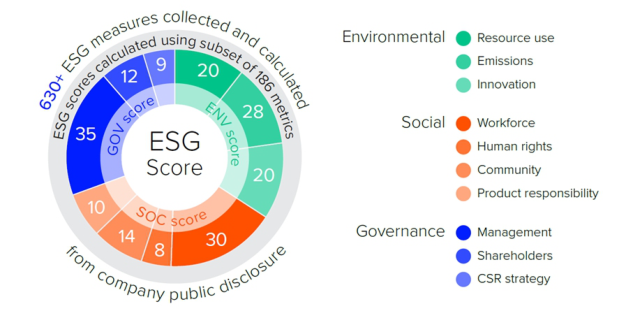
Figure 1: ESG Measures and categories per pillar (Adapted from Refinitiv, 2022a).
2020a). ESG turns out to be a critical organizational valuation index that impacts tremendously investment decisions and actions (Rollenhagen, 2022). In 2018 the sustainable responsible investment (SRI) assets reached 12 trillion dollars from 8.1 trillion in 2016. From those 12 trillion, 11.6 were handled by asset managers considering the ESG criteria (US/SIF, 2018).
On the other hand, and regardless the significant impact ESG ratings have on the financial performance of organizations, the everlasting challenge rela- ted with the lack of consensus on the ESG rating methodology remains a big shadow on the credibility of the overall ESG concept. Despite the broad definitions of the criteria, the method of assessing the quality and comple- teness of each ESG criterion for a specific company varies among the rating organizations.
Moody’s, S&P Global, MSCI, and Sustainalytics, are some examples of organizations that rate ESG differently. Therefore, organizations can come up with different ratings, depending on the criticality of each criterion covered and the overall methodology employed to measure the delivered output. This creates serious contradictions on the ESG methodology, the rating process and the overall process ESG index (Financial Times, 2022).
THE REFINITIV ESG CRITERIA To avoid confusion among the various organizations offering ESG ratings this paper emphasizes on the Refinitiv ESG ranking methodology, catego- ries, and themes (criteria). Refinitiv offers a comprehensive ESG database that covers more than 85% of the global market, with more than 630 ESG metrics, and a long history dating back to 2002 (Refinitiv, 2022b). The Refinitiv ESG Scores measure the ESG performance of companies based on data that publicly and periodically get reported in 10 categories (topics) covering the three ESG pillars (Refinitiv, 2022a). The company selected 186 of its 630 ESG metrics to calculate the ESG score. These 186 metrics are spread over 25 themes forming the 10 categories of the 3 ESG pillars (see Figure 1).
A Decision Support System Architecture for the Development and Implementation 907
Table 1. Refinitiv ESG structure.
Table available in the original PDF paper.
Pillar Category Theme Environmental Emission Emission Waste Biodiversity Environmental management systems Innovation Product innovation Green revenues, R&D and capital expenditures. Resource Use Water Energy Sustainable packaging Environmental supply chain
Social Community Equally important to all industries, hence a median weight of five is assigned to all Human rights Human rights Product responsibility Responsible marketing Product quality Data privacy Workforce Diversity and inclusion Career development and training Working conditions Health and safety Governance CSR Strategy CSR Strategy ESG reporting and transparency Management Structure (independence, diversity, committees) Compensation Shareholders Shareholder rights Takeover defences
The Refinitiv ESG metrics are based on three considerations which are the materiality, the data availability, and the relevance with the industry. The scoring methodology is based on five (5) key calculations principles: 1) Uni- que ESG magnitude (materiality) weightings, 2) Transparency stimulation, 3) ESG controversies overlay, 4) Industry and country benchmarks at the data point scoring level, 5) Percentile rank scoring. The total score a company ach- ieves is between 0 and 100 and is represented in four letter categories (A, B, C, and D) with 3 subcategories in each (A+, A,A−, etc). Table 1 demonstrate the range of themes (topics) covered by the Refinitiv ESG categories and pillars (Refinitiv, 2022b).
ESG REPORTING SOFTWARE SYSTEMS The rapid growth of the ESG index created the need for ESG reporting sof- tware, also called ESG software, to automate the collection, aggregation and analysis of ESG data and to support decision-making. The tracking of ESG
Table 2. ESG reposting software systems.
Table available in the original PDF paper.
Company Country Year Company Client Size Regions Served Size Serve Datamaran GB - 10 5.000+ Europe & Middle East, Americas Sphera USA 2016 1,000 5.000+ Europe & Middle East, Americas Workiva USA 2008 1,000 5.000+ Europe & Middle East, Americas Enablon France - 1000 5.000+ Europe & Middle East, Americas, Asia-Pacific Persefoni USA 2020 250 5.000+ Europe & Middle East, Americas LogicManager USA 2005 250 5.000+ Americas Quentic Germany 2007 500 5.000+ Europe & Middle East, Americas Novisto Canada 2019 50 5.000+ Europe & Middle East, Americas, Asia-Pacific RioESG GB 2018 50 5.000+ Europe & Middle East Emitwise GB 2019 10 5.000+ Europe & Middle East, Diginex Hong Kong 2017 100 5.000+ Europe & Middle East, Asia-Pacific
activities companies run to comply with the ESG criteria can be challenging without the use of specialized software systems to coordinate and monitor this progress. Extensive market research presents indicative software systems that coordinate, propose and support ESG activities. Table 2 indicates several ESG reporting system companies, the regions they support and their clientele size.
From the companies listed in table 2, Novisto (Novisto, 2022), Metrio (Metrio, 2022), and Enablon (Enablon, 2022) stand out with the most functionality related to the ESG criteria (see Table 3).
An analysis of the findings from tables 2 and 3 indicate that most of the companies offering ESG reporting software services are European and Ameri- can and established the last 15 years when the ESG concept started picking up globally. They are young in terms of maturity and expertise which justifies the lack on addressing many of the ESG requirements. This also indicates room for other companies to emerge and cover this gap, while the existing ones must further develop their functionality to cover more ESG requirements.
Other important findings are related with the size of each company and the regions they operate. Most of the companies are large scale with over 1.000 employees, focused mainly on the United States and European market. Many support the MENA region, a few Asia but no one Africa. A first assumption can be that North America and Europe maintain more social and sustainable personal and professional cultures therefore ESG is part of their DNA and highly considered as an important part of their strategy and operations. On the other hand, this does not favour the rest of the regions, especially the emerging markets that won’t become developed markets without companies with high ESG scores.
ESG DISCRIMINATION Strategic management and business development can be delivered easier in large scale organizations and Multinational Enterprisers (MNEs) due to
A Decision Support System Architecture for the Development and Implementation 909
Table 3. Most related ESG software companies.
Table available in the original PDF paper.
Novisto Metrio Enablon Risk management and oversight
Climate risk management GHG emissions management
Anti-bribery Diversity, equity & inclusion (DEI) Board composition and diversity
Global Reporting Initiative
Cybersecurity practices Diversity, equity & inclusion ESG risk management GHG emissions Environmental compliance Environmental compliance Energy management ESG risk management Materiality assessment Waste management Ethical sourcing Materials management Employee diversity metrics Ethics and social metrics Customer Data Diversity and inclusion Financed emissions management Ethics and culture GHG emissions management Sustainability accountability standards Climate-related risks and opportunities
Governance issues management SDGs
Task Force Climate Related disclosures Human rights Multi-tier supply chain assessment Employee health and safety Net zero planning Supply chain management Pre-loaded emission factors Raw material sourcing Climate programs management Product safety SDGs
their excess in human resources, expertise, and time orientation. Small and Medium Size Enterprises (SMEs) on the other hand operate in unpredicted environments, with limited resources aiming first for their survival than their development.
The contrast between the two types of enterprises seems chaotic in num- bers but not in plans and intentions. The contribution of the MNEs to national economies and their impact to the society and the environment can be measured with a variety of standards, metrics and practices such as Corpo- rate Social Responsibility (CSR), the Environmental, Social and Governance Index (ESG), the Socially Responsible Investments (SRI) and other. On the other hand, SMEs have the same, if not more, direct impact on the society, the local and regional economy, and the employment, but in a smaller scale. However, due to their limited human resources in terms of skills development and visibility on their efforts, they cannot record and report such actions to receive credit for their responsible management and leadership.
Such a distance between the privileges offered to MNEs against the SMEs creates development dissemination to most of the companies who are considered as SMEs. According to the European Union the Small and medium-sized enterprises (SMEs) represent 99% of all businesses in the EU, and are characterized by factors such as staff headcount (<250), turnover (≤€ 50 m) or balance sheet total (≤€ 43 m) (European Commission, 2022). SMEs employee local personnel, use local resources, contribute to the local economy, but also to the regional and national economy as most of them are active with their country. Therefore, unintentionally they address several
UN SDGs such as SDG8 (Decent Economic Work and Growth), SGD 1 (No poverty), SDG2 (Zero hunger), and others without getting any credit, the opportunity to translate such activities into ESG score, and extend they efforts beyond Corporate Social Responsibility (Markopoulos et al, 2021).
RESEARCH GAP AND PRIMARY RESEARCH RESULTS Based on secondary research for the ESG index requirements and the orga- nizations that offer ESG reporting systems the following two conclusions identify a research gap. The first one is the need for the simplification of the ESG requirements for SMEs to be able to report their activities on a lighter scale that reflects their size, operations and financial turnover. As of today, there is no indication of any attempt to democratize ESG with a parallel ESG index adjusted to the SMEs abilities. The second conclusion derives from the first one and is related with the lack of ESG reporting software that can be used by SMEs to help them record, report, and benefit from their ESG activities.
Regardless the difference between SMEs and MNEs, SMEs compose 90- 99% of the business in any country and such numbers cannot be ignored. Primary research indicates that an ESG reporting systems for the SMEs could he highly beneficial for the democratization of the ESG concept and its ada- ptation by the SMEs. To better understand the importance and impact of an ESG-SME index and reporting system,16 interviews has been conducted with SME owners and general managers from 6 industries (Finance, Software Development, Retail, Construction, Shipping and Consulting services) and 5 countries (Egypt, Finalnd, Greece, USA, and UK). The key findings are listed in table 3.
An analysis of the interview results in terms of countries and industries involved indicates that the sectors with the most awareness and maturity on the ESG index are the Finance and the Consulting Services. This is due to the fact the financial institutions understand better the financial impact of an ESG score on a company’s valuation, while the consulting services organizati- ons indicate ESG maturity as many attempts to provide such services to their clients. On the other hand, the shipping and the construction industries can be considered more conservative when dealing with ESG strategies. Coun- try wise it seems that Finland indicates high maturing and understanding on the ESG index since the environmental concept has been well rooted in the government, the companies and the citizens who live and operate with high environmental and social consciousness.
Analysing the interview results in terms of SMEs challenges to adopt the ESG index, it can be considered that the ESG strategy development, the ESG initiation process and the prioritization of the ESG activities are the ones that should start first. They are also the ones that seem to deliver faster results in terms of visibility and recognition that would motivate the company to con- tinue working on the ESG requirements. Theses three challenges are faced in most of the sectors participated in this research and in most of the countries.
The primary research and the literature review reveals the need for the development of a software technology to help SMEs select the ESG criteria
A Decision Support System Architecture for the Development and Implementation 911
Table 4. SMEs ESG challenges.
Table available in the original PDF paper.
Challenge Sector Country Egypt, Greece International visibility of ESG actions Finance, Shipping, Consulting services
Egypt, Finalnd, Greece, USA, UK ESG mentoring Software Development, Retail, Construction, Shipping
Egypt, Greece, USA, UK ESG compliance cost Finance, Software Development, Construction Egypt, Greece, UK
Egypt, Greece, USA, UK ESG activities tracking process
Finance, Software Development, Retail
ESG strategy development
Software Development, Retail, Construction, Shipping and Consulting services
Egypt, Greece
Egypt, Finalnd, Greece, USA, and UK ESG awareness in their market
Software Development, Retail, Construction, Shipping and Consulting services
Egypt, Greece, USA,
ESG activities prioritization
Finance, Software Development, Retail, Construction, Shipping and Consulting services ESG initiation process Finance, Software Development, Retail, Construction, Shipping
Egypt, Greece, USA, and UK Efforts reflection to investors
Egypt, Finalnd, Greece, USA, and UK
Software Development, Retail, Construction, Shipping and Consulting services
to be satisfied first, based on the SMEs abilities and operations strategy. Such a software technology that can help SMEs understand better the ESG process and simulate their performance against the ESG requirements can be educati- onal, informative, and inspirational for the SME to continue their operations while trying to comply with more ESG requirements.
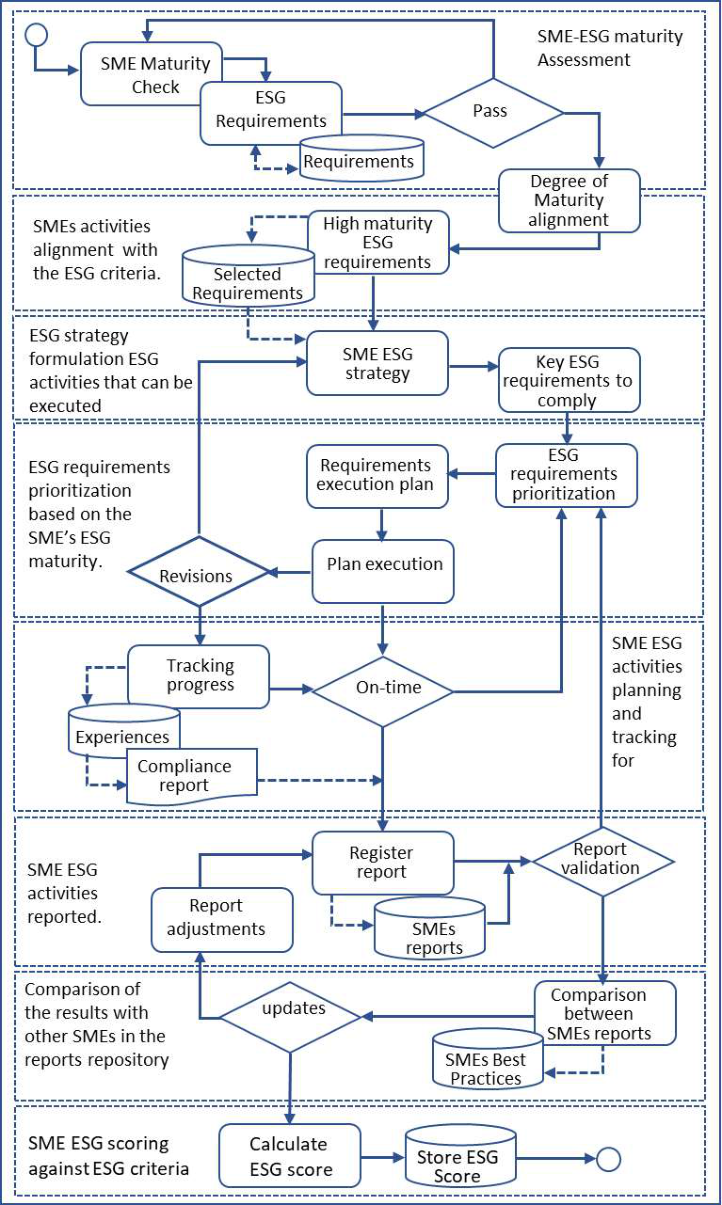
AN ESG-SMES DECISION SUPPORT SYSTEM ARCHITECTURE The architecture of the proposed ESG-SME decision support system is stru- ctured around 8 core components. These are: 1. The assessment tool of the ESG maturity, 2. The alignment of the SMEs activities on the ESG criteria. 3. The ESG strategy formulation with the ESG activities that can be executed 4. The prioritization of the ESG activities based on the SME’s ESG maturity. 5. The planning and tracking of the ESG activities. 6. The reporting process of ESG activities executed. 7. The comparison of the results with other SMEs in the results repository. 8. The ESG score received by the SME and the compa- rison of the SME with other SMEs. Figure 2 presents a high-level architecture of the proposed technology emphasizing on the 8 core components.
The first five components are executed serially while the last three com- ponents run in parallel to provide support from the SME’s best practices database, the dynamic reporting of the ESG activities and the calculation of
Figure 2: High level architecture of the ESG-SME Decision Support System.
A Decision Support System Architecture for the Development and Implementation 913
the ESG score. The first two components can be executed independently and per case, as a self-assessment tool, without the need for the SME to execute any other component.
LIMITATIONS AND AREAS OF FURTHER RESEACH The architecture of the proposed ESG-SME Decision Support System is based on an expert system whose rules need validation with extensive test runs to optimize the inference engine that triggers the execution order of the rules. Furthermore, the knowledge base needs data from SMEs across the world, industries, sizes, and operations models. As the definition of the SMEs covers companies from 5 to 250 employees and revenues from 50.000 to 50 million, the ability for an SME to adopt an ESG strategy varies significantly.
This research intends to further study such limitations, improve the design of the technology to address ESG adaptation challenges, and democratize the ESG concept (Markopoulos et al, 2020b). Such an approach requires run- ning the proposed technology in organizational cultures that can utilize their human intellectual capital (Markopoulos and Vanharanta, 2014), as green fuel (Markopoulos et al, 2020c), for their business transformation efforts to reach Green Oceans strategies (Markopoulos et al, 2020d) with sustainable innovation and Pink Ocean strategies with social innovation (Markopoulos et al., 2020e).
CONCLUSION
While SMEs form the backbone of every economy, they seem to be excluded from the ESG index losing the benefits larger organizations and MNEs enjoy. This paper presented an indicative set of ESG requirements to introduce the effort and depth of activities needed from an organization to score on the index. It also presented a wide range of software technologies supporting organizations adopt the ESG requirements and report the results. However, none of the existing ESG reporting technologies target the SMEs, leaving them with no technological support to report their ESG activities, develop a strategy around them and prioritize their actions that will bring them close to an ESG score. This need has been verified with the results of the primary research in which 16 directors of SMEs participated.
The results of the primary and secondary research on both the ESG requi- rements and the existing ESG software technology created the need for the introduction of a decision support system design that guides SMEs on the prioritization of the ESG requirements, the formation of the strategy and the mapping their operations against the ESG criteria. Such a system, with the relevant enhancements, presented in this paper can be a useful tool for the SMEs to report their ESG performance.
The goal of this research is to indicate that SMEs can and should be awarded ESG scores as well. The proposed technology can direct SMEs tow- ards ESG compliance, and report their achievements and contributions to help them attract the investments needed to keep on delivering a greater contribution to the local and international economy and society.
ACKNOWLEDGMENT
The authors would like to acknowledge Zayed University in the United Arab Emirates as this research leading to these results has received funding from Zayed University in the frame of the program “Research Incentive Fund” under the Grant agreement number 20133.
REFERENCES
Enablon (2022). Wolters Kluver, Enblon website: https://www.wolterskluwer. com/en/solutions/enablon European Commission (2022). Internal Market, Industry, Entrepreneurship and SMEs https://single-market-economy.ec.europa.eu/smes/sme-definition_en Financial Times (2022). Lies, damned lies and ESG rating methodologies. FT
Website: https://www.ft.com/content/2e49171b-a018-3c3b-b66b-81fd7a170ab5 Hicks, C. (June 28, 2018). How ESG Investing Increases Risk-Adjusted Returns.
The US News website: https://money.usnews.com/investing/investing-101/articles/ 2018-06-28/how-esg-investing-increases-risk-adjusted-returns Markopoulos E, Vanharanta. (2014). ‘Democratic Culture Paradigm for Organizational Management and Leadership Strategies - The Company Democracy Model.’ In: Charytonowicz J. (ed) Advances in Human Factors and Sustainable Infrastru- cture. 5th International Conference on Applied Human Factors and Ergonomics. vol 20. pp 190-201 Markopoulos E., Gann E.L., Kirane I.S., Vanharanta H. (2020c) Green Capitalism:
Democratizing Sustainable Innovation by Recycling Intellectual Capital Energy. In: Ahram T., Taiar R., Gremeaux-Bader V., Aminian K. (eds) Human Intera- ction, Emerging Technologies and Future Applications II. IHIET 2020. Advances in Intelligent Systems and Computing, pp. 507–519. vol. 1152. Springer. Markopoulos E., Kirane I. S., Gann E.L., Vanharanta H. (2020a) A Democratic, Green Ocean Management Framework for Environmental, Social and Gover- nance (ESG) Compliance. In: Ahram T., Taiar R., Gremeaux-Bader V., Ami- nian K. (eds) Human Interaction, Emerging Technologies and Future Applicati- ons II. IHIET 2020. Advances in Intelligent Systems and Computing. pp. 21–33, vol. 1152. Springer. Markopoulos E., Kirane I.S., Gann E.L., Vanharanta H. (2020b) A Democratic,
Green Ocean Management Framework for Environmental, Social and Gover- nance (ESG) Compliance. In: Ahram T., Taiar R., Gremeaux-Bader V., Ami- nian K. (eds) Human Interaction, Emerging Technologies and Future Applicati- ons II. IHIET 2020. Advances in Intelligent Systems and Computing. pp. 21–33, vol 1152. Springer. Markopoulos E., Kirane I.S., Piper C., Vanharanta H. (2020d) Green Ocean Strategy: Democratizing Business Knowledge for Sustainable Growth. In: Ahram T., Karwowski W., Pickl S., Taiar R. (eds) Human Systems Engineering and Design II. IHSED 2019. Advances in Intelligent Systems and Computing, chapter 20, pp. 115–125. vol. 1026. Springer. Markopoulos E., Ramonda M.B., Winter L.M.C., Al Katheeri H., Vanharanta H.
(2020e) Pink Ocean Strategy: Democratizing Business Knowledge for Social Gro- wth and Innovation. In: Markopoulos E., Goonetilleke R., Ho A., Luximon Y. (eds) Advances in Creativity, Innovation, Entrepreneurship and Communica- tion of Design. AHFE 2020. Advances in Intelligent Systems and Computing, pp. 39-51, vol 1218. Springer.
A Decision Support System Architecture for the Development and Implementation 915
Markopoulos E., Staggl A., Gann E.L., Vanharanta H. (2021) Beyond Corporate Social Responsibility (CSR): Democratizing CSR Towards Environmental, Social and Governance Compliance. Advances in Creativity, Innovation, Entrepreneur- ship and Communication of Design. AHFE 2021. Lecture Notes in Networks and Systems, vol 276, pp 94–103. Springer. Metrio (2022). Metrio Sustainability Software. Metrio website: https://www.metrio.
cn/content/dam/marketing/en_us/documents/fact-sheets/esg-scores-fact-sheet.pdf Refinitiv (2022b). Environmental, social and governance scores from Refi- nitiv. https://www.refinitiv.com/content/dam/marketing/en_us/documents/ methodology/refinitiv-esg-scores-methodology.pdf?elqCampaignId=14314 Rollenhagen. L. (2022). Know about ESG Investing. Wealthsimple website: https:// www.wealthsimple.com/en-us/learn/esg-investing#pros_of_esg_investing US/SIF (2018). Sustainable investing assets reach $12 trillion as reported by the
US SIF Foundation’s biennial Report on US Sustainable, Responsible and Impact Investing Trends. https://www.ussif.org/files/US%20SIF%20Trends%20Report% 202018%20Release.pdf
LISTED IN THE AHFE DIGITAL BOOKSTORE CATALOGUE
Explore the complete digital volume
Intelligent Human Systems Integration (IHSI 2023): Integrating People and Intelligent Systems
Read this individual research paper free through the original publisher, or explore the full digital proceedings book.
ISBN 978-1-958651-45-2
Explore this ISBN in the AHFE Bookstore ↗Listed in the July 2026 bookstore catalogue; search by ISBN to confirm current availability · Digital book purchase optional