Evangelos Markopoulos, Alisia Jordanou, Hannu Vanharanta (2023). Merging the Holacracy and the Company Democracy Models into a new disruptive and intellectual capital driven Human Resource Management methodology. In: Human Factors in Management and Leadership. AHFE Open Access, vol. 92, pp. 39–48. https://doi.org/10.54941/ahfe1003732
Human resources management (HRM) has been evolved over the years into a dynamic scientific discipline extending the concept to new frontiers beyond its initial administrative and career development purposes. Modern HRM involves advance technology such as Artificial Intelligence Expert and Fuzzy Systems, Cognitive and Behavioural Science and Technologies, Futuristic Interactive Technologies such a Metaverse, and advanced management and leadership theories related to dynamic and non-hierarchical organizational structures and cultures for the identification of the capability and the maturity of each individual, and the transformation of their skills and competencies into human intellectual capital for effective operations, productivity and corporate innovation. Such advancements in HRM must take into consideration the mental state of an employee and the employer as well, at a given situation, circumstances, operations and organizational strategy. Humans perform best, and develop themselves even better under participative and democratic management and leadership plans where opportunities are offered, and their efforts are practically recognised. On the other hand, the degree of democracy and participation needed can be questioned, forming a challenging issue to be solved. The dilemma between productivity and wellbeing becomes stronger over the years in the western world and this is where advanced technologies and management theories are introduced and integrated to better understand human beings and identify their intellectual capital, that can maximize the efficiency and productivity potentiality. This paper addresses this modern HRM challenge by comparing and contrasting the American Holacracy Model with the Nordic Company Democracy Model, two management models, from two different management schools, whose operations directly impact human resource management in terms of staffing, promoting, and career development. The Holacracy model approaches the modern HRM challenge mostly from a direct and short terms operations productivity goals while the company Democracy model approaches the same challenges from an indirect and longer term operations productivity goals. The first model relies more on participative management and leadership while the second on democratic management and leadership. They both utilize human intellectual capital with different methods and for different purposes which at the end identify the capability and maturity of each employee to correspond at dynamic organizational strategies lead from different perspectives and management philosophies. The degree and the effectiveness of the human resources responsiveness indicates the employees and managers that can perform best under each model, the career development activities to be adopted, and the career path that can be followed within the organization. The novel contribution of this paper extends beyond the comparison of the Holacracy and the Company Democracy models from the HRM perspective, but attempts to integrate the operations and philosophy of the two models with the introduction of a new and disruptive model where Holacracy operates within the Company Democracy Model. Such an approach maximizes the benefits of the two models, creates a new dynamic leadership and management type, and introduces a new organizational culture in which everyone can find the right place to perform best, evolve within the organization, and utilize their human intellectual capital which, in both models, is the driving force for efficiency, productivity, personal and organizational development.The research conducted for this paper is based on an extensive literature review, primary research with surveys and interviews but also with the analysis of case studies to indicate the need for the critically analyse the two models and set the base for the proposed integrated model. Furthermore, the paper presents the pre and post-condition for adopting the new model, highlights research limitations, and identifies areas of further research to be conducted for the optimization of the new model and its contribution to the global economy and society.
Human Resources Management (HRM) has evolved over the years into a dynamic scientific discipline extending the concept to new frontiers beyond its initial administrative and career development purposes. Modern HRM involves advanced technology such as Artificial Intelligence Expert and Fuzzy
Systems, Cognitive and Behavioral Science and Technologies, Futuristics Interactive Technologies such as Metaverse, and advanced management and leadership theories related to dynamic and non-hierarchical organizational structures and cultures for the identification of the capability and the maturity of each individual, and the transformation of their skills and competencies into human intellectual capital for effective operations, productivity, and corporate innovation.
Such advancements in HRM must take into consideration the men- tal state of an employee and the employer as well, in a given situation, circumstances, operations, and organizational strategy. Humans perform best, and develop themselves even better, within participative and demo- cratic management and leadership plans cultures where opportunities are offered for their efforts to be practically recognized. On the other hand, the degree of democracy and participation needed in such cases can be questioned, forming a challenging issue to be solved. The dilemma betw- een productivity and well-being becomes stronger over the years in the western world and this is where advanced technologies and management theories are introduced and integrated to better understand human beings and identify their intellectual capital, that can maximize their efficiency and productivity.
LITERATURE REVIEW. ADVANCES IN HRM HRM has a central role in driving optimistic employee attitudes, company performance (Delaney & Huselid, 1996; Huselid, 1995), and sustaina- ble competitive advantage. In this sense, numerous operationalizations and definitions of HRM are in store, including individual practices such as training and development of employees, talent acquisition, employee sele- ction, succession planning, performance appraisals, and the sets (HRM systems), which consist of a combination of practices (Stahl et al., 2020). It should also be noted that there can be both formal and informal HRM systems and procedures, depending on the connected channels, whether the tasks incorporated are regularized or not, and varying in their importance (Van Lancker et al., 2022). Nonetheless, the triangle of organizational per- formance, HR practices, and employee outcomes define the body of the HRM implementation processes, including the managers’ responsibility, as well as the employees’ perception regarding the system. Their attributions about the reasons their company pursues specific HR-related practices can be critical for the organization’s consequences and antecedents (Sanders, 2021). Engagement in Corporate Social Responsibility (CSR) and Corporate Sustainability (CS) are some of the hottest topics currently within the HRM sphere, as there is an emphasis on addressing the alignment of activities with the expectations and needs of the stakeholders and on tackling the biosph- ere’s critical challenges (Stahl et al., 2020). Incorporating HRM strategies and practices that have as a focal point the theme of sustainability; sustai- nable HRM encourages the achievement of social, ecological, and financial
Merging the Holacracy and the Company Democracy Models 41
standards, that impact both the micro and the macro environment of an orga- nization, within a long-term time frame (Stahl et al., 2020). Consequently, CS/CSR initiatives are delivered, directing and re-purposing the organizati- onal strategy and objectives, thus achieving optimal results in the sense of corporate sustainability. Regrettably, the HRM departments and specialists are not currently recognized as influencing bodies regarding CS/CSR strate- gies (Stahl et al., 2020). The Company Democracy Model and the Holocracy frameworks can cultivate an organizational system, with different practices, in which such issues can gradually vanish. HRM could play a vital role in the design and implementation of such strategies, including ethics frameworks, while also integrating the stakeholder perspective within the construct of the HRM performance, aligned with the wider organizational community (Stahl et al., 2020).
In 2020, Stahl, Brewster, Collings and Hajro published the “multi- stakeholder, multidimensional approach to HRM”, suggesting a multidi- mensional HRM performance model, that assesses a firm’s HRM structure potential to mitigate the negative and increase the positive outcomes, regar- ding the environmental, social, and economic domains. Such a framework encompasses actions aiming to contribute to positive outcomes for the peo- ple, the planet, and the prosperity; the triple bottom line, avoiding destructive consequences for stakeholders (Stahl et al., 2020).
Ultimately, most Corporate Social Responsibility (CSR) strategies have an internal compound that covers the patterns of how employees within their organizations are treated, as well as the external element, which focuses on covering the expectations and needs of the external stakeholders (Stahl et al., 2020). Therefore, HRM has in fact a strategic position, which when integra- ted effectively by the companies, can enhance the strategic objectives set, by encouraging employee participation and commitment to initiatives, incorpo- rating CSR principles into current HRM processes, and fostering stakeholder coherence (Stahl et al., 2020). On the practical aspect, the utilization of the Company Democracy and Holocracy models provides fruitful tactics and solutions into how such a core department can be established dynamically within its environmental context.
Emphasizing the aspect of HRM as a strategic organizational component, strategic agility is needed to utilize human resources within the entire cor- porate sphere. Specifically, the term agility has been defined as the power to revive or reassess the organization’s strategy in a dynamic manner, conside- ring the rapid fluctuations arriving from the external business environment (Doz & Kosonen, 2008). It is essential to identify the growing intensity and variety of dynamic sources that constantly change within the context of con- temporary businesses, and create a strong need for strategic agility, to address the growing challenges and opportunities through constant but incremental adjustments (Ahammad et al., 2020).
THE HOLACRACY MODEL Undisputedly, organizations face considerable new hurdles in the post- industrial age, including growing complexity, improved transparency, more
interconnection, and shorter time horizons. Shifting from the current tradi- tional hierarchies to a more flexible model that supports a sense of agility and flexibility is crucial. Organizations are expected to implement a certain number of changes to make a direction towards such a transition, which can provide a strong safety layer from these and many more challenges (HolacracyOne, 2015).
“Holacracy” as a term represents the “holarchy” concept, invented by Arthur Koestler. The term derives from the Greeks words Hola (óλα) meaning ‘everything’ and Crato meaning ‘holding’ or ‘governance’ when in manage- ment. This translates into ‘everyone’s governance’, or the ‘governance from all’. Holarchies equally value independence and teamwork at every stage involving the entire organization in a new mental management approach. The model signifies the way nature arranges itself, just like an organ within a body that has a critical role in providing vital functions in cooperation with the rest.
In Holacracy dynamic roles replace static job descriptions, distribu- ted authority replaces delegated authority, rapid iterations replace big re- organizations and transparent rules replace office politics, The model sub- stitutes the conventional pyramid-shaped organizational hierarchy with a holarchical structure and provides a new “social technology”(HolacracyOne, 2015). Within Holacracy organizations operate by distributing power and promoting self-organization and flexibility with procedures and regula- tions that govern agile team composition and business functionality. Its discrete top-down leadership helps quick reactions to opportunities or con- flict resolutions, at every level and keeps everyone aligned and focused on their targets when managing complexities or delivering business operations. (HolacracyOne, 2015).
Holacracy focuses on a constitution that formally redistributes power and lays out the rules and policies, powered by a disruptive approach to defining and updating roles scopes, and responsibilities. Roles are organized around a particular function, such as a support function, a department, a business unit, or a group working on a particular project. This function is a Holacratic circle. Team members, within the circle, can bring up conflicts, responsi- bilities, decision-making authority, and expectations of one another during governance meetings. Consequently, this holistic mechanism promotes auto- nomy and the authority to govern itself, while simultaneously communicating with other systemically related Holacratic circles.
All these approaches affect the way the HRM operates. Since an organi- zation operates with functional circles, a great dilemma arises on whether there will be succession planning incorporated within the business after the gradual installation of the model. The HR strategists play a crucial role in helping employees adjust to the new agile and flexible culture by incor- porating a set of policies, habits, and detailed training. Inevitably, such a case demands change management, re-direction of the strategic obje- ctives, and re-evaluation of the company’s values, otherwise, the change procedures towards a holacratic model will remain stagnant (Stahl et al., 2020).
Merging the Holacracy and the Company Democracy Models 43
THE COMPANY DEMOCRACY MODEL The term Democracy revolves around the philosophy that places the human being at the center of organizational development. It promotes ethos and knowledge, as well as other traits to foster a knowledge-based organizational culture and support leadership and innovation that leads to competitiveness and extroversion (Markopoulos & Vanharanta, 2014a).
The Company Democracy Model is defined as a holistic knowledge mana- gement model that can be applied to any type of organization, of any size, and in any industry. It is an applied philosophy model based on the mode- sty and wisdom of the Delphic maxims, but mostly on the principle that all people are created equal and therefore all people can think and contri- bute valuable knowledge if a democratic environment is in place to promote and protect their freedom for justified speech (Vanharanta and Markopoulos, 2018). Individuals operating in such a system develop self-awareness, self- control, commitment, motivation, cognitive capacity, competence, and social skills necessary for the creation, perception, and accurate interpretation and implementation of knowledge contributions (Markopoulos & Vanharanta, 2014b). The Company Democracy Model has been organized into six levels knowledge-related rather than process-related, therefore moving up the levels depends solely on the maturity evolution of a particular knowledge contribution (Markopoulos & Vanharanta, 2015).
The first level establishes the freedom of speech with knowledge contri- butions; the second level supports those contributions to mature by offering expertise and resources; the third level develops knowledge the matures kno- wledge contributions into actual products and services; the fourth level selects the most successful outputs of level three and explores their innovative cha- racteristics; the fifth level builds a competitiveness strategy based on the innovations of level four; and the sixth level uses the competitiveness of level five to achieve extroversion and internationalization (Markopoulos & Vanharanta, 2022a).
Every knowledge contribution ignites a Company Democracy pyramid. Each employee can start one or more pyramids, but the development of each pyramid is based on the quality of output obtained from each level. In case, for example, that knowledge is poor in validity, quality, and rationale no pyramid can be constructed, and for that employee, the process ends at the first level (Markopoulos & Vanharanta, 2022b). When constructing these pyramids, employees collaborate with the organization on mutual benefit to progress from one level to the next, however not all pyramids can achi- eve the final level, but those that will be considered a significant success for both the individual who started the process with a knowledge contribution and the organization who supported it.
Organizational HRM systems and processes are massively affected by the implementation of the Company Democracy Model. The integration of a new culture that promotes critical thinking, collective effort, respect, and collaboration is crucial for democratic organizations’ cultures to be establi- shed, otherwise, democracy can soon turn into anarchy. Therefore, prior to
applying such novel practices, HR leaders need to conduct studies to draw conclusions on where the company is currently standing in regard to the desi- red democratic levels it intends to achieve. Certain communication channels are expected to be integrated to reinforce the message and objectives effecti- vely, while training and development programs are essential in influencing employees (Stahl et al., 2020).
RESEARCH RESULTS AND GAP Primary research was conducted for this work using a survey with the par- ticipation of postgraduate students taught the Holacracy and the Company Democracy model. 7 interviews were also conducted with industry profes- sionals from the financial, technology, consulting, and shipping sector. The 412 survey responses indicated both the CDM and the Holacracy impact HR management, however, an integration process that could have made this practical is missing. There was not a clear understanding of if and how the two models can be integrated to provide a more holistic and novel HRM methodology.
Similar responses were obtained from the interviews with mixed feelings. The shipping professionals were more towards a Holocratic HRM approach as ships are small floating societies where everyone must do everything when needed. On the other hand, the finance, technology, and consulting services professionals had a more liberal approach toward knowledge creation and sharing with the CDM to be preferable. This indicates that each model seems to be industry sensitive. Holacracy is in favor of critical operations industries where each employee must be able to get out for the designated role if needed to contribute anywhere in periods of urgency or crisis. Such industries can be shipping, construction, and health, among others. On the other hand, CDM seems to be in favor of industries with the privilege to develop long mid to long-term planning for which knowledge contributions are expected from all, but also time and funding are available for the maturity of those contributions and their transformation into innovations.
Based on the above, a research gap can be identified on how these two models that seem to be far apart can be integrated and co-exist within one novel HRM model.
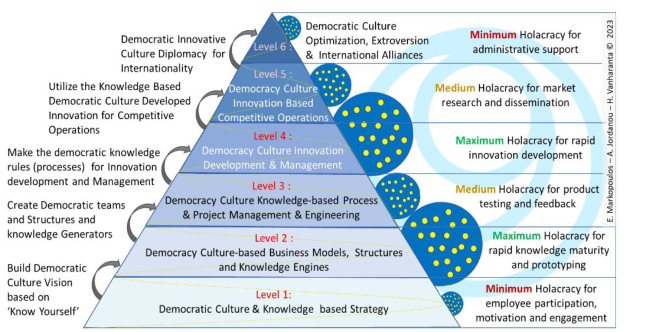
THE HOLACRATIC COMPANY DEMOCRACY The Holacracy and the Company Democracy Model represent two different management and leadership philosophies. Their integration cannot easily be achieved if the goal is to merge their processes and practices to generate a new management model. Since CDM needs time and patience for a knowledge contribution to move from one level to the next the Holacratic principles of speed and agility are violated. This on the other hand does not mean that the advantages of Holacracy cannot be used in CDM, but for this to happen, one approach can be to apply Holacratic management at specific CDM levels. A Holacratic Company Democracy is presented in Figure 1. Holacracy is embedded in the CDM levels that require agility and faster
Merging the Holacracy and the Company Democracy Models 45
Figure 1: The holacratic company democracy model.
response to maintain the competitive advantage innovative ideas can offer to an organization.
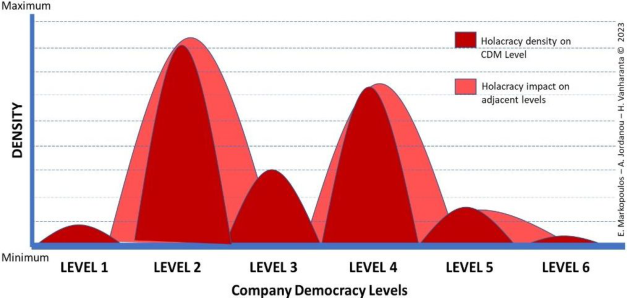
CDM level 1 for example cannot stand the pressure and speed Holacracy brings. Employees need time to think, rethink and reconsider before fin- ding the courage and confidence to open and share knowledge contributions. Level 2, however, where the best ideas are promoted for further thinking and maturity can apply Holacracy on the support team created to work on the development of the preliminary business plan and the working pro- totype. In this case, whoever in the organization has skills that match the specific project from a Holacratic cycle in which knowledge gets matured faster. The members composing this cycle have long or short time involvement based on the expertise of the team. Therefore, Holacracy fits well on CDM level 2.
CDM level 3 works on the evolution of the working prototype into an internal or external product or service based on its innovative characteristics time might matter. For this reason, and for the need of wide expertise nee- ded to test the new product/service faster in the market Holacracy can be applied in the development process, but in a less intensive way than level 2 as specific test quality processes must be applied. The market or the organi- zation’s response is what moves CDM knowledge from level 3 to level 4. If the client’s or user’s response indicates a promising market space, then level 4 is ignited to further develop the competencies of the developed product and turn it into innovation. This is where Holacracy can also be applied. The time to turn a promising product/service into an innovation is critical as it has been exposed in the market and can be copied sooner than expe- cted. Therefore, speed matters and to achieve speed fast rotation of experts is needed.
CDM levels 5 and 6 are more strategically oriented and the less Holacracy is used the better it is. The development of an aggressive mar- keting strategy based on the innovative competencies of the product/se- rvice can be supported by market research teams with diverse backgrounds
Figure 2: Holacracy strength/impact on each company democracy model level.
and skills, but this does not really require Holacracy. Same for level 6 where extroversion, internationalization, and strategic alliances are made. This is a purely strategic level and Holacracy shall be kept at minimum levels.
Figure 2 presents the intensity of Holacracy per CDM level with minimum strength in levels 1 and 6, medium strength in levels 2 and 4 high strength in levels 3 and 3.
HOLACRATIC CDM IMPACT ON HRM HRM is a continuously evolving discipline, open and ready to adopt any innovation that can improve organizational performance. From the early years of the concept until today, HRM has had a key role in the ope- rations and the strategies organizations design and execute. CDM is a concept that extends beyond knowledge and innovation management as it is based on the development of organizational cultures that enable human intellectual capital to be generated. The dynamic Holacracy on the other hand emphasizes human capital production with continuous and short-term agile performance teaming. The two models represent two different scho- ols of HRM. CDM sets ‘thinking’ as the key practice, while Holacracy sets ‘doing’.
The combination of the CDM and Holacracy, as indicated in this paper, complements and optimizes the operations and purpose of both models and distributers’ work commitments and expectations based on the stage (level) at which a business operation exists. The Holacratic-CDM identifies the emplo- yees who can think but also act, who can lead but also lead, who can plan but also commit, and who can share but also be shared. It is a continu- ous but controlled effort for progress, excellence, and career development, providing agility, creativity, and commitment for organizations to adopt non- hierarchical organizational structures and compete in a demanding business environment.
Merging the Holacracy and the Company Democracy Models 47
LIMITATIONS AND AREAS OF FURTHER RESEARCH The research presents a theoretical approach to the integration of the two models, and this might impact the expected results in case the proposed process is practically applied. Further research needs to be delivered on iden- tifying specific metrics that can measure the effectiveness degree of Holacracy at a CDM level. Such metrics can vary based on the type of innovation, the industry of the organization, the type and availability of human resources, and other factors related to expected deadlines in terms of time, quality, or delivery. Therefore, a case-based assessment tool can be used to adjust the degree of Holacracy in CDM for the best possible implementation.
Research also needs to be done on the direct impact of the Holacratic CDM in career development, how this new model can create new professional skills, and what type of professional development effort is needed,
CONCLUSION
Challenges arise constantly, therefore companies are expected to be able to respond immediately, by adjusting their organizational strategies, values, and culture in coordination HRM to identify how the employees can be affected, gather data and information internally, and provide relevant training and development techniques.
It should be noted that by the time an organization decides to implement the Democracy or Holocracy methods or the proposed Holacratic-CDM, the role of the HR department remains central to communicating the new way of working to the rest of the employees, setting up the working policies and the learning practices.
The novel contribution of this paper extends beyond the comparison of the Holacracy and the Company Democracy models from the HRM perspective but attempts to integrate the operations and philosophy of the two models with the introduction of a new and disruptive model where Holacracy opera- tes within the Company Democracy Model. The degree and the effectiveness of the human resources responsiveness indicate the employees and managers that can perform best under each model, the career development activities to be adopted, and the career path that can be followed within the organization. Such an approach maximizes the benefits of the two models, creates a new dynamic leadership and management type, and introduces a new organizatio- nal culture in which everyone can find the right place to perform best, evolve within the organization, and utilize their human intellectual capital which, in both models, is the driving force for efficiency, productivity, personal and organizational development.
REFERENCES
Ahammad, M. F., Glaister, K. W. and Gomes, E., (2020). Strategic agility and human resource management. Human Resource Management Review, 30(1), p. 100700. Delaney, J.T.and Huselid, M.A., 1(996). The impact of human resource management
practices on perceptions of organizational performance. Academy of Management journal, 39(4), pp. 949–969.
Doz, Y. and Kosonen, M., (2008). The dynamics of strategic agility: Nokia’s rollercoaster experience. California management review, 50(3), pp. 95–118. HolacracyOne, L. L. C., 2015. Holacracy-Discover a Better Way of Working.
Website: squarespace.com. Huselid, M. A., (1995). The impact of human resource management practices on turnover, productivity, and corporate financial performance. Academy of management journal, 38(3), pp. 635–672. Markopoulos E and Vanharanta H. (2022a). The Company Democracy Model.
Creating Innovative Democratic Work Cultures for Effective Organizational Knowledge-Based Management and Leadership. 2021. Routledge. Taylor & Francis Group. Chapter 12. ISBN 9780367745622. Markopoulos E and Vanharanta H. (2022b). The Company Democracy Model.
Creating Innovative Democratic Work Cultures for Effective Organizational Knowledge-Based Management and Leadership. 2021. Routledge. Taylor & Francis Group. Chapter 13. ISBN 9780367745622. Markopoulos E, & Vanharanta H. (2014a). ‘Democratic Culture Paradigm for Organizational Management and Leadership Strategies - The Company Democracy Model.’ In: Charytonowicz J. (ed) Advances in Human Factors and Sustaina- ble Infrastructure. 5th International Conference on Applied Human Factors and Ergonomics. vol 20. pp. 190–201 (2014). Markopoulos E, & Vanharanta H. (2014b). ‘Human Perception, Interpretation,
Understanding and Communication of Company Democracy’ 14th International and interdisciplinary Conference of the Research Cooperation. European Cultu- res in Business and Corporate Communication (EUCO14), 23–25 October 2014, Turku, Finland Markopoulos E, & Vanharanta H. (2015). ‘Company Democracy Model for Development of Shared Value’, Elsevier, Procedia Manufacturing, Volume 3, Pages 603-610, 2015 Sanders, K., Guest, D. and Rodrigues, R., (2021). The role of HR attributions in the
HRM–Outcome relationship: Introduction to the special issue. Human Resource Management Journal, 31(3), pp. 694–703. Stahl, G. K., Brewster, C. J., Collings, D. G. and Hajro, A., (2020). Enhancing the role of human resource management in corporate sustainability and social responsibi- lity: A multi-stakeholder, multidimensional approach to HRM. Human Resource Management Review, 30(3), p. 100708. Van Lancker, E., Knockaert, M., Audenaert, M. and Cardon, M., (2022). HRM in
entrepreneurial firms: A systematic review and research agenda. Human Resource Management Review, 32(3), p.100850. Vanharanta H, & Markopoulos E. (2018) The applied philosophy concept for management and leadership objects through the Com- pany Democracy Model, Theoretical Issues in Ergonomics Science, 20:2, 178–195, DOI: 10.1080/1463922X.2018.1510060.
LISTED IN THE AHFE DIGITAL BOOKSTORE CATALOGUE
Explore the complete digital volume
Human Factors in Management and Leadership
Read this individual research paper free through the original publisher, or explore the full digital proceedings book.
ISBN 978-1-958651-68-1
Explore this ISBN in the AHFE Bookstore ↗Listed in the July 2026 bookstore catalogue; search by ISBN to confirm current availability · Digital book purchase optional