Evangelos Markopoulos, Jens Refflinghaus, Marven Roell, Hannu Vanharanta (2022). Understanding Situationality Using the Kepner-Tregoe Problem Solving Method in the Company Democracy Model to Increase Employee Engagement and Knowledge Contribution. In: Creativity, Innovation and Entrepreneurship. AHFE Open Access, vol. 31, pp. 196–207. https://doi.org/10.54941/ahfe1001522
Publisher statistics will load when you open Metrics.
AHFE OPEN ACCESS OPEN ACCESS CONFERENCE PROCEEDINGS PAPER
Understanding Situationality Using the Kepner-Tregoe Problem Solving Method in the Company Democracy Model to Increase Employee Engagement and Knowledge Contribution
Driving sustainable and successful change towards achieving democratic organizational culture a company has to evolve through the 6 levels of the Company Democracy Model which needs to be supported by two foundational and prerequisite enablers. The first one is the critical thinking skills to build an alignment on a meta-level / logic-level / thinking level for effective and efficient communication and actions. Effective actions and communication require clear thinking which requires thinking processes. The second one is the Change Management tools and skills to drive the change. However the integration and activation of these two enablers seem to be the challenge on the first level in the company democracy model who seeks critical thinking to become change agents. This paper integrates the concepts of critical thinking and change making with the introduction of the problem solving Kepner-Tregoe (KT) Method in the Company Democracy Model. Critical Thinking is approached as the applied thinking processes to gather, organize, analyse, confirm, and communicate information in order to solve concerns and issues in an effective, unbiased and self-reflected mode that first seeks to understand and then to act. Therefore, it is the prerequisite for effective and efficient actions. This necessary exchange of information can more targeted and effortless if achieved through a democratic organizational culture which equips each member in an organization with the same logic/thinking, to reveal their intellectual capital by focusing on how to think, not what to think. Effectively thinking requires understanding the concern and the situation that creates a need to act. The concept of situationality, as introduced in the Company Democracy Model (CDM) is further supported in this paper with the KT problem solving methods to identify the core nature of a specific situational concern that enables or disables people’s thinking. The paper defines and analyses the situational concerns which can be categorized in five areas such as understanding a situation, deviation cause, alternatives selection, risk reduction and change enhancement.The identification of the situationality helps finding a thinking approach which leads to an idea that is transformed into an innovative process, product or services. This can be considered a fundamental approach for effective and efficient actions within democratic organizational cultures. Furthermore change management lies in the capability to assess a situation in which people interact, understand the mechanics of the system that forms individual or groups behaviour, and develop activities to manage these mechanics that change human behaviour. Therefore, the challenge of the first level of the company democracy model which is understanding human behaviour is based on the effectiveness of critical thinking capabilities in a systematic human performance model. The elements of the performance environment influence the performance of any person. These elements operate as a system, influencing performance as it happens. The paper presents the five performance system core elements which deal with the environment infrastructures (processes, workflows, expectation and priority setting) the capabilities and willingness of the performer, the demonstrated or desired response/ behaviour, the consequences which follow the behaviour and the performance feedback given to the performer. The paper uses the Aristotelian golden mean to effectively balance this employee performance, and identity imbalances that feed the development of corrective actions and impact behavioural change.
Critical Thinking is approached as the applied thinking process to gather, organize, analyze, confirm, and communicate data & information to solve concerns and issues in a practical, unbiased and self-reflected mode that first seeks to understand and then act. Therefore, it is the prerequisite for effective and efficient actions. This necessary processing of data and information can be more targeted and efficient if achieved through a democratic organiza- tional culture that equips each member in an organization with the same logic/thinking to reveal their intellectual capital more efficiently and effe- ctively by focusing first on how to think, not what to think. Effective and
Understanding Situationality Using the Kepner-Tregoe Problem Solving Method 197
efficient thinking requires a holistic understanding of the concern and the situation that creates a need to act.
CRITICAL THINKING IN THE KEPNER-TREGOE PROBLEM-SOLVING METHOD Critical Thinking is approached as the applied thinking process to gather, organize, analyze, confirm, and communicate data & information to solve concerns and issues in a practical, unbiased, and self-reflected mode that first seeks to understand and then act. Therefore, it is the prerequisite for effective and efficient actions. This necessary processing of data and infor- mation can be more targeted and efficient if achieved through a democratic organizational culture that supports each member in an organization to use the same set of thinking processes to reveal their intellectual capital. This is achieved by learning and embedding the different thinking processes, which enable one to focus first on how to think, not what to think. Effective and efficient thinking requires a conscious effort and a holistic understanding of the concern and the situation that creates a need to act.
According to Richards (2005), a fundamental finding of cognitive psycho- logy is that people have no conscious experience of most of what happens in the human mind. Many functions associated with perception, memory, and information processing are conducted before and independently of any con- scious direction. What appears spontaneously in consciousness is the result of thinking, not the process of thinking. This links well with Kahneman (2011), who states that people generally rely on their intuition when making decisions and solving problems. In so doing, people rely on information, experiences, and conclusions they have realised to be somewhat true in the past. Intuition, as defined by Sinclair & Ashkanasy (2005) as a “non-sequential information- processing mode comprised of cognitive and affective elements, resulting in direct knowing without any use of conscious reasoning” and used by Kah- neman (2001) under the term “System 1” thinking works very quickly and well for simple tasks or situations. Encountering, however, a new, or different and rather complex task, using intuition delivers poorer results, as has been documented extensively in the Heuristics and Biases (HB) literature (Evans, 1989, 2007), (Gilovich, et al., 2002); (Kahneman & Tversky, 1973, 1996, 2000); (Over, 2004); (Tversky & Kahneman, 1974, 1983). In using their intuition, people unconsciously use their knowledge and experience of the past, failing to the degree that the demands of the new task do not correspond to and cannot be immediately satisfied by their established knowledge and experience. More than that, several cognitive biases and external influences, popularly referred to as “noise”(Kahneman, Sibony & Sunstein, 2021), nega- tively impact people’s thinking and reasoning abilities. Rather than exploring and explaining these biases and influences more in-depth, we aim to explain the Kepner-Tregoe (KT) thinking processes and how they can help improve critical thinking by offering methods and ways to tackle and keep these biases and influences at bay.
Critical thinking is defined by Halpern (2008) as the use of those cognitive skills or strategies that increase the probability of desirable outcomes. When
measuring critical thinking, nearly all measures used aim to assess the ability to reason without being too biased by prior opinions or beliefs that one holds (Ennis, et al., 1992), (Norris and Ennis, 1989), (Watson and Glaser, 1980).
With their strong focus on gathering and processing factual information, the KT processes help to minimize the influence of prior opinions and beliefs. They do so by offering guidelines on collecting, organizing, analyzing, confir- ming, and communicating information, and can be used by both individuals and teams.
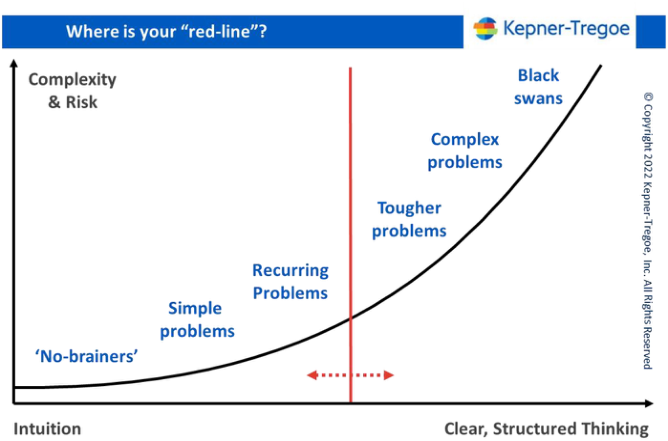
Critical thinking capabilities become relevant to the success of a busi- ness when the complexity exceeds the team’s thinking capabilities based on intuition and experience (See Figure 1).
Therefore, to master the complexity of a challenge ahead and reduce the risk of getting lost in ineffective activities, switching the thinking modus from intuition and experienced-based thinking to structured critical thinking is vital.
THE KEPNER-TREGOE EFFECTIVE THINKING FRAMEWORK The mother of all management questions is “how to be effective?”. Effective actions come from effective thinking. Unfortunately, effective thin- king needs thinking processes because our thinking is biased.
Effectiveness means to do the right things in the correct order at any given point in time. To do the right thing, one needs to understand the core nature of the need to act in a particular situation. In their research work in the 1950s, Dr. Charles Kepner and Dr. Benjamin Tregoe identified four fundamentally different needs to act:
Figure 1: Critical thinking in complexity management.
Understanding Situationality Using the Kepner-Tregoe Problem Solving Method 199
(1) Understand: what is going on?, (2) Find a cause to a deviation: why did this happen?, (3) Make a decision: Which course of action should we take? (4) Mitigate risks/enhance chances: What lies ahead?
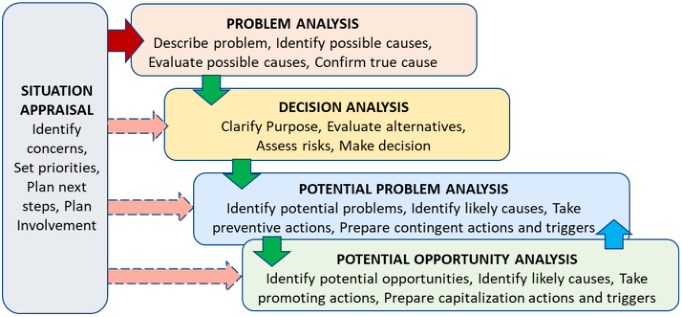
Different needs to act require different approaches to solve them effectively. The Kepner-Tregoe method builds a holistic framework for this (See Figure 2). For a start, asking the right questions in the correct order stimulates the collection of information needed to understand and subsequently solve a given situation/task. Subsequently, a solution is achieved by organizing the collected data & information in a certain way so as to enable conscious and deliberate analysis, which then delivers the resolution of the situation or task.
A foundation for effective teamwork in organizations can be laid by teach- ing people to use and visualize the four basic thinking processes consciously. These four basic thinking processes are reflected in their essence in the four questions people should ask themselves in every situation, irrespective of their job or role within the organization.
Situation Appraisal: What’s going on? Establishes clarification. It asks for sorting out and breaking down a key to the map of current events, a means of achieving and maintaining control. It reflects the pattern of thinking that enables us to impose order where there is chaos, uncertainty, or confusion. It allows us to establish priorities and decide when and how to take meaningful actions to produce high quality results.
Problem Analysis: Why did this happen? Addresses the need for efficient cause-and-effect thinking, the second basic thinking pattern. It is the pattern that enables us to move from observing the effect of a problem to understan- ding its cause so that we can take appropriate actions to correct the problem or lessen its effects.
Decision Analysis: Which course of action should we take? A choice must be made. This third basic thinking pattern enables us to decide on the path of action most likely to accomplish a particular outcome.
Potential Problem/Opportunity Analysis: What lies ahead and how should we prepare? Looks into the future. This fourth basic pattern of thinking ena- bles us to anticipate the problems & chances that might happen and makes
Figure 2: Kepner and Tregoe’s Method thinking foundations.
us think about the actions that might be necessary next month, next year, or in five years.
SITUATIONALITY IN THE COMPANY DEMOCRACY MODEL The Kepner-Tregoe method builds a holistic framework that enables peo- ple to understand their situation so as to think and act accordingly. In a sense, the method corresponds to the term of situationality introduced in the Company Democracy Model to create knowledge-based and shared value organizational cultures (Markopoulos and Vanharanta, 2015).
The Company Democracy Model provides a co-evolutionary development approach by creating an organizational democratic culture based on the orga- nizational knowledge, capability, and maturity to democratically deliver an organizational strategy (Markopoulos and Vanharanta, 2014a). The models are composed of six levels and supported with pre and post implementa- tion conditions that shape human perception, interpretation, understanding, and communication of the Company Democracy concept (Markopoulos and Vanharanta, 2014b).
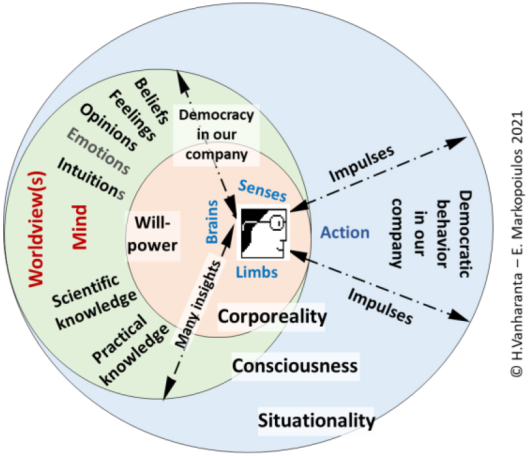
Situationality, corporeality, and consciousness form the Holistic Concept of a Man (Vanharanta, 1997). This metaphor is part of the Company Demo- cracy Model, helping people understand their company in a democratic context, meaning the degree of democracy in their company and how this democracy impacts their performance (See figure 3). Extending this view from the individual perspective to the collective, a new dimension is pro- jected of how people can have different concepts of their situation and how they handle these concepts so that they can explain their situation and also understand how these concepts build new meanings in their brains now and in the future.
Figure 3: Human mind pondering corporate democratic behavior.
Understanding Situationality Using the Kepner-Tregoe Problem Solving Method 201
Identifying situationality helps find a thinking approach that leads to an idea that is transformed into an innovative process, product, or service. This can be considered a fundamental approach for effective and efficient actions within democratic organizational cultures. Furthermore, knowledge manage- ment is based on the capability to assess a situation in which people interact, understand the system’s mechanisms that form individual or groups beha- vior, and develop activities to manage these mechanisms for human behavior change and knowledge delivery.
Knowledge-based shared mental models help individuals, but primarily teams, predict and plan reactions/behavior in any given situation, share ideas, and take responsibility for solving a challenge (Markopoulos and Vanharanta, 2018).
Therefore understanding situationality can be a critical individual or team thinking skill. Understanding the current situation in a corporate context enables people to communicate effectively and efficiently with each other, helping them share a similar language and share mental models or ways of how to process and deal with information in a specific situation.
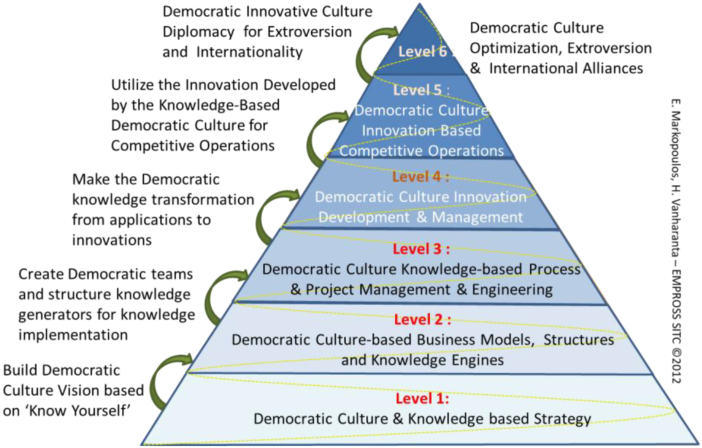
THE CREATIVITY AND SITUATIONALITY MANAGEMENT CHALLENGE IN THE CDM lEVEL 1 The six levels of the Company Democracy Model continuously generate organizational knowledge within a democratic organizational culture (See Figure 4). In brief, the first level encourages the employees of an organization to share any type of knowledge with the company. The knowledge that seems to be aligned with the interests and strategy of the organizations is moved to
Figure 4: The company democracy model.
the second level, where teams are created to verify its value with the develo- pment of prototype projects. Verified, valuable, and useful knowledge moves to the third level and is transformed into a product or service. Successful pro- ducts and services are supported with further investments at level four for the organizations to utilize their innovative characteristics. Levels five builds on the product/service competitiveness with aggressive marketing strategies, and level six moves the innovation internationally with strategic alliances and partnerships.
The model seems to follow a practical process flow; however, the signi- ficant challenge is on the first level. The degree of employee engagement is critical as this is what generated the knowledge utilized in the following levels. The Holistic concept of a Man metaphor used in the Company Democracy Models has siuationality as the outer circle and the main mental-physical requirement the company must fulfill. Employees need to understand the situations they and their company are into to start thinking, delivering, and sharing knowledge that can benefit all involved. The Company Democracy Model is a Delphic, Y-theory model based on the employee’s self-awareness to understand their situation and the opportunities offered (Markopoulos and Vanharanta 2016).
Therefore, the first level of the Company Democracy Model, which is understanding human behavior, is based on the effectiveness of critical thin- king capabilities in a systematic human performance model. The elements of the performance environment influence the performance of any person. These elements operate as a system, affecting performance as it happens.
EMPLOYEE PERFORMANCE AND ENGAGEMENT SYSTEM (EPES) Five performance system core elements are introduced to address the CDM Level 1 challenge and similar employee engagement and knowledge perfor- mance challenges. The elements deal with the environment infrastructures (processes, workflows, expectation, and priority setting), the performer’s capabilities and willingness, the demonstrated or desired response/behavior, the consequences that follow the behavior, and the performance feedback given to the performer.
Successful change initiatives that improve the engagement and perfor- mance of the employees are built on a behavior change approach that is hardwired to the situationality framework. Situationality in this context iden- tifies the drivers for change and the vision. It defines the current situation and maps the gaps to bridge for a successful transition. The method used here is the “Kepner-Tregoe Performance System”, also called “The Employee Performance and Engagement System” (EPES).
The Kepner-Tregoe Performance System was identified using scientific research into behavior. It follows a sociotechnical view of performance. The Performance System has been validated through research and application since its conception in the 1950s. It is a practical tool to help explain and pre- dict people’s performance. Therefore, it can be used for post-mortem as well as system design events, preparing a company to move towards the Company Democracy Model.
Understanding Situationality Using the Kepner-Tregoe Problem Solving Method 203
The components or elements of the performance environment influence the performance of any person. These components operate as a system, affecting performance as it happens, and they must be “in balance” for effe- ctive implementation. Changes in one element of the Performance System necessitate changes elsewhere in the system for the balance to be maintained. Performance can and should be managed by adjusting the Performance System components to create a supportive approach.
The Performers generally respond rationally and predictably to the perfor- mance environment. However, behavior is also influenced by other factors, e.g. free will, and is consequently not predetermined by the Performance System. The model is, therefore, probabilistic rather than deterministic. The Performance System exists and influences performance regardless of whe- ther it is recognized and managed. The performance will be affected by both formal and informal aspects of each Performance System component.
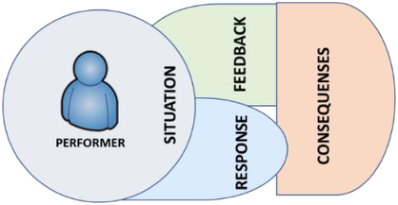
The Employee Performance and Engagement System (EPES) components are as follows: Situation, Performer, Response, Consequences, and Feedback (See Figure 5).
S (Situation): the immediate setting in which the performer works, inclu- ding (a) the performance expectations that need to be stated in a way to describe the future behavior of a performer, (b) the signals to perform the work, (c) the work environment.
P (Performer): the person or group expected to perform. What knowledge and skills does the performer need to perform?
R (Response): the specific, observable behavior(s) or action(s) of the per- former. On the route to becoming a CDM company, teams need to be engaged, committed, and willing to learn and share knowledge. The key is to break these general expectations down to observable behaviors. For example, what would a video show? What are the behaviors of an employee “being engaged”? This will develop the right level of detail for expectation setting and effective coaching. This is the main factor for successful change.
C (Consequences): the events that follow the response and increase or decrease the probability of the behavior occurring again, given the same situ- ation. Fb (Feedback): the performance-based information the performer recei- ves about progress toward a goal guides the performer in maintaining or modifying behavior.
Figure 5: Kepner-Tregoe: Employee performance and engagement system (EPES) components.
EMPLOYEE PERFORMANCE AND ENGAGEMENT SYSTEM METRICS The proposed employee performance and engagement system can measure its effectiveness with several metrics based on various parameters. Such as the employee’s expected behavior in a democratic corporate culture and the degree of influence the company has on the employees based on the type of change management model followed.
The company can also use a pinpointing approach by describing first what it wants to achieve and then what behaviors are required to create these outcomes. Table 1 presents an indicative set of metrics based on the EPES components.
Table 1. Employee performance and engagement system (EPES) indicative metrics – Kepner-Tregoe performance system.
Table available in the original PDF paper.
Metric Situation Have performance expectations, including measures, been established for the desired response? Have performance expectations been clarified with the performer? Does the performer agree that these expectations are attainable? Can the performer easily recognize the signal to perform? Is the input the performer receives appropriate, correct, and timely? Are job procedures and workflow effective? Have multiple or competing priorities been clarified? Are adequate resources: time, people, money, information, tools, or support equipment? Do the physical surroundings support effective performance? Have performance expectations, including measures, been established for the desired response? Performer & Response
Does the performer have the necessary knowledge and skill to perform? Does the performer know why the performance is expected? Is the performer well suited for the job? Consequences Are the Consequences immediate enough to encourage the desired response? Are appropriate Consequences provided consistently? Are the Consequences significant to the performer? On balance, do the Consequences encourage the desired performance? Feedback Are the Consequences immediate enough to encourage the desired response? Are appropriate Consequences provided consistently? Are the Consequences significant to the performer? On balance, do the Consequences encourage the desired performance? Are the Consequences immediate enough to encourage the desired response? Are appropriate Consequences provided consistently? Are the Consequences significant to the performer? On balance, do the Consequences encourage the desired performance?
Understanding Situationality Using the Kepner-Tregoe Problem Solving Method 205
LIMITATIONS AND AREAS OF FURTHER RESEARCH The three methods presented in this paper (CDM, KT Problem Solving & Decision Making, and EPES) and their integrations can be applied effecti- vely as they have been used individually in the past with successful results in all regions and cultures (Vahnaranta et al., 2018), (Einolander et al., 2018), but to do that must be supported and adopted by the leadership of the organizations. For example, the CDM is a leadership model, but the EPES needs to develop more leadership pre and post-condition to secure leadership engagement besides the employees engaged.
Another limitation is the time needed for the EPES to be adopted. The behavior and mindset change required takes time, and this is where the participation of the leadership is critical.
This work was the first attempt to integrate the KT problem-solving meth- ods with the Company Democracy model through the EPES. Democracy can turn into anarchy if not used properly. Therefore, it can create more problems than the ones intended to solve. Further research can be delivered on deve- loping a specific roadmap for applying the CDM-KT-EPES model that can help organizations adopt it easier. Furthermore, the metrics of the EPES can be linked with the CDM levels besides the EPES components. Lastly, appl- ying the model in a pilot organization will reveal strengths and weaknesses for further development and optimization.
CONCLUSION
Self-awareness, or ‘gnothi safton’, is a key Delphic maxim that can extend critical thinking, reasoning and learning from personal to organizational level. Organizational development is based on the continuous knowledge uti- lization and risk minimization. Both factors have the situation as common denominator. Situationality impacts the specific knowledge created under a specific instance, which impacts the risk of the actions taken based on this knowledge. Employees are the actors on a situation stage. The degree of their democratic engagement and motivation to understand their situationality, and their organization’s as well, determines the creation or the solution of organizational problems. This paper incorporated the Kepner-Tregoe pro- blem solving method in the first level of the Company Democracy Model, where employee engagement is crucial, by introducing an employee perfor- mance and engagement system. The results of this system will be reflected in all the other levels of the model.
REFERENCES
Czajkowski, K., Fitzgerald, S., Foster, I., Kesselman, C.: Grid Information Services for Distributed Resource Sharing. In: 10th IEEE International Symposium on High Performance Distributed Computing, pp. 181–184. IEEE Press, New York (2001) Einolander J., Kantola J., Vanharanta H., Markopoulos E. (2018) Safety Culture
and Collective Commitment in Organizational Context. In: Kantola J., Barath T., Nazir S. (eds) Advances in Human Factors, Business Management and Lea- dership. AHFE 2017. Advances in Intelligent Systems and Computing, vol. 594, pp. 148–159 Springer. DOI: https://doi.org/10.1007/978-3-319-60372-8_15
Ennis, R. H., Millman, J., & Tomko, T. N. (1985). Cornell Critical Thinking Tests.
Pacific Grove, CA: Midwest. Facione, P. (1992). California Critical Thinking Skills Test & California Critical Thinking Dispositions Inventory. La Cruz, CA: California Academic Press. Evans, J. St. B. T. (1989). Bias in human reasoning: Causes and consequences. Hove,
England: Erlbaum. Evans, J. St. B. T. (2007). Hypothetical thinking: Dual processes in reasoning and judgment. New York: Psychology Press. Ennis, R. H., Millman, J., & Tomko, T. N. (1985). Cornell Critical Thinking Tests.
Pacific Grove, CA: Midwest. Foster, I., Kesselman, C.: The Grid: Blueprint for a New Computing Infrastructure.
Morgan Kaufmann, San Francisco (1999) Foster, I., Kesselman, C., Nick, J., Tuecke, S.: The Physiology of the Grid: An Open Grid Services Architecture for Distributed Systems Integration. Technical report, Global Grid Forum (2002) Gilovich, T., Griffin, D., & Kahneman, D. (Eds.). (2002). Heuristics and biases: The
psychology of intuitive judgment. New York: Cambridge University Press. Halpern, D. (2008). Halpern critical thinking assessment: Background and scoring standards. Unpublished manuscript, Claremont McKenna College, CA. Kahneman, D. (2011). Thinking, fast and slow. Springer-Verlag Berlin Heidelberg
2013 Kahneman, D., Sibony, O., & Sunstein, C. R. (2021). Noise: a flaw in human judgment. First edition. New York: Little, Brown Spark. Kahneman, D., & Tversky, A. (1973). On the psychology of prediction. Psychological
Review, 80, 237–251. Kahneman, D., & Tversky, A. (1996). On the reality of cognitive illusions.
Psychological Review, 103, 582–591. Kahneman, D., & Tversky, A. (Eds.) (2000). Choices, value, and frames. New York: Cambridge University Press. Markopoulos E., Vanharanta H., (2015). ‘Company Democracy Model for Deve-
lopment of Shared Value’, Elsevier, Procedia Manufacturing, Volume 3, Pages pp. 603–610, 2015 Markopoulos E. and Vanharanta H. (2014a). ‘Democratic Culture Paradigm for Organizational Management and Leadership Strategies - The Company Demo- cracy Model.’ In: Charytonowicz J. (ed) Advances in Human Factors and Sustai- nable Infrastructure. 5th International Conference on Applied Human Factors and Ergonomics. vol. 20, pp. 190–201 (2014) Markopoulos E., Vanharanta H.. (2014b). ‘Human Perception, Interpretation,
Understanding and Communication of Company Democracy’ 14th International and interdisciplinary Conference of the Research Cooperation. European Cultu- res in Business and Corporate Communication (EUCO14), 23–25 October 2014, Turku, Finland Markopoulos E., Vanharanta H. (2018). Project teaming in a democratic company context. Theoretical Issues in Ergonomics Science, 19:6, pp. 673–691. Markopoulos E., Vanharanta H. (2016) Delphic Maxims Based Applied Philosophy
for Business and Governance Management. In: Kantola J., Barath T., Nazir S., Andre T. (eds) Advances in Human Factors, Business Management, Training and Education. Advances in Intelligent Systems and Computing, vol. 498, pp. 33–45. Springer, Springer. DOI: https://doi.org/10.1007/978-3-319-42070-7_4
Understanding Situationality Using the Kepner-Tregoe Problem Solving Method 207
May, P., Ehrlich, H.C., Steinke, T.: ZIB Structure Prediction Pipeline: Composing a Complex Biological Workflow through Web Services. In: Nagel, W.E., Walter, W.V., Lehner, W. (eds.) Euro-Par 2006. LNCS, vol. 4128, pp. 1148–1158. Springer, Heidelberg (2006) National Center for Biotechnology Information, http://www.ncbi.nlm.nih.gov Norris, S. P., & Ennis, R. H. (1989). Evaluating critical thinking. Pacific Grove, CA:
Midwest. Over, D. E. (2004). Rationality and the normative/descriptive distinction. In D. J. Koehler & N. Harvey (Eds.), Blackwell handbook of judgment and decision making (pp. 3–18). Malden, MA: Blackwell Publishing. Smith, T.F., Waterman, M.S.(1981): Identification of Common Molecular Subsequ-
ences. J. Mol. Biol. 147, 195–197 (1981) Sinclair, M., &Ashkanasy, N. M. (2005). Intuition: myth or a decision-making tool?.
Management Learning, 36(3), 353–370. Richards H. (2005): Limits of Intelligence Analysis, Orbis, quarterly journal of the Foreign Policy Research Institute, Winter 2005, S. 4 Research Cooperation. European Cultures in Business and Corporate Communica-
tion (EUCO14), 23–25 October 2014, Turku, Finland Tversky, A., & Kahneman, D. (1974, September 27). Judgment under uncertainty: Heuristics and biases. Science, 185, 1124–1131. Tversky, A., & Kahneman, D. (1983). Extensional versus intuitive reasoning: The
conjunction fallacy in probability judgment. Psychological Review, 90, 293–315. Vanharanta H., Pihlanto P., Chang A., (1997), “Decision Support for Strategic Management in a Hyperknowledge Environment and The Holistic Concept of Man,” HICSS ‘97 Proceedings of the 30th Hawaii International Conference on System Sciences. Hawaii, USA. Vanharanta H., Kantola J., Markopoulos E., Salo M., Einolander J., Hanhisalo
T.. (2018). ‘Degree of Agility in a Technology Company’s Strategy, Management and Leadership’. MPER. Management and Production Engineering Review. ISSN pp. 2082–1344, 2018 Watson, G., & Glaser, E. M. (1980). Watson-Glaser Critical Thinking Appraisal.
New York: Psychological Corp.
LISTED IN THE AHFE DIGITAL BOOKSTORE CATALOGUE
Explore the complete digital volume
Creativity, Innovation and Entrepreneurship
Read this individual research paper free through the original publisher, or explore the full digital proceedings book.
ISBN 978-1-958651-07-0
Explore this ISBN in the AHFE Bookstore ↗Listed in the July 2026 bookstore catalogue; search by ISBN to confirm current availability · Digital book purchase optional