Evangelos Markopoulos, Denis Ukperaj, Hannu Vanharanta (2022). Democratic Management Succession in Balkan Family Businesses: Appointment of Family and nonfamily Members in Leadership Roles. In: Creativity, Innovation and Entrepreneurship. AHFE Open Access, vol. 31, pp. 185–195. https://doi.org/10.54941/ahfe1001521
Family businesses are considered to be the backbone of the free-enterprise system in the Balkans. They account for the overwhelming majority of small and medium-sized enterprises and contribute significantly to the economic welfare of the region. However, the lack of succession planning, among other factors, has put the future prospects of local family businesses at risk. Accordingly, family-owned enterprises that do not have a succession plan in place could not only endanger the ongoing prosperity of their future generations but also the company’s very existence. Given that the nomination of family and nonfamily members to top senior positions may set personal interests against corporate ones, this may lead to serious problems in the firm’s strategic direction when the two are not compatible. Consequently, potential successors should be assessed across different domains to determine who is the best fit for a leadership role. Accordingly, this paper introduces the Democratic Employee Connect Model (DECM), a step-gated framework which can provide a potential solution for family businesses when planning for management succession. It is composed of six steps, which will guide family-owned enterprises during this crucial process. The six steps of the model are aligned with the six levels of the Company democracy Model to democratically identify the most suitable candidate in this succession process which is often driven by personal and family interests. Two essential components of the DECM are its scoring system and change management model applied in a democratic context. The former would help family-owned enterprises decide whether a family or nonfamily member should be the next leader of the company, whereas the latter would increase the organisational commitment and level of cohesion between family and nonfamily members. Although this framework is specific only for the Balkan region, it may also be applicable in other regions and economies of similar size with some minor adjustments. The research conducted is based on secondary data that integrates selected elements from the main family business theories in the proposed model such as the family business system theory, agency and stewardship theories, social exchange and social identity theories, and others. In addition, primary research has been collected from survey responses of 63 family businesses, interviews with five industry experts and observations of two family-owned enterprises to better understand the factors that Balkan family businesses take into account for the appointment of family and nonfamily successors.In this context, the primary and secondary research findings suggested that relational and contextual factors are more important than individual factors for the nomination of a nonfamily successor in these organisations and the opposite is true for a family successor. This provides evidence that most family-owned enterprises in the region have a strong desire to appoint family members in leadership roles as opposed to nonfamily members, whose contributions are presumably secondary to the founding family. These insights are incorporated in the Democratic Employee Connect Model (DECM) for a more accurate representation of family businesses in the region. The paper also presents research limitations that can be considered for future research.
Family businesses contribute significantly to the economic prosperity of Bal- kan countries as they are the most ubiquitous form of business organization in the region (Siakas et al., 2014). However, the lack of succession plan- ning is one of the primary reasons for the high mortality rates in these organizations. In fact, only 30% of family businesses survive to the second generation, and only 15% move to the third generation (Tharawat Maga- zine, 2014). Given that the success and continuity of family businesses rely heavily on effective succession planning, its absence could not only endan- ger the ongoing prosperity of future generations, but also the company’s very existence (Deloitte, n.d.).
Succession planning is not a singular event that occurs when the existing leader of the family business retires and passes control of the company to the next generation. It is an ongoing process that should be initiated at the early stages of the organizational life cycle due to its complex nature. Therefore, it
is essential for family and nonfamily members to be assessed across different domains for a successful leadership transition.
Accordingly, this paper aims to help Balkan family businesses decide whe- ther a family or nonfamily member should be the next leader of the company based on various factors. This theme has not been explored yet in the region. Thus, it aims to build on existing family business literature and address a research gap that most scholars have overlooked.
RESEARCH METHODOLOGY The research methodology followed in this paper is based on both primary and secondary research. The primary research studies family businesses in the Balkan region and succession theories used for leadership transition to achieve a more comprehensive understanding of the area of interest. The secondary research is based on a triangulation strategy, composed of surveys, interviews and observations. In this context, findings from the existing lite- rature were cross-referenced with primary data collected from 63 survey responses, observations of two family-owned enterprises and interviews with five industry experts to better understand the factors that Balkan family businesses consider before assigning the next family business leader.
Survey participants were firstly required to provide general information about their family business and then rank the importance of various succes- sion factors based on different scenarios. In addition, observations were based on case studies from two family businesses operating in the Balkan region, one led by a family member and the other by a nonfamily mem- ber. Lastly, these findings were complemented with information gathered from interviews with 5 high-ranking professionals (Presidents and Executive Directors) from the following organizations: Corporate Governance Insti- tute (Albania), Family Business Network Adria (Serbia), Ernst & Young – Family Enterprise (Slovenia), FBN –Bulgaria (Bulgaria), KPMG Family Business Services (Greece).
LITERATURE REVIEW AND RESEARCH GAP Family businesses are considered to be the backbone of the free-enterprise system in the Balkans. They started their activity in the early 1990s, at a time when there was a lack of wealth and state credit. That is why capital poo- ling via family networks was the most effective way to eradicate the vicious cycle of poverty and support the successful transition to private ownership and self-employment (Poutziouris et al., 1997). Nowadays, these organi- zations account for the overwhelming majority of small and medium-sized enterprises and contribute significantly to the economic prosperity of the region by generating two-thirds of total value-added and three-quarters of total employment (OECD, 2019). However, most family businesses in these former socialist economies are now facing succession issues.
Research indicates that family conflict is a major issue in 52% of family- owned enterprises in Albania (Ramadani et al., 2017), 62% in Kosovo (Gashi and Ramadani, 2013) and 63% in North Macedonia (Ramadani et al., 2015)
Democratic Management Succession in Balkan Family Businesses 187
as sons are prioritized over daughters in succession processes regardless of their age due to the widespread primogeniture. Moreover, the unwillingness of young family members to assume a leadership role in their parents’ organi- zation is a serious concern in 50% of family businesses in Greece (Vassiliadis and Vassiliadis, 2014), 47% in Romania (Hategan et al., 2019) and 52% in Serbia (Grozdani´c and Radovi´c-Markovi´c, 2015) as they want to pursue their careers elsewhere.
Additionally, more than 49% of family businesses in Croatia (Senegovi´c et al., 2015), 40% in Slovenia (Duh et al., 2015) and 48% in Bulgaria (Davidov and Yordanova, 2014) do not have a succession plan in place as their respective leaders find it difficult to accept the fact that someone could replace them successfully. Consequently, studies suggest that 30% of such business tran- sfers will not materialize as failing to plan for succession is synonymous with planning to fail for these companies (Ramadani et al., 2020).
The succession process usually starts with management succession, which ensures the founding family that the family business is well-managed first for the ownership succession to occur in the future (Walsh, 2011). Therefore, the ability to select competent leaders may be even more complicated for family businesses than any other type of organization as the nomination of family or nonfamily members to top senior positions comes with significant opportunity costs (Smith and Amoako-Adu, 1999).
In one hand, not trusting outsiders (nonfamily members) could cost family businesses the opportunity to select an effective leader that could rejuvenate the organization (Bocatto et al., 2010). On the other hand, not trusting insi- ders (family members) could lead to a hostile takeover, whereby family values are no longer a necessity to be maintained (Hiebl et al., 2013).
Although family businesses are usually viewed as an extension of the family, the more they grow in size, the less acceptable it is to assign succes- sors based on nepotism (Fang, 2015). Hence, the nomination of a nonfamily CEO usually corresponds to an upgrade in managerial expertise, knowledge and competence. They can introduce superior leadership skills, which may not be available in the limited pool of candidates from the founding family, and help these family-owned enterprises to overcome the inherent limitations and inefficiencies of family members (Zona, 2016).
As a result, family and nonfamily members should be assessed across diffe- rent domains for an effective management succession process because of the complex intertwinement of business and family dynamics.
PRIMARY RESEARCH RESULTS The survey findings suggested that Balkan family businesses were more likely to appoint a family successor regardless of their gender, age and persona- lity than a nonfamily successor when faced with the same scenario. This was equally true also for other factors such as education, experience and competencies.
Alternatively, the surveyed family businesses were more likely to appoint a nonfamily successor than a family successor if their family culture was inclusive of nonfamily members, they were characterized by a high level of
family conflict and if the nonfamily successor was perceived as qualified. The same conclusion was drawn also if these family businesses were perfor- ming poorly, their company had decreased in size, or they had many formal business structures in place.
On the other hand, all the interviewees unanimously agreed that family- owned SMEs are more likely to base their succession plans on nepotism and large family businesses on meritocracy. According to them, what puts family members at a disadvantage when running for a leadership role is their unw- illingness and incompetence to deal with all the challenges that the family business has or will have in the future. Additionally, the main reason why Balkan family businesses are reluctant to appoint a nonfamily successor is that trust, engagement and commitment levels are usually greater in family members than nonfamily ones.
Last but not least, all the interviewees argued that the assigned family busi- ness leader should have a profound understanding of business and family dynamics, be familiar with all the critical aspects of the organization and have a high level of acceptance from family and nonfamily members.
THE DEMOCRATIC EMPLOYEE CONNECT MODEL (DECM) The primary and secondary research findings suggested that relational and contextual factors are more important than individual factors for nominating a nonfamily successor in Balkan family businesses and the opposite is true for a family successor (Table 1). This provides evidence that most family-owned enterprises in the region have a strong desire to appoint family members in leadership roles regardless of their personal or professional backgrounds. However, if these organizations face difficulties in their internal or exter- nal environments, they tend to nominate nonfamily members to top senior positions.
The research results indicate the need for the development of a framework that can provide a democratic space for the identification of the most suitable candidate (Markopoulos and Vanharanta, 2017), and the implementation of an effective succession process, taking into consideration the cultural differe- nces and distances of Balkan companies from other regions around the world (Markopoulos et al., 2021a).
The proposed Democratic Employee Connect Model (DECM) can provide a potential solution to the ongoing succession crisis in the Balkans. It integra- tes two frameworks, namely the Employee Connect Model (ECM) and the Company Democracy Model (CDM) (Markopoulos and Vanharanta, 2014).
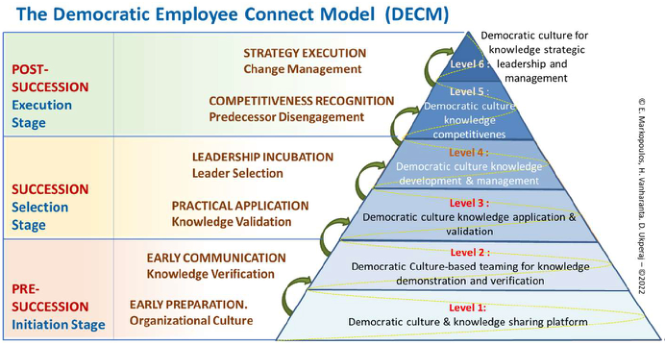
THE DECM OPERATIONS DECM will guide family businesses during their management succession pro- cess through six steps to democratically determine who is the best fit for a leadership role in the organization (Figure 1). The six levels divide the overall succession process into three periods. The first is the pre-succession period, composed of levels 1 and 2, the succession period (levels 3 and 4) and the post-succession period (level 5 and 6).
Democratic Management Succession in Balkan Family Businesses 189
Table 1. Determining factors for an effective management succession.
Table available in the original PDF paper.
Domain Variable Factor Description Individual Personal Gender Choosing a successor based on their gender Age Assigning a CEO based on their age Personality Appointing a new leader based on their proactivity to drive constructive organizational change Professional Education Selecting a successor based on their education level Experience Nominating a CEO based on their work experience outside of the family business Competencies Choosing a successor based on who is the best fit for a leadership role Relational Family Culture Appointing a new leader based on the involvement of nonfamily members in crucial decision-making processes Family Conflict Assigning a CEO based on unresolved sibling rivalry and other major disputes among family members Credibility Choosing a successor based on the level of acceptance from other family business members Contextual Business Performance
Appointing a new leader based on the performance of the company Business Size Nominating a CEO based on the size of the family business Business Structures
Selecting a successor based on the business structures of the firm
In brief, the pre-succession period emphasizes the establishment of a democratic organizational culture that can utilize talent and interdisciplinary human intellectual capital (Markopoulos et al., 2021b). This is achieved with a democratic teaming process that allows all to present and prove their leader- ship skills and commitment to the company (Markopoulos and Vanharanta, 2018). The succession period emphasizes the implementation of the succession process from the moment that potential candidates have been identified until the appointment of the most suitable one in a leadership role within the company.
The post-succession period emphasizes the organizational changes that must be executed for the new leader to succeed in the new role. These chan- ges are related to the company’s operations and the mentality of those not selected for a top senior position.
The levels of the DECM are briefly presented as following: Level 1 sets the infrastructure for the creation of human capital. It enables the existing family business leader to create a shared value culture (Marko- poulos and Vanharanta, 2015), where everyone has the freedom to express their thoughts, ideas, and beliefs as to which actions should be taken to maximize the desired succession outcomes.
Figure 1: The democratic employee connect model (DECM).
Level 2 offers family members the opportunity to turn their knowledge into intellectual capital by determining the necessary skills of the next family business leader to continue their legacy. As a result, potential successors can familiarize themselves first with all the critical aspects of the business and then be given more responsibilities gradually.
Level 3 provides the testing ground for the intellectual capital’s applicabi- lity. Rating the importance of the factors outlined in the scoring system above will help family businesses decide whether a family or nonfamily member should be the next leader of the company.
Level 4 serves as the incubator stage. The existing family business leader will train the short-listed potential successors to align family needs and busi- ness requirements through the progressive transfer of technical knowledge and managerial skills. The best-performing candidate will become the new leader of the company.
Level 5 directs the added value of the family business by the groomed successor to competitive advantage. However, the retirement of the current leader is paramount to increase the level of acceptance of the assigned CEO by other members in the organization. As a result, they will finally be able to control the company’s strategic direction by taking over all the responsibilities of their predecessor.
Level 6 implies the highest level of competency that the family business can achieve. The new leader sets its company up for success by creating a sha- red sense of identity and high-quality exchanges with family and nonfamily members simultaneously.
DECM METRICS AND INDEXES The effectiveness and contribution of DECM to family businesses can be ini- tially measured with a set of metrics that can be applied in each stage and level of the model. Table 2 presents some of the key metrics categories.
Democratic Management Succession in Balkan Family Businesses 191
Table 2. DECM indicative metric categories.
Table available in the original PDF paper.
Metric Description Cohesion The degree of friction between different groups of the family business and inclusion of nonfamily members in crucial decision-making processes Commitment The degree of involvement of family and nonfamily members in proposing and executing new ideas, knowledge, and initiatives to the company; and seeking opportunities outside of their usual roles to contribute to the long-term success of the family business Performance The degree of financial and operational performance of the family business after the appointment of the new CEO Loyalty The degree of employee loyalty to the organization, especially of family members, to remain in the company, respect the new leader and work together Innovation The productivity rate of the family business’ investments in R&D compared to its competitive landscape and the degree to which the company achieves its performance objectives over time
These metrics are intended to measure the overall success of the post- succession period, which is a continuous performance measurement process of the company under the new leadership. Nevertheless, more metrics have been defined and designed for the pre-succession and succession periods. Each metric is divided into sub-metrics with specific measurable actions that received weighed scores for the creation of the overall index for every period.
SOCIOECONOMIC IMPACT Given that family businesses are well-known for engaging extensively in philanthropic and sustainability activities and providing stable employment and consistent revenues (Glover and Trehan, 2020), the Democratic Emplo- yee Connect Model (DECM) will not serve as a one-off solution but cause a domino effect that can make communities and businesses better off by assigning the right leader, at the right time, at the right place.
The DECM will assist family businesses to assign a successor through sustainable leadership criteria (Markopoulos et al., 2021c). As a result, the chosen leader will not only increase the survival rate of their organization by effectively balancing family interests and business requirements, but also support the positive contribution of their family business to the society and economy for upcoming generations. However, it must be noted that this holi- stic model is specific only to the Balkan region, but it is also applicable to other regions and economies of similar size with some minor adjustments.
LIMITATIONS AND AREAS FOR FUTURE RESEARCH Although this study advances the understanding of the factors that family businesses in the Balkan region take into consideration to appoint family or nonfamily members in leadership roles, it does have limitations. Firstly,
primary data could have been collected from a larger number of survey par- ticipants and industry experts. Additionally, the sample used was region specific and the primary research findings lacked nonfamily members’ per- spectives. Lastly, the content validity and dimensionality of the DECM is questionable at this stage, whether it fully captures the complexities of mana- gement succession in family businesses, which in turn might influence the success rate of the framework.
Future studies should consider other variables than the ones used, such as procedural factors, to better prepare Balkan family businesses for an effe- ctive succession plan since the survey participants were only assessed across individual, contextual and relational domains. Moreover, future researchers should also explore the successor’s engagement over time, especially when a nonfamily member assumes presidency temporarily until a family member develops the required competencies to take over the organization.
Additionally, future studies can also explore the use of DECM in cor- porate geo-entrepreneurship, so that successful family businesses can tackle brain-drain (Markopoulos et al., 2020), and the public sector in the Balkan region, which has similar characteristics with family businesses with regards to leadership promotion and succession (Markopoulos et al., 2021d).
CONCLUSION
The appointment of individuals in leadership roles is a critical event for any type of organization, but it may be even more complex for family businesses as the nomination of a family or nonfamily successor may set personal intere- sts against corporate ones. In this context, most family-owned enterprises in the Balkan region have a strong desire to appoint family members in leader- ship roles regardless of their personal or professional backgrounds. However, when these organizations face difficulties in their internal or external envi- ronments, they tend to nominate a nonfamily successor. These insights were incorporated in the proposed Democratic Employee Connect Model (DECM), which can guide family businesses during their management succes- sion process through six steps to democratically determine who is the best fit for a leadership role in the family business. Consequently, this framework will not only extend the organizational continuity of Balkan family businesses, but also prolong their positive contribution to the society and economy.
REFERENCES
Bocatto, E., Gispert, C. and Rialp, J. (2010). Family-Owned Business Succession: The Influence of Pre-performance in the Nomination of Family and Nonfamily Members: Evidence from Spanish Firms. Journal of Small Business Management, 48(4), 497–523. https://doi.org/10.1111/j.~1540--627X.2010.00306.x Davidov, T. and Yordanova, D. (2014). Family Businesses in Bulgaria. Erenet Profile,
9(2), 3–14. http://www.erenet.org/publications/profile34.pdf#page=3 Deloitte. (n.d.). Wealth Generations: The Importance of Succession Planning for Family Businesses. https://www2.deloitte.com/content/dam/Deloitte/ca/Documen ts/mid-market/ca-en-mid-market-the-importance-of-succession-planning-for-f amily-businesses.pdf
Democratic Management Succession in Balkan Family Businesses 193
Duh, M., Letonja, M. and Vadnjal, J. (2015). Educating Succeeding Generation Entrepreneurs in Family Businesses – The Case of Slovenia. Entrepreneurship Education and Training, 85–112. http://dx.doi.org/10.5772/58950 Fang, H. “Chevy”, Randolph, R. V. D. G., Memili, E. and Chrisman, J. J. (2015).
Does Size Matter? The Moderating Effects of Firm Size on the Employment of Nonfamily Managers in Privately Held Family SMEs. Entrepreneurship Theory and Practice, 40(5), 1017–1039. https://doi.org/10.1111/etap.12156 Gashi, G. and Ramadani, V. (2013). Family Businesses in Republic of Kosovo: Some General Issues. In: Ramadani, V. and Schneider, R. (eds). Entrepreneurship in the Balkans, 91–115. Springer, Berlin, Heidelberg. https://doi.org/10.1007/978-3- 642-36577-5_6 Glover, J. and Trehan, K. (2020). What Is the Social-Economic Contribution of
Family Firms in the UK? A Review of the Evidence. Enterprise Research Centre. https://www.enterpriseresearch.ac.uk/wp-content/uploads/2020/09/No45-What -is-the-social-economic-contribution-of-family-firms-in-the-UK-GloverTrehan- Revised-1.pdf Grozdani´c, R. and Radovi´c-Markovi´c, M. (2015). Family Businesses Motives for Internationalisation: Evidence from Serbia. In: Dana, L. P. and Ramadani, V. (eds). Family Businesses in Transition Economies, 267–292. Springer, Cham. https://do i.org/10.1007/978-3-319-14209-8_13 Hategan, C. D., Curea-Pitorac, R. I. and Hategan, V. P. (2019). The Romanian Family
Businesses Philosophy for Performance and Sustainability. Sustainability, 11(6), 1715. https://doi.org/10.3390/su11061715 Hiebl, M. R. W., Feldbauer-Durstmüller, B. and Duller, C. (2013). The Changing Role of Management Accounting in the Transition From a Family Business To a Non-Family Business. Journal of Accounting & Organizational Change, 9(2), 119–154. https://doi.org/10.1108/18325911311325933 Markopoulos, E. and Vanharanta, H. (2014). Democratic Culture Paradigm for
Organizational Management and Leadership Strategies-the Company Democracy Model. In: Charytonowicz, J. (ed) Advances in Human Factors and Sustaina- ble Infrastructure. 5th International Conference on Applied Human Factors and Ergonomics, 20, 190–201. https://discovery.ucl.ac.uk/id/eprint/10120796 Markopoulos, E. and Vanharanta, H. (2015). The Company Democracy Model for the Development of Intellectual Human Capitalism for Shared Value. Procedia Manufacturing, 3, 603-610. https://doi.org/10.1016/j.promfg.2015.07.277 Markopoulos, E. and Vanharanta, H. (2017). Space for Company Democracy. In:
Kantola, J., Barath, T., Nazir, S. and Andre, T. (eds) Advances in Human Factors, Business Management, Training and Education. Advances in Intelligent Systems and Computing, 498, 275–287. Springer, Cham. https://doi.org/10.1007/978-3- 319-42070-7_26 Markopoulos, E. and Vanharanta, H. (2018). Project Teaming in a Democratic Company Context. Theoretical Issues in Ergonomics Science, 19(6), 673–691. https://doi.org/10.1080/1463922X.2018.1439543 Markopoulos, E., Markopoulos, G. and Vanharanta, H. (2020). Democratizing
Innovation. A Geo-Entrepreneurial Analysis and Approach Through the Com- pany Democracy Model. In: Markopoulos, E., Goonetilleke, R., Ho, A. and Luximon, Y. (eds) Advances in Creativity, Innovation, Entrepreneurship and Communication of Design. AHFE 2020. Advances in Intelligent Systems and Computing, 1218, 3–16. Springer, Cham. https://doi.org/10.1007/978-3-030-51 626-0_1
Markopoulos, E., Bilibashi, A. and Vanharanta, H. (2021a). Democratic Organizational Culture for SMEs Innovation Transformation and Corporate Entrepre- neurship. In: Markopoulos, E., Goonetilleke, R.S., Ho, A.G. and Luximon, Y. (eds) Advances in Creativity, Innovation, Entrepreneurship and Communication of Design. AHFE 2021. Lecture Notes in Networks and Systems, 276, 73–82. Springer, Cham. https://doi.org/10.1007/978-3-030-80094-9_10 Markopoulos, E., Robl, P. and Gann, E.L. (2021b). Managing Interdisciplinary
Human Intellectual Capital for Project and Organizational Development. In: Mar- kopoulos, E., Goonetilleke, R.S., Ho, A.G. and Luximon, Y. (eds) Advances in Creativity, Innovation, Entrepreneurship and Communication of Design. AHFE 2021. Lecture Notes in Networks and Systems, 276, 394–402. Springer, Cham. https://doi.org/10.1007/978-3-030-80094-9_47 Markopoulos, E., Winter, L.M.C. and Vanharanta, H. (2021c). Sustainable Leadership Wisdom Cube: Sustainable Leadership Style Evaluation Application to the Wisdom Cube Scientific Knowledge Space. In: Markopoulos, E., Goonetil- leke, R.S., Ho, A.G. and Luximon, Y. (eds) Advances in Creativity, Innovation, Entrepreneurship and Communication of Design. AHFE 2021. Lecture Notes in Networks and Systems, 276, 403-413. Springer, Cham. https://doi.org/10.1007/ 978-3-030-80094-9_48 Markopoulos, E., Hoxhallari, E. and Vanharanta, H. (2021d). Democratic Govern-
mental Corporate Entrepreneurship for the Transformation of the Public Sector in the Balkan Region. In: Markopoulos, E., Goonetilleke, R.S., Ho, A.G. and Luximon, Y. (eds) Advances in Creativity, Innovation, Entrepreneurship and Com- munication of Design. AHFE 2021. Lecture Notes in Networks and Systems, 276, 153–161. Springer, Cham. https://doi.org/10.1007/978-3-030-80094-9_19 OECD. (2019). SME Policy Index: Western Balkans and Turkey. https://www.oecd.o rg/south-east-europe/programme/SMEPI-Pocketbook-2019.pdf Poutziouris, P., O’Sullivan, K. and Nicolescu, L. (1997). The [Re]-Generation of
Family- Business Entrepreneurship in the Balkans. Family Business Review, 10(3), 239–261. https://doi.org/10.1111/j.~1741--6248.1997.00239.x Ramadani, V., Bexheti, A., Rexhepi, G., Ratten, V. and Ibraimi, S. (2017). Succession Issues in Albanian Family Businesses: Exploratory Research. Journal of Balkan and Near Eastern Studies, 19(3), 294–312. https://doi.org/10.1080/19448953. 2017.1277086 Ramadani, V., Fayolle, A., Gërguri-Rashiti, S. and Aliu, E. (2015). The Succession
Issues in Family Firms: Insights From Macedonia. In: Dana, L.P. and Ramadani, V. (eds). Family Businesses in Transition Economies, 199-221. Springer, Cham. https://doi.org/10.1007/978-3-319-14209-8_10 Ramadani, V., Memili, E., Palali´c, R. and Chang, E.P.C. (2020). Succession and Family Businesses Longevity. In: Entrepreneurial Family Businesses. Springer Texts in Business and Economics, 81–100. Springer, Cham. https://doi.org/10. 1007/978-3-030-47778-3_5 Senegovi´c, I., Bubli´c, V. and ´Cori´c, G. (2015). Family Business Succession Risks: The
Croatian Context. In: Dana, L.P. and Ramadani, V. (eds). Family Businesses in Transition Economies, 175–197. Springer, Cham. https://doi.org/10.1007/978-3- 319-14209-8_9 Siakas, K., Naaranoja, M., Vlachakis, S. and Siakas, E. (2014). Family Businesses in the New Economy: How to Survive and Develop in Times of Financial Cri- sis. Procedia Economics and Finance, 9, 331–341. https://doi.org/10.1016/S2212- 5671(14)00034-3
Democratic Management Succession in Balkan Family Businesses 195
Smith, B. F. and Amoako-Adu, B. (1999). Management Succession and Financial Performance of Family-Controlled Firms. Journal of Corporate Finance, 5(4), 341–368. https://doi.org/10.1016/S0929-1199(99)00010-3 Tharawat Magazine. (2014). What is the Economic Impact of Family Businesses?
https://www.tharawat-magazine.com/economic-impact-family-businesses/ Vassiliadis, S. and Vassiliadis, A. (2014). The Greek Family Businesses and the Succession Problem. Procedia Economics and Finance, 9, 242–247. https://doi.org/10. 1016/S2212-5671(14)00025-2 Walsh, G. (2011). Family Business Succession: Managing the All-Important Family
Component. KPMG Enterprise. https://assets.kpmg/content/dam/kpmg/pdf/2015/ 07/3468-succession.pdf Zona, F. (2016). CEO Leadership and Board Decision Processes in Family-Controlled Firms: Comparing Family and Non-Family CEOs. Small Business Economics, 47(3), 735–753. https://doi.org/10.1007/s11187-016-9764-3
LISTED IN THE AHFE DIGITAL BOOKSTORE CATALOGUE
Explore the complete digital volume
Creativity, Innovation and Entrepreneurship
Read this individual research paper free through the original publisher, or explore the full digital proceedings book.
ISBN 978-1-958651-07-0
Explore this ISBN in the AHFE Bookstore ↗Listed in the July 2026 bookstore catalogue; search by ISBN to confirm current availability · Digital book purchase optional