Since the first ideation of the World Innovation Stock Exchange in 2015, the business landscape has drastically changed. The world witnessed the introduction the Metaverse as the pioneer of cyber-parallel worlds. Societies endured a global pandemic and the subsequent socio-economic crises of unprecedented force. All happened under an ambient banalization of individual entrepreneurship as a shaping capacity with increasing impact power on the Collective (physical, cultural, and digital society). Under the phenomena of globalization and financialization, the contribution to knowledge and innovation is becoming more and more organic, since citizens themselves endorse an entrepreneurial proactiveness in tackling challenges of varied scale. The contemporary global technologic and social disruptions are changing the game of innovation management. Emerging and existing technologies of the Industrialisation 4.0 not only provide a platform to the digital world, but also augment it, thereby augmenting the impact a sole individual, a simple organization, or a remote business can have in innovating globally. Moreover, global crises have accelerated both the already occurring evolution of work-places & work-practices, and the capacity stakeholders have in endorsing collectively and holacratically projects to solve commonly faced challenges. More than ever before, the digital world enables to collaboratively develop, control and monetise one another’s Innovation. The diversity in stakeholder’s collaboration is a consequence of these structural changes. Indeed, it is no longer surprising that eminent businessmen now collaborate individually with start-up incubators, celebrities partner with social enterprises, and eminent scholars pair up with MNCs to come up with developmental programs. Above the previously mentioned technological, social, and economic disruptions, a superseding revolution has occurred. One that is structurally reshaping individual and social relationships to knowledge and knowledge management: the democratisation of intellectual capital. Nowadays, anyone connected to the web can collaborate and expose its ideas formally or informally on a variety of social media and professional platforms. The number of innovators with unique profiles, in age, geographic location, and social status has sprung. The power of metaverstic-like processes in knowledge management relies on its democratic nature, inclusively welcoming a diversity of profiles and ideas. How to take sporadic ideas and contributions internationally, expressed on a web platform, and instantaneously match them, ideally structure them, and coordinate their protagonists’ actions to pursue them? How to facilitate and incentivise the evolution idea-innovation? How to optimally take ideas on a page to a lifechanging service? Since innovation management is becoming gamified, the is an evident need to develop Metaverstic project management tools that encompasses not only AI-facilitated holacratic teaming, but also blockchained project management in all its phases (from ideation to market launch), while taking into account the critical component of innovation monetisation. In 2015, the World Innovation Stock Exchange already set the bases of such Metaverstic platform of innovation management: this Exchange structures the meeting of the minds, just as any financial stock exchange does, while following the Shared Values principles. To extend on the premises of this novel Exchange, this paper describes in detail how a component of the W.ISE will have to be developed, namely the World Innovation Stock Exchange Democratic Incubator (WISE-DI). It describes how it operates conceptually and to which extent it answers structural guidelines to practically develop this W.ISE. It addresses the critical notion of Innovation tokenization with the MarkPoints cryptocurrency, the securitization of project management via the W.ISE blockchain, and the monetization of the launched-to-market innovations in the real economy*. The ultimate benefit of the W.ISE-DI platform relies on both its smart structuring capacity and user-friendly/ interactive interface, which enable to manage intellectual contribution ownership and incentivise R&D collective financing.
Since the first ideation of the World Innovation Stock Exchange in 2015 (Markopoulos and Vanharanta, 2015a), the business landscape has drasti- cally changed: the World witnessed the introduction of metaverstic techno- logies, marking the start of the Globalization 5.0 era.
Virtual reality became mainstream in public use, and meta-elements are commoditized, built, purchased, and traded just like physical goods. Even major Multi-National Corporations (MNCs) are endorsing crypto assets and metaverstic domains as part of their business portfolio, acknowledging significant recent market shifts and their innovation development activi- ties in metaverstic technologies. Metaverstic technologies can be defined
Metaverstic Innovation Management: The World Innovation Stock Exchange 209
as any technology that contributes to Metaverse development. Metaverse is a “post-reality universe, perpetual and persistent multiuser environment physical with digital reality, creating an interconnected web of the social and networked immersive environment in persistent multiuser platforms” (Mystakidis, 2022). With the symbolic name change from Facebook to Meta, signing the beginning of the Globalization 5.0 era, human interaction and social transactions have been doubled: the digital World is becoming real, as just another parallel space to explore, exchange, and utilize when physical constraints are limiting our innovative capacity.
Another key factor contributing to the necessity of re-developing the W-ISE is the series of drastic changes in the global landscape since 2020. Socie- ties endured various global and international crises, touching the domains of health and safety, socio-economic security, and environmental respect. These crises have become a ubiquitous concern for the worldwide commu- nity. Since it is evident that threats (and future challenges overall) have no borders, it is important to stress a central principle in innovation manage- ment: democracy. Solutions do not have a pre-determined origination point. In a globalized world ruled by the factors of Globalization 5.0 (Virtualiza- tion: cross-reality and Metaverse-related technologies), following the one of the 4.0 (Cognification: integration of artificial intelligence across digital and technologic solutions), innovation can come from anywhere, at any time, and from anyone.
Managing innovation inclusively, openly, and to ones’ utmost agility is overwhelming for traditional managerial organizations and existing digital solutions. The business discipline of knowledge and innovation management needs to step to the challenge of democratically potentializing knowledge contribution and to facilitate its manifestation to market as true innovation. True innovation is meaningful and disruptive. True innovation is democratic by essence and happens only when collective forces are being consulted. These profound changes brought by the tremendous digital-real worlds entan- glement increased awareness of mutual responsibility in solving globally encountered challenges: Metaverstic contributions highlighted the emerging status of Citizen-Entrepreneur. Consequently, innovative collaborations have progressively become more diverse in stakeholder’s size and expertise due to the social changes in the business landscape.
First theorized in 2015, the new World Innovation Stock Exchange is a metaverstic technology guideline that sets the principles of making the best use of multimodal metaverse interactions for knowledge ideation, innova- tion, materialization, and monetization. Furthermore, this exchange follows the democratic practices of the Company Democracy Model (Markopoulos and Vanharanta, 2014) and the Shared Value principles (Markopoulos and Vanharanta, 2015b). This paper presents a part of this novel Exchange, the W.ISE-DI (its Democratic Incubator), by offering a gamification framework for the operation of W.ISE in virtual spaces. The WISE-DI is an innova- tive immersive metaverse application classified under the umbrella of XR technologies, namely: Extended Reality or Cross Reality.
METAVERSTIC SHARED VALUES PRINCIPLES The Globalization 5.0 fades more and more geographical borders: the metaverse has neither continent nor nations, and therefore no established jurisdiction. The Shared Value principles are thus essential in framing meta- verstic interactions to ensure the pursuit of ethical development and address to the earliest potential cyber-fraud and cyber-criminality (Kostenko, 2022). A first essential reference is the manifesto of the Seven Rules of the Metaverse (Parisi, n.d.). It structures necessary rules for the democratic development of this parallel cyber-world: “there should be only one Metaverse (rule 1), and not many Metaverses or Multiverses, as the next iteration of the Internet (rule 7). As such, the Metaverse should be for everyone (rule 2) open (rule 4), hardware-agnostic (rule 5), networked (rule 6), and collectively controlled (rule 3)”.
An additional reference enacting the development of metaverstic applicati- ons is the Company Democracy Model, which proposed solutions following the fundamental Delphic maxims (Markopoulos, Vanharanta, 2017). Ada- pting this model enabled us to apply the principles of shared value. Innovation has a compounded value added for society and the economy (Markopoulos and Vanharanta, 2015b). Innovation management in the Globalization 5.0 must follow such regulations since anyone connected to the web can colla- borate and expose its ideas formally or informally on various social media and professional platforms. As a result, many innovators with unique pro- files in age, geographic location, and social status have sprung. Metaverstic technologies have already been highlighted as facilitating sources of educa- tion democratization (Mystakidis, 2022), indicating a natural prolongation of the Company Democracy Model and its subsequent adaptations in the continuum of the digital-real world.
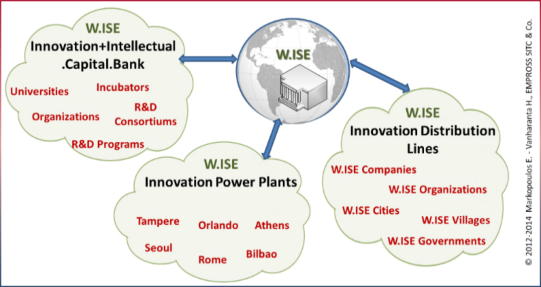
THE WORLD INNOVATION STOCK EXCHANGE The model proposed in this paper expands on the original W.ISE concepts of 2015 (Figure 1). The World Innovation Stock Exchange noted W.ISE was
Figure 1: The original W.ISE Framework for Knowledge and Innovation Development (Markopoulos and Vanharanta, 2015a).
Metaverstic Innovation Management: The World Innovation Stock Exchange 211
established before the introduction of the Metaverse to the general public. Conceptually, the W.ISE provides equivalent interactive benefits and a step further toward disintermediation, just as the Metaverse does. The W.ISE was then defined as a “state-of-the-art knowledge and innovation manage- ment initiative based on the concepts and theories of democratic innovation through freedom of knowledge expression” (Markopoulos and Vanharanta, 2015a). The value-added of the W.ISE relies on its agile, intelligent, and gamified approach to Innovation Management. Existing solutions have not yet solved how to take sporadic ideas and contributions internationally, expressed on the web, for instance, and instantaneously match them, ideally structure them, and coordinate their protagonists’ actions to pursue them. Moreo- ver, available digital knowledge and innovation management solutions show limits in facilitating and incentivizing the evolution of idea innovation. Ulti- mately, the W.ISE optimizes the transformation of ideas on a page to a life-changing service, thereby successfully utilizing and efficiently promoting the ideas deposited in it (business plans, research initiatives, patents, or sim- ply ideas, and knowledge in various forms). Practically, “the W.ISE offers a secure and rewarding hosting facility for all types of innovations, at any maturity level, under any discipline, by any type of innovation contributor, anywhere in the world” (Markopoulos and Vanharanta, 2015a).
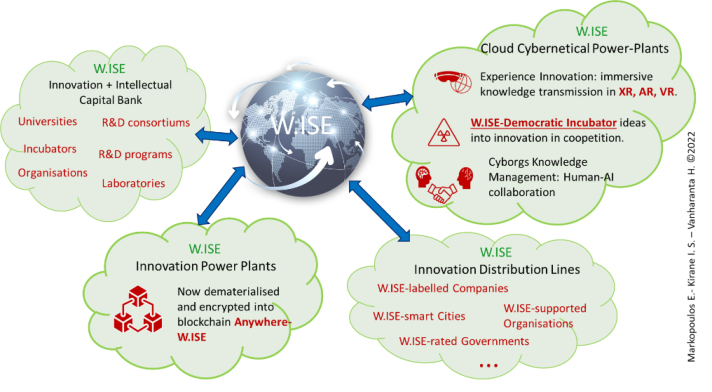
Updating the development of this exchange, the W.ISE becomes a sub- set of the Metaverse, its innovation management and knowledge sharing nexus, facilitating multimodal metaverstic interactions (figure 2). This exch- ange is redefined in 2022 as a metaverstic structuring solution, enabling disintermediation in innovation management while respecting key universal shared value socio-anthropologic principles, which are central to the W.ISE conceptualization. In other words, this exchange becomes now a platform facilitating the meeting of the minds between offerors of innovations (ideas of
Figure 2: An updated version of the W.ISE’s framework in the Globalization 5.0 era.
various maturity levels, research insights, data analytics, etc.) and demanders of contributions to both expressed and unidentified challenges.
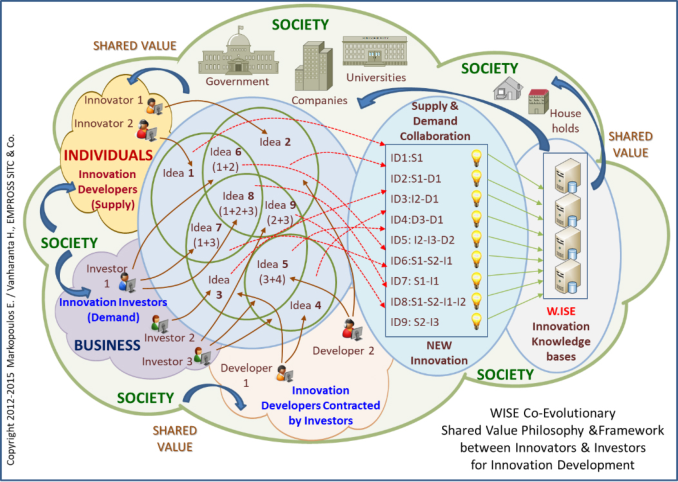
Before introducing the W.ISE-DI (Democratic Incubator), it is essential to address the limits of a critical model that schematized the original version of this exchange. Figure 3 presents the co-evolutionary shared value philosophy and framework.
Figure 3: W.ISE Co-Evolutionary shared value philosophy and framework between innovators and investors for innovation development (Markopoulos and Vanharanta, 2015a).
It conveys how such exchange is organizationally democratic and opera- tionally inclusive, with the end goal to improve the shared value societies enjoy from cooperatively developed innovations. However, this model fails to convey the dynamics between the different stakeholders (possibly both users and shapers of this exchange) and how innovations will be treated humanely and artificially.
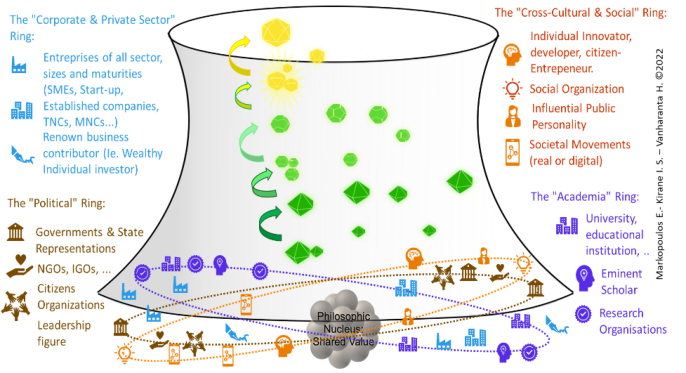
THE W.ISE DEMOCRATIC INCUBATOR To answer the above-stated interrogations and pursue the W.ISE deve- lopment improving on its identified limits, this paper proposes the W.ISE Democratic Incubator. The W.ISE-DI is a part of the W.ISE, which sets the conceptual foundations of the organization of the “www.InnovationStockExchange.org” domain and its development in the Metaverse. It further explains schematically how the W.ISE acts as a platform to facilitate the meeting of the minds and solve critical coordination problems. To solve the original model’s lack of dynamic representation, figure 4 depicts
Metaverstic Innovation Management: The World Innovation Stock Exchange 213
Figure 4: Stakeholder’s dynamic representation and ideas-to-innovation maturation in collaborative solutions development on the WISE-DI.
such interactions analogously to the atom model, with Shared Value Philoso- phy being the nucleus principle ruling these interactions, just as the ‘6 Rules of the Metaverse’.
The first depiction of the W.ISE Democratic Incubator schemes how ideas mature in an organic or facilitated way until they reach the innovation stage. Innovation, and particularly open innovation, can derive internally from employees and externally from suppliers, competitors, or specific industry and professional networks (Tidd, Bessant, and Pavitt, 2005). This diver- sity in stakeholders’ nature, resourcefulness, and scope of implication were not fully accounted for in the original W.ISE Co-Evolutionary Framework, making it difficult to grasp the infinite potential of emerging innovations from cross-disciplinary holacratic interactions.
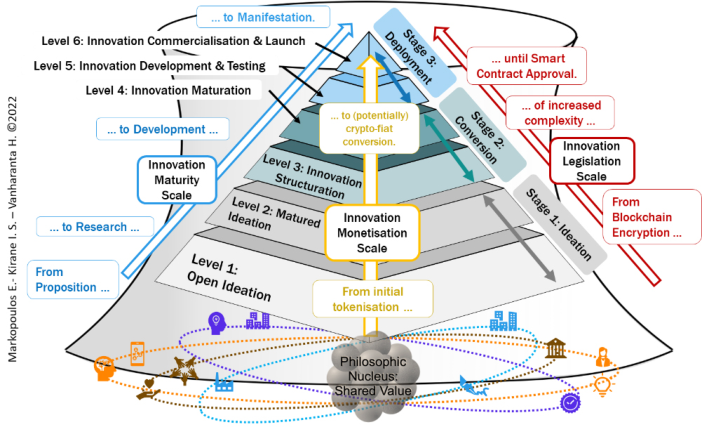
Figure 5 of the W.ISE-DI illustrates how innovations emerge, mature, and are brought to stages of practicality, meaning market applicability. Each ring represents its ecosystem. There is no finite number of rings, just clusters of users grouped by the structuring system (AI-enabled). The more users and developers join the W.ISE (or enter the W.ISE via metaverstic appli- cations), the more rings will be created and the denser they will become. The rings representation for the end-user of the W.ISE-DI is merely a way to classify stakeholders by nature, the field of action, or the area of exper- tise. Figure 5 represents only four rings: political and institutional, academia, cross-cultural and social, and corporate and private sector rings. This does not exclude that another taxonomy could have been depicted, such as the medical ring, logistics ring, economics ring, and so forth.
Figure 5: Gamified innovation management of the six levels of the W.ISE-DI.
On each ring, stakeholders of varied nature are represented, such as univer- sities, eminent scholars, and research organizations for the “academia” one. These stakeholders, compounds of the W.ISE, are perpetually moving on the Exchange platform, metaphorically spinning on each ring. Collision of these compounds (from unscheduled meetings, projects, digital conversations, or circumstantial pairing) can generate unexpected novel ideas. This ‘meeting of the minds,’ which could be an agreement, a debate, a collective brain- storm, individual and institutional stakeholders radiate thoughts and ideas in this depicted W.ISE Democratic Incubator. Concretely, these ideas can take the form of projects on their own, investigation recommendations, surveying conclusions, and even start-up pitches.
The Democratic Incubator is aligned with the Company Democracy Model on collaborative knowledge development in a co-evolutive and holacra- tic way. Its pyramidal construct helps structure innovation management in stages. Before the stages and levels description, the construction of this repre- sentation on three critical scales must be addressed: those three scales form the framing edges of the W.ISE-DI CDM pyramid, indicating the knowledge maturity, its applicability into the real economy, and its impact capacity as an innovation.
Involving holacratically various stakeholders globally from different juris- dictions brings practical challenges; for instance, on the questions of know- ledge monetization: how could a metaverstic platform such as the W.ISE-DI translate it financially and economically into the real world, using the pri- nciples of tokenization? These compliances (legal & financial) aspects are critical. However, they yet too often lack structuring rigor in conventional innovation management guidelines and models, thus often leading to inter- rogations in their practical applications for innovators (most of the time being entrepreneurs). The W.ISE-DI aims to structure those critical aspects and
Metaverstic Innovation Management: The World Innovation Stock Exchange 215
make them applicable and easily apprehensible via a gamified approach in the metaverse. Figure 5 presents three scales to address the essential issues. The first scale is the Innovation Maturity Scale (in blue) from the research phase to the development phase. The second is the Innovation Compliance- /Legalization Scale (in brown) which includes blockchain encryption of the Innovation of increased complexity as it matures until it reaches the status of an (international) smart contract. The third one (in gold) is the Innovation Monetization Scale dealing with the idea of tokenization of the exchange to its monetization (crypto-fiat forex).
GAMIFYING INNOVATION DEVELOPMENT THROUGH THE SIX LEVELS OF THE W.ISE-DI The W.ISE-DI is structured similarly to the Company Democracy Model, clu- stering its structuring six levels into three stages of Ideation, Conversion, and Deployment stages, as summarized in Table 1.
At the Ideation stage, ideas emerged from the underlying gravitational system and matured with previously formulated ideas. Level 1 is a stage within the Exchange Incubator that welcomes ideas submission of varied nature: proposals, clearly developed open problematics, call for collaboration in a prior thought venture, etc... This is the level of Open Ideation. The exch- ange collects this pool of ideas raw and unclassified and keeps a duplicated version into a decentralized cloud for sustainable knowledge management. The thoughts and ideas pass the next level upon submission when they are minted (encrypted) and receive an initial starting token: one idea starts with one MarkPoint (Markopoulos, Alexopoulos, Bouzoukouu, Bilbao, 2009). This is the Initial Idea Offering. MarkPoints have to be used in the past in pro- ject management to track the progress of a project. They are allocated based on the project complexity and criticality and gain value as the project pro- gress within time, budget, and quality. Level 2 is the Matured Ideation level, where ideas are classified, rated, and ordered given their applicability level. The software of the W.ISE-DI is equipped with dedicated AI systems which match the tokenized ideas to the most fitting existing project. Then, the ideas (represented in Figure 5 with green stars) are merged into a more pertinent one elaborated further by its stakeholders. This human-artificial interaction in agile project management refers to the “Democratic co-evolutionary spiral process for intelligent team performance” (Markopoulos et al., 2020a).
The Conversion Stage succeeds the Innovation Stage: once the idea has matured synthetically, an Ideation evolves into a potential Innovation. Level 3 is the Innovation Structuration, which can be of varying lengths and dedicated to matching holacratically teams around a project due to a devoted AI that continuously adjusts the stakeholder-project engagement (Markopoulos et al., 2020a). This is also a level in which the project’s token value fluctuates: the more users join, the more ideas are worked on, the more development actions are being taken and computed, the greater the project value is. Crypto-Capital gains of a project, expressed in MarkPoints- currency, can be valued using tracked metrics, such as the number of hours
Table 1. The W.ISE democratic incubator stages of innovation: form open ideation to innovation materialization or commercialization.
Table available in the original PDF paper.
Stage Level Description Stage 1: Ideation Level 1: Open Ideation Stage within the exchange inclusively welcoming ideas submission of varied nature: proposals, open problematic, call for collaboration in a business venture, hypotheses, newly formulated theory to assess. Level 2: Matured Ideation
Ideas are classified, rated, ordered given their applicability level. Finally, they are matched to the most pertinent / best fitting existing project with the UX support of both the MarkBot and an AI-driven teaming optimizer (Markopoulos et al., 2020a). Stage 2: Conversion
Level 3: Innovation Structuration
Element 1: Tokenisation: the more user join, the more ideas are worked on, the more development actions are being computed, the more a project (noted @Innov...) increases in value (MarkPoints). Element 2: AI holacratic teaming around the most dynamic ideas (with the most significant MP volume and value). Level 4: Innovation Maturation
Tasks completion on a sprint basis (AI Scrum managed) for the incremental technical development of a series of prototypes that tests the feasibility of features needed for the innovation to stand out with technical and functional competitiveness. The Green Innovation Waste Management Protocol of the Green Ocean Strategy is recommended (Markopoulos et al., 2020b). Stage 3: Deployment
Level 5: Innovation Development and Testing
The innovation takes the form of a well-tested and fully developed deliverable (product, service, program, …) and receives the legal credential needed (certifications, compliance assessment, and approval) to be manifested in real life. Level 6: Innovation Commercialization & Launch
The innovation is supported with a commercialization and business launching strategy (business plan, financial analysis and valuation, intellectual property rights resolution, patents, copyrights, marketing stagy, branding, etc.)
spent on the W.ISE-DI on a specific “@project/idea,” the number of acti- ons taken, the complexity of the stakeholder’s actions, the number of user interactions, the number of new users’ integration on a “@project/idea,” the frequency and quality of social feedback requested during the “@project/i- dea” soft launches, just to name a few. Within the same stage, Level 4 follows the Innovation Maturation where tasks are being completed on a sprint basis development, following the Green Innovation Waste Management Protocol
Metaverstic Innovation Management: The World Innovation Stock Exchange 217
(GIWMP) (Markopoulos et al., 2020b). To facilitate stakeholder engagement at this level, the W.ISE-DI offers a gamified perspective of this GIWMP and varied dashboard of the project’s Mark-Points Cap (project capitalization in MarkPoints currency) and its volume of stakeholder’s engagement, and the % increase or decrease of relative maturity.
The last stage of this framework is the Deployment Stage that fully deve- lops the matured knowledge into an actual product or service, tests it on the market, and extends its most effective commercialization strategy. Specifi- cally, Level 5 is the one of Innovation Development and Testing. It is the stage where the innovation’s knowledge has matured enough through previous sta- ges and passed the prototype developments needed to verify its technical and functional feasibility. The 5th level follows the same holacratic development principles on a larger scale where W.ISE-DI’s users join a project to fully deve- lop it with the skills, technologies, and expertise needed to deliver solid and competitive innovation. These skills can be gathered from WISE-DI’s users around the World, where each one receives several MarkPoints based on their engagement, skills, effort, and activities implemented. Therefore, there is no project in WISE-DI that can be too complex or too big since the brains pool for its development is unlimited. Level 5 also covers the testing phase of the innovation development. This level integrates business managers, business developers, financial analysts, marketers, psychologists, lawyers, and other experts who don’t seem active in the previous levels. Therefore WISE-DI is open for experts from every discipline, as they are all needed. Lastly, Level 6 is the Innovation Commercialization, not necessarily followed by the launch of the new product or service derived from the previous levels as a new busi- ness entity. The commercialization is executed primarily by the non-technical experts mainly contributed at Level 5.
Furthermore, potential investors can join at this level to gain an early and low-cost share of the innovation before it becomes popular. The participants in Level 5 are compensated with MarkPoints since it MarkPoints crypto is benchmarked in on the innovations’ value and the user’s contributions. The value of a MarkPoint increases from level to level, making those who joined a project at level 1 or 2 more wealthy than those who followed. This is also an incentive for the non-technical experts to join a WISE-DI project at the early levels and not later when the innovation and the potential profitability are more visible.
CONCLUSION
In Globalization 5.0, an era ruled by a ubiquitous duplication of the real world and its digital prolongation to virtual parallels, there is an obvious need to address the potential anarchic growth of applications and platforms in the Metaverse. The literature of the past two years analyzing the implications of metaverstic technologies across disciplines (legally, socio-culturally, financi- ally, and economically) converge in a general enthusiasm for the democratic power of access to innovation and progress that the Metaverse seems to bring (Mystakidis, 2022) (Markopoulos et al., 2021a) (Markopoulos et al., 2021b) (Luimula et al., 2021). Yet, progress without structure leads to destruction in
the long run. Thus, numerous scholars have called for collaboration to esta- blish guidelines in metaverstic space developments, metaverstic technology use, and metaverstic identities interactions and exchanges (Kostenko, 2022). These guidelines will emerge in the first place as extensions of what is in place in current practice.
In innovation and knowledge management, the entrepreneurs’ sphere cri- tiques in theoretical model’s applicability in the real world. The lack of agility and the lack of digital and virtual integration potentials of existing solutions in innovation management are some of the challenges the World Innova- tion Stock Exchange aims to solve. The development of W.ISE-DI gamifies the discipline of innovation management in its processes of project develo- pment, holacratic teaming, and collaborative problem-solving in the R&D phases. Furthermore, metaverstic technologies provide a platform to the digi- tal world, thereby augmenting the impact of a sole innovative individual, a simple organization, or a remote business to a globally virtual space defi- ned as Globalization 5.0. For citizen-entrepreneurs, companies, and public organizations, the benefits are multiple since this W.ISE-DI solution brid- ges the benefits of metaverstic technologies and cryptocurrencies with the challenges of traditional & novel methods in innovation management. For society as a whole, it improves the research-to-development ratio, the idea-to- innovation transition, and the wishful thinking-to-market disruption journey considerably.
REFERENCES
Kostenko O. V. (2022) ‘Electronic Jurisdiction, Metaverse, Artificial Intelligence, Digital Personality, Digital Avatar, Neural Networks: Theory, Practice, Perspe- ctive’. World Science. 1(73). doi:10.31435/rsglobal_ws/30012022/7751 Markopoulos E., Vanharanta H. (2014). ’Democratic Culture Paradigm for Orga-
nizational Management and Leadership Strategies - The Company Democracy Model. ’In: Charytonowicz J. (ed) Advances in Human Factors and Sustaina- ble Infrastructure. 5th International Conference on Applied Human Factors and Ergonomics. Vol 20. pp 190-201 Markopoulos E., Vanharanta H. (2015a). ‘World Innovation Stock Exchange Organization for Individuals, Business, and Society’, Elsevier, Procedia Manufacturing, Volume 3, 2015, Pages 595-602. Luimula M. Markopoulos E., Osterman M., Markopoulos P. Aho J., Ravise
W., Saarinen J., Reunanen T. (2021). Avatar Based Multiplayer Functionali- ties in Next-Generation Communication and Learning in Virtual Reality Social Platforms – Case MarISOT Room. Conference: The 12th IEEE International Conference on Cognitive Infocommunications. Markopoulos. E, Alexopoulos G., Bouzoukou N., Bilbao J. (2009). ’Project Tracking using a Metrics Binder Analysis (MBA) Model on Software Project Initiatives (SPI)’ WSEAS Transactions on Business and Economics, Issue 10, Volume 6, pg 513–522, October 2009. Markopoulos E., Vanharanta H. (2015b). ‘The World Innovation Stock Exchange -
Shared Value for Individuals, Business, and Society’. Procedia Manufacturing. 3. 595-602. 10.1016/j.promfg.2015.07.275.
Metaverstic Innovation Management: The World Innovation Stock Exchange 219
Markopoulos E., Vanharanta H. (2017). ‘Delphic Maxims Based Applied Philosophy for Business and Governance Management’. 498. 33-45. 10.1007/978-3-319- 42070-7_4. Markopoulos, E., Kirane, I. S., Balaj, D., and Vanharanta, H. (2020a). ‘Artificial
Intelligence and Blockchain Technology Adaptation for Human Resources Demo- cratic Ergonomization on Team Management’ - Human Systems Engineering and Design II, T. Ahram, W. Karwowski, S. Pickl and R. Taiar (eds.), Cham: Springer International Publishing, pp. 445–455. Markopoulos E., Gann E.L., Kirane I.S., Vanharanta H. (2020b) Green Capitalism: Democratizing Sustainable Innovation by Recycling Intellectual Capital Energy. In: Ahram T., Taiar R., Gremeaux-Bader V., Aminian K. (eds) Human Intera- ction, Emerging Technologies and Future Applications II. IHIET 2020. Advances in Intelligent Systems and Computing, pp 507-519. vol 1152. Springer, Cham. DOI https://doi.org/10.1007/978-3-030-44267-5_77 Markopoulos E., Luimula M., Calbureanu-Popescu C., Markopoulos P., Ranttila
P., Laukkanen S., Laivuori N., Ravyse W., Saarinen J., Nghia T. (2021a). Neural Network Driven Eye Tracking Metrics and Data Visualization in Meta- verse and Virtual Reality Maritime Safety Training. Conference: The 12th IEEE International Conference on Cognitive Infocommunications. Markopoulos P. Pyae A., Khakurel J. Markopoulos E., Saarnio R., Luimula M.
(2021b). Understanding How Users Engage in an Immersive Virtual Reality-Based Live Event. Conference: The 12th IEEE International Conference on Cognitive Infocommunications. Mystakidis, S. Metaverse. Encyclopedia (2022). 486–497. https://doi.org/10.3390/ encyclopedia2010031. Tidd, J., Bessant, J. and Pavitt, K. (2005) Managing Innovation: Integrating
Technological, Market and Organisational Change. (3rd Ed.) Wiley. Parisi, T. The Seven Rules of the Metaverse. Medium Website: https://medium.c om/meta-verses/the-seven-rules-of-the-metaverse-7d4e06fa864c (Accessed on 20 November 2021).
LISTED IN THE AHFE DIGITAL BOOKSTORE CATALOGUE
Explore the complete digital volume
Creativity, Innovation and Entrepreneurship
Read this individual research paper free through the original publisher, or explore the full digital proceedings book.
ISBN 978-1-958651-07-0
Explore this ISBN in the AHFE Bookstore ↗Listed in the July 2026 bookstore catalogue; search by ISBN to confirm current availability · Digital book purchase optional