Evangelos Markopoulos, Chaitrali Anil Bhoi, Georgios Markopoulos, Akash Nandi, Hannu Vanharanta (2025). A Participative Management Approach using the Company Democracy Model on the Indian Ministry of Education. In: Human Factors, Business Management and Society. AHFE Open Access, vol. 176, pp. 83–94. https://doi.org/10.54941/ahfe1006306
Participatory management encourages employees across an organization to engage in decision-making processes, fostering strategic thinking and instilling full accountability for deliverable outcomes. The Company Democracy Model (CDM) offers a participatory management methodology designed to generate actionable business information and knowledge, fostering the development of insights, ideas, and innovations. These elements collectively build competitive advantages critical for organizational extroversion and modern entrepreneurship.This paper explores the adaptation of the Company Democracy Model within the Indian Ministry of Education, a large and multifaceted organization comprising numerous departments, some of which function autonomously. The Ministry’s workforce reflects a mix of diverse qualifications and experiences, operating within a hierarchical organizational structure. This structure positions the Ministry as an ideal candidate for implementing the spiral method embedded in the CDM. The hierarchical delegation of authority enhances the effectiveness of leadership and guidance, while an employee-centric work approach boosts capabilities, performance, and job satisfaction—key factors for success in a pivotal public sector institution.This research provides an in-depth analysis of the implementation pathway for adopting participative management models like the CDM within the Ministry. It particularly focuses on adapting the Company Democracy Levels to address the challenges and opportunities specific to India’s public sector.
shared responsibility, it encourages strategic thinking, enhances problem- solving abilities, and creates a sense of ownership over tasks and outcomes (Koopman and Wierdsma, 2013). This style of management also promotes accountability and drives better performance in the public sector, where a significant portion of the global workforce is employed. Effectively managing human capital remains a key challenge in public management (Cho and Kim, 2009).
Over the past decade, there has been a growing trend toward promoting participatory management and leadership as a way to harness the intellectual capital within organizations (Wang et al., 2022). This approach relies on education and initiatives that invest in employees at all levels. When participative management is integrated with democratic leadership, it fosters dynamic organizational cultures that boost productivity by distributing tasks and responsibilities to the most qualified individuals for each specific case. These methods also dismantle hierarchical structures that can create barriers to knowledge sharing, innovation, and career development.
DEMOCRATIC AND NON-HIERACHICAL ORGANIZATIONAL STRUCTURES Democratic and non-hierarchical organizational structures are crucial for the successful implementation of participative management and leadership. However, achieving these structures can be challenging, as their success largely depends on the capability and maturity of employees. It requires significant self-awareness to understand and appreciate the value of such organizational frameworks, as well as a strong commitment to adapting them in order to unlock their full potential.
Democratic organizations are typically knowledge-based, providing opportunities for individuals with valuable insights to share, refine, apply, and evolve their knowledge within the company (Nonaka et al., 2014). As employees contribute to the organization’s growth, they also evolve personally and professionally. These structures are designed to enhance the human capital index of the organization while promoting innovation and intra-preneurship (Markopoulos and Vanharanta, 2015). By reducing knowledge management barriers, democratic structures encourage all employees—regardless of rank or status—to contribute to organizational strategies, offering ideas, insights, and plans.
Similarly, non-hierarchical structures focus on placing the right person in the right role at the right time for the right project (Markopoulos and Vanharanta, 2018). This approach allows employees to move fluidly to where they are needed most, prioritizing project requirements over traditional organizational hierarchies. This disruptive thinking challenges conventional structures and promotes a more dynamic, flexible workforce.
In essence, non-hierarchical structures can be adapted to meet various organizational goals and strategies by providing management with a broad range of human resource options to address specific strategic needs or projects, per case. Understanding situationality increases employee engagement and knowledge contribution (Markopoulos et al., 2022).
A Participative Management Approach Using the Company Democracy Model 85
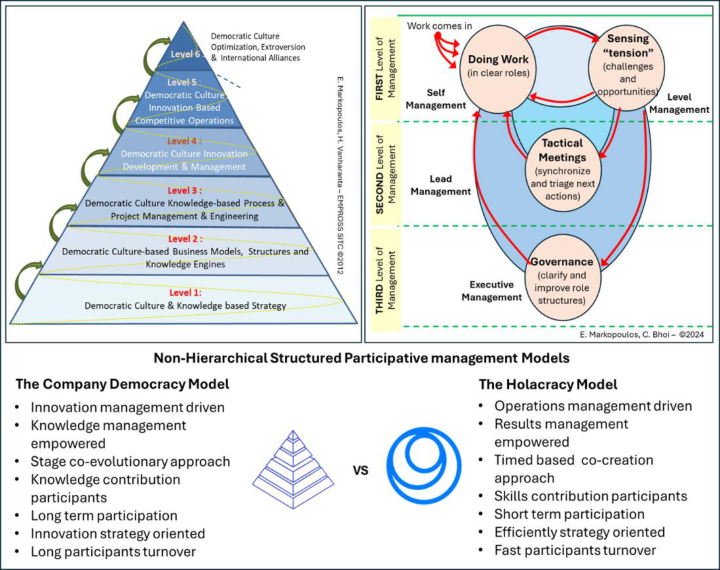
Two emerging participative management models—Holacracy and the Company Democracy Model—embody these principles and are reshaping organizational cultures with their non-hierarchical structures (see Figure 1).
The Holacracy Model applies an operations management approach, where participative management is utilized to form dynamic, self-organizing teams. These teams are tasked with addressing operational challenges, ranging from small projects to large-scale initiatives. The model emphasizes flexibility and adaptability in how teams are composed and how tasks are managed (Schell and Bischof, 2022).
In contrast, the Company Democracy Model follows an innovation management approach. It uses a non-hierarchical structure to encourage knowledge-sharing and contributions from all employees (Markopoulos and Vanharanta, 2014). This open exchange of ideas can spark innovative solutions, driving competitive projects, products, and processes within the organization. Both models support the growth of a disruptive organizational culture by promoting collaboration, adaptability, and a shared sense of responsibility.
Figure 1: Comparison of the company democracy model and the Holacracy model.
ORGANIZATIONAL STRUCTURE OF THE INDIAN MINISTRY OF EDUCATION India’s educational system and its policies are primarily governed by the Indian Ministry of Education. The Ministry is divided into two main departments: the Department of School Education and Literacy and the Department of Higher Education. In addition, the Principal Office of Accounts falls under the Department of Higher Education. All three departments report to the Ministers of State, who in turn report to the Cabinet Minister of Education.
The Department of School Education and Literacy focuses on ensuring universal access to quality education for children from pre-primary through secondary levels. This department is responsible for key functions such as policy design and enforcement, as well as managing large-scale education programs like Sarva Shiksha Abhiyan (SSA), the Mid-Day Meal Scheme (MDMS), and ensuring compliance with the Right to Education (RTE) Act (Indian Ministry of Education, 2025). Additionally, it oversees teacher training and development, and is responsible for monitoring and evaluating educational programs to identify areas for improvement. The leadership of this department includes the Secretary, Additional Secretary, and Joint Secretaries, who oversee the work of directors and operational staff. The decision-making flow within this department starts from the Minister’s office, moving to the Secretaries, Additional and Joint Secretaries, then to directors, and ultimately to district magistrates and block-level officers (Indian Ministry of Education, 2025).
The Department of Higher Education is responsible for improving India’s higher education system, which includes universities, research institutions, and technical education providers. This department manages prestigious institutions such as the Indian Institutes of Technology (IITs), National Institutes of Technology (NITs), and Indian Institutes of Management (IIMs). It also oversees key regulatory bodies like the University Grants Commission (UGC) and the All-India Council for Technical Education (AICTE) (Ministry of Human Resource Development, Government of India, 2020). The core responsibilities of this department include the development of educational infrastructure, policy formulation and implementation, managing student aid programs (including scholarships for underprivileged students), and ensuring that universities and colleges comply with national education standards. Similar to the Department of School Education, the Department of Higher Education follows a bureaucratic structure that requires multiple levels of review before decisions are made (Indian Ministry of Education, 2025).
The overall leadership of the Ministry of Education is headed by the Cabinet Minister of Education, who is responsible for strategic planning and policy direction. The State Ministers of Education represent the interests of their respective states, ensuring compliance with national education policies at the state level. Below them, Secretaries and Joint Secretaries manage the execution of policies and oversee the work of directors and operational staff (Indian Ministry of Education, 2025).
A Participative Management Approach Using the Company Democracy Model 87
CHALLENGES AND OPPORTUNITIES IN THE INDIAN MINISTRY OF EDUCATION Despite having an abundance of talented and capable individuals, the Indian Ministry of Education has often struggled to fully leverage their intellectual potential. The primary challenge lies in the traditional hierarchical structure, which limits cross-functional collaboration and stifles innovation. This structure can lead to the underutilization of the Ministry’s human intellectual capital, preventing it from achieving its full potential.
This challenge also presents an opportunity for growth, which could be addressed by adopting non-hierarchical organizational structures. By moving towards this approach, the Ministry could ensure that the right employees are assigned the appropriate responsibilities at the right time, facilitating the efficient execution of strategies. In a non-hierarchical system, employees’ contributions would be recognized based on their skills and expertise, rather than their position in the hierarchy. This would maximize the effectiveness of the Ministry’s human capital.
Such a system would also create motivational incentives for career development, empowering individuals to take ownership of their success by contributing valuable insights and solutions. Adopting this approach would not only lead to significant improvements within the Ministry, but it would also enable the Ministry to tap into India’s vast intellectual resources more effectively.
The shift towards non-hierarchical structures would promote better policy implementation, encourage innovation, and enhance adaptability within the Ministry. These organizational changes have the potential to make public sector institutions more responsive, impactful, and efficient—ultimately supporting the Ministry’s mission to provide high-quality, inclusive education across India.
SUITABILITY OF THE COMPANY DEMOCRACY MODEL FOR THE INDIAN MINISTRY OF EDUCATION The Ministry of Education consists of various departments operating under different verticals, with some functioning as autonomous bodies. The organization, as a whole, is composed of a diverse and highly qualified workforce that has the potential to make substantial contributions to the Ministry’s modernization through their knowledge, ideas, and insights. However, the Ministry could unlock its full potential by adopting participative management and leadership, which would focus on effectively utilizing the human intellectual capital within the organization. The current hierarchical structure, while functional, limits the exploration and utilization of this valuable resource (Bhoi et al., 2025).
After analyzing the organizational structure and challenges of the Indian Ministry of Education, this research proposes the adoption of the Company Democracy Model. It would delegate authority within the existing hierarchy to enhance leadership effectiveness in key areas such as knowledge management, innovation management, and talent management. A democratic, knowledge-driven approach, free from hierarchical barriers,
aligns with the Ministry’s employee-centric work culture, fostering skill development, improving performance, and promoting job satisfaction— essential elements for ensuring efficiency within a vital public sector organization.
As new projects and evolving needs continuously arise, it is crucial that knowledge management, data handling, decision-making, and service delivery remain carried out by a stable and engaged workforce. This approach would ensure consistency, improve the quality of outcomes, and protect the organization’s intellectual property, ultimately enabling the Ministry to better meet its goals and serve the public effectively.
ORGANIZATIONAL CHANGE AND NON-HIERACHICAL ORGANIZATIONAL STRUCTURES The Ministry of Education comprises various departments operating under distinct verticals, with some functioning as autonomous bodies. The organization is made up of a diverse and highly skilled workforce, capable of making significant contributions to the Ministry’s modernization through their knowledge, ideas, and insights. However, the Ministry has yet to fully tap into this potential. By adopting a participative management and leadership approach, it could better leverage the human intellectual capital within the organization. The existing hierarchical structure, while operational, limits the exploration and utilization of these valuable resources.
After reviewing the organizational structure and challenges faced by the Indian Ministry of Education, this research proposes the adoption of the Company Democracy Model. This model would grant greater authority within the existing hierarchy, boosting leadership effectiveness in critical areas such as knowledge management, innovation, and talent management. By fostering a democratic, knowledge-driven approach free from hierarchical constraints, this model would align with the Ministry’s employee- centric culture, promoting skill development, improving performance, and enhancing job satisfaction—key factors in driving efficiency in this crucial public sector institution.
As new projects and evolving needs arise, it’s essential that knowledge management, data handling, decision-making, and service delivery are carried out by a stable and engaged workforce. This approach would ensure continuity, improve outcomes, and safeguard the Ministry’s intellectual property, ultimately enabling the organization to meet its goals and better serve the public.
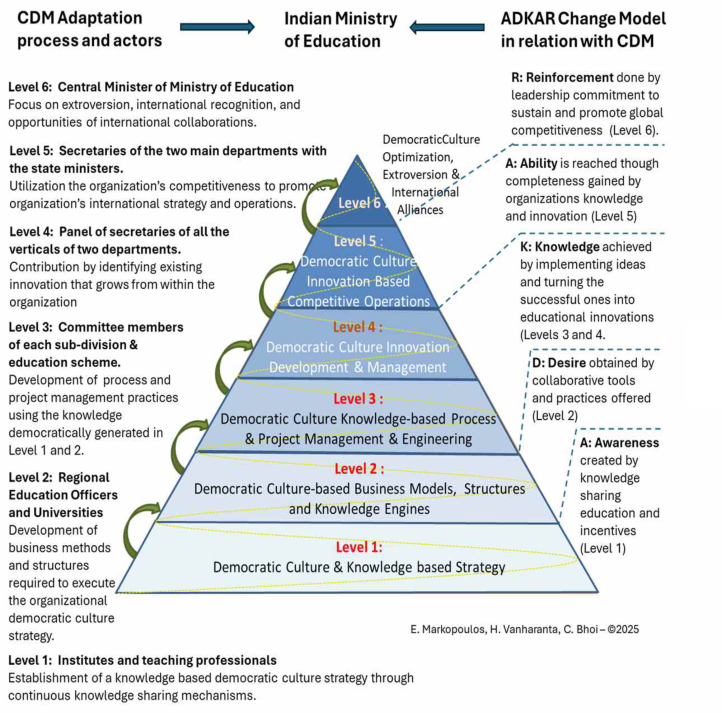
APPLICATION OF THE COMPANY DEMOCRACY MODEL USING THE ADKAR CHANGE MODEL The integration of the Company Democracy Model (CDM) with the ADKAR Change Management Model (Figure 2), creates a structured, multi- level approach that supports the development and implementation of a knowledge-based, democratic organizational culture. The ADKAR model has been specifically selected due to its Y-theory type of change management
A Participative Management Approach Using the Company Democracy Model 89
approach (Ali et al., 2021) which is aligned with the people-centric CDM (Markopoulos et al., 2023). This strategy is essential for planning, development, operations, and initiatives within the Ministry of Education.
Figure 2: Integrating the company democracy model with the ADKAR change management model in the indian ministry of education.
The proposed approach integrates the Company Democracy Model levels with the ADKAR Change Management Model activities in a co-evolutionary development process (Table 1).
It is important to note that the key actors involved in each level of the Company Democracy Model evolve as the knowledge created and the output generated advance from one level to the next. Similarly, the stages of the ADKAR Change Management Model reflect this evolution of knowledge creation, ultimately leading to the establishment of a new participative organizational culture.
Table 1: Sample human systems integration test parameters (Folds et al., 2008).
knowledge-based democratic culture strategy through continuous knowledge-sharing mechanisms
(D) Desire obtained by
Development of business
Level 2: Regional Education Officers and Universities
collaborative tools and practices offered
methods and structures required to execute the organizational democratic culture strategy.
(K) Knowledge achieved by
Development of process and
Level 3: Committee members of each sub-division & education scheme.
project management practices using the knowledge democratically generated in Level 1 and 2.
Contribution by identifying
implementing ideas and turning the successful ones into educational innovations Level 4: Panel of secretaries of all the verticals of two departments.
(A) Ability is reached though
Utilization the organization’s
existing innovation that grows from within the organization Level 5: Secretaries of the two main departments with the state ministers.
completeness gained by organizations knowledge and innovation (Level 5)
competitiveness to promote organization’s international strategy and operations Central Minister of Ministry
(R) Reinforcement done by
Level 6: Focus on
of Education
leadership commitment to sustain and promote global competitiveness
extroversion, international recognition, and opportunities for international collaborations A brief overview of the operations at each level of the Company Democracy model and how they integrate with the ADKAR change management model.
Level 1: Knowledge Generation & Awareness At this foundational level, the focus is on generating knowledge within educational institutions and among teaching professionals. This is achieved through assessments, workshops, and knowledge-sharing initiatives, helping define the organization’s growth potential. By aligning with NEP 2020, Level 1 plays a crucial role in raising awareness about change, leveraging fieldwork experience, and utilizing the ADKAR Change Model to enhance the understanding and readiness for transformation.
Level 2: Business Methods & Change Desire This level involves the development of the necessary business methods and structures to execute the organizational democratic culture strategy. It includes regional educational officers and university groups, who validate the knowledge generated in Level 1 and implement knowledge management practices within their teams. To promote change in line with NEP 2020, Level 2 focuses on building a desire for transformation, advancing knowledge
A Participative Management Approach Using the Company Democracy Model 91
management practices, and utilizing the ADKAR Change Model to encourage and manage change.
Level 3: Process Development & Change Knowledge At this stage, the focus shifts to developing process and project engineering practices, using the knowledge democratically generated in previous levels. Committee members from various educational subdivisions are responsible for implementing knowledge management practices and validating knowledge from Level 1. Level 3 strengthens the adoption of NEP 2020 by driving knowledge-based change using the ADKAR Change Model to ensure the processes align with the evolving educational goals.
Level 4: Organizational Innovation & Value Addition This level aims to identify and enhance existing organizational innovations that can contribute to global competitiveness. It consists of a panel of secretaries from key Ministry departments, who advance knowledge-based innovation. By applying the ADKAR Change Model, Level 4 enhances the Ministry’s capacity for innovation, positioning the organization to compete effectively in the global education sector.
Level 5: Business Ecosystems & Innovation Promotion Level 5 emphasizes leveraging organizational competitiveness to drive global strategy and operations. This level includes state education ministers and senior secretaries from major departments, who facilitate the creation of business ecosystems that promote innovation. The ADKAR Change Model ensures that the transformation framework is sustainable, fostering continuous innovation and adaptability.
Level 6: Globalization & Strategic Alliances At the highest level, the Ministry reaches global recognition by forming international collaborations, partnerships, and alliances. Led by the central Minister, who reports to the Cabinet, Prime Minister, and Parliament, this stage solidifies the Ministry’s global presence. By integrating the ADKAR Change Model, Level 6 reinforces the ongoing change process and establishes international education standards, aligning India’s education system with global best practices.
By progressing through these six levels, the Ministry of Education can significantly enhance its strategic capabilities, innovation potential, and global positioning. This approach ensures a smooth transition towards a knowledge-driven, democratic educational ecosystem that is both adaptive and globally competitive.
PRE AND POST CONDITIONS Pre-Conditions for Implementing the Company Democracy Model in the Ministry of Education.
As the Company Democracy Model is centered on empowering people, the pre-conditions for its successful implementation must focus on employee empowerment. Employees, especially those at Level 1, play a critical and challenging role in executing projects at the ground level. Therefore, training and communication programs should be specifically designed for them to equip them with the necessary skills and knowledge.
Employees from Levels 1 to 3 should also be provided with platforms to present their ideas for improvement and suggest projects or insights that can influence policy-making. Giving these employees the opportunity to contribute their perspectives can foster a sense of ownership and enhance their engagement in the process (Markopoulos and Vanharanta, 2017). Furthermore, there should be a focus on continuous learning, allowing employees to access the best practices, educational systems, and reforms from across the globe, enabling them to develop a diverse set of skills.
Post-Conditions for Implementing the Company Democracy Model in the Ministry of Education.
Once the Company Democracy Model is implemented, it is essential to ensure its sustainability through effective performance management. A robust performance mapping system should be established to track progress, adapt to feedback, and support micro-management where necessary. This system will help assess the ongoing effectiveness of the model and allow for continuous adaptation and improvement.
Employees should also be provided with social acknowledgment, rewards, and incentives for exceptional contributions. This can be done by establishing clear achievement metrics based on recognition, rewards, and incentives. Recognizing the efforts of employees will further motivate them to continue contributing to the Ministry’s goals.
Additionally, different verticals and smaller units within the Ministry should be granted democratic opportunities to set their own vision, implement new projects, and periodically audit their outcomes. This decentralization will foster a culture of accountability and ensure that each segment of the Ministry is aligned with the broader organizational goals.
This approach encourages continuous improvement, adaptability, and transparency, ensuring that all levels of the Ministry remain aligned with its vision and that the transformation continues to evolve in a positive direction.
LIMITATIONS AND AREAS OF FURTHER RESEARCH The primary limitation of this study lies in its reliance on a literature review and general insights into the Indian educational system, rather than detailed data gathered directly from various departments within the Ministry of Education. As a result, the recommendations are based on broader trends and challenges observed within the sector. However, this limitation also opens the door for future research.
To build on this study, future research could focus on specific units or departments within the Indian Ministry of Education. By collecting detailed data and insights from these areas, the proposed strategies could be further refined, tested, and validated through pilot implementations. This would not only strengthen the credibility of the findings but also allow for a more tailored approach that addresses the specific challenges and realities faced by the Ministry.
A Participative Management Approach Using the Company Democracy Model 93
CONCLUSION
The public sector across countries employs a significant portion of the workforce, ranging from 20% to 60%, offering job security and benefits that are unmatched by the private sector. Particularly during times of economic crisis, political instability, or geopolitical turbulence that affect global trade and business, the public sector often remains a stable and secure place to work, with its well-defined organizational and hierarchical structures. However, this stability can also lead to a situation where many public sector organizations hire large numbers of employees without fully harnessing the intellectual capacity within these organizations, missing out on the potential benefits that could be derived from effectively utilizing their intellectual capital (Markopoulos and Vanharanta, 2019).
This paper examined the Indian Ministry of Education, a large- scale organization playing a critical role in the country’s development and transformation. The adaptation of modern management approaches, particularly non-hierarchical organizational structures, is crucial for the identification, generation, and effective utilization of intellectual capital. By doing so, public sector organizations can optimize their workforce’s capabilities and maximize the impact of their contributions.
The study reviewed various management theories aimed at establishing and adapting participative management and leadership. It compared key participative management models as operational frameworks and analyzed change management theories as frameworks for adaptation.
The proposed integration of the Company Democracy Model with the ADKAR Change Management Model is presented as a highly suitable approach for the Indian Ministry of Education, and potentially for other large-scale, strategic public sector organizations globally. By implementing these models, public sector organizations can unlock the full potential of their human capital, drive innovation, and adapt more effectively to changing circumstances and challenges.
REFERENCES
Ali, M. A., Zafar, U., Mahmood, A., & Nazim, M. (2021). The power of ADKAR change model in innovative technology acceptance under the moderating effect of culture and open innovation. LogForum, 17(4). Bhoi, C. A., Markopoulos, E., Markopoulos, G., & Nandi, A. (2025). Applying
the Holacracy and Company Democracy Models to the Public Sector: A Critical Analysis of Implementation in the Indian Ministry of Education. Administrative Sciences, 15(3), 76. https://doi.org/10.3390/admsci15030076 Cho, T., & Kim, C. (2009). Participative management practices for improving performance in public sector organizations: Mediating roles of performance feedback. International review of public administration, 13(3), 35–51. Indian Ministry of Education (2025). Organisation Chart | Government of India, Ministry of Education. [online] Education.gov.in. Available at: https:// www.education.gov.in/organisation_chart_mhrd. Koopman, P. L., & Wierdsma, A. F. (2013). Participative management. In A
handbook of work and organizational psychology (pp. 297–324). Psychology Press.
Markopoulos, E., Jordanou, A., Vanharanta, H., Kantola, J. (2023). Co-opetitive Management and Leadership Methodology for Democratic Organizational Change. In: Salman Nazir (eds) Human Factors in Management and Leadership. AHFE (2023) International Conference. AHFE Open Access, vol 92. AHFE International, USA. http://doi.org/10.54941/ahfe1003731. Markopoulos, E., Refflinghaus, J., Roell, M., Vanharanta, H. (2022). Understanding
Situationality using the Kepner-Tregoe Method in the Company Democracy Model to increase Employee Engagement and Knowledge Contribution. In: Evangelos Markopoulos, Ravindra S. Goonetilleke and Yan Luximon (eds) Creativity, Innovation and Entrepreneurship. AHFE (2022) International Conference. AHFE Open Access, vol 31. pp 196–207. AHFE International, USA. http://doi.org/10.54941/ahfe1001522 Markopoulos, E., & Vanharanta, H. (2019). Public Sector Transformation via Democratic Governmental Entrepreneurship and Intrapreneurship. In Advances in Intelligent Systems and Computing Vol. 1026 (pp. 867–877). doi: 10.1007/ 978-3-030-27928-8_131 Markopoulos E. & Vanharanta H., (2018): Project teaming in a democratic
company context, Theoretical Issues in Ergonomics Science, doi: 10.1080/ 1463922X.2018.1439543. Markopoulos, E., Vanharanta, H. (2017). Space for Company Democracy. In: Kantola, J., Barath, T., Nazir, S., Andre, T. (eds) Advances in Human Factors, Business Management, Training and Education. Advances in Intelligent Systems and Computing, vol 498. Springer, Cham. https://doi.org/10.1007/978-3-319- 42070-7_26 Markopoulos, E; Vanharanta, H; (2015) The Company Democracy Model for
the Development of Intellectual Human Capitalism for Shared Value. Procedia Manufacturing, 3 pp. 603–610. 10.1016/j.promfg.2015.07.277. Markopoulos, E., & Vanharanta, H. (2014). Democratic culture paradigm for organizational management and leadership strategies-the company democracy model. In Advances in Human Factors and Sustainable Infrastructure. 5th International Conference on Applied Human Factors and Ergonomics (Vol. 20, pp. 190–201). Ministry of Human Resource Development (2020). National Education Policy
2020 Ministry of Human Resource Development Government of India. [online] Available at: https://www.education.gov.in/sites/upload_files/mhrd/files/NEP_Fin al_English_0.pdf. Nonaka, I., Kodama, M., Hirose, A., & Kohlbacher, F. (2014). Dynamic fractal organizations for promoting knowledge-based transformation–A new paradigm for organizational theory. European Management Journal, 32(1), 137–146. Schell, S., & Bischof, N. (2022). Change the way of working. Ways into self-
organization with the use of Holacracy: An empirical investigation. European management review, 19(1), 123–137. Wang, Q., Hou, H., & Li, Z. (2022). Participative leadership: A literature review and prospects for future research. Frontiers in psychology, 13, 924357.
LISTED IN THE AHFE DIGITAL BOOKSTORE CATALOGUE
Explore the complete digital volume
Human Factors, Business Management and Society
Read this individual research paper free through the original publisher, or explore the full digital proceedings book.
ISBN 978-1-964867-52-6
Explore this ISBN in the AHFE Bookstore ↗Listed in the July 2026 bookstore catalogue; search by ISBN to confirm current availability · Digital book purchase optional