Evangelos Markopoulosa, Hannu Vanharantab (2018). Democratic Culture Paradigm for Organizational Management and Leadership Strategies - The Company Democracy Model. In: Advances in Human Factors and Sustainable Infrastructure. AHFE Open Access, vol. 3. https://doi.org/10.54941/ahfe100111
Democracy is one of the most powerful words in the world. A word that indicates justice, equality, development, prosperity, respect, freedom, rights, fairness and many other significant meanings that no other word in any language can express better. However, managing, leading, achieving, and sustaining democracy in its true meaning is very difficult, not to say almost impossible. In this research we developed and defined a democratic company culture method and revealed its main components through a new organizational co-evolutionary spiral method and a process for creating a culture that suits different organizations. Companies can create new knowledge, initiate, innovate, understand, perceive and apply the results from the method and manage and lead the company to improve the degree of democratic company culture. Theoretically, the overall procedure adopted in our research is the same as that which has been presented for human and company performance improvement. First, the actuality is viewed through the current democratic behavior. Then the capability and the potentiality in the organization are examined. In this process, the indicative critical issues addressed and answered are: Actuality > what are we managing to do now for our organization’s democratic behavior? Capability > what could we achieve now to develop democratic behavior in our organization? Potentiality > what could we be doing to develop our organization’s democratic behavior? This paper presents our first approach towards identifying and defining the degree of company democracy.
Understanding democracy requires, firstly, situational self-awareness (the most important Delphic Maxim is ‘gnothi seauton’, i.e. know yourself), which in turn requires humble and honest knowledge, whether it is applied at a governmental, organizational, or individual level. Secondly, having the ability to create, perceive and properly interpret knowledge requires a culture in which good self-knowledge, self-control, commitment, motivation, cognitive capacity and competence as well as social skills are promoted. Thirdly, situational awareness on the other hand requires multi-faceted knowledge, information and data that create meanings among people. Creating such a culture with a good basic ontology requires a strong strategy to manage it and powerful leaders and managers to execute it. Being democratic or applying democracy to an organization is therefore not an easy task, objective or goal for managers, leaders and their organizations.
The Company Democracy Paradigm is based on the framework through an organizational evolutionary stage (level)- based spiral method used for the creation and execution of knowledge-based democratic cultures for effective organizational management and leadership strategies. Through such aco-evolutionary spiral method, an organization can identify and achieve the capacity, capability, competence, and maturity needed for moving through the Company Democracy levels (from a lower level to the higher). The spiral process, in this context, is based on the idea of managing the degree of democracy in organizations. The levels in the method correspond to the elements and steps of organizational democracy development. When all of these are fulfilled, the organization can be considered to have reached the point where organizational democracy can be applied efficiently, effectively, and rewardingly. By integrating engineering, management, leadership and social sciences is an opportunity and a challenge to redefine the concept of democracy at organizational operations.
For an organization it is therefore important first to understand the current degree of democracy and how this degree should be improved over time. Only those organizations with ‘self-grown’ innovation, and not imported innovation, can be successful. Effective change in the culture of any organization can be achieved through changing the people inside the organization with proper education and learning activities, but also by measuring the progress of democratic co-existance inside the organization that can enable the desired changes. (Vanharanta, 2013).
Company Democracy can be effectively applied in all type of organizations in any sector and of any size. It is a unique method that promotes the human being as the center of organizational development achieved through ethos and knowledge, elements which develop organizational culture, sustain leadership, and innovation, resulting in competitiveness and extroversion. The Company Democracy Model is a holistic model expanded to Company Micro and Macro Democracy, Company Democracy, Corporate Democracy, Business Democracy, Organizational (Institutional) Democracy, Enterprise Democracy and also Entrepreneurial Democracy for SMEs and Inventors.
THE CAPABILITY AND MATURITY TO CHANGE In general, it is important first to understand the needs as well as the current state of the organization before targeting new organizational targets and expectations. This kind of proactive vision, created with the people inside the organization, gives the people the capability to collaborate and develop organizational democracy in harmony with top leaders and executives. The development of any type of organizational culture, and even more an organizational democratic culture, must be driven by maturity stages (levels) targeted to specific organizational capability/capacity goals (Markopoulos, 2008). Any democracy, even an organizational democracy, depends on the maturity of the organization to achieve the capability and competence needed to move democratically from stage A to stage B and so on. Achieving this capability and maturity requires a co-evolution environment and a spiral-staged evolutionary development approach as the prime elements of democratic organizational culture development.
However, it must be noted that such an approach requires strong leadership and management culture to be developed and maintained gradually. It also requires innovative and strategic management and planning to reach such a degree of organizational maturity that can utilize organizational knowledge in a sophisticated way towards creating a democratic organizational culture for organizational development. The company democracy paradigm presents a framework that combines such requirements , supported by the use of fuzzy logic as the necessary technology to handle and control the fuzziness that exists in all management methods, models, and practices. Common sense is not that common, and concepts such as democracy have proved to be very fuzzy to understand, lead and manage.
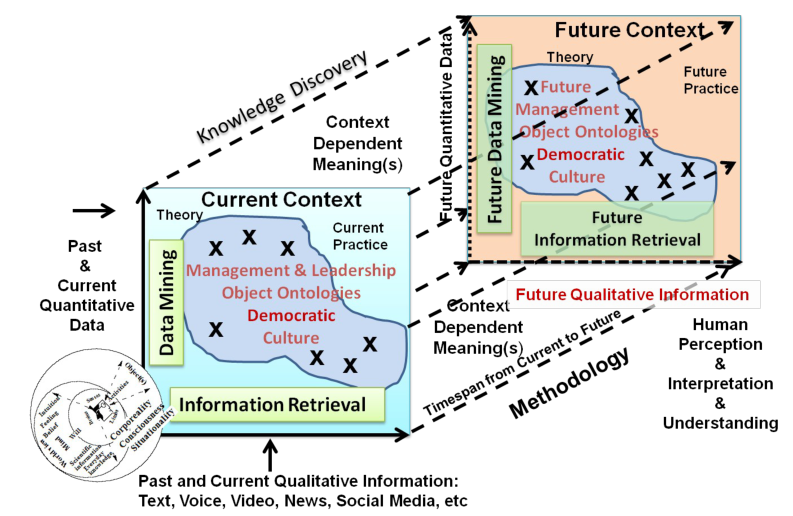
RESEARCH METHODOLOGY The research methodology used in Company Democracy combines a variety of different methods together in order to obtain real situation-aware computing, aiming to defining the degree of company democracy. The methodology is focused on covering both past and current data as well as current information in obtaining an idea of how people evaluate democratic development in their own company at present and in the future (see Figure 1).
The basic principle is to try to see how people view their company in their minds (Vanharanta, 2005). If they see it as ‘just a job’, then there is no need to go further since they do not care much about it, but if people see their work as part of their life, as a society in which they live, then more can be done with them on Company Democracy.
Figure 1. The ontology knowledge framework and methodology
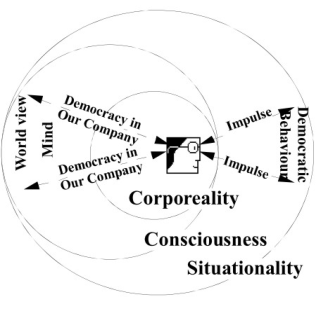
Therefore, by analyzing the behavior patterns of people in their work, meetings, decisions, and other activities, creating the Corporeality, very important information can be obtained about their past, to justify their present situation and forecast their future (see Figure 2).
Figure 2. Holistic Concept of Humans with Democratic Behavior Concept The holistic concept of a human consists of corporeality, consciousness, as well as situationality (Vanharanta, 1997). A person sees the object’s democratic behavior in his or her company. If this is then combined with a larger view, a new dimension is projected of how people can have different concepts of their situation and how they handle these concepts so that they can explain their situation and also understand how different concepts build meanings in their brains now and in the future (see Figure 3).
It is important to envisage an accessible future democratic company culture i.e. What does it contain? and How can the degree of company democracy can be evaluated? Past, current and future data, information and knowledge are therefore very important. The company must have scenarios, visions and plans of how a democratic company culture can be created. Each company member envisages a democratic company in her/his own way; however, a collective view first gives a perception and understanding of a democratic company culture, i.e. the current situation as well as what people would like to see. People must first understand the concept of democracy, and then to interpret it through the Company Democracy model, to perceive their own as well as the collective view of this important management and leadership issue.
Before utilizing of the research instruments for this methodology, it is important to understand the wider construct of company activities, which lead towards a democratic company culture. For that, the spiral method of company democracy is one important support process for democratic company growth.
Figure 3. The Meta-Physical Contrast in Democratic Company Culture
Figure available in the original PDF paper.
BASIC PRINCIPLES OF THE SPIRAL METHOD The Spiral Method is based on the concepts of process agility and mutation, which is defined as the flexibility a process can have towards achieving an organizational goal (Markopoulos, 2008). Organizational democracy is a very heavy and fuzzy concept in terms of definition and adoption. Process engineering is the prime discipline which approaches such a goal. Since democracy can be seen as a live entity with continuous change, it must be managed with agile practices that reflect such environments in order to absorb the ideas and voices of all and not just the few.
Concepts such as organizational re-engineering, re-construction, re-definition, transformation, optimization and so on, are too hard to support a democratic environment since they are based on a change that cannot easily be ‘unchanged’ later on. In order for such concepts to be effective, organizational change through agile and mutated practices is required. Change is a very hard word for live entities such as humans or organizations, therefore the risk of making an unsuccessful or erroneous change is very high, and the consequences can be devastating. The Company Democracy Model through the Spiral Method has a structured path towards supporting an organization to reach its democratic management and operations, but in this journey nothing can be considered predictable and standard. As the goal is democracy, people must learn first to be co-operative in order to co-exist and co-evolve.
RESPONSIVE ENVIRONMENT FOR DEMOCRATIC DEVELOPMENT IN ORGANIZATIONS The Spiral Method of the Company Democracy model is used as the core tool for evolutionary organizational development through the creation of an organizational democratic culture based on the organizational knowledge, capability, and maturity on strategic goals. It has been designed in such a way as to help organizations evolve in expertise and maturity towards reaching their strategic goals democratically. The method, through its iteration loops or spiral levels, creates an evolutionary framework in which an organization moves from a strategy design, which in this case is the organization’s democratic strategy, to the deployment of the strategy, based on an organizational democratic culture that generates knowledge for that purpose.
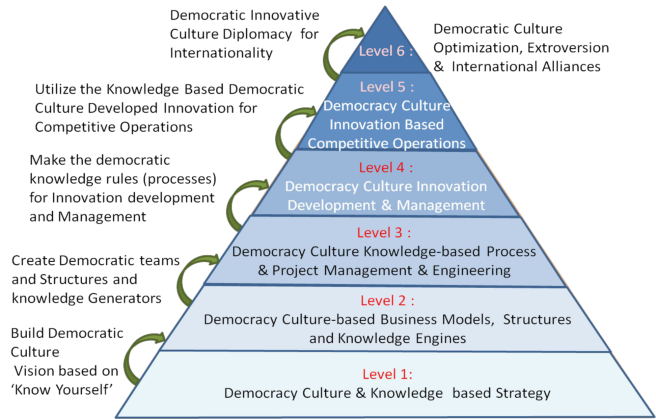
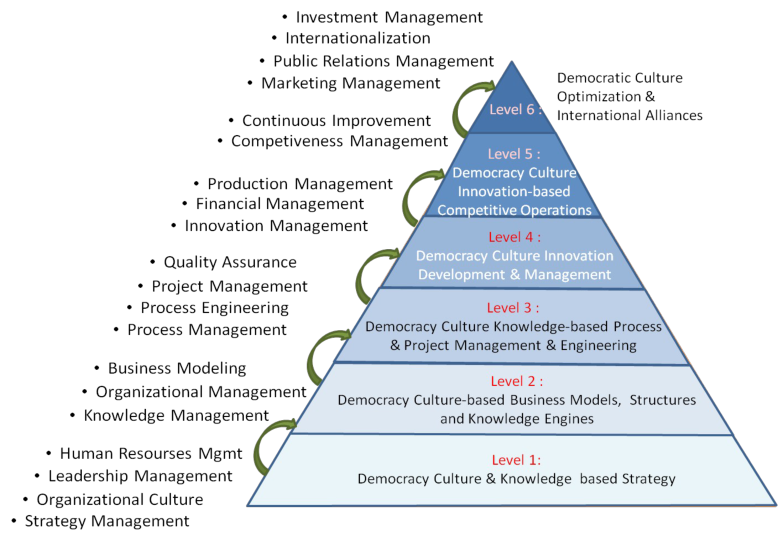
This path can be achieved via the following six levels of the Spiral Method for Organizational Democratic culture development: Level 1: Democratic Culture Knowledge based Strategy; Level 2: Democratic Business Methods, Structures and Knowledge Management; Level 3: Democratic Culture Process and Project Engineering; Level 4: Democratic Culture Innovation Management; Level 5: Democratic Ecosystems Development for Competitiveness; Level 6: Extroversion & Internationalization.
The Company Democracy Spiral Method levels are represented in a pyramid-like structure (see Figure 4). The pyramid shape has been chosen to point out the incremental progression of the levels and also to illustrate that not all who attempt this route can reach the top without commitment, determination, or organizational strategy.
Level 1 helps an organization define a knowledge based organizational democratic culture strategy, which is important for planning, development and operations, activities and initiatives. Through assessments, the organization defines and identifies the organizational knowledge that lead towards understanding its position in the democratic culture concept, its capability and maturity to proceed, and the strategy to follow towards that goal. No culture, and especially the democratic ones, can develop effective strategies without knowledge.
With such a strategy in hand, Level 2 contributes towards the development of the business methods and business structures required for the organizational democratic culture strategy to be executed. This is achieved by knowledge management practices and through knowledge elicitation engines, gathering the knowledge that democratically derives from Level 1. The development of democratic and knowledge-based business methods and structures is based on the democratic culture strategy developed by the organization. With such a strategy, the business methods define the activities and initiatives that need to be executed for the realization of the strategy, while the organizational structures define the hierarchies to be put in place in terms of personnel, management, operations, and other organizational elements. The business method defines ‘WHAT’ needs to be done while the business structures define ‘HOW’ it will be organized and achieved.
Figure 4. The Company Democracy Organizational Development levels.
Level 3 contributes on the development of process and project engineering processes, using the knowledge democratically generates in the previous levels, towards the design, implementation and application of projects and initiatives within the organizational development culture and strategy. The term process engineering integrates or develops organizational management processes and project management processes. Process engineering creates/defines processes and process management executes them, while project engineering creates/defines projects and project management executes them (Markopoulos, 2008). Management of organizational knowledge is required for both process and project engineering. Level 3 of the spiral method is very significant since it requires development (engineering) in order for the organizations to grow. Development, on the other hand, requires knowledge and knowledge can hardly exist without a democratic culture and strategy.
The first three levels of the spiral method develop the infrastructure for the creation and adaptation of Company Democracy. Strategy, business methods & structure, and process & project engineering cover the necessary basic operational and organizational development requirements for an organization to operate successfully and effectively. On the other hand, there are, and should be, organizations targeting internationalization and more aggressive and challenging development routes. Such routes can only be achieved through the development of organizational innovation, competitiveness, organizational ecosystems, international networking and extroversion. Company Democracy is needed much more in organizations targeting such development strategies. It is precisely the democratic mentality that can allow innovation, an innovative culture, and innovative thinking to develop competitiveness and extroversion. It is the democratic culture that can utilize the voice, capability, and maturity of everyone in the organization to achieve internationalization successfully as a common goal for all, and not simply as a target of the Board of Directors.
Under this prism, Level 4 contributes towards identifying the real innovation of the organization that can make the organization stand out solidly in the international arena. In order to be competitive, all organizations need to identify their strong areas, and strengths that can make a difference and get them noticed in a competitive environment. Identifying innovation and managing innovation are relevant but separate activities. Once the innovation in an organization has been identified, the organization’s strategy needs to be redefined in order to integrate the organization’s innovative elements in the strategy in an attempt to use them as competitive forces. Innovation management is a very significant initiative for all organizations desiring to develop serious competitive advantage.
With organizational innovation achieved through a democratic knowledge based organizational culture environment, Level 5 aims on the competitiveness gained from innovation and the promotion of the organization to international operations. This can be achieved through the creation of organizational business ecosystems which can promote organizational innovation and competencies. Not all innovations can be sustainable. Those who can make it to the industry through internal and external organizations eco-systems create the rewarding competitive advantages. Being accepted presupposes being competitive, and being competitive requires innovation. Innovation requires development, development requires knowledge, whereas knowledge requires a democratic culture. Level 5 is the one that gives the organization all it had worked for in the previous levels, i.e. competitiveness through co-opetition not competition.
Once an organization reaches Level 6, it reaches the peak of the strategy, i.e. extroversion, international recognition, and all the opportunities that come with the development of international collaboration, partnerships and consortia worldwide. Collaborating and participating in international schemas require high organizational competitiveness, innovation, maturity and capability to stand at this level with strong democratic processes not only technically but also in terms of communication, operation, production, and continuous knowledge utilization.
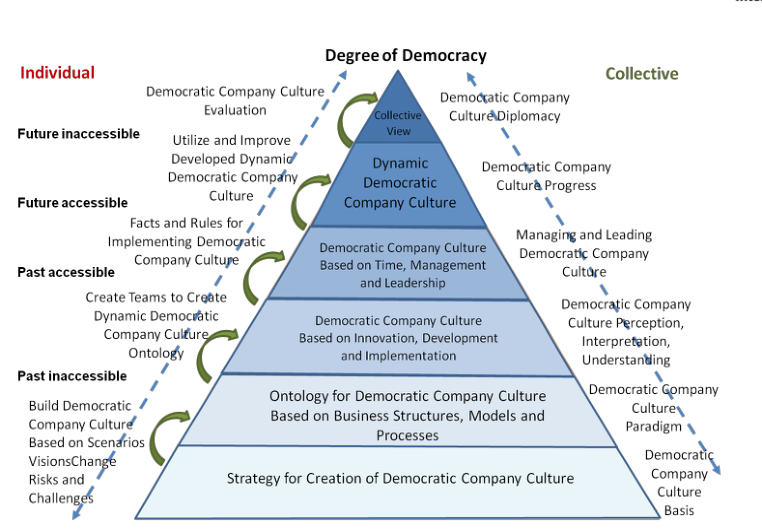
The Company Democracy levels provide the actions to be processed/proceed towards the identification of the degree of company democracy through a new pyramid type representation based on the individual and collective evolution dimensions (see Figure 5).
Figure 5. Dynamic Democratic Company Culture Co-Evolutionary Method The individual side of the pyramid can remember and see the past inaccessible part of the company democracy process, which may be accessible today and in the future. From a collective point of view, the democratic company culture basis must be firm, the created paradigm must contain all the known information, and the democratic company culture must be understood, interpreted and perceived by each company member. Company managers and leaders must know the constructs and concepts as well as the indicators, so that they can manage and lead this kind of fuzzy concept in their company and see how changes happen through key figures. The implementation continues at each company level.
The overall result of this is the identification of the possibility to evaluate the current degree of company democracy as well as to see how the people inside view the subject. Such research instruments can be accessed by everyone in the organization, allows them to evaluate, when asked, how they feel about the company democracy in their organization.
The six levels of the Company Democracy Spiral Method are supported by a number of activities executed in the method loops. The first five loops are composed of three prime activities carried out preferably in the following order: 1. Training: In order for the organization to define a common language and establish a common understanding of the level requirements. 2. Assessment: To identify the distance between the ‘as-is’ and the ‘to-be’ in the organizational democratic culture development framework. The assessment can also define the actions, priorities, effort cost and specific human recourses needed for the level to be completed. 3. Implementation Actions: The assessment results need to be executed towards reaching the requirements of the level in the development of the organizational democratic culture strategy and operations framework.
This triplet of activities, implemented at each level of the Company Democracy Spiral Method can guide the organization from level 1 to level 6. The Co-Evolutionary spiral process for a dynamic knowledge based company democracy culture version of the Company Democracy Spiral method identifies all the directions and operations an organization can have in its journey to innovative, competitive and leading extroversion (see Figure 6).
Figure 6. Co-Evolutionary Spiral Process for Dynamic Company Democracy Culture Development It must be noted that the Company Democracy Spiral Method has five (5) entry points, indicating that the organization is not obliged to go through all the levels if it is considered to have the required expertise and maturity to apply organizational democratic culture from any level and not necessarily from the start (Level 1). It must also be noted that all levels start with training and assessment actions. This helps the organization identify whether it can really start at the desired entry level without going through the previous ones. If the organization fails to advance to the next level, then the option to move one level down and complete the prerequisites is always available.
Figure available in the original PDF paper.
Organizations can repeat a level if they wish to be really confident before advancing to the next one. Once an organization reaches the optimal goal (Level 6), then the organization can redefine its strategy or develop a new one and start the process over again for that new strategy (from the beginning or from any other level).
THE SPIRAL METHOD FOR KNOWLEDGE CREATION OF DEMOCRATIC BEHAVIOR The Company Democracy Spiral Method is a vehicle for creating an organizational democratic culture for the operation and development of an organization. The six levels of the method are structured in such a way that the method reflects the Co-Evolute methodology (Kantola 2006) and its application in organizational democratic performance.
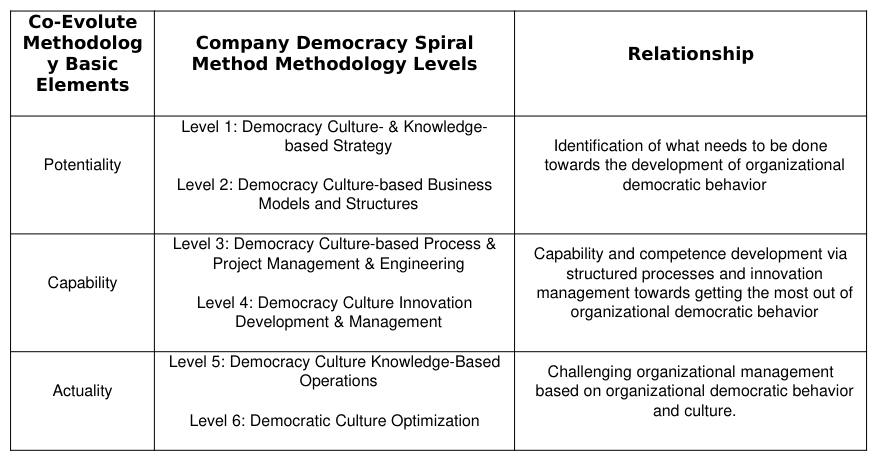
Levels 1 and 2 of the Spiral Method reflect the first basic element of the Co-Evolute organizational democratic performance approach, which is Potentiality. The relationship is based on the identification of what needs to be done towards the development of the organizational development culture and what organizational infrastructure is required to be there. Levels 3 and 4 of the Spiral Methods reflect the second basic element of the Co-Evolute organizational democratic performance approach, which is Capability. The relationship is based on the need for the development of organizational competencies within an organizational democratic culture framework, towards the achievement of democratic organizational operations and performance. Levels 5 and 6 of the Spiral Method reflect the third basic element of the Co-Evolute organizational democratic performance approach, which is Actuality. The relationship is based on the utilization of an organizational democratic culture once it is in place (see Table 1).
Table 1. Correlation between the basic elements of the Co-Evolute and the Spiral method methodologies
Both organizational development methodologies (Co-Evolute and the Company Democracy Spiral Method) are based on the utilization of the organizational knowledge that defines the organizational capability and maturity targeted towards the creation of an organizational knowledge-based culture (Paajanen, 2006). Both methods are based on the identification of an organizational strategy, which will first utilize organizational knowledge by developing a knowledge-based organizational culture that can be constantly contributing to the organization by transforming organizational tacit knowledge into explicit knowledge (Nokaka, 1995).
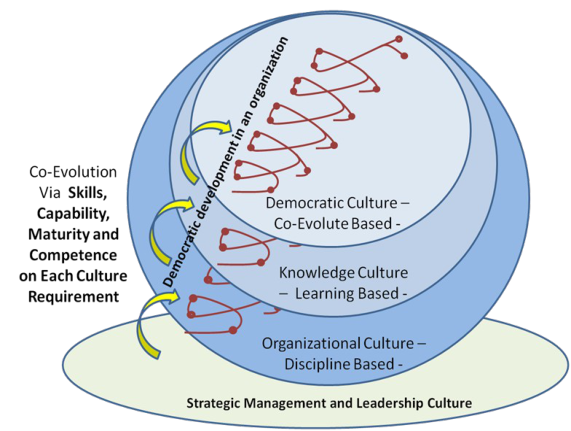
Through this transformation, a knowledge-based organizational culture can be the infrastructure of organizational democratic culture development. In order for an organization to apply democratic processes, strategies and leadership it is important to master, the best possible way, the organizational knowledge that can be used to defend, justify, and support the democratic organizational culture and development within the organization. Therefore, the chain between the concept of democratic culture, knowledge culture, and organizational culture starts from the identification of a democratic organizational strategy that will support the development of these three cultures based on the capability and maturity of the organization to learn itself first (see Figure 6).
Figure 7. Democratic Culture co-evolution within organizations
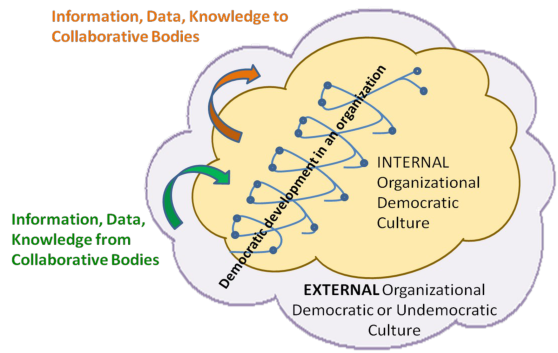
The Company Democracy Spiral Method presents the evolution of organizational knowledge within democratic behavior in a more dynamic way. The six levels of the method develop the organizational capability and maturity through an organizational knowledge culture that can be evolved into an organizational democracy-based knowledge culture. Regarding the development of such a culture, the organization can utilize the internal knowledge generated inside the organization but also the external knowledge generated outside the organization (partners, suppliers, customers, etc). This unintentional or targeted knowledge swapping process contributes significantly not only to the generation of practical knowledge, but towards extending the organizations culture outside the organization as well. Organizations that share common knowledge through common or open processes, methods and practices, form intentionally or unintentional organizational ecosystems that can support more effective collaborations.
A knowledge-based organizational democratic culture method can be developed via the Company Democracy Spiral Method within the organization itself (see Figure 8).
Figure 8. Democratic Culture co-evolution within organizations
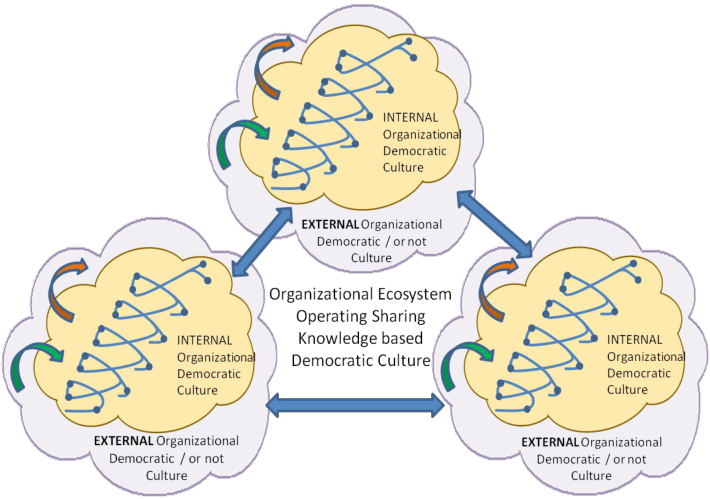
The direct and indirect, intentional and unintentional exchange of knowledge between organizations can be conceived, valued and utilized differently if an organizational democratic culture is in place. For the external - incoming knowledge, in particular, the existence of an organizational democratic process can significantly support its best possible assessment and utilization. Therefore, instead of having selected, even qualified, knowledge management experts or knowledge engineers, to access the organization’s external knowledge, environment and culture, this can be more effectively done if everyone in the organization contributes, based on their role and expertise. In a similar way, this concept can be expanded furthermore, by integrating in a more formal way, organizations collaborating with each other. Organizational networks can develop formal organizational ecosystems if, and only if, common organizational cultures are shared. A wider group of organizations can collaborate in a line of business, shared product or service development, etc, and jointly evolve through the utilization of each other’s knowledge with organizational democratic cultures in each organization (see Figure 9).
Taking this concept furthermore, organizational ecosystems based on democratic culture can increase in size, forming industry management and operating standards based on open democratic culture principles that promote the exchange and utilization of knowledge within organizations with similar operating processes, goals and visions.
Such wide organizational ecosystems can have a significant effect, at industry, sector, or region level, on ways of doing business, conceiving knowledge, development of strategies, utilization of human resources, promotion of innovation, redefinition of profitability, efficiency, productivity, and much more by having as common denominator the open co-evolutional democratic culture concept.
METHODS FOR QUALITATIVE ANALYSIS OF ORGANIZATIONAL DEMOCRACY The analyses described in this paper can be conducted with the help of ontologies and fuzzy logic. First, the relevant concepts for organizational democracy levels and their relationships can be modeled by means of ontologies. The degree to which each concept is present on the organizational democracy level can be modeled using fuzzy sets and fuzzy logic (Klir, 1995).
A fuzzy set can be defined mathematically by assigning to each possible individual in the universe of discourse a value representing its grade of membership in the fuzzy set. This grade corresponds to the degree to which that individual is similar or compatible with the concept represented by the fuzzy set (Zadeh, 1965). In this work, the perception of democracy in organizations becomes a degree of membership of fuzzy sets representing different levels of perceived democracy ontology.
Fuzzy logic is reasoning with imprecise matters. Fuzzy logic has two principle components. The first is a translation system for representing the meaning of propositions and other semantic entities. The second component is an inferential system for arriving at an answer to a question that relates to the information resident in a knowledge base (Zadeh, 1983). In the Company Democracy model, propositions refer to the semantics of democracy in organizations. Therefore, a knowledge base refers to a collection of presented meanings important in different management and leadership concepts (here: democracy in organizations). Fuzzy logic provides Decision Support
Systems (DSSs) with powerful reasoning capabilities. Vagueness in linguistics can be captured mathematically by applying fuzzy sets. Our ability to make precise and yet significant statements about a system’s behavior diminishes as the complexity of a system increases (Zadeh, 1973). Therefore, we cannot make accurate observations on complex systems – such as democracy oriented methods and systems.
Conventional mathematical methods require several preconditions to be met before they can be utilized, especially when there is concern about the independence of the factors being used. Fuzzy logic allows us to ignore these preconditions, due to the use of linguistic variables (Zadeh, 1975). Therefore, it is understood that ‘conventional’ mathematical methods face difficulties when applied to complex systems involving humans, such as democracy in this case.
CONCLUSIONS
The integrated Company Democracy Model supports an interdisciplinary approach (management strategy, knowledge, innovation, human resources, technology, production, leadership, quality, processes, innovation, research and development, etc.). It is a union of administrative and technocratic processes in an anthropocentric method that directs all sciences and practices towards the effort to unite people through the freedom of expression and to produce knowledge as raw material for innovation (see Figure 10).
Figure 10. Company Democracy: A Multidisciplinary Management Method The Company Democracy Model and the Spiral method can be considered as a tool that sets up the infrastructure needed to support an organizational knowledge based democracy culture. The Spiral method levels can be considered as the staged arena in which democracy can be measured, based on the effectiveness of the organizational culture developed. The loops/levels of the Spiral method are the organizational development and operational challenges that need to be tackled in a democratic way. They are the areas where organizational democracy needs to be demonstrated in order to ensure that the organization has the capability and maturity to apply such management methods that can be followed and executed by all and not just a few.
Taking for instance the innovation level of the Spiral Method, it is important to understand that no innovation can be developed unless there is a democratic culture in the organization where every idea can be presented by anyone, at any time, on any subject. The process engineering level of the Spiral method behaves in a similar way. Process and project engineering methods and practices need to be developed in a democratic environment in order to be accepted by all and to be used by all. In this content each Spiral Method level contributes towards achieving strategic organizational development milestones in a democratic way. Lack of democracy in the execution of such significant organizational development stages can have limited or no rewarding results. The Co-Evolute Theory and Methodology works supportively inside and around the Spiral Method towards developing an organization culture that can exist and succeed in democratic environments. A staged development approach is required, in which all organizational assets, including organizational knowledge, need to be utilized in an incremental and agile way.
Without an organizational democratic culture, with education morals, organizational knowledge cannot be created. Thus without organizational knowledge there is no innovation, and without innovation there is no development, and without development there is no competitiveness, and without competitiveness there is none of the extroversion required in today's globalized society.
REFERENCES
Kantola, J., Vanharanta, H. and Karwowski, W., (2006), The Evolute System: A Co-Evolutionary Human Resource Development Methodology. In the International Encyclopedia of Ergonomics and Human Factors. Karwowski, W. (editor), 2nd Edition, CRC Press, Boca Raton, Florida, USA. Klir, J.G., and b. Yuan. 1995. Fuzzy Sets and Fuzzy Logic, Theory and Applications. Prentice Hall, Inc. Markopoulos E., Bilbao J., Christodoulou E., Stoilov T., Vos Tanja,, and Makatsoris C. (2008). Process Development and
Management: towards the maturity of organizations. International Journal of Computers, Issue 4, Volume 2, pp. 361-370. Markopoulos E., Bilbao J., Stoilov T., Vos, T., and Reschwamm K.. (2008). “Project Management Stage Mutations within Agile Methodological Framework Process Transformations,” WSEAS International Conference on Circuits, Systems, Communications and Computers, Beijing, China. Markopoulos E., Panayiotopoulos J-C., Bilbao J., Makatsoris C., Samaras G., Stoilov T., (2008) “Project Management Process
Framework for Developing and Managing IT Systems.” 12th WSEAS International Conference on Computers., Heraklion Greece. Nonaka I., Takeuchi H., (1995) “The Knowledge-Creating Company: How Japanese Companies Create the Dynamics of Innovation,” New York, Oxford University Press. Paajanen, P., Piirto, A., Kantola, J., Vanharanta, H., (2006) “FOLIUM - Ontology for Organizational Knowledge Creation”. 10th
World multi-conference on systemics, cybernetics and informatics. Orlando, Florida, USA. Vanharanta H., Markopoulos E., (2013), “Creating a Dynamic Democratic Company Culture for Leadership, Innovation and Competitiveness”. 3rd Hellenic-Russian Forum. September 17, Athens, Greece. Vanharanta, H., (2005), “Co-Evolutionary Design for Human-Compatible Systems,” Conference on Computer-Aided
Ergonomics and Safety, May 25 - 28, Technical University of Košice, Slovakia. Vanharanta H., Pihlanto P., Chang A., (1997), “Decision Support for Strategic Management in a Hyperknowledge Environment and The Holistic Concept of Man,” HICSS '97 Proceedings of the 30th Hawaii International Conference on System Sciences. Hawaii, USA. Zadeh, L. (1965). “Fuzzy Sets,” Information and Control 8 (3): pp.338–353. Zadeh, L. (1983). “Commonsense Knowledge Representation Based on Fuzzy Logic. Computer.” Computer 16 (October):61–65. Zadeh, L. (1973). “Outline of a New Approach to the Analysis of Complex Systems and Decision Processes.” IEEE Transactions
on Systems, Man, and Cybernetics 1 (1): pp. 28–44. Zadeh, L. (1973). The Concept of a Linguistic Variable and its Application to Approximate Reasoning-I, Information Sciences, (8): pp. 199-246
LISTED IN THE AHFE DIGITAL BOOKSTORE CATALOGUE
Explore the complete digital volume
Advances in Human Factors and Sustainable Infrastructure
Read this individual research paper free through the original publisher, or explore the full digital proceedings book.
ISBN 978-1-4951-2092-3
Explore this ISBN in the AHFE Bookstore ↗Listed in the July 2026 bookstore catalogue; search by ISBN to confirm current availability · Digital book purchase optional