Magdalena Baborska-Narozny, Fionn Stevenson (2018). Performance Evaluation of Residential Architecture – Scope and Methods Applied in Two Case Studies Based in North England. In: Advances in Human Factors and Sustainable Infrastructure. AHFE Open Access, vol. 3. https://doi.org/10.54941/ahfe100103
Aims, scope and methods applied in an EU funded research project Building Performance Evaluation for Sustainable Architecture (BuPESA) are presented. As a part of this research two residential developments based in North England have been chosen for an in-depth post occupancy evaluation (POE). POE evaluates building performance in order to learn how buildings function, how they are perceived and deliver better performing buildings. The physical performance of a building against its design targets is always first established to provide a baseline against which the effects of user behaviour can be measured in terms of energy use and carbon emissions. The BuPESA evaluation involves the use of industry recognised methods as well as development and testing of two new research tools: Usability and Social Learning Tool. These tools help to explore the dynamic relationship between building and its occupants. Research into such relationship confronts physical data with complex human responses to them. BuPESA also aims to develop an enhanced BPE Framework and Service which is transferable across the EU.33.The project started in March 2013 and the fieldwork is due to finish by the end of July 2014. Preliminary discussion of the approach taken is also presented.
Scientific research into energy efficiency, carbon footprinting and renewable energy in architecture has traditionally focused on two of the three key dimensions of sustainability; environment and economy. Recent research into the third - the social dimension - focuses on the relationship between a building and its occupants. Such a relationship confronts physical data with complex human responses to them (Grams-Hanssen, 2010) with satisfaction and understanding as the ultimate measure of success. Diminishing architecture's environmental impact must therefore go in hand with keeping it “user friendly”. Developing a better understanding of building performance addresses this particularly complex and interdisciplinary challenge (Leaman et al, 2010). It leads to continuous improvement of the quality of the built environment through better policy making at all scales, briefing, promotion of good practices and solving problems that have occurred (Stevenson et al, 2010). Efficient methods to help assess and understand architecture's technical and functional performance already exist but more are needed in relation to usability and social learning, particularly in housing (Glad, 2012) which is the largest sector in the built environment. Building Performance Evaluation (BPE), with its subsidiary component of post-occupancy evaluation (POE), is the academic- and industry recognized methodology for getting feedback and learning from what has been built. There are numerous BPE methodologies (Mallory-Hill et al, 2012) which each has a different scope depending on the context involved and issues to be studied (Gupta et al 2010).
The aims, scope and methods applied in both POE studies carried out as a part of EU funded BuPESA project cover most of the core typical for POE studies and go beyond that. The ‘typical’ spectrum of methods was derived from BPEs commissioned by UK’s innovation agency, the Technology Strategy Board within Low Impact Building Innovations Platform (TSB, 2010). Case study approach using mixed methods and action research ingredient is balanced with academic aims of developing and testing new tools to enhance the BPE framework. Funding for BuPESA secured through Marie Curie Intra European Fellowship meant that among main objectives of the project was ‘training-through-research’ (REA, 2012). The selection of POE techniques applied was proposed a priori driven by the transfer of knowledge aim however necessary flexibility to respond to findings and enable ‘drill down’ evaluation process was preserved (Leaman et al, 2010).
BUPESA RESEARCH AIM, SCOPE AND METHODS POE studies within BuPESA
BuPESA is a 2 years long project with three major research aims. Firstly to focus on innovative socio-technical aspects of building performance evaluation (BPE) linking usability and social learning in order to identify key lessons for industry in relation to the procurement, design, construction and use of sustainable housing and
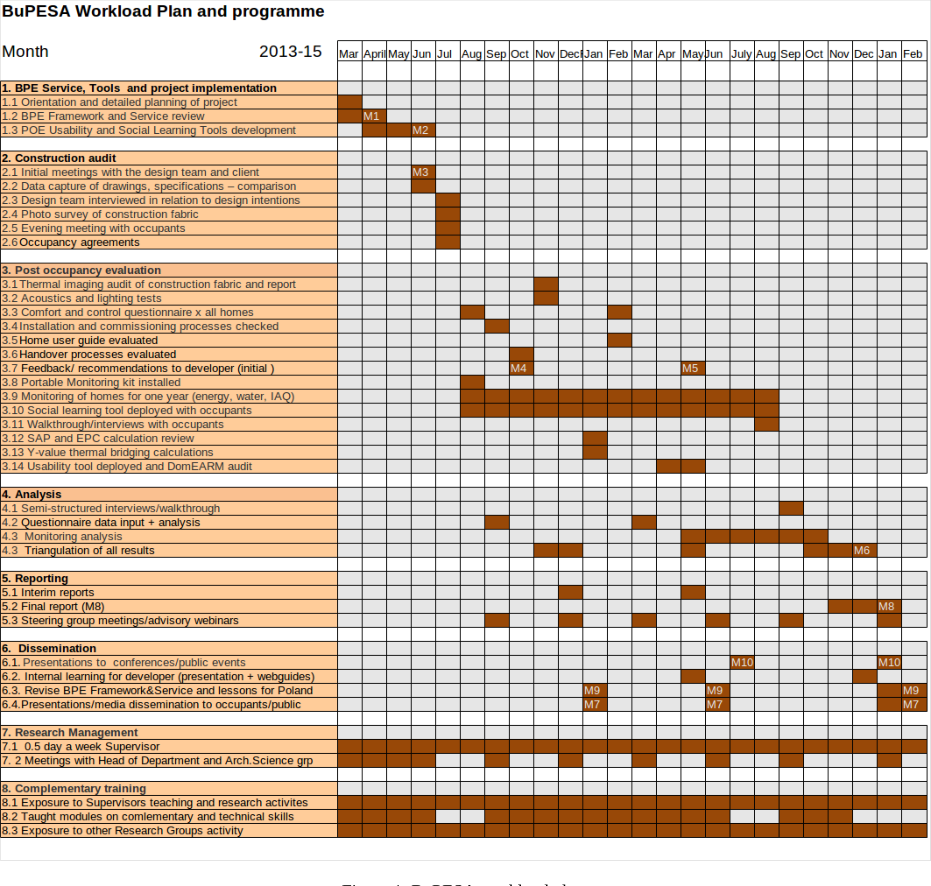
Figure 1. BuPESA workload plan.
developing two related BPE tools. Secondly to develop an enhanced BPE Framework and Service which is transferable across the EU.33. Thirdly to undertake a comprehensive post occupancy evaluation of two housing developments which includes innovative sustainable and renewable construction technology and procurement processes, in order to demonstrate and refine the new tools. The aims, scope and methods applied to these two POE projects are the focus of this paper.
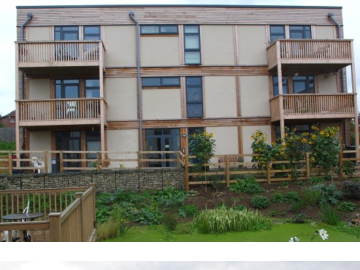
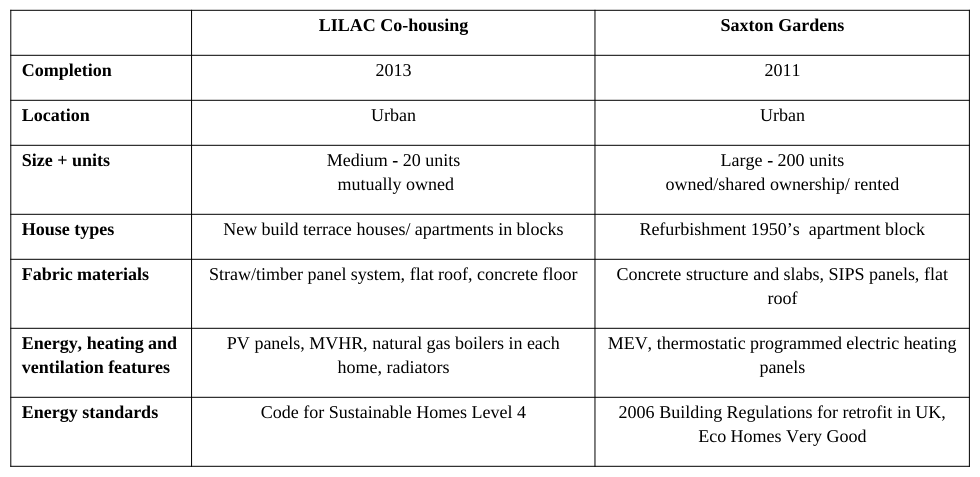
Case Studies The two case studies have been selected from a spectrum of housing developments which represent deliberately contrasting building typologies (see Figure 2), energy standards and demographic factors but within a similar climate and culture in Leeds, Northern England. This allows for a greater degree of comparability. Both developments are innovative and national awards winning, aiming for best practice in their category. One is Low Impact Living Affordable Community (LILAC) - new build housing development of 20 homes. All homes are built with ModCell pre-fabricated construction system which has received extensive government research funding in the UK to progress the technology (Wall et al, 2012). The BuPESA research project evaluates the performance of Modcell system applied in a residential development equipped with technically advanced mechanical and electrical systems (see Table 1). The evaluation aim to answer how is it actually experienced by a whole housing community. Additionally new POE tools: usability and social learning are trialled and combined with standard POE methods to understand how these aspects impact on the targets for low carbon emissions and minimised ecological footprints. The aim is to evaluate whether the unique housing development model has met its environmental and social targets for well-being, affordability and minimal impact living. The other case study is ‘Saxton’- a £40 million housing regeneration introducing 410 apartments into 2 previously redundant post war blocks of flats at the edge of city centre. The retrofit was undertaken by Urban Splash – a private developer with large portfolio of award winning urban regenerations. The POE study here similarly evaluates the performance of this unique development in relation to its usability, environmental and social targets.
Figure 2. LILAC (above) and Saxton west (bottom left) and east view (bottom right). Photo MBN At the stage of application for funding the clients in both developments declared to cooperate in the evaluation process and expressed their interest in the results. The proposal was reviewed and accepted by the University of Sheffield ethical committee.Table 1: Case study characteristics LILAC Co-housing Saxton Gardens
IMPLEMENTATION STAGE Domestic building performance evaluation is still an emerging research area (Stevenson et al, 2010). It presents specific challenges compared to the non-domestic one. Above all it involves voluntary participation of individual residents agreeing for data collection in their private homes and committing their home time. Achieving a representative sample for benchmarking purposes in a particular development may present a true barrier even if a POE is initiated by the developer. In BuPESA evaluations the study was initiated by the academia. Securing developer’s and main client’s support was not difficult given both organisations’ understanding of potential benefits of getting involved and trust in research quality guaranteed by prof. Stevenson’s expert supervision.
Overview of research scope and POE tools applied The clients’ endorsement for the study meant that some steps of POE process like: access to site and design documentation, sharing contacts to main actors at design and construction stage were to be secured. The work commenced with a detailed construction audit for each development to identify any deviations from original design intentions. The next step was an interview with all main actors involved in the developments’ delivery process. The ideal set of participants would include representatives of design team: architect, structural engineer and mechanical & electrical engineer, client, developer, contractor, and also if applicable facility manager and someone from customer service department. In practice even though not all of the above people could take part in the one hour teleconference interview it was an invaluable step to gain understanding of the targets, aspirations and challenges specific for each development. For Saxton the interview had major influence on planning the research process: it revealed that the two Saxton buildings though had the same design were in fact built in two stages, with different contractors, installers and suppliers for each stage. Initial plan to cover both buildings with evaluation was thus abandoned and research focused on the more recent one. The interviews prior which each participant had signed an informed consent in accordance with ethical procedures were transcribed and became reference documents at later stages of the project.
Recruting participants The two developments were contrasting in terms of the actual process of recruiting participants for the study. LILAC is a co-housing development. Co-housing movement envisions an intentional community where all participants know each other, sign in to certain set of values and efficient internal communication and trust are necessities of the governance model applied. This means that once a group of residents is convinced to get engaged the trust of those not yet introduced is bigger and their positive decision more likely. Also LILAC stands for Low Impact Living Affordable Community and is committed to pioneering low carbon living, thus POE’s capacity to help improve environmental performance through feedback is naturally supporting the community’s own goals. The study preconceived covering 100% sample of LILAC’s 20 dwellings and this was achieved. Ongoing positive engagement of the whole community in numerous activities involving participation is excellent. For example response rate to both surveys conducted so far was 100%. Such results must be seen in the specific co-housing context and should not be given as feasible for ‘typical’ residential development.
Saxton residents are much more anonymous and less integrated as a community. For the recruiting process this means that the ‘snowball’ effect of one volunteer inviting another is unlikely to work. Indeed only three Saxton residents indicated someone else in the development who might be interested in getting involved. The assumed sample rate for Saxton was 5% out of over 200 apartments in the evaluated building, thus the target was 20 participants. Data Protection Act does not allow the developer to release personal details of the residents to the research team and all the initial information was delivered in anonymous form, which was not ideal in terms of attracting interest. A particular difficulty during recruitment was the duration of the project defined by one year long monitoring process. Some of the apartments are owned, some are within shared ownership scheme and most are rented. In many of the rented apartments the occupants could not declare they would stay for another year, which was the first condition of getting involved. In result of introducing the research at the residents’ annual meeting, posters and numerous on site visits participation of 21apartments was secured. Within 8 month of the project 3 residents unexpectedly moved out and 2 other joined in instead. Cooperation with all those who committed to the project is also excellent – 100% response rate for one survey and 95% for another within this sample. However response rate to a paper survey that covered the whole population of the building was 44%. And this was achieved following all the best practice guidelines for distribution and collection of paper surveys. For non-domestic sector 44% might be regarded as low. For a ‘typical’ domestic context this seems to be as high as it can be given normal research situation constraints.
The BuPESA evaluation process involves tools that aim to cover three categories that influence building’s performance:
- Building delivery process and maintenance
- New fabric and technology approaches through monitored performance.
- Occupant needs, lifestyles and their control over internal environment - ‘soft’ evaluation through structured home occupancy feedback.
Figure 3. BuPESA workload plan for LILAC residents.
Figure available in the original PDF paper.
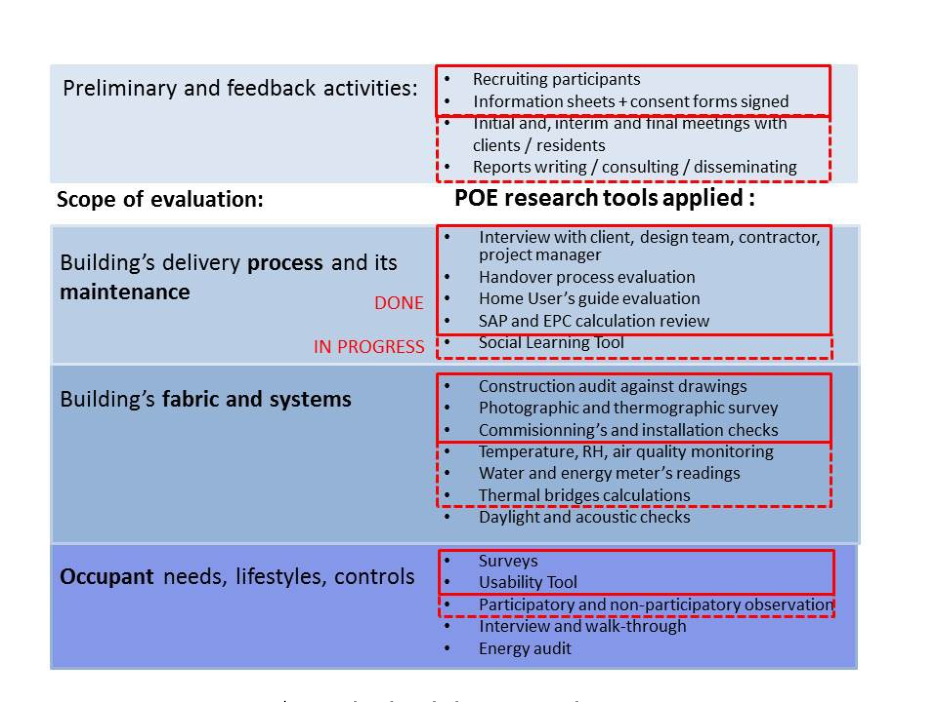
Figure 4 presents the scope of research activities planned for the project and the relevant tools applied. The already completed steps are highlighted with a red frame and those in progress are in a dashed red frame. Some steps have not started yet as selected POE activities must be linked with the seasons. The timeline for each activity is included in the workload plan (Figure 1 and 4). The evaluation process involves introductory and feedback activities that aim to keep all stakeholders and participating residents informed on finished and planned steps and interim findings. An example of plan of activities prepared for an introductory meeting with LILAC residents is shown in Figure 3. The new Usability and Social Learning tools were not included at that stage. They were introduced at an interim feedback meeting and separate consent and information forms were prepared.
Figure 4. Research tools applied in two case study POE projects
All the participating apartments are for one year equipped with three wireless sensors monitoring temperature and relative humidity (RH) in different rooms. Additionally 5 selected dwellings have CO2 meters installed. The temperature and RH sensors require regular downloading visits every 8-9 weeks due to limited memory capacity. This sequence of regular home visits, although time consuming, is a source of valuable observations and informal discussions. Rich data obtained during these visits will be cross-correlated at analysis stage with more structured occupant feedback from surveys (Usability and BUS), semi-structured interviews and Social Learning tool application. Energy and water meter readings are regularly taken for each of the dwellings. General services installation and commissioning checks have been performed with focus in both developments on the ventilation systems. Thermal imaging focused on continuity of insulation was performed, even though strict weather requirements (dry, no wind, min 10o∆T between inside and outside) for this check were very rare last winter. Associated occupant handover procedures were scrutinised. In LILAC the researcher shadowed twice an innovative handover procedure. That handover was particularly challenging given the complex systems installed and novelty of the building fabric. As a part of action research feedback was given covering guidelines of best practice handovers and SWOT analysis of the observed process. Home user’s guides (HUGs) were also analysed. The handovers and HUGs informed the starting point of home use learning process that is the focus of Social Learning tool. Description of this new tool is out of scope of this paper. A final element of design and fabric evaluation will be thermal bridges calculations using Therm software. Analysis of Standard Assesment Procedures (SAP) results issued for each dwelling revealed that in neither development thermal bridges were calculated at design stage.
Acoustics and lighting spot checks will be performed. Design of these checks will be informed by problem areas emerging from the occupant satisfaction survey. An energy audit of all household appliances (25% sample in LILAC) will be undertaken using DomEARM method (based on the UK CIBSE TM22 method) and correlated with results from the social learning tool and an evaluation of the home user guidance given. Particular attention will be paid to how well the innovative construction and environmental technologies deployed in both developments (super- insulated pre-fabricated timber and straw panels (Modcell), eco-heating, ventilation) afford opportunities for the occupants to improve their quality of life and also lessen their environmental impact, drawing the Usability and Social Learning Tools. These will in turn be related back to the design intentions to illustrate any gaps and lessons learnt to help improve design approaches.
BuPESA project gives a unique chance to gain in depth understanding of the performance of the evaluated developments due to unusually (compared to usual POE study) intense and prolonged fieldwork data collection stage and varied methods applied. It also allows evaluation of the research tools applied due to rich data obtained: their quality and validity can be tested through cross correlation.
CONCLUSIONS
This paper focuses on the aims, scope and tools applied in two ongoing POE studies of residential developments in Leeds, UK. The evaluations conducted as a part of EU funded BuPESA project give a rare opportunity to get in-depth understanding of residential building’s performance in relation with their occupants resulting from cross correlation of rich data obtained through mixed method research process. The process involves both refined and highly credible tools and new ones that expand current BPE framework. The evaluations are meant to help both academic aims of developing and testing new research tools and also the communities involved through feedback and action research element. Findings from the research will be disseminated at a later stage.
REFERENCES
Glad, W. (2012), “Housing renovation and energy systems: the need for social learning”, Building Research and Information, Volume 40, Issue 3, pp. 274-289 Grams-Hanssen, K. (2010), “Residential heat comfort practices: understanding users”, Building Research and Information
Volume 38 Issue 2, pp. 175-186 Gupta, R. and Chandiwala, S. (2010), “Understanding occupants: feedback techniques for large-scale low-carbon domestic refurbishments”, Research and Information Volume 38, Issue 5, pp. 530-548 Leaman, A. Stevenson, F. Bordass, A. (2010), “Building evaluation: practice and principles”, Building Research and
Information, Volume 38 Issue 5, pp. 564-577 Mallory-Hill, S. et al (2012), “Enhancing Building Performance”, Wiley-Blackwell, Chichester. Research Executive Agency, 7th FP – The 2012 People Programme; Guide for Applicants – Marie Curie IEF, … Stevenson, F. Rijal, H.B. (2010), “Developing Occupancy feedback from a prototype to improve housing production”, Building Research and Information, Volume 38 Issue 5, pp. 55-564 Stevenson, F. Leaman, A. (2010), “Evaluating housing performance in relation to human behaviour: new challenges”, Building
Research and Information, Volume 38 Issue 5, pp. 437-441 TSB (Technology Strategy Board) (2010), Building Performance Evaluation – Competition for funding, https://connect.innovateuk.org/web/building-performance-evaluation/about-the-competition Wall, K., Walker, P., Gross, C., White, C. and Mander, T., 2012. “Development and testing of a prototype straw bale house” . Proceedings of the Institution of Civil Engineers: Construction Materials, Volume 165 No. 6, pp. 377-384
LISTED IN THE AHFE DIGITAL BOOKSTORE CATALOGUE
Explore the complete digital volume
Advances in Human Factors and Sustainable Infrastructure
Read this individual research paper free through the original publisher, or explore the full digital proceedings book.
ISBN 978-1-4951-2092-3
Explore this ISBN in the AHFE Bookstore ↗Listed in the July 2026 bookstore catalogue; search by ISBN to confirm current availability · Digital book purchase optional