Renata Vieira Do Rosário, Alexandre Anibal Campos Bonilla, Flávio Anthero Nunes Vianna dos Santos (2026). VR Games as a Complementary Tool for Upper Limb Rehabilitation: A Biomechanical and Usability Analysis. In: Healthcare and Medical Devices. AHFE Open Access, vol. 211, pp. 105–113. https://doi.org/10.54941/ahfe1007473
This study presents an exploratory analysis of the effectiveness and applicability of a virtual reality (VR) exercise system as a complementary tool for shoulder physiotherapy rehabilitation, aiming to evaluate its usability and potential integration into clinical protocols. The investigation involves four healthy participants performing a 4-minute "easy" level protocol on the XRWorkout platform, using an IMU-based motion capture suit for detailed kinematic analysis. A biomechanical evaluation was conducted by comparing participants’ joint angles with established theoretical reference ranges. Results showed high adherence to prescribed motor trajectories, with Time Out of Range (TOR) consistently below 0.3%, indicating that movements remained predominantly within safe therapeutic boundaries. While kinematic profiles were regular, recorded range of motion was generally below theoretical maximums and inter-shoulder asymmetry was noted. It is concluded that the system demonstrates significant potential as a complementary and engagement-enhancing tool for conventional shoulder physiotherapy, providing gamified, quantifiable exercises during stages of functional recovery.
Physiotherapeutic rehabilitation of shoulder injuries, including tendinopathies, dislocations, and post-surgical recovery, is frequently hindered by critical barriers. Among the most prominent are reduced range of motion (ROM), often associated with kinesiophobia, and low patient adherence, largely attributed to the repetitive and monotonous nature of conventional therapeutic exercises (Álvarez de la Campa Crespo et al., 2023). These challenges are exacerbated in resource-constrained contexts, such as Brazil, where limited access to advanced technologies and financial restrictions within conventional clinical settings further compromise treatment continuity and effectiveness. Consequently, there is a growing demand for therapeutic tools capable of transforming physical effort into immersive, engaging, and psychologically encouraging activities that may enhance both motivation and functional outcomes. (Loureiro et al., 2024).
The effective implementation of Virtual Reality (VR) in physiotherapy requires an approach grounded in Human Systems Integration (HSI), which recognises the user as an integral component throughout the system life cycle. Several design challenges must be addressed to ensure clinical viability. Technical precision remains a critical concern, as limitations in joint tracking accuracy and initial calibration procedures may compromise the validity and reliability of clinical data. In addition, ergonomic and comfort-related factors are essential, as adverse effects such as nausea and dizziness have been identified as negatively impacting usability and user experience. Furthermore, localisation aspects, including the availability of interfaces in Portuguese and the capacity for therapeutic customisation, are fundamental for acceptance and adoption within the Brazilian healthcare context (Matamala-Gomez et al., 2023).
Virtual Reality does not replace the role of the physiotherapist; rather, it represents an evolution of therapeutic practice by functioning as an assisted exercise tool, particularly effective during the intermediate and final stages of functional recovery. VR enables a transition from mechanically repetitive exercise models to dynamic motor learning paradigms, in which patients perform functional movements within controlled and motivating virtual environments. Platforms such as XRWorkout allow the simulation of high-intensity interval training (HIIT), inspired scenarios in a safe and adaptable manner. Although meta-analyses report favourable evidence supporting the therapeutic use of VR (Laver et al., 2017; Bersotti et al., 2024), its integration into routine clinical practice remains limited, highlighting the need for structured protocols tailored to physiotherapeutic contexts. While early research focused primarily on computer graphics, the field has transitioned into a “clinical-VR era,” with a significant increase in publications within the fields of rehabilitation, neurology, and clinical psychology. In the last five years alone, medical categories such as clinical neurology and rehabilitation have emerged as top research areas, indicating that VR has moved beyond a technological novelty into a fundamental health-related tool (Cipresso et al., 2018).
The increasing accessibility of VR technology has been driven by the widespread availability of portable head-mounted displays, such as Meta Quest, and software distribution models based on free-to-play access, which eliminate initial licensing costs. These developments support the democratisation of immersive rehabilitation tools, enabling their use in remote regions or areas with limited healthcare infrastructure. As a result, high-quality rehabilitation interventions may become scalable and less dependent on heavy or costly equipment, such as resistance machines or free weights, thereby expanding the reach of physiotherapy services (Loureiro et al., 2024).
The integration of VR into physiotherapy allows for the direct mapping of in-game movements to specific therapeutic objectives. For instance, forward punching actions (jab) emphasise shoulder flexion and scapular protraction, activating the anterior deltoid; cross movements combine horizontal flexion with trunk rotation, recruiting the rotator cuff muscles, particularly the infraspinatus and teres minor; uppercut actions reproduce diagonal functional trajectories consistent with proprioceptive neuromuscular facilitation (PNF) D2 patterns; and high guard positions promote shoulder
VR Games as a Complementary Tool for Upper Limb Rehabilitation 107 abduction and external rotation within a closed kinetic chain. Additionally, the incorporation of inertial sensors, such as IMU-based motion capture suits (Smart Suit, Rokoko), combined with data analysis libraries in Python, enables objective monitoring of joint kinematics, ensuring that therapeutic progression is quantifiable and grounded in rigorous biomechanical evidence (Loureiro et al., 2024).
The primary objective of this study is the development of a gamified physiotherapy protocol based on virtual reality, employing short sessions of four minutes at an easy difficulty level, with an emphasis on correct movement execution and low intensity to minimise the risk of overuse injuries. To achieve this, the protocol is initially evaluated through a pilot pre-test involving four healthy participants, each completing two sessions, allowing for the isolation of biomechanical and psychological effects of VR without confounding pathological variables. The study aims to adapt commercial VR games to traditional clinical physiotherapy contexts, establish a scientific workflow integrating motion capture and advanced statistical analysis, and provide a methodological foundation for future clinical validation in injured populations. Ultimately, the results obtained through this protocol will be compared with those of conventional physiotherapy, including analyses of ROM as described in the existing literature (Lippert, 2011; Hamilton et al., 2012).
METHODOLOGY
Technological Infrastructure, Virtual Platform, and Data Processing The present investigation employed the XRWorkout virtual reality fitness platform (XRWorkout Developers, 2024), a commercially available Free-to- Play application distributed via the Meta Quest Store and developed specifically for Meta Quest headsets. The system functions as a virtual personal trainer, with a primary focus on high-intensity interval training (HIIT) protocols and bodyweight-based strength exercises grounded in calisthenics. By relying exclusively on the user’s own body mass as resistance, this approach eliminates the need for external equipment, such as dumbbells or elastic bands, thereby enhancing accessibility and ensuring standardisation of motor tasks.
Hardware infrastructure is centred on a head-mounted display (HMD) capable of providing stereoscopic vision, spatial audio, and accurate tracking of head position and orientation. In addition, the system requires two tracked handheld controllers equipped with grip buttons and haptic feedback. XRWorkout supports both controller-based interaction and hand-tracking technologies, allowing direct interaction with the virtual environment without the need for physical devices held in the hands.
For detailed capture and analysis of human movement kinematics, inertial measurement unit (IMU)-based motion capture suits were employed. These systems enable the tracking of multiple body segments, ensuring high precision in the acquisition of biomechanical data during execution within the virtual environment.
The exercises available on the platform are organised according to target muscle groups and physiological systems, including: Core, with emphasis on trunk musculature (abdominal muscles, obliques, and lumbar region); Upper
Limb Strength, aimed at the development of strength and endurance of the upper extremities and shoulder girdle; Lower Limb Strength, focused on strengthening and endurance of the lower extremities; and Cardiorespiratory, whose primary objective is to increase heart rate and improve cardiovascular capacity.
User interface provides two main modes for structuring training sessions. In the custom routine creation mode, users can autonomously select, combine, and organise exercises according to specific goals. In the pre-defined routine selection mode, structured programmes are made available for immediate use, without the need for prior configuration.
Statistical processing, graphical visualisation, and the construction of data tables were conducted using a hybrid analytical workflow. Initially, data were organised in Microsoft Excel, followed by advanced analyses performed using the Python programming language, which is widely recognised in the scientific literature for its robustness in scientific computing. Specific libraries and their respective versions were employed: pandas (v2.3.3) for structured data manipulation and analysis (McKinney, 2010); NumPy (v2.3.5) for efficient numerical operations (Harris et al., 2020); SciPy (v1.16.3) for statistical and mathematical algorithms (Virtanen et al., 2020); Matplotlib (v3.10.7) for static graphical visualisations (Hunter, 2007); Seaborn (v0.13.2) for advanced statistical visualisations with aesthetic refinement (Waskom, 2021); and Plotly (v6.5.0) for the generation of interactive graphs. To ensure code organisation, version control, and reproducibility of the analytical procedures, the integrated development environment PyCharm (version 2025.1.1) was utilised. This rigorous computational framework ensures not only the accuracy and clarity of the results presented, but also methodological transparency and full replicability of the analytical workflow adopted in this study.
Game Engagement and Application in Shoulder Rehabilitation Engagement Mechanics
With regard to game engagement and its application in shoulder rehabilitation, analysis of the implemented engagement mechanics is essential. The system operates on a scoring and precision evaluation calculated directly from biomechanical parameters, such as achieved range of motion and execution velocity. To structure user progression, a levelling system has been developed, starting at an Easy difficulty and gradually advancing to more demanding Hard levels. To sustain patient motivation and adherence throughout treatment, the game provides varied routines and challenges, ensuring stimulus diversity. Additionally, real-time visual and auditory feedback is supplied, enabling instantaneous performance adjustment.
Shoulder Rehabilitation Context In the specific context of shoulder rehabilitation, the technology functions primarily as an active-assisted exercise tool, particularly suited to the intermediate and final phases of functional recovery. Among its chief advantages is the ability to transform repetitive exercises, often associated with monotony and low adherence, into an engaging and immersive activity. Furthermore, the system delivers quantifiable and objective feedback on range of motion, permitting
VR Games as a Complementary Tool for Upper Limb Rehabilitation 109 precise performance measurement. Another significant benefit is systematic progress recording, generating data that facilitate therapeutic monitoring and clinical decision-making. However, an important caveat must be emphasised: its use must be authorised and supervised by a qualified healthcare professional. Such supervision is essential to conduct a prior assessment identifying safe movements for each patient, explicitly aiming to prevent overuse injuries or those resulting from improper technique during gameplay.
Detailed Specification: 4-Minute Session The training protocol has a total duration of four minutes and is structured as a gamified high-intensity interval training (HIIT) sequence based on floating visual targets (orbs) synchronised with upbeat music drawn from an extensive or customisable audio library. Each exercise segment lasts approximately 20 to 40 seconds and is separated by short transitions of 5 to 10 seconds, as well as brief visual rest periods. Throughout the session, an artificial intelligence system dynamically adapts the speed and overall intensity of the tasks in response to real-time user performance, such as physiological feedback obtained via a Bluetooth-connected heart rate monitor.
At the easy intensity level, the protocol employs slow-moving targets and a reduced training volume, characterised by a limited number of repetitions per exercise. This configuration prioritises correct movement execution and injury prevention, with emphasis on natural, full-body movements. Explosive actions, including jumps or burpees, are deliberately excluded at this level and are reserved for medium and hard intensities. The perceived exertion associated with this condition is expected to range from approximately 4 to 6 on a 10-point Rating of Perceived Exertion (RPE) scale. The exercise pool comprises more than 21 calisthenics-based movements, from which the AI system selects between four and six exercises to compose each four-minute session. A representative example of an AI-generated easy- intensity sequence, which can be further customised, includes marching in place as a low-impact sprint, squats, controlled jumps or knee lifts, and basic abdominal crunches.
The auditory and visual environment is designed to support low-intensity engagement, featuring music with a calm tempo ranging from 90 to 110 beats per minute and relaxing virtual settings, such as a beach scenario or a minimalist AI-generated holodeck. In addition, a mixed-reality visual blend allows partial visibility of the real-world floor, thereby enhancing postural stability and user safety during task execution.
3:05–3:45: Rapid mix (2–3 orbs of each) + visual cooldown.
3:50–4:00: Final statistics (calories, average HR, score).
Specific Movements and Rehabilitation Analysis The jab (open fist) replicates shoulder flexion with scapular protraction, primarily activating the anterior deltoid and pectoralis major. It is excellent for restoring functional reaching capacity. The cross (crossed fist) combines horizontal shoulder flexion with trunk rotation, intensely recruiting the infraspinatus and teres minor of the rotator cuff. The high guard position requires shoulder abduction and flexion with external rotation, activating the entire deltoid and rotator cuff in a relatively closed kinetic chain. The uppercut simulates diagonal shoulder flexion with forearm supination, engaging the anterior deltoid, clavicular pectoralis major, and biceps brachii. By reproducing functional diagonal trajectories (PNF D2 flexor pattern), it yields rapid gains in range and coordination for activities of daily living.
Finally, squats, although primarily lower-limb exercises, generate significant isometric contraction of the shoulder girdle stabilisers to maintain upright posture and high guard. This co-activation enhances overall endurance and stability of the shoulder complex.
The game, particularly in short easy-level sessions, provides a virtually guided exercise protocol auxiliary to shoulder rehabilitation. Punching and defensive movements map directly onto therapeutic exercises aimed at improving range of motion, strength, and dynamic stability of the glenohumeral joint and shoulder girdle. The gamified, low-impact nature at the introductory level renders it a motivating and potentially effective tool when integrated into a professionally designed rehabilitation plan, always under appropriate supervision to ensure safety and treatment efficacy.
RESULTS
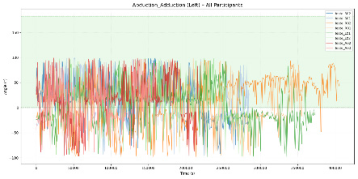
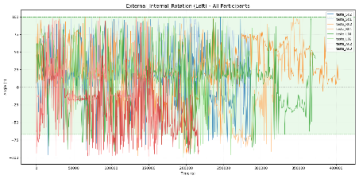
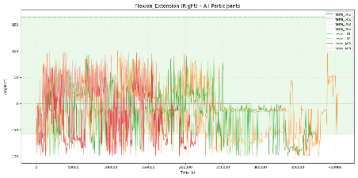
Each analyzed dataset contained simultaneous recordings of left and right shoulder movements across the three primary degrees of freedom: flexion/extension, abduction/adduction, and external/internal rotation. In this coordinate system, positive values denoted flexion, abduction, and external rotation, while negative values indicated extension, adduction, and internal rotation. Data were initially normalized within a range of –100 to +100 and subsequently converted into degrees, considering the theoretical limits of active shoulder range of motion (ROM) for individuals aged 20–54 years: flexion/extension (–57° to +165°), abduction (0° to +183°), and external/ internal rotation (–67° to +100°), as established by Reese & Bandy (2002).
The following figures provide a comparative visualization of the simultaneous movement profiles across users, illustrating that the exercises followed consistent kinematic patterns. The data are presented in six panels, organized in pairs to facilitate the analysis of bilateral symmetry and range of motion.
Collectively, these visualizations highlight a high degree of movement regularity and strict adherence to the prescribed motor trajectories within the virtual environment. This adherence is further evidenced by the Time Out of Range (TOR), which remained consistently low across nearly all conditions (0.00001 to 0.002). This corresponds to less than 0.3% of the total execution time, indicating that participants remained predominantly within the therapeutic window.
Figure 1: Left and right shoulder abduction/adduction.Figure 2: Left and right shoulder internal/external rotation.Figure 3: Left and right shoulder flexion/extension.
Analysis revealed that, in most cases, the recorded ROM was significantly lower than the theoretical limits. Normalized maximum values near +100 did not necessarily reflect the full execution of functional range, potentially due to sensor saturation, limited calibration, or intentional movement restriction during the task. Shoulder extension, in particular, was minimally explored, with averages ranging between –5° and –25°.
Furthermore, a notable inter-shoulder asymmetry was observed: the left shoulder exhibited a greater component of flexion and external rotation, whereas the right shoulder showed reduced amplitude and a predominance of internal rotation. This pattern is likely related to handedness or specific motor strategies adopted during interaction with the virtual environment. Finally, additional qualitative patterns revealed frequent saturation at extreme limits, suggesting rapid or intense movements, as well as prolonged periods near zero, indicating static postures. Intra- task variability was high, with standard deviations frequently exceeding 35–45°, characterizing non-cyclic, irregular movements or the presence of multiple motor corrections.
CONCLUSION
The results indicate that, within a gamified virtual reality environment designed for shoulder rehabilitation, participants performed movements predominantly within the range considered optimal for therapeutic purposes. The fraction of Time Out of Range (TOR) was consistently low (less than 0.3% of the total time), suggesting high adherence to the motor trajectory proposed by the protocol. This finding highlights the effectiveness of the virtual task design regarding target amplitude guidance, real-time feedback, and adjusted difficulty levels. The observed inter-shoulder asymmetry may reflect natural motor preferences or compensatory patterns, warranting further investigation in populations with established handedness and in patients with shoulder dysfunction.
ACKNOWLEDGMENT
Special thanks are due to the volunteers who participated in this study, without whom this research would not have been possible.
REFERENCES
Álvarez de la Campa Crespo, M., Donegan, T., Amestoy-Alonso, B., Just, A., Combalía, A., Sanchez-Vives, M.V. (2023). Virtual embodiment for improving range of motion in patients with movement-related shoulder pain: an experimental study. Journal of Orthopaedic Surgery and Research, 18, 729. https://doi.org/10.1186/s13018-023-04158-w Bersotti, F. M. et al. (2024). Virtual rehabilitation is better than conventional
physical therapy to improve the functionality of gait in elderly people? Systematic review and meta-analysis. Motriz Revista de Educação Física, v. 30, pp. e10220112–e10220112, July 2024. Brady, N., Lewis, J., McCreesh, K., Dejaco, B. and McVeigh, J.G. (2022).
Physiotherapist beliefs and perspectives on virtual reality–supported rehabilitation for the assessment and management of musculoskeletal shoulder pain: a focus group study protocol (version 2). HRB Open Research, 4, 40. https://doi.org/10.12688/hrbopenres.13239.2 Cipresso, P. et al. (2018). The past, present, and future of virtual and augmented reality research: A network and cluster analysis of the literature. Frontiers in Psychology, v. 9, p. 2086. Hamilton, N., Weimar, W., and Luttgens, K. (2012). Kinesiology: Scientific Basis
of Human Motion, 12th edn. McGraw-Hill, New York, NY. ISBN 978-0-07- 802254-8. Harris, C. R. et al. (2020). Array programming with NumPy. Nature, v. 585, pp. 357–362. Hunter, J. D. (2007). Matplotlib: A 2d graphics environment. Computing in Science
& Engineering, v. 9, n. 3, pp. 90–95. Laver, K. E. et al. (2017). Virtual reality for stroke rehabilitation. Cochrane Database of Systematic Reviews, v. 11, n. 11, p. CD008349, November 2017. Lippert, L.S. (2011). Clinical kinesiology and anatomy. 5th edn. Philadelphia, PA:
F.A. Davis Company. Loureiro, R.C.V., Rodrigues, A.M., Santos, C.M., Bastos, V.H., Fernandes, O., Teixeira, S., Velasques, B., Ribeiro, P. (2024). Effects of immersive virtual reality on motor and perceptual variables in musculoskeletal rehabilitation. Virtual Reality, 28, 150. https://doi.org/10.1007/s10055-024-0150-4
VR Games as a Complementary Tool for Upper Limb Rehabilitation 113 Matamala-Gomez, M., Slater, M., Sanchez-Vives, M.V. (2023). Immersive virtual
reality and embodiment: A systematic review. PLOS ONE, 18(4), e0284445. https://doi.org/10.1371/journal.pone.0284445 Mckinney, W. (2010). Data structures for statistical computing in python. In: Walt, S. van der; Millman, J. (Ed.). Proceedings of the 9th Python in Science Conference. [s.n.], pp. 56–61. Meta Reality Labs. (s.d.). Reality Labs | Meta. [Online]. Niehorster, D. C.; Li, L.; Lappe, M. (2017). The accuracy and precision of position
and orientation tracking in the htc vive virtual reality system for scientific research. i-Perception, v. 8, n. 3, p. 2041669517708205. Reese, N. B., & Bandy, W. D. (2002). Joint range of motion and muscle length testing. Philadelphia, PA: W.B. Saunders. ISBN 0-7216-8942-6. Virtanen, P. et al. (2020). Scipy 1.0: Fundamental algorithms for scientific
computing in python. Nature Methods, v. 17, pp. 261–272. Waskom, M. L. (2021). seaborn: Statistical data visualization. Journal of Open Source Software, v. 6, n. 60, p. 3021. Xrworkout Developers. (2024). XRWorkout Free to Play VR Fitness.
LISTED IN THE AHFE DIGITAL BOOKSTORE CATALOGUE
Explore the complete digital volume
Healthcare and Medical Devices
Read this individual research paper free through the original publisher, or explore the full digital proceedings book.
ISBN 978-1-964867-87-8
Explore this ISBN in the AHFE Bookstore ↗Listed in the July 2026 bookstore catalogue; search by ISBN to confirm current availability · Digital book purchase optional