Balázs Péter Hámornik, Máté Köles, Anita Komlódi, Károly Hercegfi, Lajos Izsó (2019). Features of Collaboration in the VirCA Immersive 3D Environment. In: Advances in Cognitive Engineering and Neuroergonomics. AHFE Open Access, vol. 7. https://doi.org/10.54941/ahfe100223
Real time, synchronous collaborative work mostly happens in real world situations. There are applications that allow computer-mediated synchronous collaboration, but they are far from the experience of a real life meeting. The Virtual Collaboration Arena allows multiple people to work in real time in a virtual space collaboratively. Relatively little is known about how collaboration in virtual reality compares to physically co-located activities. In order to investigate these differences and to reveal any usability issues the system has, we studied 20 pairs of participants working together on a simple cooperative task that required planning. One of the participants was in an immersive 3D cave and the other participant carried out the task from a desktop computer. They communicated over an audio channel in addition to seeing each other as avatars in the space. The cooperative communication was recorded and the conversation was transcribed. The transcripts were coded into three categories of communicative acts: 1) utterance related to coordination; 2) utterances related to information sharing for the task; and 3) usability-related communication. The sessions were divided into three stages of the task and the ratio of the three types of communicative acts were compared across the three stages. According to the Cochran’s tests there were significant differences between the temporal sections of the task for coordination (Q(2)=72,13; p < 0.001), information sharing for the task (Q(2)=77,06; p < 0.001), and usability (Q(2)=15,14; p < 0.001). Coordination utterances were frequent in the beginning and the ending sections of the collaboration. Information sharing utterances appeared in a higher ratio in the middle section. Thus, in the beginning and at the end of the sessions our participants were focused on explicitly coordinating their tasks (“What shall we do?” and “What has been done?”), while in the middle of the session they were focused on sharing the content for the schedule accompanied by less explicit coordination.The amount of usability-related comments goes down after the first section. The decrease of usability-related interactions along the progression of time is showing a possible learning effect or the effect of practice that grows through the task. The pattern of variation in communicative actions along the three phases of task completion indicates that the virtual 3D environment is usable; the participants are able to learn to use it. These findings show that this 3D virtual environment can appropriately enable collaborative information interpretation and sharing activities.
Collaborative tasks that require shared documents to be viewed or edited, benefit greatly from actual physical presence of the collaborators. Architects looking at or working on a design plan together, as opposed to only discussing it over the phone, can improve joint decision making. However, being in the same physical space is often not manageable because of geographic distances. There are many technologies that enable computer-supported collaboration, but they do not offer the same interpersonal environment of a real-life collaboration (Peters & Manz, 2007).
3D virtual spaces have the most potential to simulate real physical co-presence. Not only hearing but also seeing another person (or at least an avatar representing that person) will create a higher sense of presence, interpersonal trust and perceived communication quality (Bente, Rüggenberg, Krämer, & Eschenburg, 2008). Such environments are being utilized in many fields including architectural design (Boukerche, Al Hamidi, Pazzi, & Ahmad, 2009), business applications (Remolar et al., 2010), document sharing (Tong, Karlsson, & Wei, 2009) and education (Dafoulas, Saleeb, & Loomes, 2012). Despite the widespread use of such systems, very few studies (Benford, Greenhalgh, Rodden, & Pycock, 2001) are aimed at exploring the features of cooperative work in virtual environments. Since today’s systems cannot create perfect representations of the real world, they will probably influence the way people perform tasks together. Interactivity is also constrained in many ways compared to the real world (e.g. the use of input devices). These basic differences will be further modified by individual differences. Some will display better skill at interacting with a virtual environment, while others will always show distrust (Brown, Poole, & Rodgers, 2004; Komiak, Weiquan, & Benbasat, 2005) or feel uneasy in such situations.
In our study we investigated how people perform a simple cooperative information management task in a 3D virtual space with simple avatars. Our aim was to create a scenario that had a real-life analogue and is rich in visual information. We have chosen the task of creating a plan for a two-day tourist visit in Budapest. Participants were given posters in the virtual environment that contained all the information required to make decisions on availability (opening hours) and exact location. The collaboration was supported by the Virtual Collaboration Arena (VirCA) software.
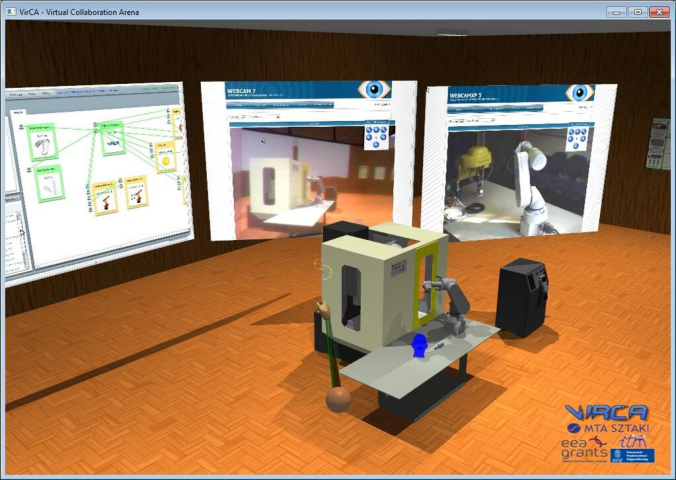
VirCA is a modular, component based interactive virtual reality manager software. It was developed by the Cognitive Informatics Research Group of the Computer and Automation Research Institute of the Hungarian Academy of Sciences. VirCA enables collaborative work in virtual environments, and even the control of real world objects (Galambos & Baranyi, 2011; Galambos, Reskó, & Baranyi, 2010; Vámos, Fülöp, Reskó, & Baranyi, 2010). In the situation shown in Figure 1, the digital model of a robot can be manipulated in the virtual environment while looking at the direct camera feed about the actual robot. Commands given in VirCA will translate into real life; the robot will execute tasks. This mix between virtual and real environments allows experimentation with devices and layout that would otherwise consume a lot of money and time. The VirCA environment allows users to carry out these tasks collaboratively. Thus, geographically dispersed users can solve problems together in the virtual space.
Figure 1. A simple virtual room in VirCA. The real world robot can be seen in the rightmost browser window, while its virtual model is in the middle. In the browser to the left, the modular structure of VirCA can be seen. Each box is a specific module that can be connected to others thus creating very complex systems.
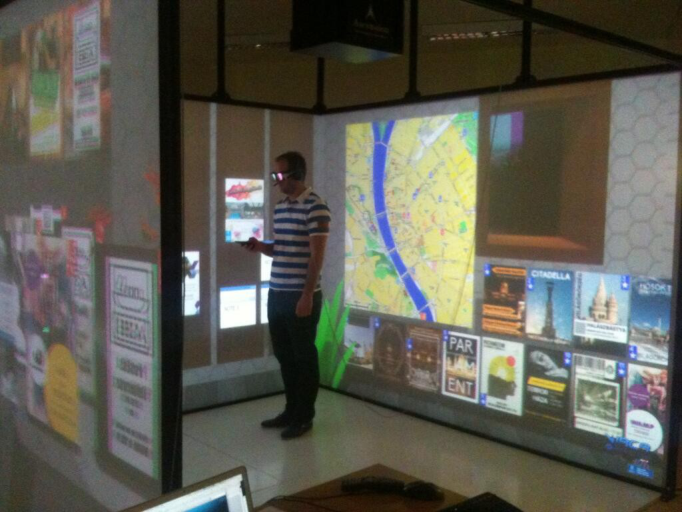
In order to create higher levels of immersion, the developers built a 3D virtual reality room (Figure 2). Passive stereoscopic pictures are projected on three screens (3m X 2,25 m) around the user. An electromagnetic tracking device is mounted on the 3D glasses. With this, the software is able to calculate the movement of the user and change the displayed picture accordingly.
Figure 2. One of the participants in the virtual 3D cave environment.
VirCA was developed with cooperative work in mind. But in what manner does virtual collaboration differ from its real world counterpart? Could a digital environment support such a task as planning a schedule or can it even enhance the experience in some ways?
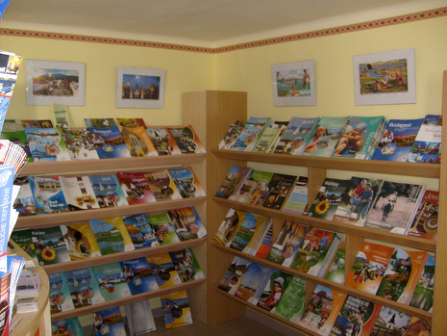
In order to explore these broad research questions, we conducted a study of collaboration in virtual environments. The collaborative scenario we chose was planning a visit for tourists. We chose this because of two main reasons: the task was familiar to the demographic we had access to as participants and it is easily comparable to a real world, physically co-located collaborative situation. If two people enter a tourist office to scout for events and sights, they will encounter a lot of visual information. Brochures, map and even postcards will contain images of the sights they are advertising. This can easily be simulated in a virtual environment (see Figure 3 for comparison).
Figure 3. The interior of an actual tourist office and the virtual office created in VirCA.
Avatars representing the participants in VirCA are very simplistic; they have a head and an arm. The direction the head is facing is While they may lack detail, creating more realistic avatars (e.g. based on the facial features of the participants) can lead to the uncanny valley effect (Mori, MacDorman, & Kageki, 2012) that will in turn cause the feeling of presence and agency to diminish (Nowak & Biocca, 2003). Similar to a real tourist office the virtual environment created in VirCA contained the following objects:
1. Posters containing information on restaurants, sights, and events (Figures 3, 4). This information includes opening hours and addresses that are essential for the planning task. The information displayed on the posters was not editable by the participants.
2. A city map with numbers denoting the location of the restaurants, sights, and events from the posters. (Figure 3).
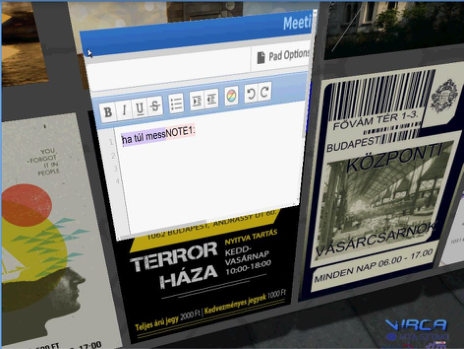
3. Sticky notes or post-its that are note windows available for both collaborators to write in and attach to posters. (Figure 4). Once attached, they would move together with the poster.
4. A jointly editable document where participants described their planned tour schedules. (Figure 4).
Figure 4. A sticky note (left) and the jointly editable note (right).
METHOD
Participants Forty people (20 pairs) participated in the study. The mean age was 23.4. The participants were college students recruited from the universities of Budapest. Most of our participants came from technical majors. Participants were paired randomly, no matching was made on any ground. Partners in some of the pairs knew each other, while in others they did not. The effects of individual differences will not be presented in this paper, but will be analyzed later on.
General Procedure In each pair, one participant was seated in front of a desktop personal computer equipped with a Tobii T120 eye- tracker, while the other was in the immersive 3D virtual cave. In both locations, they first began with the solo practice. In this phase they were briefly trained on the space and the interaction tools at their disposal. They were shown how to move a poster, how to attach a sticky/post-it note, and how to type in the editable objects. . Until removed, they would move together with the poster. After both participants felt ready, we established the communication between them. Next, a joint practice commenced, where they experienced collaborative editing and object manipulation. Apart from moving posters, participants were also able to highlight them. When highlighted, a poster appeared brighter. When participants felt comfortable with the controls, they received the main task instructions.
The task in the study was to plan a schedule of tours for a foreign student group spending a weekend in Budapest, Hungary. In order to create the plan, participants had to use information (tourist attractions, restaurants, opening hours and location) displayed on posters that were displayed on the walls of the virtual environment. The plan itself had to be written in a shared editable document in the immersive space. This task is natural and familiar for students, as they confirmed in their post-interaction interviews. The participants were allowed to use their own experience to recommend visits that were not included in the posters, but the occurrence of this was minimal. They were also told to create schedules that were manageable. This meant that the programs had to be available at the time and should not be too far from the last one (2-3 km maximum). To provide a starting point, a hotel in the Pest side of the city was also given as the residence of the tourists.
The task was considered completed when both participants agreed that they were done. Each session continued with a taped interview about the task and the cooperation. They also filled out questionnaires about their knowledge of Budapest and their experience with 3D programs (CAD software and games). Participants also completed the Myers-Briggs Type Indicator (Briggs Myers, McCaulley, Quenk, & Hammer, 1998) at a later time. The sessions on average took about 35-40 minutes, but there was great variability among the pairs. Some finished the main task in around 20 minutes, others in 50 minutes.
Three video recordings were created from each session. One recording was a screen capture of the desktop participant’s view. Another recoding was from an external video camera capturing the other participant’s interactions in the immersive space. A third virtual and invisible “cameraman” was also used. This view was an invisible participant set up a second desktop personal computer with a view into the virtual space. The viewpoint and thus the recording camera angle was controlled by one of the experimenters and was dynamically moved in the room to provide the best view on the interaction between the two participants. All three recordings contain the audio of the participants’ conversation. The third recording was selected for analysis purposes as it captured the movements of both participants in the space.
Coding The audio recordings of the participants’ interactions were transcribed. The recordings in sum contained 6618 utterances. We defined utterances as the meaningful base units of verbal interactions. They are most frequently a whole sentence, but in some cases fragments of sentences that have a unique meaning and are separated from other utterances by pauses. To categorize these utterances, we adopted the coding scheme of Juhasz and Soos (2007) who used it to analyze team communication in high risk environments. We narrowed down their original categories to three of the most meaningful for our study. Those utterances can be related to coordination, information sharing, and usability. See Table 1 for descriptions and examples for each category.
Two trained coders categorized each utterance. The inter rater agreement was high in all categories (Coordination κ=0.625, Information sharing κ=0.674, Usability κ=0.675).
RESULTS
In order to make temporal comparisons of interactions each recording was cut into three equal and meaningful parts based on our previous unstructured observations of the interactions of our participants: (1) the beginning that covers activities of orientation, (2) the middle that includes the activities of partly independent working, (3) the end of the task completion that usually is for the recombination and reviewing of results.
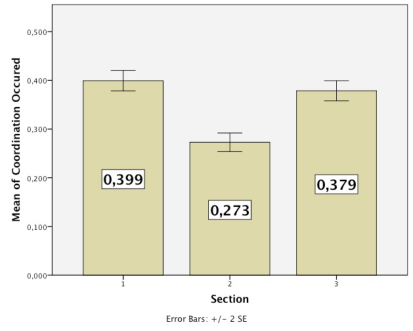
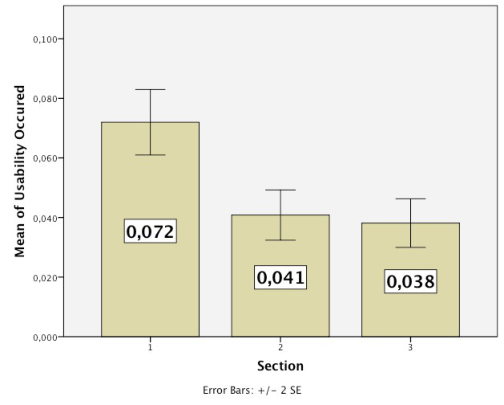
We conducted a Cochran’s Q test to compare the ratio of occurrences of the interaction types (coordination, information sharing, usability) between the three phases of task completion. We have found significant differences between the sections for Coordination (Q(2)=72.13; p<0.001), Information sharing for the task (Q(2)=77.06; p<0.001), and Usability (Q(2)=15.14; p<0.001) (see Figures 5, 6).
The changes of the frequencies in Coordination and Information sharing between the task phases are showing an inverted pattern of occurrences compared to each other. Coordination has a “U” shape change over time and Information sharing has an inverted “U” shape through the sections. Thus, in the beginning and at the end of the session our participants were focused on explicitly coordinating their tasks (“What shall we do?” and “What has been done?”), while in the middle of the session they were focused on sharing the content for the schedule (“Let’s do it!”).
Figure 5. The mean of Coordination (left) and Information Sharing (right) related utterances for each section. (Based on dichotomous coding data where 1 represents the true value for an utterance coded to the cagetory. Codes are exclusive.)
The decrease of Usability-related interactions along the progression of time is showing a possible learning effect or the effect of practice that grows through the task. On the other hand, this finding also indicates that the virtual 3D environment is usable; the participants are able to learn to use it.
Figure 6. The mean occurrence of Usability related utterances for each section. As time progressed, usability related communication diminished. (Based on dichotomous coding data where 1 represents the true value for an utterance coded to the cagetory. Codes are exclusive.)
The fewer occurrences of Coordination in the middle phase indicate that during the actual task performance the participants needed less explicit coordination. They have developed the common ground of understanding at the beginning, and they focused on the content of the task. It is similar to the findings of Burtscher et al. (2011) and also to the findings of Juhasz and Soos (2007) on teamwork in high-risk environments. This is a feature of cooperation that we confirmed a 3D immersive environment. As the patterns of interaction are similar to those in a physical environment, we conclude that the 3D virtual environment can appropriately support collaborative information interpretation and sharing activities.
As for the cooperative behavior and object manipulation, participants rarely utilized the post-it notes. They could have been used as reminders or to store additional information about a poster. Most participants reported that they felt that the post-its were not needed for such a simple task. Were the task more complex or longer term, the post-it notes could have been more useful. Participants also usually avoided typing, which could have contributed to the under-use of post-its. This will be discussed later in more detail.
The highlight function was also rarely used by our participants. Most of the time, they forgot about the function, and were reminded of it during the interview. The highlight function can also serve as a reminder for the participant or it can serve as a sharing tool. The reminder function was not needed for the relatively short and simple task, as discussed above. Participants also reported that sharing the posters via pointing was easy and did not need the highlight function. Since both of them had a virtual arm, pointing at the mentioned object was sufficient. Also, providing a much easier way of communication (direct audio contact) also made both highlighting and post-its superfluous.
There were a few usability issues tied to the new wireless device that enabled typing in the virtual environment. However, typing seemed to be a problem even for the participant who was seated before a regular monitor and had a regular keyboard. In the post session interviews, many reported that typing felt immersion breaking and counter intuitive in a virtual environment. It forced participants to constantly look away from the scene. Since most of their interaction was direct graphical manipulation (mostly arranging posters), probably a different output format for the study would have been more appropriate.
DISCUSSION
Our findings show that the 3D cave provides a usable environment for effective cooperation on an information use and interpretation activity. This space contributed to the creation and maintenance of the collaborative relationship of the participants (Crabtree, Tolmie, & Rouncefield, 2013) (and not hindered it). These results about the temporal distribution coordination are similar to the findings of Burtscher et al. (2011) and also to the findings of Juhasz and Soos (2007) on teamwork in high-risk environments. This similarity shows that typical patterns of collaboration can emerge in information-intensive tasks in virtual environments and thus validate our research goals.
The analysis of cooperative communication coded in the 3D cave described the features of the task completion in this environment. According to our findings the support (software-) solutions of coordination are needed at the beginning (orienting), and at the end of the task (recombination). In the middle our participants were performing the actions decided previously thus the focus here should be on information sharing.
Many participants mentioned typing as an immersion breaking element. One solution would be to create a table on one of the walls, where they could arrange the posters they choose to form the schedule. Thus instead of copying information from one object to another, users could directly place objects with the desired information. If the task requires more information to be added, then maybe a floating virtual keyboard would be more suitable. VirCA already has Kinect and motion capture suit support, so implementing a virtual keyboard might be a better way of enabling text input.
CONCLUSIONS AND FUTURE WORK Our results demonstrate that shared collaborative 3D virtual environments can support collaborative information interpretation and use tasks effectively. As the patterns of interactions mirror those in physically co-located, real world collaborations, we can conclude that meaningful collaboration can be achieved in these spaces. Our future research will focus on further analysis of the data collected in order to better describe the collaboration and inform Cognitive Engineering and Neuroergonomics (2019) design.
Our future plans include the more detailed description of collaborative information processing behavior in the shared virtual reality environment. The analysis of the eye-tracking data recorded at the desktop computer can be a useful tool in disambiguating certain interactions and it can also reveal usability problems. Further analysis of individual differences in spatial-visual ability, expertise and experience with navigating in a 3D environment, and personality types measured by the MBTI will also probably influence interaction and task execution. Understanding the impact of individual differences will help inform the design of these spaces.
REFERENCES
Benford, S., Greenhalgh, C., Rodden, T., & Pycock, J. (2001). Collaborative virtual environments. Communications of the Acm, 44(7), 79-85. doi: Doi 10.1145/379300.379322 Bente, G., Rüggenberg, S., Krämer, N. C., & Eschenburg, F. (2008). Avatar-Mediated Networking: Increasing
Social Presence and Interpersonal Trust in Net-Based Collaborations. Human Communication Research, 34(2), 287-318. doi: 10.1111/j.1468-2958.2008.00322.x Boukerche, A., Al Hamidi, A., Pazzi, R., & Ahmad, L. (2009, March 30 2009-April 2 2009). Architectural design for the 3D virtual Radiology Department using Virtual reality technology. Paper presented at the Computational Intelligence in Virtual Environments, 2009. CIVE '09. IEEE Workshop on. Briggs Myers, I., McCaulley, M. H., Quenk, N., & Hammer, A. L. (1998). MBTI® Manual: CPP Inc. Brown, H. G., Poole, M. S., & Rodgers, T. L. (2004). Interpersonal Traits, Complementarity, and Trust in Virtual
Collaboration. J. Manage. Inf. Syst., 20(4), 115-138. Burtscher, M. J., Manser, T., Kolbe, M., Grote, G., Grande, B., Spahn, D. R., & Wacker, J. (2011). Adaptation in anaesthesia team coordination in response to a simulated critical event and its relationship to clinical performance. British Journal of Anaesthesia, 106(6), 801-806. doi: Doi 10.1093/Bja/Aer039 Crabtree, A., Tolmie, P., & Rouncefield, M. (2013). “How Many Bloody Examples Do You Want?” Fieldwork and
Generalisation. In O. W. Bertelsen, L. Ciolfi, M. A. Grasso & G. A. Papadopoulos (Eds.), ECSCW 2013: Proceedings of the 13th European Conference on Computer Supported Cooperative Work, 21-25 September 2013, Paphos, Cyprus (pp. 1-20): Springer London. Dafoulas, G., Saleeb, N., & Loomes, M. (2012, 21-23 June 2012). The impact of 3D virtual environments on communication patterns. Paper presented at the Information Technology Based Higher Education and Training (ITHET), 2012 International Conference on. Galambos, P., & Baranyi, P. (2011). VirCA as Virtual Intelligent Space for RT-Middleware. Paper presented at the
IEEE/ASME International Conference on Advanced Intelligent Mechatronics (AIM), Budapest, Hungary. Galambos, P., Reskó, B., & Baranyi, P. (2010). Introduction of Virtual Collaboration Arena (VirCA). Paper presented at the The 7th International Conference on Ubiquitous Robots and Ambient Intelligence, Busan, Korea. Juhasz, M., & Soos, J. K. (2007, 26-31 Aug. 2007). Impact of non-technical skills on NPP Teams; performance:
Task load effects on communication. Paper presented at the Human Factors and Power Plants and HPRCT 13th Annual Meeting, 2007 IEEE 8th. Komiak, S., Weiquan, W., & Benbasat, I. (2005, 03-06 Jan. 2005). Comparing Customer Trust in Virtual Salespersons With Customer Trust in Human Salespersons. Paper presented at the System Sciences, 2005. HICSS '05. Proceedings of the 38th Annual Hawaii International Conference on. Mori, M., MacDorman, K. F., & Kageki, N. (2012). The Uncanny Valley [From the Field]. Robotics & Automation
Magazine, IEEE, 19(2), 98-100. doi: 10.1109/mra.2012.2192811 Nowak, K. L., & Biocca, F. (2003). The Effect of the Agency and Anthropomorphism on Users' Sense of Telepresence, Copresence, and Social Presence in Virtual Environments. Presence: Teleoperators and Virtual Environments, 12(5), 481-494. doi: 10.1162/105474603322761289 Peters, L. M., & Manz, C. C. (2007). Identifying antecedents of virtual team collaboration. Team Performance
Management, 13(3-1), 117-129. doi: 10.1108/13527590710759865 Remolar, I., Chover, M., Quiros, R., Gumbau, J., Ramos, F., Castello, P., & Rebollo, C. (2010, 20-22 Oct. 2010).
Virtual Trade Fair: A Multiuser 3D Virtual World for Business. Paper presented at the Cyberworlds (CW), 2010 International Conference on. Tong, S., Karlsson, J., & Wei, P. (2009, 22-24 July 2009). Collaborative 3D DocuSpace: A platform for nextgeneration document services in 3D virtual worlds. Paper presented at the Service Operations, Logistics and Informatics, 2009. SOLI '09. IEEE/INFORMS International Conference on. Vámos, Á., Fülöp, I., Reskó, B., & Baranyi, P. (2010). Collaboration in Virtual Reality of Intelligent Agents. Acta
Electrotechnica et Informatica, 10(2), 21-27.
LISTED IN THE AHFE DIGITAL BOOKSTORE CATALOGUE
Explore the complete digital volume
Advances in Cognitive Engineering and Neuroergonomics
Read this individual research paper free through the original publisher, or explore the full digital proceedings book.
ISBN 978-1-4951-2101-2
Explore this ISBN in the AHFE Bookstore ↗Listed in the July 2026 bookstore catalogue; search by ISBN to confirm current availability · Digital book purchase optional