Gregorio Lameira, Alexandre Anibal Campos Bonilla, Milton Cinelli (2026). Influence of chair height on posture while playing the cello: a biomechanical analysis using motion capture. In: Physical Ergonomics and Human Factors. AHFE Open Access, vol. 223, pp. 134–144. https://doi.org/10.54941/ahfe1007805
Posture plays a significant role in the physical health of musicians in general, especially those who play string instruments, such as cellists, for whom the interaction between the trunk, upper limbs, and instrument support requires proper alignment. This study aims to investigate the influence of different chair heights on the posture of a cellist during the performance of a musical scale, using biomechanical analysis through motion capture. One participant who was a beginner on the instrument performed the task under four conditions: seated on the same chair adjusted to heights of 42 cm (23.1% of the participant’s height), 48 cm (26.4%), and 54 cm (29.7%), and in a near-standing position. Joint angles of the shoulder (the primary variable) were analyzed, as well as those of the pelvis and the elbow of the arm holding the bow (secondary variables). No changes in the height of the endpin were considered; that is, it was not adjusted and remained at the same setting for all participant positions. The results showed that chair height has a direct effect on shoulder flexion, with lower mean values observed at the 48 cm chair height and greater demands in the near-standing posture. Thus, within the scope and limitations of this study, it was concluded that chair height can, to some extent, alter the ideal posture of the cellist, impacting comfort, stability, and biomechanical efficiency. Furthermore, the importance of individualized furniture adjustments for musicians is emphasized.
Initial Considerations Some of the demands of musical practice include motor precision, postural stability, and continuous repetition of movements, which makes musicians susceptible to musculoskeletal disorders related to musical performance, or PRMDs (playing-related musculoskeletal disorders) (Zaza, 1998). Among string instrumentalists, the risk is intensified due to the need to support the instrument while simultaneously maintaining trunk symmetry during upper- limb movements (Foxman & Burgel, 2006).
In the field of musical ergonomics, efforts have been made to understand these demands and to propose preventive strategies. For bowed string instruments, a synthesis of the biomechanical literature was presented by Kelleher, Campbell, and Dickey (2013) in an analysis involving 74 articles, of
Influence of Chair Height on Posture While Playing the Cello: A Biomechanical 135 which 34 met the inclusion criteria. These studies involved violinists, violists, cellists, and double bass players and predominantly employed methods such as electromyography (EMG), motion analysis, and various forms of instrumentation, reinforcing the interest in investigating string players, especially violinists. This review highlights that the studies are still largely descriptive, indicating opportunities for a better understanding of injuries as well as for the development of protective strategies.
In addition, there is evidence of reports of a high frequency of pain and discomfort among professional musicians, reaching up to 84% in some samples (Kelleher et al., 2013). The review also points to debates regarding the ideal physiological posture, although there are no clear definitions of postural neutrality during performance. Other studies, such as that by Teixeira et al. (2015), corroborate these findings by identifying a high prevalence of musculoskeletal discomfort in violinists and violists, especially in the shoulders, spine, and upper limbs, caused by prolonged maintenance of postures during instrumental practice. Although the study refers to other string instruments, it also provides conditions for understanding the physical demands placed on cellists.
Regarding the relationship between ergonomics and music, Costa (2005) suggests that musical performance should be understood as a complex bodily work activity, in which aspects such as furniture, the instrument, and the environment have a direct influence on the musician’s health. It is emphasized that when these elements are inadequate, postural compensations are adopted, increasing the propensity for injuries.
There are also specific discussions on injury prevention for cellists, such as the study by Kodama (2022), which emphasizes the importance of integrating body awareness, somatic techniques, and healthy habits from the initial stages of training. The author indicates that inadequate instrumental practice may promote excessive tension, affect physical and mental health, and increase susceptibility to injuries.
With the application of new methodologies, it has been possible to broaden investigations into musicians’ postures. Rousseau et al. (2023) report an increase in the use of objective and three-dimensional methods, such as motion capture and inertial sensors. These techniques allow, for example, the quantification of joint angles and movement patterns.
In addition, Ohlendorf et al. (2017) propose a protocol to investigate posture and pressure distribution in professional musicians using advanced technologies such as video raster stereography, which provides three- dimensional assessment, and pressure sensors applied to different types of chairs. The study shows that seat structure influences posture. Furthermore, small variations in the chair can alter the biomechanics of performance. Complementarily, Eska, Niess, and Müller (2022) report on the potential of systems based on motion recognition and feedback, reinforcing the importance of biomechanical technologies in the context of musical practice.
Despite all these recent studies and literature reviews, there is little investigation specifically focused on chair height itself, despite its ergonomic relevance. Given this context, the use of motion capture, such as that employed
in the present study, may be relevant for quantifying the relationship between furniture, posture, and biomechanical demands. Thus, understanding how different chair heights affect the joint angles of cellists may contribute to advances in musical ergonomics.
Problem and Objectives There is still limited understanding of the specific impact of chair height on the biomechanics of cellists. This study analyzes how different seat heights influence posture and joint angles during the performance of a musical scale by a beginner cellist, disregarding adjustments to the instrument’s endpin. The analysis focused on joint angles, with left shoulder flexion as the primary variable, and pelvic extension and right elbow flexion as secondary variables. Four postural conditions were compared: chairs with heights of 42 cm, 48 cm, and 54 cm, as well as a near-standing condition. The study aims to contribute to the understanding of the relationship between furniture, posture, and biomechanical demands in cello performance.
METHODOLOGY
Participant This study involved an adult male student, a beginner in cello practice, aged 39 years. His anthropometric measurements were recorded for biomechanical contextualization and calibration of the Rokoko motion capture system, a procedure recommended in studies that use inertial-sensor suit systems for kinematic analysis (Mihcin et al., 2019). The collected measurements included: height (182 cm), arm span (185 cm), foot length (28 cm), hand length (50 cm), shoulder width (46 cm), shoulder height (152 cm), pelvic height (99 cm), pelvic width (36 cm), and knee height (52 cm).
The participant did not report any musculoskeletal pain at the time of testing and used his own cello during the practice session.
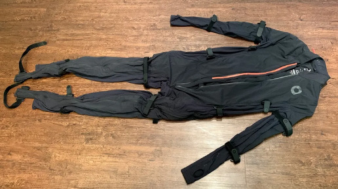
Instrument Data collection was carried out using the Rokoko Smartsuit motion capture system, composed of inertial measurement units distributed throughout the body.
Figure 2: Participant playing the cello during the experiment.
Influence of Chair Height on Posture While Playing the Cello: A Biomechanical 137 The system records, in recording frames, numerical values corresponding to joint angles along different axes. The data were automatically exported to a spreadsheet containing multiple columns. For this study, only selected columns were used, such as: timestamp (indicating time in increasing order, every ten milliseconds) and some angles. From these, only three variables were selected for detailed analysis: LeftShoulder_flexion (primary variable), Pelvis_extension, and RightElbow_flexion (secondary variables).
PROCEDURE The participant performed a one-note scale under four distinct postural conditions:
1) Chair with the seat height adjusted to 42 cm from the floor: in this first scenario, the chair height corresponds to 23.1% of the participant’s stature. 2) Chair with the seat height adjusted to 48 cm from the floor: in this second scenario, the chair height corresponds to 26.4% of the participant’s stature. 3) Chair with the seat height adjusted to 54 cm from the floor: in this third scenario, the chair height corresponds to 29.7% of the participant’s stature. 4) Near-standing posture: the participant performed the scale in an intermediate position, neither fully seated nor fully standing.
Each condition was repeated three times, resulting in twelve recordings; however, two repetitions from each condition were used (combined for joint analysis), totaling eight recordings.
The experiment was conducted in a controlled environment, with the presence of two additional individuals who assisted during the experiment, and with the beginner cellist performing either seated or in an elevated posture according to the condition. The protocol was standardized, and the participant was instructed to play the scale naturally, without targets for speed or precision beyond habitual execution.
Data Processign The high values result from the numerical scale exported by the Rokoko system; however, they were also normalized to physiological degrees (°) in order to facilitate biomechanical interpretation of the results. For each joint, minimum, maximum, mean, and standard deviation values were calculated. These results are presented in Table 1.
Table 1: Minimum, maximum, mean, and standard deviation values under all conditions.
Table available in the original PDF paper.
Joint Condition Minimum Maximum Mean Standard deviation Left shoulder flexion 42 cm 52.44 (0.00°) 8,004,546 (8.00°) 5,788,126 (5.79°) 1,851,494 (1.85°)
48 cm 39.34 (0.00°) 7,484,317 (7.48°)
4,681,383 (4.68°)
1,661,649 (1.66°)
54 cm 50.34 (0.00°) 7,668,455 (7.67°)
5,026,621 (5.03°)
1,649,677 (1.65°)
Near- standing
62.16 (0.00°) 9,597,621 (9.6°)
5,947,207 (5.95°)
2,047,199 (2.05°)
Pelvic extension 42 cm 6.879 (0,01°)
8.377.542 (8,38°)
6.708.626 (6,71°)
2.073.099 (2,07°)
48 cm 5.355 (0,01°)
6.801.321 (6,80°)
5.060.277 (5,06°)
1.585.347 (1,59°)
54 cm 2.129 (0,00°)
6.978.984 (6,98°)
3.298.249 (3,30°)
1.650.106 (1,65°)
Near- standing
0 (0,00°)
6.529.727 (6,53°)
2.730.851 (2,73°)
1.374.625 (1,37°)
Right elbow flexion
42 cm 78,96 (0,00°)
9.999.158 (10,00°)
6.315.077 (6,32°)
3.623.680 (3,62°)
48 cm 85,91 (0,00°)
9.998.132 (10,00°)
5.350.693 (5,35°)
4.058.171 (4,06°)
54 cm 95,74 (0,00°)
9.998.616 (10,00°)
6.920.539 (6,92°)
3.302.752 (3,30°)
Near- standing
88,39 (0,00°)
9.999.129 (10,00°)
6.084.470 (6,08°)
3.702.816 (3,70°)
RESULTS
The results are presented in three parts: left shoulder flexion (primary variable), pelvic extension, and elbow flexion of the bowing arm (secondary variables), all of which are already summarized in Table 1.
Left Shoulder Flexion As evidenced in Table 1, the chair with a height of 48 cm presented the lowest mean values of shoulder flexion, as well as one of the lowest standard deviations, indicating greater joint stability during the performance of the musical scale.
In contrast, the near-standing condition presented the highest maximum values and the largest standard deviation, indicating greater biomechanical demand on the shoulder. In the intermediate conditions of 42 cm and 54 cm, the behaviors were similar, with mean values higher than those observed at 48 cm but lower than those of the near-standing posture. Thus, small variations are sufficient to alter the behavior of the left shoulder, reinforcing the role of the seat in the cellist’s posture.
Influence of Chair Height on Posture While Playing the Cello: A Biomechanical 139 Seat-to-Floor Distance of 42 cm
Percentiles (10%, 25%, median, 75%, 90%) were calculated to understand the ranges within which the participant remained for most of the time. In this case, the following were obtained:
Table 2: Statistics related to the 42 cm seat height.
Most of the data, between P25 and P75, lie between 5.44° and 7.04°, with the shoulder considerably elevated. The histogram peak falls within this range, indicating that the participant played with a relatively high shoulder elevation for a substantial portion of the time.
Graph 4: Histogram of left shoulder flexion (42 cm).
Seat-to-Floor Distance of 48 cm In this case, the following were obtained:
Table 3: Tatistics related to the 48 cm seat height.
Table available in the original PDF paper.
Statistic Value 10th percentile (P10) ≈ 3,89×10⁶ (≈ 3,89°)
Graph 5: Histogram of left shoulder flexion (48 cm).
With the chair adjusted to a height of 48 cm, the histogram showed a shift toward smaller angles, with most samples falling between 4.0° and 5.5°. This suggests that the shoulder remained in a more neutral position with less elevation compared to the other conditions.
Seat-to-Floor Distance of 54 cm In this case, the following were obtained:
Table 4: Statistics related to the 54 cm seat height.
Table available in the original PDF paper.
Statistic Value 10th percentile (P10) ≈ 4,16×10⁶ (≈ 4,16°)
With the chair adjusted to a height of 54 cm, the angles were distributed in an intermediate manner, with a predominant range of approximately 4.7° to 6.1°, suggesting moderate shoulder elevation—greater than in the 48 cm condition but lower than in the 42 cm chair condition.
Graph 6: Histogram of left shoulder flexion (54 cm).
Influence of Chair Height on Posture While Playing the Cello: A Biomechanical 141 Near-Standing
In this case, the following were obtained:
Table 5: Statistics related to the near-standing condition.
Table available in the original PDF paper.
Statistic Value 10th percentile (P10) ≈ 9,46×10⁶ (≈ 0,95°)
Maximum ≈ 9,60×10⁶ (≈ 9,60°) In the near-standing posture, the histogram showed a concentration of higher values, with most samples between 5.8° and 6.5% and a prolonged tail reaching up to 9.6°, indicating a systematically more elevated shoulder and a higher occurrence of extreme postures.
Graph 7: Histogram of left shoulder flexion (near-standing).
The values presented in the tables correspond to the data exported by the Rokoko system, on a scale with inertial measurement units, followed by values normalized to physiological degrees (°), obtained by division by 106. Minimum values close to zero are related to initial segments of the data collection or to postural transitions and do not represent continuous task execution.
Pelvic Extension Pelvic extension shows a different behavior that reflects the influence of chair height on the base of posture. According to Table 1, the 48 cm condition presents lower intermediate mean values and lower variability, suggesting greater pelvic stability and more consistent trunk alignment during the performance of the musical scale.
In the extreme conditions—especially in the near-standing posture—lower mean values of pelvic extension were observed, which may be associated
with greater postural instability and, consequently, greater difficulty in maintaining efficient trunk organization without the support of the seat. The 42 cm condition, in turn, presented higher mean values, which may suggest greater anterior pelvic tilt as a compensation to achieve stability.
Right Elbow Flexion (Bowing Arm) The results show that different chair heights may also affect the bowing gesture. As shown in Table 1, the 48 cm condition presented intermediate mean values, which may indicate that the elbow maintains greater functional freedom necessary for bow control.
The 42 cm and 54 cm conditions presented higher mean values of elbow flexion, suggesting greater joint demand for controlling bow movement. The near-standing posture, similarly to the previous two, also showed a high mean value, and the higher standard deviation may indicate postural instability and variations in movement to compensate for the lack of support.
DISCUSSION
The results of this experiment indicate that chair height can indeed influence the postural organization of the cellist, affecting joint angles of the shoulder, pelvis, and elbow of the bowing arm. Compared to the other conditions, the 48 cm chair showed the best postural alignment, as it resulted in lower shoulder elevation and smaller joint amplitude, which may suggest greater biomechanical efficiency and stability.
The excessive shoulder elevation observed in the 42 cm condition and in the near-standing posture corroborates the findings of Foxman and Burgel (2006), who identified the shoulder girdle as one of the segments most vulnerable to the development of occupational pain in musicians. The greater shoulder elevation in these conditions suggests increased joint overload, which may be associated with a higher risk of discomfort and injury, as also suggested by Teixeira et al. (2015).
The pelvic behavior observed in this study parallels research indicating that the base of support influences trunk positioning (Ackermann & Adams, 2004). In the experiment, it was possible to observe that when the pelvis did not provide adequate stability, the participant sought compensations at the shoulder and elbow.
Regarding the bowing arm elbow, the higher chair condition (54 cm) and the near-standing posture suggest that the participant needed to make adjustments to compensate for the positioning of the instrument.
From a methodological perspective, the use of motion capture aligns with the recommendations of Rousseau et al. (2023), who emphasize the importance of quantitative and three-dimensional methods for postural assessment in musicians. Even with subtle differences among the analyzed conditions, the measurement of joint angles provided stronger support for the biomechanical analysis of the influence of chair height.
CONCLUSION
This study aimed to investigate the influence of different chair heights on the posture of a beginner cellist using joint angle analysis obtained through motion capture. The results demonstrated that: a) chair height can affect shoulder flexion values, pelvic posture, and
movement of the bowing arm elbow; b) the chair adjusted to a height of 48 cm provided the most neutral posture, with lower shoulder elevation, reduced variability, and greater overall stability; c) the near-standing posture was the most demanding condition for the
participant, leading to greater joint amplitude and higher shoulder elevation; d) the chair adjusted to a height of 42 cm produced greater trunk inclination, requiring joint compensations (similar to the near-standing condition); and finally, e) the 54 cm chair showed intermediate behavior, with some increased
demands, though less intense than in the extreme conditions.
Suggestions for future studies include:
including larger samples with musicians at different skill levels;
analyzing additional body segments;
comparing chairs with different characteristics;
investigating a possible relationship between posture and sound quality in the interaction between biomechanics and musical perception.
REFERENCES
Ackermann, Bronwen; Adams, Raymond. Physical characteristics and pain patterns of skilled violinists. Medical Problems of Performing Artists, vol. 19, no. 2, pp. 65–71, 2004. Available at: https://www.researchgate.net/publication/289419226_ Physical_Characteristics_and_Pain_Patterns_of_Skilled_Violinists. Accessed on: Dec. 7, 2025. Costa, C.P. Contribuições da ergonomia à saúde do músico: considerações sobre
a dimensão física do fazer musical. Música Hodie. 2005. Available at: https:// revistas.ufg.br/musica/article/download/2474/2428/10420. Accessed on: Dec. 17, 2025. Eska, B.; Niess, J.; Müller, F. Proper posture: designing posture feedback across musical instruments. Proceedings of the ACM Conference on Human Factors in Computing Systems (CHI). New Orleans: ACM, 2022. Available at: https://arxiv. org/abs/2205.15110. Accessed on: Dec. 17, 2025. Foxman, Irwin; Burgel, Barbara J. Musician health and safety: Preventing playing-
related musculoskeletal disorders. AAOHN Journal, vol. 54, no. 7, pp. 309–316, 2006. Available at: https://journals.sagepub.com/doi/epdf/10.1177/21650799060 5400703. Accessed on: Dec. 07, 2025. Kelleher, Leila K.; Campbell, Kody R.; Dickey, James P. Biomechanical research on bowed string musicians: a scoping study. Medical Problems of Performing Artists, vol. 28, no. 4, pp. 212–218, 2013. Available at: https://www.researchgate. net/publication/259321634_Biomechanical_Research_on_Bowed_String_ Musicians_A_Scoping_Study. Accessed on: Dec. 06, 2025.
Kodama, Isabella. Healthy Cello Playing: Teaching Cello to Promote Injury Prevention” Musicology and Ethnomusicology: Student Scholarship. 120. 2022. Available at: https://digitalcommons.du.edu/cgi/viewcontent. cgi?article=1135&context=musicology_student. Accessed on: Dec. 06, 2025. Mihcin, Senay; et al. Investigation of wearable motion capture system towards
biomechanical modelling. Proceedings of the International Conference on Biomechanics. 2019. Available at: https://www.researchgate.net/ publication/335194888_Investigation_of_Wearable_Motion_Capture_System_ Towards_Biomechanical_Modelling. Accessed on: Dec. 17, 2025. Ohlendorf, D.; Wanke, E.M.; Filmann, N.; Gronenberg, D.A., Gerber A. Fit to play: Posture and seating position analysis with professional musicians - a study protocol. J Occup Med Toxicol. 2017. Available at: https://pubmed.ncbi.nlm.nih. gov/28265296/. Accessed on: Dec. 09, 2025. Rousseau C.; Taha L.; Barton G., et al. Assessing posture while playing in musicians:
A systematic review. Applied Ergonomics. 2023. Available at: https://www. sciencedirect.com/science/article/pii/S000368702200206X. Accessed on: Dec. 16, 2025. Teixeira, C.S.; Andrade, R.D.; Kothe, F.; Felden, É.P.G. Instrumental practice and body discomfort in violin and viola players. O Mundo da Saúde. 2015. Available at: https://bvsms.saude.gov.br/bvs/periodicos/mundo_saude_artigos/Pratica_ instrumental_desconforto_corporal.pdf. Accessed on: Dec. 17, 2025. Zaza, Christine. Playing-related musculoskeletal disorders in musicians: A systematic
review of incidence and prevalence. Canadian Medical Association Journal, vol. 158, no. 8, pp. 1019–1025, 1998. Available at: https://pmc.ncbi.nlm.nih.gov/ articles/PMC1229223/pdf/cmaj_158_8_1019.pdf. Accessed on: Dec. 05, 2025.
LISTED IN THE AHFE DIGITAL BOOKSTORE CATALOGUE
Explore the complete digital volume
Physical Ergonomics and Human Factors
Read this individual research paper free through the original publisher, or explore the full digital proceedings book.
ISBN 978-1-964867-99-1
Explore this ISBN in the AHFE Bookstore ↗Listed in the July 2026 bookstore catalogue; search by ISBN to confirm current availability · Digital book purchase optional