Alessio Silvetti, Dimitri Mandolesi, Tiwana Varrecchia, Giorgia Chini, Alberto Ranavolo, Cristina Chieffo, Adriano Papale (2025). Posture analysis of a TV broadcast cameraman: a case study. In: Physical Ergonomics and Human Factors. AHFE Open Access, vol. 185, pp. 100–107. https://doi.org/10.54941/ahfe1006469
The work of a cameraman has ergonomic challenges which require care. A long-standing posture, peculiar of the task, along with the used camera equipment may result in the development of muscle fatigue that may cause musculoskeletal disorders over time. Aim of the paper is a posture analysis assessment of the biomechanical overload risk of cameramen's work in live broadcast television and to suggest potential solutions to risk reduction. In our case study, during the activity, the cameraman monitors the filming through a screen not adjustable in the upper body of the camera. The live television broadcast lasted 150 minutes, with 6 advertising breaks of 5 minutes each. We made video recordings of the task highlighting as the posture adopted could be classified as static and, thus, evaluated according to ISO standard 11226. Alongside this, we have also analyzed the posture with the 3DSSPP software (v. 7.1.3), allowing us to calculate, the maximum static holding time in which the worker can adopt the reconstructed posture before muscular fatigue occurs.The postural analysis of both trunk and legs showed no critical issues. Different results, instead, for both upper limbs and the neck. Throughout the task, the worker has a neck extension of 37°. According to ISO 11226, the neck posture belongs to the ‘not recommended’ area. Both shoulders were abducted (29° the right limb; 23° the left limb). This posture, based on the software's mathematical model, could be adopted with no support by the 5th percentile workforce for up to 4 minutes.Our evaluation, in this case, highlighted a crucial issue concerning screen height, which is above the eye level forcing the worker to extend the head for up to 40 minutes continuously. This is well above the 435s exposure time that 3DSSPP software calculates that muscle fatigue in the neck can occur for the 50th percentile of the working population. Besides, the ISO 11226 standard does not recommend neck extension, which was 37° in our 3DSSPP reconstruction. A simultaneous abduction of both shoulders to move the camera, although worker partially releases weight on the camera dumbbells, also contributes to overloading the neck joint. Placing the display on the back of the machine body, and adjusting its height, should allow workers to have a more neutral posture during activity. Our paper only refers to the camera model we observed; different camera could result in other conclusions. In future, we plan to further investigate this task by means of the muscle fatigue analysis using surface electromyography to assess through the time-varying median frequency.
Posture Analysis of a TV Broadcast Cameraman: A Case Study 101
INTRODUCTION
The broadcast scenario presents ergonomic features that entail a detailed biomechanical risk assessment for camera operators and directors. Both tasks present a potential risk to workers due to sustained static and constrained awkward postures due to TV equipment.
Nowadays, only a few research reports in the literature have investigated biomechanical overload risk in camera operators. Every paper agrees that musculoskeletal disorders are common among workers. Nevertheless, the limited studies did anamnestic questionnaires and concerned camera operators who held the equipment over their shoulders.
A study (Asfour, 1988) in a laboratory setting analyzed the heart rate and oxygen consumption of four experienced camera operators. Findings classify the activity as a heavy effort level.
Another paper (Karatas, 2003) concludes that carrying a heavy mobile camera on the shoulder might cause suprascapular nerve entrapment in newsreel workers. Karatas also claims to consider suprascapular nerve an occupational disease of filmer.
A case study showed that a cameraman who carried a 9 kg camera for one hour continuously experienced a right subclavian vein thrombosis while working where the right upper limb was flexed and abducted (Beasley, 2015). A survey of 166 camera operators using anamnestic questionnaires (Kim, 2015) in a broadcasting station highlights shoulder pain as the most serious musculoskeletal disorder of male workers. Kim found ergonomic factors and physical burden the most significant factors affecting work-related musculoskeletal disorders (WRMSDs) in filmers.
Cameramen workers should be able to improve the ergonomic occupational environment and adopt preventive measures against risk factors during their jobs.
Afterward, a further study (Jeong, 2018) matched the occurrence and severity of WRMSDs between filmers and desk workers. This study found that filmers have a higher risk of WRMSDs than desk workers, notably for neck, shoulders, and lower limbs. The authors claimed the need for improvements to reduce musculoskeletal disorders in these workers.
Recently, in an Indian study (Yadav, 2023), authors gave the Nordic Musculoskeletal Questionnaire to 100 film operators categorized into two groups: one group operates portable shoulder cameras, while the other group works with studio cameras fixed to the ground. Authors reported a high occurrence of WRMDs in workers, notably in the lower back, followed by the shoulder and neck. This latest research is of special interest as India’s film industry, commonly referred to as Bollywood, is, according to the World Economic Forum, the most important in the world due to its number of productions, well ahead even of the more famous Hollywood (https://www.weforum.org/stories/2020/02/5-facts-to- show-anyone-who-thinks-the-global-film-business-is-all-about-hollywood/).
As for static standing posture, in a recent paper (Rodriguez-Romero, 2022) on office workers, a threshold of 30 minutes was identified as a limit for low back and foot complaints. After 30 minutes, the prevalence of low back pain rises from 15% to 40% and foot pain from 0% to 25%. Furthermore, the research found a correlation between increased pain and high workers’ Body Mass Index.
The literature shows that the filmer’s working posture is intrinsically related to the task and the equipment used. It could cause a faster onset of muscle fatigue and lead to musculoskeletal disorders.
All studies mainly focused on the job’s medical and health issues. None of them performed a quantitative risk assessment, apart from Asfour (1988). He classified the job of a filmmaker as being heavy.
The workers performed the job with a standing posture for a long time. Our aim is a biomechanical analysis of a cameraman in a live television broadcast. We also aim to identify and suggest ergonomic accommodations to prevent the operators’ occupational health and minimize their biomechanical overload risk.
MATERIALS AND METHODS
We analyzed the posture of a broadcast studio cameraman working on a mobile studio camera that is pushed and pulled, set at different heights and distances from the worker. The cameraman monitors the filming using a fixed display placed on the upper side of the camera.
We examined a live TV broadcast from 11:00 a.m. to 1:26 p.m., with six advertising breaks lasting about five minutes each. We performed video recordings that we analyzed in the laboratory. Video recordings confirm that even though the cameraman made minor postural adjustments for load reduction, the posture adopted throughout the task is to be considered a static posture and, thus, can be analyzed with the ISO 11226 criteria.
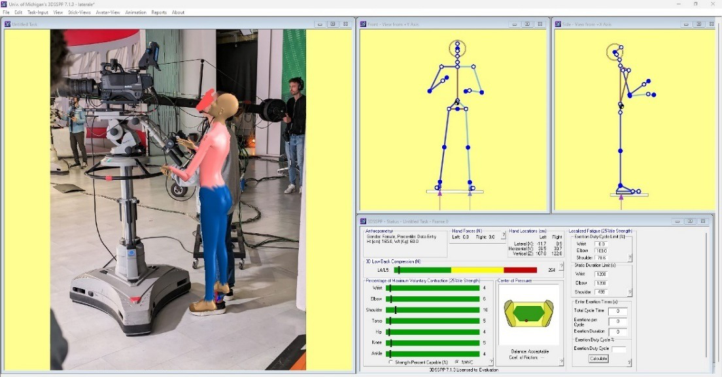
Further, we captured snapshots from our videos to perform a posture assessment with 3DSSPP software (v. 7.1.3). The software provides the most relevant body angles in the three planes. 3DSSPP also provides an estimation of the percentage of Maximum Voluntary Contraction (%MCV) and the maximum time in which the operator can maintain the posture reconstructed before muscle fatigue occurs (Tmax) based on the Potvin threshold (Potvin 2012a, 2012b). We obtained values from the 5th, 25th, and 50th percentile working populations in both parameters. Fig. 1 shows the reconstruction of a female cameraman. We considered a female worker because at higher risk for the development of musculoskeletal disorders (height 165 cm; weight 60 Kg) (Pedulla, 2024; Cimas, 2018; Cote, 2011).
Posture Analysis of a TV Broadcast Cameraman: A Case Study 103
Figure 1: Reconstruction with 3DSSPP software of the posture adopted by the cameraman. The image also shows estimated values of %MCV for several body districts and the overall balance status.
RESULTS
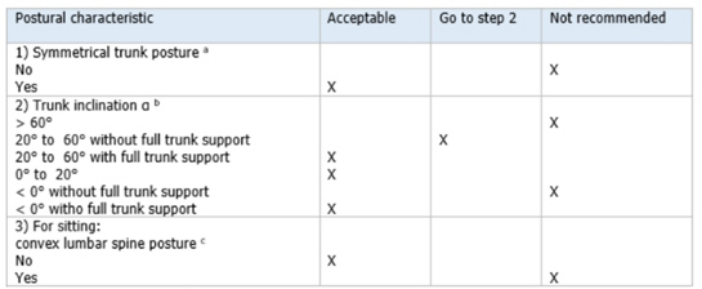
Both methods did not show critical issues for trunk and leg posture. The posture was proper. The worker’s restricted posture occasionally resulted in a trunk extension. According to ISO 11226, Table 1 (Figure 2), trunk extension is not recommendable.
Figure 2: Image shows Table 1 of ISO 11226 for the first-level assessment of trunk postures. Extension beyond 0◦without full support (point 2) is not recommendable.
Our analysis showed negative issues concerning the upper limbs and neck. While filming, the worker needed to look within the display screen, set on top of the camera, to view the scene. This task required a neck extension of about 37
. The ISO 11226 standard’s suggested thresholds
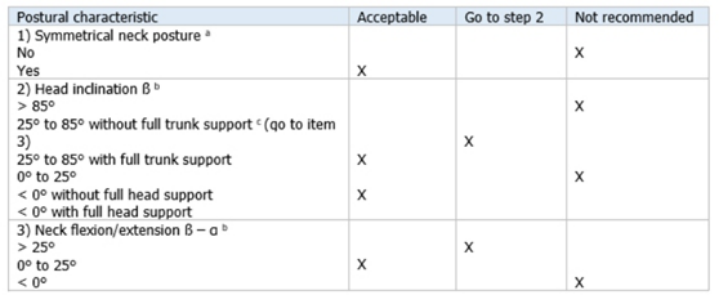
(Figure 3) concerning static neck postures consider the neck extension not recommendable.
Figure 3: The image shows Table 3 of ISO 11226 for the first-level assessment of neck postures. Extension beyond 0◦(point 3) is not recommendable.
Data from 3DSSPP software confirms those made applying ISO 11226 standard. Our data indicate that, for a very weak female working population (5th percentile), the MCV of the neck muscles was 29%, and the maximum exposure time before muscle fatigue occurred was somewhat more than two minutes (127 s). In the case of a weak female working population (25th percentile), results indicated 19% MCV for muscle activation and 287 s for maximum exposure time. Lastly, 3DSSPP for an average female working population (50th percentile) revealed values of 16% of the MCV and just over 7 minutes (435 s) of the maximum time a worker can adopt the posture before muscle fatigue occurs.
Table 1 synthesizes the 3DSSPP data for the three percentiles of the working population analyzed for the neck area.
Table 1: Percentile values of the maximum voluntary contraction and maximum exposure time before muscle fatigue occurs for neck flexion/extension for each of the three percentiles of the examined working population.
Table available in the original PDF paper.
Percentile %MCV Neck Tmax Neck (s) 5
29% 127 s 25
19% 287 s 50
16% 435 s
3DSSPP upper limbs analysis’ shows a shoulder abduction (29
right limb; 23
left limb) for both sides. Table 5 of ISO 11226 suggests this is acceptable only with full forearm support.
The upper limbs, in our scenario, are not fully supported. To move the camera, the cameraman placed only his hands on its handles, forcing him
Posture Analysis of a TV Broadcast Cameraman: A Case Study 105
into a constrained posture with his shoulders slightly raised. The posture of the shoulder also affects the posture of the trunk. Based on the thresholds of ISO 11226 (Table 6), shoulders could be abducted between 20
and 30
, with no full limb support, no longer than 3 to 4 minutes. Beyond this time, the posture is not recommendable.
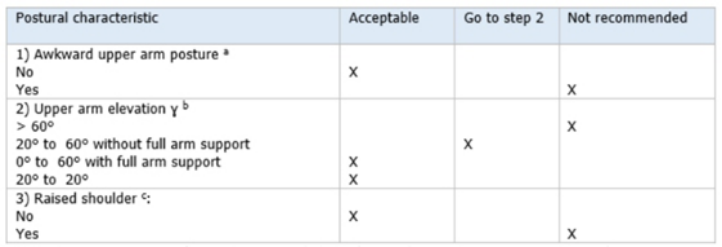
The shoulders were also slightly elevated. Table 5 (Figure 4) of ISO 11226 shows that the elevation of the shoulders is not acceptable.
Figure 4: Image shows Table 5 of ISO 11226 for the first-level assessment of the upper limb. The abduction between 20◦and 60◦is acceptable only with full upper limb support. Elevation (point 3) is not recommendable.
Table 2 synthesizes 3DSSPP data from the three percentiles of the working population examined for the left and right shoulder abduction in case the limbs are unsupported. By population percentile, the %MCV of the left shoulder ranged from a minimum of 8% in the 50th to a maximum of 14% (5th percentile). The maximum exposure time ranged from 725 s (about 12 minutes) in the 50th percentile to 257 s (about 4 minutes) in the 5th percentile.
Data from the right shoulder were similar to the left one. The %MCV ranges from a minimum of 8% (50th percentile) to a maximum of 15% (5th percentile). The maximum exposure time ranges from 713 s (50th percentile) to 253 s (5th percentile).
Table 2: Percentile values of the maximum voluntary contraction and maximum exposure time before muscle fatigue occurs for the shoulder abdo-adduction for each of the three percentiles of the examined working population.
Table available in the original PDF paper.
Percentile %MCV Shoulder SX
Tmax (s) Shoulder SX
%MCV Shoulder DX
Tmax (s) Shoulder DX 5
14% 257 s 15% 253 s 25
10% 508 s 10% 499 s 50
8 % 725 s 8% 713 s
Our posture analysis suggests that, despite neck extension, the balance is acceptable. Orthogonal compressive force on the L4/L5 lumbar region (264N) is also within the latest thresholds (Jager, 2018). The workers’ symmetric posture does not highlight remarkable values concerning shear forces at the lumbosacral region.
DISCUSSION AND CONCLUSION Postural analysis of a worker using a fixed monitor above the camera body revealed a critical issue related to the monitor heights.
The placement of the monitor over the plane of the eyes constrains the worker to neck extension for up to 40 continuous minutes before an advertisement break. As a result, this exposure time is well above the 435 s estimated by 3DSSPP for neck muscle fatigue occurrence in the 50th percentile of the working population. Furthermore, the ISO 11226 standard does not recommend neck extension at all, which reached 37
in the 3DSSPP reconstruction we did. Contemporary abduction in both shoulders to move the camera, even if the operator partially unloads the weight on the camera’s handgrips, decreasing the shoulder load, however, contributes to a further overload of the neck zone. In addition, the use of the camera also implied some postural correction throughout the upper body, which sometimes required the operator to extend the trunk. Again, this postural issue falls within the not recommended ones according to ISO 11226.
The data we found in the current case study refer to the examined work population and the equipment used in our scenario. A taller work population, such as males, and different equipment could result in different values.
A prolonged neck extension could lead to various outcomes (Neupane, 2017) of neck disorders (pain, stiffness, weakness, and numbness), headaches, and circulatory disorders. Implementing ergonomic design actions can significantly improve workers’ health.
Relocating the monitor to the back of the camera and adding an adjustable arm to modify its height will lead to a more neutral posture for the workers.
The solutions we proposed to customize the monitor heights to the worker’s anthropometry would decrease the potential risk of static postures.
The benefits of improved video-camera design would be more objectively assessed with a muscle fatigue analysis through median frequency spectrum analysis, particularly in trunk, shoulder, and neck muscles (Rampichini, 2020).
REFERENCES
Asfour SS, Waly SM, Genaidy AM, Gonzalez RM. Physiological stresses associated with television camera operators’ tasks. Appl Ergon. 1988;19:275–80. Beasley R, Braithwaite I, Evans R. Upper extremity deep vein thrombosis
in a TV cameraman. Occup Med (Lond). 2015 Jun;65(4): 337–9. doi: 10.1093/occmed/kqu212. Epub 2015 Mar 1. Cimas M, Ayala A, Sanz B, Agulló-Tomás MS, Escobar A, Forjaz MJ. Chronic musculoskeletal pain in European older adults: Cross-national and gender differences. Eur J Pain. 2018 Feb;22(2): 333–345. doi: 10.1002/ejp.1123. Epub 2017 Dec 12. PMID: 29235193. Côté JN. A critical review on physical factors and functional characteristics that
may explain a sex/gender difference in work-related neck/shoulder disorders. Ergonomics. 2012;55(2): 173–82. doi: 10.1080/00140139.2011.586061. Epub 2011 Aug 17. PMID: 21846285.
Posture Analysis of a TV Broadcast Cameraman: A Case Study 107
Jäger M. Extended compilation of autopsy-material measurements on lumbar ultimate compressive strength for deriving reference values in ergonomic work design: The Revised Dortmund Recommendations. EXCLI J. 2018 Apr 27;17: 362–385. doi: 10.17179/excli2018-1206. PMID: 29805345; PMCID: PMC5962898. Jeong HS, Suh BS, Kim SG, Kim WS, Lee WC, Son KH, Nam MW. Comparison
of work-related musculoskeletal symptoms between male cameramen and male office workers. Ann Occup Environ Med. 2018 May 2;30:28. doi: 10.1186/s40557-018-0243-y. Karata¸s GK, Gö˘gü¸s F. Suprascapular nerve entrapment in newsreel cameramen. Am J Phys Med Rehabil. 2003 Mar;82(3): 192–6. doi: 10.1097/01. Kim JH, Suh BS, Kim SG, Kim WS, Shon YI, Son HS. Risk factors of work-
related upper extremity musculoskeletal disorders in male cameramen. Ann Occup Environ Med. 2015 Jan 24;27(1):5. doi: 10.1186/s40557-014-0052-x. Neupane S, Ali U, Mathew A. Text neck syndrome-systematic review. Imperial journal of interdisciplinary research 2017 3 (7), 141–148. Pedulla R, Glugosh J, Jeyaseelan N, Prevost B, Velez E, Winnitoy B, Churchill L,
Raghava Neelapala YV, Carlesso LC. Associations of Gender Role and Pain in Musculoskeletal Disorders: A Mixed-Methods Systematic Review. J Pain. 2024 Dec;25(12):104644. doi: 10.1016/j.jpain.2024.104644. Epub 2024 Jul 29. PMID: 39084479. Potvin, J. R. An equation to predict maximum acceptable loads for repetitive tasks based on duty cycle: Evaluation with lifting and lowering tasks. Work. 2012, 41(Supplement 1), 397–400. Available at: 10.3233/WOR-2012-0189-397. Potvin, J. R. Predicting maximum acceptable efforts for repetitive tasks: An equation
based on duty cycle. Human factors. 2012, 54(2), 175–188. Available at: 10.1177/0018720811424269. Rampichini S, Vieira TM, Castiglioni P, Merati G. Complexity Analysis of Surface Electromyography for Assessing the Myoelectric Manifestation of Muscle Fatigue: A Review. Entropy (Basel). 2020 May 7;22(5):529. doi: 10.3390/e22050529. PMID: 33286301; PMCID: PMC7517022. Rodríguez-Romero B, Smith MD, Pértega-Díaz S, Quintela-Del-Rio A, Johnston V.
Thirty Minutes Identified as the Threshold for Development of Pain in Low Back and Feet Regions, and Predictors of Intensity of Pain during 1-h Laboratory- Based Standing in Office Workers. Int J Environ Res Public Health. 2022 Feb 16;19(4):2221. doi: 10.3390/ijerph19042221. Tsantili AR, Chrysikos D, Troupis T. Text Neck Syndrome: Disentangling a New Epidemic. Acta Med Acad. 2022 Aug;51(2): 123–127. doi: 10.5644/ama2006- 124.38. Yadav N, Zore L, Yadav AK. Prevalence of work-related musculoskeletal disorders
among cameramen. International Journal of Health Sciences and Research. 2023 September 13(9):111. doi: https://doi.org/10.52403/ijhsr.20230918.
LISTED IN THE AHFE DIGITAL BOOKSTORE CATALOGUE
Explore the complete digital volume
Physical Ergonomics and Human Factors
Read this individual research paper free through the original publisher, or explore the full digital proceedings book.
ISBN 978-1-964867-61-8
Explore this ISBN in the AHFE Bookstore ↗Listed in the July 2026 bookstore catalogue; search by ISBN to confirm current availability · Digital book purchase optional