Alessio Silvetti, Ari Fiorelli, Antonella Tatarelli, Lorenzo Fiori, Giorgia Chini, Tiwana Varrecchia, Adriano Papale, Alberto Ranavolo, Francesco Draicchio (2023). Application of wearable technologies for the assessment of biomechanical risk in hairdressers. In: Human Factors and Wearable Technologies. AHFE Open Access, vol. 85, pp. 21–29. https://doi.org/10.54941/ahfe1003623
It is usual to link respiratory and skin health issues to hairdressing job. The most current papers from throughout the world reported on biomechanics as well. Shoulder, lower back, and upper back joints were the most impacted. Several authors conducted ergonomic risk assessments through standardized protocols, like REBA, founding high-risk levels. Other authors measured shoulder and wrist movement with IMU or inclinometer founding a high biomechanical risk. Only one study used electromyography (sEMG) to compare the activity of male and female hairdressers founding those women had considerably higher sEMG activity. This study only measured the muscle work from upper limb flexors and extensors. To our knowledge, no research has investigated the whole upper body kinematics and sEMG from the upper arm, shoulder, and trunk using instrumentally based tools for hairdressers’ risk assessment. The aim of our study is a biomechanical risk assessment of the subtask of hair drying in two different ways (horizontally – HOR and upwardly - UP). We acquired four expert workers using an optoelectronic system and sEMG. sEMG results showed that the left side of the body was generally more involved than the right one in both the assessed tasks. Latissimus Dorsi, Trapezius Superior, Deltoideus Anterior, and Flexor Carpi Ulnaris were severely affected by this. In the UP task, the shoulders (Trapezius Superior and Deltoideus Anterior) had high mean percentage of Maximum Voluntary Contraction (%MVC) values. According to our sEMG results, holding a phone that weighs almost 1 kg in a static position is less straining on the upper limb and shoulder than constantly moving the left hand while holding a small comb. Kinematic data seems to support this. The left side showed the highest Range of Motion (RoM) values than the right for shoulder abd-adduction and elevation on the UP task and shoulder horizontal abduction, elbow flex-extension, and wrist prono-supination on both tasks. The shoulder flex-extension showed comparable high RoM values in both tasks.Our findings also show a high standard deviation for RoMs, indicating a high heterogeneity in performing the same task. Our research found that hair-drying is a demanding task for hairdressers. We recommend using wearable technologies to have a more reliable work situation instead of standardized protocols for risk assessment.
Hairdressing is commonly associated with skin and respiratory health dis- eases. Most recently, also biomechanical has been noted. Musculoskeletal disorders (MSDs) in hairdressers became so relevant that even EU-OSHA wrote a report on this (https://osha.europa.eu/it/publications/occupational- health-and-safety-hairdressing-sector). As reported in the EU-OSHA rese- arch hairdressing sector mainly consist of several micro-enterprises. The research also highlights that hairdressing in EU countries is a predominantly female (about 80% women workers) and young profession (around 80% are under 26) where the wage is usually lower than the national average.
Aweto (2015) investigated the prevalence of work-related musculoskeletal disorders (WMSDs) through a survey questionnaire and the coping strategies adopted by hairdressers in a sample of 299 workers. He reported a 12-month prevalence of 75.6% of WMSDs. The most commonly affected body parts were low back (76.3%), shoulder (62.5%), and neck (46.3%). The most relevant coping strategy that employees adopted was to take regular pauses for rest. Moreover, Aweto found a statistical significance between WMSDs and age, years worked, and hours spent in a standing position.
Mishra (2020) conducted a survey questionnaire on 768 subjects (384 hairdressers and control subjects each) and reported that, nearly half of the hairdressers suffered from knee and foot pain, followed by lower back (39.8%) and upper back (38.8%). Moreover, the odds of developing neck and shoulder pain were significantly higher than the control. Women hairdressers were more likely to experience WMSDs than males.
In another paper from Mussi (2008) on 220 Brazilian hairdressers he found similar odds ratio of Mishra. He also evidences the importance of dissemi- nating recommendations for preventing WMSDs through suitable furniture, equipment, and work tools, environmental conditions, size of the workplace, work organization, and work psychosocial factors.
In interviewer-led questionnaire research on 147 hairdressers, Bradshaw (2011) found a significantly high presence of WMSDs in hairdressers com- pared to non-hairdressing controls. The joints most affected were the leg/foot, shoulder, lower back, and upper back. He found that hairdresser training is widespread, but it does not correlate with a risk awareness of the workers. Long daily working hours (>12 hours) and gender were associated with an increased risk of developing WMSDs.
Moreover, De Smet (2009) noted a 41% occurence of work-related upper limb disorders (WRULD) in a sample of 145 hairdressers significantly cor- related with burnout and workaholism. Surprisingly, he failed to establish evidence of a benefit from using ergonomic equipment.
Hassan (2015) found that elbow, shoulder and back pain were the most prevalent pains in the past 12 months and hand and wrist pain led 12.5% of hairdressers to visit a doctor. To decrease WMSDs, he suggests improving work organization with adequate rest, rotating the tasks and using height adjustable chairs.
Kaushik (2014) found on 59 male hairdressers that awkward neck posture and repetitive movement of the upper limb increase the risk of disability in
Application of Wearable Technologies for the Assessment of Biomechanical Risk 23
workers with the increase in age and experience. The author also found that increased age and experience lead to a loss of pinch strength on the dominant side.
Several authors did a biomechanical risk assessment in hairdressing. Some- one applied the Nordic Musculoskeletal Questionnaire or the REBA protocol (Mahdavi, 2013; Reza, 2008). Others used inclinometers to objectify the posture (Wahlstrom, 2010). In one paper, Chen (2010) used electrom- yography (sEMG) to assess ergonomic risk factors for the wrist of the hairdresser.
Reza (2008) found significative prevalences of WMSDs in hairdressers (6% wrists, 21% neck, 31% shoulders, 54% back, and 69% legs). He found significant correlations between disorders of wrist and legs with sex, leg disorder and work time, and disorders of wrist and legs with REBA score.
Similarly to Reza was the study by Mahdavi (2013). Mahdavi performed a risk assessment and classified 46% of the 1032 analyzed postures at a high risk and 14.9% at a very high risk. The REBA score significantly correlated to WMSDs in the neck, wrist, hip, and thigh. Mahdavi highlights that prolonged standing, awkward working postures, repetitive movements, extreme postu- res, high shoulder flexion and abduction, trunk flexion, and overexertion are important risk factors for the genesis of WMSDs in hairdressing.
Wahlstrom (2010) did a postural analysis of the shoulders through incli- nometers in 20 hairdressers that worked at least 30 h a week. For 58% of the working day (279 min), hairdressers performed customer tasks (CT), while the remaining time (42% for 207 min) they performed auxiliary non- customers tasks or had breaks (AT). According to Wahlstrom, hairdressers worked with their right arm lifted over 60 degrees 9.0% of the time during CT and 3.7% executing AT. He concludes that hairdressers may develop WMSDs in the neck and shoulders due to the time they rised their shoulders.
Finally, Chen (2010) investigated wrist angles and forearm flexor and extensor sEMG of 21 hairstylists in the subtasks of hair cutting, washing, and blow-drying. Results showed that the average time of a woman’s hai- rcut is significantly longer than a man’s haircut (51.4 minutes Vs. 35.6). He also found a significant higher sEMG activity (p < 0.001) in female hairsty- lists than male. Chen claims that the higher force exertion and wrist velocity of female hairstylists, along with overexposure, could be the reasons for the higher rate of wrist/hand pain in female hairdressers than in male barbers.
The aim of our study is a biomechanical risk assessment of the subtask of blow-drying in two different ways in experienced workers.
To our knowledge, no one has ever used instrument-based tools to assess Biomechanical risk of trunk, shoulder, and upper arms in hairdressers.
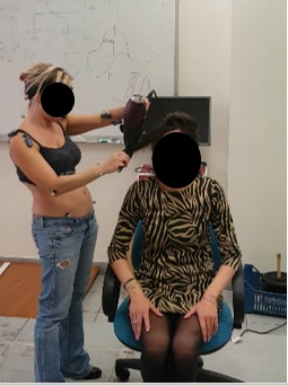
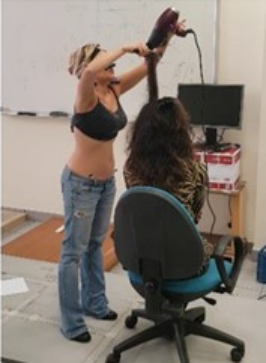
MATERIAL AND METHODS We acquired four experienced health workers, two women and two men, with more than ten years of experience (height 168.7±9.1 cm; weight 64±8.6 kg). They performed the task of blow-drying in two different ways. The first was drying the hair horizontally (Fig. 1 – HOR), and the second was drying the hair up (Fig. 2 – UP). We registered three acquisitions for the two tasks. For
Figure 1: The hairdresser performing the task of drying horizontally.Figure 2: The hairdresser performing the task of drying up.
each we acquired five cycles of drying. We did not considered the first and the last cycles in the analysis. The phone used was a professional one, and its weight was 850gr.
Electromyography Electromyography was acquired bilaterally from the following muscles: Latissimuss Dorsi (LAT), Erector Spinae (ES), Trapezius Superior (TRAP), Deltoideus Anterior (DA), Extensor Carpi Ulnaris (EXT), Flexor Carpi Ulna- ris (FLEX). We recorded the sEMG signals using a surface electromyography system (FreeEMG, BTS SpA, Ita) equipped with 12 wireless probes at a sam- pling frequency of 1 kHz. We placed the probes using disposable pre-gelled electrodes Ag/AgCl (H124SG, Kendall Arabic, Donau, Germany) following
Application of Wearable Technologies for the Assessment of Biomechanical Risk 25
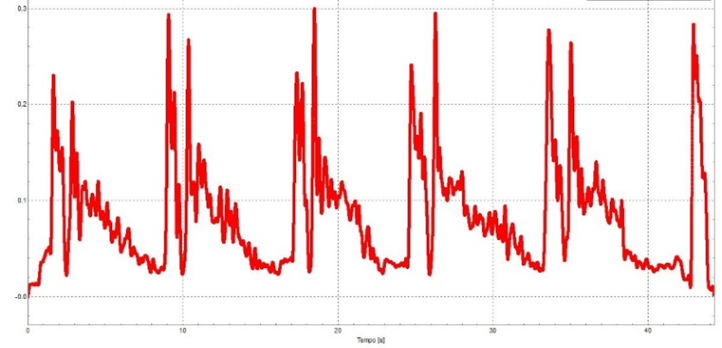
the recommendations of the Atlas of Muscle Innervation Zones (Barbero, 2012). The electromyography signals were processed using Analyze software (BTS SpA, Ita). We filtered the acquired signals in the frequency band of inte- rest [20–450 Hz] using a digital filter and Butterworth 9th-order passband to reduce motion artifacts (electrode-to-skin) and additional high-frequency noise elements. To obtain the linear envelope and to extract the muscu- lar activity profile, we rectified and filtered the signals using a Butterworth 3rd-order low-pass filter with a cut-off frequency of 10 Hz. We normalized the sEMG signals to maximum voluntary contraction (MVC). We perfor- med MVC acquisitions according to SENIAM instructions (Hermens, 2000). We, finally, computed the mean values, expressed as a percentage of Maxi- mum Voluntary Contraction (%MVC). Fig. 3 shows an example of the linear envelope from Deltoideus Anterior.
Kinematic We used an optoelectronic motion analysis system (SMART-E System, BTS, Milan, Italy) consisting of eight infrared ray cameras operating at 120 Hz.
We placed spherical reflecting markers on the following bony landmarks: C1, C7, T10, Sacrum, right and left acromion, right and left olecranon, right and left ulnar styloid process, right and left radial styloid process, and right and left ASIS.
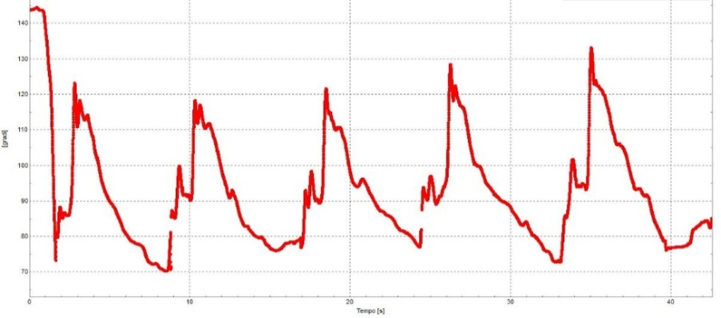
We filtered the kinematic signals with a 5Hz low bass band filter. The marker of the right elbow was used as a reference to determine the cycles. Fig. 4 shows an example of the kinematic signals acquired.
We calculated the mean Range of Motion (RoM) of the following joint angles: neck (flex-extension, lateral bending), upper back (flex-extension, lateral bending), shoulders (abd-adduction, flex-extension, horizontal abd- adduction, elevation), elbows (flex-extension), wrists (prono-supination).
Figure 3: Image shows an example of the linear envelope of the Deltoideus Anterior, as %MVC, from one acquisition. It is possible to identify the five cycles acquired.Figure 4: Image illustrates an example of the movement of the left elbow during the acquisitions. As in Fig. 3, it is possible to identify the five cycles.
RESULTS
Electromyography Hereafter (Table 1), the mean activity values (±SD), as %MVC, for the investigated muscle for the two tasks analyzed.
In the HOR task, the shoulder muscles on the left side showed almost double mean muscle activation levels than the right side (16.1% TRAPSX Vs. 8.8% TRAPDX; 12.5% DASX Vs. 6.9% DADX). Also the Latissimus Dorsi showed the highest mean value on the left side than the right one (18.3% Vs.14.5%). Erector Spinae values on both sides were nearly equal (9.1% ESDX Vs. 9.0% ESSX). The upper arm muscles showed similar mean values of the extensor muscles (18.9% EXTDX Vs. 17.9% EXTSX). The left side showed, instead, a mean highest value of the flexor muscle (14.0% FLEXSX Vs. 11.3% FLEXDX).
The task UP had more activity than the task HOR did. Particularly in both ES, TRAP, and DA muscles. Both EXT and the left EXT showed the lowest values in the UP task than HOR. In this task, we found the highest mean
Table 1. Mean activity values (±SD), expressed as %MVC, for the investigated muscle for the two tasks analyzed.
Application of Wearable Technologies for the Assessment of Biomechanical Risk 27
values. They were both on the left side (TRAP 27.3%, DA 21.3%). The left side had the highest TRAP, DA and FLEX values.
Kinematic The table below (Table 2) shows the mean (±SD) RoM in degree for both the investigated tasks. All RoM values were higher in the UP task than in the HOR task.
The neck showed RoM values of 16.3
in UP task and 11.2
in HOR for the flex-extension; the lateral bending showed 10.8
in UP and 6.7
in HOR. The only remarkable result for the upper back was the flex-extension in UP, which reported a value of 4.5
. We did not observed notable trunk lateral bending. For the flex-extension movement, the shoulders showed pretty symmetric high RoM values in the upper arms for both tasks. In the HOR task, the right shoulder had a flex-extension of 29.3
and the left of 31.1
; in the UP task, the right shoulder had a flex-extension of 49.9
and the left of 53.9
. The abd-adduction movement showed similar values for both arms in both tasks (between 17.3
and 20.8
) save for left abd-adduction in the UP task (40.8
). Also, the horizontal abd-adduction showed similar RoM values for both arms in the analyzed tasks (between 10.5
and 17.3
). The only value notable for shoulder elevation, was in the left arm in the UP task (19.7
).
Along with the shoulder flex-extension, the elbow flex-extension also sho- wed remarkable RoM values comprised between 22
(Right arm, HOR) and 51.7
(left arm, UP). Finally, the wrist prono-supination was the movement that showed the highest RoMs comprised between 42.1
(Right wrist, HOR) and 73.6
(Left wrist, UP); this last value was the highest found in our experimental setup.
Table 2. Mean RoM values (±SD), in degree, for both the investigated tasks.
Literature shows that hairdressing is a highly demanding job for musculo- skeletal systems.
Hairdressers are particularly vulnerable to repetitive movements of the upper limbs, awkward and static posture. There are several tasks worthy of attention that it’s hard to standardize because they depend on the type of hair that is different for every customer. The two most relevant tasks are haircut and hair-drying. We simulated this last one in our lab, and acquired electromyographic and kinematic signals from four seasoned workers.
For what we know, this is the first kinematic and electromyography recor- ding from the arms, shoulder, and trunk in hairdressers. Previous papers only reported kinematics of the wrists and electromyography of the lower arm or shoulder.
Electromyography results showed that, in both investigated tasks, the left side of the body was generally most involved than the right one. That was particularly true for LAT, TRAP, DA, and FLEX.
The LAT did not show a remarkable difference between the two tasks; the values were similar for both sides.
The shoulders (TRAP and DA) showed relevant mean %MVC values, particularly in the UP task.
As reported by Forman (2021), the extensor muscle of the upper limb is less task dependent than the flexor. This is particularly relevant to our results from FLEX. The right side, the one holding the phone, showed less %MVC mean values than the right side, the one holding the comb. Our sEMG results suggest that handling a 1 kg phone in a static position is less deman- ding for upper limbs and shoulders than using a light comb in continuous motion.
Kinematic data seems to support this. The shoulder abd-adduction and elevation on the UP task and shoulder horizontal abd-adduction, elbow flex- extension, and wrist prono-supination showed the highest RoM values on the left side than on the right on both tasks. The shoulder flex-extension, showed similar overall high RoM values. This last movement of the shoulders has to be considered the most relevant as it showed the highest RoM values.
Neck and trunk, finally, showed little RoM, particularly for lateral bending.
In conclusion, our study demonstrates that hair-drying is a highly deman- ding task for the hairdresser.
Our results also showed high SD for the RoM, thus revealing high vari- ability in the execution of the tasks in hairdressers despite our extreme standardization. The high variability of the movement in this field do not reccommend the use of standardized ergonomics tools for biomechanical risk assessment. Wearable technologies could provide data hard to note through observational methods.
We recommend applying wearable technologies (Ranavolo, 2018) to have a more reliable work situation in hairdressers.
Application of Wearable Technologies for the Assessment of Biomechanical Risk 29
REFERENCES
Aweto, Happiness Anulika et al. (2015) “Prevalence of work-related musculoskeletal disorders among hairdresser”. INTERNATIONAL JOURNAL OF OCCUPATI- ONAL MEDICINE AND ENVIRONMENTAL HEALTH Volume 28 No. 3. Barbero, M., Merletti, R., Rainoldi, A.: Atlas of Muscle Innervation Zones:
Understanding Surface Electromyography and Its Applications. Springer, (2012). https://doi.org/10.1007/978-88-470-2463-2 Bradshaw, Lisa et al. (2011) “Self-reported work-related symptoms in hairdressers”.
OCCUPATIONAL MEDICINE Volume 61 No. 5. Chen, Hsieh-Ching et al. (2010) “Ergonomic risk factors for the wrists of hairdressers”. APPLIED ERGONOMICS Volume 41 No. 1. De Smet, Els et al. (2009) “Prevalence of work related upper limb disorders in
hairdressers: A cross sectional study on the influence of working conditions and psychological, ergonomic and physical factors”. WORK Volume 34 No. 3. Forman, Davis et al. (2021) “Wrist extensor muscle activity is less task-dependent than wrist flexor muscle activity while simultaneously performing moderate-to- high handgrip and wrist forces”. ERGONOMICS Volume 64 No. 12. Hassan, Omayma et al. (2015) “Occupational respiratory and musculoskeletal
symptoms among egyptian female hairdressers” JOURNAL OF COMMUNITY HEALTH Volume 40 No. 4. Kaushik, Abhishek et al. (2014) “Upper extremity and neck disability in male hairdressers with concurrent changes in pinch strength: an observational study”. HEALTHLINE Volume 5 No. 2. Mahdavi, Sakineh et al. (2013) “Evaluation of the risk of musculoskeletal disorders
using Rapid Entire Body Assessment among hairdressers in Khorramabad, Iran, in 2014”. JOURNAL OF OCCUPATIONAL HEALTH AND EPIDEMIOLOGY Volume 2 No. 3. Mussi, Giselle et al. (2008) “Prevalence of work-related musculoskeletal disorders in Brazilian hairdressers”. OCCUPATIONAL MEDICINE Volume 58 No. 5. Ranavolo, Alberto et al. (2018) “Wearable Monitoring Devices for Biomechanical
Risk Assessment at Work: Current Status and Future Challenges-A Systematic Review”. INT J ENVIRON RES PUBLIC HEALTH Volume 15 No. 9. Reza, Miri Mohammad et al. (2008) “Evaluation of ergonomic postures of hairdressers by REBA in Birjand”. OFOGH-E-DANESH Volume 14 No. 2. Wahlstrom, Jens et al. (2010) “Upper arm postures and movements in female
hairdressers across four full working days”. Volume 54 No. 5.
LISTED IN THE AHFE DIGITAL BOOKSTORE CATALOGUE
Explore the complete digital volume
Human Factors and Wearable Technologies
Read this individual research paper free through the original publisher, or explore the full digital proceedings book.
ISBN 978-1-958651-61-2
Explore this ISBN in the AHFE Bookstore ↗Listed in the July 2026 bookstore catalogue; search by ISBN to confirm current availability · Digital book purchase optional