Alessio Silvetti, Alberto Ranavolo, Giorgia Chini, Tiwana Varrecchia, Antonella Tatarelli, Lorenzo Fiori, Adriano Papale, Ari Fiorelli, Francesco Draicchio (2022). Integrating sEMG into NIOSH protocol: a manual material handling risk assessment in the fruit and vegetable department of a supermarket. In: Physical Ergonomics and Human Factors. AHFE Open Access, vol. 63, pp. 71–78. https://doi.org/10.54941/ahfe1002598
The biomechanical risk of cashiers in the retail sector has been extensively studied in literature. Despite high back pain prevalence in this sector manual material handling (MMH), instead, seems almost ignored. The aim of our study is MMH risk assessment in a fruit and vegetable department of a supermarket. This task wasn't still investigated, to date, together with standardized protocols and instru-mental-based tools. The sizes of the shelf allowed the use of the NIOSH protocol for the low level, whereas middle and high did not allow its use due to horizontal distance that exceeded the 63 cm set by the protocol. To integrate the NIOSH pro-tocol was used surface electromyography (sEMG). The recommended weight limit (RWL) in our case, according through NIOSH liftinq equation, was 17 Kg. The maximum handled weight from the workers was 14 Kg. The maximum mean peak value while lifting 14 Kg at a low level was 40.1% of Maximum Voluntary Contraction (MVC) in the left Erector Spinae. We assumed this sEMG value to be a safety value and used as a limit for lifts at the middle and high shelf levels because the maximum handled weight of 14 Kg was lower than the 17 Kg limit calculated through the NIOSH equation for the low level. This sEMG limit was exceeded, in the middle, while lifting 14 Kg (47.8% MVC), and in the high level lifting 10 Kg (44.7% MVC), 12 Kg (50.3% MVC), and 14 Kg (57.7% MVC). Our findings show that, for the analyzed shelf and for the male working popula-tion of that supermarket, we could accept as reasonably safe handling boxes up to 14 Kg for the low level, up to 12 Kg in the middle, and up to 8 Kg in high. This study shows that the integration of different assessment tools, such sEMG and NIOSH protocol, could help to a better estimation of biomechanical risk assess-ment. The study, moreover, provided practical guidelines for the health and safety service concerning the recommended load handled on each shelf level to minimize the risk of MMH in the fruit and vegetable department.
The biomechanical risk of cashiers in the retail sector has been extensi- vely studied in literature also by our laboratory (Draicchio, 2012). A study from 1992-2000 of occupational disease complaints in Canada’s retail sector
shows that this task accounted for only 16% of cases of back pain and 24% of cases for upper limb disorders (Forcier, 2008). Forcier highlights that manual material handling (MMH) in retails seems almost ignored in the literature.
Other than Canada, there is a lack of data regarding musculoskeletal disor- ders (MSDs) in workers in the retail industry, possibly owing to the high turnover in employees, who tend to be young and rarely gain more than a few years of experience. When Gardner et al. (Gardner, 1999) analyzed back accidents involving thousands of retail merchandise whose jobs consi- sted in MMH, they found that the store worker’s accident rate was highest among workers with a heavy workload and limited work experience. A study on supermarkets (Violante, 2005) in Italy showed a 12-month storewide low back pain prevalence of 35% and revealed that the department with high biomechanical risk was the fruit and vegetable. High lifting frequencies, heavy lifting weights, prolonged and marked trunk inclination, which are all required in such departments, are generally identified as the major causes of MSDs.
The National Institute for Occupational Safety and Health (NIOSH) pro- tocol (Waters, 1994) cannot always be applied owing to its lifting task limitations and restrictions in this sector. The biomechanical load related to MMH activities in the retail industry is associated with both the goods’ weight and the shelf level, which determines the heights and the horizon- tal distances at the beginning and the end of the lifting action. However, marketing needs could be the reason for the shelf-level choice.
The few studies available in the literature that assessed the risk of MMH in supermarkets used various standardized protocols: PATH (Bucholz, 1996) a qualitative method, has been applied to assess MMH in retail workers who perform non-repetitive work activities (Pan, 1999). Coyle (Coyle, 2005) did MMH risk assessment in supermarkets by adopting two standardized protocols, REBA (Hignett, 2000) and New Zealand Code of Practice for Manual Handling Hazard Control Record [http://www.osh.dol.govt.nz/orde r/catalogue/pdf/manualcode.pdf], to gain a better understanding of the work environment.
A NIOSH report (https://www.cdc.gov/niosh/docs/2015-100/default.ht ml) suggests an adjustable-height cart for reducing biomechanical risk in shelf-filling and in-storage in the warehouse. The University of OHIO inve- stigated the effectiveness of the proposed solution through Lumbar Motion Monitor (Davis, 2014). Findings show that the adjustable cart had both positive and negative features. The Adjustable Ergo Cart reduced the sagit- tal trunk motion, static trunk moment, and NIOSH cumulative lifting index (CLI) but increased trunk twisting motion compared to the traditio- nal cart. Davis claims that this may have partially resulted from the size and maneuverability of the adjustable cart relative to the traditional one.
In our previous paper conducted in the laboratory (Silvetti, 2015), we simulated the MMH task on a typical shelf of a fruit and vegetable depar- tment. Our findings show that kinematics and surface electromyography (sEMG) can be integrated with the NIOSH protocol when it’s not applicable.
Therefore, this study aims to perform MMH risk assessment in a fruit and vegetable department of a supermarket. This task wasn’t still investigated,
Integrating sEMG into NIOSH Protocol: A Manual Material Handling Risk Assessment 73
to date, together with standardized protocols and instrumental-based tools such as sEMG.
Considering that the sizes of the shelf differed from the laboratory ones and only allowed the use of the NIOSH protocol for the low level, whereas middle and high did not allow its use due to horizontal distance that exceeded the 63 cm set by the protocol, the sEMG was used to integrate the NIOSH protocol.
MATERIAL AND METHODS We enrolled for this study an experienced male worker with no history of musculoskeletal disorders or neurological diseases. The worker executed three lifts with various weights (4, 6, 8, 10, 12, and 14 kg) for each of the three shelf levels (low, middle, high).
We recorded electrical muscle activity using a Wi-Fi surface electromyo- graphy system (FreeEMG, BTS SpA, Milan, Italy) at 16 channels with a sampling frequency of 1 kHz. After skin preparation, sEMG signals were detected from each muscle by two Ag/AgCl pre-gelled disposable surface ele- ctrodes (H124SG, Kendall ARBO, Donau, Germany). According to the Atlas of muscular innervation zones (Barbero, 2012), we placed the electrodes in the direction of the muscle fibers. We investigated mean and peak values, as a percentage of Maximum Voluntary Contraction (%MVC), from the follo- wing muscles: right Erector Spinae (ESdx), left erector Spinae (ESsx), right Rectus Abdominis (ABDdx), left rectus Abdominis (ABDsx). The subject per- formed three isometric contractions from each muscle to elicit the maximal voluntary isometric contraction (MVCi) as described in the Atlas of muscular innervation zones. The sEMG signals were rectified, integrated with a mobile window of 0.125 s, and filtered with a 5 Hz Hamming low-pass filter. We normalized the processed signals to the maximum value of the MVCi by using Smart Analyzer software.
RESULTS
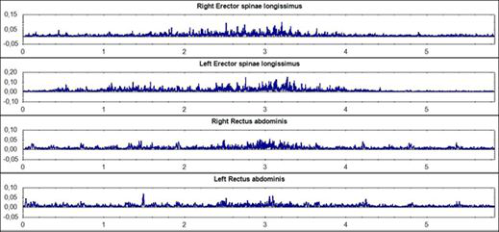
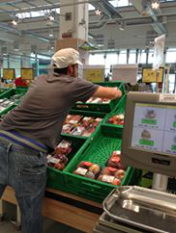
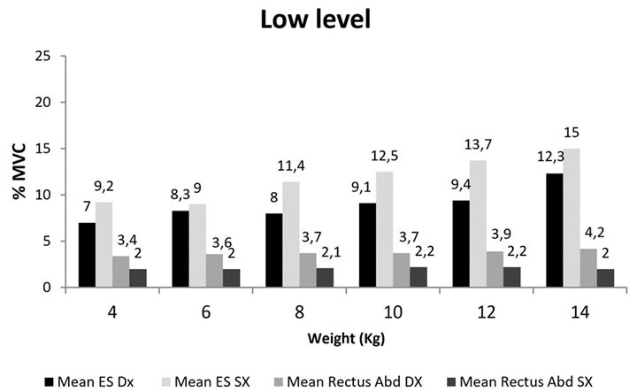
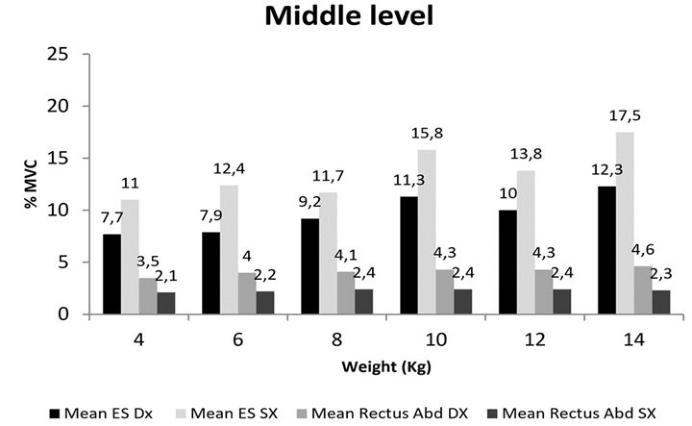
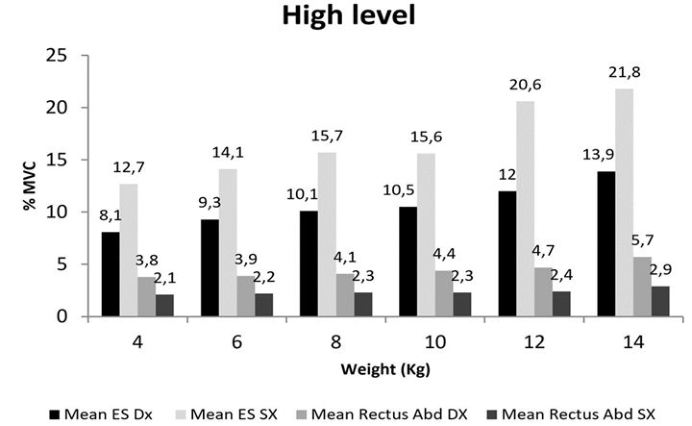
Figure 1 shows the processed sEMG signals from one of the acquisitions; graphs display mean activity levels for the four investigated muscles, for the six-weights lifted and the three shelf levels: low (Figure 3), middle (Figure 4), and high (Figure 5). Figure 2 shows the worker executing the task.
Data displayed in Figures 1, 2, and 3 indicate that the abdominal muscles show low levels of mean %MVC (between 2 and 2.9% ABDsx and 3.4 and 5.7% ABDdx) on all three levels of the shelf and for all investigated weight. We observed the highest value for both ABDs (2.9% sx and 5.7% dx) while lifting 14 Kg at the high level.
About trunk muscles, we measured mean %MVC values for the ESdx com- prised between 7% (handling 4 Kg at the low level) and 13.9% (lifting 14 Kg at a high level). ESsx values, meanwhile, ranged from 9% (handling 6 Kg at a low level) to 21.8% (lifting 14 Kg at a high level).
Risk assessment with the NIOSH protocol was only feasible with the low level of the shelf; the handling at middle and high height, instead, can’t
Figure 1: Image shows an example of EMG processed signals of the four investigated muscles.Figure 2: Image shows worker while handling the crate at the high level of the shelf.Figure 3: Image shows for each of the four investigated muscles and the six weights the mean activity, as %MCV, concerning the handling at the low level of the shelf.
be assessed through NIOSH protocol dues to their horizontal distance that exceeded 63 cm. The recommended weight limit for low level, applying the NIOSH protocol equation, was 17 Kg. This weight was higher than the 14 Kg
Integrating sEMG into NIOSH Protocol: A Manual Material Handling Risk Assessment 75
Figure 4: Image shows for each of the four investigated muscles and the six weights the mean activity, as %MCV, concerning the handling at the middle level of the shelf.Figure 5: Image shows for each of the four investigated muscles and the six weights the mean activity, as %MCV, concerning the handling at the high level of the shelf.
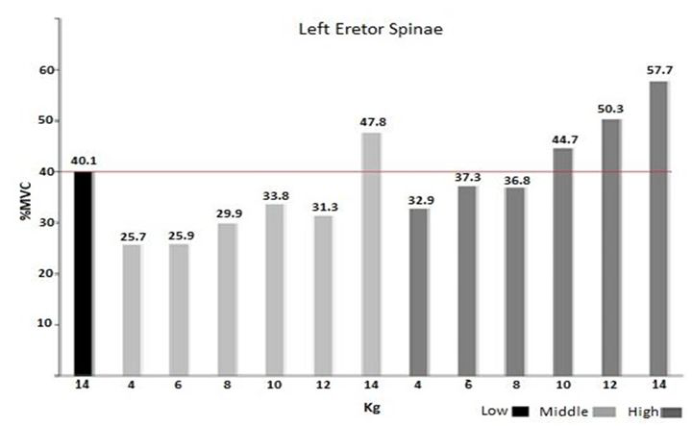
maximum weight lifted by the workers on the shelf. We found the maximum peak value of 40.1% MVC while lifting 14 Kg at the low level for the ESsx (Figure 6). We assumed this %MVC value, obtained under conditions where the weight lifted is below the weight limit computed with the NIOSH equa- tion, to be a safety value and it used as a limit for lifts at the middle and high levels of the shelf.
Figure 6: Image shows the ESsx mean peak level for 14 Kg at the low level and 4 Kg to 14 Kg at the middle and high levels. The red horizontal line represents our proposed sEMG limit that is 40.1% MVC.
The limit value of 40.1% was exceeded, in the middle level, only while lifting 14 Kg (47.8% MVC). The limit value of 40.1% was exceeded at the high level while lifting 10 Kg (44.7% MVC), 12 Kg (50.3% MVC), and 14 Kg (57.7% MVC).
Figure 6 shows the mean ESsx peak level. It is noticeable from the figure that handling 14 Kg at the low height has a higher mean ESsx peak value than those observed in weights between 4 and 12 Kg at the middle level and while handling weights between 4 and 8 Kg at a high level.
CONCLUSION
The sizes of the shelf allowed the use of the NIOSH protocol only for the low level, whereas middle and high levels did not allow its use due to the horizon- tal parameter that exceeded the 63 cm set by the protocol. Because of this, we used an additional tool such as sEMG to integrate the NIOSH protocol. The recommended handled weight for low level applying the NIOSH equation was 17 Kg. The maximum mean peak value while lifting 14 Kg at a low level was 40.1% in the ESsx. This value was assumed to be a safety value and used as a TLV for lifts at the middle and high shelf levels because the maximum handled weight of 14 Kg was lower than the 17 Kg limit calculated through the NIOSH equation.
In general, we found poor abdominal muscle activity: the highest mean values for both abdominals while lifting 14 Kg at the high level (2.9% sx, 5.7% dx). Overall, all muscle activation values while lifting 14 Kg at the low level were higher than lifting weights to 8 Kg at the middle and up to 6 Kg at the high level. Our limit of 40.1% was exceeded, in the middle level, only
Integrating sEMG into NIOSH Protocol: A Manual Material Handling Risk Assessment 77
while lifting 14 Kg (47.8%), and in the high level while lifting 10 Kg (44.7%), 12 Kg (50.3%), and 14 Kg (57.7%). Our findings show that, for the analyzed shelf and in the considered case- study of that supermarket, we could accept as reasonably safe handling boxes up to 14 Kg for the low level, up to 12 Kg in the middle, and up to 8 Kg in high.
The integration of instrumental and observational tools allowed MMH risk assessment of a task often reported in supermarkets as one of the most dangerous. Sometimes it is not possible to assess this task through standardized protocols such as NIOSH lifting equation.
The major limitation of our paper is the limited number of the sample (only one worker). We acquired the only experienced worker that did not suffe- red from MSDs. We did not acquired novice workers because literature has widely highlighted the different strategies in MMH between experienced and novice workers (Gagnon, 2005). This was also showed from Gardner (Garn- der, 1999) that found highest significant different accident rate in novice workers with respect to experienced ones.
Despite this limitation we can claim, that instrumental based tools, such as sEMG, can be applied also in context where common standardized pro- tocols cannot be used or provide poor information about biomechanical risk assessment (Ranavolo, 2018).
The study provided practical guidelines for the health and safety service concerning the recommended load handled on each shelf level to minimize the risk of MMH in the fruit and vegetable department.
REFERENCES
Barbero, Marco. Et al. ed. (2012). Atlas of Muscle Innervation Zones. Italia: Springer-Verlag. Bucholz, Bryan. et al. (1996) “PATH: A work sampling-based approach to ergo-
nomic job analysis for construction and other non-repetitive work”. APPLIED ERGONOMICS Volume 27 No. 3 Coyle, Alison. (2005) “Comparison of the Rapid Entire Body Assessment and the New Zealand Manual Handling ‘Hazard Control Record’ for assessment of manual handling hazards in the supermarket industry”. WORK. Volume 24 Davis, Kermit G. Anes, Lida Orta. (2014) “Potential of adjustable height carts in
reducing the risk of low back injury in grocery stockers”. APPLIED ERGONO- MICS Volume 45 No. 2 Draicchio, Francesco. Et al. (2012) “Biomechanical evaluation of supermarket cashiers before and after a redesign of the checkout counter” ERGONOMICS Volume 55 No. 6 Forcier, Lina. Et al. (2008) “Supermarket workers: their work and their health,
particularly their self-reported musculoskeletal problems compensable injuries” WORK. Volume 30 Gagnon, Micheline. Et al. (2005) “Ergonomic identification and biomechanical evaluation of workers’ strategies and their validation in a training situation: summary of research” CLINICAL BIOMECHANICS Volume 20 No. 6 Gardner, Lytt, I. Et al. (1999) “Risk factors for back injury in 31,076 retail
merchandise store workers” AM. J. EPIDEMIOL. Volume 150 No. 8
Hignett, Sue. Et al. (2000) “Rapid Entire Body Assessment (REBA)” APPLIED ERGONOMICS Volume 31 No. 2 Pan, Christopher, S. Et al. (1999) “Ergonomic exposure assessment: an application
of the PATH systematic observation method to retail workers. Postures, Activities, Tools and Handling” INT. J. OCCUP. ENVIRON. HEA. Volume 5 No. 2 Ranavolo, Alberto. Et al (2018) “Wearable Monitoring Devices for Biomechanical Risk Assessment at Work: Current Status and Future Challenges—A Systematic Review” INT. J. ENVIRON. RES. PUBLIC HEALTH Volume 15 No. 9 Silvetti, Alessio. Et al. (2015) “Kinematic and electromyographic assessment of
manual handling on a supermarket greengrocery shelf” WORK Volume 51 Violante, Francesco, Saverio. Et al. (2005) “Relations between occupational, psychosocial and individual factors and three different categories of back disorder among supermarket workers” INT. ARCH. OCC. ENV. HEA. Volume 78 No. 8 Waters, Thomas et al. (1994) “Applications Manual for the Revised NIOSH Lif-
ting Equation”. Cincinnati, OH: U.S. Department of Health and Human Services, Centers for Disease Control and Prevention, National Institute for Occupational Safety and Health, DHHS (NIOSH) Publication No. 94-110
LISTED IN THE AHFE DIGITAL BOOKSTORE CATALOGUE
Explore the complete digital volume
Physical Ergonomics and Human Factors
Read this individual research paper free through the original publisher, or explore the full digital proceedings book.
ISBN 978-1-958651-39-1
Explore this ISBN in the AHFE Bookstore ↗Listed in the July 2026 bookstore catalogue; search by ISBN to confirm current availability · Digital book purchase optional