Nutan Ashok Chougule, Aliuddin Ahmed, Yueqing Li (2022). Effect of the backpack load on students’ discomfort. In: Physical Ergonomics and Human Factors. AHFE Open Access, vol. 63, pp. 8–12. https://doi.org/10.54941/ahfe1002590
Backpacks are very useful in our day-to-day life, work, offices, and school. Especially students carry backpack to school every day with heavy loads of textbooks, notebooks, and laptop. This is an increasing concern of students carrying heavy backpacks in most countries. From the article of Huntsville Hospital, in the United States around 79 million students carry backpack to school. In 2007, more than 23,000 backpack-related injuries were treated at hospital rooms, physician offices and clinics. The load exerted from the backpack is one of the reasons of variations in the cervical and shoulder posture and it is suggested that carrying a backpack weighing 15% of body weight will be heavy for adults. This study evaluates the effect of backpack loads on the user discomfort in neck, shoulder, upper back, lower back, and knee during a walking activity. For this experiment, 12 participants were selected in the age group of between 18 to 21 years old from Lamar University. The backpack load which is exerted by the backpack was independent variable. As per the research, 15% of total weight of the body is the standard weight to carry the backpack during walking activity. Since, we have considered 10%, 15% and 20% weights of the backpack to the total body weight of participants. The user discomfort is considered as dependent variable. The walkway was embedded with three force plates with various backpack loads (10%, 15%, and 20%). Participants were told to walk on defined route for 10 minutes. After each task, participants had 5-minutes break and were asked to rate their discomfort level. The same procedure was carried out for all participants and measurement data were collected.The result showed a significant main effect of backpack load on the user discomfort of neck, shoulder, upper back, lower back and knee. The user discomfort with 20% load was significantly higher than that with 10% load for all 5 body parts. During the experiment, it was observed that female participant who weighs in range of 100-120 lbs. were experienced most discomfort and not able continue experiment when the weight of the backpack was more than 15% of the total body weight. Whereas the participants with the range of body weight around 160-180 lbs. experienced less discomfort in their neck and shoulder throughout the experiment. In conclusion, the research found that the backpack load significantly affects the user discomfort when student walk carrying the backpack. The research should have practical meaning to decide the appropriate weight of the students’ backpack and develop a more user-friendly design.
Backpacks are particularly useful in our day-to-day life, work, offices, and school, etc. Especially students carry backpack to school every day with heavy loads of textbooks, notebooks, and laptop etc. There is an increasing concern of students carrying heavy backpacks in the United States, Canada, New Zealand, Holland, Italy, and Greece (June & Karen, 2008). As per the article of Huntsville Hospital, in the United States around 79 million students carry backpack to school. In 2007, more than 23,000 backpack-related inju- ries were treated at hospital rooms, physician offices and clinics (Huntsville, 2019). A lot of research has been done on young adults who form a signifi- cant portion of backpack users (Ikechukwu, Wisdom, Osita, & Arochukwu, 2017). Walking with backpack loads induces additional mechanical stress on the spine and has been identified as a risk factor of lower-back pain. The peak lumbosacral joint compression force increases by 7%, 23%, 31%, and 64% when an adult walks with backpack load at 10%, 15%, 20%, and 30% body weight respectively (Simon S. W. & Daniel H. K., 2019; Tarkeshwar & Michael, 2008; Christa, Ilse, An, Gerlinde, & Arthur, 2007).
As per the study of Cook and Neumann, they have considered 10% and 20% total weight of the body for their experiment. But to get more accu- rate results, more parameters should be considered such as 10%, 15%, and
Effect of the Backpack Load on Students’ Discomfort 9
20% of the total weight of the body of students/participants (Thomas M. & Neumann, 2007). Study from Lee, Max and Panagiotis, Georgios considered mostly adults aging between 21-35 years old and other research considered children in their experiments. To cover the gap of age, we have selected teena- ger which are between 18 to 21 years old (Lee, Max C., Joshua, & Mark G., 2019; Panagiotis, Georgios, Spyridon, & Zeiss, 2004). This study evaluated the effect of backpack loads on the user discomfort during a walking task. In this case, the hypothesis deals with how the varia- tion of load would affect the magnitude of user discomfort during a walking exercise.
MATERIALS AND METHODS
To study the effect of loads of the backpack on the five different body segments, experiments were conducted by using total weight of the student body to the different percentage of weight of backpack. The experiment was taken place on the university campus and defined three rounds for each par- ticipant to walk for ten minutes with an interval of five minutes break after each round.
Participants 12 young and healthy college students consisting of both genders (Male and Female) were recruited. The age group of participants was between 18 to 21 years old.
Equipment Equipment included a backpack, a weighing machine, school material for the load, etc. The load which is exerted by the backpack was the indepen- dent variable. As per the research, 15% of the total weight of the body is the standard weight to carry the backpack during walking activity. So, the rese- arch considered 10%, 15%, and 20% weight of the backpack to the total weight of the body of participants. The user discomfort was considered as dependent variable.
Experiment Task Participant were asked to carry the various backpack loads (10%, 15%, and 20% body weight) to walk on defined route for 10 minutes with 5 minu- tes interval in between each activity on university campus. After each task, participants were asked to fill in a discomfort questionnaire. The same pro- cess/experiment will be carried for all the twelve participants. The tasks were completely randomized for each participant.
Experiment Procedure First, all participants were provided with instructions of the experiment. After that they were provided with pre-experiment questionnaire to receive demo- graphic information such as age, height, weight, gender, physical disability, use of backpack during week, etc. Afterwards participant started walking
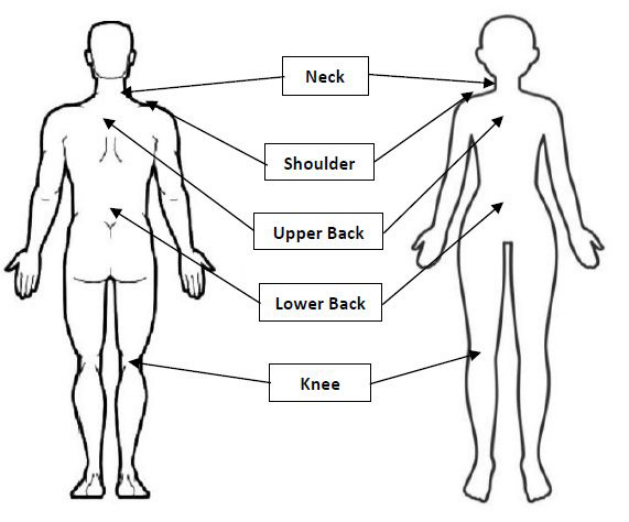
Figure 1: Body segments considered for the experiment.
activity with 10%, 15%, and 20% weight of total body weight of the par- ticipant in a random sequence. Each walking activity was succeeded by a minute’s break and a questionnaire which gathered discomfort information regarding the body segments like neck, shoulder, upper back, lower back, and knee. During each activity, changes in body posture of each participant were observed. Questions were asked such as are how they feel, if they want to take rest, etc.
The experiment concluded with a final questionnaire to get participants’ general feedback. Figure 1 shows the body segments which were considered in this study.
RESULTS
The experiment was a repeated measure and within design. The data were analyzed using ANOVA. The result showed a significant main effect of back- pack load on the user discomfort of neck, shoulder, upper back, lower back, and knee. The user discomfort with 20% load was significantly higher than that with 10% load for all five body parts.
Discomfort on Neck The results showed a significant main effect of weight on neck discomfort (F2,22 = 10.67, p < 0.0006). The post hoc test showed that the neck discom- fort in 20% (M = 5.41, SD = 2.81) was significantly higher than that in 10%
Effect of the Backpack Load on Students’ Discomfort 11
(M = 2.83, SD = 2.13). However, there was no significant different of neck discomfort between 10% and 15%.
Discomfort on Shoulder The results showed a significant main effect of weight on shoulder discomfort (F2,22 = 18.31, p < 0.0001). The post hoc test showed that the shoulder discomfort in 20% (M = 5.92, SD = 2.57) was significantly higher than that in 15% (M = 4.50, SD = 2.78), which was also significantly higher than that in 10% (M = 2.75, SD = 2.18).
Discomfort on Upper Back The results showed a significant main effect of weight on upper back discom- fort (F2,22 = 11.58, p < 0.0004). The post hoc test showed that the upper back discomfort in 20% (M = 4.42, SD = 2.57) was significantly higher than that in 15% (M = 3.42, SD = 2.31), which was also significantly higher than that in 10% (M = 1.67, SD = 1.37).
Discomfort on Lower Back The results showed a significant main effect of weight on lower back discom- fort (F2,22 = 7.50, p < 0.0033). The post hoc test showed that the lower back discomfort in 20% (M = 4.00, SD = 2.56) was significantly higher than that in 10% (M = 2.00, SD = 2.05). However, there was no significant different of lower back discomfort between 10% and 15%.
Discomfort on Knee The results showed a significant main effect of weight on knee discomfort (F2,22 = 4.25, p < 0.0275). The post hoc test showed that the knee discom- fort in 20% (M = 2.75, SD = 2.53) was significantly higher than that in 10% (M = 1.17, SD = 0.39). However, there was no significant different of knee discomfort between 10% and 15%.
DISCUSSION
The result showed a significant main effect of backpack load on the user discomfort. The user discomfort with 20% load was significantly higher than that with 10% load for all five body parts. The reason behind this is whenever students carry the heavy load of backpack, they lean forward to balance the weight of the backpack and this may cause the discomfort in body segments such as neck, shoulder, upper back, and lower back. Continuous use of the heavy backpack load may cause the injury in the body segment.
The result of this experiment was solely from the measurement data of user discomfort collected by the questionnaires. The scope this study can be enlarged by making use of the changes in the Cervicothoracic angle. This experiment can be done by using image analysis method. This will provide real time deflections in body segments and hence the results will be explicit.
The postquestionnaire showed that participants with an approximate range of body weight 100-120 lbs. experienced the most discomfort in their
neck and shoulder. Whereas participants with the range of body weight around 160-180 lbs. experienced less discomfort in their neck and shoul- der throughout the experiment. Almost all the participants did not feel any discomfort in their knees during the experiment. During the experiment, it was observed that one female participant who weighs in range of 100-120 lbs was not able finish the experiment when the weight of the backpack was more than 15% of the total body weight.
CONCLUSION
In conclusion, the research found that the backpack load significantly affects the user discomfort when student walk carrying the backpack. The resea- rch should have practical meaning to decide the appropriate weight of the students’ backpack and develop a more user-friendly design.
REFERENCES
Christa, D., Ilse, J., An, d. B., Erlinda, L., & Arthur, S. (2007). Evaluation of the effect of backpack load and position during standing and walking using biomechanical, physiological and subjective measures. Ergonomics, 728–742. Huntsville, H. (2019). The American Occupational Therapy Association Inc. Retrie-
ved from https://www.al.com/living/2011/08/back-to-school_burden_79_milli.ht ml Ikechukwu, O. A., Wisdom, O. U., Osita, N., & Arochukwu, F. E. (2017). Effect of Backpack Strap Patterns on Gait Parameters in Young Adults at Self-Selected Nor- mal and Fast Walking Speeds. Elsevier-American Academy of Physical Medicine and Rehabilitation, 676–682. June, M. Y., & Karen, J. (2008). Backpack usage and self-reported musculoskeletal
discomfort in university students. The Human Factors and Ergonomics Society 52nd annual meeting, 702–705. Lee, D., Max C., S., Joshua, A., & Mark G., L. S. (2019). The effect of backpack load position on photographic measures of craniovertebral posture in 150 asymptomatic young adults. Work 65 (2020) 361–368, 361-368. Panagiotis, K., Georgios, K., Spyridon, Z., & Zeiss, P. (2004). Backpacks, Back
Pain, Sagittal Spinal Curves and Trunk Alignment in Adolescents. A Logistic and Multinomial Logistic Analysis, 247–255. Simon S. W., L., & Daniel H. K., C. (2019). Effects of backpack load on critical changes of trunk muscle activation and lumbar spine loading during walking. Elsevier - Human Movement Science 66 (2019) 164–172. Tark Eshwar, S., & Michael, K. (2008). Effects of backpack load position on
spatiotemporal parameters and trunk forward lean. Elsevier, 49–53. Thomas M., C., & Neumann, D. A. (2007). The effects of load placement on the EMG activity of the low back muscles during load carrying by men and women. Ergonomics, 30:10, 1413–1423.
LISTED IN THE AHFE DIGITAL BOOKSTORE CATALOGUE
Explore the complete digital volume
Physical Ergonomics and Human Factors
Read this individual research paper free through the original publisher, or explore the full digital proceedings book.
ISBN 978-1-958651-39-1
Explore this ISBN in the AHFE Bookstore ↗Listed in the July 2026 bookstore catalogue; search by ISBN to confirm current availability · Digital book purchase optional