Ka Hin Kevin Lee, Yueqing Li (2024). Gender Disparities in Wrist Movement Patterns Among Collegiate Amateur Golfers: A Biomechanical Case Study. In: Human Factors in Sports, Performance and Wellness. AHFE Open Access, vol. 150, pp. 21–30. https://doi.org/10.54941/ahfe1005286
The study investigated how gender impacts college golfers' wrist angles as they execute swings. While many studies have been done on numerous aspects of golf biomechanics, little has been done to fully investigate gender differences in wrist movement patterns in college golf. Understanding these differences can be helpful in developing specialized training plans and methods to prevent injuries for male and female college golf players and improve performance. Many previous studies have only focused on the professional level of golfers when gender was an independent variable, this study will focus on the collegiate amateur golfers and explore if there are any significant gender-related disparities between male and female golfers, specifically in wrist angles. A sample of collegiate golfers will be selected from Division One college golf teams. Four collegiate golfers evenly split between the males and females will make up the sample. To guarantee appropriate representation, efforts will be made to engage an equal number of male and female participants. Wearing motion sensors connected to their wrists, participants must execute a series of golf swings. The motion sensors will record wrist angle data in real-time during the swings, including pitch, roll, and yaw, using accelerometer and gyroscope technology. To reduce external influences on the execution of the swing, data collecting will take place in controlled settings, such as indoor golf practice facilities. In this proposed research we will be using a combination of Xsens Wireless motion sensors, as well as software such as MATLAB, to help filter the data so we can perform statistical analysis. The collected data will be analyzed in this research to compare and analyze the variations in wrist motion between male and female collegiate golfers. The study will utilize statistical techniques to examine any gender-based differences in wrist movement patterns during golf swings. The investigation will concentrate on certain wrist angle measures to identify significant variations between individuals who are male and female. The results of this study may provide significant insight into the biomechanical differences in wrist angles that occur across genders in college golfers' swings. Recognizing these differences might help with creating individualized training plans, improving teaching techniques, and producing injury prevention plans for male and female college golf players. This study intends to add to the body of knowledge on sports biomechanics by examining gender-specific disparities in wrist angles during golf swings among collegiate players. The results have important significance for improving performance, injury prevention methods, and training methodology refinement in collegiate golf.
Wireless motion trackers have been implemented in various ways in previous studies. There have been studies proving using motion track systems is bene- ficial to coaching within golf and can improve technical aspects of the golfer from the data gathered (Evans et al., 2012). Previously, camera motion track apparatus was not as commercially available, however with the rise of Xsens commercializing wireless motion tracking, there is new potential research to be carried out. Xsens has been validated as being able to measure to a high degree when compared to a camera-based system (Zhang et al., 2013). This research will utilize Xsens MTw Awinda to read lead wrist motion data to determine if there are any significant differences between amateur college golfers for angular velocities in Roll, Pitch, and Yaw.
LITERATURE REVIEW
The realm of golf biomechanics has witnessed a surge in exploration, delving into various facets of kinematics and swing mechanics. This investigation on gender-specific variations in wrist movement patterns among amateur col- lege golfers is built upon prior research, setting the stage for such inquiries. Notably, the study by Paulich et al. (2018) introduced the Xsens MTw Awinda, a wireless inertial-magnetic motion tracker, highlighting advance- ments in motion-tracking technology. This technology holds promise in enhancing the precision and accuracy of gathering three-dimensional kine- matic data linked to wrist movement during the golf swing among collegiate players, a cornerstone of our proposed study focusing on gender inequalities in golf biomechanics.
Furthermore, the methodological insights provided by van Meulen et al. (2017) into assessing lower arm motions using a single inertial sensor align seamlessly with our study’s approach. This methodology ensures a robust technological framework for analysing wrist movement patterns specific to amateur male and female golfers, a critical aspect of our investigation. While Lindsay et al. (2002) did not directly address gender differences or wrist angles, their insights into trunk motion in male professional golfers con- tribute to our understanding of body motions throughout the swing, an essential context for interpreting wrist movement patterns.
Nesbit’s (2005) comprehensive analysis of three-dimensional kinematic and kinetic characteristics of the golf swing enriches our understanding of wrist motions targeted by the experiment. Similarly, Fedorcik et al. (2012) provided valuable insights into wrist mechanics based on golf handicaps, offering a reference point for understanding performance-related subtleties in wrist mechanics among amateur collegiate male and female golfers, which is relevant to our investigation. Additionally, the meticulous inves- tigation by Evans et al. (2012) into the repeatability of three-dimensional thoracic and pelvic kinematics during the golf swing underscores the signifi- cance of accurate biomechanical measures, aligning with our study’s guiding principles.
Moreover, Lai et al.’s (2011) exploration of swing arm kinematics, though not directly addressing gender, adds complexity to the research landscape,
Gender Disparities in Wrist Movement Patterns Among Collegiate Amateur Golfers 23
broadening our understanding of swing mechanics. This study, along with others mentioned, serves as pillars for our proposed research, facilitating a deeper exploration of gender-specific disparities in wrist movement patterns among amateur golfers. By integrating insights from these studies, we aim to advance our understanding of gender-specific biomechanical differences in golf swings and their implications for performance and injury prevention strategies.
Previously with motion track systems being hard to obtain, with the com- mercialization of Xsens, this study can use this equipment to aid in sports research. However, with it being a new system, it needs to be proven to be able to collect accurate and real-time data. Zhang et al. (2013) contributed significantly to this literature review by providing significant insight into the validation of the Xsens system. While their major focus was on lower limb joint angular kinematics, validating the motion capture technology is critical to ensure the reliability and quality of data measuring. This validation sup- ports the methodological integrity of this investigation, which will use Xsens Wireless motion sensors to measure wrist angles during golf swings.
Prior studies have compared kinematic differences between professional male and female golfers. Zheng et al. (2008a; 2008b) performed a study where they placed biomechanical markers onto their participants and were able to conclude that professional female golfers have a significantly lower wrist angular velocity. This will be important to this proposed study as it will dive into more specific wrist data to explore if there are any significant findings.
Previous studies in golf biomechanics have revealed various limitations, emphasizing the need for more concentrated study within this new area. Many studies, including those by Lindsay et al. (2002) and Nesbit (2005), did not specifically address gender variations in wrist movement patterns during the golf swing. This constraint prevents a thorough knowledge of how gender affects biomechanics among amateur golfers. Furthermore, sev- eral researchers, such as Zheng et al. (2008), encountered technological and technique limits, with developments in motion tracking technologies not completely utilized, thereby jeopardizing the precision and accuracy of kinematic data. Furthermore, Fedorcik et al. (2012) investigated wrist mechanics based on golf handicaps but were unable to distinguish between gender-related subtleties and skill level differences.
The proposed study attempts to address and overcome the limitations found in prior studies. One notable improvement is its explicit focus on gender-specific differences in wrist movement patterns among collegiate golfers. This methodical approach allows for a more sophisticated knowledge of how gender affects biomechanics throughout the golf swing, specifically wrist data. Furthermore, the study uses modern motion tracking technology, notably the Xsens MTw Awinda system, to collect precise and accurate data on wrist movement patterns. This technical innovation provides a signifi- cant improvement over prior investigations, addressing concerns about the limits of less advanced motion capture devices. Furthermore, the suggested study goes beyond Fedorcik et al. (2012) by identifying gender-related vari- ations in wrist movement patterns across skill levels. By using an integrated
24 Lee and Li
approach that incorporates findings from trunk motion studies as well as three-dimensional kinematic and kinetic analysis, the study promotes itself as a refined and sophisticated assessment, filling gaps in earlier research. These enhancements together contribute to the main study topic of understanding differences in wrist movement patterns among amateur golfers, resulting in a more rigorous and informative investigation of this biomechanical study.
METHODS
Participants 4 Division One college golfers have been picked for this study. Two Female college golfers and two males, the mean ages of the females being 22 years old (SD= 0) and 23 years old for the male (SD= 1.5). These participants have been proven to play and compete for their university in Division One colle- giate golf tournaments. They are a part of the same collegiate team, therefore their workloads both on course and off course training are all scheduled the same.
Apparatus Each participant will bring a 7 iron to the experiment, their club of choice. Wearing motion sensors connected to their wrists, participants must execute a series of golf swings. The motion sensors will record wrist angle data in real- time during the swings, including pitch, roll, and yaw, using accelerometer and gyroscope technology. To reduce external influences on the execution of the swing, data collecting will take place in controlled settings, such as indoor golf practice facilities. In this proposed research we will be using a combination of 2 Xsens Wireless motion sensors strapped on the forearm and wrist of the lead arm, as well as software such as MATLAB, to help filter the data so we can perform statistical analysis. Using Xsens MTw Awinda we will be able to measure lead wrist angles live and collect data. Samples were taken at a frequency of 100 Hz.
Independent Variables Gender will be the independent variable in this study.
DEPENDENT VARIABLES Roll
Wrist roll is the rotational movement of the wrist along its longitudinal axis, with the hand turned inward or outward. Wrist roll is important in golf biomechanics because it shapes the position of the clubface throughout the swing, which influences the shot’s trajectory and accuracy. The roll action of the wrist aids in dynamic control of the golf club, helping players to square the clubface at impact and accomplish desired ball flight results. Understanding wrist roll patterns is especially important for determining variances in swing mechanics and probable gender differences. This idea is consistent with the description given by Robertson and Caldwell (2016), who define wrist roll as the rotation of the hand along its longitudinal axis.
Gender Disparities in Wrist Movement Patterns Among Collegiate Amateur Golfers 25
Pitch Wrist pitch in golf biomechanics refers to the upward or downward tilting of the wrist along its lateral axis. This motion impacts the club’s angle of attack, which determines the golf ball’s trajectory and launch angle. Wrist pitch helps golfers control the clubhead dynamically, allowing them to fine- tune the loft and direction of their strokes. Understanding differences in wrist pitch is critical for analyzing individual swing mechanics and, in the context of this study, identifying potential gender disparities. Robertson and Caldwell (2016) define wrist pitch as the bending of the wrist across its lateral axis.
Yaw Wrist yaw is the rotation of the wrist about its vertical axis, which causes the hand to twist or turn from side to side. In the field of golf biomechanics, wrist yaw is an important factor in determining the orientation of the clubface and, as a result, the direction in which the golf ball moves. This rotating action increases the golfer’s potential to square up the clubface at impact and manage the ball’s spin. Understanding wrist yaw patterns is crucial for analyzing the nuances of the golf swing, and it is especially important in investigating potential gender differences. Robertson and Caldwell (2016) describe wrist yaw as the twisted movement of the hand along its vertical axis.
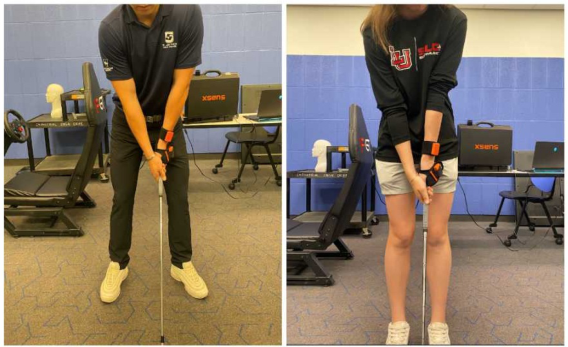
Task When participants begin the experiment, we will place two MTw Awinda sensors on the lead forearm and the lead wrist. Prior research has validated the use of a single Xsens MTw Awinda sensor (Van Meulen et al. 2017). Participants will be asked to warm up with the equipment to get used to the apparatus. Once warmed up they will be asked to perform 5 measured golf swings. Before beginning the swing, they will be asked when they are ready to hit. At this point, the wireless motion sensor will be calibrated in relation to their starting position before beginning the recordings of each swing. Figure 2 shows one participant from each gender group set up with the equipment.
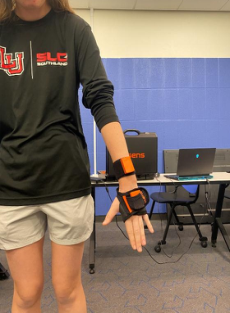
Figure 1: Close up to hardware prior to beginning swing trials.
26 Lee and Li
Figure 2: Hardware in the participants starting position before they begin each swing trial.
PROCEDURE Participants will have a designated time slot where they will come into the facility and begin the experiment. Initially, they will be given a proper warm- up before starting the experiment. The experiment will begin with putting on the hardware for Xsens MTw Awinda for the lead arm and wrists. This will include one motionless sensor on the forearm and one on the wrist of the lead hand. After the hardware is properly set up, the researcher will begin to calibrate the starting position of the participant. Once the device is calibrated, the participants will perform 5 swings of maximum exertion. Before each trial of the swing, the researcher will have to re-calibrate the starting position before beginning each recording of the swing trials.
DATA ANALYSIS The MATLAB code given determines the peak angular velocity for the Roll, Pitch, and Yaw angles using raw Xsens wrist data. First, the necessary data columns for time, roll, pitch, and yaw are retrieved from the dataset. The algorithm then uses numerical differentiation to calculate the time differences (dt) between consecutive data points. The angular velocities for roll (droll), pitch (dpitch), and yaw (dyaw) are calculated by dividing the difference in the corresponding angles by the time differences. The algorithm then determines the peak angular velocities by calculating the greatest absolute values of these angular velocity profiles.
RESULTS
In this research on the gender-specific disparity in wrist movement pat- terns among amateur collegiate golfers, examined the average peak angular velocities in roll, pitch, and yaw during the swing.
Gender Disparities in Wrist Movement Patterns Among Collegiate Amateur Golfers 27
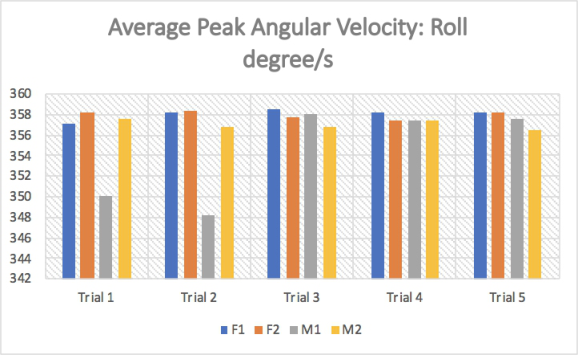
Roll The study of gender-specific differences in wrist movement patterns among amateur golfers showed notable results in terms of average peak angular velocities. For the wrist roll variable, the average peak angular velocity for female participants was 358.02 degrees per second. In comparison, male participants achieved an average peak angular velocity of 355.65 degrees per second for the same parameter, as seen in Figure 2. This modest but apparent discrepancy in wrist roll velocities reveals a possible gender-related complexity in the rotational mechanics of the wrist during the golf swing.
In further detail, female participants’ individual data points varied from 357.645 to 358.305 degrees per second, indicating a very consistent trend in wrist roll velocities. Individual data points for males ranged between 352.48 and 357.46 degrees per second, indicating a significantly greater range of velocities.
Figure 3: Bar plot for peak angular velocities for wrist roll data (F being female and M being male).
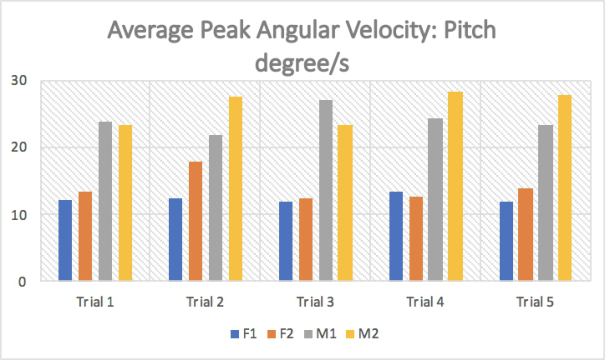
Pitch The study of gender-specific differences in wrist movement patterns among amateur golfers includes an assessment of average peak angular velocities for wrist pitch. Female participants had an average peak angular velocity of 13.227 degrees per second while measuring their wrist pitch. In contrast, male participants had a much greater average peak angular velocity (25.13 degrees per second) for the same parameter.
Individual data points revealed that female participants’ wrist pitch veloc- ities ranged from 12.21 to 15.135 degrees per second, indicating substantial variability. Individual data points from male participants ranged from 23.55 to 26.46 degrees per second, indicating a very regular pattern in wrist pitch velocities. The measured average peak angular velocities highlight the significant differences in how amateur male and female golfers.
28 Lee and Li
Figure 4: Bar plot for peak angular velocities for wrist pitch data (F being female and M being male).
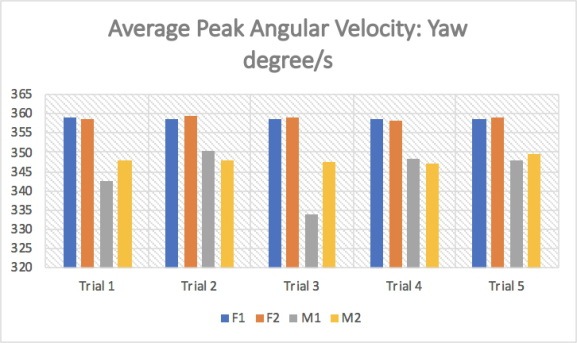
Yaw The study in search of gender-specific differences in wrist movement patterns among amateur golfers includes an analysis of average peak angular veloci- ties for wrist yaw. Female participants had an average peak angular velocity of 358.742 degrees per second when measured for wrist yaw. In compari- son, male participants had a slightly lower average peak angular velocity of 346.234 degrees per second for the same parameter. Examining individual data points, female participants’ wrist yaw velocities ranged from 358.425 to 358.935 degrees per second, indicating a continuous high trend. Male participants’ individual data points ranged from 340.665 to 349.03 degrees per second, showing a greater range of velocities.
Figure 5: Bar plot for peak angular velocities for wrist Yaw data (F being female and M being male).
Gender Disparities in Wrist Movement Patterns Among Collegiate Amateur Golfers 29
DISCUSSIONS The study of gender-specific differences in wrist movement patterns among amateur collegiate golfers, including wrist roll, pitch, and yaw, gives a more detailed knowledge of the biomechanical differences that contribute to the complexities of the golf swing. Our data show that male and female individ- uals had different average peak angular velocities while rolling their wrists. Females had an average peak angular velocity of 358.018 degrees per second, which was higher than males’ average of 355.654 degrees per second. This is consistent with the larger biomechanical picture shown by prior research, such as those by Evans et al. (2012) and Zheng et al. (2008), emphasizing the necessity to examine gender-specific variations in wrist movement dynamics. Similarly, an assessment of wrist pitch indicates a significant gender-related difference, with females having an average peak angular velocity of 13.227 degrees per second and males having a much higher average of 25.13 degrees per second. This is consistent with the findings of Fedorcik et al. (2012) and Zheng et al. (2008), who emphasize the role of gender and skill level in wrist mechanics during the golf swing. For wrist yaw, the observed aver- age peak angular velocities support the idea of gender-specific differences. Females averaged 358.742 degrees per second, while males had a slightly lower average of 346.234 degrees per second. These findings are consistent with earlier research, including Zhang et al. (2013) and Zheng et al. (2008), emphasizing the importance of taking gender differences into account when studying wrist motions.
This study adds to the increasing body of knowledge in sports biomechan- ics by focusing on gender-specific wrist movement patterns among collegiate amateur golfers. The use of advanced motion tracking technology, inspired by Paulich et al. (2018) and van Meulen et al. (2017), confirms precision in data collecting, increasing the confidence of our findings.
CONCLUSION
This study investigated gender-specific variations in wrist movement patterns among collegiate amateur golfers, examining wrist roll, pitch, and yaw to identify biomechanical factors that shape the golf swing. Our data analy- sis revealed varied disparities, with females having slightly higher average peak angular velocities in wrist roll than males, emphasizing the impor- tance of taking gender-specific variations in wrist movement dynamics into account Similarly, strong gender-related variations in wrist pitch were identi- fied, emphasizing the importance of gender and skill level on wrist mechanics during the golf swing.
While this study provides useful insights into gender-specific wrist move- ment patterns among amateur golfers, it is important to recognize several limitations that may guide future research. To begin, the very small sam- ple size may restrict the generalization of our findings. Future research might benefit from a larger subject pool with a variety of skill levels and demograph- ics to improve the external validity of the findings. Furthermore, regulated environments in indoor golf practice facilities, although reducing external effects, may not adequately replicate the intricacies of real-world playing
30 Lee and Li
circumstances. Research on outdoor golf courses with varied terrains and environmental conditions might provide a more complete knowledge of wrist biomechanics in a variety of scenarios.
ACKNOWLEDGMENT
I express our gratitude to Dr. Yueqing Li for his invaluable support through- out the entire duration of the project.
REFERENCES
Evans, K., Horan, S. A., Neal, R. J., Barrett, R. S., & Mills, P. M. (2012). Repeatability of three-dimensional thorax and pelvis kinematics in the golf swing measured using a field-based motion capture system. Sports Biomechanics, 11(2), 262–272. Fedorcik, G. G., Queen, R. M., Abbey, A. N., Moorman, C. T., & Ruch, D. S. (2012).
Differences in wrist mechanics during the golf swing based on golf handicap. Journal of Science and Medicine in Sport, 15(3), 250–254. Lai, D. T. H., Hetchl, M., Wei, X., Ball, K., & Mclaughlin, P. (2011). On the difference in swing arm kinematics between low handicap golfers and non-golfers using wireless inertial sensors. Procedia Engineering, 13, 219–225. Lindsay, D. M., Horton, J. F., & Paley, R. D. (2002). Trunk Motion of Male Profes-
sional Golfers Using Two Different Golf Clubs. Journal of Applied Biomechanics, 18(4), 366–373. Meulen, van, Bert-Jan van Beijnum, Buurke, J. H., & Veltink, P. H. (2017).
Assessment of lower arm movements using one inertial sensor. PubMed. Paulich, Monique & Schepers, Martin & Rudigkeit, Nina & Bellusci, G.. (2018).
Xsens MTw Awinda: Miniature Wireless Inertial-Magnetic Motion Tracker for Highly Accurate 3D Kinematic Applications. Nesbit, S. M. (2005). A three dimensional kinematic and kinetic study of the golf swing. PubMed. Robertson, D. G. E., Caldwell, G. E., Hamill, J., Kamen, G., & Whittlesey, S. (2013).
Research methods in biomechanics. Human kinetics. Zhang, J.-T., Novak, A. C., Brouwer, B., & Li, Q. (2013). Concurrent validation of Xsens MVN measurement of lower limb joint angular kinematics. Physiological Measurement, 34(8), N63–N69. Zheng, N., Barrentine, S. W., Fleisig, G. S., & Andrews, J. R. (2008a). Swing kine-
matics for male and female pro golfers. International Journal of Sports Medicine, 29(12), 965–970. Zheng, N., Barrentine, S., Fleisig, G., & Andrews, J. (2008b). Kinematic Analysis of Swing in Pro and Amateur Golfers. International Journal of Sports Medicine, 29(6), 487–493.
LISTED IN THE AHFE DIGITAL BOOKSTORE CATALOGUE
Explore the complete digital volume
Human Factors in Sports, Performance and Wellness
Read this individual research paper free through the original publisher, or explore the full digital proceedings book.
ISBN 978-1-964867-26-7
Explore this ISBN in the AHFE Bookstore ↗Listed in the July 2026 bookstore catalogue; search by ISBN to confirm current availability · Digital book purchase optional