Bartłomiej Gąsienica Walczak, Judyta Zachwieja (2024). Cognitive effects of using the modified fun forms of falling method in measuring the susceptibility to body injuries during a fall in children. In: Human Factors in Sports, Performance and Wellness. AHFE Open Access, vol. 150, pp. 93–103. https://doi.org/10.54941/ahfe1005294
The child's first experience in the development of his postural functions is a fall. At the core of this phenomenon is a loss of balance. Our previous findings have proven that in the course of motor activity of children aged 2 to 6, two-year-olds will make the fewest mistakes when falling and colliding with the ground. The fourth year of life is the moment when this number increases from year to year. The aim of the study is to recommend a modified fun forms of falling (FFF-M) method for children to diagnose susceptibility to body injuries during a fall (SFI). We examined 86 children (boys and girls) aged: 4 years (n = 22); 5- (n = 30); 6- (n = 34). A modification of the SFI research method based on fun forms of falling involves the introduction of three elements: (1) accurate recording of the duration of each FFF; (2) while playing 'puddle with obi' (obi means judo belt), subjective estimation of the force used (L-light, M-medium, H-high) - this is the conventional level B, i.e. the force causing the fall is located at the height of the center of gravity; (3) more accurate estimation of collision errors with the ground (supporting with hands, rolling onto the back, hitting the head). The shortest session lasted 14 minutes, the longest 30 minutes. Fun form at level ‘a’ (localization of force below the center of gravity) lasted the shortest (3 min), and at level ‘c’ (localization of force above the center of gravity or together with criteria ‘a’, but identical FFF) lasted the longest (19 min). During FFF at level ‘b’, medium use of force to throw the child off balance was predominant. Children from all age groups were most likely to make upper limb errors during FFF (on average: 16 four-year-olds; 20 five-year-olds, 24 six-year-olds). Head impacts were observed in 1 four-year-old, 3 five-year-olds, and 3 six-year-olds. One child from each age group made no mistakes (0%) during FFF, and one child made mistake every time (100%). The conjunction of the research results (duration of the session, subjectively estimated strength, accurate estimation of errors during a fall) with the directive to simplify the diagnosis authorizes the recommendation of FFF 'puddle with obi' as a sufficient criterion for diagnosing the SFI phenomenon in children from two to six years of age. However, the assumption should be made that the evaluation should be based on the results of careful observation of at least 5 child falls.
The child’s first experience in the development of his postural functions is a fall (WHO 2021). At the core of this phenomenon is a loss of balance (Kalina et al., 2013, Ma´sli´nski et al., 2017, Kurzeja et al., 2022). Very often, falls result in bodily injuries that require hospitalization (Wang et al., 2001, Park et al., 2004, Khambalia et al., 2006). To reduce this risk, it is important to teach more than just safe falling techniques. It is necessary to have extensive knowledge about the phenomenon of susceptibility to body injuries during a fall – abbreviated as SFI (Kalina 2009, Kalina et al., 2011, Kalina 2012, Mroczkowski and Sikorski 2015, Mroczkowski et al., 2020, Ga˛sienica-Walczak and Kalina 2021 Kalina et al., 2022, Klimczak et al., 2022). Toronjo-Hornillo et al. in their research assessed school children using an original test which records five basic elements during a backward fall: position of the neck, the hands, the trunk, the hips, and the knees. Next, they implemented safe falls program during physical education (PE) classes (Toronjo-Hornillo et al., 2018). Invernizzi et al. recommend Safe Fall, Safe Schools Program (SFSSP) based on 10-min warm-up sessions during PE classes (Invernizzi et al., 2019).
The above-mentioned programs are based on teaching safe falls (Jaskólski and Nowacki 1972, Kalina et al., 2008, Ga˛sienica-Walczak et al., 2010, Mroczkowski 2015, Dobosz et al., 2018, Kubacki et al., 2022) to school- age children. However, this education should also apply to younger children. Kalina et al. have proven that in the course of motor activity of children aged 2 to 6, two-year-olds make the fewest mistakes when falling and colliding with the ground. The fourth year of life is the moment when this number increases from year to year. The authors of this work emphasize the need to create universal safe fall from toddlerhood programs. They also recommend the need for additional observations and answers to the following questions: 1. During fun form of falling (FFF) when the force acted around the child’s centre of gravity (task 2, level b), is the excessive force used during the diag- nostic session to cause them to fall on soft ground (a subjective assessment would be sufficient, a three-level scale for assessing the force used to over- come the child’s resistance: small; average; large) the reason of some of the children’s errors? 2. Are each of the games used equally attractive for chil- dren, easy to understand during verbal description and then motor execution (Kalina et al., 2022)?
The aim of the study is to recommend a modified fun forms of falling (FFF- M) method for children to diagnose susceptibility to body injuries during a fall (SFI).
MATERIAL & METHODS Participants
Study group consisted of 86 children (37 boys and 49 girls) aged: 4 years (n = 22); 5- (n = 30); 6- (n = 34). Each of them was diagnosed indepen- dently by two physiotherapist (woman) during a special session on a soft surface. Children (from various regions of Poland) were recruited among
Cognitive Effects of Using the Modified Fun Forms of Falling Method in Measuring 95
participants of rehabilitation camps at a specialized center in Rabka Zdrój (southern Poland). Before starting the diagnosis based on the FFF method, the parents or legal guardians of the child were familiarized with the purpose of the research. After expressing consent and verbally stating that there were no contraindications to the child’s participation in these games, they participated in the session as observers. There was not a single case of parents (guardians) intervening with a request to interrupt the session.
Study Design Two elements modify the study of the SFI phenomenon using the FFF method: recording the time of each task in the diagnostic session; estimating the force used (the researcher recorded the magnitude of force used and the results indicated the force used most often) to cause the child to fall during the sec- ond task (FFFb). The remaining elements are unchanged. The modification is based on fun forms of falling (Kalina et al., 2022). This method consists of three tasks:
In first task (FFFa - localization of force below the center of gravity) child rolls the rehabilitation (Swiss) ball (diameter 65 cm) during walking or trot- ting backwards. The physiotherapist (at any time he/she decided) knocked the ball aside to make the child fall – Photo 1.
Figure 1: Visualization of FFFa (with permission of the Arch Budo editorial team).
Figure available in the original PDF paper.
In second task (FFFb – ‘puddle with obi’ - the force acted around the child’s center of gravity) the child was instructed to pull a judo belt held by a physiotherapist and try to drag him to a predetermined place (Photo 2).
Figure 2: Visualization of FFFb (with permission of the Arch Budo editorial team).
Figure available in the original PDF paper.
In the third task (FFFc - force applied simultaneously over and below the child’s center of gravity), the physiotherapist was holding a toy above the child’s head. The child was reaching for it (with one or both hands) while walking backwards until it got to a pile of mattresses; the child tripped and fell (Photo 3).
96 Ga˛sienica-Walczak and Zachwieja
Figure 3: Visualization of FFFc (with permission of the Arch Budo editorial team).
Figure available in the original PDF paper.
Basic Evaluation Criteria Duration of the task, number of falls, number of errors made (supporting with hand, hitting the head, etc.), total SFI index - susceptibility fall injuries.
Criteria for the Synthesis of Results The condition for answering the research questions is a joint assessment of play time and a critical assessment of the phenomenon of force used in relation to statistical calculations.
The synthesis of the results is to facilitate the separation of three sets of chil- dren according to the criterion of the degree of risk of bodily injury during an unintentional fall (SFI degree). The homogeneous set consists of children classified to the average (risk from 38% to 63.99%) SFI degree level (raw score from 6 to 8 points). Children at lower risk (0.1% to 37.99%) are qual- ified from the combined SFI levels: VL (very low, raw score 0 points) and L (low, raw score 1 to 5 points). Children at higher risk (risk from 64% to 100%) are qualified from the combined SFI levels: H (high, raw score from 9 to 11 points), VH (very high, raw score from 12 to 13 points) and E (extreme, raw score 14 points).
Statistical Analysis The estimation of the results is based on the following indicators: frequency (N, n); mean (M); minimum (Min); Maximum (Max); standard deviation (SD or ±); skewness and kurtosis (recommended by Ferguson and Takane (Ferguson and Takane 1989). Correlation coefficients were calculated. The interpretation of the correlation coefficient (r) is based on the Guilford’s clas- sification. We used ‘z score test for two population proportions’ to calculate the significance of the difference between two proportions. In the studies, the level of at least p<0.05 for a directional test and higher was shown as statistically significant differences.
RESULTS
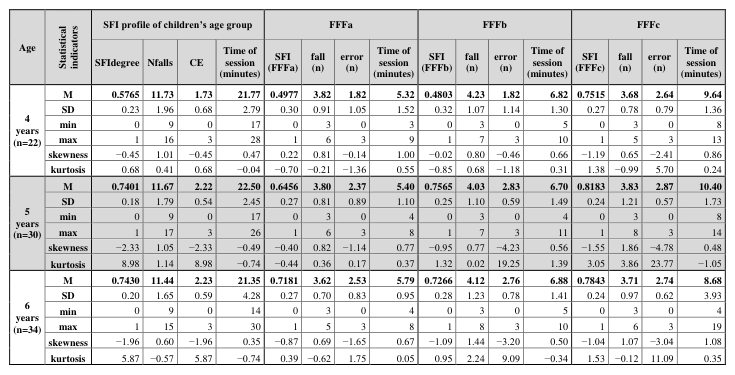
The shortest session of FFF lasted 14 minutes, the longest 30 minutes. Fun form at level ‘a’ lasted the shortest (3 min), and at level ‘c’ lasted the longest (19 min) – Table 1.
Session duration and the number of unintentional falls correlate highly (r = 0.660). These variables are equally highly correlated in the case of FFFc (r = 0.710). They are slightly less related in the case of FFFb (r = 0.609). However, in the group of 6-year-olds, this correlation is negative and almost
Cognitive Effects of Using the Modified Fun Forms of Falling Method in Measuring 97
Equation reproduced from the original PDF.Table 1. Estimation of the results of the FFF method used in diagnosing the phenomenon of SFI in children aged 4 to 6 years (n = 86).
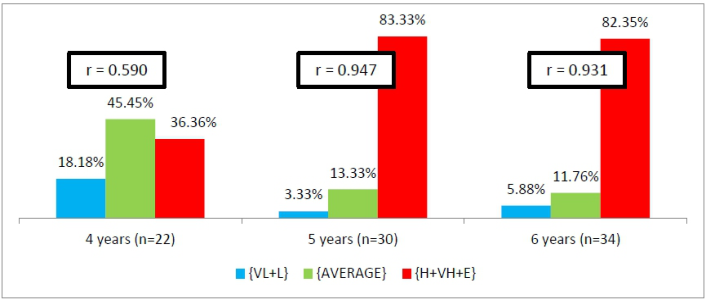
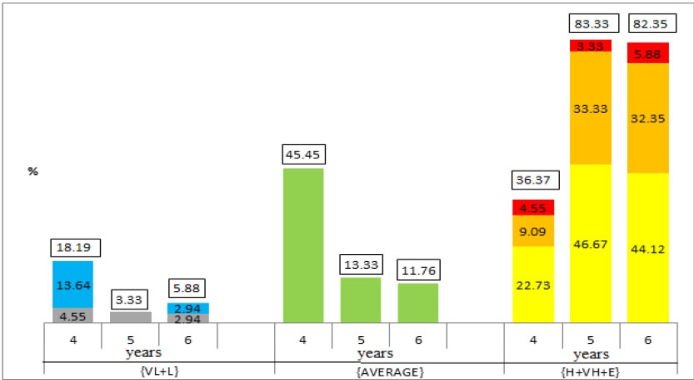
In groups of 5- and 6-year-olds, the percentage of children assigned to the combined {H+VH+E} levels was the highest: 83.33%, 82.35%, respec- tively. In four-year-olds, the highest percentage was assigned to the average level: 45.45% (Figure 1 and 2). Statistically significant differences (p<0.001) were revealed within the cumulative sets: average and H+VH+E SFI degree between 4 and 5-year-olds and 4 and 6-year-olds. The correlations in the number of children qualified for particular sets (average and cumulative) monitored in Figure 1 are high among 4-year-olds and almost complete among 5- and 6-year-olds.
Figure 4: Proportions of children aged 4 to 6 years differing in the degree of risk of bod- ily injury during an unintentional fall (correlation of the number of children classified to the average level and the accumulated levels below and above this set).
98 Ga˛sienica-Walczak and Zachwieja
Figure 5: Decomposition of the empirical data from Figure 1 into raw results.
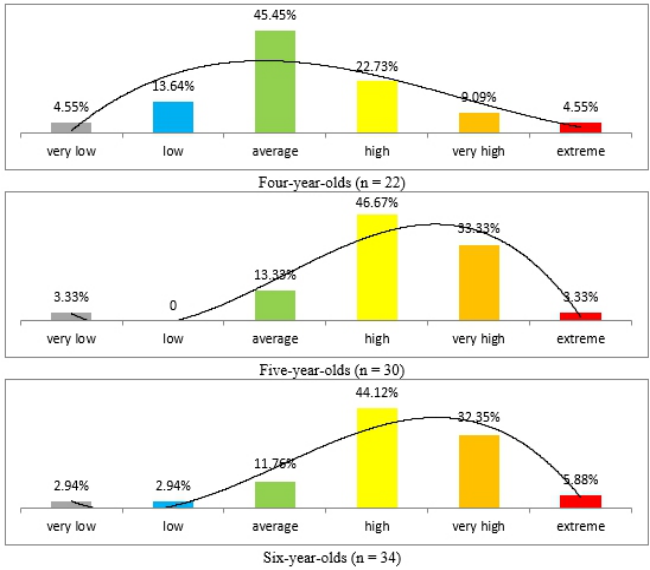
One child from each age group made no mistakes (level low) during FFF. One child from group four-years-old and five-years-old and two children from group six-years-old made mistakes every time (level extreme) – Figure 3.
Figure 6: Visualization of the distribution of SFI risk levels in the age groups of the examined children.
Cognitive Effects of Using the Modified Fun Forms of Falling Method in Measuring 99
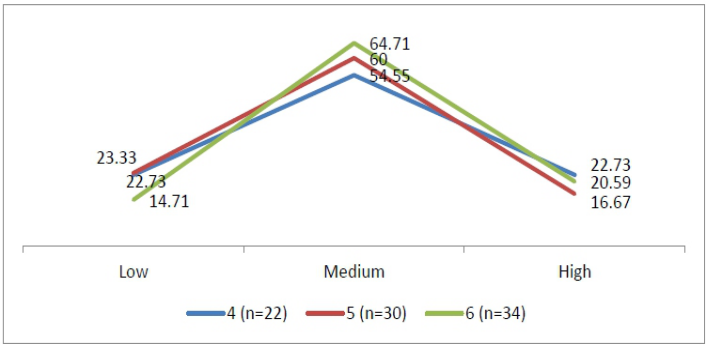
During FFFb, medium (60.46%, n = 52) use of force to throw the child off balance was predominant (Figure 4). Differences in the force used (of the same magnitude) between age groups are not statistically significant.
Figure 7: Use of force (%) to throw the child (from particular age groups) off balance during FFFb.
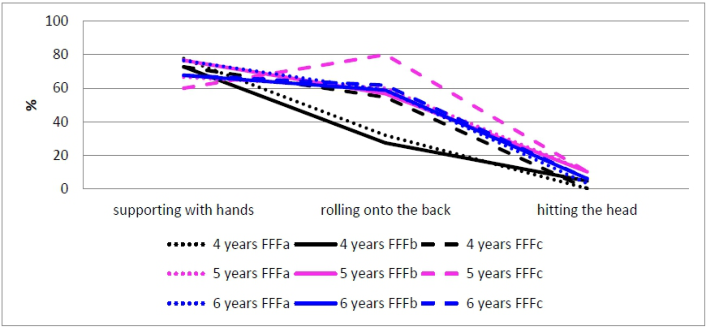
Children from all age groups were most likely to make upper limb errors during FFF (on average: 16 four-year-olds; 20 five-year-olds, 24 six-year- olds). Head impacts were observed in 1 four-year-old, 3 (the same children in every FFF), five-year-olds, and 3 (one child in all FFF, second in FFFb and third in FFFc) six-year-olds (Figure 5).
Figure 8: Profiles of children from age groups making body control errors in individual FFFs.
One child (boy) in the group of 4-year-olds made the mistake of hitting his head on the ground during FFFb (using light force). Moreover, in each FFF he made 3 falls (a total of 9, including 8 times rolling onto the back, one time
100 Ga˛sienica-Walczak and Zachwieja hitting the head). His SFI degree = 1. Diagnostic session time: 24 minutes (FFFa 9 minutes, FFFb 7 minutes, FFFc 8 minutes).
DISCUSSION
Basically, two empirical arguments justify the reduction of the FFF method in reducing the phenomenon to one game - FFFb. The first is a negative, high correlation (-0.997) of the number of falls with the FFFa time found among six-year-olds. This result means that the number of falls decreased (arithmetic mean 3.62 with extreme results: min 3 and max 5) and the play time increased (5.79 minutes) compared to four-year-olds (3.82-; 3-6-; 5.32-, respectively) and five-year-olds (3.80-; 3-6-; 5.40-). The justification for this phenomenon is age, because the sixth year of life is the ‘first apogee of motor skills’ (with- out differentiating the child’s gender, as is the case when determining the ‘golden age of motor skills - which falls earlier in girls than in boys). Second, cognitive and motor aspects of FFFc. It is difficult for two- and three-year- old children (as pointed out by physiotherapists who also diagnose these age groups [RMK et al. SMAES 2022)] to immediately understand the essence of this game.
Moreover, in the case of FFFa, there are grounds to assume that the result of six-year-olds may be related to their higher ability to tolerate disturbances of body balance compared to four- and five-year-olds. Not every time the physiotherapist knocked the ball, the child lost balance and fell. Meanwhile, before the game ends, the child should fall at least 3 times (unless the child willingly showed the desire to continue playing). Each case of simulation that did not end with a fall resulted in an increase in FFFa time.
This pattern was not revealed during FFFc. Five-year-olds on average made the most falls and the duration of the third task was the longest among them. However, there is no reason to claim that FFFc was the most attractive for the surveyed children. On the contrary, all FFFs (in the light of empirical data) are attractive to children. However, it was one 6-year-old girl who played the game the longest: 19 minutes (with the average time of this group being 8.86) and during this time the girl fell only 5 times.
The results of the research that formed the basis for the answer to the first question (concerning the force necessary to throw the child off balance during FFFb) indicate that this factor is not crucial. The previously mentioned 4-year-old child hit his head during FFFb using light force. Physiotherapists performing this diagnostic game most often used medium force (60.46%, n = 52). Differences in the proportions of children from particular age groups were not statistically significant. The smallest dispersion of results between groups was found for high strength (from 16.67% to 22.73%).
An in-depth analysis of the results proves that if the force causing the child’s fall is below the center of gravity (FFFa), FFFb - acted around the child’s center of gravity, FFFc - applied simultaneously over and below the child’s center of gravity) the number of mistakes made during a fall increases. Most often (60% to approximately 80%) children supported themselves with their hands, regardless of the type of FFF. The least common and least diffuse (0% to 10%) error was head hitting. In the group of 4-year-olds, this mistake was
Cognitive Effects of Using the Modified Fun Forms of Falling Method in Measuring 101
made only by one boy - the SFI degree indicator was maximum. He made mistakes during each fall (regardless of the type of FFF: out of 9 falls, he made the mistake ‘rolling onto the back’, 8 times, and one time ‘hitting the head’). Kalina et al. indicate that the most significant secrets are hidden by the organisms of individuals who, irrespective of age, reveal during laboratory observations of the SFI phenomenon especially extreme raw SFI scores (1 or 100%) or very high degree (from 0.8000 to 0.9999) of this characteristic (Kalina et al., 2022)
CONCLUSION
The conjunction of the research results (duration of the session, subjectively estimated strength, accurate estimation of errors during a fall) with the direc- tive to simplify the diagnosis authorizes the recommendation of FFFb ‘puddle with obi’ as a sufficient criterion for diagnosing the SFI phenomenon in chil- dren from two to six years of age. However, the assumption should be made that the evaluation should be based on the results of careful observation of at least 5 child falls. However, the optimal diagnosis should be based on 9 falls. This criterion is determined by the child’s willingness to continue play- ing on his own will. Then the theoretical distribution of results would cover 11 class intervals - the boundaries of the continuum would be falls without errors (0%) and, respectively, all falls with errors (100%). Therefore, future analyzes of collective outcomes based only on FFFb should be based on either 5 unintentional falls or 9.
STUDY LIMITATIONS There may be some possible limitations in this study. The methodological limitation of this research is the lack of prior research studies on the topic. Limitations during the research process may result from interest in individual FFFs and the difficulty in understanding them.
REFERENCES
Dobosz, D. Barczy´nski, BJ. Kalina, A. Kalina RM. (2018) The most effective and economic method of reducing death and disability associated with falls. Arch Budo 14: 239–246. Ferguson, GA. Takane, Y. (1989) Statistical Analysis in Psychology and Education.
6th ed. New York: Mcgraw-Hill INC. Ga˛sienica-Walczak, B. Barczy´nski, BJ. Kalina, RM. Kucio C. (2010) The effectiveness of two methods of teaching safe falls to physiotherapy students. Arch Budo 6(2): 63–71. Ga˛sienica-Walczak, B. Kalina, RM. (2021) Validation of the new version of “the
susceptibility test to the body injuries during the fall” (STBIDF-M). Arch Budo 17: 371–400. Invernizzi, PL. Signorini, G. Michielon, G. Padulo, J. Scurati R. (2019) The “Safe Falls, Safe Schools” multicentre international project: evaluation and analysis of backwards falling ability in Italian secondary schools. Journal of Physical Education and Sport Vol. 19 (Supplement issue 5), Art 277, pp. 1871–1877.
102 Ga˛sienica-Walczak and Zachwieja
Jaskólski, E. Nowacki, Z. (1972) Teoria, metodyka i systematyka miekkiego padania.
Part I. Teoria MiÄ™kkiego padania. Wrocław: WY ˙Zsza SzkoŁA Wychowania Fizycznego; 83–88 [in Polish]. Kalina, RM. (2009) Miekkie la˛dowanie. Med Tribune 13: 28–29 [in Polish]. Kalina, RM. (2012) Miekkie la˛dowanie. In: Klukowski K, editor. Medycyna sportowa. Part II. Warszawa: Medicaltribune Polska; 199–203 [in Polish]. Kalina, RM. Barczy´nski, BJ. Jagiełło, W. Prze´zdziecki, B. Kruszewski, A. Harasymow-
icz, J. Syska, J. Szamotulska, K. (2008) Teaching of safe falling as most effective element of personal injury prevention in people regardless of gender, age and type of body build – the use of advanced information technologies to monitor the effects of education. Arch Budo 4: 82–90. Kalina, RM. Barczy´nski, BJ. Klukowski, K. Langfort, J. Ga˛sienica-Walczak, B. (2011) The method to evaluate the susceptibility to injuries during the fall – validation procedure of the specific motor test. Arch Budo 7(4): 201–215. Kalina, RM. Dłubacz, N. Zachwieja, J. Pilarska, E. Dobosz, D. Ga˛sienica-Walczak, B.
Kruszewski, A. (2022) Innovative method of diagnosing the susceptibility to the body injuries during the fall of children from 2 to 6 years. Arch Budo Sci Martial Art Extreme Sport 18: 211–228. Kalina, RM. Jagiełło, W. Barczy´nski, BJ. (2013) The method to evaluate the body balance disturbation tolerance skills – validation procedure of the’Rotational Test’. Arch Budo 1: 59–80. Khambalia, A. Joshi, P. Brussoni, M. Raina, P. Morrongiello, B. Macarthur, C. (2006)
Risk factors for unintentional injuries due to falls in children aged 0–6 years: a systematic review. Injury Prevention 12: 378–381. Klimczak, J. Oleksy, M. Ga˛sienica-Walczak, B. (2022) Reliability and objectivity of the susceptibility test of the body injuries during a fall of physiotherapy students. Phys Educ Students. Kubacki, R. Bołociuch, M. Rauk-Kubacka, A. (2020) Teacher Ball Ukemi: metody
i narzedzia modelowania sposobów nauczania bezpiecznego upadania. Jelenia Góra: Wydawnictwo AD Rem [in Polish]. Kurzeja, P. Ga˛sienica-Walczak, B. Ogrodzka-Ciechanowicz, K. Prusak, J. (2020) Analysis of the Ability to Tolerate Body Balance Disturbance in Relation to Selected Changes in the Sagittal Plane of the Spine in Early School-Age Children. Journal of Clinical Medicine 11(6):1653. Ma´sli´nski, J. Piepiora, P. Cie´sli´nski, W. Witkowski, K. (2017) Original methods and
tools used for studies on the body balance disturbation tolerance skills of the Polish judo athletes from 1976 to 2016. Arch Budo 13: 285–296. Mroczkowski, A. (2015) Motor safety of a man during a fall. Arch Budo 11: 293–
303. Mroczkowski, A. (2020) Susceptibility to Head Injury during Backward Fall with Side Aligning of the Body. Appl Sci 10: 8239. Mroczkowski, A. Sikorski, MM. (2015) The susceptibility to body injuries during a
fall and abilities related to motor coordination of children aged 10 to 12. Arch Budo Sci Martial Art Extreme Sport 11: 65–71. Park, SH. Cho, BM. Oh, SM. (2004) Head Injuries from Falls in Preschool Children.
Yonsei Med J. Apr; 45(2): 229–232. Toronjo-Hornillo, L. DelCastillo-Andrés, O. Campos-Mesa, MdC. Diaz Bernier, VM.
Zagalaz Sanchez, ML. (2018) Effect of the Safe Fall Programme on Children’s Health and Safety: Dealing Proactively with Backward Falls in Physical Education Classes. Sustainability 10: 1168.
Cognitive Effects of Using the Modified Fun Forms of Falling Method in Measuring 103
Wang, MY. Kim, KA. Griffith, PM. Summers, S. McComb, JG. Levy, ML. Mahour, GM. (2001) Injuries from falls in the pediatric population: An analysis of 729 cases. Journal of Pediatric Surgery. Vol. 36, 10, 1528–1534. World Health Organization (WHO). Falls 2021 Apr 26 (Feb 10, 2024). Available
Read this individual research paper free through the original publisher, or explore the full digital proceedings book.
ISBN 978-1-964867-26-7
Explore this ISBN in the AHFE Bookstore ↗Listed in the July 2026 bookstore catalogue; search by ISBN to confirm current availability · Digital book purchase optional