Artur Kalina, Artur Kruszewski, Bartłomiej Gąsienica Walczak (2025). Likelihood of injury from falls in different external and internal circumstances for young adults. In: Human Factors in Sports, Preventive Medicine and Innovative Agonology. AHFE Open Access, vol. 188, pp. 60–68. https://doi.org/10.54941/ahfe1006483
external and internal factors. The aim of this study is to answer the question of whether modifying external circumstances (falls at the same level versus falls from a height with feet down) and internal circumstances under the same laboratory conditions, in the sense that the coordination difficulty of subsequent tasks increases, influences the variation in the probability of damage to individual body parts? Seventy-one students (male and female) were observed. A simulated fall backwards on soft ground involved adopting as quickly as possible to a horizontal stance from a vertical stance after a GO command. The first test fall was preceded by the subject performing a deep squat several times with their own hands resting on the hands of the tester (pre-test). All students successfully completed the pre-test. During the second test fall at the same level, 35 students were required to clap their hands and press the sponge with their chin against their torso, while 36 preceded the fall with a 360° clockwise and anticlockwise rotation. During the simulated fall, the motor modification involved clapping the hands and pressing the sponge with the chin against the torso. Results: During a simulated fall backwards from a height with the feet down, the likelihood of damage to the legs and hips increases dramatically compared with a fall at the same level (from 8-14% to 69%). The applied motor modifications during the second and third test falls favour a reduction in hand errors in relation to the first task (right from 73% to 68% and 57%; left from 70% to 63%). Conclusions: the relationship of error reduction effects to lateralisation is possible. Thus, it is advisable to evaluate the phenomenon with a distinction of the dominant hand in subsequent studies.
The effects of unintentional or intentional falls are influenced by numerous compilations of external and internal factors. The internal ones relate directly to the acting human being. That is, abstracting from falling while asleep
Likelihood of Injury From Falls in Different External and Internal Circumstances 61
or in a state of limited consciousness for another reason, these are various properties related to personality, to motor experience, to health, etc.
It is the intrinsic factors that are the basis for classifying people into different groups of increased fall risk. In general, it is in these groups that the probability of injury after a fall impact is higher compared to the population of healthy people. While, for example, people of retirement age (65 years and older) belong to this set, the age factor is already a secondary criterion in groups at increased risk of falling due to certain categories of disease: osteoporosis; diabetes; Alzhaimer’s; Parkinson’s; blindness, etc. It is clear that the accumulation of both older age and even several of the listed diseases increases the risk of both falls and multiple organ injuries ( ˙Zak, 2002; Klimczak et al., 2024).
Certain external factors, such as slippery ground, darkness, uneven ground, collision with a vertical obstacle or with an object in motion preceding a fall and other numerous circumstances, can further increase the risk of multi-organ damage or magnify the extent of damage to one organ when the body collides with the ground (or even earlier with a stationary or moving object) (Duckham et al., 2013; Amin et al., 2022).
In this study, we observe a group of subjects homogeneous in terms of age, ability to perform a deep squat without experiencing pain and lack of contraindications to exercise. However, we perform motor modifications and external circumstances during a three-fold simulated backward fall under safe laboratory conditions on a soft surface.
The aim of this study is to answer the question of whether modifying external circumstances (falls at the same level versus falls from a height with feet down) and internal circumstances under the same laboratory conditions, in the sense that the coordination difficulty of subsequent tasks increases, influences the variation in the probability of damage to individual body parts?
MATERIAL AND METHODS observation, including no perceived pain in any part of the body. The prerequisites for entering the simulated backward falls on a soft surface were correct performance of the pre-test and no feeling of pain in any part of the body during the exercise.
All observed students met these criteria. Thus, we assumed that additional verification of the homogeneity of the study sample from the population would be reinforced by the absence of significant differences in the proportion of errors made by the majority of observed body parts in the circumstances of different motor modifications of falling backwards on the same ground level. Fulfilment of this condition would mean that it is legitimate to analyse all observed falls of test subjects with separation of results into arranged external circumstances. Such a separation would be a simplified model of the probability of damage to different body parts due to a fall, taking into account the variety of external and internal influences. We modelled it on two weddings ‘the susceptibility test to the body injuries during the fall’
(Kalina, 2009; Ga˛sienica-Walczak and Kalina, 2021; Klimczak et al., 2022; Kruszewski et al., 2024).
SIMULATED FALLS WITHIN THE STBIDF Pre-Test
Several times the subject performs a deep squat with his/her own hands resting on the hands of the researcher – to make sure that he/she does not facilitate this exercise by pressing his/her hands on the hands of the researcher. Answer the question about whether they feel any pain and indicate the parts of their body (Ga˛sienica-Walczak and Kalina, 2021).
Task 1 A simulated fall backwards on soft ground involved adopting as quickly as possible to a horizontal stance from a vertical stance after a GO command.
Task 2 Before repeating the task and the GO command, the person was instructed, depending on the randomly selected group: (A) to clap their hands and press the sponge against their upper torso with their chin; (B) to perform alternating 360
rotations to the right and left and immediately assume a horizontal posture (new testing fall).
Task 3 Activities identical to Task 2 performed by Group A, preceded by a backwards jump from a 20 cm platform after a GO command (Task 3 in STBIDF and Task 6 in STBIDF-M).
Evaluation Criteria, Based on the ‘Zero-One’ Formula A guarantee of the reliability of the results of the observations of the 5 body parts over the course of the three, consecutive Tasks was provided by the video technology recording and the concordance of the assessments of the three competent observers (any initial discrepancy in the assessments was verified by re-observations until doubts were resolved).
The quality of cushioning of the fall by the lower limbs was assessed first, followed by the effect of first contact with the ground by the buttocks or immediately the back and alternatively the upper limbs and head (the absence of such contact when the buttocks or back collide is evidence of the absence of errors).
A lower limb error during each Task was considered to be a collision with the ground of the buttocks or immediately of the back in the absence of an acute angle between the thighs and shins at the moment of contact of the body with the ground, and during Task 3 instead of jumping off the platform descending, or after jumping stopping instead of continuing the squat, etc. The finding of these errors implies a risk to the hips as well (which, in an evaluative sense, equate to a risk of injury to the entire torso) and is documented with 1 point under the headings ‘legs’ and ‘hips’.
Likelihood of Injury From Falls in Different External and Internal Circumstances 63
Similarly, in both of these boxes, it is documented that the buttocks hit the ground or rotate to the side when the body makes contact with the ground – this is evidence of insufficient cushioning of the falling body by the lower limbs.
A hand(s) error is simultaneous or preceding contact with the ground of the body and similarly for the head.
Errors in stopping clapping or holding the sponge with the hand, but without touching (hitting) the head on the ground and similarly with the hands, are recorded in the test documentation (with symbols ‘C’, ‘S’ respectively), but not qualified as indicators of the likelihood of damage to these body parts during a fall under adverse circumstances (Kalina et al., 2024).
Statistical Analysis The implication of the assumption of homogeneity of the groups proved to be true to a high degree (empirical evidence in the ‘results’ section). An empirical measure of the probability of risk of injury during a fall in the simulated three external and internal circumstances (their assessment is related to the quality of motor responses to the arranged external circumstances) is the ratio (in %) of errors made by the observed body parts (legs, hips, right hand, left hand, head).
Thus, the probability of this risk (compendiously: risk) is calculated from observing five body parts of 71 people during three consecutive backward falls - each successive motor simulation being more difficult than the previous one in terms of motor coordination. However, during Task 2, the motor modifications varied: 35 falls in group A and 36 in group B. This does not change the principle that the continuum of errors for each Task ranges from 0 to 355, and for each body part from 0 to 213.
RESULTS
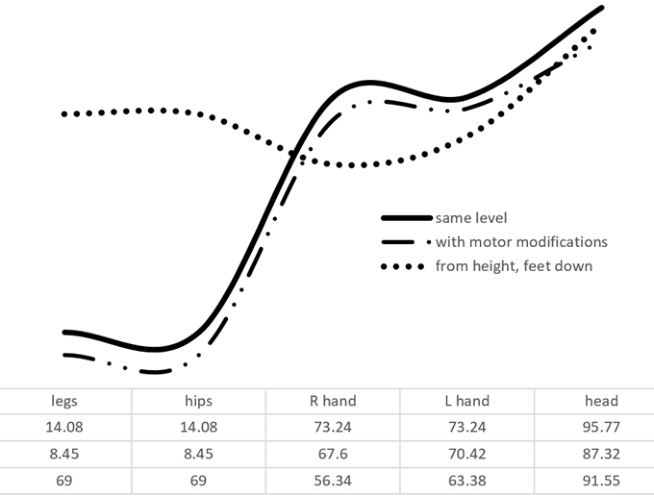
The highest risk of multi-organ damage is associated with a fall from a height with the legs down (56.06%). Even with a small difference in the levels at which the fall was initiated and completed, the risk of injury to the head is 91.55%, legs and hips (torso) 69%, left hand 63.38%, right hand 56.34% (Figure 1).
This risk is reduced if the fall takes place on a surface on which the person is moving (no difference in level) and when the hands and head are engaged in activities conducive to protecting these body parts from the effects of impact with the ground, and the over will rise to such a challenge even without full awareness. Empirical evidence is provided by a statistically significant difference (p < 0.05) in errors made with the head between those who clapped their hands and pressed the sponge against the torso with their chin during a simulated fall (77.14% made errors) and those who preceded the fall with body rotations (97.22% made errors) (Table 1). The risk in the group of 71 students, irrespective of differential motor modifications, was distributed as follows: head 87.32%, left hand 70.42%, right hand 67.61% legs and hips (torso) 8.45% (Figure 1).
Figure 1: Risk of injury to various body parts by young adults (n = 71) based on the results of a simulated backward fall under three external circumstances and concomitant motor modifications of increasing coordination difficulty.Table 1: Proportion (%) of errors made with observed body parts during simulated falls during Task 1 and Task 2 by students differing in Task 2 motor modification: Group A (n = 35); Group B (n = 36).
Table available in the original PDF paper.
Group Body Part Legs Hips R Hand L Hand Head
Task 1
A 20 20 77.14 74.29 94.29 B 8.33 8.33 69.44 72.22 97.22
Task 2
A Hand clapping and chin pressing sponge against torso 14.29 14.29 68.57 65.71 77.14*
B Two 360
rotations to right and left 2.78 2.78 66.67 75 97.22*
*p<0.05
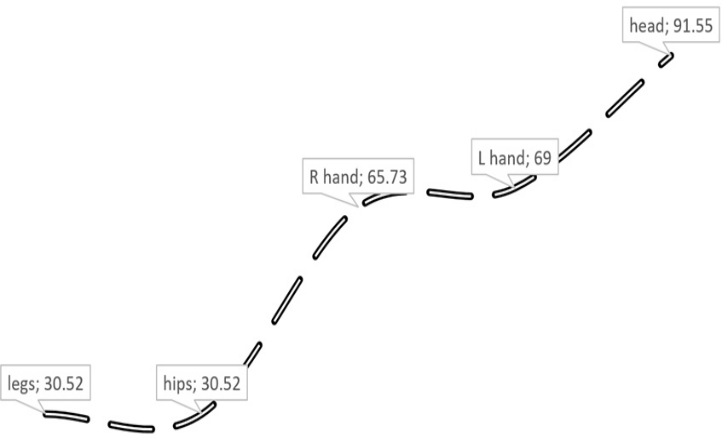
The model of probable risk of injury shows the regularity that the further a part is from the point of support by the feet before a fall is initiated, the greater the risk of injury: head 91.55%, left hand 69%, right hand 65.73% legs and hips (torso) 30.52% (Figure 2).
Likelihood of Injury From Falls in Different External and Internal Circumstances 65
Figure 2: Probable injury risk model (in %) based on summation of identified body- to-body collision errors based on observations of 213 simulated backward falls in laboratory conditions.
DISCUSSION
The simple way of predicting injuries from falls does not diminish the significance of the findings presented in this work. On the other hand, there is neither a simple explanation for some universal cause of errors made during unintentional falls, nor the possibility of recommending a single method to prevent these injuries from occurring (Boguszewski et al., 2013; Mroczkowski, 2015, 2020; Ga˛sienica-Walczak and Kalina et al., 2021; Ga˛sienica-Walczak and Zachwieja, 2024).
It is easy to observe the external circumstances of falls – those simulated and those recorded by CCTV or other monitoring to which access would be possible. It is much more difficult to make internal changes, i.e. concerning those elements of a person’s personality (knowledge, skills, perception, confidence, etc.) that could reduce this risk. In the case of professional education, imagination and attention to motor safety and exercise safety (the former is strongly related to motor coordination and the latter to the energy sphere of the body) are essential. This is a basic prerequisite in order to stimulate, through motor simulations of the likely external circumstances of a fall, people’s potential ability to overcome the consequences of such events, which they are not always aware of.
A more in-depth analysis of the motor responses of the students tested differing in the required motor modification during Task 2 provides empirical justification for the comments made above. Among the students who clapped their hands and pressed the sponge against their torso during Task 2 were (admittedly few) those who reduced the errors with both hands and head
made during Task 1. Meanwhile, we found no such adaptive effect among those who performed dynamic body rotations, alternating 360
, before the simulated fall. Only one of them did not make a head error in each of the three simulated falls. In his case, exercises with a sponge pressed against the torso are unnecessary.
Another example provides empirical evidence of how complex each individual’s coordination structure is. Of the students who, although they did not support themselves with their hands during Task 3, stopped clapping by adopting a horizontal posture, the majority (18.3% of the 28% of cases found) had not had this experience before as they performed body rotations.
The developed, simplified model of the risk of damage to individual body parts during an unintentional or intended fall, but performed incorrectly to, for example, avoid colliding with an object in motion, is based on just a few simple yet safe motor simulations. This model confirms our earlier findings that the further away a body part is from the ground on which a person moves in a vertical posture, the greater the risk of damage to it (Kalina et al., 2008; Ga˛sienica-Walczak and Kalina, 2021; Kalina et al., 2022; Ga˛sienica-Walczak and Kalina, 2023).
Contrary to appearances, the conclusion does not lead to a recommendation to focus attention on the protection of these body parts in the necessary intervention programmes. The magnitude of the escalation of errors made with the legs (including the documented risk of injury to the trunk) in the course of simulating a fall from a height with the feet down (by being instructed to jump backwards onto soft ground from a platform not much higher than the tread of a standard staircase) provides clear evidence of how important a cushioning function the legs perform during falls. No other external handicap during the applied motor simulations resulted in such a drastic increase in the risk of injury to body parts other than the legs. Even on the contrary, the effect of hand clapping was increasingly effective in reducing errors with the hands during Task 2 (although this was a motor modification aimed at 35 students, not all) and Task 3. Although a 3% greater difference in errors committed with the left hand does not mandate the conclusion that an individual is more likely to protect the dominant hand, it is an important indication that future research should document observational results taking this criterion into account.
CONCLUSION
It is possible that error reduction effects are related to lateralisation. We recommend that a procedure for evaluating the phenomenon with a distinction of the dominant hand be included in future studies.
REFERENCES
Barreira, C. (2019) ‘From phenomenology to a theory of corporal combat and martial arts’, Revista de Artes Marciales Asiáticas, 14(2s), p. 64. doi: 10.18002/ rama.v14i2s.6002.
Likelihood of Injury From Falls in Different External and Internal Circumstances 67
Berkowitz, L. (1990) ‘On the formation and regulation of anger and aggression: A cognitive-neoassociationistic analysis’, American Psychologist, 45(4), pp. 494–503. Bluth, M. H., Thomas, R., Cohen, C., Bluth, A. C. & Goldberg, E. (2016) ‘Martial
arts intervention decreases pain scores in children with malignancy’, Pediatric Health, Medicine and Therapeutics, 7, pp. 79–87. doi: 10.2147/PHMT. S104021. Bushman, B. J. (1996) ‘Individual differences in the extent and development of aggressive Amin, K., Skyving, M., Bonander, C., Krafft, M., Finn Nilson, F. (2022) Fall- and collision-related injuries among pedestrians in road traffic environment – A Swedish national register-based study. Journal of Safety Research 81 (2022) 153–165. Boguszewski, D., Zabłocka, M., Adamczyk, J. G. (2013) Evaluation of susceptibility
to injuries resulting from falls of children with visual impairment. Eur J Adapt Phys Act 6(1): pp. 7–16. Duckham, R. L., Procter-Gray, E., Hannan, M. T., Leveille, S. G., Lipsitz, L. A., Li, W. (2013). Sex differences in circumstances and consequences of outdoor and indoor falls in older adults in the MOBILIZE Boston cohort cohort study. BMC Geriatrics; 13(1): 133. https://doi.org/10.1186/1471-2318-13-133. Ga˛sienica-Walczak, B., Kalina, A. (2023) Predictive validity of STBIDF (the
susceptibility test to the body injuries during the fall) – two methodological aspects. Arch Budo Sci Martial Art Extreme Sport 2023; 19: pp. 219–246. Ga˛sienica-Walczak B, Kalina RM. (2021) Validation of the new version of “the susceptibility test to the body injuries during the fall” (STBIDF-M). Arch Budo; 17: pp. 371–400. Ga˛sienica-Walczak B. Zachwieja J. (2023) Cognitive effects of using the modified fun
forms of falling method in measuring the susceptibility to body injuries during a fall in children. Applied Human Factors and Ergonomics and the Affiliated Conferences (AHFE 2023); 2023 Jul 20-24; San Francisco, USA. Healthcare and Medical Devices. 2023; 79: pp. 316–324. Kalina, RM. (2009) Miekkie la˛dowanie. Med Tribune; 13: pp. 28–29. Polish. Kalina, A., Kruszewski, A., Ga˛sienica-Walczak, B. Motor modifications versus movement habits in measuring the SFI phenomenon. Arch Budo J Inn Agon 2024, 20: pp. 250–269. Kalina, R. M., Barczy´nski, B. J., Jagiełło, W., Prze´zdziecki, B., Kruszewski, A.,
Harasymowicz, J., Syska, J., Szamotulska, K. (2008) Teaching of safe falling as most effective element of personal injury prevention in people regardless of gender, age and type of body build – the use of advanced information technologies to monitor the effects of education. Arch Budo 2008; 4(4): pp. 82–90. Kalina, R. M. Dłubacz, N. Zachwieja, J. Pilarska, E. Dobosz, D. Gasienica-Walczak, B. Kruszewski, A. (2022) Innovative method of diagnosing the susceptibility to the body injuries during the fall of children from 2 to 6 years. Arch Budo Sci Martial Art Extreme Sport 18: pp. 211–228. Klimczak, J., Dobosz, D., Balewska-Juras, K., Kalina, A., Kruszewski, A., Orłowska-
Bojarska. I., Staniszewska M., Subkowska, M., Ga˛sienica-Walczak, B. (2024) - Cognitive-behavioural effects of reducing the susceptibility to the body injuries during the fall by nursing home care patients under the influence of innovative interventions. Arch Budo J Inn Agon; 20: pp. 100–117. Klimczak J, Oleksy M, Ga˛sienica-Walczak B. (2022) Reliability and objectivity of the susceptibility test of the body injuries during a fall of physiotherapy students. Phys Educ Stud; 26(1): pp. 4–10.
Kruszewski A, Litwiniuk A, Waszkiewicz E. (2024) Reliability and objectivity of the new version of the ‘susceptibility test for body injuries during a fall’ (STBIDF-M) in physiotherapy students. Physical Education of Students; 28(5): pp. 303–312. https/://doi.org/10.15561/20755279.2024.0507 Mroczkowski, A. (2015) Motor safety of a man during a fall. Arch Budo 2015; 11:
pp. 293–303. Mroczkowski, A. (2020) Susceptibility to Head Injury during Backward Fall with Side Aligning of the Body. Appl Sci 2020; 10(22): 8239. ˙Zak, M. (2005) Programy fizjoterapeutyczne i ich wpływ na mo˙zliwo´sci podniesienia
sie po upadku. Fizjoterapia 2005; 13(2): pp. 12–19. Polish.
LISTED IN THE AHFE DIGITAL BOOKSTORE CATALOGUE
Explore the complete digital volume
Human Factors in Sports, Preventive Medicine and Innovative Agonology
Read this individual research paper free through the original publisher, or explore the full digital proceedings book.
ISBN 978-1-964867-64-9
Explore this ISBN in the AHFE Bookstore ↗Listed in the July 2026 bookstore catalogue; search by ISBN to confirm current availability · Digital book purchase optional