Elizabeth Waszkiewicz, Artur Kruszewski (2025). The misuse of the term ‘therapy’ in science, education and in many areas of services may border on 'anti-therapy'. In: Human Factors in Sports, Preventive Medicine and Innovative Agonology. AHFE Open Access, vol. 188, pp. 39–45. https://doi.org/10.54941/ahfe1006480
Such a radical formulation of the problem requires at least the most general premise. It seems that the dominant factor is the tendency of individuals and even very large social groups to succumb to, among other things, various fashions – ‘fashionable directions of research’, ‘fashion for specific fields of study’, ‘following the fashion of the era’, etc. The appearance of such and similar slogans on social media, in marketing and in common social communication is not surprising. Semantic liberalism in a similar style in the field of science and education leads to justified criticism. In principle, the social orientation of the connections between the practice of physiotherapy and psychotherapy is common, not only with the scope of impact on individual spheres of personality – in the first case, physical (more closely related to body structure and motor skills), in the second, with the mental layer. It is probably also common to associate psychology (with numerous sub disciplines and scientific specialties) as the direct scientific background of psychotherapy. It is no longer certain that most people know that although there is no scientific discipline of physiotherapy, there are scientific disciplines that provide the knowledge and skills necessary in this profession. Therefore, it should not be an exaggeration to emphasize that without confirmation of these competences by appropriate exams, it would be impossible to formally recognize the qualifications to practice as a physiotherapist. However, in the social space, there are many more word combinations with the word ‘therapy’ that can confuse even people who understand the listed subtleties of psychotherapy. These include: art therapy, hippotherapy, judo therapy, music therapy, etc. Of the listed terms, ‘judo’ seems to be the most recognizable, but as a combat sport, and such associations should be expected to be common. Meanwhile, ‘judo therapy’ is a synonym for sekkotsu – the traditional Japanese art of bone-setting (is a type of folk medicine in which practitioners are engaged in joint manipulation – traditionally, they practiced without any formal training in accepted modern medical procedures). Since this is the tradition, it is rather about treatment, not therapy. More pronounced paradoxes are associated with the term ‘music therapy’. Among the benefits of music therapy there is pain-reducing. However, there is clear evidence that many instrumental musicians after 35 years of practice require ongoing interventions by a physiotherapist or orthopaedist. In this paper, we provide empirical evidence for innovative music prevention in the context of violin teaching. Pain diagnosis and immediate pain-reducing interventions are conducted before, during, and after the lesson. In this way, we attempt to resolve the paradox of ‘eliminating pain through music therapy at the expense of the instrumentalist’s pain’.
Such a radical formulation of the problem requires at least the most general premise. It seems that the dominant factor is the tendency of individuals and even very large social groups to succumb to, among other things, various fashions – ‘fashionable directions of research’, ‘fashion for specific fields of study’, ‘following the fashion of the era’, etc.
The appearance of such and similar slogans on social media, in marketing and in common social communication is not surprising. Semantic liberalism in a similar style in the field of science and education leads to justified criticism. In principle, the social orientation of the connections between the practice of physiotherapy and psychotherapy is common, not only with the scope of impact on individual spheres of personality – in the first case, physical (more closely related to body structure and motor skills), in the second, with the mental layer.
It is probably also common to associate psychology (with numerous sub disciplines and scientific specialties) as the direct scientific background of psychotherapy. It is no longer certain that most people know that although there is no scientific discipline of physiotherapy, there are scientific disciplines
that provide the knowledge and skills necessary in this profession. Therefore, it should not be an exaggeration to emphasize that without confirmation of these competences by appropriate exams, it would be impossible to formally recognize the qualifications to practice as a physiotherapist. However, in the social space, there are many more word combinations with the word ‘therapy’ that can confuse even people who understand the listed subtleties of psychotherapy. These include: art therapy, hippotherapy, judo therapy, music therapy, etc. (Meregillano, 2004; Gallagher, 2017; Yermakova and Podolski, 2019). Of the listed terms, ‘judo’ seems to be the most recognizable, but as a combat sport, and such associations should be expected to be common. Meanwhile, ‘judo therapy’ is a synonym for sekkotsu – the traditional Japanese art of bone-setting (is a type of folk medicine in which practitioners are engaged in joint manipulation – traditionally, they practiced without any formal training in accepted modern medical procedures). Since this is the tradition, it is rather about treatment, not therapy.
More pronounced paradoxes are associated with the term ‘music therapy’. Among the benefits of music therapy there is pain-reducing (Gutgsell et al., 2013; McConnell et al., 2016). However, there is clear evidence that many instrumental musicians after 35 years of practice require ongoing interventions by a physiotherapist or orthopaedist (Tomasik, 2020). In this paper, we provide empirical evidence for innovative music prevention in the context of violin teaching.
The cognitive aim of this case-study is to make a preliminary observation of the effects of a violin teaching method with elements of health exercises with a dual preventive meaning
MATERIAL AND METHODS Rationale and Assumptions of an Innovative Violin Teaching Method With Elements of Health Exercises With a Dual Preventive Meaning
The complementary approach is the primary method of this work. We have proceeded from the assumption that the lack of a formal publication, or a series of coherent and accessible lectures of the methodology of complementary research is not an obstacle either to the creation of innovative methods of music education combined with physical exercise (Waszkiewicz, 2023, Waszkiewicz and Ba˛k, 2024), or to the interpretation of observational results according to this concept (Kalina, 2023b).
We based the basic rationale for the developed warm-up exercises on scientific knowledge of the body’s preparation for exercise and praxeological principles of economy and rationality of action in the broader context of motor preparation for everyday physical activity. In the case of learning to play the violin, mainly the coordination abilities of the body with the use of the upper limbs are activated - an empirical obviousness not only in the context of this research project. What is no longer so obvious is the selection of exercises that would meet as many adaptation criteria as possible. Precisely because of this broader context of motor preparation for daily physical activity, it is not just a matter of providing the body with optimal stimuli,
The Misuse of the Term ‘Therapy’ in Science, Education and in Many Areas of Services 41
including especially the upper limbs, in order to effectively repeat motor activities with complex coordination structures throughout the session. This motor-artistic activity also requires mental focus (not only on reading notes) and an appropriate emotional attitude. Thus, two abilities are also important: controlling the details of the current task and controlling emotions. If we add that the function of the warm-up should also be to reduce the pain felt before the instrumental education session (which is, of course, an alternative) and, above all, to prevent this phenomenon during the exercise, the elements mentioned (empirical variables) appear in the various circumstances of an unintentional fall, which is a threat to loss of life or health throughout ontogeny. It is for this reason that the warm-up exercises used in the project are identical to those recommended in intervention programmes to reduce the consequences of unintentional falls (Kalina et al., 2024; Klimczak et al., 2024; Kruszewski et al., 2024).
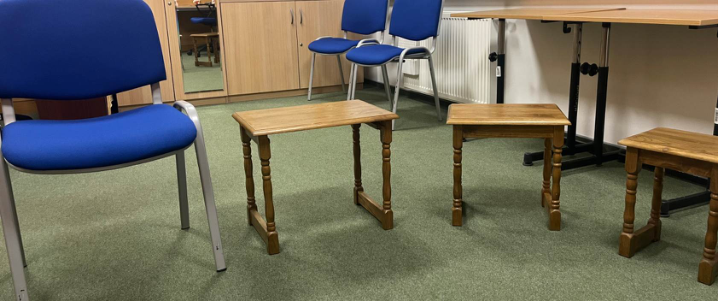
Floor Exercise The warm-up exercises begin with a repetitive activity of sitting down and standing up (assumedly without hands-on assistance) on at least three chairs and stools, each of different heights – in the set presented, from highest to lowest, they are as follows: 43-; 41-; 39-; 37cm (Figure 1).
Figure 1: Chair and stools of varying heights used during violin education sessions with physical exercise elements with a dual pro-factor.
The primary evaluation criteria are the timing of individual series (10- to 30-seconds), the correctness of the movement in biomechanical and ergonomic terms, exercise HR, and the duration of breaks between series. A secondary criterion is the number of repetitions of the exercise (those correct and with errors). Motor correctness is a qualitative criterion that allows modification of the ways of sitting down and standing up, in the sense of increasing the coordination complexity of the task (with simultaneous clapping of the hands; combined with a 360
rotation of the body before changing from upright to seated posture; with two rotations alternately to the right and left; combined clapping, rotation of the body, sitting down and
42 Waszkiewicz and Kruszewski
standing up, etc.). It is assumed that if, after meeting the criteria for motor correctness, the exercise HR decreases with the same duration of exercise and a similar number of repetitions, the student should be stimulated to intensify the activity or an additional external load should be applied (e.g. wrist or ankle weights).
After two minutes of such motor tasks, exercises are used to warm up the hands and entire upper limbs for a further 2–3 minutes. A finger massager, available from specialist shops, is also used. It is assumed that recurring pain in a particular part of the body before and/or during any part of the session requires consultation with a physiotherapist or orthopaedist. During subsequent sessions, the exercises recommended by these specialists should be incorporated from the fifth minute of the warm-up, during the final part of the session and recommended for repetition at home.
The impulse to explain the multifaceted meaning of these exercises (influencing the cognitive sphere in a verbalised way) can be either the curiosity of the student or the educator’s sense of the right moment to do so.
Evaluation Observational data is documented in the Quantitative and Qualitative Evaluation of the Musician’s Physical Exertion During the Session and includes: heart rate (HR), sense of pain (on a scale of 0 to 10), motivation (on a scale of 1 to 10) and motor-artistic effect (on a scale of 1 to 25) (Waszkiewicz & Ba˛k, 2024).
Independently of these indicators, the behaviour and opinions of the pupils are documented, as well as the spontaneous reactions of parents interested in the innovative elements of the ongoing violin education sessions with physical exercise elements with a dual preventive meaning. This preliminary report is mainly based on a synthesis of these opinions, comments, but also documented indicators measuring HR, pain and motivation.
Participants One 13-year-old boy, 18 months of violin lessons. Four girls (months of violin tuition in brackets): 10 years (30); 10 years (18); 11 years (54); 11 years (6). Lessons (individual sessions with the teacher) take place twice a week for 30 or 45 minutes each.
RESULTS
The expected physiological effect for a professional warm-up (HR = 120 to 130). Two girls are equipped with a smartwatch with HR monitoring function. Motivation to exercise is similar to the session before the experiment. Only one child never declared experiencing pain before, during and after the session. The others most often declare pain in the upper limbs, lower limbs and back and almost always the pain is reduced during the session.
Systematically, the parents of three children attend the sessions as observers. With their comments and behaviour, they express their
The Misuse of the Term ‘Therapy’ in Science, Education and in Many Areas of Services 43
appreciation for the care given to their child’s health. The greatest curiosity is aroused by the exercises used in the warm-up.
DISCUSSION
Only the results of systematic observations over longer educational cycles will authorise the formulation of conclusions and recommendations. Knowledge of the cumulative health effects will be most important. This cumulative effect is to be ensured by the recommended warm-up exercises. However, the phenomenon is very complex, not only in the sense of concern for methodological correctness and the prospect of the effects of widespread implementation of an empirically verified model of music prevention.
On the one hand, while the individual ‘topography of pain’ of the musician’s body falls into the methodological category of ‘phenomenon diagnosis’, the reduction of this pain in the course of an instrumental music education session is in principle a therapeutic procedure, and the term ‘therapy’ does not belong to the language of the methodology of the sciences. This is not just an example of the semantic trap we have set for ourselves by talking about the misuse of the term ‘therapy’. This is the real methodological problem of any case where establishing the boundary of identification of phenomena is difficult because of the overlapping ranges of meaning of the names used.
Pain, in this case of the musical instrumentalist, is that phenomenon which source may or may not be directly related to his or her motor activity necessary to produce sounds from an instrument with specific properties in relation to other instruments. When the obvious cause of the musical instrumentalist’s pain is the motor activity of perfecting the playing of the instrument in question (usually exercises are repeated several times a day), it is still very difficult to make a detailed diagnosis with traditional educational methods. It is this traditional model that lacks the innovative elements described in this work.
However, when a competent music teacher with extended knowledge and skills is able to identify the pain, apply appropriate exercises or procedures (the necessary physiotherapeutic or medical interventions are involved) and prevent the escalation of adverse effects in the musician’s morpho-functional musculoskeletal system in a timely manner, the prevalence of preventive measures is clearly dominant. Thus, calling this complex of activities music prophylactic both within the education of musical instrumentalists and in the professional practice of the stage musician is, in our opinion, justified and evidence-based.
But pain is at the same time a phenomenon whose alleviation is possible in certain cases through treatments that qualify as music therapy (Klassen et al., 2008; Gutgsell et al., 2013; Lee 2016; McConnell et al., 2016). And this is a paradox no longer of a semantic nature, but with serious implications for public health – ‘eliminating pain through music therapy at the expense of the instrumentalist’s pain’. The scale of the paradox is illustrated by a simple statistic. For example, The American Music Therapy Association (AMTA) represents 10,000 music therapists, corporate members,
44 Waszkiewicz and Kruszewski
and related associations worldwide (www.musictherapy.org.), but we did not come across data on the number of music prophylactic associations and experts.
The global innovation dimension of the music prophylactic initiated by us within the INNOAGON project (Kalina, 2023a, Kalina & Kruszewski, 2023; Kalina, 2024), connects most closely with the second component of health exercises with a dual preventive significance. Applied within this music prophylactic formula, the initial warm-up exercises, in addition to providing physiological stimuli of optimal strength to prepare the body for the physical exertion of the musician, are the basis for habit formation that rededuces the risk of the consequences of injury due to an unintentional fall.
The legs are the most important shock absorber of unintentional and intentional falls, especially from a height with the feet down (Jaskólski & Nowacki, 1972; Ga˛sienica-Walczak and Kalina, 2021; Kalina et al., 2024; Klimczak et al., 2024). Sitting down and standing up from seats of different heights, with a preference for the lowest heights and without helping oneself with one’s hands, is the simplest way to restore a two- year-old child’s motor memory. From the age of three, falling children begin to precede a collision with the ground by supporting themselves with their hands (Kalina et al., 2022, Ga˛sienica-Walczak and Zachwieja, 2023). Unfortunately, this element of possible and necessary prevention is still beyond the perception of coordinators responsible for public health up to the macro scale.
CONCLUSION
It is not beyond the realm of possibility that the presented music prophylactic model will become the key to solving the global problem of premature death or years spent in disability due to unintentional falls. Such a conclusion does not diminish the health concerns of instrumental musicians. On the contrary, the cultural significance of music in the lives of millions of individuals and whole generations can become a turning impil in the promotion of music education with elements of health exercises with a double preventive significance. The recognition of so-called music stars combined with their promotion of these simple and effective health exercises is not something impossible to achieve for the global benefit of public health.
REFERENCES
Gallagher, L. M., Lagman, R., Bates, D., Edsall, M., Eden, P., Janaitis, J., & Rybicki, L. (2017). Perceptions of family members of palliative medicine and hospice patients who experienced music therapy. Supportive Care in Cancer; 25: 1769–1778. Ga˛sienica-Walczak, B., Kalina, R. M. (2021) Validation of the new version of “the
susceptibility test to the body injuries during the fall” (STBIDF-M). Arch Budo; 17: 371–400. Ga˛sienica-Walczak, B., Zachwieja, J. (2023) Cognitive effects of using the modified fun forms of falling method in measuring the susceptibility to body injuries during a fall in children. Applied Human Factors and Ergonomics and the Affiliated Conferences (AHFE 2023); 2023 Jul 20–24; San Francisco, USA. Healthcare and Medical Devices. 2023; 79: pp. 316–324.
The Misuse of the Term ‘Therapy’ in Science, Education and in Many Areas of Services 45
Gutgsell, K. J., Schluchter, M., Margevicius, S., DeGolia, P. A., McLaughlin, B., Harris, M., Mecklenburg, J., & Wiencek, C. (2013). Music therapy reduces pain in palliative care patients: A randomized controlled trial. Journal of Pain & Symptom Management, 45, 822–31. Jaskólski, E., Nowacki, Z. (1972) Teoria, metodyka i systematyka mie˛kkiego
padania. Part I. Teoria mie˛kkiego padania. Wrocław: Wy˙zsza Szkoła Wychowania Fizycznego; 1972: 83–88. in Polish. Kalina, A., Kruszewski, A., Ga˛sienica-Walczak, B. Motor modifications versus movement habits in measuring the SFI phenomenon. Arch Budo J Inn Agon 2024, 20: 250–269. Kalina, RM. (2023a) Innovative Agonology – Its Definition, Detailed Theories,
General Rule of Struggle, and Laws. Proceedings of the 14th International Conference on Applied Human Factors and Ergonomics and the Affiliated Conferences (AHFE 2023); 2023 Jul 20-24; San Francisco, USA. Healthcare and Medical Devices 2023; 79: 272–279. Kalina, R. M. (2023b) Methodology of complementary research as the basis for integrating science in fulfilling its social mission in the future. Arch Budo; 19: 77–82. Kalina, R. M. (2024) BUDO & INNOAGON – historical complexity but similar
missions. Arch Budo J Inn Agon; 20: 1–15. Kalina, R. M. Dłubacz, N. Zachwieja, J. Pilarska, E. Dobosz, D. Gasienica-Walczak, B. Kruszewski, A. (2022) Innovative method of diagnosing the susceptibility to the body injuries during the fall of children from 2 to 6 years. Arch Budo Sci Martial Art Extreme Sport; 18: 211–228. Kalina, R. M, Kruszewski, A. (2023) INNOAGON is an acronym for ‘innovative agonology’, but is not synonymous with ‘science of martial arts’. Arch Budo; 19: 193–204 Klassen, J. A., Liang, Y., Klassen, T. P., & Harling, L. (2008) Music for pain
and anxiety in children undergoing medical procedures: A systematic review of randomized controlled trials. Ambulatory Pediatrics; 8(2): 117–128. Klimczak, J., Dobosz, D., Balewska-Juras, K., Kalina, A., Kruszewski, A., Orłowska-Bojarska, I., Staniszewska, M., Subkowska, M., Ga˛sienica-Walczak, B. (2024) -Cognitive-behavioural effects of reducing the susceptibility to the body injuries during the fall by nursing home care patients under the influence of innovative interventions. Arch Budo J Inn Agon; 20: 100–117. Kruszewski, A., Litwiniuk, A., Waszkiewicz, E. (2024) Reliability and objectivity
of the new version of the ‘susceptibility test for body injuries during a fall’ (STBIDF-M) in physiotherapy students. Physical Education of Students; 28(5): 303–312. Lee, J. H. (2016.). The effects of music on pain: A meta-analysis. Journal of Music Therapy; 53(4): 430–477. McConnell, T., Scott, D., Porter, S. (2016). Music therapy for end-of-life care: An
updated systematic review. Palliative Medicine; 30(9): 877–883. Meregillano, G. (2004). Hippotherapy. Phys Med Rehabil Clin N Am;15(4): 843–54. Tomasik, S. (2020) The Violinist’s Warm-up. Warszaw-Kraków: Polskie Towarzystwo Muzyczne. Waszkiewicz, A. (2023) Multidimensional Educational Models Recommended by Innovative Agonology – Examples of Physical Education and Music Education. Healthcare and Medical Devices, Vol. 79, 2023, 290–298. Waszkiewicz, E., Ba˛k, R. (2024) An innovative method of monitoring health, mental,
motor and artistic indicators during violin lessons. Arch Budo J Inn Agon; 20: Yermakova, T. S, Podolski, A. (2019) Pedagogical approach to the development of art therapy – a review. Arch Budo; 15: 171–179.
LISTED IN THE AHFE DIGITAL BOOKSTORE CATALOGUE
Explore the complete digital volume
Human Factors in Sports, Preventive Medicine and Innovative Agonology
Read this individual research paper free through the original publisher, or explore the full digital proceedings book.
ISBN 978-1-964867-64-9
Explore this ISBN in the AHFE Bookstore ↗Listed in the July 2026 bookstore catalogue; search by ISBN to confirm current availability · Digital book purchase optional