Kazusa Oki (2025). Development of Basic Guidelines for Safe Lift Access for Disabled Skiers. In: Human Factors in Sports, Preventive Medicine and Innovative Agonology. AHFE Open Access, vol. 188, pp. 14–21. https://doi.org/10.54941/ahfe1006477
There are many rules for safe skiing in resorts. However, there are still no global standard rules for lift embarkation and disembarkation. The reasons for this lie in the variety of lift configurations, and that these are often left to the rules of respective ski resorts. The Japan Association for Skiing Safety has established rules for getting on and off lifts. However, this rule has certain limitations. These guidelines were developed for skiers without disabilities. Therefore, there is an urgent need to develop guidelines for skiers with disabilities that can be applied in Japanese ski resorts. In order to create guidelines for skiers with disabilities to get on and off lifts. The disabled skiers in this study were limited to sitting skiers. The survey asked skiers with disabilities how easy or difficult it is to get on and off their lifts. In addition, lift embarkation and disembarkation movements were videotaped and analyzed using motion analysis software (myDartfish Pro S, Dartfish Japan Co., Ltd.). In order to ascertain the kind of assistance that resort operators offered to disabled skiers, I also interviewed with them. Consequently, the proximity of the lift chair to the snow surface was a factor that made getting on and off the lift difficult. Then, skiers have to place the outriggers on the snow surface at the right time and get out of the lifts with considerable momentum. The skier's body position at this time was a neck angle of 45 degrees and waist-to-neck angle of 60 to 70 degrees. The operator had no way of knowing the movements of sitting skiers and did not know how to support them. These guidelines would help formulate standards to help prevent accidents and injuries to the disabled.
Sports for the disabled in Japan are thriving, and there are notable achievements in various sports. Many of the athletes in the disabled skiing events are among the best in the world. In the 2022 Paralympics in Beijing, Japan’s athletes won a total of seven medals: four gold, one silver, and two bronze. Six of these medals were won in the alpine skiing events. The success of these athletes has been influential in the development of skiing for the disabled. However, there are no unified guidelines for disabled skiers in Japan. In addition, it is rare to find messages for people with disabilities posted on the websites of ski resorts. Support for persons with disabilities who wish to ski alpine skiing should have guidelines for behaviours at the ski resort they will be using, in addition to technical and equipment manuals.
Development of Basic Guidelines for Safe Lift Access for Disabled Skiers 15
The U.S. Paralympic Nordic Skiing (2017) has established guidelines on how to coach athletes and match athletes with equipment. This is a very useful guideline for coaching people with disabilities. However, this is not enough for application to alpine skiing. The reason for this is that Alpine skiing and Nordic skiing are run in different locations. Alpine skiing involves getting on and off the lift. Especially for sitting skiers, getting on and off this lift can be a very difficult challenge.
In order for people to enjoy snow sports safely, it is necessary to create a safe environment and strengthen people’s awareness of safety. International Ski and Snowboard Federation (FIS) provides 10 rules to help people around the world ski safely on the slopes. These rules have been translated into Japanese and posted on each ski resort’s website and on the grounds. In addition, there are safety standards tailored to the characteristics of Japanese ski resorts. The Japan Association for Skiing Safety (JASS, 2013) has adopted the Standards on Snow Sports Safety as the guideline for safety management. These standards describe the potential hazards of snow sports, the responsibilities of the skiers or snowboarders, and the operation and management of ski resorts. These potential hazards include not only when skiing or snowboarding, but also when getting on and off the lifts. A survey of injuries that occurred during the 2023/2024 ski season at ski resorts throughout Japan shows that the injuries at lift station, during rides, and at alight area were 111 people (JASS, 2024). The study indicates that more injuries are sustained at the lift alight area than at the lift station. Furthermore, it is known that injuries and fatalities have occurred in lift areas worldwide (Marc et al., 2018). However, these were not known under what circumstances people were injured.
Lift-related injuries occurring at ski resorts in Japan may include disabled skiers. There is a need to provide guidelines not only for non- disabled skiers, but also for those with disabilities. The purpose of this study is to develop guidelines for getting on and off the lift for disabled skiers. In particular, the current study will focus on sitting skiers. The development of these guidelines could contribute to a reduction in the number of injuries related to lift boarding and disembarking in Japan.
METHODS
Subjects The subjects were five sitting skiers. These skiers are used for getting on and off the lifts. One of these subjects was a beginner.
Survey Period and Location The survey was conducted in March 2024. The location was a ski resort in Fukushima, Japan. The lack of snow this season forced us to conduct the survey at ski resorts that were open.
16 Oki
Ethical Procedures I provided the subjects with a written and verbal explanation of the study. Then, the subjects signed a consent form if they were willing to cooperate in the study.
Video Survey The research involved videotaping disabled skiers as they got on and off the lift, both from the side and from the front. These video data were analyzed by myDartfish Pro S (Dartfish Japan Co., Ltd.) for skier movements. This analysis software can analyze videos in two dimensions.
Interview Survey The interview survey was also conducted to supplement the video survey. Questions were asked to clarify the subjects’ perspectives on getting on and off the lift (see Table 1).
Table 1: Questions for the interview process.
Table available in the original PDF paper.
Situation Questions Area of getting on and off the lift -Was the lift height appropriate? -Was the lift speed appropriate? -Were there any dangerous situations? Staff’s behavior - Did he/she say anything to you?
→What words were spoken to you? - Did you have any specific support?
→What support did you receive? All situation - What kind of support do you think would help you avoid dangerous situations?
RESULTS
Characteristics of the Movement When Getting On and Off the Lift The present study extracts and shows the characteristic movements of skiers when getting on and off the lift.
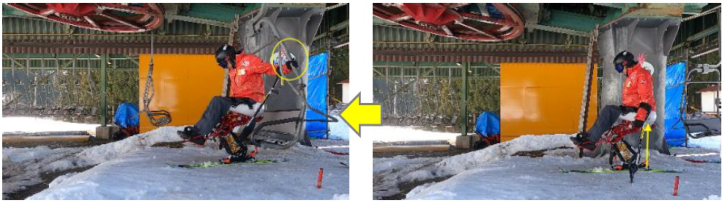
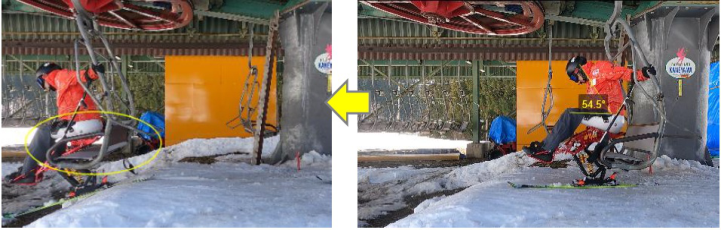
First, I analyzed video footage taken from the side of the skier’s characteristic movements when getting on the lift. Advanced level skiers move smoothly to the lift station and stop in the appropriate position. If the machine is capable of keeping the bucket seat in the proper position, push the snow surface with the outriggers to raise the bucket seat. These skiers need to be ready for this position before the lift is approaching. However, some types of machines cannot keep bucket seats in a high position. In this case, the skiers should lift bucket sheet by outriggers to the appropriate height when a lift is imminent. As the lift approaches, the skiers grab the lift frame and fits the lift into the indentation between the bucket seat and the ski bindings (see Figure 1). The skier’s upper body was tilted forward at an angle of 54.5 degrees. The lift and bucket seats match when the skiers are airborne, leading
Development of Basic Guidelines for Safe Lift Access for Disabled Skiers 17
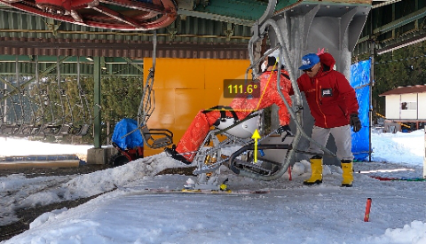
to a stable ride (see Figure 2). A beginner may not be able to perform these series of movements smoothly. The movement to grab the lift is especially difficult. If you grab the bottom of the lift, the skier’s back will be bent backward, and you may hit your head on the safety bar. The skier’s upper body was 111.6 degrees (see Figure 3). This was found to be an important point in getting on the lift and something that needed to be included in the guidelines as a safety measure.
Figure 1: Preparation process before getting on the lift.Figure 2: How to get on the lift as an advanced level skier.Figure 3: Characteristics of a beginner skier getting on the lift.
18 Oki
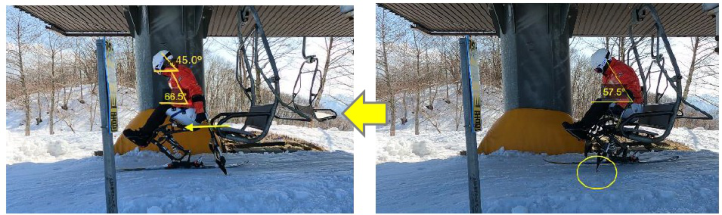
Then, I analyzed video footage taken from the side of the skier’s characteristic movements when getting off the lift. Advanced skiers can smoothly position themselves to get off the lift. The position is to lean forward (57.5 degrees) and place the outriggers on the snow surface when the skier reaches the lift landing. The skier lifted their body from the lift with the outrigger as the viewpoint. At this time, it is important to lift the body forward. After that, the upper body is tilted further forward (66.5 degrees). However, the neck angle is such that both the front and the snow surface can be seen (45 degrees), and the skier skis from the lift landing (see Figure 4). It may be difficult to smoothly perform such a series of actions for beginners. Especially, there is a possibility of losing skier’s balance when descending from a lift at a brisk pace. The speed of the lift and the slope of the lift landing could affect the descending posture and balance of the sitting skiers.
Figure 4: How to get off the lift as an advanced level skier.
Safe Lift Access Environment From the Skier’s Perspective This study obtained answers to questions about getting on and off the lifts from the perspectives of sitting skiers. The interview survey was using a semi-structured interview method. The skiers found that they do not think the current ski resort environment is the best. In particular, different ski resorts cited different lift boarding and disembarking environments, and staff responses as problems (see Table 2).
Table 2: Interview answers about getting on and off the lift.
Table available in the original PDF paper.
Situation Questions Answers Area of getting on and off the lift
Was the lift height appropriate?
Sometimes it was not appropriate. The height of the lifts and snow surface varies from ski resort to ski resorts.
Was the lift speed appropriate?
Sometimes it was not appropriate.
Were there any dangerous situations?
Low or high lift positions lead to difficulty in getting on or off the lift.
Continued
Development of Basic Guidelines for Safe Lift Access for Disabled Skiers 19
Table 2: Continued Situation Questions Answers
Table available in the original PDF paper.
It was difficult to grab on to the lift if there is no indentation on the back rest when riding the quad lift. The lift was too high to ride the lift. Staff’s behavior
Did he/she say anything to you?
A staff asked me “Do you want to slow down?”. →What words were spoken to you?
Did you have any specific support?
Some staff members slowed down the lift without saying anything. →What support did you receive?
Some staff members were attentive and responsive to my needs. All situation
What kind of support do you think would help you avoid dangerous situations?
Sometimes I asked a staff to slow down and the message is not communicated to the operator. Communication is important. If we fall, the staff should stop the lift immediately. It is dangerous for the operator to look away. They should be thorough in their risk management. The lift heights are different at different ski resorts, and I would like to see them standardized. In the case of IC card type tickets, the automatic ticket gate is too narrow to fit the chair portion. I would like the structure to take into account sitting skiers as well.
Selection of Contents for Guidelines Development Contents were considered in developing the guidelines based on the video survey and interviews. As a guideline that can be used in Japan, this study set up content that can be adapted to any ski resort (see Table 3).
Table 3: Table of contents of guidelines for disabled skiers.
Table available in the original PDF paper.
1 Equipment used by sitting skiers and its characteristics 2 Environmental maintenance of lift stations Snow surface conditions Lift height from snow surface Position of operators and number of people assigned Speed control
Continued
20 Oki
Table 3: Continued 3 How to get on the lift for sitting skiers 4 How to get off the lift for sitting skiers 5 Support by staff or operator
Table available in the original PDF paper.
Keep in mind on a daily basis Resourceful support 6 Possible accidents and responses 7 Emergency Contacts in Japan 8 Other
STUDY LIMITATIONS AND FUTURE PROSPECTS The current study attempted to create guidelines for sitting skiers, which is an unexplored area worldwide. However, this is only the first version. In the future, it will be necessary to increase the number of people surveyed and the number of ski resorts surveyed, and to refine the content of the survey. Then, the study will also refer to the National Ski Areas Association of USA’s ‘Lift Safety’ to be able to provide videos on safe lift boarding and alighting.
According to the handbook on guideline development (WHO, 2014), it is recommended that the preparation be done by one person. However, it is necessary to build an organization that includes the people who use the guidelines, those who are seminal in the equipment used by the sitting skiers, and those involved in the ski areas. This study will aim to create guidelines that are more in line with the field.
CONCLUSION
In this study, video and interview surveys were conducted to develop a guideline for getting on and off the lift of sitting skiers. The video survey was mainly used to clarify the movements of getting on and off the lifts. In addition, the movements of advanced level skier and beginner could be compared, and safer movements could be provided in the images. The interview survey provided information on creating a safe environment from the skier’s perspective that could not be confirmed by video. The need for a review of safety management based on the experience of sitting skiers could be demonstrated.
ACKNOWLEDGMENT
Acknowledgement is extended to all skiers and ski resort personnel who cooperated with the survey.
REFERENCES
International Ski and Snowboard Federation. FIS Code of Conduct for Skiers and Snowboarders. Available at: https://assets.fis-ski.com/f/252177/49280306c8/ fis-code-of-conduct-for-skiers-and-snowboarders-en.pdf (Accessed: 11 December 2024). Marc Blancher, François Albasini, Fidel Elsensohn, Ken Zafren, Natalie Hölzl,
Kyle McLaughlin, Albert R. Wheeler, III, Steven Roy, Hermann Brugger, Mike
Development of Basic Guidelines for Safe Lift Access for Disabled Skiers 21
Greene, and Peter Paal. (2018). Management of multi-casualty incidents in mountain rescue: Evidence-based guidelines of the International Commission for Mountain Emergency Medicine (Icar Medcom). High Altitude Medicine & Biology Volume 19, Number 2, pp. 131–140. National Ski Areas Association. Lift Safety. National Ski Areas Association Website: https://nsaa.org/liftsafety/ The Japan Association for Skiing Safety (JASS). (May 2013). Standards on Snow Sports Safety. Available at: https://www.nikokyo.or.jp/files/libs/142/ 20210307212223505.pdf (Accessed: 29 November 2024). The Japan Association for Skiing Safety (JASS). (July 2024). Ski Resort Injury
Report for Season 2023/2024. Available at: https://www.nikokyo.or.jp/pages/38/ (Accessed: 12 December 2024). U.S. Nordic Paralympic Nordic Skiing. (2017). USPN’s Sit Ski Instructor Manual -Version 2017. Available at: https://assets.contentstack.io/v3/assets/ blteb7d012fc7ebef7f/blt8cfef5b6c57fb40b/654a901c67092b040a94ef03/ 88182_Sit_Ski_Instructor_Manual2_FINAL-ua_ (2).pdf (Accessed: 13 November 2024). World Health Organization. (2014). WHO Handbook for Guideline Development, 2nd ed. World Health Organization Press. Available at: https://iris.who.int/handle/ 10665/145714 (Accessed 22 January 2025).
LISTED IN THE AHFE DIGITAL BOOKSTORE CATALOGUE
Explore the complete digital volume
Human Factors in Sports, Preventive Medicine and Innovative Agonology
Read this individual research paper free through the original publisher, or explore the full digital proceedings book.
ISBN 978-1-964867-64-9
Explore this ISBN in the AHFE Bookstore ↗Listed in the July 2026 bookstore catalogue; search by ISBN to confirm current availability · Digital book purchase optional