Elizabeth Waszkiewicz (2023). Multidimensional Educational Models Recommended by Innovative Agonology – Examples of Physical Education and Music Education. In: Healthcare and Medical Devices. AHFE Open Access, vol. 79, pp. 290–298. https://doi.org/10.54941/ahfe1003499
Almost all types of education are in some sense multidimensional, even if it is difficult to ascribe formal, or passion-driven, experiential, cognitive-behavioral competences closely related to the subject of education to the teaching subject (an individual or a team). From the perspective of the mission of innovative agonology, the most valuable ways, methods, forms and means of educational activities are those whose use (in a session, in a cycle, or as a ‘passion for life’) stimulates as much as possible some aspect of somatic, mental and social health, but also at least one element (component) of survival.From a broader point of view, i.e. the social mission of evidence-based science, the important premise is that although humans are genetically adapted to operate in terrestrial environments, however, they are also active underground, in water, in the air and in space. In each of these environments, one pole of the continuum of survival possibilities accumulates minimal health criteria, while the opposite pole – a long list of factors that mean inevitable death. This diversity of human operating environments and the roles they fulfill within them implies the legitimacy of recommending very complex educational models, some of which require multilevel selection.Apart from individual career paths, swimming and wrestling (even if pursued without the pressure of sports performance) optimally stimulate the somatic dimension of health (hard-respiratory capacity, strength and endurance of the largest muscle groups and flexibility) compared to other sporting activities. The survival dimension is already diverse. For instance, swimming skills increase the chance of survival in an aquatic environment while hand-to-hand combat skills increase the likelihood of effective self-defense in situations of physical aggression. And wrestling is a contact sport (psychophysical activity involving a permanent ‘dialogue of minds and bodies’), so it qualifies as a model that also stimulates the mental dimension of health. Moreover, in general, also the adepts of other martial arts interact in a peculiar way with the centuries-old heritage of the cultures from which these arts originate (social dimension of health). Unfortunately, the effective and attractive status of educational models based on martial arts is depreciated by the pathology of bloody fights of neo-gladiatorship. These spectacles are promoted and camouflaged in the public sphere precisely under the banner of mixed martial arts (the first part of the phrase ‘mixed’ is only 31.25% of the name).Brazilian capoeira is an example of a multifaceted educational model that combines martial art with music. Although innovative agonology is an appropriate science for formulating justifications at the interface between these two arts (martial art and music), the well-established standards of music education are its competition. These standards include respect for centuries-old traditions and multiculturalism, a commitment to routine with an awareness of the unlimited potential for creating beauty and positive emotions. The coordinating perfectionism of the instrumentalists is also admired. However, a hypothesis is justified: ignoring scientific knowledge (including human motor skills) from areas of activity other than music is the cause of, among other things, interpersonal conflicts (for instance teacher-student) and negative effects encompassing all dimensions of health.
Multidimensional Educational Models Recommended by Innovative Agonology 291
cognitive-behavioral competences closely related to the subject of education to the teaching subject (an individual or a team). From the perspective of the mission of innovative agonology, the most valuable ways, methods, forms and means of educational activities are those whose use (in a session, in a cycle, or as a ‘passion for life’) stimulates as much as possible some aspect of somatic, mental and social health, but also at least one element (component) of survival (Rudnia´nski, 1980, Kalina, 2015, 2016a, 2016b, 2017).
From a broader point of view, i.e., the social mission of evidence-based sci- ence, the important premise is that although humans are genetically adapted to operate in terrestrial environments, however, they are also active under- ground, in water, in the air and in space. In each of these environments, one pole of the continuum of survival possibilities accumulates minimal health criteria, while the opposite pole - a long list of factors that mean inevitable death. This diversity of human operating environments and the roles they fulfill within them implies the legitimacy of recommending very complex educational models, some of which require multilevel selection.
The aim of this paper is to put forward a general multidimensional educa- tional model, based on the methodological criteria of innovative agonology, exemplified by the combination of physical education and music education.
GENERAL MULTIDIMENSIONAL EDUCATIONAL MODEL Since innovative agonology (a new applied science) is dedicated to the pro- motion, prevention and therapy in all dimensions of health and regards the optimization of activities that increase the ability to survive (from micro to macro scales), the educational issues should also be multidimensional and taking into account various aspects. Thus, the most valuable educational models would be those whose positive effects would concern all of the fol- lowing dimensions of health and survival (its four pillars:) A somatic health, B mental health, and C social health, D survival ability (Kalina, 2012, 2018, Michnik et al. 2017, Kalina and Kalina, 2020, Ga˛sienica Walczak, 2021).
The ‘diversity of aspects’ here is naturally limited by a number of factors, but fortunately the freedom to compile educational and diagnostic approa- ches is not constrained by some rigid methodological rigor. On the contrary, since the basic method of innovative agonology is the complementary appro- ach (Kalina, 2016a, Kalina and Barczy´nski, 2017), it is obvious that the main limiting factor for the applicability of this method is the competence of the subject (an individual or a team), which is a factor of internal nature and consists of the subject’s knowledge, skills, motivation, aptitude, etc. Of les- ser importance here are the external circumstances, such as available tools, infrastructure, facilities, etc.
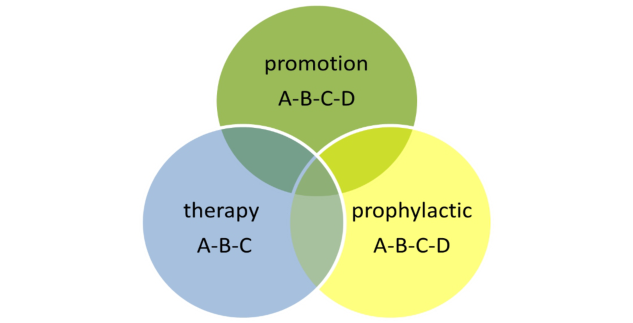
One straightforward example of the variety of aspects (out of many possi- ble ones) could be the question of complementary but separate approaches: during promotion, during prevention, or during therapy of each of the afore- mentioned pillars A to C. A more challenging compilation of aspects would be to simultaneously pursue promotion and prevention goals within any of these pillars (including D) during a lesson, training session, workshop, lecture or other form of educational interaction. The most challenging but in a sense
292 Waszkiewicz
Figure 1: A model of the ideal combination of all dimensions of health and survival with promotion, prevention, and necessary therapy through the application of the complementary approach in multidimensional education.
ideal model, would be to use a complementary approach during any of the forms of educational interaction in such a way as to positively influence some aspect of each pillar and, in addition, to fulfill some specific aim of promotion, prevention, and therapy (Figure 1).
Thus, not only the complementary approach method is important, but each of the measures used during a specific form of educational interaction. If one of the goals of a training session is to stimulate physical capacity, then jogging is the simplest measure. If a person jogs in the park while wearing attractive clothes, he/she is cheerful and attracts the attention of many people, then, in addition to preventive effects of jogging (in the sense of influencing one’s own health), it also fulfils a multidimensional promotional function (promo- tes jogging, aids marketing, encourages other people to be physically active, influences the strengthening of social health, etc.). If the very same jogging is a recommended measure after a recognized cardiac incident, it also fulfills the function of a therapeutic measure. However, in this case it is difficult to find a clear connection with pillar D.
However, if the goal of this person was to learn to swim (assuming that he or she could not swim before the aforementioned cardiac incident), here would be present not only the aspect (factor) of stimulating physical capacity would be present here, but also - and equally prominent - the survival in an aquatic environment. In this model, the effective promotion of social health leads to the enhancement of mental health. It is clear that a park or other public place with a large number of people is one of those outdoor circum- stances that is more suitable for promoting social health than an intimate swimming pool.
NARROW SPECIALIZATION AS AN EXAMPLE OF LIMITED MULTIDIMENSIONAL EDUCATION EFFECTS AND HEALTH RISKS If we remain in the area of human motor activity (everyday utilitarian, pro- ductive, sporting, artistic, defensive, military, police, etc.), it is not difficult
Multidimensional Educational Models Recommended by Innovative Agonology 293
to find evidence of two categories. The first concerns the weakening of a very large part of one’s own motor potential at the expense of achieving extreme perfectionism in a more or less limited range of activities performed. The second one concerns the negative health effects as a result of ongoing repetition of the same activities (especially asymmetrical in terms of body parts) over many years. Contrary to appearances, negative health effects are not only about somatic health and survival, nor about the micro scale, i.e., relativizing with each individual.
Considering the sum of mental and physical human activity, the conse- quences of ignoring the criteria of multidimensional education based on a correctly interpreted complementary approach become clear. This correctness is most simply put by the directive that the most important element is to care- fully influence the timing, intensity, and content of each individual form of educational interaction, optimally integrated into daily, weekly, multi-weekly, multi-monthly, annual, and multiyear cycles.
Knowing that every mental and physical activity engages not only the cognitive-behavioral sphere of the human personality, but also, with varying intensity, the heuristic, emotional, moral, etc. spheres, an elementary question arises about even the most general characteristics of this interaction. Based on the recommendations of R. M. Kalina (Kalina, 2020), the main promo- ter of innovative agonology in the global scientific sphere, this activity at various stages of formal education (types of schools, other institutions and entities) and spontaneous education should have the strongest possible con- nection with the realization of specific goals. These goals concern optimal adaptation to life in society (based on correct interpersonal relations), with the satisfaction of one’s own needs, including professional aspirations lin- ked to intellectual, physical, moral resources, etc. - without exploiting other people, but cooperating with them by mutual consent. Given the permanent impact of the Internet and.electronic media on most societies across the globe, the dilemma of the coherence of formal and spontaneous education arises. Thus, the second elementary question concerns the quality of the coordina- tion of both varieties of education, from the micro scale (the individual, the family) to the macro scale (the Internet, for instance) through intermediate levels.
The answers to both questions do not spark optimism. Methodologies of complementary research and the foundations of multidimensional education based on a complementary approach are both still missing. Furthermore, the prospect of its widespread implementation is very distant (paradoxi- cally, inversely proportional to the ability of societies to communicate about the ‘most important’ events through the Internet). The disappointing pros- pects for the quality of coordination of most important matters to the functioning of societies (today we may legitimately detail them as national, federalized, global) and smaller entities were already raised 98 years ago by Albert North Whitehead: “The tasks of coordination are left to those who lack the strength or character to be successful in a particular field” (Whitehead, 1925).
294 Waszkiewicz
THE HEALTH AND SURVIVAL CONSEQUENCES OF THE EXTREME IGNORANCE OF THOSE RESPONSIBLE FOR FORMAL AND SPONTANEOUS EDUCATION Apart from individual career paths, swimming and wrestling (even if pur- sued without the pressure of sports performance) optimally stimulate the somatic dimension of health (hard-respiratory capacity, strength and endura- nce of the largest muscle groups and flexibility) compared to other sporting activities (Midgley, 1979). The survival dimension is already diverse. For instance, swimming skills increase the chance of survival in an aquatic envi- ronment while hand-to-hand combat skills increase the likelihood of effective self-defense in situations of physical aggression. And wrestling is a contact sport (psychophysical activity involving a permanent ‘dialogue of minds and bodies’), so it qualifies as a model that also stimulates the mental dimension of health. Moreover, in general, also the adepts of other martial arts inte- ract in a peculiar way with the centuries-old heritage of the cultures from which these arts originate (social dimension of health). Unfortunately, the effective and attractive status of educational models based on martial arts is depreciated by the pathology of bloody fights of neo-gladiatorship (Piepi- ora and Witkowski, 2020, Krzemieniecki et al., 2021). These spectacles are promoted and camouflaged in the public sphere precisely under the banner of mixed martial arts (the first part of the phrase ‘mixed’ is only 31.25% of the name).
The use of the most effective tools of spontaneous education: the Internet, television and other electronic media for strengthening health and survival capacity, constitutes (some indirect evidence, yet not the only one, of the ignorance of the entities (individuals and institutions) who use them. Shu- shing down the evidence of the disastrous health effects (somatic, mental, social) of mixed martial arts and the counter-effective pattern of self-defense, is a testimony to the blatant asymmetry of honest communication of full kno- wledge of martial arts and combat sports in the social sphere. The motor and mental, barbaric offer to massacre a lying opponent stands in opposition to the techniques and rules of hand-to-hand combat accepted in the culture of modern Olympism, which are both unique means of teaching the combatants to respect each other’s physicality. Moreover, this offer also defies the legal criteria of necessary self-defense. Methods of effective restraint of an oppo- nent’s body movements based on combat sport techniques that prohibit the use of any blow (especially judo and wrestling) are sufficient to demonstrate one’s own superiority, and are, indeed, are capital use in self-defense - and do not endanger anyone’s health. Thus, these techniques effectively used in necessary defense, like any other use of one’s own body in a relatively mild but sufficient manner to deter the aggressor from continuing the attack, ful- fil a multidimensional mission. In particular, it includes: respecting the law; being responsible for the somatic and mental health of the opponent (even if the opponent is the aggressor) and one’s own health; providing positive pat- terns of social functioning, even when one is the object of deliberate attack. In other words, this multidimensionality (although only seemingly based on an incidental event), spread in global media coverage, can become widely
Multidimensional Educational Models Recommended by Innovative Agonology 295
available and may represent, in many respects, a blueprint of the ideal model (Figure 1).
Modern media effectively avoid such coverage. Thus, reliable knowledge of both the health and humanistic qualities of practicing a large part of mar- tial arts and combat sports and of the optimal enhancement of personal safety in this way is only available in scientific and popular science publications.
BRAZILIAN CAPOEIRA: A MULTIDIMENSIONAL EDUCATIONAL MODEL THAT COMBINES MARTIAL ART WITH MUSIC This educational model based on combining martial art with music associated with Brazilian culture has strong connotations with the promotion, preven- tion, and therapy of all dimensions of health and the field of self-defense. However, this fascinating spectacle involving several people differentiates the roles of the performers. Self-defense is not the domain of musicians, although the combination of both skills: playing up to several instruments and unified movements in a kind of combat dance is not excluded. An analysis of works dedicated to Brazilian capoeira does not provide evidence of a combination of both skills even by masters of this unique martial art (Litwiniuk et al., 2021). However, what is documented are positive effects within each dimen- sion of health. However, the advantages of capoeira as a method of enhancing personal safety (psychomotor self-defense competences) can in principle be based on the results of theoretical studies or painstaking retrospective com- parative analyses involving individuals who have experienced circumstances that entitled them to necessary defense.
Thus, it is an interesting methodological challenge to find out the effects of multidimensional, and especially long-term, health and defense education, based on combining martial arts with music. The most accessible research subjects are undoubtedly capoeira practitioners. Given the profound crisis of interpersonal relationships and the prospect of fulfilling the social mis- sion of science (cognitive and applied) the issue of creating new empirical systems, based on the idea of combining martial arts with music, is indeed relevant. The need for broad applications concerning prevention and therapy of all health dimensions, from micro to macro scales, comes to the fore. It is innovative agonology that is the right science to formulate justifications at the interface of the two arts, with regard to the multidimensional effects of adaptation and the formulation of recommendations for multidimensional education as well.
THE BIGGEST CHALLENGES Professional teaching of martial arts and combat sports, like any other pur- poseful physical activity, is based not only on knowledge of human motor skills, but also on many other aspects of how the human body functions under various circumstances, including extreme mobilizing or depressing stress (mentally, physiologically or both). The education of musicians (inclu- ding professional teachers) is just another kind of purposeful physical activity based mainly on the dynamic exploration of the muscles of the upper limbs
296 Waszkiewicz
performing various manipulative actions limited by the duration of a musi- cal piece or a concert. The traditional model of this education, on the one hand, does not take into account the scientific knowledge of human moto- ric remaining in close relationship with kinesiology, neurology, physiology, biomechanics and other specific disciplines. However, centuries-old traditi- ons and multiculturalism are respected, as well as a commitment to routine with an awareness of the unlimited potential to create beauty and positive emotions.
A common element concerning human motoric is the admiration of the coordinative perfectionism of instrumentalists, as well as athletes-dancers during capoeira performances who demonstrate hand-to-hand combat tech- niques using the lower limbs. A common element in the training of professi- onals able to combine a given specific martial art with music is the creation of beauty and positive emotions for public use - the anticipated positive effect has the strongest connection with social health. The right models for such competences are the experiences encoded in traditional music education models.
Diagnostics, the Easiest Aspect to Implement, Despite Appearances The pillars, symbolically marked with letters A to D, correspond to the termi- nology and structure of the study of these phenomena within the framework of the Positive Health and Survival (SPHSA) - primarily on the basis of the respondent’s declaration (subjective assessment), then by empirical verifica- tion of the declared value of individual indicators (Kalina, 2012). However, the available publications report mainly on the application of this method to the subjective assessment stage (Jagiełło et al., 2012, Kalina, 2012, Tsos et al., 2016). The results of studies taking into account both stages, and therefore also empirical verification, only apply to the A pillar (Dobosz, 2018, 2019). The only rigor of the open-ended formula for the application of diagnostic tests is the adjustment of the individual indicators to a five-grade scale (pillars A, B, C) increased by one grade in the absence of a specific skill (pillar D).
CONCLUSION
There will be no conflict of interest in formulating the general principles of multidimensional education combining martial art with music for preven- tion and therapy in all dimensions of health. On the contrary, there is a unique opportunity to create a new prevention and therapy formula dedi- cated to an individual or a small group (micro-scale). Moreover, modern, attractive performances combining martial arts (without the ‘mixed’ part, as in ‘mixed martial arts’) with music could have a positive impact on the qua- lity of social health. The promotional aspect could even extend to the macro scale: transmission via Internet links and global electronic media.
However, a hypothesis is justified: ignoring scientific knowledge (including human motor skills) from areas of activity other than music education is the cause of, among other things, interpersonal conflicts (for instance teacher- student) and negative effects encompassing all dimensions of health.
Multidimensional Educational Models Recommended by Innovative Agonology 297
REFERENCES
Dobosz D. (2018) Empirical verification of self-rated positive health (somatic dimension) in men with professional competence in the field of health education. ARCH BUDO SCI MARTIAL ART EXTREME SPORT; 14: pp. 93–100. Dobosz, D. (2019) Empirical verification of self-rated positive health (somatic dimen-
sion) in women with professional competence in the field of health education. PEDAGOG PSYCHOL MED-BIOL PROBL PHYS TRAIN SPORT; 2: pp. 66–75. Ga˛sienica Walczak, B. (2019) Acceptance of the sense of implementing safe fall programs for people with visual impairments or after amputation of limbs – the perspective of modern adapted physical activity. PHYS EDUC STUDENTS Volume 23(6) pp. 288–296. Jagiełło, W, Sawczyn, S, Jagiełło, M. (2012) The subjective profile of positive health
and survival abilities in women differing as to physical activity. ARCH BUDO Volume 8(4) pp. 219–224. Kalina, R. M. (2012) The profile of Sense of Positive Health and Survival Abilities indices (subjective assessment) as a diagnostic tool used in health-related training. ARCH BUDO Volume 8(3) pp. 179–188. Kalina, R. M. (2015) Agonology as a deeply esoteric science – an introduction to
martial arts therapy on a global scale. PROCEDIA MANUFACTURING Volume 3 pp. 1195–1202. Kalina, R. M. (2016a) Agonology – the prospect of an effective defence of peace and unrestricted freedom of scientists. ARCH BUDO 2016; 12: 1–13. Kalina, R. M. (2016b) Innovative agonology as a synonym for prophylactic and
therapeutic agonology – the final impulse. ARCH BUDO 12 pp. 329–344. Kalina, R. M. (2017) Multidimensional tests as a fundamental diagnostic tool in the prophylactic and therapeutic agonology – the methodological basis of perso- nal safety (Part I: non-motoric simulation). ARCH BUDO SCI MARTIAL ART EXTREME SPORT Volume 13 pp. 191–201. Kalina, R. M. (2018) Multidimensional tests as a fundamental diagnostic tool in the
prophylactic and therapeutic agonology – the methodological basis of personal safety (Part II: motor and psychomotor multidimensional tests). ARCH BUDO SCI MARTIAL ART EXTREME SPORT Volume 14 pp. 1–14. Kalina, RM. (2020) Language and methods of innovative agonology as a guide in interdisciplinary research on interpersonal relationships and people with the environment – from micro to macro scale Arch Budo; 16: pp. 271–280. Kalina, R., Barczy´nski, B. (2017) Mixed assessment of agonology as the primary
means of defence against intellectual violence and to extend mental health and social health. Proceedings of the AHFE 2017 International Conference on Human Factors in Sports, Injury Prevention and Outdoor Recreation; 2017 Jul 17-21; Los Angeles, USA. Orlando: Springer; 2017. Kalina, R. M., Kalina, A. (2020) Three methods of prophylaxis and therapy of innovative agonology, important from the perspective of personal safety ARCH BUDO SCI MARTIAL ART EXTREME SPORT Volume 16 pp. 7–15. Krzemieniecki, L. A., Piepiora, P., Witkowski, K. (2021) At the interface of gladi-
atorship and neo-gladiatorship – humanistic perspective in the diachronic and synchronic terms. ARCH BUDO SCI MARTIAL ARTS EXTREME SPORT Volume 17. Litwiniuk, A., Waszkiewicz, E., Ba˛k, R. (2021) Prophylactic and therapeutic effects of combining music with martial arts: a systematic review of literature. ARCH BUDO Volume 17 pp. 400–410.
298 Waszkiewicz
Michnik, R, Wodarski P, Bieniek A., Jurkoj´c, J., Mosler, D., Kalina, R. M. (2017) Effectiveness of avoiding collision with an object in motion – virtual reality techno- logy in diagnostic and training from perspective of prophylactic of body injuries. ARCH BUDO 2017; 13: 203–210. Midgley, R., ed. (1979) The Complete Encyclopaedia of Exercises. London. Piepiora, P., Witkowski, K. (2020) Personality profile of combat sports champions
against neo-gladiators. ARCH BUDO Volume 16 pp. 281–293. Rudnia´nski, J. (1980) Between Efficiency and Ethics: Methods of Environment Control in Nonarmed Struggle. PRAXIOLOGY Volumen 1 pp. 113–130. Tsos, A., Oliynyk, O. V., Szepeluk. A. (2016) Subjective health profiles among
Ukrainian students of medical vocational school. Health Probl Civil; 10(1): pp. 32–38. Whitehead, A. N. (1925) Science and the Modern World. Lowell Lectures. Cambrige at the University Press.
LISTED IN THE AHFE DIGITAL BOOKSTORE CATALOGUE
Explore the complete digital volume
Healthcare and Medical Devices
Read this individual research paper free through the original publisher, or explore the full digital proceedings book.
ISBN 978-1-958651-55-1
Explore this ISBN in the AHFE Bookstore ↗Listed in the July 2026 bookstore catalogue; search by ISBN to confirm current availability · Digital book purchase optional