Jay Kalra, Zoher Rafid-Hamed, Chiamaka Okonkwo, Patrick Seitzinger (2023). Quality Care and Patient Safety: A Best Practice Model for Medical Error Disclosure. In: Healthcare and Medical Devices. AHFE Open Access, vol. 79, pp. 103–112. https://doi.org/10.54941/ahfe1003478
1 Department of Pathology and Laboratory Medicine, College of Medicine, University of Saskatchewan, Saskatoon, Canada; Royal University Hospital, Saskatchewan Health Authority, 103 Hospital Drive Saskatoon, Saskatchewan, S7N 0W8, Canada ↗↗↗
2 Department of Pathology and Laboratory Medicine, College of Medicine, University of Saskatchewan, Saskatoon, Canada ↗
3 Department of Pediatrics, College of Medicine, University of Saskatchewan, 103 Hospital Drive, Saskatoon, S7N 0W8, Canada; Jim Pattison Children’s Hospital, Saskatchewan Health Authority, 103 Hospital Drive Saskatoon, S7N 0W8, Canada ↗↗
Over recent years, adverse events and medical errors have become topics of increased concern in health care. Despite the efforts of healthcare organizations and providers to prevent medical errors and adverse events, medical errors are still inevitable. Disclosure of an adverse event is essential in managing a medical error's consequences. We have previously reviewed disclosure policies at the provincial level and found no uniform approach to disclosure in Canada. Effective communication between healthcare providers, patients, and their families throughout the disclosure process is vital in supporting and fostering the physician-patient relationship. Given the variability of medical error disclosure policies, comparing the disclosure process between different health authorities may allow us to better understand the best practice model given the proper parameters. Disclosure policies can provide a framework and guidelines for appropriate disclosure, leading to more transparent practices. The purpose of this study is to review and compare the disclosure policies implemented by individual health authorities across Canada. We will evaluate each policy based on the inclusion of the following key points: avoidance of blame; support to the staff; an apology or expression of regret; avoidance of speculation; some form of patient support; education/training to healthcare workers; immediate disclosure; team-based approach; accessibility; and documentation. The clinical significance of the study is to find similarities and differences between various health regions' policies of disclosure as well as report the best practice model for medical error disclosure across Canada. We suggest implementing a uniform national policy that addresses errors in a non-punitive manner and respects the patient's right to an honest disclosure. A prime role exists for the accrediting and regulatory authorities to initiate policy changes and appropriate reforms in the area. Not only should disclosing medical errors be a routine part of medical care to enhance quality improvement, but it would also protect patients' health and autonomy.
Quality care and patient safety are closely related concepts in healthcare. Quality care refers to providing effective, efficient, timely, patient-centered, and equitable medical care (Allen-Duck et al. 2017). It encompasses the entire care experience, from the initial consultation with the patient to follow-up and management care. Patient safety refers to the prevention of patient harm associated with healthcare (Lawati et al. 2018). This includes reducing the
risk of errors, adverse events, and infections in the care process. Quality care is essential to ensure that patients receive appropriate treatment at the right time, while patient safety helps to minimize the risk of harm.
An adverse event in healthcare refers to an unintended or unexpected nega- tive outcome that occurs during the provision of medical care (Vaismoradi et al. 2020). Adverse events can range from minor injuries to serious harm or death and occur due to medical errors, system failures, or other causes. Adverse events can have serious consequences for patients that range from minor injuries to death. The downstream effects of adverse events can lead to increased healthcare costs, extended hospital stays and a lower quality of life for patients. The purpose of this study was to review and compare Canadian medical error disclosure policies set forth by provincial and territorial health regions across Canada and discuss steps to navigate this complex challenge.
OBSTACLES AND CHALLENGES TO ERROR DISCLOSURE Errors are often inherent to medical processes. Many barriers that accom- pany errors make the disclosure process challenging. From the perspective of both patients and providers, disclosure of errors can often bring many issues, including emotional turmoil and fear of malpractice litigation.
Poor patient–doctor relationships are a barrier to disclosure (Bari et al. 2016). Increased workloads and doctor shortages lead to less time with patients, which patients may perceive as professional indifference or una- vailability. It has been suggested that physicians are a ‘second victim’ of an error as they are also affected by medical errors (Wu, 2000). Coping strate- gies may include denying, discounting, and distancing (Helo and Moulton, 2017). Healthcare workers may hesitate to provide some information to patients. Studies suggest that disclosing adverse events and discussing details with pati- ents is uncommon (White and Gallagher, 2013). The disclosure gap refers to the mismatch between recommendations for disclosing harmful errors and the evidence that disclosure is an uncommon practice. The focus on enha- ncing quality care should be supplemented by policies to increase honesty and openness with patients.
Another obstacle medical professionals face in disclosing errors is the potential to strain physician-patient relationships (Kaldjian et al. 2007). Due to the increasingly high number of patients requiring treatment, physicians often cannot build the quality relationships they desire which may be viewed by patients as indifference. This further exacerbates physicians’ challenges in disclosing medical errors. Despite these obstacles, physicians should seek to disclose medical errors to patients and their families on both ethical and pragmatic grounds. The ethical concern is that failure to adequately disclose medical errors compromises patients’ autonomy. Being denied information severely impedes patients’ ability to provide informed consent and to act in their best interests.
It has been demonstrated that patients desire full disclosure of harmful errors but are concerned that healthcare workers will not do so (Heidari et al. 2018). Studies have shown that honesty and openness in disclosing medical
Quality Care and Patient Safety: A Best Practice Model for Medical Error Disclosure 105
mistakes reduce the risk of malpractice litigation and enhance patient trust in the physician by fulfilling a need that the patient did not expect to be fulfilled (Hébert et al. 2001).
STRENGTHENING THE REGULATORY LANDSCAPE For medical error and patient safety to be addressed, there needs to be appro- priate leadership in all realms, including physicians, organizations, and other related authorities. For example, the Institute of Medicine (IOM) report incorporated the concept of leadership into its recommendations indicating, “Health care organizations and the professionals affiliated with them should make continually improved patient safety a declared and serious aim by establishing patient safety programs with defined executive responsibility (Institute of Medicine, 2001).” The IOM report explains that the crux of the responsibility includes providing clear and specific guidelines for others to follow with incentives to encourage the application of new information.
The US Joint Commission on Accreditation of Healthcare Organizations (JCAHO) is pioneering patient safety initiatives, which recognize the role of leadership and assuming responsibility for achieving patient safety standards. We have previously suggested that quality and patient safety initiatives should be a part of the accreditation process (Kalra, 2004). Numerous national and local organizations can assume leadership roles and implement programs. Alternatively, a separate commission or institute dedicated solely to quality care and patient safety may be prioritized.
INTERNATIONAL SCENE Medical error disclosure varies widely around the world. In some countries, there are laws and regulations in place that mandate the disclosure of medical errors to patients and their families (Mazan et al. 2020). In other countries, disclosure practice needs to be more formalized and may be left up to the discretion of individual healthcare providers (Busetti et al. 2021). Medical error disclosure is becoming increasingly common in the United States, with many healthcare organizations implementing policies and procedures for disclosing errors to patients and their families. For example, in 2001, the US Joint Commission on Accreditation of Healthcare Organizations (JCAHO, 2003) implemented a policy that demanded disclosure of critical events. In addition, some states have laws requiring healthcare providers to disclose errors to patients and report them to a state agency (Hannawa, 2012).
The National Health Service (NHS) encourages open and honest com- munication with patients and their families about medical errors. In 2003, the NHS declared a “duty of candour” whereby healthcare providers must inform patients of adverse events that cause harm (Department of Health, 2003). In New Zealand, they have adopted a no-fault compensation policy that entitles patients to payments if they are injured due to medical errors (Paterick et al. 2009). Healthcare providers pay insurance premiums to fund these payments and are, in turn, protected from individual legal liability (Wal- lis, 2017). Some healthcare providers may avoid or delay disclosing errors due
to fear of legal repercussions or negative reputation impacts. We have previ- ously reported the Canadian Provincial College of Physicians and Surgeons policies encouraging open disclosure of adverse events and have suggested its integration into a ‘no-fault’ model (Kalra et al. 2004). While health jurisdictions have taken steps across Canada to minimize adverse events expe- rienced by patients, the issue of honest disclosure has yet to be addressed. As a result, considerable doubts exist if any healthcare provider would cede the right of self-protection without appropriate legislation to address the issue.
CANADIAN DISCLOSURE POLICIES The Canadian provinces and territories have each created a policy requiring their healthcare providers to disclose medical errors. As such, no uniform policy is in use around the country, potentially leading to a lack of pro- per disclosure in some provinces. Disclosure policies for adverse events in the health authorities throughout Canada were reviewed and evaluated. The study excluded Quebec due to a lack of complete data availability. Upon comparing the policies of the different health authorities across Canada, we found that the majority of the provinces and territories followed similar guidelines.
In the Province of British Columbia, we reviewed policies from 100% (5/5) of the health regions. Of the policies we reviewed, 86% included an apology, 57% included avoidance of blame, 86% included avoidance of speculation, 86% included patient support, 71% included provider support, and 29% included provider training (Table 1). The Province of Alberta has a single health authority, and after reviewing its policy, we found that all six criteria were included in its disclosure policy. The Province of Saskatchewan has a single health authority, and after reviewing their policy, we found that they included all criteria except for healthcare provider training on the disclosure process. In the Province of Manitoba, we received policies from 100% (5/5) of the health regions. Of the policies we reviewed, 100% included an apology, 80% included avoidance of blame, 80% included avoidance of speculation, 100% included patient support, 60% included provider support, and 40% included provider training.
In the Province of Ontario, we received policies from 76% (11/14) of the health regions, also known as Local Health Integrated Networks (LHINs). Of the policies we reviewed, 91% included an apology, 91% included avoidance of blame, 82% included avoidance of speculation, 91% included patient sup- port, 82% included provider support, and 45% included provider training. Ontario is currently undergoing a transition from the previous 14 LHINs, to 50+ health teams across the province. In the Province of Newfoundland and Labrador, we received policies from 100% (4/4) of the health regions. Of the policies we reviewed, 100% included an apology, 100% included avoidance of blame, 100% included avoidance of speculation, 100% included patient support, 100% included provider support, and 25% included provider trai- ning. In the Province of Nova Scotia, we received policies from 100% (2/2) of the health regions. Of the policies we reviewed, 100% included an apology,
Quality Care and Patient Safety: A Best Practice Model for Medical Error Disclosure 107
Table 1. Average percent of each criteria found in the disclosure policies of the health regions in canadian provinces and territories.
100% included avoidance of blame, 100% included avoidance of specula- tion, 100 % included patient support, 100% included provider support, and 0% included provider training. The Province of Prince Edward Island has a single health authority, and after reviewing their policy, we found that they included all six criteria. In the Province of New Brunswick, we received policies from 100% (2/2) of the health regions. Of the policies we reviewed, 100% included an apology, 100% included avoidance of blame, 100% included avoidance of specula- tion, 100% included patient support, 100% included provider support, and 0% included provider training. In Nunavut, there is a single health region. We reviewed the policy and found that 100% included an apology, 100% included avoidance of blame, 100% included avoidance of speculation, 100 % included patient support, 100% included provider support, and 0% included provider training. In the Northwest Territories, we received policies from 100% (3/3) of the health regions. Of the policies we reviewed, 100% included an apology, 67% inclu- ded avoidance of blame, 100% included avoidance of speculation, 100% included patient support, 100% included provider support, and 33% inclu- ded provider training. In Yukon, we received feedback that their health sector did not have a policy regarding the disclosure of medical errors. However, we were directed to the minimum standards of practice for disclosing harm as a physician, as per the Yukon Medical Council.
RANKING OF CRITERION In order to provide guidance on future disclosure policies, we have identified and ranked six critical components for any medical error disclosure policy. The expression of regret or an apology to the victim is the most important component of medical error disclosure policy. It allows a better relationship to be established and serves as a gateway to open and honest discussion. The second-ranked feature is support for the patient. This component is vital because we practice patient-centered care, and the patient must alw- ays be cared for. This is especially true following a medical error, as this is often when patients are most vulnerable. In addition, providing support for a patient offers a chance to strengthen the patient-physician relationship. The avoidance of blame and support for the provider go hand in hand with a disclosure policy. Studies indicate that healthcare providers are often negle- cted and given very little support (Borz-Baba et al. 2020). A lack of support for healthcare providers could have the same negative backlash as a lack of support for patients. Support should be provided to anyone involved in an adverse event and disclosure discussion. The avoidance of blame is another way in which to provide support for those involved. By offering support to those involved, we can foster a culture that is non-punitive and adheres to a no-fault model.
The next most important feature of a disclosure policy is training for those involved. The importance of proper disclosure is emphasized by mentioning that training is provided. The provision of training must be included to avoid the re-occurrence of a medical error. Moreover, we encourage health authori- ties to develop disclosure discussion training workshops for new and current staff to attend. Unfortunately, many Canadian health regions lack the inclu- sion of provider training in their policies. Lastly, the last key component of a disclosure policy is the avoidance of speculation. Physicians and patients should both avoid speculation as it might create unwanted strain. Instead, only sufficient and appropriate evidence should be used to speculate the cause or root of a medical error. Including these critical components in medical error disclosure policies will allow for more uniform policy creation and avoid medical error ramifications. These consequences include the chance of malpractice suits, broken patient-physician relations, and overall ethical implications for the physician.
DISCUSSION
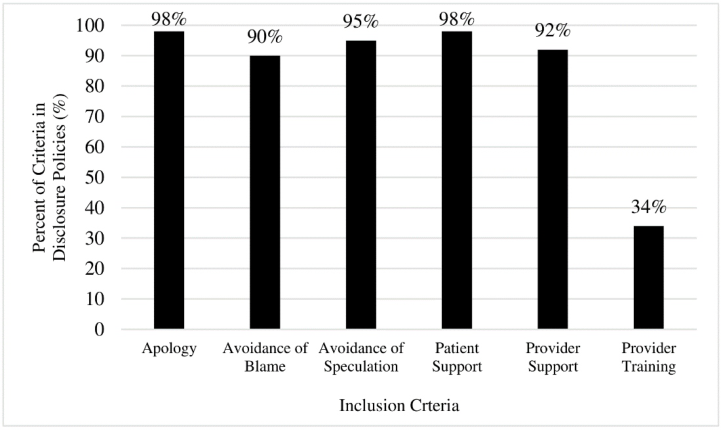
We assessed disclosure policies across Canada using six parameters: an apo- logy or expression of regret, avoidance of blame, avoidance of speculation, support for the patient, support for providers, and training of providers. Across the provinces and territories, the top two criteria found within the disclosure policies include an apology or expression of regret, and patient support, averaging 98%, respectively. The criteria mentioned the least across all health region disclosure policies was provider training, averaging 34% across Canada (Figure 1).
A sincere apology or expression of regret is vital during the disclosure pro- cess. It conveys care and empathy and strengthens the relationship between
Quality Care and Patient Safety: A Best Practice Model for Medical Error Disclosure 109
Figure 1: Percent of inclusion criteria in medical error disclosure policies in all health regions across Canada.
a patient and a physician (Mazor et al. 2013). However, an apology is not an admission of fault or liability and will not be considered within the litigation setting (Canadian Medical Protective Association, 2021). Currently, most Canadian Provinces and Territories except Yukon have adopted variants of the Apology Act (Kalra et al. 2005; Canadian Medical Protective Associa- tion, 2021). Often litigation and its consequences can be minimized with an apology (Peterson et al. 2019). Avoiding blame is a practice in adopting a safety culture within current healthcare institutions.
As an alternative to a culture of safety approach, many organizations have adopted a non-punitive practice of reporting medical errors (Rogers et al. 2017). In this fashion, members at all levels of the organization work colla- boratively to rectify the error and use it as a learning opportunity to bridge gaps within the system. Avoidance of speculation is essential in the disclo- sure process, as only the known facts should be disclosed to the patient, and any further questions can be addressed later once the facts are known. Fai- lure to do so can create unwanted emotional distress for patients and their families (Simanowitz, 1985). Immediate disclosure is a strongly recommen- ded practice within the disclosure process and should be carried out after the patient’s immediate healthcare needs are met. It should also occur as soon as it is medically and emotionally practical for a patient and after a patient consent to participate in the disclosure process (Henry, 2005). If a patient is not competent to participate in the disclosure process, their legally authori- zed medical proxy will participate in the disclosure process. Support for the patient is critical in the disclosure process, as medical errors can significantly affect various areas of a patient’s life. Most notably, it can harm the patient’s health. It can significantly impact the patient and their families emotionally, financially, and socially (Wu et al. 2013).
Some medical errors can lead to long-term disability or death; thus, the effects can be very serious. Support for the provider is imperative during the disclosure process, as it can take a significant emotional toll, and often, they face litigation and damage to their professional reputation (Conway and Weingart, 2009). The Canadian Medical Protective Association (CMPA) recommends seeking emotional support from one’s trusted family, friends, or colleagues (Canadian Medical Protective Association, 2009). Additionally, they recommend seeking support and resources from provincial governing bodies for physicians and the CMPA. Physicians have an ethical and legal obligation to disclose medical errors to patients. However, provider trai- ning appears to be absent in the disclosure policies of several Provinces and Territories, averaging at a low 34%. Provider training on medical error disclosure is a parameter that needs improvement in the Canadian healthcare system. It should be implemented during a physician’s medical education and professional practice (Borz-Baba et al. 2020).
CONCLUSION AND FUTURE DIRECTIONS Providing safe patient care is a significant challenge confronting today’4s healthcare system. The value and significance provided through the develo- pment of a culture of safety cannot be understated. Well-designed patient safety initiatives based on systematic interventions may produce the best results in enhancing the quality of healthcare processes. However, these ini- tiatives need adequate integration with organizational policies as they are developed. There is also a pressing need for uniform, well-defined poli- cies to address the bioethical component of medical errors, particularly the disclosure of errors and emotional issues attached to them.
REFERENCES
Allen-Duck A, Robinson JC, Stewart MW. Healthcare Quality: A Concept Analysis. Nurs Forum. 2017 Oct;52(4): 377–386. doi: 10.1111/nuf.12207. Epub 2017 Apr 13. PMID: 28407249; PMCID: PMC5640472. Bari A, Khan RA, Rathore AW. Medical errors; causes, consequences, emoti-
onal response and resulting behavioral change. Pak J Med Sci. 2016 May- Jun;32(3): 523–8. doi: 10.12669/pjms.323.9701. PMID: 27375682; PMCID: PMC4928391. Borz-Baba C, Johnson M, Gopal V. Designing a Curriculum for the Disclosure of Medical Errors: A Requirement for a Positive Patient Safety Culture. Cureus. 2020;12(2): e6931. Busetti F, Baffoni G, Tocco Tussardi I, Raniero D, Turrina S, De Leo D. Policies
and practice in the disclosure of medical error: Insights from leading coun- tries to address the issue in Italy. Med Sci Law. 2021 Jan;61(1_suppl): 88–91. doi: 10.1177/0025802420979441. PMID: 33591872. Coping with an adverse event, complaint or litigation. Canadian Medical Protective Association; 2009. Available From: www.cmpa-acpm.ca/en/advice- publications/browse-articles/2009/coping-with-an-adverse-event-complaint-or- litigation. Conway JB, Weingart SN. Leadership: assuring respect and compassion to clinicians involved in medical error. Swiss Med Wkly 2009;139:3.
Quality Care and Patient Safety: A Best Practice Model for Medical Error Disclosure 111
Department of Health. Making Amends. London: DoH, 2003. Disclosure of Patient Safety Incidents. Canadian Medical Protective Associ- ation; 2021. Available From: www.cmpa-acpm.ca/en/education-events/good- practices/physician-patient/disclosure-of-patient-safety-incidents. Hannawa AF. Medical error disclosure: a pressing agenda for public health researchers. J Public Health Res. 2012 Oct 31;1(3): 214–5. doi: 10.4081/jphr.2012.e33. PMID: 25170466; PMCID: PMC4140373. Hébert PC, Levin AV, Robertson G. Bioethics for clinicians: 23. Disclosure of medi-
cal error. CMAJ. 2001 Feb 20;164(4): 509–13. PMID: 11233873; PMCID: PMC80781. Helo S, Moulton CE. Complications: acknowledging, managing, and coping with human error. Transl Androl Urol. 2017 Aug;6(4): 773–782. doi: 10.21037/tau.2017.06.28. PMID: 28904910; PMCID: PMC5583051. Heidari A, Razaghi M, Asghari F. Public preferences and attitudes towards the disclosure of medical errors: a survey in Iran. J Med Ethics Hist Med. 2018 Aug 4;11:8. PMID: 31346385; PMCID: PMC6642464. Henry LL. Disclosure of medical errors: ethical considerations for the development
of a facility policy and organizational culture change. Policy Politics & Nurs Pract.2005;6(2):127–34. Institute of Medicine. (2001) Crossing the Quality Chasm: A New Health System for the 21st Century. Washington, DC, National Academy Press. Joint Commission on Accreditation of Healthcare Organization. Comprehensive
Accreditation Manual for Hospitals: The Official Handbook. Chicago, Illinois: JCAHO; 2003. Kaldjian LC, Jones EW, Wu BJ, Forman-Hoffman VL, Levi BH, Rosenthal GE.
Disclosing medical errors to patients: attitudes and practices of physicians and trainees. J Gen Intern Med. 2007 Jul;22(7): 988–96. doi: 10.1007/s11606-007- 0227-z. Epub 2007 May 1. PMID: 17473944; PMCID: PMC2219725. Kalra J. Medical Errors: an introduction to concepts. Clinical Biochemistry 2004; 37: 1043–1051. Kalra J, Massey KL, Mulla A. Disclosure of Errors. Health Affairs 2004; 23:
273–274. Kalra J, Massey KL, Mulla A. Disclosure of Medical Error: Policies and Practice.
Journal of the Royal Society of Medicine. 2005;98(7):307–9. Lawati MHA, Dennis S, Short SD, Abdulhadi NN. Patient safety and safety culture in primary health care: a systematic review. BMC Fam Pract. 2018 Jun 30;19(1):104. doi: 10.1186/s12875-018-0793-7. PMID: 29960590; PMCID: PMC6026504. Mazan JL, Lee MK, Quiñones-Boex AC. American Pharmacists Attitudes and
Behaviors Regarding Medication Error Disclosure. Innov Pharm. 2020 Dec 15;11(4):10.24926/iip.v11i4.3373. doi: 10.24926/iip.v11i4.3373. PMID: 34007660; PMCID: PMC8127122. Mazor KM, Greene SM, Roblin D, et al. More than words: patients’ views on apology and disclosure when things go wrong in cancer care. Patient Educ Couns 2013;90: 341–6. Paterick ZR, Paterick BB, Waterhouse BE, Paterick TE. The Challenges to Transpa-
rency in Reporting Medical Errors. J Patient Saf 2009. Peterson KA, Rutherford M, Drvol D, et al. Disclosure of Adverse Events: A Guide for Clinicians. Pediatr Qual Saf. 2019;4(4): e185. Rogers E, Griffin E, Carnie W, Melucci J, Weber RJ. A Just Culture Approach to
Simanowitz A. Standards, attitudes and accountability in the medical profession.
Lancer. 1985;(2): 546–7. Vaismoradi M, Tella S, A Logan P, Khakurel J, Vizcaya-Moreno F. Nurses’ Adherence to Patient Safety Principles: A Systematic Review. Int J Environ Res Public Health. 2020 Mar 19;17(6):2028. doi: 10.3390/ijerph17062028. PMID: 32204403; PMCID: PMC7142993. Wallis KA. No-fault, no difference: no-fault compensation for medical injury
and healthcare ethics and practice. Br J Gen Pract. 2017 Jan;67(654): 38–39. doi: 10.3399/bjgp17X688777. PMID: 28034949; PMCID: PMC5198606. White AA, Gallagher TH. Medical error and disclosure. Handb Clin Neu- rol. 2013;118: 107–17. doi: 10.1016/B978-0-444-53501-6.00008–1. PMID: 24182370. Will you be sorry for saying “I’m sorry”?. CMPA; 2008. Available from: https://www.cmpa-acpm.ca/en/advice-publications/browse-articles/2008/apol ogy-legislation-in-canada-what-it-means-for-physicians Wu AW. Medical error: the second victim. The doctor who makes the mistake needs help too. BMJ. 2000 Mar 18;320(7237): 726–7. doi: 10.1136/bmj.320.7237.726. PMID: 10720336; PMCID: PMC1117748. Wu AW, Boyle DJ, Wallace G, Mazor KM. Disclosure of adverse events in the United
States and Canada: an update, and a proposed framework for improvement. J Public Health Res. 2013;2(3): e32.
LISTED IN THE AHFE DIGITAL BOOKSTORE CATALOGUE
Explore the complete digital volume
Healthcare and Medical Devices
Read this individual research paper free through the original publisher, or explore the full digital proceedings book.
ISBN 978-1-958651-55-1
Explore this ISBN in the AHFE Bookstore ↗Listed in the July 2026 bookstore catalogue; search by ISBN to confirm current availability · Digital book purchase optional