Jay Kalra, Zoher Rafid-Hamed, Bryan Johnston, Patrick Seitzinger (2024). Patient Centered Care: Medical Error Disclosure Guidelines Across Canada. In: Healthcare and Medical Devices. AHFE Open Access, vol. 130, pp. 78–87. https://doi.org/10.54941/ahfe1004840
1 Department of Pathology and Laboratory Medicine, College of Medicine, University of Saskatchewan, Saskatoon, Canada; Royal University Hospital, Saskatchewan Health Authority, 103 Hospital Drive Saskatoon, Saskatchewan, S7N 0W8, Canada ↗↗↗
2 Department of Pathology and Laboratory Medicine, College of Medicine, University of Saskatchewan, Saskatoon, Canada ↗
3 Department of Pediatrics, College of Medicine, University of Saskatchewan, 103 Hospital Drive, Saskatoon, S7N 0W8, Canada; Jim Pattison Children’s Hospital, Saskatchewan Health Authority, 103 Hospital Drive Saskatoon, S7N 0W8, Canada ↗↗
The quality of healthcare is an emerging concern worldwide. Despite attempts to minimize adverse events and medical errors, the disclosure of medical errors by health professionals remains a significant challenge. We have previously reported that international policies and the Canadian Provincial College of Physicians and Surgeons both encourage the open disclosure of adverse events and have suggested its integration into a ‘no-fault’ model. Disclosure policies can provide a framework and guidelines for appropriate disclosure, leading to practices that are more transparent. The purpose of this study was to review, evaluate, and compare individual policies across Canadian health regions to provide guidelines for the best possible medical error disclosure policy. We evaluated the policies of each health region using the following five criteria (an apology or expression of regret, support for the patient, avoidance of blame, avoidance of speculation, and support for providers) which are considered critical to designing patient centered guidelines for medical error disclosure. The majority of provincial and territorial health regions (7 out of 11) have implemented disclosure policies that include all of the evaluated criteria. In Eastern Canada, more than 90% of the disclosure policies included an apology, patient support, and avoidance of blame, while more than 80% included avoiding speculation and providing support for providers. Similarly, in Western Canada, more than 80% of policies contained an apology, patient support, and avoidance of speculation, while provider support was found in at least 60% of surveyed policies. In Nunavut and the Northwest Territories, all policies contained an apology, patient support, avoidance of speculation, and provider support. On average, health region disclosure policies included an apology (98%), patient support (98%), avoidance of speculation (95%), provider support (92%), and avoidance of blame (90%). Designing best practice error disclosure policy requires integrating many aspects, including bioethics, physician-patient communication, quality of care, and team-based care delivery. We suggest that disclosure practice in Canada move toward a uniform, patient centered approach that addresses errors non-punitively to encourage medical error disclosure, reduce medical errors, and improve patient safety.
Patient Centered Care: Medical Error Disclosure Guidelines Across Canada 79
INTRODUCTION
The quality of health care is an emerging concern worldwide (Abrampah et al. 2018). Despite the efforts of healthcare organizations and providers to improve patient safety and minimize the risk of harm, medical errors remain inevitable. Medical error has been defined as a problem that arises during patient management (Hofer et al. 2000). The Institute of Medicine’s (IOM) report “To Err is Human” described medical errors as a public health risk (Kohn et al. 2000). The report stresses that preventable medical errors are common in medical practice, resulting in the deaths of 98,000 people in United States hospitals annually and costing the nation $17-29 billion in health care, lost income, and other injury-related expenses (Andel et al. 2012). Medical errors contribute to an increase in morbidity and mortality of patients and is speculated to be the 3rd leading cause of death in the United States (Makary and Daniel, 2016), with procedure and drug-related adverse events being the most common. Self-reported survey data has shown that 95% of physicians have witnessed a medical error, and 61% of health care professionals believe errors are a routine part of medical practice (Marsa, 2001). The gravity of medical errors lies in their potential to induce adverse events.
ADVERSE EVENTS AND PATIENT SAFETY An adverse event in healthcare refers to an unintended or unexpected neg- ative outcome that occurs during the provision of medical care (Vaismoradi et al. 2020). Events can range from minor injuries to serious harm or death and occur due to medical errors, system failures, or other causes. Bates et al. define an adverse event as “injuries that result from medical management rather than the underlying disease”(Bates et al. 1997). In any health care pro- cess, exposure to an adverse event is inevitable (Institute of Medicine, 2001; Hughs, 2008). In Canada, the rate varies between 5% and 7.5% (Forster et al. 2003; Baker et al. 2004) and the “Health Care in Canada 2004”report states that about 5.2 million Canadians have experienced a preventable adverse event either in themselves or in a family member (Gagnon, 2004). Baker et al. estimated that hospitalized Canadians have a 7.4% chance of experiencing an adverse event and that 38% of adverse events are preventable (Baker et al. 2004). In 2003, the National Health Service (NHS) declared a “duty of can- dour” whereby healthcare providers must inform patients of adverse events that cause harm (Department of Health, 2003). Recognizing and reporting medical errors are essential for investigating adverse events and identifying avoidable ones. When an avoidable adverse event is recognized, steps can be taken to prevent its recurrence. Thus, disclosure of an adverse event is essential in managing the consequences of medical errors.
Despite various challenges and implications, disclosing medical errors to patients and their families is an essential component of quality health care on both ethical and pragmatic grounds (Guillod, 2013; Coffey et al. 2016). Although studies suggest that disclosing adverse events and discussing details with patients is uncommon (White and Gallagher, 2013), it has been demon- strated that patients desire full disclosure of harmful errors but are concerned that healthcare workers will not do so (Heidari et al. 2018). Honesty and
openness in disclosing medical mistakes reduce the risk of malpractice liti- gation and enhances patient trust in the physician by fulfilling a need that the patient did not expect to be fulfilled (Hébert et al. 2001). When a sit- uation requiring disclosure arises, physicians realize that disclosure should take place. However, they face overwhelming hurdles leading to uncertainty about if and how to disclose errors. A prevailing reluctance to admit medical errors and disclose them to patients and their families exists in the current healthcare system, with past research revealing that approximately three out of four physicians fail to disclose errors to patients (Robbennolt, 2009). This lack of disclosure is attributed to various barriers encountered by physicians when attempting to communicate incidents of medical error.
BARRIERS TO MEDICAL ERROR DISCLOSURE Despite attempts to minimize adverse events and medical errors, the disclo- sure of medical errors by health professionals remains a significant challenge. The disclosure of medical error has traditionally been a balance between an ethical duty to report errors and fear of litigation. The patient’s bill of rights and medical ethics clearly entitles the patient to full disclosure of any medical error incurred during their care. In fact, the disclosure of medi- cal error reduces the risk of malpractice litigation and can restore trust in the physician-patient relationship. Disclosure policies provide a framework and guidelines for appropriate disclosure, leading to practices that are more transparent.
Canada’s current medical error disclosure landscape reflects an increasing emphasis on transparency, accountability, and patient-centered care. Dis- closure policies offer a structured framework and set of guidelines for the proper communication of errors, ultimately contributing to enhanced quality of care and greater transparency within healthcare practices. Policies guid- ing the appropriate disclosure of medical errors limit breaches of trust and safeguard the therapeutic relationship (Edwin, 2009). We have previously reported the Canadian Provincial College of Physicians and Surgeons policies encouraging open disclosure of adverse events and have suggested its integra- tion into a ‘no-fault’ model (Kalra, 2004; Kalra, 2011). The Royal College of Physicians and Surgeons of Canada has endorsed the disclosure of adverse events, including medical errors, to all partners including patients (Davies et al. 2003), but no uniform Canadian guidelines are yet in place. The pur- pose of this study was to review, evaluate, and compare individual policies across Canadian provincial and territorial health regions to provide guide- lines for the best possible medical error disclosure policy. These guidelines aim to align existing provincial and territorial disclosure policies towards standardization, promoting the creation of a uniform, non-punitive medical error disclosure policy.
REVIEW OF DISCLOSURE POLICIES Medical error disclosure policies were requested and obtained from individ- ual health authorities in Canadian Provinces and Territories. Quebec was excluded from the study due to a lack of complete data availability. Requests for the disclosure policies were through email, telephone, or documents from
Patient Centered Care: Medical Error Disclosure Guidelines Across Canada 81
the health authorities’ website. Upon receipt of the disclosure policies, their contents were evaluated based five criteria identified as critical for any med- ical error disclosure policy. The criteria we chose to compare within medical error disclosure policies were: whether an apology was included in the policy, mention of support for the patient, mention of avoidance of blame, mention of provider support, and mention of avoidance of speculation. We have taken the liberty to rank them in order of importance: 1) Expression of regret or apology, 2) Patient Support, 3) Avoidance of Speculation, 4) Avoidance of Blame, and 5) Provider Support. This was done to provide the best guidelines for the development of current and future medical error disclosure policies based on a patient-centered care approach.
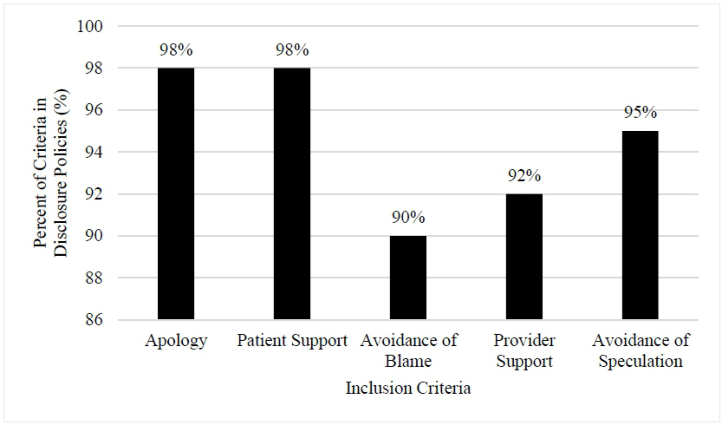
MEDICAL ERROR DISCLOSURE ACROSS CANADA In Canada, most provincial and territorial health authorities (7 out of 11) have implemented policies that follow a patient-centered approach to medical error disclosure (Table 1). These policies include all the necessary compo- nents for effective disclosure: 1) an apology or expression of regret, 2) patient support, 3) avoidance of speculation 4) avoidance of blame, and 5) provider support. In Central and Eastern Canada, more than 90% of the disclosure policies included an apology, patient support, and avoidance of blame, while more than 80% also included avoiding speculation and providing support for healthcare providers. Similarly, in Western Canada, more than 80% of policies contained an apology, patient support, and avoidance of specula- tion, while provider support was found in over 70% of surveyed policies. In Nunavut and the Northwest Territories, all policies contained an apol- ogy, patient support, avoidance of speculation, and provider support. Across Canada, all surveyed policies on average included an apology (98%), patient support (98%), avoidance of blame (90%), provider support (92%), and avoidance of speculation (95%) (Figure 1). Overall, each of the key criteria were included in at least 90% of the policies reviewed across the provinces and territories in Canada.
Table 1. Average percent of each criteria found in the disclosure policies of the health regions in Canadian Provinces and Territories.
Table available in the original PDF paper.
Apology Patient Support
Avoidance of Blame
Patient Support
Avoidance of Speculation Central and Eastern Canada Ontario 91 91 91 91 82 Nova Scotia 100 100 100 100 100 New Brunswick 100 100 100 100 100 Prince Edward Island 100 100 100 100 100 Newfoundland and Labrador 100 100 100 100 100 Western Canada British Columbia 86 86 57 86 86 Alberta 100 100 100 100 100 Saskatchewan 100 100 100 100 100 Manitoba 100 100 80 100 80 Nunavut & Territories Nunavut 100 100 100 100 100 Northwest Territories 100 100 67 100 100
Figure 1: Comparing the frequency of inclusion criteria in medical error disclosure policies in canadian provincial and territorial health regions.
CENTRAL AND EASTERN CANADA DISCLOSURE POLICIES In Central and Eastern Canada, we received policies from the provinces of Ontario, Nova Scotia, New Brunswick, Prince Edward Island, and New- foundland and Labrador. In the Province of Ontario, we received policies from 76% (11/14) of the health regions, also known as Local Health Inte- grated Networks (LHINs). Of the policies we reviewed, 91% included an apology, 91% included patient support, 91% included an avoidance of blame, 82% included provider support, and 82% included avoidance of speculation. None of the policies were accessible through the health region’s websites while 91% included documentation of the disclosure. Ontario is cur- rently undergoing a transition from the previous 14 LHINs, to 50+ health teams across the province (Crawley, 2019). In the Province of Nova Scotia, we received policies from 100% (2/2) of the health regions. Of the policies we reviewed, 100% included an apology, 100% included patient support, 100% included an avoidance of blame, 100% included provider support, and 100% included avoidance of speculation. The policies were accessible through the health region’s websites, and 100% included documentation of the disclosure.
In the Province of New Brunswick, we received policies from 100% (2/2) of the health regions. Of the policies we reviewed, 100% included an apol- ogy, 100% included patient support, 100% included an avoidance of blame, 100% included provider support, and 100% included avoidance of specula- tion. None of the policies were accessible through the health region’s websites while 100% included documentation of the disclosure. Prince Edward Island has a single health authority, and upon reviewing their policy, we found that it covered all five criteria. However, their disclosure policy was not accessible on the health region’s website. In the Province of Newfoundland and Labrador, we received policies from 100% (4/4) of the health regions.
Patient Centered Care: Medical Error Disclosure Guidelines Across Canada 83
Of the policies we reviewed, 100% included an apology, 100% included patient support, 100% included an avoidance of blame, 100% included provider support, and 100% included avoidance of speculation. While 25% of the policies were accessible through the health region’s websites, 100% included documentation of the disclosure.
WESTERN CANADA DISCLOSURE POLICIES In Western Canada, we received policies from the provinces of British Columbia, Alberta, Saskatchewan, and Manitoba. In the Province of British Columbia, we received policies from 100% (5/5) of the health regions. Of the policies we reviewed, 86% included an apology, 86% included patient support, 57% included an avoidance of blame, 71% included provider sup- port, and 86% included avoidance of speculation. While 43% of the policies were accessible through the health region’s websites, 86% included docu- mentation of the disclosure. The Province of Alberta has a single health authority and after reviewing their policy, we found that all five criteria were included in their disclosure policy. Similarly, the Province of Saskatchewan has a single health authority, and their policy covered all the identified cri- teria. In the Province of Manitoba, we received policies from 100% (5/5) of the health regions. Of the policies we reviewed, 100% included an apol- ogy, 100 % included patient support, 80% included an avoidance of blame, 60% included provider support, and 80% included avoidance of specula- tion. While 40% of the policies were accessible through the health region’s websites, 100% included documentation of the disclosure.
NUNAVUT AND TERRITORIES DISCLOSURE POLICIES From the Territories we received policies from Nunavut, the Northwest Ter- ritories, and the Yukon. In Nunavut, there is a single health region, we found that all five criteria were included in their disclosure policy. None of the poli- cies were accessible through the health region’s websites while 100% included documentation of the disclosure. In the Northwest Territories, we received policies from 100% (3/3) of the health regions. Of the policies we reviewed, 100% included an apology, 100% included patient support, 67% included an avoidance of blame, 100% included provider support, and 100% included avoidance of speculation. While 67% of the policies were accessible through the health region’s websites, 100% included documentation of the disclosure. In Yukon, we received feedback stating that their health sector did not have a policy regarding the disclosure of medical errors. However, we were directed to the minimum standards of practices for disclosing harm as a physician (Yukon Medical Council, 2024).
DISCUSSION
Initiating the disclosure of a medical error with an apology or expression of regret is crucial, as it establishes a foundation for a better relationship and serves as a gateway to open and honest discussion. The expression of regret or an apology to the patient and their family stands out as the most significant
component of medical error disclosure policies. The Canadian Patient Safety Institute (CPSI) guidelines indicate that when a patient receives a statement of apology, it often leads to a restoration of the patient-physician trust (Dis- closure Working Group, 2011). The second most important component of a medical error disclosure policy is support for the patient. Following the occur- rence of a medical error, patients are at their most vulnerable, and offering support presents an opportunity to strengthen the patient-physician relation- ship. Patient support is vital because we practice patient- centered care and medical errors can significantly impact the patient and their families emotion- ally, financially, and socially (Wu et al. 2013). Physicians and patients should avoid speculation as it can create unwanted and avoidable strain. Only the known facts should be disclosed to the patient, and any further questions can be addressed later once the facts are known. Failure to do so can cre- ate unwanted emotional distress for patients and their families (Simanowitz, 1985). Avoiding blame is a crucial aspect of providing support for those involved in a medical error. Attributing individual blame can lead to potential malprac- tice litigation, strained patient-physician relationships, and ethical challenges within the healthcare team (Wu et al. 2009; Kadivar et al. 2017). To address this concern, many organizations have adopted a non-punitive practice of reporting medical errors (Rogers et al. 2017). This approach ensures that no individuals are wrongly blamed, aligning with a non-punitive and no-fault model. Lastly, providing support for those involved fosters a culture that is non-punitive and adheres to a no-fault model of care. Unfortunately, health care providers receive limited support after an adverse event (White et al. 2015). CPSI recommends support for anyone involved in an adverse event or its disclosure discussion (Vaismoradi et al. 2020), as the lack of support for healthcare providers can potentially result in similar negative consequences as the lack of support for patients (Koinis et al. 2015).
CONCLUSION AND RECOMMENDATIONS A standardized disclosure policy revolving around candid acknowledgment of medical error using a non-punitive approach is the best way to address medical error. A set of best practice medical error disclosure guidelines encourages accurate reporting of medical errors and improves patient safety. Transparent communication with patients cultivates a comprehensive under- standing of the intricate landscape of medical error in Canada. Quality and patient safety initiatives should be a part of the accreditation process. At the local level, strong leadership supported by organizational commit- ment to improving provider training is essential in improving medical error disclosure. A team-based approach to the disclosure process fosters sup- port and open communication. Subsequently, provider training on medical error disclosure needs improvement in the Canadian healthcare system and ideally should be implemented during a physician’s medical education and professional practice. The provision of training is necessary to avoid the re-occurrence of a medical error and we encourage facilities to develop disclo- sure discussion and training workshops for new and current staff to attend.
Patient Centered Care: Medical Error Disclosure Guidelines Across Canada 85
Increasing the accessibility of disclosure policies to medical staff and the public will lead to greater transparency and help to navigate the complex bioethical considerations involved in the disclosure process. Open and hon- est disclosure should be the standard of care nationwide, becoming a routine aspect of patient-centered care. We suggest practice of disclosure in Canada should transition toward a uniform, patient-centered approach that addresses errors non-punitively, fostering a culture of learning dedicated to reducing errors and enhancing patient safety.
REFERENCES
Allen-Duck A, Robinson JC, Stewart MW. Healthcare Quality: A Concept Analysis.
Nurs Forum. 2017 Oct;52(4): 377–386. doi: 10.1111/nuf.12207. Epub 2017 Apr. 13. PMID: 28407249; PMCID: PMC5640472. Bari A, Khan RA, Rathore AW. Medical errors; causes, consequences, emotional response and resulting behavioral change. Pak J Med Sci. 2016 May- Jun;32(3): 523–8. doi: 10.12669/pjms.323.9701. PMID: 27375682; PMCID: PMC4928391. Abrampah, N. M. et al. (2018) ‘Quality improvement and emerging global health
priorities’, International Journal for Quality in Health Care [Preprint]. Available at: https://doi.org/10.1093/intqhc/mzy007. Andel, C. et al. (2012) ‘The Economics of Health Care Quality and Medical Errors’, Journal of health care finance [Preprint]. Available at: https://doi.org/null. Baker, G. R. et al. (2004) ‘The Canadian Adverse Events Study: the incidence of
adverse events among hospital patients in Canada’, Canadian Medical Association Journal [Preprint]. Available at: https://doi.org/10.1503/cmaj.1040498. Bates, D. W. et al. (1997) ‘The costs of adverse drug events in hospitalized patients.
Adverse Drug Events Prevention Study Group.’, JAMA [Preprint]. Available at: https://doi.org/10.1001/jama.277.4.307. Chamberlain, C. J. et al. (2012) ‘Disclosure of “nonharmful” medical errors and other events: duty to disclose.’, Archives of Surgery [Preprint]. Available at: https: //doi.org/10.1001/archsurg.2011.1005. Coffey, M. et al. (2016) ‘Parent Preferences for Medical Error Disclosure: A Quali-
tative Study’, Hospital pediatrics [Preprint]. Available at: https://doi.org/10.1542/ hpeds.2016-0048. Crawley, M. (2019) ‘How Ontario health care will change with Ford government’s reforms.’, CBC News. Available at: https://www.cbc.ca/news/canada/toron to/what-are-ontario-health-teams-doug-ford-government-1.5035750 (Accessed: 26 January 2024). Davies, J. M., Herbert, P. C. and Hoffman, C. (2003) The Canadian patient safety
dictionary. Edmonton, Alta.; Ottawa, Ont.: Royal College of Physicians and Surgeons of Canada. Department of Health (2003) Making Amends. London: DoH. Disclosure Working Group (2011) Canadian disclosure guidelines: being open and honest with patients and families. Edmonton, AB: Canadian Patient Safety Institute. Edwin, A. K. (2009) ‘Non-disclosure of medical errors an egregious violation of eth-
ical principles.’, Ghana Medical Journal [Preprint]. Available at: https://doi.org/ null. Forster, A. J. et al. (2003) ‘The Incidence and Severity of Adverse Events Affecting Patients after Discharge from the Hospital’, Annals of Internal Medicine [Preprint]. Available at: https://doi.org/10.7326/0003-4819-138-3-200302040- 00007.
Gagnon, L. (2004) ‘Medical errors affect nearly 25% of Canadians’, Can Med Assoc J, 171(123). Guillod, O. (2013) ‘Medical error disclosure and patient safety: legal aspects’, Journal
of Public Health Research [Preprint]. Available at: https://doi.org/10.4081/jphr .2013.e31. Hébert, P. C. et al. (2001) ‘Bioethics for clinicians: 23. Disclosure of medical error’, Canadian Medical Association Journal [Preprint]. Available at: https://doi.org/null. Heidari, A., Razaghi, M. and Asghari, F. (2018) ‘Public preferences and attitudes
towards the disclosure of medical errors: a survey in Iran.’, Journal of medical ethics and history of medicine [Preprint]. Available at: https://doi.org/null. Hofer, T. P. et al. (2000) ‘What is an error’, null [Preprint]. Available at: https://doi.
org/null. Hughs, R. (2008) ‘Nurses at the “Sharp End” of Patient Care – Patient Safety and Quality: An Evidence-Based Handbook for Nurses’, null [Preprint]. Available at: https://doi.org/null. Institute of Medicine (2001) Crossing the Quality Chasm: A New Health System for
the 21st Century. Washington (DC): National Academies Press. Kadivar, M. et al. (2017) ‘Ethical and legal aspects of patient’s safety: a clinical case report.’, Journal of medical ethics and history of medicine [Preprint]. Available at: https://doi.org/null. Kalra, J. (2004) ‘Medical errors: an introduction to concepts’, Clinical Biochemistry
[Preprint]. Available at: https://doi.org/10.1016/j.clinbiochem.2004.08.007. Kalra, J. (2011) Medical errors and patient safety: strategies to reduce and disclose medical errors and improve patient safety. De Gruyter. Kohn, L. T., Corrigan, J. M. and Donaldson, M. S. (2000) ‘To err is human’, null
[Preprint]. Available at: https://doi.org/10.17226/9728. Koinis, A. P. et al. (2015) ‘The Impact of Healthcare Workers Job Environment on Their Mental-emotional Health. Coping Strategies: The Case of a Local General Hospital.’, Health Psychology Research [Preprint]. Available at: https://doi.org/ 10.4081/hpr.2015.1984. Makary, M. A. and Daniel, M. (2016) ‘Medical error—the third leading cause of
death in the US’, BMJ [Preprint]. Available at: https://doi.org/10.1136/bmj.i2139. Marsa, L. (2001) ‘Health-care industry riddled with mistakes, survey shows’, LA Times, 14 May. Robbennolt, J. K. (2009) ‘Apologies and Medical Error’, Clinical Orthopaedics and
Related Research [Preprint]. Available at: https://doi.org/10.1007/s11999-008- 0580-1. Rogers, E. et al. (2017) ‘A Just Culture Approach to Managing Medication Errors.’, Hospital Pharmacy [Preprint]. Available at: https://doi.org/10.1310/hpj5204-308. Simanowitz, A. (1985) ‘Standards, Attitudes and Accountability in the Medical
Profession’, The Lancet [Preprint]. Available at: https://doi.org/10.1016/s0140- 6736(85)90474-x. Vaismoradi, M. et al. (2020) ‘Nurses’ Adherence to Patient Safety Principles: A Systematic Review’, International Journal of Environmental Research and Public Health [Preprint]. Available at: https://doi.org/10.3390/ijerph17062028. White, A. A. et al. (2015) ‘Risk Managers’ Descriptions of Programs to Support
Second Victims after Adverse Events’, Journal of healthcare risk management: the journal of the American Society for Healthcare Risk Management [Preprint]. Available at: https://doi.org/10.1002/jhrm.21169.
Patient Centered Care: Medical Error Disclosure Guidelines Across Canada 87
White, A. A. and Gallagher, T. H. (2013) ‘Medical error and disclosure.’, Handbook of Clinical Neurology [Preprint]. Available at: https://doi.org/10.1016/b978-0- 444-53501-6.00008-1. Wu, A. W. et al. (2009) ‘Disclosing Medical Errors to Patients: It’s Not What You Say,
It’s What They Hear’, Journal of General Internal Medicine [Preprint]. Available at: https://doi.org/10.1007/s11606-009-1044-3. Wu, A. W. et al. (2013) ‘Disclosure of Adverse Events in the United States and Canada: An Update, and a Proposed Framework for Improvement’, Journal of Public Health Research, 2(3), p. jphr.2013.e32. Available at: https://doi.org/10. 4081/jphr.2013.e32. Yukon Medical Council (2024) ‘Disclosure of Harm’. Available at: www.yukonmedicalcouncil.ca/pdfs/Disclosure_of_Harm.pdf (Accessed: 26 January 2024).
LISTED IN THE AHFE DIGITAL BOOKSTORE CATALOGUE
Explore the complete digital volume
Healthcare and Medical Devices
Read this individual research paper free through the original publisher, or explore the full digital proceedings book.
ISBN 978-1-964867-06-9
Explore this ISBN in the AHFE Bookstore ↗Listed in the July 2026 bookstore catalogue; search by ISBN to confirm current availability · Digital book purchase optional