Avani Saxena, Bryan Johnston, Jay Kalra (2024). Improving Quality of Care through Tailored Medical Education in a Pathology Residency Program. In: Human Factors in Design, Engineering, and Computing. AHFE Open Access, vol. 159, pp. 1222–1231. https://doi.org/10.54941/ahfe1005690
Improvements in quality and safety in healthcare and reducing medical errors are imperative. Quality health care is defined as “the degree to which health services for individuals and populations increase the likelihood of desired health outcomes and are consistent with current professional knowledge”. Postgraduate residency training programs are designed for residents to acquire competence through workplace-based clinical care provision and academic learning. Academic teaching helps consolidate basic and applied knowledge for quality patient care. Residency programs in Pathology, one of which is “Diagnostic and Clinical Pathology” aimed at general competence in clinical and laboratory medicine is heavily influenced by the changing landscape of practice and emerging technologies. Within the Diagnostic and Clinical Pathology residency program specifically, the best pedagogical approach to delivering academic (classroom-based) teaching to promote quality care, reduce medical errors, prepare for digital literacy and promote resource stewardship remains unclear. This study measured residents' perceptions of course satisfaction, ability to meet learning objectives and future clinical application across courses offered in three different pedagogical approaches (an introductory "Boot Camp" course utilizing traditional didactic lectures, interactive case-based sessions, and asynchronous learning based on pre-developed Modules). Specific topics related to quality care- among other topics – included, utilization, role as a laboratory professional, medical error, quality and safety, and self-efficacy of practicing required behaviors. Clinical scenarios, such as acetaminophen poisoning, provided a scaffolding for learning these aspects. Kirkpatrick level 1 “Reaction” was evaluated across satisfaction, engagement, perceived relevance and usefulness, emotional response and immediate feedback through a survey (10 questions for satisfaction, 7 for achievement of learning objectives, 1 for usefulness for clinical application and open-ended comments). Descriptive statistics were used for reporting quantitative data and key quotes/themes were extracted from the narrative comments. For all three teaching methods, most residents agreed that sessions were satisfactory (>80%), had met learning objectives (>75%), and were comfortable applying material for clinical applications (80%) The interactive case-based sessions scored highest, averaging 91%, 86% and 100% respectively in these three categories. Didactic teaching sessions and pre-developed modules had a wider range of disagreement amongst the residents, specifically related to time, opportunities for discussion and achievement of learning objectives. Open-ended responses highlighted case-based teaching as “bridging the gap between theoretical knowledge and clinical application” and articulated the need for more case-based teaching. While all three methods were well-received and met expectations, our study suggests that a difference may exist between pedagogical approaches to improve quality care. The boot camp provided foundational knowledge; the interactive cases consolidated learning, and the modules highlighted clinical relevance and applicability. Recognizing that most medical errors result from system and process issues and the centrality of high quality medical education to safe care, utilizing different modalities for academic teaching (across the system and emphasizing current and emerging topics) to complement workplace-based learning for deep and practical knowledge is essential for teaching Pathology residents. Future studies with a larger sample size and additional measures of engagement are needed to assess if an interactive case-based approach is a superior educational strategy.
Improving Quality of Care Through Tailored Medical Education 1223
INTRODUCTION
Improvements in quality and safety in healthcare and reducing medical errors are imperative (Kalra, Kalra, and Baniak, 2013). Quality health care is defined as “the degree to which health services for individuals and populations increase the likelihood of desired health outcomes and are consistent with current professional knowledge” (Lohr and Schroeder, 1990). The importance of integrating Human Factors and Ergonomics with quality improvement approaches to improve safe care are well-recognized (Hignett et al., 2015). Postgraduate residency training programs are designed for residents to acquire competence through workplace-based clinical care provision and academic learning. Academic teaching helps consolidate basic and applied knowledge for quality patient care (McGaghie et al., 2024). Residency programs in Pathology, one of which is Diagnostic and Clinical Pathology, aimed at general competence in clinical and laboratory medicine is heavily influenced by the changing landscape of practice and emerging technologies. Within the Diagnostic and Clinical Pathology residency program specifically, the best pedagogical approach to delivering academic (classroom-based) teaching to promote quality care, reduce medical errors, prepare for digital literacy and promote resource stewardship remains unclear.
Postgraduate residency programs utilize a number of teaching and learning methods spanning workplace-based learning experiences and academic sessions. Academic sessions are offered either through academic half days once a week or sessions dispersed throughout the week (Chen et al., 2015; Chen et al., 2023). These include didactic lectures or short presentations on key topics by both faculty members and residents, discussion of topics based upon cases (case-based learning) in a small group learning format (Armson et al., 2020), self-directed learning through modules (asynchronous learning) developed on specific topics, and introductory Boot Camp sessions at the beginning of the residency.
Traditional didactic lecture-based learning is predominantly concerned with knowledge transfer and acquisition (Vella, 1992). It has many limitations, such as a) its dependence on memorization of a vast amount of information (Tang et al., 2017), b) constraints of learners including memory (Fry, Ketteridge, and Marshal, 2009) and attention span (Binder, Haughton, and Van Eyk, 1990), c) teacher-centricity and scant opportunities for interactions between teachers and learners (Cendan, Silver, and Ben- David, 2011), and d) questionable development of critical thinking and decision-making skills (Haidet et al., 2004; Downar et al., 2017). Active learning with more active participation by learners through a number of modalities enhances learning (Svinicki, 1999). Active learning can take many forms including self-directed learning, case-based learning, problem- based learning, and collaborative and cooperative learning. Active learning is being increasingly utilized in residency training programs (Zakrajsek and Newton, 2021). Asynchronous review by learners of the content developed and subsequently facilitated by teachers is one form of self- directed learning (Robinson and Persky, 2020) and has been increasingly
utilized in online teaching. Self-directed learning is conducive to learners retaining responsibility (Charokar and Dulloo, 2022) and is considered particularly helpful in developing life-long learning skills. Case-based learning utilizes clinical cases, which permits simultaneous construction of knowledge and application to solving clinical issues (Thistlethwaite et al., 2012). It is especially useful for development of clinical reasoning and critical thinking (Van Gog et al., 2005). A few studies have shown that case-based teaching/learning is better than didactic lectures, e.g., in pharmacology (Jain et al., 2023), physiology (Dave, Kumar, and Sadariya, 2022), medical oncology (Bi et al., 2019), and through a meta-analysis of teaching methods in medical education (Maia et al., 2023). Case-based learning improves critical thinking and expert clinical reasoning (Chen et al., 2015). The landscape of clinical and laboratory medicine residency training in Canada is changing. The Royal College of Physicians and Surgeons recently changed the General Pathology program title to Diagnostic and Clinical Pathology (DCP). This better reflects pathologists’ role in delivering care and draws attention to the changing needs of trainees. Quality improvement initiatives are captured in accreditation standards. The Diagnostic and Clinical Pathology residency training program in Canada is in accordance with the requirements of the Royal College of Physicians and Surgeons of Canada (RCPSC). The RCPSC has adopted the principles of competency-based medical education (CBME) into its Competence-By- Design (CBD) framework. As a mode of education, CBD is governed by competencies, accreditation standards, training experiences, and the Pathway to Competence document for the discipline (RCPSC, 2024). There are four stages of training: Transition to Discipline, Foundations, Core, and Transition to Practice. The first two are usually completed within the first year and the last stage in approximately the last six months of training. There are multiple subspecialty areas within the program, including Anatomic Pathology (now called Diagnostic and Molecular Pathology), Hematopathology, Medical Microbiology, and Medical Biochemistry, each with its defined competencies. The program utilizes both workplace learning and academic teaching.
While there are reports of teaching practices in pathology (Koch, Chang, and Dintzis, 2021; Sinha, 2021; Carnevale et al., 2024), a review of existing literature showed that there is no single educational strategy for teaching medical residents in the Diagnostic and Clinical Pathology residency program and that the most effective pedagogical approach for academic teaching remains unclear. The overall purpose of this project was to inform the way forward to enhance academic teaching and learning. This study, confined to teaching in Medical Biochemistry and utilizing Kirkpatrick’s framework, evaluated resident perceptions of three modes of academic teaching - traditional didactic lecture-based teaching, case-based teaching, and asynchronous module-based teaching.
Improving Quality of Care Through Tailored Medical Education 1225
METHODS
The Diagnostic and Clinical Pathology residency program at the University of Saskatchewan, in Saskatchewan, Canada is a five-year program that selects two residents per year following a national resident-matching process. The aim of the program is to educate, support, and mentor residents to become competent laboratory physicians with the skills to handle the wide variety of challenges posed in Pathology and Laboratory Medicine practice. The training is offered across multiple distributed sites, providing experience in both Anatomical Pathology and all laboratory services (Biochemistry, Hematopathology, Microbiology, and Transfusion Medicine). The content for each of the three teaching methods (traditional didactic lectures, case- based sessions and modules) was developed based on the curricular objectives outlined within the Diagnostic and Clinical Pathology program. The three teaching methods were evaluated as a part of a targeted needs assessment based on Kern’s 6-step approach to focus on the specific needs of the residents participating in the curriculum (Thomas et al., 2022).
There were nine residents (two second-year, three third-year, two fourth- year and two in the final fifth-year), with a gender ratio (7 male: 2 female). Eight residents were in their core stage of training and one in Foundations.
The data was collected over a period of 3 weeks in 2023. The focus of this study was level 1 (reaction) of residents to the three modes of teaching. The survey was based on the components evaluated in Kirkpatrick’s level 1 (satisfaction, engagement, perceived relevance and usefulness, emotional response and immediate feedback) (Kirkpatrick and Kirkpatrick, 2007). A survey was developed to evaluate residents’ satisfaction (10 questions), achievement of learning objectives (7 questions), and usefulness for clinical application (1 question) through structured questions. A five-point Likert scale (strongly disagree, disagree, neutral, agree, and strongly agree for satisfaction and learning objectives; very uncomfortable, uncomfortable, neither comfortable nor uncomfortable, comfortable, and very comfortable for usefulness for clinical application) and open-ended responses were used. The open-ended comments were guided by three questions (main takeaway, what would you change, and any additional comments). The specific survey instruments are provided below.
Survey Instrument: Participant Satisfaction
1. The information was presented clearly 2. The course was well organized 3. The information was relevant 4. The cases were useful 5. Overall, I was satisfied with this course 6. The time allotted to complete this course was just right 7. The facilitators used effective teaching methods 8. I was given ample opportunity to have my questions answered 9. Sufficient time was allotted for interaction 10. The presentations were free of any commercial bias
Learning objectives
1. I can recognize the potential obstacles to applying this information 2. I can describe the core elements of my learnings 3. I can apply these knowledge and principles into managing patients and offering consultations 4. I can describe the strategies for dealing with inappropriate utilization 5. I understand how I can help my colleague’s decision making 6. I understand my role as a laboratory professional Usefulness for clinical application
1. Overall, how comfortable do you feel when applying this information in clinical practice?
Open-ended narrative comments:
1. What is your main take away you hope to incorporate into your clinical practice? 2. Is there anything you would change about (how information was presented, what information was included, the use of case scenarios, additional information you would like included)? 3. Do you have any additional comments?
Quantitative Likert scale data was analyzed by descriptive statistics. A composite score based on specific survey questions was generated for each teaching method. Themes were identified from the narrative comments.
RESULTS
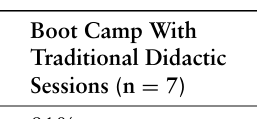
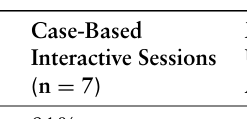
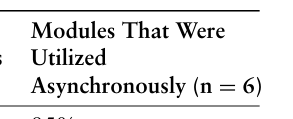
The overall findings regarding satisfaction, achievement of objectives, and usefulness for clinical applicability are shown in Table 1. Residents perceived all three types of teaching methods favorably (satisfaction: >80%, achievement of learning objectives: >75% and usefulness for clinical applications: >80%). Case-based interactive sessions received the highest ratings.
Table 1. Overall findings on satisfaction, learning objectives and clinical application of the three teaching methods. The percentages reflect total responses in “strongly agree” and “agree” categories.
Table available in the original PDF paper.
Equation reproduced from the original PDF.Equation reproduced from the original PDF.Equation reproduced from the original PDF.
76% 86% 81%
Satisfaction 81% 91% 85% Achievement of learning objectives
86% 100% 83%
Usefulness for clinical application
Most residents were satisfied (“agree” or “strongly agree” with the questions asked) with the three pedagogical methods. The residents had a diverse range of opinions for the Boot Camp question on “time allotted
Improving Quality of Care Through Tailored Medical Education 1227
for the course” with one “strongly disagree” and two “neutral” responses. For case-based discussions, “ample opportunity to have questions answered” received one “strongly disagree” response. There were no responses in the “strongly disagree” or “disagree” categories for the modules.
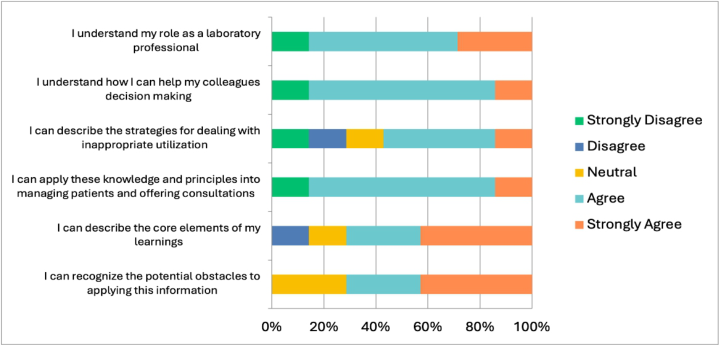
Most responses were in the categories of “agree” or “strongly agree” for the six questions exploring this topic. None of the residents had any response in the “strongly disagree” or “disagree” categories for case-based sessions or modules. The Boot Camp session scored lowest in achieving learning objectives among the different pedagogical methods. Figure 1 shows the percent agreement across the individualized learning objectives to highlight areas of disagreement. Of note, the objective “I can describe the strategies for dealing with inappropriate utilization” had the highest level of disagreement.
Figure 1: Comparison of percent agreement across individualized learning objectives within the Boot Camp teaching session (didactic teaching).
All residents were comfortable with applying the information to clinical settings (86% comfortable, 14% very comfortable) based on the learning through case-based teaching. However, both the Boot Camp and the modules had one “strongly disagree” response (approximately 14%).
The main take away responses reflected knowledge acquisition from each of the teaching methods, (e.g., “provide the fundamental knowledge, quickly acquire essential biochemistry knowledge and skills…”in the didactic sessions, “approach to problem solving and basic approach to managing laboratory issues”) through case-based teaching, and (“consolidating personal learning and bridging various disciplines and learning of specific high-yield topics”) through review of modules. Case-based teaching was highly favored as reflected in the comment, “bridging the gap between theoretical knowledge and clinical application.” Additional comments highlighted that case-based teaching should be utilized more for academic sessions.
DISCUSSION
While the residents were satisfied with all three approaches of teaching (didactic, case-based, and asynchronous utilization of pre-developed modules), case-based interactive sessions scored the highest for satisfaction, achievement of objectives, and usefulness for clinical applications. The disagreement noted in the residents’ satisfaction with the time allotted to complete the Boot Camp and the time given to have questions answered in the case-based sessions is likely reflective of the premium placed on time in teaching medical education. Within the Boot Camp session, it is particularly informative that residents reported disagreement with “I can describe the strategies for inappropriate test utilization”since test utilization and resource stewardship are of critical importance to Pathology and Laboratory Medicine practice.
Although pathology teaching practices have been reported in the literature (Koch, Chang, and Dintzis, 2021; Sinha, 2021; Carnevale et al., 2024) in our thorough review of the published peer-reviewed literature, we were not able to identify best pedagogical practices in the DCP residency program. Since quality improvement is embedded in accreditation standards, we undertook this study to determine resident perceptions of three teaching methods. Residents identified that the three teaching methods contributed differently to their learning. Didactic lectures helped with gaining foundational knowledge. Interactive cases were important for consolidating learning, developing clinical reasoning, and practical problem solving. The asynchronous biochemistry modules were important for furthering clinical relevance and clinical applicability. The differences amongst the responses, likely reflect a combination of learner factors (e.g., motivation (Wu, Zheng, and Guo, 2020), preferred learning styles (Loo, 2004), opportunities for experiential learning (Yarley, Teunissen, and Dornan, 2012), stage in the model of adult skill development (Pena, 2010), appropriateness of content and its presentation (Ruiz et al., 2006) and facilitator skills (McLean, 2003).
Case-based learning, a form of active learning, utilizes real or simulated clinical cases and helps learners in both consolidation of knowledge and development of skills for clinical applicability through expert facilitation (Thistlethwaite et al., 2012). Its usefulness for development of clinical reasoning and critical thinking (Van Gog et al., 2005) and its effectiveness has been shown extensively (Chen et al., 2015; Jain et al., 2023; Dave, Kumar, and Sadariya, 2022; Bi et al., 2019; Maia et al., 2023). This method allows learners to take initiatives in solving the problems embedded in the cases (Armbruster et al., 2009). Our finding of a high rating of achievement of learning objectives is in keeping with this method’s focus on learning outcomes (Tang et al., 2017; Cendan, Silver, and Ben-David, 2011).
The comment by one of the participants, “bridging the gap between theoretical knowledge and clinical application” highlights this method’s utility in linking basic science to clinical practice (Beech and Domer, 2002). A unanimous perception of the residents for its usefulness for clinical applications most likely reflects case-based teaching’s importance for developing clinical reasoning (Anderson and Helberg, 2007) and
Improving Quality of Care Through Tailored Medical Education 1229
understanding of underlying mechanisms (Ferguson, 2006). A relatively recent meta-analysis of case-based teaching in undergraduate medical education also identified a high level of “interest and motivation” amongst the learners (Maia et al., 2023), which would contribute to participation in academic sessions and increase receptivity to learning. This method also offers an opportunity for enhancing interpersonal professional relationships between learners and teachers. However, case-based teaching also has some disadvantages, e.g., more time requirement for preparation for case discussions (Doran et al., 2011), which may contribute to stress in an already highly stressful environment of residency education.
CONCLUSION
Overall, these three methods within the DCP residency program were both well-received and met expectations. A high level of satisfaction with all three methods indicates that these proven educational pedagogies are useful for learning. Our findings suggest that a difference may exist between pedagogical approaches. Each teaching session had its strengths: the resident Boot Camp provided foundational knowledge, the interactive cases consolidated learning, and the biochemistry modules highlighted clinical relevance and applicability. A strategic approach to integration of these methods is likely to help with construction of knowledge and clinical decision-making (Graffam, 2007). Our study was limited to Kirkpatrick level 1 data, a small sample size, and descriptive statistics of central tendency. Future studies with a larger sample size and additional measures of engagement are needed to assess if an interactive case-based approach is a superior educational strategy.
REFERENCES
Armbruster P, Patel M, Johnson E, Weiss M. Active learning and student-centered pedagogy improve student attitudes and performance in introductory biology. CBE Life Sci Educ. 2009;8(3): 203–13. Armson H, Wycliffe-Jones K, Mackay MP, Roder S. Academic Half-Days: Facilitated
Small Groups to Promote Interactive Learning. Family medicine. 2020;52(1): 53–64. Anderson SM, Helberg SB. Chart-based, case-based learning. S D Med. 2007;60(10):391, 3, 5, 7, 9. Beech DJ, Domer FR. Utility of the case-method approach for the integration of clinical and basic science in surgical education. Journal of cancer education : the official journal of the American Association for Cancer Education. 2002;17(3): 161–4. Binder C, Haughton E, Van Eyk D. Increasing Endurance by Building Fluency:
Precision Teaching Attention Span. TEACHING Exceptional Children. 1990;22(3): 24–7. Bi M, Zhao Z, Yang J, Wang Y. Comparison of case-based learning and traditional method in teaching postgraduate students of medical oncology. Medical Teacher. 2019;41(10): 1124–8.
Carnevale K, Saxena R, Talmon GA, Lin A, Padilla O, Kreisle RA. Pathology teaching in different undergraduate medical curricula within and outside the United States: a pilot study. Academic pathology. 2024;11(1):100102. Cendan JC, Silver M, Ben-David K. Changing the student clerkship from traditional
lectures to small group case-based sessions benefits the student and the faculty. Journal of surgical education. 2011;68(2): 117–20. Charokar K, Dulloo P. Self-directed Learning Theory to Practice: A Footstep towards the Path of being a Life-long Learne. J Adv Med Educ Prof. 2022;10(3): 135–44. Chen LYC, McDonald JA, Pratt DD, Wisener KM, Jarvis-Selinger S. Residents’ Views
of the Role of Classroom-Based Learning in Graduate Medical Education Through the Lens of Academic Half Days. Academic Medicine. 2015;90(4). Chen LYC, Quach TTT, Dayan R, Giustini D, Teunissen PW. Academic half days, noon conferences and classroom-based education in postgraduate medical education: a scoping review. CMAJ Open. 2023;11(3): E411. Dave US, Kumar A, Sadariya BR. Comparison of case-based learning with didactic
lectures in undergraduate physiology curriculum. National Journal of Physiology, Pharmacy and Pharmacology. 2022;12(11): 1821–4. Doran J, Healy M, McCutcheon M, O’Callaghan S. Adapting Case-Based Teaching to Large Class Settings: An Action Research Approach. Accounting Education. 2011;20: 245–63. Downar J, McNaughton N, Abdelhalim T, Wong N, Lapointe-Shaw L, Seccareccia D,
et al. Standardized patient simulation versus didactic teaching alone for improving residents’ communication skills when discussing goals of care and resuscitation: A randomized controlled trial. Palliat Med. 2017;31(2): 130–9. Ferguson KJ. Beyond multiple-choice questions: Using case-based learning patient questions to assess clinical reasoning. Med Educ. 2006;40(11):1143. Fry H, Ketteridge S, Marshall S. A handbook for teaching and learning in higher
education : enhancing academic practice. 3rd ed. New York London: New York, London : Routledge; 2009. Graffam B. Active learning in medical education: Strategies for beginning implementation. Medical Teacher. 2007;29(1): 38–42. Haidet P, Morgan RO, O’Malley K, Moran BJ, Richards BF. A controlled trial of active versus passive learning strategies in a large group setting. Advances in health sciences education : theory and practice. 2004;9(1): 15–27. Hignett, S., Jones, E. L., Miller, D., Wolf, L., Modi, C., Shahzad, M. W., Buckle, P.,
Banerjee, J., & Catchpole, K. (2015). Human factors and ergonomics and quality improvement science: integrating approaches for safety in healthcare. BMJ quality & safety, 24(4), 250–254. Jain S, Paliwal A, Kashyap G, Shoaib M. Case based learning vs traditional didactic lectures as a teaching-learning method in Pharmacology. Journal of Population Therapeutics and Clinical Pharmacology. 2023;30(18): 425–32. Kalra J, Kalra N, Baniak N. Medical error, disclosure and patient safety: A global
view of quality care. Clin Biochem 2013; 46(13-14): 1161–9. Kirkpatrick DL, Kirkpatrick JD. Implementing the four levels: A practical guide for effective evaluation of training programs. San Francisco: Berrett-Koehler Publishers, Inc.; 2007. Koch LK, Chang OH, Dintzis SM. Medical Education in Pathology: General
Concepts and Strategies for Implementation. Arch Pathol Lab Med. 2021;145(9): 1081–8. Lohr KN, Schroeder SA. A Strategy for quality assurance in Medicare. N Engl J Med.
1990;322(10): 707–12.
Improving Quality of Care Through Tailored Medical Education 1231
Loo R. Kolb’s learning styles and learning preferences: is there a linkage? Educ Psychol-Uk. 2004;24(1): 99–108. Maia D, Andrade R, Afonso J, Costa P, Valente C, Espregueira-Mendes J. Academic
Performance and Perceptions of Undergraduate Medical Students in Case-Based Learning Compared to Other Teaching Strategies: A Systematic Review with Meta-Analysis. Education Sciences [Internet]. 2023; 13(3). McGaghie WC, Barsuk JK, Wayne DB, Issenberg SB. Powerful medical education improves healthcare quality and return on investment. Med Teach 2024; 46(1): 46–58. McLean M. What can we learn from facilitator and student perceptions of facilitation
skills and roles in the first year of a problem-based learning curriculum? BMC medical education. 2003;3(1):9. Peña A. The Dreyfus model of clinical problem-solving skills acquisition: A critical perspective. Medical Education Online. 2010;15(1):4846. RCPSC. Information by Discipline General Pathology Ottawa, ON: The Royal College of Physicians and Surgeons of Canada; [Available from: https://www.royalcollege.ca/en/standards-and-accreditation/information- by-discipline?specialty=royal-college%3Aibd%2Fspecialty%2Fgeneral- pathology&subspecialty=&special-program=&afc-diploma=. Robinson JD, Persky AM. Developing Self-Directed Learners. Am J Pharm Educ.
2020;84(3):847512. Ruiz Md Facp JG, Mintzer MJ, Issenberg SB. Learning objects in medical education.
Medical Teacher. 2006;28(7): 599–605. Sinha. S. Enhancing pathology learning for medical students – via blended learning by clinicians [version 1] MedEdPublish. 2021;10(82). Svinicki MD. New Directions in Learning and Motivation. New directions for
teaching and learning. 1999;1999(80): 5–27. Tang F, Chen C, Zhu Y, Zuo C, Zhong Y, Wang N, et al. Comparison between flipped classroom and lecture-based classroom in ophthalmology clerkship. Med Educ Online. 2017;22(1):1395679. Thistlethwaite JE, Davies D, Ekeocha S, Kidd JM, MacDougall C, Matthews P, et al.
The effectiveness of case-based learning in health professional education. A BEME systematic review: BEME Guide No. 23. Med Teach. 2012;34(6): e421-44. Thomas PAe, Kern DEe, Hughes MTe, Tackett SAe, Chen BYe, Ebsco v. Curriculum development for medical education : a six-step approach. Fourth edition.. ed2022. van Gog T, Ericsson KA, Rikers RMJP, Paas F. Instructional design for advanced
learners: Establishing connections between the theoretical frameworks of cognitive load and deliberate practice. Educational Technology Research and Development. 2005;53(3): 73–81. Vella F. Medical education: capitalizing on the lecture method. Faseb J. 1992;6(3): 811–2. Wu H, Li S, Zheng J, Guo J. Medical students’ motivation and academic performance:
the mediating roles of self-efficacy and learning engagement. Med Educ Online. 2020;25(1):1742964. Yardley S, Teunissen PW, Dornan T. Experiential learning: AMEE Guide No. 63.
Medical Teacher. 2012;34(2): e102-e15. Zakrajsek T, Newton WP. Promoting Active Learning in Residency Didactic Sessions.
2021.
LISTED IN THE AHFE DIGITAL BOOKSTORE CATALOGUE
Explore the complete digital volume
Human Factors in Design, Engineering, and Computing
Read this individual research paper free through the original publisher, or explore the full digital proceedings book.
ISBN 978-1-964867-35-9
Explore this ISBN in the AHFE Bookstore ↗Listed in the July 2026 bookstore catalogue; search by ISBN to confirm current availability · Digital book purchase optional