Jay Kalra, Bryan Johnston (2025). Artificial Intelligence Revolution in Healthcare: Enhancing Clinical Practice with a New Member of the Team. In: Artificial Intelligence and Social Computing. AHFE Open Access, vol. 163. https://doi.org/10.54941/ahfe1006206
Artificial intelligence (AI) is a relatively new medical resource with the potential to revolutionize current practices in the prevention and treatment of disease. AI has been defined as computer programs accomplishing tasks traditionally associated with human intelligence such as learning and solving problems. As the ethical benefits of increased efficiency and productivity of AI systems are being realized, the consequences of implementing such transformative technologies has raised ethical and regulatory questions across the globe. AI represents a tool to address longstanding issues in healthcare delivery and can achieve a caliber of healthcare quality that was previously beyond our grasp. However, AI systems may incorporate and often amplify existing patterns of practice, including societal biases and inequitable healthcare practices. Surmounting these ethical and regulatory challenges represents the next frontier in the successful implementation of AI to promote human development and wellbeing. In this study, we examined the current literature and analyzed the scope of practice around the ethical and regulatory issues surrounding AI in medicine and its application to healthcare. Knowledge integration was performed across disciplines relevant to the potential role for AI in facilitating progress, innovation, and quality assurance in healthcare. Thematic analysis was conducted on qualitative data pertaining to both ethical and regulatory challenges concerning the implementation of AI into healthcare practices. The project provided exposure to the innovative field of AI and various strategies related to ethical issues, regulatory laws, quality improvement, and healthcare management. We explored both the reliability and current limitations of AI in order to create best practices guidelines designed to facilitate the successful incorporation of AI into healthcare fields. Ethical challenges of AI such as risk management, data security, and a lack of transparency span all sectors working to implement these new technologies. All medical disciplines working to leverage the potential applications of AI struggle with the ethical challenges of informed consent, autonomy, accountability, biases, and equitable healthcare delivery. The field of laboratory medicine and pathology was a pioneer in the implementation of AI technology. Laboratory medicine and pathology face additional hurdles when ensuring accurate interpretation of results such as unequal contexts, opportunity costs, and low levels of acceptable risk and uncertainty. Rather than an all-or-nothing approach, we suggest a stepwise, transparent, and patient-centered approach with clear boundaries to the incorporation of new tools. The AI-assisted era of medical care will be transformative but will never be void of all risk or ethical challenges. This work represents the first of many steps in using AI technology to optimize healthcare delivery in a way that protects and strengthens the ethical values of medical care.
INTRODUCTION - GLOBAL LANDSCAPE OF AI IN HEALTHCARE Artificial Intelligence (AI) has emerged as a powerful and transformative tool in healthcare over the past several years (Bekbolatova et al., 2024). The implementation of AI in healthcare represents a complex integration of a multimodal tool capable of analyzing vast amounts of data to improve patient outcomes (Dixon et al., 2024; Elhaddad and Hamam, 2024). AI is defined as computer programs that accomplish tasks traditionally associated with human intelligence, such as learning and problem-solving. As diagnostic tools like AI and machine learning have entered the realm of clinical practice, they have created unique opportunities for healthcare systems to optimize their paths forward. In modern healthcare, time and attention are often in limited supply and administrative tasks, information gathering, and documentation have been cited as reasons for the diminishing focus on the humanistic aspects of patient care (Kalra and Seitzinger, 2022, 2023). AI may offer an opportunity to alleviate some of the strains on our healthcare system, allowing us to concentrate on the elements of clinical care that are distinctly humanistic (Jotterand and Bosco, 2022). Effective medical practice requires the availability of data, the application of information, and appropriate clinical judgment (Bekbolatova et al., 2024).
Artificial intelligence is transforming healthcare globally, making profound impacts on diagnostic tools, decision support systems, treatment personalization, public health, and predictive modelling (Pinto-Coelho, 2023; Bhandari, 2024). It has become a significant medical resource with the potential to revolutionize current practices in disease prevention and treatment. For instance, in diagnostics, AI systems can analyze medical images, such as X-rays, MRIs, and CT scans, to detect abnormalities like tumours or fractures with high accuracy and speed (Pinto-Coelho, 2023; Umapathy et al., 2023). This capability significantly enhances diagnostic precision and accelerates the identification of medical conditions, improving patient outcomes and streamlining healthcare processes.
Additionally, AI-powered patient monitoring tools offer real-time health tracking, providing continuous oversight and ensuring timely responses to changes in a patient’s condition (McKee and Wouters, 2022).
While AI holds immense potential, it must complement human intelligence rather than replace it. Machines and technologies are becoming integral members of healthcare teams, contributing to multidisciplinary collaboration and enhancing the overall quality of care (Jeyaraman et al., 2023). This human-centric perspective reinforces the need for rigorous evaluation, continuous oversight, and adherence to ethical principles to ensure AI’s role in healthcare remains beneficial and sustainable (Ouanes and Farhah, 2024). This study explores the revolutionary potential of AI in healthcare by examining its impact on clinical decision-making, operational efficiencies, and the ethical and regulatory challenges it presents. By addressing biases, data security, and the need for transparency, the research aims to provide insights and strategies for successfully integrating AI into healthcare systems, ultimately enhancing patient outcomes and trust in medical practices.
Artificial Intelligence Revolution in Healthcare: Enhancing Clinical Practice 201
ETHICAL AND REGULATORY CHALLENGES FOR AI WORKFLOW INTEGRATION The ethical challenges of implementing AI in healthcare are multifaceted, particularly in high-stakes decision-making where the consequences directly affect patient outcomes. AI systems must be designed and used responsibly, supported by robust risk management frameworks to ensure that errors and adverse events are minimized (Ferrara et al., 2024; Labkoff et al., 2024). This is especially crucial in areas such as diagnostics and treatment planning, where AI recommendations can have life-altering implications. Transparent processes for evaluating AI’s reliability and performance are vital for maintaining patient safety and trust. Informed consent and patient autonomy are critical ethical considerations in using AI technologies. Patients have the right to understand how AI systems are utilized in their care, including the role these systems play in decision-making processes. Clear communication about the benefits, risks, and limitations of AI tools is essential for ensuring that patients can make informed decisions about their treatment (Pruski, 2024). Respecting patient autonomy also involves ensuring that AI complements, rather than replaces, the clinical judgment of healthcare providers.
Regulatory compliance is a major hurdle in AI deployment. Different countries impose varied laws and standards, complicating cross-border AI adoption (Palaniappan et al., 2024). The European Union’s AI Act, the U.S. FDA’s AI/ML guidelines, and Canada’s Artificial Intelligence and Data Act (AIDA) require AI applications in healthcare to emphasize transparency, safety, and accountability (Harvey and Gowda, 2020; Aboy, Minssen and Vayena, 2024; Canadian Medical Protective Association (CMPA, 2024). Data security is a primary concern, as AI relies on vast amounts of sensitive patient data. Compliance with privacy regulations is critical to protecting patient confidentiality. Establishing data governance, encryption, and access control protocols mitigates risks associated with AI-driven healthcare (Chen and Esmaeilzadeh, 2024). To ensure AI’s safe deployment, regulatory bodies must define liability in AI-assisted decisions. Standardized evaluation criteria should be developed to ensure AI tools meet safety and efficacy benchmarks before widespread adoption.
OVERCOMING SYSTEMIC BARRIERS ON AI IN HEALTHCARE Thematic analysis of current literature reveals that transparency, biases, and equitable application are recurring ethical challenges in the implementation of AI in healthcare. Transparency is critical for fostering trust among patients, clinicians, and regulatory bodies. AI systems must be designed with explainability in mind, enabling users to understand how decisions are made (Markus, Kors and Rijnbeek, 2021; Jotterand and Bosco, 2022; Pruski, 2024). A lack of transparency can lead to mistrust and hesitance in adopting AI-driven tools, particularly when decisions impact patient care. The demand for “explainable AI” underscores the need for systems that not only perform well but also provide clear reasoning for their outputs (Upadhyay et al., 2023).
202 Kalra and Johnston
Biases embedded in AI systems remain a significant concern. These biases often stem from unrepresentative training datasets, which fail to capture the diversity of patient populations (Nazer et al., 2023). For instance, studies have shown that AI models trained on datasets primarily composed of data from Western populations may underperform in other demographic groups, exacerbating health disparities. Addressing these biases requires deliberate efforts to ensure inclusivity in data collection and rigorous testing of AI systems across diverse populations (Kim et al., 2024).
Equitable application of AI in healthcare is essential to prevent widening gaps in access to care (Garcia-Saiso et al., 2024). Case studies highlight both the risks and benefits of AI implementation. In some instances, AI-driven diagnostic tools have improved healthcare delivery by providing faster, more accurate results. However, these benefits are often concentrated in well-resourced settings, leaving underserved populations at a disadvantage. Strategies such as open-source AI tools and partnerships with public health organizations are vital for ensuring equitable access to AI’s benefits (Baumgartner et al., 2023).
CROSS-DISCIPLINARY APPROACH TO KNOWLEDGE INTEGRATION Collaboration among technical, medical, and regulatory experts is essential for addressing the complex challenges posed by AI in healthcare. Integrating knowledge from these diverse fields ensures that AI systems are not only technically robust but also aligned with medical ethics and regulatory standards (Hummelsberger et al., 2023). For instance, medical practitioners provide critical insights into the clinical context and patient needs, while technical experts deliver the tools and methodologies for developing effective AI systems. Regulatory professionals, on the other hand, help navigate the intricate legal landscape, ensuring that AI technologies meet the necessary safety and ethical standards (Mennella et al., 2024).
Insights from other industries that use AI, such as finance and transportation, offer valuable lessons for healthcare. For example, the financial sector has long grappled with issues of algorithmic bias, transparency, and accountability, leading to the development of frameworks for explainability and fairness. Similarly, the transportation industry’s emphasis on safety and reliability in autonomous systems offers parallels for the healthcare sector, where patient safety is paramount. By examining these industries, healthcare professionals can adapt proven strategies to tackle similar challenges in AI implementation (Fehr et al., 2024).
Cross-disciplinary collaboration is also crucial for fostering innovation. Interdisciplinary teams can identify gaps in current practices and develop novel solutions that utilize the strengths of AI while addressing its limitations (Alowais et al., 2023). For example, partnerships between computer scientists and pathologists have resulted in the creation of AI-powered tools for digital pathology,
Artificial Intelligence Revolution in Healthcare: Enhancing Clinical Practice 203
improving diagnostic accuracy and efficiency (Huang et al., 2024). By continuing to integrate knowledge across disciplines, healthcare can unlock AI’s full potential to enhance patient care and operational efficiency.
ARTIFICIAL INTELLIGENCE: A CATALYST FOR COLLABORATION AI has emerged as a powerful catalyst for interdisciplinary collaboration. By combining technical expertise with clinical insights, interdisciplinary teams can design AI systems that are both effective and aligned with patient care needs. AI also enhances healthcare systems through data- driven decision-making, offering insights that improve strategic planning and resource allocation. For example, predictive models using population health data can inform public health interventions, enabling targeted responses to emerging health crises (McKee, Rosenbacke and Stuckler, 2025). Similarly, AI-driven analytics in hospital settings provide actionable insights for optimising staffing, reducing readmission rates, and enhancing patient care delivery. These collaborative efforts highlight the potential of AI to transform healthcare by fostering innovation and efficiency across disciplines (Abukhadijah and Nashwan, 2024).
Through its ability to facilitate progress and promote interdisciplinary collaboration, AI is redefining quality improvement and innovation in healthcare. Its integration into practice ensures that healthcare systems remain adaptive and forward-looking, ultimately enhancing patient outcomes and system performance (Alowais et al., 2023).
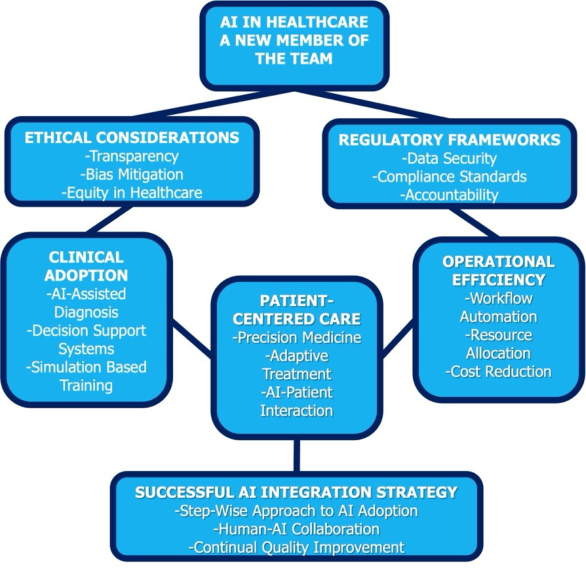
PATIENT-CENTRED STRATEGIES FOR TRANSPARENT IMPLEMENTATION The adoption of AI in healthcare should follow a stepwise and patient-centred approach, ensuring that each phase of implementation aligns with the core values of medical care (see Figure 1). Stepwise adoption enables rigorous evaluation of AI tools in controlled settings before broader deployment, minimizing risks and identifying areas for improvement (Abukhadijah and Nashwan, 2024). Starting with pilot projects and gradually scaling up the use of AI systems ensures that their reliability, effectiveness, and safety are thoroughly validated.
Transparency is critical for maintaining trust among patients, clinicians, and other stakeholders (Kiseleva, Kotzinos and De Hert, 2022; Upadhyay et al., 2023). Clear communication regarding the role of AI in decision- making processes helps patients and healthcare providers understand the benefits and limitations of these tools. Strategies to enhance clarity include using explainable AI, which allows users to comprehend how and why decisions are made by the system. By fostering transparency, healthcare organizations can address concerns about “black box”algorithms and ensure that patients feel informed and respected in their care journeys (Ghassemi, Oakden-Rayner and Beam, 2021).
204 Kalra and Johnston
Figure 1: A roadmap to welcoming AI as a clinical team member while ensuring ethical, regulatory, and patient-centered practices.
RISK AND QUALITY MANAGEMENT Effective risk and quality management protocols are essential for the successful integration of AI in healthcare. Defining acceptable risk thresholds for AI systems ensures that their deployment does not compromise patient safety (Ferrara et al., 2024; Ranjbar et al., 2024). These thresholds should be established in collaboration with medical, technical, and regulatory experts, taking into account the potential risks and benefits of AI tools. Regular assessments of AI performance against these thresholds help to maintain safety and reliability in their use (Mahmood et al., 2024).
Continuous monitoring and quality assurance protocols are vital for addressing challenges and ensuring the long-term success of AI implementation. Monitoring mechanisms should track system performance, user feedback, and patient outcomes to identify areas for improvement (Ranjbar et al., 2024). Quality assurance processes, such as routine validation and updates to AI algorithms, help to maintain their accuracy and relevance in clinical practice. These measures also provide opportunities for iterative learning and innovation, allowing AI systems to evolve alongside advancements in healthcare (Overgaard et al., 2023).
Artificial Intelligence Revolution in Healthcare: Enhancing Clinical Practice 205
PIONEERING ROLE OF LABORATORY MEDICINE AND PATHOLOGY Laboratory medicine and pathology have been at the forefront of AI integration in healthcare, pioneering the adoption of advanced technologies to enhance diagnostic accuracy and operational efficiency. The early adoption of AI technologies in pathology has revolutionized the field, allowing pathologists to improve diagnostic workflows and provide more precise results (Försch et al., 2021; Huang et al., 2024). For instance, AI-driven systems can analyze large volumes of histopathological images with unmatched accuracy and speed. These tools assist in identifying subtle abnormalities that might be overlooked by human eyes. By automating repetitive tasks like quantifying cell counts or assessing biomarkers, AI systems enable pathologists to concentrate on complex diagnostic challenges (Shafi and Parwani, 2023; Greeley et al., 2024). Moreover, AI technologies in laboratory medicine extend beyond diagnostics to operational improvements. Automated systems streamline laboratory workflows, optimize resource utilization, and reduce turnaround times (Lin et al., 2023). AI-powered predictive models assist in inventory management by forecasting reagent usage and demand, ensuring uninterrupted laboratory operations (Herman et al., 2021). Through these innovations, laboratory medicine and pathology exemplify how AI can enhance clinical outcomes and drive efficiencies in healthcare. By embracing AI, these fields continue to lead the way in adopting cutting-edge technologies that improve diagnostic precision, operational performance, and patient care (Fatima et al., 2024).
AI IN HEALTHCARE: STRATEGIC PLANNING Artificial intelligence holds immense promise for revolutionizing healthcare, offering transformative potential across diagnostics, treatment personalization, public health, and operational efficiency (Bekbolatova et al., 2024). The integration of AI into healthcare has already demonstrated significant benefits, such as enhancing diagnostic precision, enabling personalized care, and streamlining healthcare delivery (Alowais et al., 2023; Garcia-Saiso et al., 2024; Guraya, 2024). However, the implementation of AI is not without challenges. Ethical concerns, such as ensuring transparency, mitigating biases, and promoting equitable healthcare delivery, underscore the complexities of incorporating AI into clinical practice (Boudi et al., 2024; Mennella et al., 2024). Similarly, regulatory barriers, including data security, compliance standards, and accountability, highlight the need for robust frameworks to guide the adoption of AI technologies (Palaniappan et al., 2024).
These findings emphasize the importance of ethical and patient-centered frameworks in shaping the future of AI in healthcare. By prioritizing values such as transparency, inclusivity, and accountability, healthcare organizations can harness the full potential of AI while safeguarding the core principles of medical care. Through a thoughtful and measured approach, AI can complement human intelligence, enhance clinical decision- making, and address longstanding challenges in healthcare delivery. These
206 Kalra and Johnston
recommendations provide a framework for integrating AI into healthcare in a way that enhances both patient outcomes and system efficiency.
REFERENCES
Aboy, M., Minssen, T. and Vayena, E. (2024) ‘Navigating the EU AI Act: Implications for regulated digital medical products’, npj Digital Medicine, 7(1), p. 237. Available at: https://doi.org/10.1038/s41746-024-01232-3. Abukhadijah, H. J. and Nashwan, A. J. (2024) ‘Transforming Hospital Quality
Improvement Through Harnessing the Power of Artificial Intelligence’, Global Journal on Quality and Safety in Healthcare, 7(3), pp. 132–139. Available at: https://doi.org/10.36401/JQSH-24-4. Alowais, S. A. et al. (2023) ‘Revolutionizing healthcare: The role of artificial intelligence in clinical practice’, BMC Medical Education, 23(1), p. 689. Available at: https://doi.org/10.1186/s12909-023-04698-z. Baumgartner, R. et al. (2023) ‘Fair and equitable AI in biomedical research and
healthcare: Social science perspectives’, Artificial Intelligence in Medicine, 144, p. 102658. Available at: https://doi.org/10.1016/j.artmed.2023.102658. Bekbolatova, M. et al. (2024) ‘Transformative Potential of AI in Healthcare: Definitions, Applications, and Navigating the Ethical Landscape and Public Perspectives’, Healthcare, 12(2), p. 125. Available at: https://doi.org/10.3390/ healthcare12020125. Bhandari, A. (2024) ‘Revolutionizing Radiology With Artificial Intelligence’, Cureus
[Preprint]. Available at: https://doi.org/10.7759/cureus.72646. Boudi, A. L. et al. (2024) ‘Ethical Challenges of Artificial Intelligence in Medicine’, Cureus [Preprint]. Available at: https://doi.org/10.7759/cureus.74495. Canadian Medical Protective Association (CMPA) (2024) CMPA - The medico-legal lens on AI use by Canadian physicians. Available at: https://www.cmpa-acpm.ca/en/research-policy/public-policy/the-medico- legal-lens-on-ai-use-by-canadian-physicians (Accessed: 19 January 2025). Chen, Y. and Esmaeilzadeh, P. (2024) ‘Generative AI in Medical Practice: In-Depth
Exploration of Privacy and Security Challenges’, Journal of Medical Internet Research, 26, p. e53008. Available at: https://doi.org/10.2196/53008. Dixon, D. et al. (2024) ‘Unveiling the Influence of AI Predictive Analytics on Patient Outcomes: A Comprehensive Narrative Review’, Cureus [Preprint]. Available at: https://doi.org/10.7759/cureus.59954. Elhaddad, M. and Hamam, S. (2024) ‘AI-Driven Clinical Decision Support Systems:
An Ongoing Pursuit of Potential’, Cureus [Preprint]. Available at: https://doi.org/ 10.7759/cureus.57728. Fatima, G. et al. (2024) ‘Transforming Diagnostics: A Comprehensive Review of Advances in Digital Pathology’, Cureus [Preprint]. Available at: https://doi.org/ 10.7759/cureus.71890. Fehr, J. et al. (2024) ‘A trustworthy AI reality-check: The lack of transparency
of artificial intelligence products in healthcare’, Frontiers in Digital Health, 6, p. 1267290. Available at: https://doi.org/10.3389/fdgth.2024.1267290. Ferrara, M. et al. (2024) ‘Risk Management and Patient Safety in the Artificial Intelligence Era: A Systematic Review’, Healthcare, 12(5), p. 549. Available at: https://doi.org/10.3390/healthcare12050549. Försch, S. et al. (2021) ‘Artificial Intelligence in Pathology’, Deutsches Ärzteblatt international [Preprint]. Available at: https://doi.org/10.3238/ arztebl.m2021.0011.
Artificial Intelligence Revolution in Healthcare: Enhancing Clinical Practice 207
Garcia-Saiso, S. et al. (2024) ‘Artificial Intelligence as a Potential Catalyst to a More Equitable Cancer Care’, JMIR Cancer, 10, p. e57276. Available at: https://doi.org/ 10.2196/57276. Ghassemi, M., Oakden-Rayner, L. and Beam, A. L. (2021) ‘The false hope of
current approaches to explainable artificial intelligence in health care’, The Lancet Digital Health, 3(11), pp. e745–e750. Available at: https://doi.org/10.1016/ S2589-7500(21)00208-9. Greeley, C. et al. (2024) ‘Scalable deep learning artificial intelligence histopathology slide analysis and validation’, Scientific Reports, 14(1), p. 26748. Available at: https://doi.org/10.1038/s41598-024-76807-x. Guraya, S. Y. (2024) ‘Transforming simulation in healthcare to enhance interprofessional collaboration leveraging big data analytics and artificial intelligence’, BMC Medical Education, 24(1), pp. 941, s12909-024-05916-y. Available at: https://doi.org/10.1186/s12909-024-05916-y. Harvey, H. B. and Gowda, V. (2020) ‘How the FDA Regulates AI’, Academic
Radiology, 27(1), pp. 58–61. Available at: https://doi.org/10.1016/ j.acra.2019.09.017. Herman, D. S. et al. (2021) ‘Artificial Intelligence and Mapping a New Direction in Laboratory Medicine: A Review’, Clinical Chemistry, 67(11), pp. 1466–1482. Available at: https://doi.org/10.1093/clinchem/hvab165. Huang, Z. et al. (2024) ‘A pathologist–AI collaboration framework for enhancing
diagnostic accuracies and efficiencies’, Nature Biomedical Engineering [Preprint]. Available at: https://doi.org/10.1038/s41551-024-01223-5. Hummelsberger, P. et al. (2023) ‘Insights on the Current State and Future Outlook of AI in Health Care: Expert Interview Study’, JMIR AI, 2, p. e47353. Available at: https://doi.org/10.2196/47353. Jeyaraman, M. et al. (2023) ‘Unraveling the Ethical Enigma: Artificial Intelligence
in Healthcare’, Cureus [Preprint]. Available at: https://doi.org/10.7759/ cureus.43262. Jotterand, F. and Bosco, C. (2022) ‘Artificial Intelligence in Medicine: A Sword of Damocles?’, Journal of Medical Systems, 46(1), p. 9. Available at: https://doi.org/ 10.1007/s10916-021-01796-7. Kalra, J. and Seitzinger, P. (2022) ‘Implications and Consequences of Artificial
Intelligence in Healthcare Quality and Medical Training’, in. 13th International Conference on Applied Human Factors and Ergonomics (AHFE 2022). Available at: https://doi.org/10.54941/ahfe1002109. Kalra, J. and Seitzinger, P. (2023) ‘Expanding Our Grasp: Artificial Intelligence as the Next Leap Forward in Healthcare Quality’, in. 14th International Conference on Applied Human Factors and Ergonomics (AHFE 2023). Available at: https:// doi.org/10.54941/ahfe1003467. Kim, J. Y. et al. (2024) ‘Development and preliminary testing of Health Equity Across
the AI Lifecycle (HEAAL): A framework for healthcare delivery organizations to mitigate the risk of AI solutions worsening health inequities’, PLOS Digital Health. Edited by G. Guillot, 3(5), p. e0000390. Available at: https://doi.org/10.1371/ journal.pdig.0000390. Kiseleva, A., Kotzinos, D. and De Hert, P. (2022) ‘Transparency of AI in Healthcare as a Multilayered System of Accountabilities: Between Legal Requirements and Technical Limitations’, Frontiers in Artificial Intelligence, 5, p. 879603. Available at: https://doi.org/10.3389/frai.2022.879603.
208 Kalra and Johnston
Labkoff, S. et al. (2024) ‘Toward a responsible future: Recommendations for AI-enabled clinical decision support’, Journal of the American Medical Informatics Association, 31(11), pp. 2730–2739. Available at: https://doi.org/ 10.1093/jamia/ocae209. Lin, E. et al. (2023) ‘Digital pathology and artificial intelligence as the next
chapter in diagnostic hematopathology’, Seminars in Diagnostic Pathology, 40(2), pp. 88–94. Available at: https://doi.org/10.1053/j.semdp.2023.02.001. Mahmood, U. et al. (2024) ‘Artificial intelligence in medicine: Mitigating risks and maximizing benefits via quality assurance, quality control, and acceptance testing’, BJR|Artificial Intelligence, 1(1), p. ubae003. Available at: https://doi.org/10.1093/ bjrai/ubae003. Markus, A. F., Kors, J. A. and Rijnbeek, P. R. (2021) ‘The role of explainability
in creating trustworthy artificial intelligence for health care: A comprehensive survey of the terminology, design choices, and evaluation strategies’, Journal of Biomedical Informatics, 113, p. 103655. Available at: https://doi.org/10.1016/ j.jbi.2020.103655. McKee, M., Rosenbacke, R. and Stuckler, D. (2025) ‘The power of artificial intelligence for managing pandemics: A primer for public health professionals’, The International Journal of Health Planning and Management, 40(1), pp. 257–270. Available at: https://doi.org/10.1002/hpm.3864. McKee, M. and Wouters, O. J. (2022) ‘The Challenges of Regulating Artificial
Intelligence in Healthcare Comment on “Clinical Decision Support and New Regulatory Frameworks for Medical Devices: Are We Ready for It? - A Viewpoint Paper”’, International Journal of Health Policy and Management, p. 1. Available at: https://doi.org/10.34172/ijhpm.2022.7261. Mennella, C. et al. (2024) ‘Ethical and regulatory challenges of AI technologies in healthcare: A narrative review’, Heliyon, 10(4), p. e26297. Available at: https:// doi.org/10.1016/j.heliyon.2024.e26297. Nazer, L. H. et al. (2023) ‘Bias in artificial intelligence algorithms and recommendations for mitigation’, PLOS Digital Health. Edited by M. Kalla, 2(6), p. e0000278. Available at: https://doi.org/10.1371/journal.pdig.0000278. Ouanes, K. and Farhah, N. (2024) ‘Effectiveness of Artificial Intelligence (AI)
in Clinical Decision Support Systems and Care Delivery’, Journal of Medical Systems, 48(1), p. 74. Available at: https://doi.org/10.1007/s10916-024-02098-4. Overgaard, S. M. et al. (2023) ‘Implementing quality management systems to close the AI translation gap and facilitate safe, ethical, and effective health AI solutions’, npj Digital Medicine, 6(1), p. 218. Available at: https://doi.org/10.1038/s41746- 023-00968-8. Palaniappan, K. et al. (2024) ‘Gaps in the Global Regulatory Frameworks for
the Use of Artificial Intelligence (AI) in the Healthcare Services Sector and Key Recommendations’, Healthcare, 12(17), p. 1730. Available at: https://doi.org/ 10.3390/healthcare12171730. Pinto-Coelho, L. (2023) ‘How Artificial Intelligence is Shaping Medical Imaging Technology: A Survey of Innovations and Applications’, Bioengineering, 10(12), p. 1435. Available at: https://doi.org/10.3390/bioengineering10121435. Pruski, M. (2024) ‘AI-Enhanced Healthcare: Not a new Paradigm for Informed
Consent’, Journal of Bioethical Inquiry, 21(3), pp. 475–489. Available at: https:// doi.org/10.1007/s11673-023-10320-0. Ranjbar, A. et al. (2024) ‘Managing Risk and Quality of AI in Healthcare: Are Hospitals Ready for Implementation?’, Risk Management and Healthcare Policy, Volume 17, pp. 877–882. Available at: https://doi.org/10.2147/RMHP. S452337.
Artificial Intelligence Revolution in Healthcare: Enhancing Clinical Practice 209
Shafi, S. and Parwani, A. V. (2023) ‘Artificial intelligence in diagnostic pathology’, Diagnostic Pathology, 18(1), p. 109. Available at: https://doi.org/10.1186/s13000- 023-01375-z. Umapathy, V. R. et al. (2023) ‘Perspective of Artificial Intelligence in Disease
Diagnosis: A Review of Current and Future Endeavours in the Medical Field’, Cureus [Preprint]. Available at: https://doi.org/10.7759/cureus.45684. Upadhyay, U. et al. (2023) ‘Call for the responsible artificial intelligence in the healthcare’, BMJ Health & Care Informatics, 30(1), p. e100920. Available at: https://doi.org/10.1136/bmjhci-2023-100920.
LISTED IN THE AHFE DIGITAL BOOKSTORE CATALOGUE
Explore the complete digital volume
Artificial Intelligence and Social Computing
Read this individual research paper free through the original publisher, or explore the full digital proceedings book.
ISBN 978-1-964867-39-7
Explore this ISBN in the AHFE Bookstore ↗Listed in the July 2026 bookstore catalogue; search by ISBN to confirm current availability · Digital book purchase optional