Bryan Johnston, Jay Kalra (2025). Introducing the CARES Model: Integrating Artificial Intelligence, Medical Education, and Patient-Centered Care. In: Human Factors in Design, Engineering, and Computing. AHFE Open Access, vol. 199, pp. 1485–1493. https://doi.org/10.54941/ahfe1006960
Artificial Intelligence (AI) is transforming the delivery of patient-centred healthcare in Canada and around the globe. As AI becomes mainstream in daily clinical practice, it is increasingly critical to equip physicians and medical trainees with the skills to effectively integrate AI into patient-centered care. In Canada, medical education is guided by the CanMEDS framework, which is structured around seven CanMEDS roles: Medical Expert, Communicator, Collaborator, Leader, Health Advocate, Scholar, and Professional. Despite the growing influence of AI in healthcare, there is a notable absence of AI-specific competencies within medical education for critically evaluating AI tools, interpreting AI-generated outputs, and safely and ethically integrating AI into clinical decision-making. To bridge this gap, we suggest a new model for physicians and medical trainees to critically evaluate the use of AI in clinical practice, based on patient-centered principles. This model is based on the core concepts of Communication, Autonomy, Respect, Equity, and Safety, which together form the CARES model. Integrating the CARES model into medical education should adopt a constructivist approach, leveraging active learning, case-based scenarios, simulations, and real-world experiences to prepare learners for the complexities of AI in clinical practice. Our research suggests that the CanMEDS framework offers an ideal foundation to explore the core domains of the CARES model, which can be adopted and integrated into daily clinical practice to promote digital literacy. Importantly, the CARES model can be adapted to fit existing medical curricula and tailored to align with global efforts to integrate AI into medical education. Additionally, we have found that central to this approach is the incorporation of feedback loops from both learners and instructors to ensure a sustained focus on patient-centered care. Our findings highlight the opportunities presented by the CARES model to promote digital literacy among physicians and medical trainees in a novel way using the existing CanMEDS framework. By leveraging the flexibility of the CanMEDS framework, we hope to increase digital literacy among physicians and medical trainees. The CARES model represents a novel approach to prepare the next generation of healthcare providers to use AI safely and effectively in their practice while maintaining a patient-centered focus.
Artificial Intelligence (AI) is transforming the delivery of patient-centred healthcare in Canada and around the globe. As the next generation of healthcare providers completes their medical education, it is critical to equip them with the skills to effectively integrate AI into patient-centered care. AI tools offer immense potential to enhance precision, streamline workflows, and improve decision-making across clinical contexts. However, their integration into clinical environments introduces complex ethical, technical, and human factors challenges that must be addressed to ensure patient safety, trust, and equity (Weiner et al., 2025). As diagnostic tools like AI and machine learning enter daily clinical practice, they create unique opportunities for healthcare systems to optimize their workflows—but also demand new competencies for responsible use.
In Canada, medical education is guided by the CanMEDS framework, which has recently transitioned to a competency-based medical education (CBME) model structured around seven core roles: Medical Expert, Communicator, Collaborator, Leader, Health Advocate, Scholar, and Professional. Despite this structure, there remains an absence of AI- specific competencies for critically evaluating AI tools, interpreting AI- generated outputs, and safely and ethically incorporating AI into clinical decision-making. To address this gap, we propose the CARES model— Communication, Autonomy, Respect, Equity, and Safety—which aligns with core biomedical ethics and embeds key human factors principles into clinical education. This paper explores how the CARES model, when layered onto the CanMEDS framework, can help foster digital literacy and patient-centered thinking among physicians and medical trainees. Together, these frameworks form a practical and values-driven foundation for preparing healthcare providers to use AI in ways that are safe, transparent, and ethically sound.
HUMAN FACTORS AND AI IN CLINICAL PRACTICE Human factors optimize the interaction between clinicians and AI, by ensuring usability, reducing cognitive overload, and preventing errors caused by system complexity—leading to safer patient outcomes (Braverman, 2024). AI is increasingly becoming embedded in clinical workflows, providing powerful tools for diagnostics, decision support, and resource management. For example, AI-based triage systems are being implemented to help rapidly assess and prioritize incoming patients. These systems analyze electronic health record (EHR) data, vital signs, and presenting symptoms to assign triage levels and suggest who needs urgent attention. (Da’Costa et al., 2025; Tyler et al., 2024). From AI-powered imaging systems to predictive models for disease progression, these technologies promise to enhance both the precision and efficiency of healthcare delivery. However, their integration into patient care environments introduces a set of complex challenges that extend beyond algorithmic performance (Hassan et al., 2024). Healthcare systems are inherently multifaceted, involving clinicians, patients, administrators, and regulators. AI must operate within these intricate systems while supporting, rather than replacing, clinical judgment. This makes the principles of human
Introducing the CARES Model: Integrating Artificial Intelligence, Medical Education 1487
factors engineering essential for understanding and improving how clinicians interact with AI tools in real-world settings.
Human factors engineering focuses on optimizing system performance by designing technologies that align with human capabilities, limitations, and work environments. In healthcare, this means considering how AI fits into the daily practices of providers—how it affects cognitive load, team communication, clinical workflows, and most importantly, trust. Poorly integrated AI systems can lead to unintended consequences such as automation bias, overreliance on algorithmic recommendations, and breakdowns in shared decision-making. The “black box” nature of many AI models, where the rationale behind outputs is not easily explainable, undermines clinician trust and poses a barrier to patient-centered care (Akingbola et al., 2024). These challenges are magnified in high-stakes settings like emergency medicine, oncology, and intensive care, where decisions must be both rapid and transparent.
Moreover, systemic barriers such as technical limitations, workflow misalignment, attitudinal barriers, informational barriers, usability issues, and environmental barriers further complicate the integration of AI into healthcare (Wang et al., 2023). Without adequate preparation, clinicians and medical trainees may feel disempowered, overwhelmed, or skeptical of AI-enabled tools (Grunhut et al., 2021; Saroha, 2025). Designing AI systems with intuitive interfaces, meaningful feedback loops, and contextual awareness can mitigate some of these risks. Medical education must prioritize digital literacy and human-AI teaming to prepare healthcare providers to critically appraise, question, and effectively apply AI insights (Alam et al., 2023). As AI handles more knowledge-based tasks, the physician’s role must increasingly center on empathy, trust-building, shared decision-making, and compassion. Training should cultivate these “soft skills” throughout medical education to prevent the dehumanization of care and maintain strong doctor-patient relationships (Sauerbrei et al., 2023). By integrating human factors principles into both system design and medical training, we can foster a safer, more ethical, and user-friendly approach to AI in clinical practice.
THE CARES MODEL: PRIORITIZING HUMAN-CENTERED PRINCIPLES To ensure that AI tools are safely and ethically integrated into clinical care, a values-based approach, specifically patient-centered values, is essential (Knop et al., 2022). In response to the paucity of AI competencies in current medical education frameworks, we propose the CARES model— Communication, Autonomy, Respect, Equity, and Safety (see table 1). These five pillars reflect core human factors and ethical design principles that can guide the development, deployment, and evaluation of AI in healthcare. While many AI initiatives focus on technical performance, the CARES model emphasizes how AI tools interact with clinicians and patients, ensuring that the therapeutic relationship remains at the center of patient care.
1488 Johnston and Kalra
Table 1: Roadmap for integrating CanMEDS roles with the CARES model.
Table available in the original PDF paper.
Cares Principle Key Canmeds Role Patient-Centered Care Communication Communicator - Facilitate understanding, shared decision-making and informed consent
Autonomy Collaborator -Foster active patient involvement and respect individual preferences Respect Professional -Honour patient dignity, privacy, and cultural values
Equity Health Advocate -Promote fair access and reduce disparities in AI-supported care Safety Medical Expert -Protect patients from harm through transparent and responsible AI use
Each element of the CARES model addresses a critical aspect of human-AI interaction:
Communication ensures that patients and clinicians transparently discuss the use, benefits, and limitations of AI tools. Good communication builds trust in new technologies and helps patients fully understand— and consent to—how AI impacts their diagnosis and treatment. When clinicians clearly explain AI’s role, patients remain empowered, fostering confidence and mitigating fear or misunderstanding.
Autonomy preserves both the patient’s and clinicians’ right to make informed, independent decisions. Even as AI provides support or recommendations, the ultimate decisions are made by people. This safeguards personal agency, upholds the principles of informed consent, and prevents AI from becoming a substitute for clinical judgment or patient involvement.
Respect revolves around protecting patient dignity, privacy, and cultural values. Respectful AI use means data is handled with care, patient identity is protected, and technology is deployed with sensitivity to individual beliefs, needs, and contexts.
Equity is crucial for ensuring that AI does not exacerbate existing health disparities or introduce new biases. By prioritizing fairness, inclusivity, and proactive bias correction, equity-focused policies ensure that all populations benefit equally and that AI tools do not create or widen gaps in care.
Safety demands that AI systems are thoroughly tested, monitored, and continuously improved to minimize risks and prevent patient harm. Maintaining rigorous safety standards ensures that clinicians and patients can trust the reliability, security, and effectiveness of AI, which are crucial for its adoption and ethical use.
Introducing the CARES Model: Integrating Artificial Intelligence, Medical Education 1489
These principles mirror the goals of human factors engineering— optimizing systems to enhance performance, reduce error, and prioritize the needs and experiences of the end users.
The CARES model also promotes the development of digital literacy among physicians and medical trainees. By integrating these patient-centred principles into educational frameworks, learners gain tools to critically evaluate the role of AI in clinical settings. For example, they are trained not only to interpret AI output but also to its use in a given context. This shifts the focus from simply using technology to critically evaluating its application. The CARES model prepares learners to identify ethical risks, challenge algorithmic bias, and collaborate in multidisciplinary teams where AI is one of many inputs. In doing so, CARES creates a foundation for the responsible adoption of AI in healthcare, rooted in empathy, professionalism, and patient-centred values.
INTEGRATING THE CARES MODEL INTO THE CANMEDS FRAMEWORK The CanMEDS framework is the cornerstone of Canadian medical education, defining the essential competencies that physicians must demonstrate across seven interconnected roles: Medical Expert, Communicator, Collaborator, Leader, Health Advocate, Scholar, and Professional. While the framework has evolved to reflect contemporary challenges in healthcare, it has yet to meaningfully incorporate competencies related to AI, digital literacy, or human-AI collaboration (Thoma et al., 2022). Rather than proposing an entirely new role, the CARES model offers a patient-centered and ethically grounded way to embed AI-specific competencies into each existing CanMEDS role. This approach is supported by a recent Delphi study that highlights the competencies required for professional and trainee education (Singla et al., 2024). This approach preserves the integrity of the CanMEDS framework while ensuring it remains responsive to the rapidly evolving technological landscape of clinical practice.
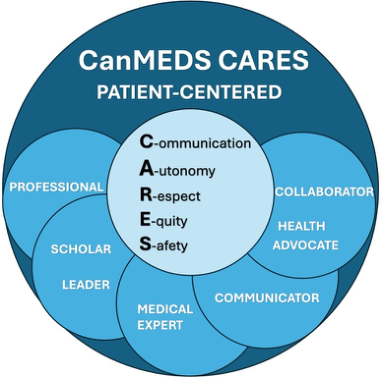
Each pillar of the CARES model naturally aligns with the CanMEDS competencies (see Figure 1). For example, Communication aligns with the Communicator role, reinforcing the need to clearly explain the purpose, limitations, and risks of AI-supported care to patients and team members. Autonomy intersects with the Collaborator and Professional roles, emphasizing shared decision-making, transparency, and patient empowerment. Respect supports the Health Advocate and Professional roles, promoting equitable, culturally sensitive care in the face of algorithmic generalization. Equity links to the Leader and Health Advocate roles, as clinicians must advocate for fair access to AI technologies and recognize bias in training datasets. Safety is at the core of the Medical Expert and Scholar roles, as it involves understanding algorithmic behaviour, identifying system limitations, and responding to emerging concerns like data security and patient privacy.
Integrating the CARES model into CanMEDS also offers a clear path for competency-based assessment through Entrustable Professional Activities
1490 Johnston and Kalra
(EPAs). These specific, observable tasks can be used to track learner progression and readiness for independent practice. Constructivist teaching strategies, such as simulation, case-based learning, and reflective exercises, provide the ideal environment for assessing these competencies in action. Successful teams utilize iterative feedback, simulation-based testing, and collaborative training to bridge the gap between AI applications and the realities of clinical practice (Knop et al., 2022; Wekenborg et al., 2025). Case-based teaching using real-world scenarios helps students connect ethical challenges with clinical realities (Weidener and Fischer, 2023). The synergy between CARES and CanMEDS will enable the mastery of patient- centered AI competencies and produce ethically grounded physicians who are prepared to lead the safe and effective integration of AI into healthcare.
Figure 1: Blending CanMEDS CARES model with patient-centered care.
IMPLICATIONS FOR POLICY DESIGN AND FUTURE RESEARCH The integration of AI into healthcare cannot succeed without parallel advancements in educational policy and curriculum design. The WHO released comprehensive guidance outlining recommendations for governments, technology developers, and healthcare providers. These focus on transparency, safety, equity, respect, and communication in the development and use of AI tools, which aligns well with our CARES model (Ethics and Governance of Artificial Intelligence for Health, 2024). While the CanMEDS framework provides a strong foundation for competency-based training, the absence of AI-related competencies leaves medical educators and institutions without a shared roadmap for implementation. As national medical organizations revise training standards—such as the upcoming CanMEDS 2025 revamp—there is a unique opportunity to integrate the CARES model within new curricular guidelines. The CanMEDS 2025 revision is expanding to include AI, data-informed medicine, virtual care,
Introducing the CARES Model: Integrating Artificial Intelligence, Medical Education 1491
health equity, anti-racism, social justice, physician humanism, and complex adaptive systems as key emerging concepts (Thoma et al., 2023). Accrediting bodies such as the Royal College of Physicians and Surgeons of Canada and the College of Family Physicians of Canada should collaborate with AI developers, human factors experts, and clinicians to define core AI literacy outcomes, ensuring consistency across institutions while allowing flexibility for discipline-specific needs (Johnston and Kalra, 2025; Kalra et al., 2025).
Educational strategies must also evolve to reflect the interdisciplinary nature of AI in healthcare (Turner et al., 2025). Integrating CARES- aligned competencies into EPAs, clinical skills sessions, ethics modules, and interprofessional training programs will help connect technical understanding and human-centered practice. Simulation-based learning (Elendu et al., 2024), interactive case studies, and real-world AI tool evaluation exercises can provide safe, structured environments for learners to build competence and confidence (Agarwal et al., 2025). Faculty development will also be essential, as educators themselves must gain familiarity with AI concepts and tools to effectively mentor trainees. Institutional investment in digital infrastructure, faculty training, and cross-disciplinary partnerships will be key to sustaining this curricular transformation (Blanco et al., 2025).
Future research should focus on validating the CARES model as a tool for evaluating digital literacy, patient-centered decision-making, and ethical AI use in clinical practice. Mixed-methods studies (Tolentino et al., 2025) assessing learner outcomes, patient satisfaction, and safety indices will offer support for CARES-based educational interventions. In a stepwise progression, longitudinal studies could examine how CARES-aligned training affects real-world behaviour, such as the ability to identify bias in AI systems, communicate AI-generated recommendations to patients, or investigate safety concerns. Policy-oriented research would also examine how regulatory bodies can integrate CARES principles into national AI standards, licensing requirements, and medico-legal guidelines. By combining evidence-based curriculum development with principled governance, healthcare systems can equip future clinicians to confidently, clearly, and compassionately navigate the AI-driven future (Thompson et al., 2025).
CONCLUSION
The rise of artificial intelligence in healthcare presents both a remarkable opportunity and a significant responsibility. As AI systems become more integrated into clinical workflows, the need to ensure their safe, ethical, and fair use becomes increasingly evident. While AI can improve diagnostic accuracy, lessen clinician workload, and enhance patient outcomes, these advantages will only be achieved if healthcare professionals are trained to critically assess, interpret, and apply AI tools within a human-centred approach. The CARES model—Communication, Autonomy, Respect, Equity, and Safety—offers a clear and practical structure to guide this integration, grounded in human factors, biomedical ethics, and patient-centered care.
1492 Johnston and Kalra
Rather than creating new silos in medical education, CARES complements and enriches the existing CanMEDS framework, providing a pathway to integrate AI competencies into well-established roles and curricula. By emphasizing transparency, collaboration, and continuous feedback, the CARES model prepares physicians not only to incorporate AI into their daily practice but also to champion its ethical integration in line with patient-centred principles.
Integrating these principles into the development, deployment, and oversight of AI in medicine ensures that technological innovation serves human needs and values. In essence, Communication, Autonomy, Respect, Equity, and Safety are not just safeguards—they are essential drivers for using AI in ways that truly enhance human health, build resilient patient-physician relationships, and promote a future where technology and humanity advance together. The CARES model represents a meaningful step toward that future—one in which technological innovation and humanistic practice coexist in service of better, more equitable, patient-centered care.
REFERENCES
Agarwal, G., Ramamoorthi, L., Yuen, T., Merced, E., Brenner, J., Wu, W., Sabina, R., 2025. Exploring Applications of Artificial Intelligence Tools in Clinical Care and Health Professions Education: An Online Module for Students. MedEdPortal 11524. Akingbola, A., Adeleke, O., Idris, A., Adewole, O., Adegbesan, A., 2024. Artificial
Intelligence and the Dehumanization of Patient Care. J. Med. Surg. Public Health 3, 100138. Alam, F., Lim, M. A., Zulkipli, I. N., 2023. Integrating AI in medical education: Embracing ethical usage and critical understanding. Front. Med. 10, 1279707. Blanco, M. A., Nelson, S. W., Ramesh, S., Callahan, C. E., Josephs, K. A., Jacque,
B., Baecher-Lind, L. E., 2025. Integrating artificial intelligence into medical education: A roadmap informed by a survey of faculty and students. Med. Educ. Online 30, 2531177. Braverman, A., 2024. Integrating Human Factors in the Healthcare System: Embracing Aviation Methodologies and Artificial Intelligence (AI) to Enhance Provider Performance and Patient Safety. Int. J. Transl. Med. Res. Public Health 8, e016. Da’Costa, A., Teke, J., Origbo, J. E., Osonuga, A., Egbon, E., Olawade, D. B., 2025.
AI-driven triage in emergency departments: A review of benefits, challenges, and future directions. Int. J. Med. Inf. 197, 105838. Elendu, C., Amaechi, D. C., Okatta, A. U., Amaechi, E. C., Elendu, T. C., Ezeh, C. P., Elendu, I. D., 2024. The impact of simulation-based training in medical education: A review. Medicine (Baltimore) 103, e38813. Ethics and Governance of Artificial Intelligence for Health: Large Multi-Modal
Models. WHO Guidance, 1st ed. ed, 2024. World Health Organization, Geneva. Grunhut, J., Wyatt, A. T., Marques, O., 2021. Educating Future Physicians in Artificial Intelligence (AI): An Integrative Review and Proposed Changes. J. Med. Educ. Curric. Dev. 8, 23821205211036836. Hassan, M., Kushniruk, A., Borycki, E., 2024. Barriers to and Facilitators of
Artificial Intelligence Adoption in Health Care: Scoping Review. JMIR Hum. Factors 11, e48633.
Introducing the CARES Model: Integrating Artificial Intelligence, Medical Education 1493
Johnston, B., Kalra, J., 2025. Patients over Process: Stratifying Risk in the Design, Development, and Deployment of Artificial Intelligence in Healthcare. Presented at the 16th International Conference on Applied Human Factors and Ergonomics (AHFE 2025). Kalra, J., Johnston, B., Rafid-Hamed, Z., Seitzinger, P., 2025. Stethoscope to
Algorithm: Equipping Tomorrow’s Doctors for Artificial Intelligence Driven Healthcare. Presented at the 16th International Conference on Applied Human Factors and Ergonomics (AHFE 2025). Knop, M., Weber, S., Mueller, M., Niehaves, B., 2022. Human Factors and Technological Characteristics Influencing the Interaction of Medical Professionals With Artificial Intelligence–Enabled Clinical Decision Support Systems: Literature Review. JMIR Hum. Factors 9, e28639. Saroha, S., 2025. Artificial Intelligence in Medical Education: Promise, Pitfalls, and
Practical Pathways. Adv. Med. Educ. Pract. Volume 16, 1039–1046. Sauerbrei, A., Kerasidou, A., Lucivero, F., Hallowell, N., 2023. The impact of artificial intelligence on the person-centred, doctor-patient relationship: some problems and solutions. BMC Med. Inform. Decis. Mak. 23, 73. Singla, R., Pupic, N., Ghaffarizadeh, S.-A., Kim, C., Hu, R., Forster, B. B.,
Hacihaliloglu, I., 2024. Developing a Canadian artificial intelligence medical curriculum using a Delphi study. Npj Digit. Med. 7, 323. Thoma, B., Abbott, C., Snell, L., 2023. The future of the CanMEDS physician competency framework. Can. Med. Educ. J. 14, 1–3. Thoma, B., Paprica, P. A., Kaul, P., Cheung, W. J., Hall, A. K., Affleck, E., 2022.
Data-Informed Medicine in CanMEDS 2025. Can. Med. Educ. J. Thompson, R. A. M., Shah, Y. B., Aguirre, F., Stewart, C., Lallas, C. D., Shah, M. S.,
2025. Artificial Intelligence Use in Medical Education: Best Practices and Future Directions. Curr. Urol. Rep. 26, 45. Tolentino, R., Hersson-Edery, F., Yaffe, M., Abbasgholizadeh-Rahimi, S., 2025.
AIFM-ed Curriculum Framework for Postgraduate Family Medicine Education on Artificial Intelligence: Mixed Methods Study. JMIR Med. Educ. 11, e66828. Turner, L., Knopp, M. I., Mendonca, E. A., Desai, S., 2025. Bridging Artificial Intelligence and Medical Education: Navigating the Alignment Paradox. Sch. 6, 135–148. Tyler, S., Olis, M., Aust, N., Patel, L., Simon, L., Triantafyllidis, C., Patel, V., Lee,
D. W., Ginsberg, B., Ahmad, H., Jacobs, R. J., 2024. Use of Artificial Intelligence in Triage in Hospital Emergency Departments: A Scoping Review. Cureus. Wang, L., Zhang, Z., Wang, D., Cao, W., Zhou, X., Zhang, P., Liu, J., Fan, X., Tian, F., 2023. Human-centered design and evaluation of AI-empowered clinical decision support systems: a systematic review. Front. Comput. Sci. 5, 1187299. Weidener, L., Fischer, M., 2023. Teaching AI Ethics in Medical Education: A Scoping
Review of Current Literature and Practices. Perspect. Med. Educ. 12, 399–410. Weiner, E. B., Dankwa-Mullan, I., Nelson, W. A., Hassanpour, S., 2025. Ethical challenges and evolving strategies in the integration of artificial intelligence into clinical practice. PLOS Digit. Health 4, e0000810. Wekenborg, M. K., Gilbert, S., Kather, J. N., 2025. Examining human-AI interaction
in real-world healthcare beyond the laboratory. Npj Digit. Med. 8, 169.
LISTED IN THE AHFE DIGITAL BOOKSTORE CATALOGUE
Explore the complete digital volume
Human Factors in Design, Engineering, and Computing
Read this individual research paper free through the original publisher, or explore the full digital proceedings book.
ISBN 978-1-964867-75-5
Explore this ISBN in the AHFE Bookstore ↗Listed in the July 2026 bookstore catalogue; search by ISBN to confirm current availability · Digital book purchase optional