Elizabeth Waszkiewicz (2026). The ability to act precisely before and after warming up educational sessions with adolescent violinists – pilot profiles. In: Human Factors in Sports, Preventive Medicine and Innovative Agonology. AHFE Open Access, vol. 226, pp. 10–16. https://doi.org/10.54941/ahfe1007817
Although the ability to perform precise actions determines the effectiveness of many human activities, it is not sufficiently emphasized in motor skills research. In the case of musicians, the degree of this motor skills should be correlated with the artistic effects of musical art. However, basic knowledge regarding whether this hypothesis has been sufficiently empirically verified is lacking. The fundamental dilemma concerns the tools that can be used to relatively universally measure the ability to perform precise actions under various circumstances, including those involving physical exertion, often combined with mental stress. The aim of this pilot study is the profiles of four young violinists (11-12 years old), who differ in years of practice and achievements in national and international competitions for beginner violinists. During four months of observation of standard violin lessons at a state primary music school in Poland, one session each month was arranged, preceded by a very simple yet emotionally attractive warm-up. However, before and after a five-minute, quite intense warm-up, the students attempted to throw five rehabilitation bags into a container within 10 seconds, initially from a distance of 2 meters (during the first two sessions) and from a distance of 1.5 meters during the remaining sessions. Effectiveness is measured by the proportion of successful throws, separately with the right and left hands. The analytical calculations also included the overall effectiveness (%) of 80 throws performed by the individual, the time taken for each series of throws (accurate to one hundredth of a second), and the correlations between these indicators for each student separately. Ann, an 11-year-old second-year music student, leads in overall throw effectiveness (47.25%), while Gabi (a 12-year-old sixth-grade student, i.e., with the longest experience and no significant artistic achievements) has 41.25%. Winners of numerous violin competitions: Eve 47.5%, Lucy 46.25%, respectively. Differentiating the calculated indicators when all students are taught by the same expert excludes the influence of the quality of teaching on the results of artistic achievements and innovative use of motor tasks in seemingly disparate physical activities. Therefore, this direction of complementary research seems to be an appropriate recommendation for the search for universal indicators for measuring the ability to act precisely in various states of arousal due to physical exertion combined with the influence of mental stress factors.
Although the ability to perform precise actions determines the effectiveness of many human activities, it is not sufficiently emphasized in motor skills research. In the case of musicians, the degree of this motor skills should be correlated with the artistic effects of musical art. However, basic knowledge regarding whether this hypothesis has been sufficiently empirically verified is lacking.
Robert Bąk (2025) re-analysed the results of four dissertations whose authors used a simple empirical arrangement of Polish school pupils aged between 14 and 16. The students repeated five identical motor tasks five times, each within 10 seconds (5 throws of a ball into a basket from a fixed Received February 20, 2026; Revised April 5, 2026; Accepted April 22, 2026; Available online July 20, 2026
The Ability to Act Precisely Before and After Warming up Educational Sessions 11 position and in the same way each time): Task 1 before warm-up; Task 2 after warm-up; Tasks 3 to 5 was % of accurate throws immediately after 60 seconds of intense effort (active break after each effort was 3 minutes). None of the observed students performed all of the ball throws into the basket perfectly. The leader (who regularly participated in basketball training) performed the first three Tasks, flawlessly, but during the fourth and fifth tasks, he missed the basket after one of the throws. Unfortunately, the authors of the re-analysed works did not monitor effectiveness with accuracy in each of the 10-second series. A similar effectiveness (92% accurate shots) was documented by another student among those who declared regular physical activity in their free time. His effectiveness profile (%) from Task 1 to Task 5: 100; 80; 100; 80; 100. In circumstances where unstable results predominated, B`k used a method of estimating the effectiveness of precise action according to the criteria of minimum stability of results every 20% of accurate throws in each series. At least one Task completed unsuccessfully (0% effectiveness) qualified the student to ‘instability’. Such students were found in less than 8% of those declaring extracurricular physical activity and 29% of ‘passive’ students. In addition, less than 8% of ‘active’ students documented a minimum of 80% stability of effectiveness (four accurate throws out of 5), but none of the ‘passive’ students.
Applying this diagnosis to predicting the composition of a basketball team, the factor of inefficiency (apart from free throw execution), especially during the first two shots in each 10-second series, does not yet determine a person’s usefulness to the team. In the case of instrumental musicians, a detailed analysis of the repeatability of errors (in reality, expected motor perfection) at a specific moment of an appropriate motor test (or quasi- test) that provides universal information about the ability to act precisely in various states of body arousal is a key element of professional diagnosis. In many cases, the lack of expected effectiveness is not a result of neurological or coordination defects, but rather a lack of ability to concentrate properly on the motor task. In basketball, there can be many opportunities to compensate for partial failures and ultimately win. In music (and not only instrumental music), a single mistake at any point in a piece determines the final outcome of a concert, competition or one’s own satisfaction.
Therefore, the fundamental dilemma concerns the tools that can be used to relatively universally measure the ability to perform precise actions under various circumstances, including those involving physical exertion, often combined with mental stress.
The aim of this pilot study is the profiles of four young violinists (11-12 years old), who differ in years of practice and achievements in national and international competitions for beginner violinists. in system development programs drove hundreds of human-centered design improvements.
MATERIAL AND METHODS Participants (in Alphabetic Order)
Ann, an 11-year-old second-year music student, over 18 months of violin practice. Eve, an 11-year-old third-year music student, over 30 months of violin practice. Gabi, a 12-year-old sixth-grade student, i.e., with the longest experience (over 40 months) and no significant artistic achievements. Lucy, an 11-year-old fourth-year music student, over 40 months of violin practice. just like Eve the winner of numerous violin competitions (international and national).
Study Design During four months of observation of standard violin lessons at a state primary music school in Poland, one session each month was arranged, preceded by a very simple yet emotionally attractive warm-up. However, before and after a five-minute, quite intense warm-up, the students attempted to throw five rehabilitation bags into a container (basket) within 10 seconds, initially from a distance of 2 meters (during the first two sessions) and from a distance of 1.5 meters during the remaining sessions. The basic element of the first module of the specialist part of the session consisted of specialist warm-ups using the violin (open strings with the whole bow, portato across the strings, spiccato, soutilié, etc.), as well as so-called left-hand exercises. This part of the session is marked with the symbol ‘Violine-WU’. The main module, marked with the symbol ‘Etude’, included teaching and perfecting pieces arbitrarily adapted by the teacher to the motor and mental abilities of the student, taking into account formal educational criteria. Each module (part of the session) lasted about 15 minutes.
Measurement Process Effectiveness is measured by the proportion of successful throws, separately with the right and left hands. The analytical calculations also included the overall effectiveness (%) of 80 throws performed by the individual (5 with each hand in a series), the time taken for each series of throws (accurate to one hundredth of a second), and the correlations between these indicators for each student separately. Motor-artistic effect (on a scale of 1 to 25) is based on five movement features modelled on the Schnabel (1987) criteria: accuracy, rhythm, range, force, tempo (Waszkiewicz, Kruszewski, 2024, Waszkiewicz Bąk, 2025). AAP-Index is a general measure of the ability to act precisely before and after warming up taking into account all observations. MA-Index is an average of the ‘Violine-WU’ and ‘Etude’ indices. The other recorded indices (motivation, pain perception, duration and intensity of effort, overall workload – Waszkiewicz, Bąk, 2025) are not analysed in this study.
For the purposes of correlation studies, indicators of the effectiveness of rehabilitation bag throws in identical external circumstances (same distance to the basket) were used separately for each hand. These leader data were correlated with ‘Violine-WU’, ‘Etude’, AAP-Index, and MA-Index.
RESULTS
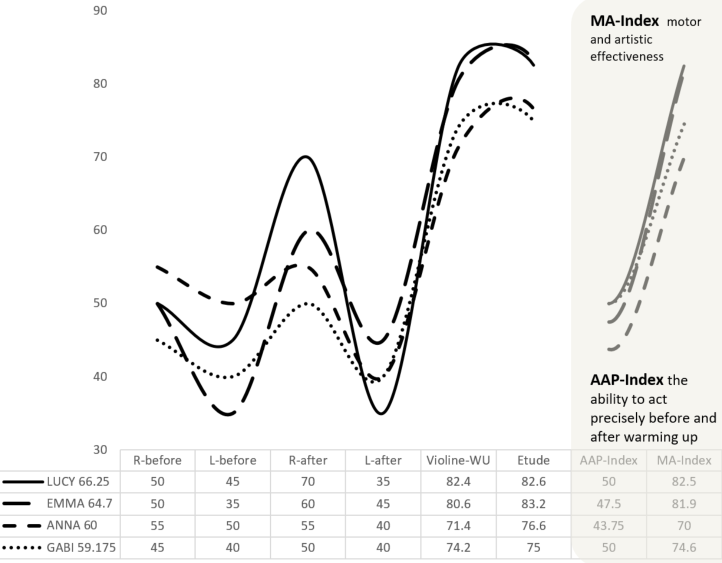
Ann and Lucy are leaders in overall throw effectiveness (50%), while Eve has 47.5% and Gabi 43.75%. Lucy is the leader in terms of the average AAP-Index and MA-Index (66.25% effectiveness). The difference between this result and Eve’s is only 1.55%, while Eve trails Lucy by an even smaller margin (0.6%) in terms of the MA-Index. This index differentiates young violinists more (range 12.5%) than AAP-Index (range 6.25%). In addition, the intensive warm up resulted in an increase in the effectiveness of right-hand throws for all students, but also in significant inter-individual differences (Figure 1).
Figure 1: Simplified profiles of the ability to act precisely in various states of arousal of the body using non-specific and specific motor means of four young violinists (when identifying individuals, the average value of the AAP and MA indices is monitored).
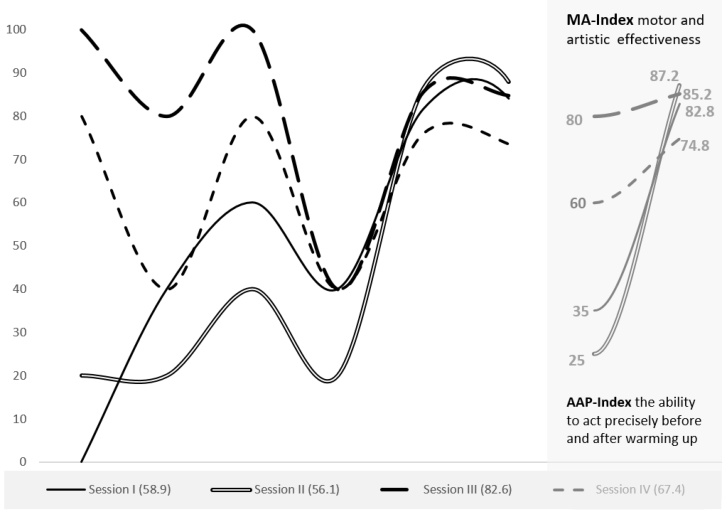
The profile of the leader (Lucy) suggests that the reason for the significant variation in the effectiveness of rehabilitation bags throws is the distance to the basket. Reducing this distance to 1.5 metres in sessions III and IV significantly increased the effectiveness of the throws (Figure 2). This effect is clearly illustrated by the detailed results matrix (Table 1).
Table 1: Matrix of the effectiveness of rehabilitation bags throws by the leader of the ranking, Lucy (X accurate throws) during the observed sessions (shaded fields show the monitored effectiveness of throws in a series in % and the time of execution of throws in seconds).
Table available in the original PDF paper.
Before Warm-up After Warm-up Hand Order of Throws Order of Throws
%
% Time (s)
Time (s) 1 2 3 4 5 1 2 3 4 5 Session 1 (basket 2 m away)
Right 0 6.64 x x x 60 8.7 Left x x 40 8.17 x x 40 8.31 Session 1 (basket 2 m away)
Right x 20 7.8 x x 40 7.9 Left x 20 8 x 20 8 Session 1II (basket 1.5 m away)
Right x x x x x 100 8 x x x x x 6 Left x x x x 80 8 x x 7 Session 1V (basket 1.5 m away)
Right x x x x 80 8 x x x x 80 8 Left x x 40 8.5 x z 40 8.5
Figure 2: Lucy’s profile – the general indicators of the ability to act precisely before and after warming up (AAP-Index) and motor-artistic effectiveness (MA-Index) and are monitored separately, and sessions III and IV (rehabilitation bags throws from a distance of 1.5 metres) are marked with dotted lines.
The Ability to Act Precisely Before and After Warming up Educational Sessions 15 Although the small number of sessions observed limits the validity of an in-depth analysis of the correlation between empirical variables (including in circumstances where the distance to the basket) was changed after two sessions), certain results are nevertheless important premises for further observation. In Lucy’s case, all 15 pairs of indicators are fully correlated (r = 1) at a basket distance of 1.5 metres. However, 8 pairs of these indicators are negatively correlated (r = −1) at a basket distance of 2 metres.
DISCUSSION
The results of these pilot studies provide important evidence that the preparatory process can be effectively optimised by trial and error and by adjusting the details of motor tasks that require maintaining a high level of precision regardless of changing external circumstances and thus disrupting the homeostasis of the active person. In many sports, the lack of expected precision can be compensated for by the athlete’s energy potential. For example, biathlon provides evidence that some competitors, despite flawless shooting, lose to competitors who perform so-called penalty laps as a result of inaccurate shooting. Only a certain similarity applies to team games and rocket sports.
In the case of instrumental music in particular, there are no similarities – as emphasised in the introduction. This is one of the reasons why the methodological aspect of this research comes to the fore. It is not only about increasing the competitiveness of musicians at various levels of competition. In my opinion, the health aspects of long-term practice by professional and even amateur musicians should be placed at the forefront. The temptation to succeed in prestigious music competitions encourages musicians to increase the time spent rehearsing pieces. If, in such circumstances, a musician either reinforces motor-based errors, or is unable or neglects to compensate for the negative impact of instrumental specialisation on posture and movement, or accumulates these and other occupational risk factors (including mental ones), then the threat to health can dramatically exceed the body’s tolerance limits. Mental stress emerges.
Therefore, the quality of diagnostic methods and tools, as well as methods of continuous training for musicians, should be verified with the participation of specialists from various fields. A complementary methodological approach is therefore a leading factor (Kalina, 2023, 2024, Waszkiewicz, 2023; Waszkiewicz and Kruszewski, 2024, Bąk, 2025; Waszkiewicz and Bąk, 2025).
Only at first glance does the mere correction of distance and the results of correlational observations of one person seem insignificant, even though it stands out among young violin students. However, when other observations not formally covered by the rigours of the experiment’s protocols are also taken into account, the whole may constitute a set of very important premises. A characteristic behaviour of all the students was to demonstrate dissatisfaction with their lack of effectiveness when throwing rehabilitation bags. After reducing the distance to the basket, the students commented that it was necessary to concentrate on the task, especially under time pressure, and then the tasks were not as difficult as they had previously seemed. In addition, the students demonstrated curiosity as to whether increasing the intensity of non-specific (in the musical sense) motor tasks could interfere
16 Waszkiewicz with the effectiveness of the throws, despite focusing on the need to repeat them precisely. Since musicians are discouraged from practising sports that pose a risk of injury to their hands, especially their fingers, from an early age, attractive forms of motor tasks that verify the repeatability of precise actions can become optimal stimuli for stimulating not only coordination, but also muscle strength and endurance. Manipulating the mass and shape of objects thrown at a target, as well as the distance to the target and its size, and the effort preceding a predetermined precise action, are just a few examples of how to achieve training regimes (quasi-tests) whose results will correlate with motoric-artistic effects and health effects.
CONCLUSION
Differentiating the calculated indicators when all students are taught by the same expert excludes the influence of the quality of teaching on the results of artistic achievements and innovative use of motor tasks in seemingly disparate physical activities. Therefore, this direction of complementary research seems to be an appropriate recommendation for the search for universal indicators for measuring the ability to act precisely in various states of arousal due to physical exertion combined with the influence of mental stress factors.
REFERENCES
Bąk R. (2025). The ability to act precisely before and during changing psychomotor effort – a laboratory example of measuring multivariate dispositional possibility of action. Arch Budo J In Agon 2025; 21: Kalina, R.M. (2023) Methodology of complementary research as the basis for
integrating science in fulfilling its social mission in the future. Arch Budo; 19: 77–82. Kalina, R.M. (2024) Complementary Approach and Mixed Assessments – INNOAGON’s Basic Research Methods. Human Factors in Sports, Performance and Wellness, 2024; 150: 59–65. Schnabel G. (Hrsg.) Methoden zur Gewinnung empirischen Wissens. In:
Forschungsmethoden in sportmethodischen Wissenschaftsdisziplinen. Wiss. Ztschr. DHfK. Sonderheft. Leipzig nr 3; 1987. German: Waszkiewicz E, Bąk R. (2024) An innovative method of monitoring health, mental, motor and artistic indicators during violin lessons. Arch Budo J Inn Agon 2024, 20: 318–332. Waszkiewicz E, Kruszewski A. (2024) Measurement of motivation and qualitative
effects of physical effort during two motor learning sessions with multifaceted variation of goals, methods, measures and tools – example of violin playing and safe fall. Human Factors in Design, Engineering, and Computing, Vol. 159, 2024, 1471–1482.
LISTED IN THE AHFE DIGITAL BOOKSTORE CATALOGUE
Explore the complete digital volume
Human Factors in Sports, Preventive Medicine and Innovative Agonology
Read this individual research paper free through the original publisher, or explore the full digital proceedings book.
ISBN 979-8-950676-02-4
Explore this ISBN in the AHFE Bookstore ↗Listed in the July 2026 bookstore catalogue; search by ISBN to confirm current availability · Digital book purchase optional