Zbigniew Norbert Piepiora, Justyna Bagińska, Paweł Adam Piepiora (2026). Financing the removal of the effects of natural disasters in physical culture facilities by local government units in Poland. In: Human Factors in Sports, Preventive Medicine and Innovative Agonology. AHFE Open Access, vol. 226, pp. 32–43. https://doi.org/10.54941/ahfe1007820
Natural disasters increasingly challenge the stability of social infrastructure, with physical culture facilities intended for sports, physical education, tourism, recreation, and physical rehabilitation being particularly vulnerable to climate-related shocks. The objective of this research is the knowledge about the spatial and temporal dynamics of expenditures incurred by Polish local governments for restoring physical culture facilities affected by natural disasters. The study evaluates the fiscal response of Polish Local Government Units (LGUs) to the damage caused by natural disasters between 2008 and 2024. By integrating data from the EM-DAT international disaster database and the Polish Local Data Bank (BDL), this research identifies critical spatial and temporal patterns in recovery spending. The analysis reveals a significant geographical disparity: while disaster-related expenditures at the provincial level were concentrated almost exclusively in the Dolnośląskie and Podkarpackie provinces, municipalities and cities with county rights across most of Poland – with the exception of the Podlaskie and Zachodniopomorskie provinces – faced recurring financial burdens. Notably, the data highlights 2010, 2011 and 2024 as pivotal years for disaster relief funding, particularly in Dolnośląskie province. In the case of the budgets of municipalities and cities with county rights, the highest expenditures for disaster relief were recorded in 2011. The findings suggest that current financing models remain largely reactive. The paper argues for a strategic shift toward proactive fiscal resilience to ensure the long-term sustainability of physical culture infrastructure in disaster-prone regions.
Between 2008 and 2024, more than 10,000 natural disasters were recorded worldwide, with floods and storms accounting for nearly two-thirds of these events. These catastrophes resulted in 1.6 million fatalities, affected over 4.7 billion people, and generated total losses amounting to $5 trillion. In Europe, 1,370 natural disasters were documented during the same period, similarly
Financing the Removal of the Effects of Natural Disasters 33 dominated by floods, storms, and extreme temperatures; these events claimed 1/3 million lives, affected nearly 22 million people, and caused damages exceeding $400 billion. Within this context, Poland recorded 52 natural disasters—primarily storms, floods, and extreme temperatures—which killed over 5,000 people and affected nearly 200,000, with total losses estimated at $6 billion (EM-DAT, 2026). Importantly, these phenomena also severely impacted physical culture facilities designed for sports, physical education, tourism, recreation, and physical rehabilitation (Piepiora et al., 2023).
In Poland, data regarding the financing of natural disaster recovery has been compiled since 2008 by the Local Data Bank of the Central Statistical Office. These records, categorized under public finances, track expenditures across provincial, county, and municipal budgets (including cities with county rights). Each of these administrative levels includes a sub-group titled ‘Expenditure incurred in chapters 78 - Removal of the effects of natural disasters in selected sections,’ which is further organized into budget classification sections. Specifically, funding for physical culture is recorded under Section 926 (defined as ‘Physical culture and sport’ between 2008 and 2010), while tourism is categorized separately under Section 630 (Local, 2026). This distinction aligns with the Act on Sport, which differentiates between sport, physical education, and physical rehabilitation within the broader framework of physical culture (Ustawa, 2026a).
Given the separation of tourism and the lack of a dedicated section for recreation, this article analyses the expenditures incurred for natural disaster recovery between 2008 and 2024 specifically within Section 926 (Physical culture), as defined by the Act on Sport. This study aims to provide the knowledge about the fiscal burden of natural disaster recovery for physical culture infrastructure within the budgets of Polish local government units.
LITERATURE REVIEW
The Natural Disaster Act defines a natural disaster as “an event related to the forces of nature, in particular atmospheric discharges, seismic shocks, strong winds, intense precipitation, prolonged extreme temperatures, landslides, fires, droughts, floods, ice phenomena on rivers, seas, lakes and reservoirs, mass occurrence of pests, plant or animal diseases or infectious human diseases, or the action of other natural forces” (Ustawa 2026b). Within this definition, the legislator also incorporates a periodization of these events (Piepiora, 2012).
Furthermore, the Act clarifies the scale and nature of such phenomena, defining a natural disaster as “a natural catastrophe or technical failure whose effects threaten the life or health of a large number of people, property on a large scale or the environment in significant areas, and assistance and protection can only be effectively provided through the use of extraordinary measures, in cooperation with various authorities and institutions, as well as specialist services and formations operating under unified leadership” (Ustawa, 2026b).
Global scholarship offers diverse perspectives on the fiscal implications of such events. Crow et al. (2018) investigated how local governments navigate fiscal constraints during recovery, drawing on flood data from Colorado.
Their findings suggest that while most local units gain instrumental experience in grant management, some develop broader strategies for long- term community resilience and disaster preparedness. Similarly, Chen (2019) used a 17-year panel of data from New York State to demonstrate that while a local government’s reserve funds significantly influence its financial health, the disasters themselves may not severely impact financial indicators when fiscal institutional variables are controlled. In the Chinese context, Miao et al. (2019) observed that natural disasters tend to increase total provincial spending and central government transfers, with negligible effects on tax revenues.
Further refining these economic insights, Deryugina (2022) noted that disasters typically increase short-run government expenditures while decreasing tax revenues at the national level, albeit with notable exceptions. Ishida et al. (2023) examined the quantitative impact on municipal cash flows, finding that, with the exception of the Great East Japan Earthquake, affected municipalities faced temporary deteriorations in net cash flow and primary balances immediately following an event. Most recently, Capuno et al. (2024) utilized a difference-in-differences approach to analyse the 2013 Haiyan Typhoon (Alejandria and Smith, 2020), showing that local public revenues and expenditures often remain stable, with the primary impact being felt in debt payments.
In the Polish context, Bal-Domańska (2011) analysed disaster relief financing across various levels of government in the Lower Silesian Province, emphasizing that recurring disasters in the same localities significantly weaken their economic standing. Building on the legacy of the 1997 floods, Piepiora (2012) examined losses and recovery funding in the budgets of selected Lower Silesian counties and municipalities between 1997 and 2007. Janowicz-Lomott and Lyskawa (2013) focused specifically on flood-related funding sources by analyzing data from the Ministry of Finance and the Ministry of Interior. Subsequent research by Piepiora et al. (2015a) found that the share of disaster relief within expenditures for public safety and health remains minimal.
Further regional analyses by Dylewski and Filipiak (2018) in the border regions of Western Poland observed a stabilization in disaster relief spending within public safety sections. Piepiora (2019) later expanded this scope to evaluate the economic effectiveness of structural flood protection and infrastructure recovery between 2003 and 2016, while Piepiora and Kachniarz (2019) extended the research beyond floods to measure municipal outlays for all types of natural disasters between 2008 and 2017. Siwiec et al. (2022) provided estimates of losses caused by extreme weather events across Polish provinces and counties through 2019. Recent legal-economic analyses by Przywora et al. (2025) have demonstrated the impact of new flood counteraction regulations, while Standar (2025) aggregated disaster relief expenditures across multiple budget sections at the provincial level.
Research specifically targeting the financing of physical culture by local governments has been advanced by Babczuk and Talik (2014), Żołądkiewicz- Kuzioła et al. (2020), Bohdanowicz (2024), and Grabowski (2025), focusing on expenditure patterns by unit type. Notably, Żołądkiewicz-Kuzioła
Financing the Removal of the Effects of Natural Disasters 35 et al. (2020) highlighted that Section 926 (Physical culture) includes a specific chapter for the removal of natural disaster effects. Despite these contributions, the specific intersection of disaster recovery financing and physical culture remains a significant research gap that the present study seeks to fill.
MATERIALS AND METHOD The research process initiated with a comprehensive literature review. The Scopus and Google Scholar databases were systematically searched using the following specific keywords: ‘Financing the removal of the effects of natural disasters by local government units in Poland,’ ‘Financing the removal of the effects of natural disasters by local government units,’ ‘Financing the removal of the effects of natural disasters in physical culture facilities by local government units in Poland,’ and ‘Financing the removal of the effects of natural disasters in physical culture facilities by local government units’ (Scopus, 2026; Google Scholar, 2026).
In the second step, data was retrieved from the EM-DAT database regarding the occurrence and impact of natural disasters in Poland, framed against broader European and global trends between 2008 and 2024(EM-DAT, 2026). Subsequently, data was extracted from the Local Data Bank (BDL GUS) concerning the territorial area of Poland at the provincial, county, and municipal levels for the 2008–2024 period (Local, 2026). This dataset focused on two primary characteristics: 1) population size, and 2) expenditures recorded under budget chapter 78 (Removal of the effects of natural disasters), specifically within ‘Section 926 - Physical culture and sport’ for the years 2008–2010 and ‘Section 926 - Physical culture and sport’ for 2011–2024.
In the fourth step, the collected data was processed using spreadsheet software. Expenditures, originally expressed in PLN at current prices for the 2008–2024 period, were adjusted using the Annual Consumer Price Index to account for the changing value of money over time. Furthermore, absolute chain increases were converted into relative single-base increases, with 2024 established as the base year (Table 1) (Piepiora, 2019; Statistics, 2026).
Table 1: Annual consumer price index in Poland in the 2008-2024 period* (study based on (Statistics, 2026)).
Table available in the original PDF paper.
Year Annual Consumer Price Index (I)
I/100 The Value of the Product of Indicators
2008 104.2 1.04 1.746520481
2009 103.5 1.04 1.676123303
2010 102.6 1.03 1.619442805
2011 104.3 1.04 1.578404293
2012 103.7 1.04 1.513331057
2013 100.9 1.01 1.459335639
2014 100.0 1 1.44631877
2015 99.1 0.99 1.44631877
(Continued)
Table 1: Continued.
Table available in the original PDF paper.
Year Annual Consumer Price Index (I)
I/100 The Value of the Product of Indicators
2016 99.4 0.99 1.459453855
2017 102.0 1.02 1.468263435
2018 101.6 1.02 1.439473956
2019 102.3 1.02 1.416805075
2020 103.4 1.03 1.384951197
2021 105.1 1.05 1.339411216
2022 114.4 1.14 1.274416
2023 111.4 1.11 1.114
2024 100.0 1 1
*Assumption: 2024 is the base year.
To facilitate international comparison, financial values were converted from PLN to US dollars using the National Bank of Poland exchange rate as of 13 February 2026 (PLN 3.5528 = USD 1) (Narodowy, 2026). In the sixth stage, the findings were visualized through charts and a cartogram (Pieniążek et al., 2014); the latter was generated in QGIS 3.44.1, employing the Jenks natural breaks optimization method for data classification (QGis, 2026; Head, 2026). The research concluded with a synthesis of insights derived from the comprehensive temporal and spatial analysis.
RESULTS
Between 2008 and 2024, expenditures for disaster relief within the physical culture section were recorded in only two provincial budgets: Dolnośląskie and Podkarpackie. In the case of Dolnośląskie, funding was allocated in 2010, 2011, and 2024, whereas in Podkarpackie, these expenditures occurred exclusively in 2014 (Table 2).
Table 2: Expenditures of provincial budgets incurred in chapters ***78 - Removal of the effects of natural disasters in section 926 - Physical culture in US dollars from 2024 (study based on (Local, 2026; Statistics, 2026; Narodowy, 2026)).
Podkarpackie 0 0 0 0 230308.07 0 0 A contrasting situation was observed regarding county budgets; between 2008 and 2024, no funds were allocated to disaster relief within the physical culture section.
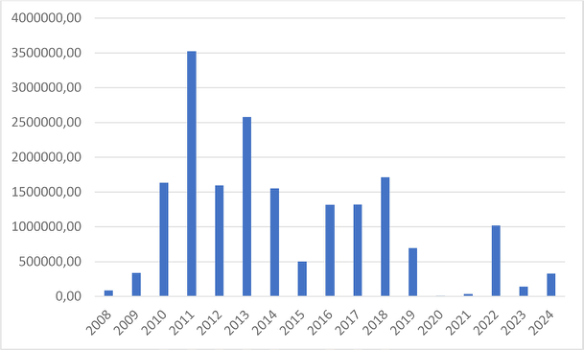
Figure 1: Expenditures of municipal and county-level city budgets incurred in chapters ***78 – Removal of the effects of natural disasters in section 926 – Physical culture in Poland in 2008–2024 in US dollars in 2024. (study based on (Local, 2026; Statistics, 2026; Narodowy, 2026)).
In the budgets of municipalities and cities with county rights, expenditures for removing the effects of natural disasters in the field of physical culture showed a steady increase from 2008 to 2011. This trend peaked in 2011, reaching slightly over USD 3.5 million, before transitioning into a downward trend that continued through 2024 (Figure 1).
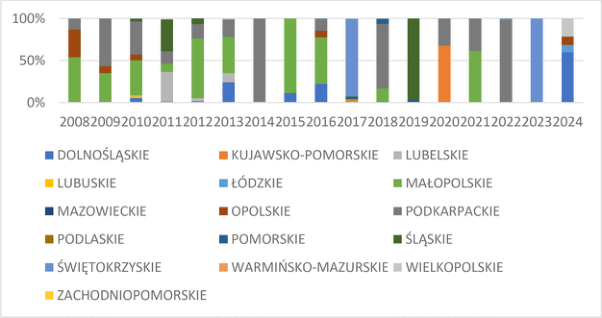
Figure 2: Expenditure of municipal and county-level city budgets incurred in chapters ***78 – Removal of the effects of natural disasters in section 926 – Physical culture – share of individual provinces in total expenditure in Poland in 2008–2024 (%). (study based on (Local, 2026; Statistics, 2026; Narodowy, 2026)).
Spatial analysis revealed shifting regional dominance over the years. The Małopolskie Province accounted for the largest share of municipal and city- with-county-rights expenditures in 2008, 2010, 2012, 2013, 2015, 2016, and 2021. The Podkarpackie Province dominated in 2009, 2014, 2018, and 2022 (reaching a near 100% share in those years). Other leading regions included the Śląskie Province in 2011 and 2019, and the Świętokrzyskie Province in 2017 and 2023 (achieving a 100% share). Kujawsko-pomorskie dominated
the spending in 2020, while Dolnośląskie Province took the lead in 2024. Notably, the Podlaskie and Zachodniopomorskie Provinces were the only regions where municipal and city budgets recorded no expenditures for physical culture disaster relief during the entire analysed period (Figure 2).
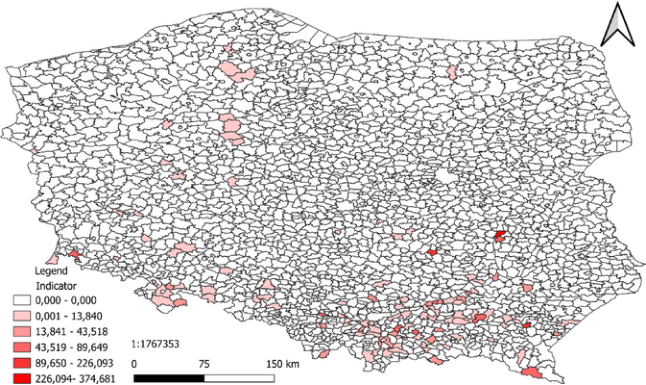
Figure 3: Expenditures of municipal and county-level city budgets incurred in chapters ***78 - Removal of the effects of natural disasters in section 926 - Physical culture in Poland in 2008-2024 to the population of individual units in 2024 in US dollars in 2024. (study based on (Local, 2026; Statistics, 2026; Narodowy, 2026; QGiS, 2026; Head, 2026)).
Finally, disaster relief expenditures in the physical culture section were verified on a per capita basis relative to the type of local government unit (Figure 3). For each category, the five units with the highest expenditure levels were identified (Table 3). The most significant per capita spending was recorded in Janowiec (rural municipality), Jawornik Polski (urban-rural municipality), Bieruń (urban municipality), and Przemyśl (city with county rights).
Table 3: Expenditures of municipal budgets and cities with county rights incurred in chapters ***78 - Removal of the effects of natural disasters in section 926 - Physical culture in Poland in 2008-2024 to the population of individual units in 2024 in US dollars in 2024 by type of local government unit. (study based on (Local, 2026; Statistics, 2026; Narodowy, 2026)).
Table available in the original PDF paper.
No. Name Expenditures (USD 2024/Person) Urban municipalities
1 Bieruń 73,89
2 Zawidów 8,3
3 Szczawno-Zdrój 7,79
4 Przeworsk 5,01
5 Kędzierzyn-Koźle 2,07
(Continued)
Table 3: Continued.
Table available in the original PDF paper.
No. Name Expenditures (USD 2024/Person) Rural municipalities
1 Janowiec 374,68
2 Łapanów 89,65
3 Iwkowa 76,34
4 Cisna 71,06
5 Wilków 69,17
Rural-urban municipalities
1 Jawornik Polski 226,09
2 Suchedniów 134,75
3 Ropczyce 81,94
4 Leśna 68,4
5 Stronie Śląskie 43,47
Cities with county rights
1 Przemyśl 23,77
2 Krosno 1,65
3 Nowy Sącz 1,08
4 Rzeszów 0,09
5 Wrocław 0,02
CONCLUSION
The analysis of disaster relief funding in the physical culture sector reveals a direct correlation between extreme weather events and regional fiscal responses. In the Podkarpackie Province, expenditures were recorded exclusively in 2014, specifically allocated to mitigate the effects of storms (Local, 2026; Piepiora et al., 2015b), which—as noted in the introduction— were among the most frequent natural hazards in Poland between 2008 and 2024 (EM-DAT, 2026). A more complex pattern emerged in the Dolnośląskie Province, where funding was concentrated in 2010, 2011, and 2024. These expenditures were primarily driven by two catastrophic flood events in the Odra and Vistula basins (May–June 2010 and September 2024). Notably, the 2011 outlays represent a ‘lag effect,’ where local governments continued to finance the restoration of infrastructure damaged during the preceding year’s floods (Piepiora, 2019; Jarynowski et al., 2025; Raport, 2025).
At the municipal level (including cities with county rights), 2011 marked the peak of disaster-related spending for physical culture facilities across Poland. This nationwide surge was largely attributed to recovery efforts in municipalities severely impacted by the 2010 floods, such as Bieruń, Kędzierzyn-Koźle, Janowiec, and Ropczyce, as well as major urban centres like Krosno, Nowy Sącz, Rzeszów, and Wrocław (Działek et al., 2017; Piepiora, 2019; Ligenza et al., 2021; Przybyła et al., 2024; Powódź, 2026).
Detailed case studies further illustrate the localized nature of these fiscal burdens. Funding supported recovery from the August 2010 flood in Zawidów (Kostecki et al., 2012) and the 2024 flooding caused by Storm Boris in Szczawno-Zdrój (Jarynowski et al., 2025; Raport, 2025). Other significant interventions included flood relief in Przeworsk and Cisna (2009), Leśna (2012–2013), Iwkowa (2016), Stronie Śląskie (2016), and Jawornik Polski (2021–2022). Storm-specific repairs were also prominent in Suchedniów following the events of 2017 (Local, 2026; Piepiora, 2019).
In summary, the 2008–2024 period in Poland was dominated by storms, floods, and extreme temperatures, mirroring broader European climate trends. The financial burden of restoring physical culture infrastructure was unevenly distributed across administrative levels and regions. And thus, on the provincial level only Dolnośląskie (responding to 2010 and 2024 floods) and Podkarpackie (responding to 2014 storms) recorded expenditures. On the county level no expenditures were recorded for disaster relief in the physical culture sector during the analysed period. Finally, on the municipal level, funding was utilized in nearly all regions, with the notable exceptions of the Podlaskie and Zachodniopomorskie provinces. The findings of the research confirm that the peak of national expenditure occurred in 2011, identifying it as the critical recovery year following the flood of 2010.
REFERENCES
Act of 18 April 2002 on the State of Natural Disaster, consolidated text: Journal of Laws 2025, item 112. (2026 Feb 23). Available from: https://isap.sejm.gov.pl/isap. nsf/DocDetails.xsp?id=wdu20020620558 [in Polish] Act of 25 June 2010 on Sport, consolidated text: Journal of Laws 2026, item 95.
(2026 Feb 23). Available from: https://isap.sejm.gov.pl/isap.nsf/download.xsp/ WDU20101270857/U/D20100857Lj.pdf [in Polish] Alejandria, M.C.P. and Smith, W. (eds.). (2020). Disaster Archipelago. Locating Vulnerability and Resilience in the Philippines. Lanham: Lexington Press. An imprint of The Rowman & Littlefield Publishing Group, Inc. Babczuk, A. and Talik, A. (eds.). (2014). Finansowanie sportu ze środków publicznych
(Financing of Sport from Public Funds). Warsaw: C.H. Beck Publishing. [in Polish] Bal-Domańska, B. (2011). Finansowanie zadań związanych z usuwaniem skutków klęsk żywiołowych w jednostkach samorządu terytorialnego województwa dolnośląskiego w 2009 roku (Financing tasks related to mitigating the effects of natural disasters in local government units of the Lower Silesian Voivodeship in 2009). Vol. 179, pp. 184–195 [in Polish] Bohdanowicz, L. (2024). Praktyka zarządzania klubem piłkarskim. Strategia,
struktura, tożsamość (The Practice of Football Club Management: Strategy, Structure, Identity). Warsaw: CeDeWu Sp. z o.o. [in Polish] Capuno, J., Corpuz, J. and Lordemus, S. (2024). Natural disasters and local government finance: Evidence from Typhoon Haiyan. Journal of Economic Behavior & Organization. Vol. 220, pp. 869–887. DOI: 10.1016/j. jebo.2024.03.007 Centre for Research on the Epidemiology of Disasters (CRED). Emergency Events
Database (EM-DAT), The International Disaster Database. Brussels: UCLouvain. (2026 Feb 16). Available from: https://www.emdat.be
Financing the Removal of the Effects of Natural Disasters 41 Chen, G. (2019). Assessing the Financial Impact of Natural Disasters on Local
Governments. Public budgeting & finance. Vol. 40, No. 1, pp. 22–44. DOI: 10.1111/pbaf.12245 Crow, D.A., Albright, E.A., Ely, T., Koebele, E. and Lawhon L. (2018). Do Disasters Lead to Learning? Financial Policy Change in Local Government. Review of Policy Research. Vol. 35, No. 4, pp. 564–589. DOI: 10.1111/ropr.12297 Deryugina, T. (2022). “The fiscal consequences of natural disasters”, in: Handbook
on the Economics of Disasters. Skidmore M, editor. Cheltenham: Edward Elgar Publishing. DOI: 10.4337/9781839103735 Dylewski, M. and Filipiak, B.Z. (2018). Finansowanie zadań z zakresu likwidacji skutków katastrof naturalnych w jednostkach samorządu terytorialnego szczebla powiatowego (Financing of Tasks Related to Mitigating the Effects of Natural Disasters in County-Level Local Government Units). Scientific Fascicles of SGGW: European Policies, Finance, and Marketing. Vol. 20, No. 69, pp. 48–59. DOI: 10.22630/PEFIM.2018.20.69.28 Działek, J., Biernacki, W., Konieczny, R., Fiedeń, Ł., Franczak, P., Grzeszna, K.
and Listwan-Franczak, K. (2017). Zanim nadejdzie powódź (Before the Flood Comes). Kraków: Institute of Geography and Spatial Management. Uniwersytet Jagielloński w Krakowie. [in Polish] Google Scholar. (2026 Feb 18). Available from: https://scholar.google.com Grabowski, A. (2025). Finansowanie sportu profesjonalnego oraz stadionów piłkarskich w Polsce przez jednostki samorządu terytorialnego. Przykłady i implikacje (The Financing of Professional Sports and Football Stadiums in Poland by Local Government Entities: Examples and Implications), Warsaw: Polskie Wydawnictwo Ekonomiczne S.A. [in Polish] Head Office of Geodesy and Cartography (GUGiK). Home page. Data. National
Register of Boundaries. (2026 Feb13). Available from: https://www.geoportal. gov.pl/en/data/national-register-of-boundaries/ Ishida, M., Ohno, T. and Kobayashi, W. (2023). Natural disasters and local government finance. Policy Review. Vol. 19, No. 2, pp. 1–41. (2026 Feb 23). Available from: https://www.mof.go.jp/english/pri/publication/pp_review/ppr19_02_02.pdf Janowicz-Lomott, M. and Lyskawa, K. (2013). “Financing the effects of catastrophic
events in local government units – the search for the optimal solution”. In: Filipovic, D. and Goltnik Urnaut. A., editors. Economic and Social Development: Book of Proceedings of the 2nd International Scientific Conference, Paris, France, 5th April 2013. Celje: Varazdin development and Entrepreneurship Agency, Varazdin, Croatia and Faculty of Commercial and Business Sciences. Jarynowski, A., Maksymowicz, S., Nowakowska, I., Romanowska, M., Mokrzycki, P. and Stochmal, M. (2025). Powódź 2024 w Polsce w perspektywie społecznych aspektów Jednego Zdrowia publicznego (The 2024 Flood in Poland from the Perspective of the Social Aspects of One Health). Wrocław: IBI. [in Polish] Kostecki, S., Rędowicz, W., and Machajski, J. (2012). Wpływ stanu technicznego na
katastrofę zapory zbiornika wodnego Niedów (The Impact of Technical Condition on the Catastrophe of the Niedów Reservoir Dam). Przegląd Budowlany; Vol. 5, pp. 96:99. [in Polish] Ligenza, P., Tokarczyk, T. and Adynkiewicz-Piragas, M. (eds.). (2021). Przebieg i skutki wybranych powodzi w dorzeczu Odry od XIX wieku do czasów współczesnych (The Course and Consequences of Selected Floods in the Odra River Basin from the 19th Century to the Present Day). Warszawa: Instytut Meteorologii i Gospodarki Wodnej Państwowy Instytut Badawczy. [in Polish]
Local Data Bank Statistics Poland. (2026 Jan 31). Available from: https://bdl.stat.
gov.pl/bdl/start Miao, Q., Chen, C., Lu, Y. and Abrigo, M. (2019). Natural Disasters and Financial Implications for Subnational Governments: Evidence from China. Public Finance Review. Vol. 48, No. 1, pp. 72–101. DOI: 10.1177/1091142119884710 Narodowy Bank Polski. (2026 Feb 13). Home page/Statistics/Rates/Table no. 030/A/
NBP/2026 of 2026-02-13. available from: https://nbp.pl/en/archiwum-kursow/ table-no-030-a-nbp-2026-of-2026-02-13 Pieniążek, M., Szejgiec, B., Zych, M., Ajdyn, A. and Nowakowska, G. (2014).
Graficzna prezentacja danych statystycznych. Wykresy, mapy, GIS (Graphical Presentation of Statistical Data: Charts, Maps, GIS). Warszawa: Główny Urząd Statystyczny. [in Polish] Piepiora, P.A., Piepiora Z.N., Stackeová, D. and Bagińska, J. (2023). Editorial: Physical culture from an interdisciplinary perspective. Front. Psychol. Vol. 14, pp. 1254027. DOI: 10.3389/fpsyg.2023.1254027 Piepiora, Z. (2012). Ekonomiczne aspekty lokalnej polityki przeciwdziałania
skutkom katastrof naturalnych (Economic Aspects of Local Policy for Mitigating the Effects of Natural Disasters). Kowary: Zbigniew Piepiora [in Polish] Piepiora, Z., Kachniarz, M. and Babczuk, A. (2015a). “Financing the counteraction of natural disasters’ effects in Lower Silesian voivodeship”. In: Wang, M., editor. 2015 International Conference on Management Engineering and Management Innovation (ICMEMI 2015), Proceedings of the 2015 International Conference on Management Engineering and Management Innovation, Changsha, China from January 10-11, 2015. Zhengzhou: Atlantis Press. DOI: 10.2991/ icmemi-15.2015.39 Piepiora, Z.N. (2019). Ekonomiczna efektywność strukturalnej ochrony przeciwpowodziowej w Polsce (The Economic Efficiency of Structural Flood Protection in Poland). Wrocław: Wydawnictwo Uniwersytetu Przyrodniczego. [in Polish] Piepiora, Z.N., Kachniarz, M., Babczuk, A. and Piepiora, P. (2015b). “Counteracting
the natural disasters effects in Subcarpathian Voivodeship”. In: Jedlička, P., editor. International Conference Hradec Economic Days 2015: Economic Development and Management of Regions; 2015 Feb 3-4; Hradec Králové, Czech Republic. Gaudeamus: University of Hradec Králové, pp. 110–115. Piepiora Z.N. and Kachniarz, M. (2019). “The Measurement of Budget Outlays of Local Government Units for Removing the Natural Disasters’ Effects”. In: Corlătean, T., editor. RAIS Conference Proceedings. The 14th International RAIS Conference on Social Sciences and Humanities on August 19-20, 2019. Princeton: RAIS. Flood 2010 Report. Bieruń, 7th July 2010 (2026). Available from: https://
archiwumbip.bierun.pl (accessed on 2026 Mar 02). Przybyła, K., Hełdak, M., Kachniarz, M., Ramsey, D., Kulczyk-Dynowska, A.
and Szara, K. (2024). The Central Functions of Cities in Poland in Light of Administrative Reform. Sustainability, Vol. 16, No. 18, pp. 8097. https://doi. org/10.3390/su16188097 Przywora, B., Żelasko-Makowska, E. and Paradowski, M. (2024). “Economic and Legal Aspects of Mitigation of the Natural Disaster Effects on the Example of Floods in Poland”. In: Kot, S., Khalid, B. and ul Haque, A., editors. New Challenges of the Global Economy for Business Management. Global Conference on Entrepreneurship and the Economy in an Era of Uncertainty 2024. Singapore: Springer Nature. DOI: 10.1007/978-981-96-4116-1_28 QGIS. (2025 Aug 13). Available from: https://qgis.org
Financing the Removal of the Effects of Natural Disasters 43 Report on the review and update of the preliminary flood risk assessment for the 3rd
planning cycle. Annex No. 7. Flood of September 2024. (2025). Warsaw: State Water Holding Polish Waters. [in Polish] Scopus. (2026 Feb 18). Available from: https://www.scopus.com Siwiec, E. (ed.). (2022). Atlas skutków zjawisk ekstremalnych w Polsce (Atlas of the Impacts of Extreme Events in Poland). Warsaw: Institute of Environmental Protection – National Research Institute. [in Polish] Standar, A. (2025). Finansowanie usuwania skutków klęsk żywiołowych przez
jednostki samorządu terytorialnego w Polsce wobec narastającego ryzyka klimatycznego (Financing the remediation of natural disaster effects by local government units in Poland in the face of growing climate risk). Annals of the Polish Association of Agricultural and Agribusiness Economists. Vol. 27, No. 4, pp. 176–192. DOI: 10.5604/01.3001.0055.3167 [in Polish] Statistics Poland. Yearly price indices of consumer goods and services from 1950.
(2026 Feb 11). Available from: https://stat.gov.pl/en/topics/prices-trade/price- indices/price-indices-of-consumer-goods-and-services/yearly-price-indices-of- consumer-goods-and-services-from-1950/ Żołądkiewicz Kuzioła, A., Krupa, D. and Walczak, D. (2020). Financing physical culture by local government units. Journal of Physical Education and Sport® (JPES). Vol. 20, No. 5, pp. 2845–2850. DOI:10.7752/jpes.2020.s5386
LISTED IN THE AHFE DIGITAL BOOKSTORE CATALOGUE
Explore the complete digital volume
Human Factors in Sports, Preventive Medicine and Innovative Agonology
Read this individual research paper free through the original publisher, or explore the full digital proceedings book.
ISBN 979-8-950676-02-4
Explore this ISBN in the AHFE Bookstore ↗Listed in the July 2026 bookstore catalogue; search by ISBN to confirm current availability · Digital book purchase optional