Dries Matthys, Siemen Lippens, Stijn Verwulgen (2024). Prism Glasses Reduce Aerodynamic Drag in Time Trial Cycling on The Velodrome. In: Human Factors in Sports, Performance and Wellness. AHFE Open Access, vol. 150, pp. 12–20. https://doi.org/10.54941/ahfe1005285
In the highly competitive world of cycling time trials, reducing aerodynamic drag is the most important instrument to increasing performance. This study explores the effects of using prism glasses, already used by climbers, to prevent overstraining neck muscles while securing another climber above, as a new tool to decrease aerodynamic drag in cycling time trials. The prism glasses shift a person’s vision with 45°, allowing the cyclist to keep their head tucked and pointed downwards, while still being able to see the road ahead. This study compared this downward, more ergonomic position with the glasses with an upright time trial head position in five high level cyclists on an indoor velodrome. The setup and methodology of the study was approved by the ethical commission of the University of Antwerp, allowing for the cyclists to ride on the velodrome at high speeds of 45 km/h with the glasses. The study revealed significant improvements in aerodynamic drag (CdA) for participants when wearing prism glasses while obtaining a downward head position, compared to the normal upward head position during cycling. Participants showed reductions in CdA ranging from 2.1% to 3.3% compared to normal racing position. Results were confirmed across all participants with frontal area tracking on a static indoor bike trainer (FAAST-trainer pro), where cyclists held an identical position to the one during the velodrome tests. Participants were able to comfortable use the glasses at high speeds in straight sections, however not in corners. The balance of the ride is affected by the glasses, but the learning curve proved to be steep for the participants in this study.
Aerodynamics is the study of how air flows over objects and the forces that the air and objects exert on each other. Drag is the force of wind or air resis- tance pushing in the opposite direction to the motion of the object, in our case, the cyclist and the bike (Science learning Hub, 2014).
In cycling time trials, cyclists refine their posture to optimize aerodynam- ics, aiming to minimize air resistance and gain crucial time advantages that can impact the race’s outcome (Schaffarczyk et al., 2022). Understanding the aerodynamics of cycling is crucial for optimizing performance and effi- ciency. About 90% of the overall resistance experienced by cyclists is caused by the aerodynamic drag, when cycling at speeds between 35 km/h and 55 km/h (Grappe et al., 1997). The primary source of aerodynamic drag stems
Prism Glasses Reduce Aerodynamic Drag in Time Trial Cycling on the Velodrome 13
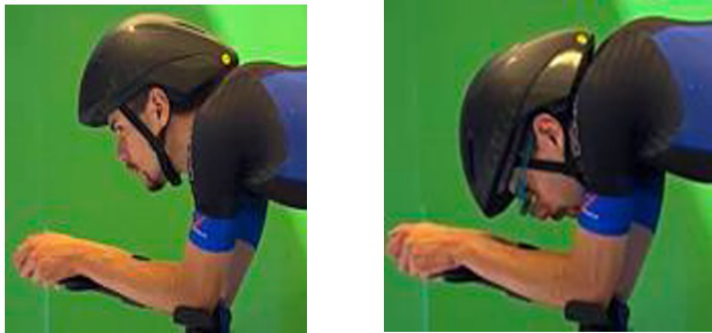
from the cyclist’s body, typically contributing to 60% to 82% of the over- all drag, depending on the rider’s position on the bicycle. The residual drag is attributed to the bicycle itself (Malizia and Blocken, 2020). The drag is directly linked to the effective frontal area and the shape of the cyclist, which is influenced by a cyclist’s body position. The larger the frontal area, the more collisions with the wind and the greater the drag. However, the contribution of shape to drag is up to five times smaller than the contribution of frontal area (Matthys et al., 2023). To reduce aerodynamic drag, a cyclist will both use optimized equipment and an optimal body position on the bike, to opti- mize drag. This study focuses on the specific topic of the change in the head position of a cyclist to attempt to reduce aerodynamic drag. Changing the head position as in Figure 1 leads to an alteration in frontal surface area, and in particular a decrease in aerodynamic drag.
Figure 1: Forward head position (left) versus downward head position (right), (Matthys et al., 2023).
This adjustment involves cyclists looking down towards the ground instead of keeping their gaze forward. Moreover, applying this downward position of the head reduces the tension in the posterior neck muscles and thereby contributes to an enhanced ergonomic position for the cyclist. As a result, cyclists often tilt their heads in alignment with their bodies, not only to reduce aerodynamic resistance but also to attain a more ergonomic position.
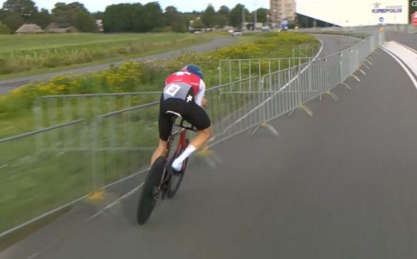
However, this adjustment can compromise their visibility of the road ahead, potentially leading to accidents. For example, the accident of Stefan Kung at the EC TT 2023. Maintaining an aerodynamically inclined position with a lowered head, Kung failed to perceive the gradual reduction in track width, as shown in Figure 2. Unaware of the impending spatial limitation, he collided with the barriers, resulting in minor injuries and a concussion (road.cc article, 2023). This is an example of non-awareness of the track by the cyclists whilst being in total concentration and cycling in the aerodynamic position with the head down.
Figure 2: Picture right before accident of Stefan Kung (EC TT 2023 Drenthe, Netherlands).
This study focuses on the possible implementation of a new intervention to help the cyclist be more aerodynamic and be safer in this downward head position. It is interesting to note that sport climbers are already using a tool to respond to similar needs. They use prism glasses as an optical aid for moni- toring their companion above their head to avoid straining the posterior neck muscles (Schweizer, 2012). Prism glasses are glasses designed to modify the angle of your field of vision. It would allow cyclists to maintain a clear line of sight in the forward direction, while at the same time allowing the neck to maintain a more ergonomic-and a more aerodynamic-position.
In a previous study (Matthys et al., 2023), a consistent reduction in frontal surface area was found in one subject when wearing prism glasses on a static smart trainer, more specifically on a FAAST-trainer: a physical immersive exercise bike that emulates posture, velocity, and power delivered by the user through an adaptable power load adjusted in real-time. In this study, a one-subject case was presented. This follow-up research will present five par- ticipants and expand the environment from an indoor static measurement to a controlled outdoor environment by using a velodrome.
The specific focus is on determining whether the use of prism glasses can lead to an effective reduction in aerodynamic drag in outdoor cycling. In addition, the potential ergonomic benefits associated with the use of prism glasses will be investigated. A third aspect of this study delves into the aspect of safety. Specifically, we inquire if the use of prism glasses allows the cyclist to maintain an unobstructed view of the road ahead, removing the danger caused by the aerodynamic downward head position. On top of visibility, it is crucial to consider the impact on balance and response time while cycling with these prism glasses as it holds critical importance on whether these prism glasses are safe to wear in time trials. Ultimately, this study seeks to answer the question of whether prism glasses can improve performance in outdoor cycling, in a first step, confined to velodrome racing.
MATERIALS AND METHODS
The methodology designed for this study is aimed at being the first real- life cycling test for cycling with the prism glasses at high speeds in a safe
Prism Glasses Reduce Aerodynamic Drag in Time Trial Cycling on the Velodrome 15
environment. Cycling on a velodrome allows for this safe environment and for accurate aerodynamic measurements. The protocol of the study consisted of two parts, 1) riding on the velodrome and 2) frontal surface area mea- surements while riding on the FAAST-trainer. The study was approved by the joint ethical committee of the University of Antwerp and University hospital Antwerp February 2023 (internal reference number 5186). All participants gave informed consent.
This study contains five participants. Each participant is a triathlete with 10+ years of experience in road cycling and cycling in a time trial position. As such, all participants are comfortable with riding on the velodrome at high speeds. All tests were conducted on the 250m indoor velodrome of Wielercentrum Eddy Merckx (Ghent, Belgium).
Participants used their own bike, either a time trial bike or a race bike with time trial extensions mounted on the handlebars. For the velodrome aerody- namic tests, the tires of each bike are inspected before and after testing to have a fixed pressure of 7.0 bar, to control the impact of varying rolling resis- tance on the results. All drivetrains were in good condition and lubricated, therefore we use the general estimation of 97.7% for drivetrain efficiency. To measure the power output the athletes produced during the tests, each bike is equipped with a power meter, which is calibrated before the start of the tests. The speed of the cyclists is measured with an on-wheel mounted speed sensor (e.g., Garmin speed sensor 2) cross checked with time-distance measurements at the velodrome. To collect all the data, a cycling computer is connected to the speed- and power sensor.
The weight of the cyclist and bike were measured before and after testing as this is important to calculate the rolling resistance of the cyclist. The envi- ronmental parameters (temperature, air density and humidity) are constantly monitored as they are important for the calculation of the drag (CdA) from the power and speed data of the participants.
After warmup on the velodrome, and some time to get comfortable riding with the prism glasses, each participant performed the following test runs on the velodrome:
2*5 laps at around 45 km/h with vision forward.
2*5 laps at around 45 km/h with the prism glasses.
2*5 laps at around 45 km/h with vision forward.
2*5 laps at around 45 km/h with the prism glasses.
To prevent fatigue from influencing the participant’s ability to ride at a constant speed, rest is provided between the test runs, until the participant indicates to be fully recovered.
After performing all the tests, the participants filled out the questionnaire about their experience: focus on safety, ergonomics, ease of use of riding with the prism glasses on the velodrome. The answers are used to sketch how the tests, and thus riding with the prism glasses, were perceived by the participants to indicate their perception of safety, ergonomics, ease of use and possible use in outdoor cycling environments.
Lastly, the participants were put on the FAAST-Trainer, a stationary setup consisting of the participant’s bike mounted on a smart trainer and a 3D- depth camera that records the frontal surface area of the participant during the test runs, where they performed another two tests of approximately 2min in the same position as on the velodrome. Their frontal surface area was recorded during these two minutes, once with the prism glasses and the head down and once with vision forward. This data is used to compare static frontal surface area with dynamic cycling CdA from the velodrome tests.
The power and speed data obtained during the velodrome tests, together with all relevant static parameters are used to calculate the CdA if the participant in each run. This calculation is done using a webapp designed by Streamline Cycling (Streamline Cycling, n.d.). The calculations for the obtained CdA are based on the virtual elevation method or ‘Chung method’, the most accurate way of obtaining CdA in real-life cycling aerodynamic tests. The statistical analysis of these results is performed in Excel, the significance level set to 0.05.
RESULTS
The processing of the power and speed data of the velodrome tests, together with all the measured and estimated constant parameters, resulted in 4 CdA’s per intervention. The application of a paired t-test on these two groups of 4 CdA’s revealed a statistically significant one-tailed difference between riding with the prism glasses and the normal head position with vision forward in all participants for the velodrome tests, as shown in Table 1.
Table 1. Summary of the processed mean CdA values of the velodrome tests with and without the prism glasses.
Secondly, the measurements conducted with the FAAST-trainer resulted in frontal surface area differences shown in table 2, this table shows a CdA value, note that this is a constant Cd and the variable measured A (frontal surface area). Thus, the absolute values in this test should not be compared. A paired T-test showed that for all participants these differences were statis- tically significant (p<0,001) as they are made of 10 data points per second, for 2 minutes with a small standard deviation.
Lastly, the questionnaires filled in by all participants revealed insights into their experience with and opinion about cycling with the glasses. The answers were similar for all participants and can be summarised as:
Prism Glasses Reduce Aerodynamic Drag in Time Trial Cycling on the Velodrome 17
Initially there was a lot of difficulty riding with the glasses, but there was a steep learning curve.
They felt safe riding with the glasses after some time. However, they would not feel that way outside or with others on the track.
They did not feel any ergonomic differences in neck position in these short test runs.
Taking the banked curves of the velodrome while looking through the glasses was not possible, however using them in the straight section was perceived relatively comfortable after a while.
They would use the prism glasses in future cycling time trials, on a course with a lot of straights and if the aerodynamic benefit were sufficiently large. They believe in the idea, although it is not yet safe enough.
Table 2. Summary of results of frontal surface area measurements with FAAST-trainer.
The results of the study showed that all five participants became more aerody- namic when using the prism glasses in comparison to a forward vision. That this would happen in the FAAST tests for frontal surface area was expected from the previous study (Matthys et al., 2023). However, this paper does not only show that it is possible to ride on the velodrome at high speeds with the glasses, but on top of that the data suggests that as well as on the FAAST, during real-life cycling, these prism glasses reduce drag.
As shown in Table 1, the reduction in CdA is between 2 and 3.3% for all participants. This is noticeably lower than the reduction in frontal surface area measured on the FAAST-trainer. There are a few possible explanations, or a combination of them for this discrepancy: 1) the perfect downward head position was not held on the velodrome as the participants lifted their head slightly in the turns, since their balance was disturbed by their vision if they would look through the glasses, 2) The participants’ position was not as steady while using the prism glasses, due to more effort required to keep bal- ance and more cognitive load, 3) The Cd when using the prism glasses might slightly differ from the Cd with the vision forward, 4) even though enough
rest was provided, fatigue could have influenced the ability of the partici- pants to ride at a constant speed while being extremely focused on riding as close as possible to the line on the velodrome.
Next to the difference between the frontal surface area measurements, there also is a slight difference between the participants that should be dis- cussed. As stated in (Crouch et al., 2017), the effectiveness of any type of bicycle equipment or position change is dependent on the cyclists position and morphology. This implies that the reduction measured in this study for this cyclist with this equipment cannot be extended to all cyclists.
We know for sure that the CdA is reduced, however we have no exact data supporting that Cd is also reduced. However, we know from previous research with CFD-analysis that a downward head position (in their case with prism glasses) also reduced Cd, as the airflow around the head and shoulders of the cyclist is altered, due to the head and helmet closing the gap between the upper arms of the cyclist, as shown in Figure 1. Additionally, this down- ward head position allows a cyclist to shrug their shoulders. this is customary practice in cycling time trials when a low head position is held. Shrugging is bringing the neck and shoulders closer to the head to reduce drag. Shrug- ging with the normal head position is biomechanically more difficult and less effective as the tension on the neck and shoulders is too high. However, in this study we asked the participants not to shrug and only alter the head position. Since shrugging is easier with the tucked head, it is hypothesised to make the benefit of riding with prism glasses even larger.
From the answers of the participants on the questionnaire, asking for their opinions about and perceptions from riding with the glasses, we can identify several links between participants’ perceptions and aerodynamic test results. As there was only a limited time to adjust to the prism glasses, their might have been a learning curve within the experiment. As a participant would not be as comfortable yet in the beginning with the glasses, this could result in a less ideal head position, a less constant line on the track and less con- stant speed. These are all factors influencing the result or the accuracy of the resulting CdA.
This translation from the drag reduction shown on the FAAST-trainer into a significant drag reduction in multiple participants while riding a bike at high speed is a step in the right direction for possible implementation of this technology in cycling time trials.
The methodology of this study was designed in such a way that a next phase of the use of prism glasses could be assessed in a valid, safe, and con- trolled way. However, this paper does acknowledge a few limitations of the methodology. First, the inability to monitor the exact neck angle and position of the participants during the velodrome tests to strengthen the claim of the causal relationship between the prism glasses and the reduced drag. Second, due to limited time on the track for this first real-life test of the glasses, there was a limited sample size of five male cyclists doing a limited number of test runs while being not 100% comfortable with the glasses just yet. We strongly suggest future research to increase the time spent riding with the glasses.
In future work, there should be a focus on quantifying the aspect of safety, balance, and response time in order to take steps towards for example UCI
Prism Glasses Reduce Aerodynamic Drag in Time Trial Cycling on the Velodrome 19
approval to use the glasses in time trials. On top of that, we strongly recom- mend designing and adapting different forms of the prism glasses to further increase usability. For example, only one eye, being able to put them on and off while riding. For example: A study that was performed in parallel with this paper explored a new and improved design with the ability to choose the angle of the prism was designed.
Lastly, we believe helmet design and helmet choice can have a major impact on the CdA in this downward position, this is another aspect that should be explored to further decrease drag while using the glasses.
CONCLUSION
This study aimed to analyse the effect of the use of prism glasses on aerody- namic drag on a cyclist in time trial position in a real-life cycling environment and further asses its usability. Five experienced cyclists performed aero- dynamic testing on a velodrome with and without the prism glasses. All participants had a drag reduction between 2.0 and 3.3% while wearing the glasses on the velodrome. Frontal surface area measurements while riding on a smarttrainer showed a reduction in A between 3.0 and 8.8%. The partici- pants found the glasses to disturb their balance and confidence on the bike; However, they all had a steep learning curve in their ability to ride with the glasses at high speeds around the velodrome. Cycling on the straight section of the velodrome was perceived to be safe and comfortable, cycling in the banked turns was not possible while looking through the glasses as there was too much disturbance of balance. The results from this study show that the use prism glasses is possible in real-life cycling on straight sections. On top of that, it will be faster than a head position with forward vision. Further exploration into design, alternative and optimisation of the glasses should be performed before use in cycling time trials racing on the open road.
REFERENCES
Causes of aerodynamic drag (no date) Science Learning Hub. Available at: https:// www.sciencelearn.org.nz/resources/1346-causes-of-aerodynamic-drag (Accessed: 20 February 2024). Crouch, T. N. et al. (2017) ‘Riding against the wind: a review of competition cycling
aerodynamics’, Sports Engineering, 20(2), pp. 81–110. Available at: https://doi.or g/10.1007/s12283-017-0234-1. Former UCI chief calls for crackdown on “crazy” head-down time trialling after Stefan Küng’s bizarre crash straight into barriers at European Championships (2023) road.cc. Available at: https://road.cc/content/news/calls-crackdown-head-down-p osition-after-kung-crash-303981 (Accessed: 20 February 2024). Grappe, F. et al. (1997) ‘Aerodynamic drag in field cycling with special reference
to the obree’s position’, Ergonomics, 40(12), pp. 1299–1311. Available at: https: //doi.org/10.1080/001401397187388. Malizia, F. and Blocken, B. (2020) ‘CFD simulations of an isolated cycling spoked wheel: Impact of the ground and wheel/ground contact modeling’, European Jour- nal of Mechanics - B/Fluids, 82, pp. 21–38. Available at: https://doi.org/10.1016/ j.euromechflu.2020.02.002.
Matthys, D. et al. (2023) ‘An Optical Intervention to Improve Cycling Time Trials: A Feasibility Study’, Applied Sciences, 13(5), p. 3274. Available at: https://doi.or g/10.3390/app13053274. Schaffarczyk, A. et al. (2022) ‘Aerodynamic Benefits by Optimizing Cycling Pos-
ture’, Applied Sciences, 12(17), p. 8475. Available at: https://doi.org/10.3390/ap p12178475. Schweizer, A. (2012) ‘Sport climbing from a medical point of view’, Swiss Medical Weekly [Preprint], (41). Available at: https://doi.org/10.4414/smw.2012.13688. Streamline Cycling (no date). Available at: https://streamline-cycling.com/ (Accessed:
20 February 2024).
LISTED IN THE AHFE DIGITAL BOOKSTORE CATALOGUE
Explore the complete digital volume
Human Factors in Sports, Performance and Wellness
Read this individual research paper free through the original publisher, or explore the full digital proceedings book.
ISBN 978-1-964867-26-7
Explore this ISBN in the AHFE Bookstore ↗Listed in the July 2026 bookstore catalogue; search by ISBN to confirm current availability · Digital book purchase optional