Senne Henderieckx, Alexander Van Gastel, Jochen Vleugels, Sam Smets, Stijn Verwulgen (2022). Cycling Stability and Symmetry using a Corrective Bib Short. In: Physical Ergonomics and Human Factors. AHFE Open Access, vol. 63, pp. 36–44. https://doi.org/10.54941/ahfe1002594
In cycling, biomechanical posture optimization strives to improve core stability and symmetry in the lower and upper extremities to raise power output. In addition, the shape and pose of the cyclists determine the projected frontal area, which is the major factor influencing drag during cycling. In this study, a high-fidelity prototype garment was developed that includes kinetic bands and proprioceptive devices to adjust biomechanical posture during cycling. The aim is to measure improved projected frontal area, stability, and symmetry as a result of wearing a corrective cycling garment. Thirty participants were gathered under strict exclusion criteria to ensure a representative sample of the population. Two exploratory studies were conducted: experimental and reference measurements of 1) 11 cyclists’ pedal balance and projected frontal area, and 2) 5 cyclists’ biomechanical movements through an optical motion tracking system. The results indicate an improved pedal balance and deteriorated stability and symmetry for the corrective bib short.
Despite innovations have yielded performance improvements through enha- nced user experience (Barry et al., 2015), and aerodynamics (Malizia and Blocken, 2020), the aspect of biomechanics remains largely neglected. In this study, a high-end prototype cycling bib short is developed to adjust biomechanical posture while cycling.
Bioracer Motion (Bioracer, Tessenderlo, Belgium) is an analysis tool capa- ble of measuring simultaneous bilateral movements and has provided insight on cyclists’ biomechanics. It shows that riders perform a systematically asymmetric movement, leading to instability during repetitive dynamically imposed circular cycling. This causes suboptimal power transfer, where part of the rider’s energy is spent on continuous postural correction. Other stu- dies have shown that physical abnormalities together with suboptimal bicycle settings, equipment failure, and wear can also lead to this phenomenon and injuries (Schwellnus and Derman, 2005; Willson et al., 2005; Pouliquen et al., 2018). Moreover, optimal power transfer, and asymmetric and unbalanced cycling movements have a negative impact on drag. For which the projected frontal area is the largest influence (Defraeye et al., 2010).
Cycling Stability and Symmetry Using a Corrective Bib Short 37
Recent studies suggest that increasing trunk stability might be a key aspect of efficient power transfer, flowing movements, and stability in limbs (EnergyLab, 2019). For instance, Bioracer revealed that the major asym- metry occurs in the pelvis and hip area. One theory is that the trunk is not connected to the bicycle during cycling, whereas feet are affixed to the bike through click pedals and hands firmly grip the handlebars. To improve overall balance and symmetry, the hip region should be corrected or limi- ted in terms of freedom of movement. However, if the correction is carried out by means of bicycle adjustments, the problem could partially shift to other areas (Menard et al., 2020). This phenomenon is referred to as com- pensation and results in an additional layer of complexity as the proposed garment should not only improve symmetry and stability to the pelvis and hips, but also reduce effects of compensation. However, there is no consensus on the direct positive effect of better symmetry and stability on performance (Maloney, 2018).
Effective interventions are compression technologies. Firstly, proprio- ceptive interventions have proven potency (Han et al., 2016), providing constant pressure to the gluteus maximus, stimulating symmetric limb move- ment, and stabilizing the trunk (EnergyLab, 2019). Secondarily, kinetic bands have proven potency (Williams et al., 2012; Trecroci et al., 2019) and pro- viding corrective forces to important cycling muscle groups (e.g., adductors and piriformis) (Kalron and Bar-Sela, 2013).
MATERIALS AND METHODS
Participants Thirty participants were only included after satisfying the following criteria: 1) familiar with cycling, 2) ownership of a racing bicycle, 3) no history of pain related to cycling, 4) informed consent after the nature and any risk were provided. Afterwards, participants with a medium size for cycling clo- thing were selected for statistical analysis. For the first experimental study 11 participants were included (0 female, 11 male; 1 competitive cyclist, 5 trained cyclists, 5 untrained cyclists; age 28.73 ± 3.35 years; body mass 80.59 ± 2.22 kg; height 1.85 ± 0.02 m; functional threshold heart rate 159.82 ± 4.35 bpm). Competitive cyclists are considered as riders who regu- larly participate in competitive races. The second experimental study includes 5 participants (0 female, 5 male; 0 competitive cyclists, 5 trained cyclists, 0 untrained cyclists; age 31.6 ± 5.56 years; body mass 80.88 ± 1.19 kg; height 1.83 ± 0.02 m). Participants’ age varies between 20 and 50 years and include healthy males without proprioceptive restrictions. Both exploratory studies were conducted from October 2021 till December 2021. Ethical approval was obtained from the ethics committee of the Antwerp University Hospital and the University of Antwerp.
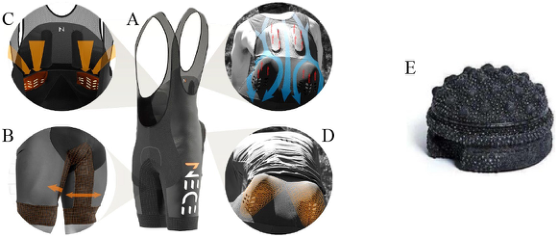
Corrective Cycling Bib Short The corrective bib short is equipped with embeddable compression devices (see Figure 1). Constant pressure is applied to both the gluteus maximus
Figure 1: (A) Corrective cycling bib short with (B) kinetic Tevo bands and (C) internal pockets to place (D) the proprioceptive devices. (E) The device consist of a flat side and a convex shape side with a knobby surface positioned on the gluteus maximus.
through expanded polypropylene devices (BLACKROLL®, Bottighofen, Switzerland). This should improve hip and knee alignment, and spread the effect inferiorly throughout the leg. Furthermore, the gluteus maximus’ tran- sverse and frontal plane hip motion correlates with frontal plane knee motion (Hollman et al., 2014). Lastly, the gluteus maximus functions as the provider of power and stability during a dynamic cycling movement (Hug and Dorel, 2009; Holliday et al., 2019). One kinetic Tevo band (Bioracer, Tessenderlo, Belgium) is located at the adductors from origin to insertion and runs across the groins. This application of Tevo bands should stimulate a leg movement where the ankle, knee, and hip are in line. They provide a subtle countera- cting force in response to the abduction of the upper legs and knees during cycling.
Exploratory Study 1 The first exploratory study is a randomized, placebo-controlled intervention study and consists of a comparison between participants’ projected frontal area and pedal balance while using a corrective cycling bib or control bib. Participants performed tests during two sessions. To avoid the influence of the first session on the second, they were conducted across two different days, with minimally one day in between. The first session involves a Hunter- Coggan protocol exertion test: 1) twenty minutes moderate cycling, 2) three repetitions of one minute at 100 rpm with one minute in between to rest, 3) five minutes moderate, 4) five minutes all-out, 5) ten minutes calmly, and 6) twenty minutes all-out. During the final twenty minutes, measurements were taken to determine the functional threshold heart rate (FTHR). Lastly, a fifteen-minute down-warming step concluded the first session of experiment one. The second session’s procedure goes as follows: 1) three-minute warm- up at a chosen cadence and power, 2) five-minute incremental heart rate test, 3) one-hour ride at a moderate pace to reach a state of fatigue, 4) five-minute incremental heart rate test. Step (2) is repeated consecutively to take perfor- mance measurements with both the corrective cycling bib and control bib. Similarly, step (4) is also repeated consecutively, with the added factor of
Cycling Stability and Symmetry Using a Corrective Bib Short 39
fatigue achieved as a result of step (3). During each minute of the incremen- tal heart rate test, the participant is encouraged to hit a heart rate zone that is one level higher than the previous. Each participant’s specific heart rate zones were determined with the FTHR taken during the Hunter-Coggan protocol in session one.
Indoor Rider-Bike Training System For the first exploratory study, an indoor rider-bike training system (Vox- dale, Wijnegem, Belgium) was used to measure the projected frontal area and pedal balance. The projected frontal area is measured through an infrared depth-sensing camera (Intel RealSense Depth Camera D415, Intel corpora- tion, USA). The system monitors the real-time projected frontal area of the cyclist and bicycle and actively adjusts the output resistance of the smart trainer (Wahoo KICKR, Wahoo Fitness). This results in a simulation of drag forces that occur in real-world scenarios as a result of undesirable biomech- anical movements (e.g., lateral movement in the frontal plane of the body). Projected frontal area, drag area, distance, power output and speed are con- stantly measured by the indoor rider-bike training system (Peeters et al., 2020). The pedal balance is measured with the help of a pulse sensor attached to the left chain stay of the bike frame and is outputted in milliseconds. The pedaling cycle is divided into 48 segments; each is calculated during cycling. The average of right pedal values is subtracted from the left pedal values. Consequently, a positive value indicates a more powerful right pedaling and vice versa for left, e.g., 5 time units as left value, -10 time units as right value, result in 15 time units and indicates an acceleration in the right pedal cycle. An outcome closer to zero indicates a pedal balance, thus a more stabilized and symmetric pedaling result.
Heart rate was monitored using the Polar H10 module (Polar, Kempele, Finland).
Exploratory Study 2 The second exploratory study was a randomized, placebo-controlled inte- rvention study and consisted of a comparison between participants’ symme- try and stability performances while using a corrective cycling bib or control bib. The procedure followed these steps: 1) a three-minute warm-up ses- sion at a moderate pace, 2) eight-minute cycling at incrementally increasing wattages, 3) one hour ride at a moderate pace to reach a state of fatigue, 4) eight-minute cycling at incrementally increasing wattages. During step (1) cyclists were asked to select a relatively comfortable gear for the eight- minute cycling tests at steps (2) and (4) as changing gear was prohibited. Step (2) was repeated consecutively to take performance measurements with both the corrective cycling bib and normal bib. Similarly, step (4) was repe- ated consecutively, with the added factor of fatigue achieved as a result of step (3). In steps (2) and (4) wattages were increased after each following minute. The increment was determined through the weight and experie- nce level, e.g., a pro-cyclist weighing 70 kg, starts at 140 watts in the first
minute and ends at 385 in the last minute. Lastly, biomechanical measure- ments are only taken from the last thirty seconds of each incremental stage, as the first thirty seconds served as a familiarization period to the provided wattage.
Optical Motion Tracking System (Bioracer Motion) For the second exploratory study, an optical motion tracking system (Bio- racer, Tessenderlo, Belgium) was used to analyze the stability and symmetry of specific body parts through a 3D point cloud. Six optical cameras define the positioning of the infrared emitting body markers. Reference markers are placed on the bike’s steering wheel and base as static foundations to track the cyclists’ motion.
Biomechanical data is used to analyze knee, hip, pelvis and shoulder move- ment. Markers are placed on the patella, greater trochanter, anterior and posterior iliac crest, and acromion to obtain data on knee, hip, pelvis 1 and 2, and shoulder respectively. Stability measurements are quantified in the following way: 1) lateral movement of the lower body, defined as maximal deviation of markers in the frontal plane for knee and hip, and 2) movement volume, defined as maxi- mal deviation of a shoulder marker in frontal, sagittal, and transversal plane during a measurement.
Symmetry measurements are measured as the average difference in distance to the frame between the left and right sides for the knee, hip, pelvis and shoulder. A negative number means that the body part of the cyclist is situated on the left side. Since this study analyzes the degree of asymmetry, absolute values are considered.
Statistical Analysis The t-test and univariate analysis were used to explore the statistical signifi- cance of differences in projected frontal area, stability and symmetry between the two interventions of experimental study 1. For experimental study 2, the same tests investigate the differences in stability and symmetry between the two interventions using data obtained from the motion capture system.
RESULTS
Exploratory Study 1
Table 1 shows the results for the indoor rider-bike training system measu- rements. The correction indicates a more significant improvement than the control group for the power output (p < 0.001), the absolute pedal balance (p < 0.001), and the absolute pedal balance per cycle (p < 0.05). However, the projected frontal area measurement shows that it is significantly better for the control (p < 0.001). Additionally, an univariate analysis indicated that the cyclist, the bib short as well as their interaction between them have a significant influence on the drag area, power and pedal balance (p < 0.001).
Cycling Stability and Symmetry Using a Corrective Bib Short 41
Table 1. Indoor rider-bike training system measurements for the two interventions of exploratory study 1.
Table 2 shows symmetry measurements for the knee, hip, pelvis and shoulder. The position of the shoulders is significantly more symmetrical for the control compared to the correction (p < 0.001). Furthermore, the same effect arises for the absolute value of the hip (p < 0.001). The cyclist and the bib short have a significant impact on the position of the shoulder and the symmetry of the absolute values of the hip (p < 0.05); unlike their interaction (p > 0.05). The position of the pelvis 1 is significantly more symmetrical for the correction compared to the control (p < 0.05). In addition, the same outcome occurs for the absolute value of the pelvis 1 (p < 0.05). The cyclist, the bib short and the interaction between them have a significant impact on the position of the pelvis 1 and the absolute value of it (p < 0.001).
Table 2. Symmetry measurements of knee, hip, pelvis, and shoulder for the two interventions of exploratory study 2.
Table 3 shows stability measurements for the knee, hip, pelvis and shoulder separately. The stability of the left and right shoulder, the left and right pelvis 1, and left pelvis 2 are significantly more stable for the control compared to the correction (p < 0.05). The cyclist has a significant effect on the stability of the shoulder and pelvis (p < 0.01); whereas the bib short and the interaction between them has no significant influence (p > 0.05).
Table 3. Stability measurements of knee, hip, pelvis, and shoulder for the two interventions of exploratory study 2.
Table available in the original PDF paper.
Control Correction P-value Stability left shoulder (cm3) 50.03 ± 6.16 75.44 ± 9.29 0.004 Stability right shoulder (cm3) 55.64 ± 6.85 70.50 ± 8.68 0.023 Stability left pelvis 1 (cm3) 26.34 ± 20.02 36.41 ± 34.95 < 0.001 Stability right pelvis 1 (cm3) 5.07 ± 20.56 32.03 ± 33.08 0.006 Stability left pelvis 2 (cm3) 27.92 ± 17.47 33.75 ± 26.70 0.011 Stability right pelvis 2 (cm3) 27.35 ± 20.83 28.54 ± 26.25 0.510 Stability left hip (cm3) 2.02 ± 0.74 2.12 ± 1.07 0.220 Stability right hip (cm3) 2.02 ± 0.67 2.09 ± 0.85 0.224 Stability left knee (cm3) 4.86 ± 1.39 5.09 ± 1.68 0.147 Stability right knee (cm3) 5.47 ± 1.22 5.67 ± 0.84 0.208
DISCUSSION
The first exploratory study suggests that the corrective intervention has a positive impact on pedal balance and power output, unlike drag area. When compared to reference measurements, results of study 1 show that the cor- rection has potential to optimize the pedal balance, thus obtaining a more stable and symmetric pedaling.
The second exploratory study investigated the effect of the corrective inte- rvention on the stability and symmetry of knee, hip, pelvis, and shoulder. Firstly, it suggests that the corrective intervention has a positive influence on the symmetry of the pelvis, unlike the shoulder and hip. The cyclist as well as their shorts are affecting the symmetry values. Secondly, stability analysis shows that the corrective intervention has a negative influence on body parts like shoulder and pelvis. However, stability is more strongly affected by the individuals’ performance than by the used intervention.
In addition, symmetry and stability variables both show profitable and adverse outcomes. However, the exploratory findings suggest that there is space for further research and is required to verify the results of this study. In addition, cyclists did not experience the kinetic bands and proprioceptive devices as obtrusive. It is worth mentioning that participants preferred the tight fitting that the Tevo bands provided.
CONCLUSION
This study analyzes the effect of a corrective cycling bib short on proje- cted frontal area, cycling stability and symmetry. The corrective intervention
Cycling Stability and Symmetry Using a Corrective Bib Short 43
has beneficial and detrimental effects. The exact effect on biomechanical efficiency has still no consensus, despite earlier studies and this additional exploratory study. Therefore, future studies should investigate the exact effect of the dependent variables like pedal balance, symmetry and stability on injury prevention and performance, as well as the usability during training or races.
REFERENCES
Barry, N., Burton, D., Sheridan, J., Thompson, M. and Brown, N. (2014). Aerodynamic performance and riding posture in road cycling and triathlon. Proceedings of the Institution of Mechanical Engineers, Part P: Journal of Sports Engineering and Technology, 229(1), pp. 28–38. Defraeye, T., Blocken, B., Koninckx, E., Hespel, P. and Carmeliet, J. (2010). Aerody-
namic study of different cyclist positions: CFD analysis and full-scale wind-tunnel tests. Journal of Biomechanics, 43(7), pp. 1262–1268. EnergyLab (2019). Blessurevrij wielrennen. [ebook] EnergyLab. Available at: http://e-portfolio.howest.be/ruben-crop/wp-content/uploads/sites/276/2019/ 06/Blessurevrij-wielrennen.pdf [Accessed 26 November 2020]. Han, J., Waddington, G., Adams, R., Anson, J. and Liu, Y. (2016). Assessing proprioception: A critical review of methods. Journal of Sport and Health Science, 5(1), pp. 80–90. Holliday, W., Theo, R., Fisher, J. and Swart, J. (2019). Cycling: joint kinematics and
muscle activity during differing intensities. Sports Biomechanics, pp. 1–15. Hollman, J., Galardi, C., Lin, I., Voth, B. and Whitmarsh, C. (2014). Frontal and transverse plane hip kinematics and gluteus maximus recruitment correlate with frontal plane knee kinematics during single-leg squat tests in women. Clinical Biomechanics, 29(4), pp. 468–474. Hug, F. and Dorel, S. (2009). Electromyographic analysis of pedaling: A review.
Journal of Electromyography and Kinesiology, 19(2), pp. 182–198. Kalron, A. and Bar-Sela, S. (2013). A systematic review of the effectiveness of Kinesio Taping® -Fact or fashion?. European Journal of Physical and Rehabilitation Medicine, 49(5), pp. 699–709. Malizia, F. and Blocken, B. (2020). Bicycle aerodynamics: History, state-of-the-art
and future perspectives. Journal of Wind Engineering and Industrial Aerodyna- mics, 200, pp. 104–134. Maloney, S. (2019). The Relationship Between Asymmetry and Athletic Performance: A Critical Review. Journal of Strength and Conditioning Research, 33(9), pp. 2579–2593. Menard, M., Domalain, M., Decatoire, A. and Lacouture, P. (2018). Influence
of saddle setback on knee joint forces in cycling. Sports Biomechanics, 19(2), pp. 245–257. Peeters, T., Vleugels, J., Garimella, R., Truijen, S., Saeys, W. and Verwulgen, S. (2020).
Vibrotactile feedback for correcting aerodynamic position of a cyclist. Journal of Sports Sciences, 38(19), pp. 2193–2199. Pouliquen, C., Nicolas, G., Bideau, B., Garo, G., Megret, A., Delamarche, P. and Bideau, N. (2018). Spatiotemporal analysis of 3D kinematic asymmetry in profes- sional cycling during an incremental test to exhaustion. Journal of Sports Sciences, 36(19), pp. 2155–2163. Schwellnus, M. and Derman, E. (2005). Common injuries in cycling: Prevention,
diagnosis and management. South African Family Practice, 47(7), pp. 14–19.
Trecroci, A., Formenti, D., Rossi, A., Esposito, F. and Alberti, G. (2019). Short- Term Delayed Effects of Kinesio Taping on Sprint Cycling Performance. Journal of Strength and Conditioning Research, 33(5), pp. 1232–1236. Williams, S., Whatman, C., Hume, P. and Sheerin, K., 2012. Kinesio Taping in
Treatment and Prevention of Sports Injuries. Sports Medicine, 42(2), pp. 153–164. Willson, J., Dougherty, C., Ireland, M. and Davis, I., 2005. Core Stability and Its Relationship to Lower Extremity Function and Injury. Journal of the American Academy of Orthopaedic Surgeons, 13(5), pp. 316–325.
LISTED IN THE AHFE DIGITAL BOOKSTORE CATALOGUE
Explore the complete digital volume
Physical Ergonomics and Human Factors
Read this individual research paper free through the original publisher, or explore the full digital proceedings book.
ISBN 978-1-958651-39-1
Explore this ISBN in the AHFE Bookstore ↗Listed in the July 2026 bookstore catalogue; search by ISBN to confirm current availability · Digital book purchase optional