Diego Fabri, Stijn Verwulgen, Jouke Verlinden (2026). DigiKnitting: Enabling Knitting in 3D. In: Human Dynamics, Product Evaluation and Quality. AHFE Open Access, vol. 212, pp. 86–96. https://doi.org/10.54941/ahfe1008073
Volumetric knitting is an emerging additive manufacturing technique that combines the layer-by-layer logic of 3D printing with the interlocking loop structure of knitting. Unlike conventional knitting, which is largely limited to 2D manifold structures comprising of flat or hollow forms, volumetric knitting enables the production of solid volumetric three-dimensional textile structures from a single continuous yarn without knots, adhesives, or assembly. Similar to traditional knitted fabrics, these structures can be completely constructed from a monomaterial and conversely, are fully reversible, creating a fully monomaterial system with the potential for near-complete material recovery and recycling.These characteristics offer potential advantages in the context of growing environmental challenges and increasingly stringent sustainability regulations. In particular, the European Union’s Strategy for Sustainable and Circular Textiles aims to transform the textile sector by 2030. Volumetric knitting may represent a response to these demands by enabling textile structures that are inherently compatible with circular design principles, and end of life retrieval. A digital representation of volumetric knitting in combination with machine instructions creates opportunities for on-demand production and mass customization, allowing stitch topologies to be adapted to specific functional or ergonomic requirements. Furthermore, because the material can be undone and re-knitted into a new geometry, volumetric knitted products can be reconfigured throughout their lifecycle, behaving more like update-able digital file than fixed physical object.Despite this potential, this technology remains in an early stage of development. This paper addresses key barriers to its wider adoption through a Research through Design (RtD) approach focused on improving the digital manufacturability of volumetric knitting. The research contributes to fields of software design and fabrication methods.First, an open-source digital design platform was developed to support the visualisation and design of volumetric knit structures, lowering the cognitive barriers associated with creating three-dimensional knit paths. Second, a fabrication system and a mechanical tool was designed to improve reproducibility and explore pathways toward future automation. The resulting prototype demonstrates the feasibility of producing solid knitted volumes through a structured process. Together, these contributions form an integrated framework in which digital design and fabrication methods reinforce one another. By providing open-source tools, methodologies, and design guidelines, this paper contributes to the democratization and future industrialization of volumetric knitting as a novel form of additive textile manufacturing, while supporting further research into sustainable and circular textile production.
The textile sector accounts for a significant share of global resource consumption and waste generation. Current production models rely heavily on multi-material composites, adhesive bonding, and cut-and-sew processes that make end-of-life material recovery both technically and economically challenging (European Commission, 2022). In response, the European Commission’s Strategy for Sustainable and Circular Textiles calls for a transition toward products that are durable, repairable, recyclable, and traceable by design (European Commission, 2022, 2025). Emerging policy instruments, including Extended Producer Responsibility and the Digital Product Passport, further reinforce the need for circular product development and transparent material lifecycles (European Commission, 2022).
Within this regulatory and environmental context, knitting occupies a structurally advantageous position. Knitted fabrics are composed of a single continuous yarn, formed into interconnected loops without permanent bonding. These loop structures contain no adhesives or permanent bonds (McCann et al., 2016), meaning the constituent yarn can be recovered by mechanically unraveling the object without chemical processing (Hirose et al., 2024). When combined with the layer-on-layer logic of 3D printers, this reversibility extends to three-dimensional solid objects.
The potential of knitted structures for circular manufacturing has already been demonstrated in adjacent applications. Cerulo et al. (2022) identified three-dimensional knitting as a promising solution for the upholstered furniture sector, highlighting the potential of monomaterial and reversible knitted padding structures to address circularity challenges in upholstery. Building upon this foundation, Hirose et al. (2024) formalised the concept of volumetric knitting. Unlike conventional V-bed knitting, which is limited to flat or hollow geometries, volumetric knitting produces fully interconnected three-dimensional textile volumes: each stitch passes simultaneously through loops from the previous row and the previous layer, creating solid structures from a single continuous yarn without cutting, adhesives, or assembly. These characteristics position volumetric knitting as a promising manufacturing paradigm for circular, on-demand, and mass-customised textile production.
Despite these properties, volumetric knitting faces two barriers to wider adoption. First, a cognitive accessibility barrier: existing software either transmits machine instructions for predefined patterns (Hirose et al., 2024) or automatically generates patterns from input shapes (Hirose et al., 2026), leaving the three-dimensional loop topology of volumetric knitting itself difficult to visualize and reason about at the level of individual stitches. Second, a fabrication reproducibility barrier: no standardised manual production method exists, making experimental research difficult to replicate or compare.
This paper addresses two of these barriers through a Research through Design (RtD) approach (Stappers & Giaccardi, 2017). Complementary contributions are presented: a digital design tool for visualising and configuring volumetric knit structures, and a physical fabrication tool that supports reproducible production. Both are evaluated against explicit design requirements.
The overarching research question is: how can tools be designed to improve the accessibility and reproducibility of volumetric knitting as a novel form of additive textile manufacturing?
RELATED WORK
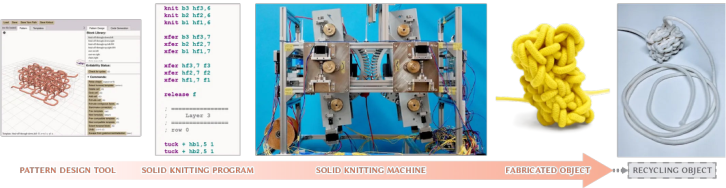
The technical foundations of volumetric knitting were established by Hirose et al. (2024), who introduced the concept of solid knitting alongside a custom machine prototype and a dedicated software interface for generating and transmitting machine instructions. Their work demonstrated that solid three-dimensional textile volumes can be produced from a single continuous yarn by connecting each new loop to both the previous row and the previous layer, and documented an equivalent manual, hand-knitting procedure that does not require specialised hardware (Figure 1).
Figure 1: The solid knitting pipeline: pattern design tool, machine program, knitting machine, and fabricated, recyclable object (adapted from Hirose et al., 2024).
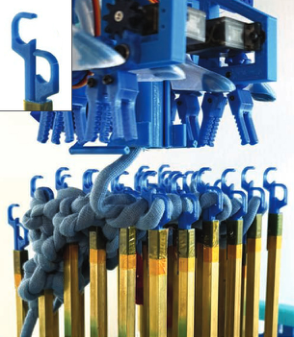
A complementary hardware-oriented approach was presented by Guimbretière et al. (2025), who developed a two-dimensional array of motorised needles capable of producing complex solid knitted geometries (Figure 2). Although their system expands the manufacturing possibilities of volumetric knitting, it relies on specialised hardware that remains inaccessible to most.
Figure 2: Motorised needle array used to actuate solid-knit loop transfers (Guimbretière et al., 2025).
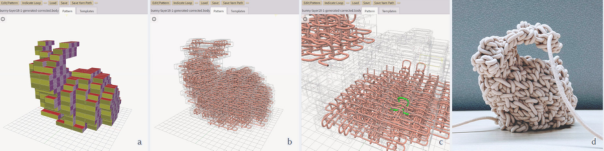
DigiKnitting: Enabling Knitting in 3D 89 Building upon the foundation of solid knitting, Hirose, Larsson and Igarashi (2026) developed skCAD, a computational design tool that automatically generates valid solid-knitting patterns from block-based three-dimensional models (Figure 3). While skCAD significantly improves the accessibility of shape design, it primarily operates at the geometric level and offers limited control over stitch-level topology.
Figure 3: skCAD pattern generation: voxel input, generated yarn path, loop detail, and resulting knitted form (adapted from Hirose et al., 2026).
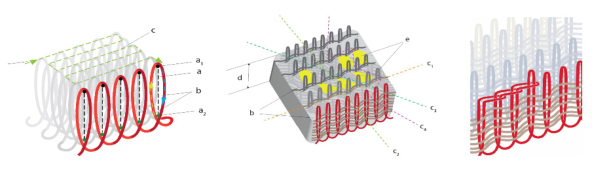
A related methodological reference is MultiWeave, developed by Pajupuu (2022) and further elaborated by Pajupuu and Kirs (2025). MultiWeave is a technique for fabricating three-dimensional woven textile volumes using temporary vertical loop supports, around which a weft yarn is freely guided layer by layer without the use of knots. Notably, MultiWeave shares a conceptual parallel with volumetric knitting: both approaches build up a three-dimensional textile mass from a continuous yarn guided around a set of structural anchor points, and both are executable manually as well as semi-automatically.
Taken together, existing research has established the technical feasibility of volumetric knitting and highlighted the potential of topology-driven material behavior. However, significant gaps remain regarding accessible stitch-level design tools, reproducible fabrication methods, and empirical understanding of the relationship between stitch topology and mechanical performance. These gaps form the primary motivation for the contributions presented in this paper.
Figure 4: MultiWeaving fabrication sequence, illustrating loop formation, interlayer connections, and the resulting three-dimensional textile structure (adapted from Pajupuu and Kirs, 2025).
METHODS
This research applies a Research through Design (RtD) framework (Stappers & Giaccardi, 2017), evaluating core architectural and fabrication principles through the creation of two complementary digital and physical artifacts. To guide development and validation, explicit design requirements were formulated for both tracks prior to evaluation.
For the digital design tool: D1. The software must translate abstract three-dimensional stitch connections into an intuitive, interactive layer-by-layer visual interface.
D2. The user must have explicit control over individual stitch assignment within the design matrix (Cast-on, Knit, Purl, Tuck, Connector).
D3. The application must use a lightweight, shareable data schema to store and transfer stitch topologies without processing heavy geometric meshes.
For the fabrication tool: F1. The physical bed mechanism must securely hold at least two overlapping loops per stitch position simultaneously during inter-layer transitions.
F2. Pin spacing must allow manual tool access without interfering with or dropping adjacent loop structures.
F3. The fabrication bed layout must scale dynamically to accommodate custom sample widths and lengths without requiring single-piece rebuilds.
These six requirements form the basis against which both artifacts are evaluated in the Validation section.
RESULTS
All developed tools and methodologies have been released as open-source resources to accelerate knowledge exchange and enable reuse.
The DigiKnitting Design Tool To address the cognitive accessibility barrier (D1–D3), DigiKnitting was developed as a browser-based, open-source design environment for volumetric knitting, prioritizing externalisation and communication of stitch-level design decisions over automated pattern generation. The tool is freely available at https://fabridiego.github.io/Volumetric-Knitting-TriCAD/, with its source code released at https://github.com/FabriDiego/Volumetric-Knitting-TriCAD.
Architecture and Interface DigiKnitting was developed in Three.js (Cabello, 2010) as a browser-based voxel modelling environment that requires no installation and runs directly within a standard web browser. Accessibility was considered a key design requirement, allowing researchers, designers, and hobbyists to engage with volumetric knitting without specialised software or hardware. The system represents volumetric knit structures as layered voxel grids in which each cell
DigiKnitting: Enabling Knitting in 3D 91 corresponds to a potential stitch position; users navigate through successive layers and assign stitch types to individual voxels, effectively constructing the knit volume stitch by stitch.
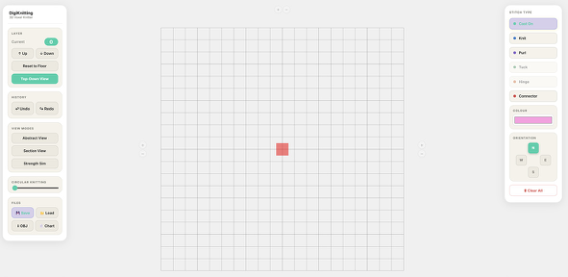
Figure 5: The DigiKnitting interface: layer and history controls (left), active design canvas (centre), and stitch-type, colour and orientation controls (right).
Figure 5 shows the interface in its top-down canvas mode. The central canvas displays the active layer as a grid onto which stitches are placed by selecting a stitch type from the right-hand panel and clicking the corresponding cell. The left-hand panel controls the active layer (Up/Down navigation, reset to floor), provides Undo/Redo history, switches between visualisation modes, and exposes file operations (Save, Load, OBJ export, and chart export), together with a circular-knitting toggle for cylindrical geometries.
To satisfy D3, each design is serialised into a lightweight JSON schema rather than a full geometric mesh. The schema records, per layer, an ordered list of occupied grid cells, each annotated with a stitch type, a planar orientation, and a colour tag; layers are nested under a top-level object that also stores the grid dimensions and circular-knitting state. Because the schema encodes topology rather than rendered geometry, files remain on the order of a few kilobytes even for multi-layer samples, and can be exchanged, version-controlled, or archived independently of the rendering engine.
Stitch Library and Visualisation Modes The software implements five stitch types: cast-on, knit, purl, tuck, and connector. Together, these elements form the fundamental vocabulary through which volumetric knit structures can be constructed and manipulated, directly satisfying D2.
To support interpretation of these structures, two additional visualisation modes were developed. Abstract View represents the design as a symbolic stitch chart extended into three dimensions. Section View exposes internal layers and connectivity relationships, making it easier to reason about the construction logic of the volume. Additional functionality includes chart generation and OBJ export, enabling both physical fabrication and integration with external digital workflows.
The Fabrication Tool While DigiKnitting enabled the visualisation and communication of volumetric knit structures, the transition from digital design to physical fabrication remained a significant challenge. Existing fabrication approaches either rely on custom machine prototypes (Hirose et al., 2024) or specialised hardware systems (Guimbretière et al., 2025), making them difficult to reproduce and limiting their accessibility for researchers and designers. To address this reproducibility barrier (F1–F3), a physical fabrication tool was developed with two objectives: to provide a structured and repeatable method for producing volumetric knit samples, and to establish a foundation for future automation. Rather than replacing hand knitting, the tool functions as a bridge between manual production and machine-based manufacturing.
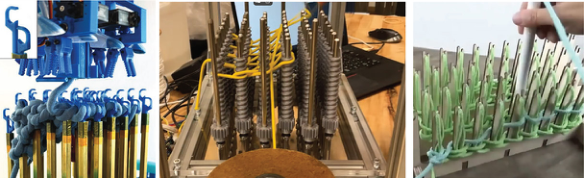
Design Inspiration The fabrication system is based on the principles of peg-loom (spool) knitting, in which yarn loops are formed around a grid of pins and lower loops are lifted over upper loops to form new stitches; this principle was extended into three dimensions by arranging pins within a planar grid and introducing connections between successive layers. Figure 6 situates this approach relative to the three existing fabrication precedents discussed in the Related Work.
Figure 6: Three existing fabrication precedents: motorised needle array (Guimbretière et al., 2025), rotating pins (Hirose et al., 2024), and laser-cut knitting aids (Pajupuu, 2022).
Iterative Development The fabrication tool was developed through four successive design iterations. Early prototypes employed simple wooden dowels arranged in a grid configuration. These experiments confirmed the feasibility of the fabrication method and revealed two requirements for successful operation, corresponding to F1 and F2: each pin required a temporary storage position that could hold a loop while subsequent stitches were formed, and sufficient spacing between pins was necessary to allow knitting tools to access loops without interference.
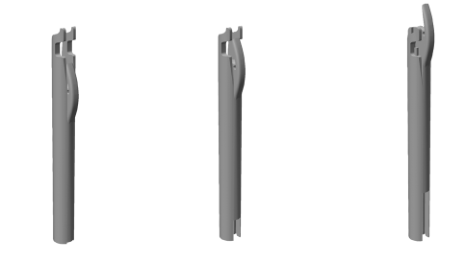
Subsequent iterations replaced the wooden dowels with designed 3D-printed pins, enabling control over geometry and functionality. Through iterative refinement, a pin design emerged that incorporates three operational
DigiKnitting: Enabling Knitting in 3D 93 states (Figure 7): an open position, allowing loop manipulation; a closed position, securing loops during stitch formation; and an eject position, releasing completed loops onto the knitted structure.
Figure 7: The three operational pin states: open, closed, and eject (left to right).
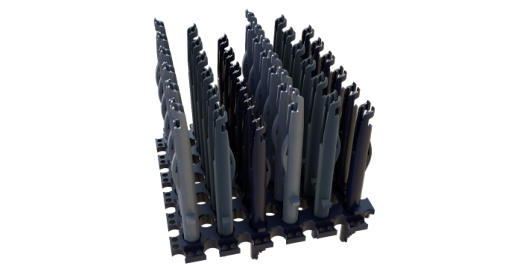
To satisfy F3, the pins were integrated into a modular pin-bed system composed of interchangeable grid plates (Figure 8). This approach allows fabrication setups of varying dimensions to be assembled without dedicated tooling and supports experimentation with different volumetric configurations. During development, knitting gauge was identified as a critical parameter influencing fabrication feasibility, and gauge selection became an explicit design decision within the fabrication workflow.
Figure 8: CAD rendering of the modular, interchangeable 3D-printed pin-bed grid.
Outcome The resulting system provides a reproducible method for fabricating volumetric knit structures with controlled stitch topology. Although the process remains manual and, when using thick yarn, slower than the hand- knitting method demonstrated by Hirose et al. (2024), it introduces a level of consistency previously absent from volumetric knitting research, confirmed by the iterative verification reported below.
VALIDATION Both artifacts were evaluated against the design requirements formulated in the Methods section: the digital tool qualitatively through pilot tests and expert interviews, and the fabrication tool iteratively across its four prototype generations against F1–F3, using usability, knit-result quality, and fabrication efficiency as evaluation criteria.
Digital Tool Validation Four pilot sessions were conducted with design students who had prior experience in knitting or crochet but no prior exposure to volumetric knitting, followed by two expert interviews: a doctoral researcher in heritage conservation specializing in historic textiles, and Yuichi Hirose, doctoral researcher at Carnegie Mellon University and lead author of both the solid knitting publication (Hirose et al., 2024) and skCAD (Hirose et al., 2026).
D1 (layer-by-layer interface): all pilot participants were able to construct a volumetric design and reason about successive layers within a single session. Several participants stated that the layer-by-layer construction logic only became clear once visualised in the software, a finding both experts independently confirmed from their own user-testing experience.
D2 (explicit stitch control): geometric, three-dimensional stitch rendering was consistently interpreted more readily than symbolic notation. However, participants with prior hand-knitting experience occasionally misread the purl stitch as a description of a needle action rather than the visual property it represents in the tool, indicating that prior procedural knowledge can interfere with the tool’s intended mental model.
D3 (lightweight data schema): the JSON-based save and load workflow was used successfully by all participants to store and reopen designs. No participant reported difficulty with the file operations, though several requested clearer onboarding for the transition from digital design to physical fabrication, a limitation also raised independently by both experts.
The heritage-conservation expert highlighted the effectiveness of the section view and the simplified geometric representation. Hirose positioned the tool as complementary to skCAD, valuing the stitch-level control and colour-coding system, and confirmed that the construction of secondary layers remains one of the most difficult aspects of volumetric knitting to communicate to new users. Taken together, the pilot tests and expert interviews indicate that D1–D3 are met, while identifying onboarding and the digital- to-physical transition as the primary direction for further development.
Fabrication Tool Validation The fabrication tool was evaluated at the end of each of its four design iterations against F1–F3, using the three criteria introduced above. The first, wooden-dowel iteration satisfied F1 only partially: dowels could hold a single loop but lacked a dedicated storage position for a second, overlapping loop, motivating the three-state pin design of the second iteration. This design fully satisfied F1 and improved knit-result quality, but
DigiKnitting: Enabling Knitting in 3D 95 pin spacing remained too tight for comfortable tool access, leaving F2 unmet. The third iteration increased pin spacing and switched to fully 3D-printed pins, satisfying F2. The fourth, modular grid-plate iteration satisfied F3 by allowing bed dimensions to be reconfigured from interchangeable plates rather than a single fixed structure. Across the four iterations, fabrication efficiency improved as the number of manual correction actions per stitch decreased, although the current prototype remains slower than the hand- knitting method demonstrated by Hirose et al. (2024).
CONCLUSION
This paper presented two open-source contributions toward making volumetric knitting accessible and reproducible: a browser-based design tool for stitch-level visualisation, and a modular pin-bed fabrication tool validated through four iterative cycles against explicit design requirements.
Future work will focus on four directions: expanding the design tool to support a wider range of stitch types, further developing the mechanical hardware and its automation, integrating the digital and physical workflows into a unified soft- and hardware system, and further investigating the computational properties of volumetric knitting to establish generalizable design principles. By releasing the design tool, the fabrication tool, and their underlying data formats as open-source resources, this work lowers the barriers to designing, fabricating, and studying volumetric knit structures as a circular, programmable textile manufacturing technology.
ACKNOWLEDGMENT
The authors would like to thank Yuichi Hirose for his valuable input through multiple touchpoints during this research.
REFERENCES
Cabello, R. (2010). Three.js [JavaScript library]. Available at: https://github.com/ mrdoob/three.js/ [Accessed 16 June 2026]. Cerulo, B., Papile, F., Motta, M., Marinelli, A., Conti, G.M. and Del Curto, B. (2022).
3D knitting for upholstery: Guidelines to design at the interface of sustainable fashion and furniture. Human Factors for Apparel and Textile Engineering, 32, pp. 129–137. Available at: https://doi.org/10.54941/ahfe1001547. European Commission (2022). EU strategy for sustainable and circular textiles.
Luxembourg: Publications Office of the European Union. European Commission (2025). Textiles strategy – Environment. Available at: https:// environment.ec.europa.eu/strategy/textiles-strategy_en [Accessed 19 June 2026]. Guimbretière, F., Kwatra, A. and Hudson, S.E. (2025). Using an array of needles to
create solid knitted shapes. In: Proceedings of the 38th Annual ACM Symposium on User Interface Software and Technology. New York: ACM, pp. 1–11. Available at: https://doi.org/10.1145/3746059.3747759. Hirose, Y., Gillespie, M., Bonilla Fominaya, A.M. and McCann, J. (2024). Solid knitting. ACM Transactions on Graphics, 43(4), pp. 1–15. Available at: https:// doi.org/10.1145/3658123.
Hirose, Y., Larsson, M. and Igarashi, T. (2026). skCAD: A design tool for solid knitting with automatic pattern generation. In: Proceedings of the 2026 CHI Conference on Human Factors in Computing Systems. New York: ACM, pp. 1–21. Available at: https://doi.org/10.1145/3772318.3791148. McCann, J., Albaugh, L., Narayanan, V., Grow, A., Matusik, W., Mankoff, J. and Hodgins,
J. (2016). A compiler for 3D machine knitting. ACM Transactions on Graphics, 35(4), pp. 1–11. Available at: https://doi.org/10.1145/2897824.2925940. Pajupuu, K. (2022). MultiWeave. Algorithmic Pattern Salon. Available at: https:// doi.org/10.21428/108765d1.ea9ce1dc. Pajupuu, K. and Kirs, M.-T. (2025). MultiWeave: Knight’s tour and other sources of
inspiration. In: Proceedings of the First Conference on Algorithmic Patterns in the Creative Arts, 1. Available at: https://2025.algorithmicpattern.org/proceedings/ SVNK8R/paper.html. Stappers, P.J. and Giaccardi, E. (2017). Research through design. In: M. Soegaard and R. Friis-Dam, eds. The encyclopedia of human-computer interaction. 2nd ed. Aarhus: The Interaction Design Foundation, pp. 1–94.
LISTED IN THE AHFE DIGITAL BOOKSTORE CATALOGUE
Explore the complete digital volume
Human Dynamics, Product Evaluation and Quality
Read this individual research paper free through the original publisher, or explore the full digital proceedings book.
ISBN 978-1-964867-88-5
Explore this ISBN in the AHFE Bookstore ↗Listed in the July 2026 bookstore catalogue; search by ISBN to confirm current availability · Digital book purchase optional