Karla Hohwieler, Jessica Conradi (2026). Influence of simulated ship motion on human-computer interaction at a multi-display workstation. In: Human Dynamics, Product Evaluation and Quality. AHFE Open Access, vol. 212, pp. 1–8. https://doi.org/10.54941/ahfe1007807
Users at computer centred workspaces aboard ships often deal with high information rates from different sources. Those information sources may include various sensor data as well as visual and acoustical input. Therefore, setups with multiple displays and input devices are beneficial. Usually, such workspaces are built and evaluated in static environments, not regarding the influence of realistic ship motion. However, this motion may affect the user in different ways. Externally induced motion may impair motor skills or cognitive skills and possibly will cause motion sickness. The aim of this study is the assessment of a multi-display workstation setup for use on vessels by determining the influence of simulated ship motion on performance of human-computer interaction, focussing on motor skills. For that reason, we built a simulator consisting of a multi-display setup and a motion simulation platform. For this system we designed three realistic ship motion profiles. We expect different motion related impact on motor skills depending on the externally induced motion direction, e.g. wave direction relative to the ship. Therefore, we used motion profiles limited to motion on a single axis to obtain one pitching and one rolling motion. The third motion profile consists of almost no motion which is used as control condition. Additionally, we created simple tasks to investigate the performance of mouse and touch interaction as these types of interaction address motor skills. In a repeated measures design n=18 experts (aged 35,3 ± 6,9 years, 15 male, 3 female) performed tasks under three different motion conditions. The results of a multivariate analysis of variance with repeated measures show a significant impact of motion on mouse interaction time (p < 0,01). Post-test showed differences between pitching and low motion (p < 0,01) as well as pitching and rolling (p = 0,019). For the minimum touch button size, no significant impact was found, but there was a slight indication of motion-related impact (p = 0,051). According to the naval experts the simulated motion is generally realistic, albeit quite uniform. Thus stronger, less uniform motion profiles may intensify motion related performance degradation. Therefore, studies with intensified motion profiles are planed as well as including additional tasks provoking higher mental workload, e.g. by using more complex tasks.
Vessel motion has general and specific effects on task performance (Stevens and Parsons, 2002; Wertheim, 1998). General effects describe general motion induced performance degradation including motivational, energetical and biomechanical impacts (Stevens and Parsons, 2002; Wertheim, 1998). One widely known general effect of ship motion on human performance is motion sickness. Another general effect, the biomechanical impact of externally induced motion, is the difficulty of maintaining postural control. Those motion provoked balance problems are referred to as motion induced interruptions (MII) (Stevens and Parsons, 2002; Wertheim, 1998). While MII Received February 5, 2026; Revised April 2, 2026; Accepted April 21, 2026; Available online July 20, 2026
2 Hohwieler and Conradi occur for gros motor tasks like standing and walking, specific effects include fine motor tasks like pushing a button (Stevens and Parsons, 2002). Some studies analysed the effects of vessel motion on postural control, especially MII (Duncan et al., 2022; Garvin and Harris, 2021; Gehl, 2013). While Garvin and Harris (2021) and Gehl (2013) focused on balance control, Duncan et al. (2022) analysed how different motion intensities affect visual searching task performance and balance control. They found a decreased performance in terms of identifying objects correctly and an increase of balance controlling mechanism, i.e. compensatory stepping and raised lower limb muscle activity (Duncan et al., 2022).
Furthermore, specific effects describe the influence of externally induced motion not only on motor tasks but also on specific skills that are required to execute cognitive tasks of different complexity, e.g. visual tracking (Stevens and Parsons, 2002). Tasks that are executed on multi-display workstations aboard ships usually imply observation and interpretation of radar images as well as verbal and written communication. Researchers examine the performance of the skills that are needed to complete typical ship tasks to test the impact of externally induced motion on those tasks. Wang et al. (2022) investigated the influence of simulated motion on performance and perceived workload of mouse, trackball, touchscreen and leap motion interaction tasks. They used three standardised HCI tasks, a one-directional, a multi-directional and a dragging task, suggested by ISO 9241-411 guidelines (ISO, 2012). Two one directional motions, lateral and fore-and-aft, and one omnidirectional motion profile were used. The authors combined all interaction devices to analyse the impact of different external motion on the task performance and found a significant increase of task completion time and error rate for all motion conditions compared to the static condition (Wang et al., 2022). The influence of external motion on single interaction device performance seems to be small but has not been analysed in detail by the authors. Tian et al. (2024) analysed the performance of mouse, trackball, touchscreen and leap motion interaction tasks under two motion conditions. They used the same three standardised HCI tasks as Wang et al. (2022). The two motion conditions differed in amplitude, resulting in one motion condition of low intensity and one of high intensity. Results show a significant increase of the task completion time and error rates for both motion conditions compared to the static condition. Liu et al. (2024) studied touchscreen interaction performance in a moving environment. Therefore, participants had to hit different sized and spaced buttons to perform letter or number inputs. The externally induced, simulated motion was the same as used by Tian et al. (2024); one low intensity motion condition and one high intensity motion condition. Liu et al. (2024) observed an increase of task completion time, perceived workload and discomfort as well as a decreased accuracy associated with increased motion intensity.
Those studies provide evidence for external motion impact on HCI task performance (Liu et al., 2024; Tian et al., 2024; Wang et al., 2022). However, the tasks do not resemble realistic tasks that are usually performed abord vessels. Additionally, the results do not distinguish between interaction devices. Matsangas et al. (2014) and Duncan et al. (2018) studied motion related performance decrements of more realistic interaction tasks. Matsangas et al. (2014) investigated whether motion sickness reduces the cognitive multitasking
Influence of Simulated Ship Motion on Human-Computer Interaction 3 performance. Thus, they analysed the indirect effect of the motion exposure on cognitive performance. Participants solved arithmetic and memory tasks alongside visual and auditory reaction tasks, while or without being exposed to motion. Results indicated that cognitive multitasking performance decreased as a result of the development of mild motion sickness during the second experimental session (Matsangas et al., 2014). Duncan et al. (2018) used a visual tracking and an arithmetic task to test cognitive performance under motion condition compared to no motion condition. They found a negative impact of externally induced motion on the tracking task performance (in terms of time to complete the task and error rate) but not on the arithmetic task performance. For the arithmetic task, participants were required to solve addition equations of two random 2-digit numbers. Every equation was shown on a display for 5 seconds and answers were given verbally. The visual tracking task consisted of a Cogstate’s Groton Maze Learning Test (Cogstate Ltd., New York, NY) that must be solved by guessing the next path sequence and tapping it with a finger (Duncan et al., 2018).
Those studies show the impact of externally induced motion on different aspects of human performance and wellbeing. The motion itself varies in intensity and/or movement direction. Vessel motion consists of motion along six DoF, i.e. surge, sway and heave translational movements as well as roll, pitch and yaw rotational movements. Motion on different axes varies in size of impact on human wellbeing and task performance: the literature states especially roll, pitch and heave motion affect humans aboard ships (Duncan et al., 2022; Garvin and Harris, 2021; Stevens and Parsons, 2002; Wertheim et al., 1998). Wertheim et al. (1998) found evidence for heave motion only leading to a significant sea sickness incidence if combined with roll and pitch motion.
As a result of these findings, we hypothesise that the interaction performance on a multi-display workstation decreases under simulated following and beam sea motion, i.e. pitching and rolling respectively, compared to a low motion condition.
Method
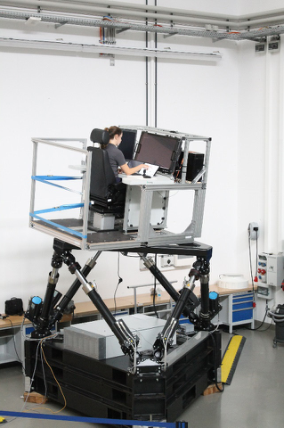
The motion simulation system for the simulation of vessel motion consists of a motion platform, a multi-display workstation and three different motion profiles (see Figure 1). The motion-simulation platform is an MB-E- 6DOF/24/1800KG hexapod by Moog B.V. (Nieuw-Vennep, the Netherlands). It is operated electrically, has a payload of 1.8 tonnes and six degrees of freedom (DoF). According to the documentation the possible displacement per axis of the hexapod of z-axis translation is ± 0.35m, of x-axis rotation it is ± 20.2° and of y-axis rotation it is –20°/+22.6°. We measured the motion range of the hexapod when rotational movements about the x- and y-axes and translational movements in z-axis direction are combined. The resulting motion range is about ± 13cm vertical translation and 10° rotation about the x- and y-axes. The multi- display workstation is mounted on top of the motion platform and consists of five screens: one 4K 32-inch display, two full HD 17-inch vertically arranged displays and two full HD 13-inch touch screens. Additionally, the workspace involves a standard mouse, keyboard and joystick. In the following we focus on mouse and touch interactions since those types of interaction address motor
4 Hohwieler and Conradi skills. Finally, we processed realistic ship motion data to drive the vessel motion simulator. Based on literature reviews we expect different motion related impact on motor skills depending on the externally induced motion direction, e.g. wave direction relative to the ship (Duncan et al., 2022; Garvin and Harris, 2021; Stevens and Parsons, 2002; Wertheim et al., 1998). Therefore, we used motion profiles mainly limited to motion on one axis to obtain one pitching and one rolling motion. Both motion profiles have small amplitudes, because of the limited motion range of the hexapod. However, amplitudes and wavelengths of the motion profiles varied as the motion simulation was inspired by real ship motion data. The third motion profile comprises almost no motion. Motion in this condition is so small that no impact was expected. Therefore, we used the ‘almost no motion’ profile as control condition and abstained from using a fully motion-free condition for experimental economics.
Figure 1: Vessel motion simulation system.
To determine the influence of the motion profiles on human-computer interaction, we focused on the interaction types “mouse” and “touch”. In regard to mouse interaction, we developed a drag-and-drop task in which an object has to be moved to a target of matching size by using the mouse. To complete a mouse interaction task four circles and seven rectangles of different sizes have to be moved successfully to the corresponding target. Dependent variable is time on task. The touch interaction task consists of a square that appears in a random position on the screen and has to be touched to disappear and change size and position. If the square was touched successfully, the size of the following square decreases, if the square was not touched correctly, the size of the following square increases. Dependent variables for touch interaction performance were time on task and minimum touch button size with a hit rate of at least 90%.
Furthermore, mean reaction time at each motion condition was examined. This was done to test if time on task could be related to a general reaction time decrease caused by the externally induced motion. In the reaction time task, the participants had to tap a key on the keyboard as soon as a displayed circle randomly changes its colour. This interaction was repeated 20 times
Influence of Simulated Ship Motion on Human-Computer Interaction 5 per block and every block appeared ones in the beginning, ones in the middle and ones at the end of each session. The dependent variable is mean reaction time of all reaction interactions per session.
15 male and 3 female participants (age = 35.3 ± 6.9 years) with experience in maritime work, performed interaction tasks under one out of three motion conditions per day on three consecutive days. The participant selection was random. However, all participants were right-handed. Motion profile order and task order were permutated. One session lasted for 40 to 50 min depending on the completion time of each participant.
The software SPSS Statistics 29.0 (IBM, Armonk, NY, USA) was used to test for normal distribution of the data sets and significant difference in mean interaction performance between the three motion conditions. For normal distribution a Kolmogorov-Smirnov test was used and for sphericity a Mauchly test. The hypothesis was tested by a multivariate analysis of variance with repeated measures. The used independent variable was the externally induced motion that consists of three conditions: rolling, pitching and low motion.
Results
All tested dependent variables, i.e. time on task of mouse and of touch interactions and minimum touch button sizes, were approximately normally distributed, as assessed by the Kolmogorov-Smirnov Test, p < 0.05.
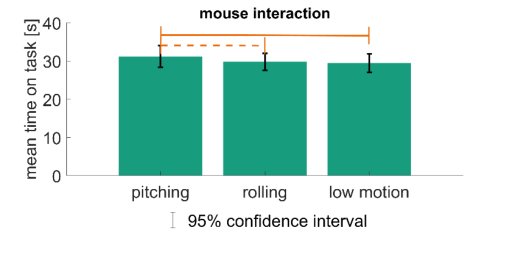
The time participants spend on the mouse interaction task in the different motion conditions were as follows; for the pitching condition: mean = 31.18s, std = 4.44s, for the rolling condition: mean = 29.78s, std = 4.06s and for the low motion condition: mean = 29.45s, std = 4.54s. Results of a multivariate analysis of variance with repeated measures show a motion related significant reduction of interaction performance for the mouse interaction time (p < 0.01). Post testing indicated significant differences of the mouse task completion time between the pitching and the low motion condition (p < 0.01) as well as between pitching and rolling motion conditions (p = 0.019), displayed in Figure 2. No significant difference was detected for the time on task of mouse interaction between rolling and low motion conditions (p = 0.41).
Figure 2: Mean interaction duration of the mouse task (time on task) for the three different motion conditions. The solid orange line indicates a significant difference with p < 0.01, while the dashed line indicates a significant difference with p < 0.05.
6 Hohwieler and Conradi The mean touch task completion time, i.e. time on task, for the pitching condition with left hand interaction was 57.6s ± 9.39s, mean left hand interaction at the low motion condition was 57.2s ± 7.4s and mean left hand interaction at the roll motion condition was 55.7s ± 7.79s. The right hand mean touch interaction duration, of all right handed participants, at the low motion condition was 55.09s ± 9.98s, at pitching 53.6s ± 7.57s and at the rolling condition 51.79s ± 6.61s. Touch interaction duration was tested by a two factorial analysis of variance with repeated measures. No significant differences in distributions of the touch interaction duration of the three motion conditions pitching, rolling and low motion could be found for p < 0.05. Minimum sizes of at least 90% successfully touched targets mean and standard derivation values in pixels and millimetres are listed in Table 1. The results showed no significant impact but hinted to a statistical trend of motion impact on target size (p = 0.051).
Table 1: Descriptive statistics of min. touch button sizes with at least 90% striking rate for left- and right-hand interaction.
Table available in the original PDF paper.
Min Touch Button Size Mean [px] mean [mm] STD [mm] left hand interaction
pitching 106.79 16.34 5.70 rolling 102.38 15.66 5.18
low motion 88.54 13.55 3.15 right hand interaction
pitching 108.10 16.54 6.05 rolling 111.18 17.01 6.45
low motion 94.93 14.52 5.72 Mean reaction time of pitching motion condition was 0.365s ± 0.043s, at rolling motion condition it was 0.357s ± 0.034s and at the low motion condition the mean reaction time was 0.351s ± 0.03s. Results of a multivariate analysis of variance with repeated measures did not find any significant difference in reaction times between the three motion conditions (p = 0.108).
Discussion
This study was conducted to test if simulated, externally induced ship motion has an impact on mouse and touch screen interaction at a multi-display workstation.
A decreased interaction performance under a pitching motion condition compared to a rolling as well as a low motion condition could be found for mouse interaction time on task. Furthermore, the results hinted to an increased minimum target size of touched objects. The simulated rolling motion did not affect the minimum touch target size with statistical significance. There was no significant motion related performance degradation found in terms of the touch interaction variable “time on task” and the reaction time for neither the pitching nor the rolling condition compared to the low motion condition.
Influence of Simulated Ship Motion on Human-Computer Interaction 7 We found a small impact of externally induced motion on mouse interaction and a hint to an impact on touch interaction. However, the administered intensity of motion was low and lacked variation, as reported by experts. This might explain the limited motion related impact on HMI performance. The motion profiles were simulated with a motion-simulating platform with a limited range of motion. Thus, the motion profile datasets consist of small motion ranges, and no algorithm was included to compensate those motion range limitation and to obtain more realistic motion profile intensities. However, the motion profiles were mainly reduced to motion on one axis to study the influence of different directions of externally induced motion on HMI performance. Past studies used motion ranges about the roll and the pitch axes of 5° to 12° when identifying motion related performance degradation of HCI tasks (Liu et al., 2024; Tian et al., 2024; Wang et al., 2022), while we used motion ranges of max. 6° roll or pitch angles to simulate ship motions. In further studies, both the low motion intensity and the motion uniformity should be addressed.
Another possible reason for the small differences between the motion conditions on mouse and touch interaction tasks may be the short motion impact duration. In real vessel environment working scenarios the persons abord vessels are continuously exposed to externally induced motion for several hours or multiple days, while our experiment only lasted for 40-50 min per session. Motion related impairments could be suppressed by the participants with the end of the motion exposure in sight.
The time to complete a mouse interaction task during externally induced motion is significantly higher compared to the time on task during almost no external motion, while the reaction time is not affected by externally induced motion. This might indicate different task complexity and underlying control mechanism of the mouse interaction task and the reaction time task. Because the mouse interaction task comprises fine motor and cognitive skills, in terms of identifying the fitting target within many target options plus moving the mouse, it appears to be more complex than the reaction time task. It is stated that more complex tasks, e.g. tasks that are controlled by a combination of fine motor and cognitive skills, show stronger motion related performance impairments (Duncan et al., 2018; Matsangas et al., 2014). To investigate the motion related impact on task completion time because of task complexity, further studies should be conducted.
CONCLUSION
This study was conducted to test if simulated externally induced ship motion has an impact on mouse and touch screen interaction at a multi-display workstation. Therefore, 18 participants performed a drag-and-drop task with a standard computer mouse and an aiming task with the finger on a touch screen, while they were exposed to different external motion conditions. Additionally, the reaction time was determined. Two motion profiles with different main motion axis were used: one rolling motion condition and one pitching motion condition. A third motion profile was an almost static condition, used as baseline. The participants were seated at a newly designed multi-display workstation mounted on a motion platform, that simulated
8 Hohwieler and Conradi the three motion conditions. The results show a significant impact of motion on mouse interaction time (p < 0.01). For the minimum touch button size, no significant impact was found, but there was a slight indication of motion- related impact (p = 0.051).
Despite the limited intensities of the simulated motion a small influence of externally induced motion on human-computer-interaction (mouse and touch) was found. Therefore, this research can be seen as a general confirmation of motion related impact on HMI-tasks. Consequently, this work motivates more extensive research into the impact of externally induced motion on users at computer centred workspaces aboard ships. However, these studies should vary in motion profiles, interaction types, task types and exposition times.
REFERENCES
Duncan, C. A., Bishop, N., Komisar, V., MacKinnon, S. N. and Byrne, J. M. (2022) “The Effect of Wave Motion Intensities on Performance in a Simulated Search and Rescue Task and the Concurrent Demands of Maintaining Balance”, Human factors, vol. 64, no. 3, pp. 579–588. Duncan, C. A., Hickey, C. J. and Byrne, J. M. (2018) “The effects of a moving
environment on postural control and task performance during manual materials handling, visual tracking and arithmetic tasks”, International Journal of Industrial Ergonomics, vol. 66, pp. 221–229. Garvin, M. and Harris, T. (2021) “Vessel Motions and Work Interruptions Aboard a Fast Rescue Craft”, International Journal of Maritime Engineering, vol. 163, A1, pp. 139–147. Gehl, G. E. (2013) Assessing motion induced interruptions using a motion platform,
Master Thesis, Monterey, California, Naval Postgraduate School. ISO (2012) 9241-411: Ergonomics of human-system interaction, Geneva, Switzerland: International Organisation for Standardization. Liu, K., Zeng, J. and Tao, D. (2024) “Assessing touchscreen operations under
vibration: effects of vibrational environments, button size, and button spacing on digit- and letter-entry task performance”, Universal Access in the Information Society, vol. 23, pp. 293–303. Matsangas, P., McCauley, M. E. and Becker, W. (2014) “The Effect of Mild Motion Sickness and Sopite Syndrome on Multitasking Cognitive Performance”, Human Factors, vol. 56, no. 6. Stevens, S. C. and Parsons, M. G. (2002) “Effects of Motion at Sea on Crew
Performance: A Survey”, Marine technology and SNAME news, vol. 39, no. 01, pp. 29–47. Tian, Y., Shi, Y., Wu, Y., He, W., Liu, S. and Tao, D. (2024) “Assessing mouse, trackball, touchscreen and leap motion in ship vibration conditions: A comparison of task performance, upper limb muscle activity and perceived fatigue and usability”, International Journal of Industrial Ergonomics, vol. 101. Wang, H., Da Tao, Cai, J. and Qu, X. (2022) “Effects of vibration and target size on
the use of varied computer input devices in basic human-computer interaction tasks”, Human Factors and Ergonomics in Manufacturing & Service Industries, vol. 32, no. 2, pp. 199–213. Wertheim, A., Bos, J. and Bles, W. (1998) “Contributions of roll and pitch to sea sickness”, Brain Research Bulletin, vol. 47, no. 5, pp. 517–524. Wertheim, A. H. (1998) “Working in a moving environment”, Ergonomics, vol. 41,
no. 12, pp. 1845–1858.
LISTED IN THE AHFE DIGITAL BOOKSTORE CATALOGUE
Explore the complete digital volume
Human Dynamics, Product Evaluation and Quality
Read this individual research paper free through the original publisher, or explore the full digital proceedings book.
ISBN 978-1-964867-88-5
Explore this ISBN in the AHFE Bookstore ↗Listed in the July 2026 bookstore catalogue; search by ISBN to confirm current availability · Digital book purchase optional