Caterina Battaglia, Isabella Nevoso, Elena Polleri (2025). Bridging the gap: workshop results on the interaction between human creativity and artificial intelligence. In: Human Interaction and Emerging Technologies (IHIET-AI 2025): Artificial Intelligence and Future Applications. AHFE Open Access, vol. 161, pp. 183–194. https://doi.org/10.54941/ahfe1005909
In the expansive realm of contemporary Artificial Intelligence (AI) technologies, designers and architects are challenged to collaborate synergistically with these powerful tools. While the potential of AI is considerable, it also gives rise to significant questions regarding the intellectual property of generated works and the nature of interaction between humans and technology. Furthermore, this technologies challenge the definition of creativity, prompting the question of how to distinguish the role of a human from that of a machine. This prompts the question of how the transition from human ingenuity to automation can be achieved in a way that doesn’t compromise the uniqueness of human contributions in fields such as creativity and the arts. It is therefore necessary to assess how far tasks can be delegated to AI without compromising the value of the inputs that humans are able to provide.Responses to these questions can be identified through a comprehensive examination of recent technological developments that promote informed and conscious use. These reflections inspired the organisation of the Alter Ego Symposium and Workshop, which took place in April and May 2024 at the Department of Architecture and Design at the University of Genoa. The symposium aimed to encourage Italian PhD students and researchers to consider the potential benefits of integrating AI into academic research. The workshop instead, addressed at department students, focused on exploring image generation technologies and their ability to translate verbal prompts into detailed visual representations. The workshop consisted of two phases. The first phase featured presentations by academic experts who introduced fundamental concepts of AI and analyzed existing generative image tools. This provided students with a comprehensive overview of various AI types, their applications, and their limitations. In the second phase, participants focused on the practical application of the knowledge acquired. Based on a contribution presented at the Alter Ego Symposium, students were required to create two works representing its content. The first work was created using traditional tools like paper and pencil, while the second employed generative AI technologies. The students employed the OpenAI Copilot system to generate an image that was as similar as possible to the original hand-drawn one. Through a process of iterative modification of prompts, the students came to understand the importance of precision in language and word choice for achieving satisfactory visual results.The final comparison of outcomes, which will be explored in detail in the full paper, highlighted the significant role that AI tools can play in supporting design and concept development processes. However, it also emphasised the necessity for designers to communicate effectively and accurately with these systems in order to achieve results that meet user expectations. Currently, while AI is capable of processing natural language, it still encounters difficulties in autonomously interpreting the full range of semantic nuances present in the provided prompt, particularly when imprecise terms are used. Despite the rapid advancements in AI through self-learning algorithms, the point at which humans can be entirely replaced in design and creative content generation remains distant.
NAVIGATING THE INTERSECTION OF HUMAN CREATIVITY AND ARTIFICIAL INTELLIGENCE: OPPORTUNITIES, CHALLENGES, AND ETHICAL IMPLICATIONS In the vast and intricate domain of contemporary Artificial Intelligence (AI) technologies, designers and architects are increasingly called upon to engage with tools that, while offering extraordinary opportunities, raise complex and multifaceted questions. The synergy between humans and machines transcends the mere pursuit of efficiency or automation, instead encompassing profound and far-reaching issues that touch upon creativity, intellectual property, and ethics.
The capabilities of modern AI are truly astounding: sophisticated algorithms can now generate artworks, design architectural structures, compose musical pieces, and draft written texts all with a speed and precision that would have been unimaginable just a few decades ago (Schmidhuber, 2010). However, this raises an essential question: who should be considered
the work’s true author? If a machine is capable of producing a painting or a musical composition, should it be regarded as the artist/creator, or is it merely a tool in human hands? A case in point is image generation systems like DALL·E, which can create visually complex and refined works from a simple textual description. However, since the work originates from human- issued commands, it is necessary to determine who ultimately holds the rights and intellectual property.
A further pertinent example can be found in the field of architecture, where advanced parametric modelling tools, such as Grasshopper, when combined with machine learning algorithms, enable architects to automate the design process and explore innovative solutions (Selmı & ˙Ilerisoy, 2022). In this context, a pressing question arises: what is the boundary between the architect’s creative intuition and the machine’s computational processing? These inquiries open up a broader debate on the very nature of creativity (Nevoso & De Natale, 2024). Historically, creativity has been considered a uniquely human attribute, originating from ingenuity, knowledge, intuition, and personal sensitivity (Csikszentmihalyi, 2013). However, with the advent of AI, we are witnessing a gradual redefinition of this concept: to what extent can creativity be attributed to an algorithm that inherently operates on pre-existing models and reprocesses vast amounts of data created by others?
The deployment of automated tools with the capacity to perform generative processes with such precision necessitates a period of critical reflection. On the one hand, AI offers unparalleled opportunities in terms of speed and the capacity to explore new creative frontiers. On the other hand, it is crucial to define the limits within which delegating tasks to machines is permissible without undermining the intrinsic and irreplaceable value of human creativity. To illustrate, in the music sector, some algorithms are capable of generating personalized tracks in a matter of seconds. Nevertheless, it remains unfeasible for an algorithm to emulate the emotional potency of a Beethoven symphony or the intuition of a human composer, which encompasses lived experiences, sensitivities, and perceptions that transcend the limitations of mere data processing.
The key to addressing these concerns lies in a comprehensive and nuanced understanding of emerging technologies and their judicious application. Only by fully comprehending the internal workings of AI tools can their potential be fully realized, and passive reliance on them avoided. Rather than perceiving AI as a threat to human creativity, it would be more accurate to view it as an extension and support to our abilities. Indeed, it is capable of amplifying our imagination and enabling us to explore ideas and solutions that would otherwise remain inaccessible without technological assistance.
The challenge is not merely technical; it is also philosophical and cultural. How might we preserve and enhance our distinctive creative essence in a world that is becoming increasingly dominated by automation? The answer may not lie in competing with AI; rather, it may lie in seeking a fruitful collaboration with it. This collaboration should highlight those qualities that are inherently human and that machines cannot replicate. These include empathy, intuition, and the ability to imbue artistic and design outputs with deep, personal meaning.
Bridging the Gap: Workshop Results on the Interaction Between Human Creativity 185
ALTER EGO: EXPLORING THE OPPORTUNITIES AND LIMITS OF ARTIFICIAL INTELLIGENCE AT THE UNIVERSITY OF GENOA In the wake of the preceding reflections, two major events were devised, conceptualized and curated by a cohort of doctoral students from the Department of Architecture and Design (DAD) at the University of Genoa (UniGe). Caterina Battaglia, Martina Castaldi, Irene De Natale, Isabella Nevoso, and Elena Polleri were responsible for the organization and coordination of the Symposium and Workshop, entitled “Alter Ego - Opportunità e limiti dell’intelligenza artificiale applicata alla ricerca” (Alter Ego - Opportunities and Limits of Artificial Intelligence Applied to Research), which took place in April and May 2024 at the department.
The symposium, which formed part of the doctoral research activities outlined by the department’s doctoral board, benefited from the support of a scientific committee composed of professors Enrica Bistagnino, Niccolò Casiddu, Renata Morbiducci, and Giulia Pellegri. The event was initiated through a Call for Papers, which was circulated among Italian doctoral students and researchers to elicit contributions that would facilitate a critical reflection on the opportunities and challenges posed by the introduction of artificial intelligence in academic research. The ultimate goal was to compile a publication that would address these topics.
Following this first event, which attracted widespread participation and sparked an open discussion on a topic of interest to many academics, the Alter Ego Workshop took place, aimed at DAD students and focused on exploring AI technologies applied to image generation. The workshop specifically delved into the capacity of these tools to convert prompts written in natural language into detailed and complex visual images, thereby facilitating direct interaction between the design process and advanced technologies.
The workshop activities were structured in several phases. Initially, two academic experts in the field introduced the foundational concepts of artificial intelligence, providing an in-depth analysis of the functioning of current image-generating tools. The presentations provided students with a comprehensive overview of the various types of AI, elucidating both their potential and inherent limitations. In particular, Francesco Burlando, a research fellow at the University of Genoa, illustrated the current applications of AI in a range of fields, from relatively simple automated systems such as the Roomba robot to more sophisticated applications in human safety. Subsequently, Enrico Pupi, a doctoral student at the Polytechnic University of Turin, examined a range of facets of AI, with a specific emphasis on pivotal concerns such as ethics and data protection. This inaugural phase of the workshop sought to foster critical reflection on the potential roles that future designers and architects might assume in a context that is increasingly shaped and dominated by AI. In the second part of the workshop, the focus shifted to the critical and practical application of the theoretical concepts learned earlier. Drawing from the theme of “Babele” a contribution written by Professor Giovanni Galli (Galli, in press) of the University of Genoa and presented during the Symposium, students were tasked with creating a visual representation of a significant image from the narrative, selected at their discretion.
The initial stage of the assignment entailed the generation of the image through the utilization of conventional techniques, such as the use of paper and pencil. Subsequently, students were encouraged to utilize generative AI technologies and digitally rework their hand-drawn creations. In particular, the students were instructed to utilize the Copilot system, developed by OpenAI, to generate an image that closely resembled their manually produced version. Through repeated iterations, accompanied by the modification and refinement of prompts in either Italian or English, students were able to experiment and gain insight into the crucial importance of linguistic precision and careful lexical choice in crafting commands, to achieve consistent and satisfactory visual results. This process of juxtaposing traditional techniques with advanced technological solutions enabled a deeper reflection on the role of language as a bridge between creative imagination and its visual translation, as well as the importance of deliberate and calibrated interaction with emerging technologies.
WORKSHOP ORGANIZATION: FROM PAPER TO COPILOT To guarantee a consistent and intelligible presentation of the results, students were furnished with a predefined layout, which permitted the uniform display of both works and facilitated their comparison. Specifically, students were required to include three images: the manually produced version, the image generated with the initial prompt, and the one obtained after several attempts to refine the prompt. Furthermore, students were obliged to include a written section, composed independently, which outlined the creative process and incorporated personal reflections on the production of the work and the selection of prompts employed.
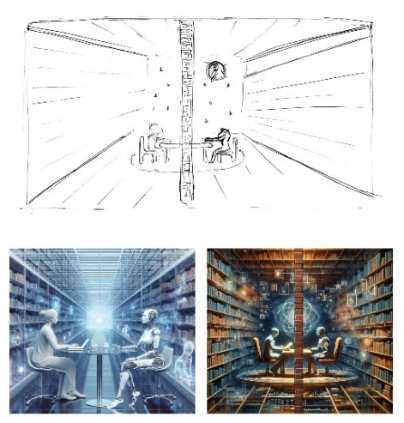
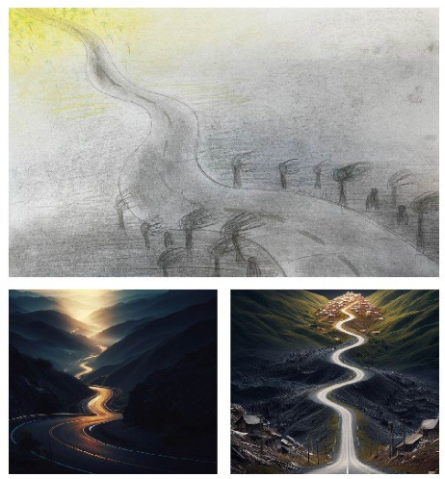
Figure 1: I noticed how the artificial intelligence exceeded my expectations, following the prompt very closely [...]. The AI’s ability to translate a detailed description into a visually accurate image demonstrated the effectiveness of image generation technologies [...]. Designed by Fabio Testa (2024).
Bridging the Gap: Workshop Results on the Interaction Between Human Creativity 187
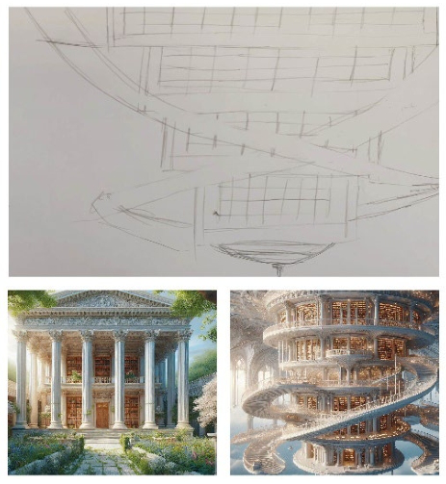
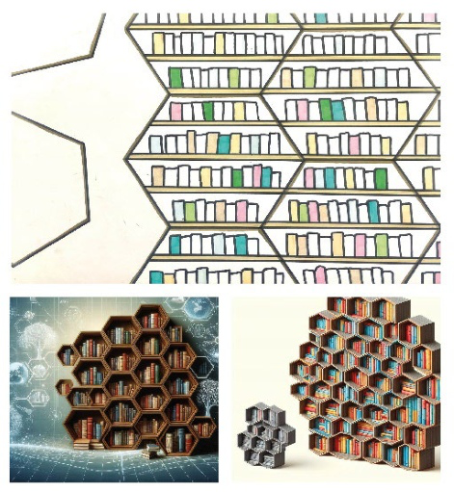
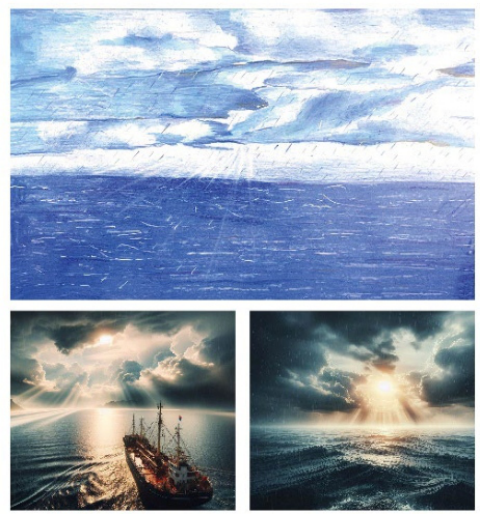
Figure 2: In choosing the prompts, I opted for those that best inspired my idea. In addition, I decided to keep the prompts short because I believe this allows the image generator to better express his creativity and explore a wider range of possible interpretations. Designed by Silvio Agnoli (2024).Figure 3: When choosing and using the prompt it is very important to use simple and direct language, describing in detail what I want my image to represent [...]. Designed by Matilde De Simoni (2024).Figure 4: Initially the prompt was short and the scene very generic. After many attempts, separating sentences with full stops or commas, writing in Italian or English, the situation did not improve [...]. I tried asking chatGPT to optimise the prompt, the result improved [...]. Designed by Giulia Borasio (2024).Figure 5: The program immediately understood the image I intended to develop. The initial image was a bit bare, then by enriching the description with more specific details and features I was able to arrive at the final result. Designed by Elena De Marchi (2024).
Bridging the Gap: Workshop Results on the Interaction Between Human Creativity 189
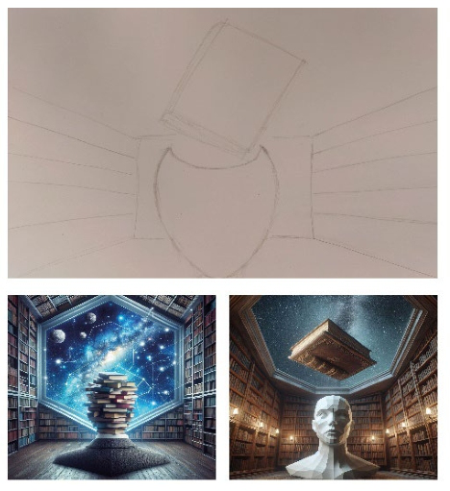
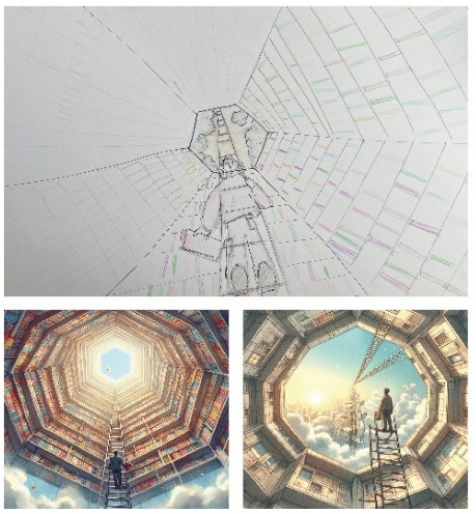
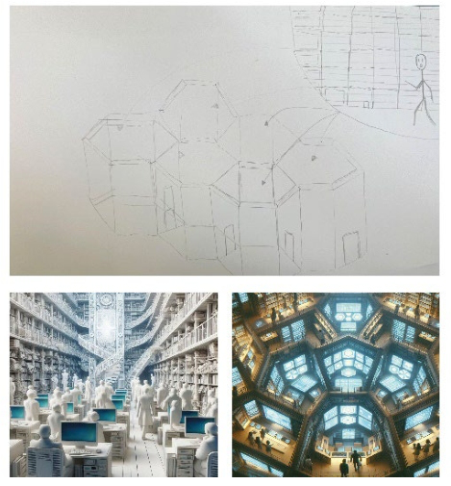
Figure 6: [...] I was astonished that I did not give any indication whatsoever about the clouds and the sky and that the program entered clouds as I imagined them. Designed by Benedetta Gaggero (2024).Figure 7: In the prompt you have to choose what you pay more attention to, whether the setting or the point of view [...]. Designed by Nicole Lomuscio (2024).Figure 8: It is difficult to understand whether you have to make long sentences or shorter ones. Even if you give precise indications on the size of the rooms, it continues to make them irregularly. The more specific the prompt, the more it starts adding details. Some prompts are not followed. [...] I tried to divide each element, separating it with punctuation but often the AI could not follow my instructions. It was difficult to formulate a prompt that would allow me to arrive at a result as close as possible to what I imagined. Designed by Giorgia Attard (2024).
A total of nineteen results were produced, each exhibiting distinctive characteristics and raising specific issues worthy of in-depth analysis. For the sake of brevity, the eight most significant works, both in terms of the images themselves and the reflections they elicited from the authors, are presented below. The work of each student is accompanied by the author’s commentary (Figs. 1–8).
The analysis of the works produced during the workshop revealed a plethora of topics of significant interest, which warrant further in-depth consideration. In many instances, it was observed that the software, despite being prompted with simplified descriptions, was able to replicate the original idea with remarkable fidelity, demonstrating high precision in both the details and the overall composition of the scenes. In some instances, the program even reproduced elements that were not explicitly mentioned in the prompt, such as cloudy skies or valleys, which suggests a semi-autonomous operation based on probabilistic deductions. It seems reasonable to posit that other elements within the prompt may have prompted the software to infer the presence of such features, thereby demonstrating a predictive capacity and revealing a sophisticated inferential capability.
However, when confronted with the challenge of representing more intricate or unconventional perspectives, such as a view from below or the
Bridging the Gap: Workshop Results on the Interaction Between Human Creativity 191
depiction of complex architectural structures, the software Copilot exhibited notable deficiencies, demonstrating difficulty in fully comprehending the instructions outlined in the prompts. Despite the authors’ endeavours to provide comprehensive and structured descriptions through intricate and meticulously crafted prompts, the system failed to generate results that met their expectations.
From these observations, an important lesson emerged: to achieve outcomes that closely align with the author’s vision, it is preferable to adopt an approach based on simple and concise phrases, in order to avoid misunderstandings. Subsequently, the process may undergo further iterations, with the incremental incorporation of more comprehensive elements to the prompt, thereby facilitating a gradual enhancement of the result towards the desired objective.
The final comparison of the works demonstrated the potential value of using artificial intelligence tools in the processes of design and conceptualization. However, it became evident that the success of these tools is contingent upon the user’s ability to interact with them in a precise and accurate manner. Despite notable advances, artificial intelligence (AI) remains unable to fully and autonomously grasp the semantic nuances of complex prompts, particularly when ambiguous or imprecise terminology is used to convey actual intentions. While AI has the potential to offer extraordinary capabilities, the interpretative role of human intellect remains indispensable, as it enables the filtering of machine-generated results and aligns them with the desired aesthetic vision and sensibility.
FUTURE SCENARIOS: PRESERVING HUMAN CREATIVITY AND ETHICS THROUGH SYNERGY WITH AI-DRIVEN CREATIVE PROCESSES Notwithstanding the considerable strides made in the artificial intelligence domain, driven by self-learning algorithms that facilitate exponentially accelerated and sophisticated development, the role of the human being in the realms of design and creative content generation remains indispensable. The increasing capacity of machines to process data, identify patterns, and generate original content has given rise to a vigorous debate concerning the potential replacement of human labour in this domain. However, it is imperative to recognise that human creativity is not merely a matter of technical proficiency; it is also deeply embedded in our experiences, emotions, and cultural context.
The human cognitive abilities of intuition and empathy represent pivotal elements in the creative production process. Artists, designers, and creative professionals do not merely combine existing ideas; they draw from an emotional and cultural reservoir that machines, no matter how advanced, cannot replicate (Turkle, 2011). Furthermore, creativity necessitates the ability to navigate uncertainty, express complex emotions, and comprehend cultural nuances, which are exclusive to the human experience (De Bono, 1969). Additionally, the creative process frequently exhibits a non-linear
trajectory, wherein errors and unanticipated occurrences can culminate in unanticipated discoveries and innovations (Amabile & Kramer, 2011).
It can be reasonably deduced from the results of the workshop that the effective utilization of artificial intelligence as a support tool in design and professional contexts necessitates the acquisition of specific skills about the utilization of generative AI tools and the expeditious crafting of solutions. In the absence of a comprehensive grasp of the operational mechanics of these tools, their utilization can not only prove futile but, on occasion, even counterproductive, resulting in substantial errors. Indeed, while the consequences of improper use of AI in contexts such as those addressed in the workshop may be relatively contained, the misuse of AI in critical sectors, such as medicine or architecture, could result in severe issues (Van de Berg & du Plessis, 2023).
Generative AI tools are designed to be powerful allies in the creative process; however, they require informed and conscious use. Only through training and practice can users learn to harness the full potential of these technologies, avoiding an over-reliance on automated results that may not meet specific design needs (Mahdavi Goloujeh et al., 2024).
Moreover, while AI technologies are capable of producing content rapidly and efficiently, there is an increasing acknowledgement of the intrinsic value of human art, creativity, and craft. The works of humans are imbued with a history, context, and vision that machines are unable to fully comprehend or reproduce. The capacity to narrate, elicit sentiments, and prompt profound introspection represents a pivotal facet of creativity that transcends the mere generation of content (Ruiz-Rojas et al., 2024). Conversely, the incorporation of AI into the creative process presents distinctive prospects for enhancing efficiency and expanding expressive possibilities. AI tools can function as collaborators, aiding creative professionals in exploring novel concepts and executing intricate projects. The convergence of human and machine capabilities could yield innovative and unexpected outcomes, but this collaboration must be guided by a human perspective, one that prioritises ethical conduct, authenticity, and the meaningfulness of the creative experience. As artificial intelligence continues to advance and becomes a powerful ally in the field of creativity, the point at which human beings will be entirely replaced in this domain still seems remote and, perhaps, fortuitously unattainable. The distinctive and irreplaceable aspect of design and creative content production, namely human creativity, will continue to be shaped by its inherent challenges, emotions, and capacity for innovation. It is therefore imperative that the adoption of generative AI tools is informed and mindful to ensure that the full potential of this technology is realised. This will ensure that the technology works in synergy with human capabilities rather than replacing them (Ruiz-Rojas et al., 2023).
In light of the above, it becomes evident that there is a need to promote the integration of AI technologies into educational pathways, both at the school and academic levels. The introduction of dedicated courses on the critical and creative use of AI could represent a significant contribution to preparing future generations to address the challenges posed by the current and constant technological progress. Providing students with a comprehensive
Bridging the Gap: Workshop Results on the Interaction Between Human Creativity 193
understanding of the fundamental principles of AI, its applications, and its potential, as well as its limitations, will not only enhance their technical expertise but also encourage a more nuanced reflection on the ethical, social, and cultural implications associated with the use of these tools. These skills, acquired through targeted educational programs, could thus serve as the foundation for conscious and responsible interaction with emerging technologies, fostering a virtuous collaboration between humans and AI, aimed at innovation and growth in the contemporary context.
ACKNOWLEDGMENT
The present work is the result of a shared reflection by the authors, developed through in-depth dialogue on the themes explored during the Symposium and Workshop entitled Alter Ego - Opportunities and Limits of Artificial Intelligence Applied to Research, held respectively in April and May 2024 at the Department of Architecture and Design of the University of Genoa. These events provided interdisciplinary forums for discussion, bringing together researchers and professionals who contributed to stimulating and enriching the debate on key issues related to the interaction between artificial intelligence and research.
DISCLAIMER The authors of this work declare that the content presented by the students, which is the subject of discussion in this paper, was generated through generative technologies based on artificial intelligence. Although utmost care has been taken in the use of sources and the management of copyright, it is not possible to determine the specific sources from which the systems used for image generation during the workshop draw their inputs. The authors do not assume any responsibility for potential copyright infringements arising from the use of protected materials.
REFERENCES
Amabile, T., & Kramer, S. (2011). The progress principle: Using small wins to ignite joy, engagement, and creativity at work. Harvard Business Review Press. Csikszentmihalyi, M. (2013). Creativity: The psychology of discovery and invention
(First Harper Perennial Modern Classics edition). Harper Perennial. De Bono, E. (1969). The mechanism of the mind. Cape. Galli, G. (in press). Babele. In Alter Ego: Opportunità e limiti dell’intelligenza artificiale applicata alla ricerca (pp. xx-xx). GUP, Genova. Mahdavi Goloujeh, A., Sullivan, A., & Magerko, B. (2024). Is It AI or Is It Me?
Understanding Users’ Prompt Journey with Text-to-Image Generative AI Tools. In Proceedings of the 2024 CHI Conference on Human Factors in Computing Systems (CHI ‘24). Association for Computing Machinery, New York, NY, USA, Article 183, 1–13. https://doi.org/10.1145/3613904.3642861 Nevoso, I., & De Natale, I. (2024). Ridefinire i confini creativi. Riflessioni sulla convergenza tra design e intelligenza artificiale. In G. Leandri (A cura di), IDEA – Innovation Design Application (pp. 37–48). GUP. https://gup.unige.it/sites/gup.u nige.it/files/2024-03/IDEA_Innovation_Design_Application_2024.pdf
Ruiz-Rojas, L. I., Acosta-Vargas, P., De-Moreta-Llovet, J., & Gonzalez-Rodriguez, M. (2023). Empowering Education with Generative Artificial Intelligence Tools: Approach with an Instructional Design Matrix. Sustainability, 15, 11524. https://doi.org/10.3390/su151511524 Ruiz-Rojas, L. I., Salvador-Ullauri, L., & Acosta-Vargas, P. (2024). Collaborative
Working and Critical Thinking: Adoption of Generative Artificial Intelligence Tools in Higher Education. Sustainability, 16, 5367. https://doi.org/10.3390/su 16135367 Schmidhuber, J. (2010). Formal Theory of Creativity, Fun, and Intrinsic Motivation.
IEEE Transactions on Autonomous Mental Development, 2(3), 230–247. https://doi.org/10.1109/TAMD.2010.2056368 Selmı, M., & ˙Ilerisoy, Z. Y. (2022). A comparative study of different grasshopper plugins for topology optimization in architectural design. Gazi University Journal of Science Part B: Art Humanities Design and Planning, 10(3), 323–334. Turkle, S. (2011). Alone together: Why we expect more from technology and less
from each other. Basic Books. Van den Berg, G., & Du Plessis, E. (2023). ChatGPT and Generative AI: Possibilities for Its Contribution to Lesson Planning, Critical Thinking and Openness in Teacher Education. Educ. Sci., 13, 998. https://doi.org/10.3390/educsci13100998
LISTED IN THE AHFE DIGITAL BOOKSTORE CATALOGUE
Explore the complete digital volume
Human Interaction and Emerging Technologies (IHIET-AI 2025): Artificial Intelligence and Future Applications
Read this individual research paper free through the original publisher, or explore the full digital proceedings book.
ISBN 978-1-964867-37-3
Explore this ISBN in the AHFE Bookstore ↗Listed in the July 2026 bookstore catalogue; search by ISBN to confirm current availability · Digital book purchase optional