Sarah Rudder (2025). Optimizing Resource Allocation and Traceability in Human-Centered Design (HCD). In: Human Interaction and Emerging Technologies (IHIET-AI 2025): Artificial Intelligence and Future Applications. AHFE Open Access, vol. 161, pp. 124–130. https://doi.org/10.54941/ahfe1005903
This study builds on previous work conducted by the researcher using a model-based framework to implement systems engineering (SE) practices and processes into a digital environment. Findings of a human-centric design (HCD) approach to system development include the optimization of resource allocation. By focusing on individual capabilities, transparency is built and employees are positioned for success. Upon incorporating these aspects, the results are anticipated to be increased traceability throughout the operational lifecycle to improve overall project management (PM). This paper builds on the findings of initial efforts to include additional model elements and the relationships between them using the Unified Architecture Framework (UAF). Results will then be assessed for applicability to actual SE processes in a digital environment.
Systems engineering (SE) is a discipline that transcends traditional engineering domains. The Unified Architecture Framework (UAF) produces models and views to develop an understanding of the complex relationships that exist between organizations, systems, and end users. The UAF profile to enable practitioners to express architectural model elements and organize them in a set of viewpoints, aspects, and view specifications (OMG, 2022).
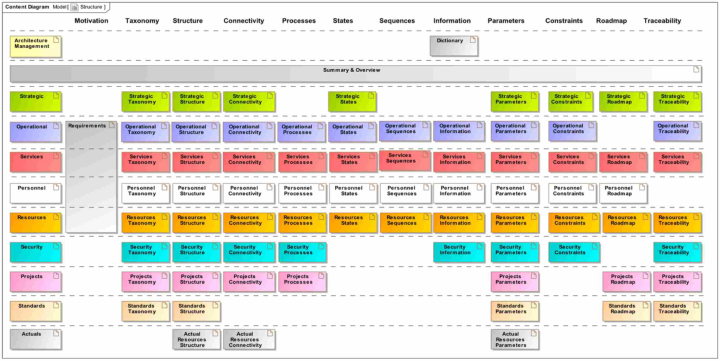
Previous research concentrated on a subset of the UAF within a digital environment using a manufacturing production line system (PLS) as a generic example. This paper intends to advance original work by the author with additional views recommended by the UAF approach. The case study will continue to address the Personnel and Resources domains regarding aspects such as human resource requirements, personnel and resource roadmaps, risk, and evaluation of individual persons’ competencies. The author’s research previously concluded that the Personnel and Resource domains of the framework are helpful in capturing information to analyze and improve human-centric designs (HCD). Figure 1 shows the UAF domain grid the
Optimizing Resource Allocation and Traceability in Human-Centric Design (HCD) 125
author is researching in relation to HCD of a PLS within the context of its operational environment.
Figure 1: UAF domain grid.
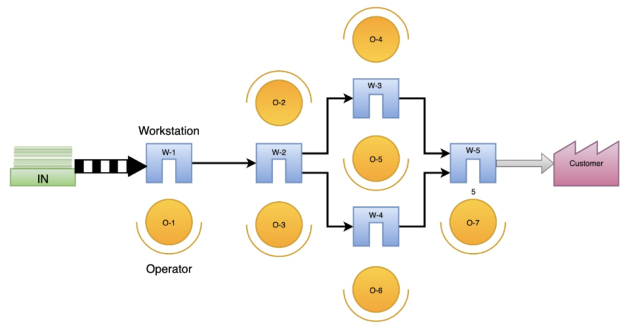
Using the previously built model of the PLS shown in Figure 2, additional views of both domains can be constructed for further understanding.
Figure 2: Production line system (PLS).
Martin & O’Neill, 2021, prescribe a workflow to the UAF that includes defining resource and personnel architectures with tasks to accomplish each.
PERSONNEL DOMAIN TECHNIQUES The following sections discuss the management of personnel and their competencies.
126 Rudder
Human Resource Management (HRM) Human resource management (HRM) is concerned with all aspects of how people are managed within organizations and can be defined as a strategic, integrated, and coherent approach to the development and well-being of employees (Armstrong & Taylor, 2014). It includes various tasks including worker relations, employee satisfaction, and provision of employee services to improve organizational efficiency (Anwar & Abdullah, 2021). Human resources are crucial in the process of converting other resources into outputs [i.e., products and services] (Tiwari & Saxena, 2012). In general, human resources determine outcomes quality and subsequent success of organizations (Midhat et al., 2021).
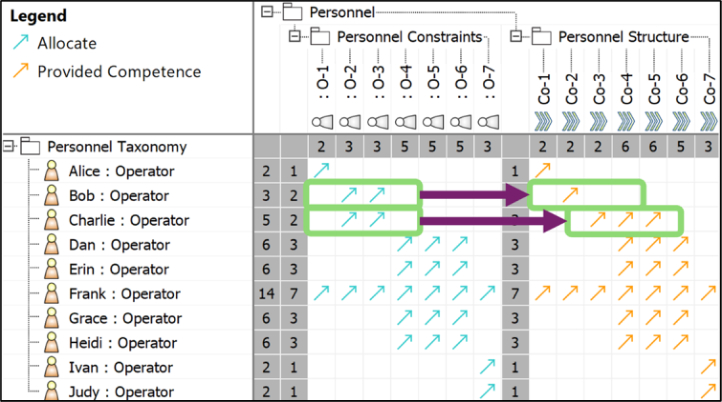
Personnel Competency The International Council on Systems Engineering (INCOSE) defines competency as “an observable, measurable set of skills, knowledge, abilities, and behaviors that an individual needs to successfully perform work roles or occupational functions”. Competency measures human performance to improve personnel management and employee development (Armstrong, 2006). There should be a strong link between capability and competence (Holt & Perry, 2011). Bartram, 2012, outlines a universal competency framework (UCF) that provides a practical basis for understanding behavior at work and the likelihood of their individual success within certain roles. Competency models define effective performance and then align learning opportunities with individual development goals (Getha-Taylor et al., 2013). Figure 3 shows individual competencies and constraints and exemplifies how a digital model using UAF may be used to identify gaps between operator assignments and known abilities.
Figure 3: Personnel competencies and constraints.
Optimizing Resource Allocation and Traceability in Human-Centric Design (HCD) 127
RESOURCE DOMAIN STRATEGIES OMG, 2022, defines resources as “software, artifacts, capability configurations, and natural resources that implement the operational requirements”. The PLS workstations and the human competencies (i.e., capability configurations) necessary to satisfy operational requirements are currently the focus of this domain.
Resource Allocation Allocating employees to workstations that each is competent to operate is critical on a warehouse floor. A single point of failure in the PLS shown in Figure 2 would significantly affect availability and reduce system reliability.
RESEARCH METHODS The Personnel domain defines and explores organizational resource types (OMG, 2022). This paper will look at views described in Table 1.
Table 1. UAF personnel domain views and purpose (OMG, 2022).
Gantt charts are visual representations that define key tasks, dependencies between activities, and deadlines to support higher-level milestone achievements and satisfy the purpose of the Personnel Availability view. Although this information can be captured in the UAF model, tools focused on project management (PM) lend themselves to constructing and updating accurate schedules for teams.
Martin, & O’Neil, 2021, have identified several key activities for the Resource domain including:
Resources comply with standards
Resources are delivered in accordance with project activities and milestones
Resources contribute to implementation of operational concepts
Resources are characterized and verified The resource views in Table 2 will be created and evaluated for relevancy to these objectives.
Table 2. UAF resource domain views and purpose (OMG, 2022).
Table available in the original PDF paper.
Resources View Purpose Taxonomy Defines the inheritance hierarchy of resource-level elements Structure Defines the SoS structure and physical resources Parameters Defines measurements of resource-level artifacts Typical Measurements Defines technical performance measurements (TPM) of the resource by type and category
128 Rudder
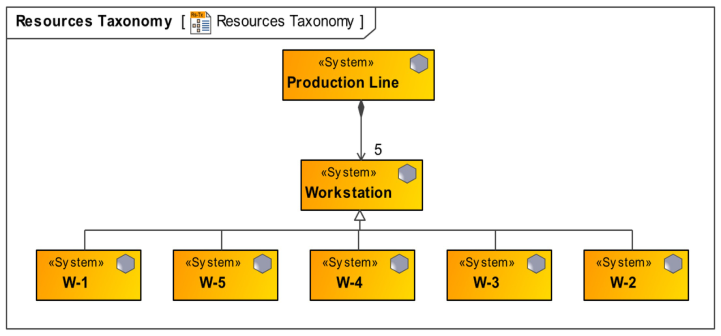
Figure 4 conveys the resources taxonomy for workstation systems (W1-W5) of the production line. This graphic shows the PLS is composed of exactly five (5) workstations. W1-W5 are all types of workstations that inherit properties from the system.
Figure 4: Resources taxonomy view.
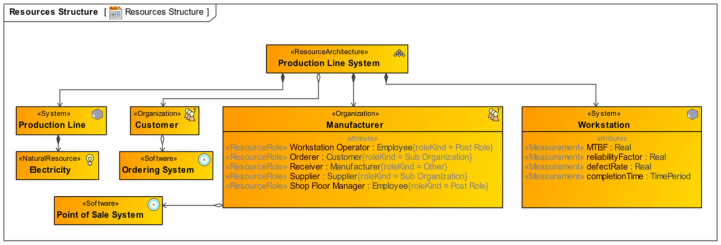
Figure 5 shows the PLS resource structure composed of systems, organizations, and natural resources. The architecture references the customer and the ordering and point-of-sale (POS) software. Attributes of the workstation system will contribute to the resource parameters and TPM views downstream of this activity.
Figure 5: Resources structure view.
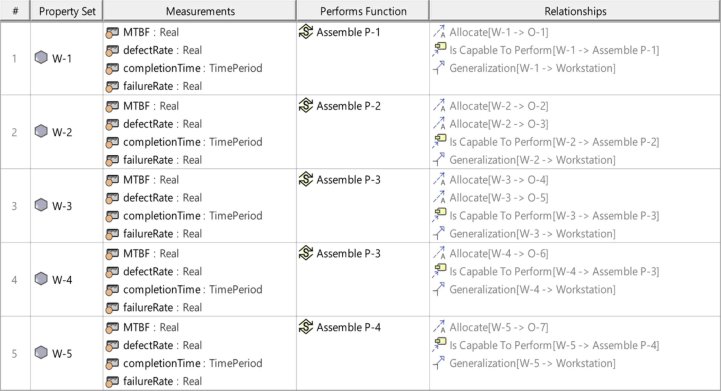
The following TPMs of the PLS workstation systems have been identified and captured in the UAF model (not inclusive): (1) mean-time between failure (MTBF), (2) reliability, (3) defect rate, and (4) completion time. Figure 6 places workstations into a succinct table with the typical measurements, the functions that each performs, and the relationships with other elements defined in the model.
Optimizing Resource Allocation and Traceability in Human-Centric Design (HCD) 129
Figure 6: Resource typical measurements view.
Reliability for the PLS is determined using the failure rate for each workstation. Data-driven preventive maintenance based on the results improves asset performance, enhances safety, increases cost savings, and decreases downtime.
CONCLUSION
This paper has demonstrated the potential of integrating SE practices with HCD using the UAF to optimize resource allocation and improve traceability throughout the operational lifecycle. By focusing on the Personnel and Resource domains, the research highlighted how these elements can be modeled and assessed for better alignment with operational requirements.
FUTURE WORK
Paths forward for the integration of the UAF personnel and resources domains into an SE-based digital enterprise have been established. Next steps to support viability of this approach for HCD are to assess types and number of required resources. Ordering, scheduling, and delivering PLS inputs to the operators’ assigned workstations must be timely for SoS sustainment. The impact of work to date should be traced to the UAF project and operational domains for assessment.
REFERENCES
Anwar, G. & Abdullah, N. N. (2021). The impact of Human resource management practice on Organizational performance. International Journal of Engineering, Business and Management, 5(1), 35–47. https://doi.org/10.22161/ijebm.5.1.4 Armstrong, M. (2006). A handbook of human resource management practice (10th
edition). Kogan Page.
130 Rudder
Armstrong, M. & Taylor, S. (2014). Armstrong’s handbook of human resource management practice (13. ed). Kogan Page. Bartram, D. (2012) White Paper—The SHL Universal Competency Framework. Getha-Taylor, H., Hummert, R., Nalbandian, J., & Silvia, C. (2013). Competency
Model Design and Assessment: Findings and Future Directions. Journal of Public Affairs Education, 19(1), 141–171. https://doi.org/10.1080/15236803. 2013.12001724 Holt, J. & Perry, S. A. (2012). A Pragmatic Guide to Competency. Martin, J. & O’Neil, D. (2021). Enterprise Architecture Guide for the Unified Architecture Framework (UAF). INCOSE International Symposium, 31(1), 242– 263. https://doi.org/10.1002/j.2334-5837.2021.00836.x Midhat Ali, M., Qureshi, S. M., Memon, M. S., Mari, S. I., & Ramzan, M. B.
(2021). Competency Framework Development for Effective Human Resource Management. Sage Open, 11(2), 21582440211006124. https://doi.org/10.1177/ 21582440211006124 Object Management Group (OMG). (2022). Unified Architecture Framework (UAF) Domain Metamodel. Tiwari, P. & Saxena, K. (2012). Human Resource Management Practices: A Comprehensive Review.
LISTED IN THE AHFE DIGITAL BOOKSTORE CATALOGUE
Explore the complete digital volume
Human Interaction and Emerging Technologies (IHIET-AI 2025): Artificial Intelligence and Future Applications
Read this individual research paper free through the original publisher, or explore the full digital proceedings book.
ISBN 978-1-964867-37-3
Explore this ISBN in the AHFE Bookstore ↗Listed in the July 2026 bookstore catalogue; search by ISBN to confirm current availability · Digital book purchase optional