Sarah Rudder (2024). Using a Model-Based Systems Engineering (MBSE) Approach for Human-Centric Design. In: Human Factors in Design, Engineering, and Computing. AHFE Open Access, vol. 159, pp. 330–338. https://doi.org/10.54941/ahfe1005598
This research explores the integration of model-based systems engineering (MBSE) practices with human-centric design principles to enhance enterprise operations. The primary focus is on incorporating personnel data into digital SE environments to improve human resource management and project outcomes. Utilizing the Unified Architecture Framework (UAF), the study develops a model that captures the complex relationships between organizational structures, resources, and human factors. A production line system (PLS) serves as a case study to demonstrate how MBSE tools can simulate and optimize human interactions within the operational environment. Key findings include improved traceability of personnel competencies between individual persons and proper resource allocation based on capabilities. The research concludes with a recommendation further studies to include performance requirements, personnel and resource roadmaps, and the consideration of organizational and societal influences on employees.
This research is motivated by the desire to extend typical systems engineering (SE) models to provide detailed information regarding employees within an enterprise. The case study was conducted with the goal of answering the following questions: (1) How can personnel data be captured in a digital environment conducive to SE processes? (2) Does capturing project management information within an engineering model assist with human resource management and decisions?
Model-Based Systems Engineering (MBSE) As model-based systems engineering (MBSE) tools become increasingly integrated into the digital thread during product design and development, additional approaches and methods have arisen. For the proper implementation of MBSE practices, a modeling language, tool, and approach must be defined and documented (Delligatti, 2014). Several graphical modeling languages that support the International Organization
Using a Model-Based Systems Engineering (MBSE) Approach 331
of Standards (ISO) 15288 - Systems engineering processes are available to assist with product development and design at the system, subsystem, and component levels. The Unified Architecture Framework Modeling Language (UAFML) extends expected capabilities of the Unified Modeling Language (UML) and the Systems Modeling Language (SysML) to provide similar solutions for enterprises and system-of-systems (SoS).
The framework itself encompasses a multitude of management concepts in addition to technical necessities. Given the increase in available model elements within UAFML, the flexibility of an MBSE approach is enhanced for more project-specific deviations to include parameters and constraints such as schedule, cost, and resources. UAF produces models and views to develop an understanding of the complex relationships that exist between organizations, systems, and end users. The UAF profile to enable practitioners to express architectural model elements and organize them in a set of viewpoints, aspects, and view specifications (OMG, 2022).
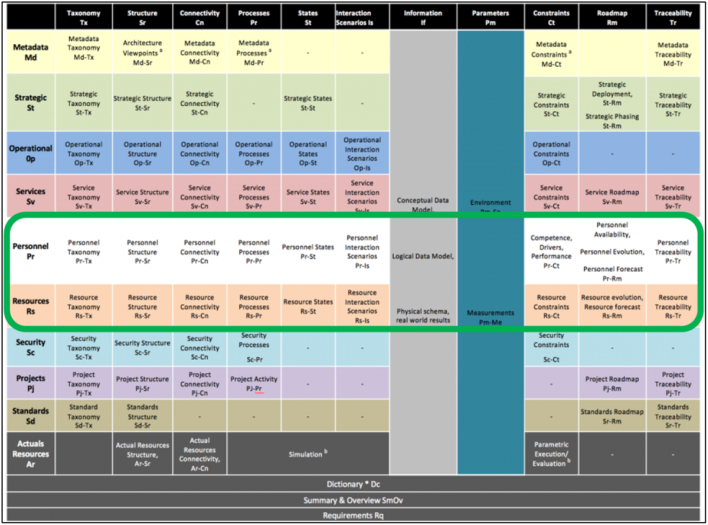
The profile has a domain metamodel to guide the modeler through the process shown in Figure 1. Each row of the grid represents a domain within the UAF. The columns are different views (i.e., diagrams) that can be created for the domains. This paper will focus on the Personnel domain and traceability to the Resource domain.
Figure 1: UAF grid.
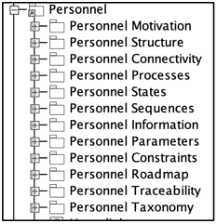
For each domain, packages in the containment tree construct the UAF and direct the process as shown in Figure 2.
332 Rudder
Figure 2: Personnel domain package structure.
The goal of the Personnel domain is to understand human resources and the interactions between them to better define the necessary human factors characteristics. Table 1 shows the subset of views constructed for the Personnel domain (OMG, 2022).
Table 1. UAF personnel domain views.
Table available in the original PDF paper.
Concern Purpose Personnel View
Defines organizational structure
Taxonomy Organizational personnel types Defines inheritance hierarchy of organization, posts, and persons Structure Organization structure used to support capabilities Processes Functions executed by organizational personnel Defines the functional flow of organizational interactions States Capture state-based behavior of organizational personnel
Defines time-ordered interaction between resources
Defines possible states of the organization and responses to various events and actions Sequences Interactions between organization personnel (i.e., roles) Defines measurements for personnel-level artifacts Constraints Show personnel abilities defined by knowledge, skills, and aptitude
The goal of the Resources domain is to define resources by providing defining resources required for implementation of successful enterprises [i.e., system-of-systems (SoS)]. Model elements originating in the Personnel domain are re-used here to architect human-machine interfaces (HMI).
Human Factors Engineering (HFE) The main objective of human factors engineering (HFE) [i.e., human factors and ergonomics) is to understand the interactions between people and the environment to optimize the human well-being and overall system performance (Salvendy, G., 2022). Human factors (HF) design should account for failure to match requirements of a task with operator capabilities
Using a Model-Based Systems Engineering (MBSE) Approach 333
(Jankovich, J.P., 1973). HF seeks to support systems development through the systematic and reasoned design of human-computer interactions (HCI) [Dowell, J. & Long, J].
In addition to HF evaluations, task and activity analysis is included in human-systems integration, where a task is a prescription to operators and an activity is what people do (Boy, 2017). According to Perrow, C., 1983, organizational context and social influence should be included in HFE analyses of the operations. This presents a need to integrate SE and HFE to satisfy requirements of mapping human users with tasks they are capable of accomplishing.
RESEARCH METHOD This research is focused on ways resource management integrates into a digital environment to provide a more complete model. UAF includes a particular focus on resources, associated requirements, their unique attributes, technical capabilities, areas for improvement, and allocated tasking. This information assists analysis of resource workload, dependencies, constraints, and parameters which leads to simulation capabilities for a production line while maintaining a human-centric approach. This research evaluates how capturing resource information in a digital environment serving as a single source of truth benefits a standard production system and an organization’s employees. The information to create at least one recommended diagram for the views identified in Table 1 will be modeled within an MBSE tool. After data capture, the views will be constructed and evaluated for usefulness. A simple production line system (PLS) will be modeled with the following attributes:
Five (5) workstations
Seven (7) required human resources
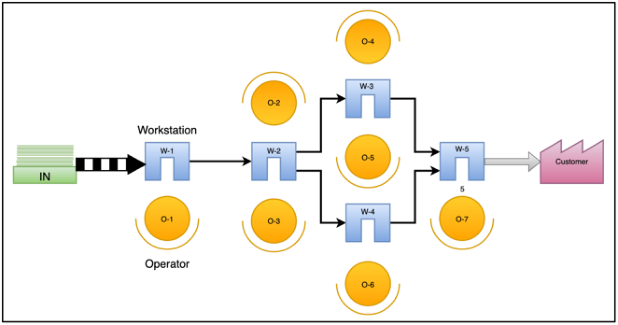
Figure 3 is a high-level graphic of the PLS with orders scheduled for input and complete assemblies as output to the customer, workstations, and operator(s) assigned to each station. Note this example is not an optimized manufacturing design.
Figure 3: Production line system of interest.
334 Rudder
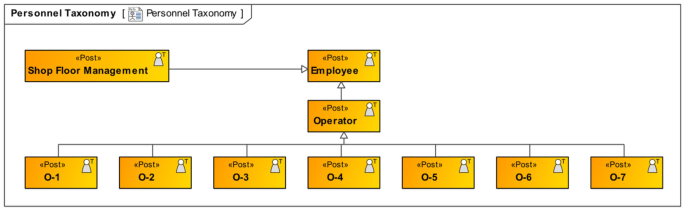
Starting with Personnel Taxonomy, posts were created for all operational roles shown in Figure 4.
Figure 4: PLS personnel taxonomy diagram.
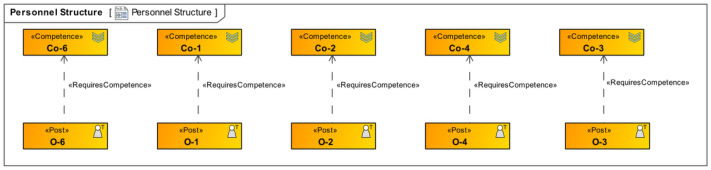
Competencies necessary for these posts were added to the Personnel Structure shown in Figure 5.
Figure 5: PLS personnel structure diagram.
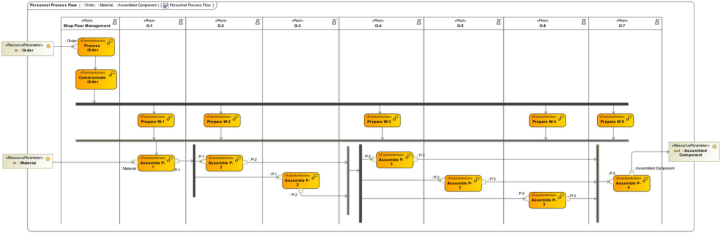
As shown in Figure 6, a Personnel Process Flow diagram was built to demonstrate the functions performed by posts in the PLS and the resource information exchanged between them. Executing this flow within the MBSE tool demonstrates the sequence of events that transpires to transform the inputs to the desired output at a high-level.
Figure 6: PLS personnel process flow diagram.
Using a Model-Based Systems Engineering (MBSE) Approach 335
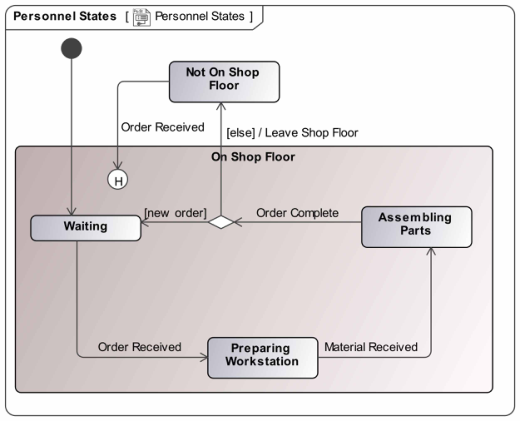
The Personnel domain states were identified in alignment with the PLS process flow shown in Figure 7.
Figure 7: PLS personnel states diagram.
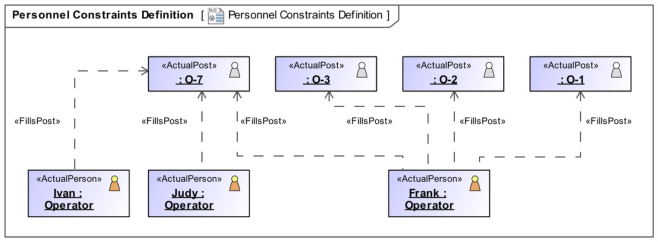
The Personnel Constraint Definition diagram can now be produced to realize actual posts and actual persons to fill the posts. Ten alternative operators have been added with dependencies to show the posts each can hold. The actual persons are then allocated to the competencies. A subset of these relationships is shown in Figure 8.
Figure 8: PLS constraint definition diagram.
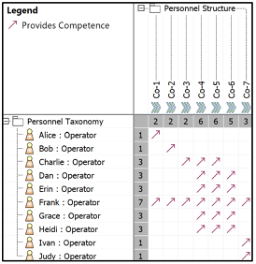
Within the SE model, traceability is now be shown between the actual person model elements acting as operators and their individual competencies shown in Figure 9.
336 Rudder
Figure 9: Matrix of operator competencies.
The Resources domain defines resources that are required for implementation of successful enterprises [i.e., system-of-systems (SoS)]. Model elements originating in the Personnel domain are re-used here to architect human-machine interfaces (HMI).
Table 2. UAF resources domain views.
Table available in the original PDF paper.
Concern Purpose Resources View
Defines the SoS structure and physical resources
Taxonomy Resource types Defines the inheritance hierarchy of resource-level elements Structure Resource structure, connectors, and interfaces in a specific context Connectivity Interactions between resources Defines internal resource exchanges of the enterprise Processes Capture activity-based behavior and flows
Defines SoS states
Defines functional flow of resource-level elements States Capture state-based behavior of a resource Information Capture operational, resource, and strategic information for resources
Defines structural or functional resource implementation
Defines resource-level information exchanged between system-level elements Parameters System performance Defines measurements of resource-level artifacts Constraints Define limitations, constraints, and performance parameters for resources Roadmap Resource structure changes over time Defines dependencies between resources, resource tasking, and schedules
The workstations that comprise the PLS were added to the Resource Taxonomy view as systems. The Resources Structure diagram realizes a more complete view of the architecture with the consideration of human-in-the- loop in the manufacturing floor context. Figure 10 shows the introduction
Using a Model-Based Systems Engineering (MBSE) Approach 337
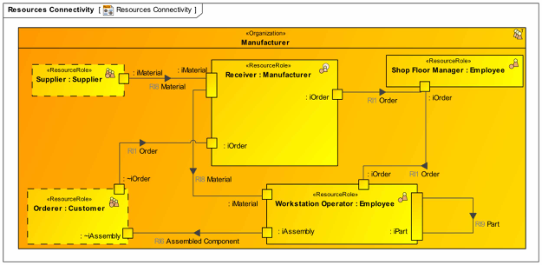
of relationships forming between the Personnel and Resources domains. Explicit connections showing resource information exchange items are created between ports owned by organizational resource roles.
Figure 10: PLS resource connectivity diagram.
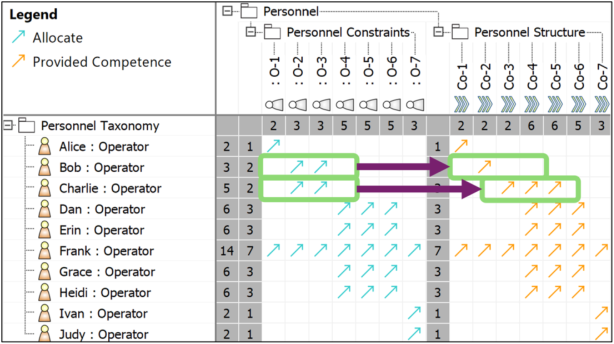
RESEARCH RESULTS The allocated attributes of model elements can be traced to multiple other domains, increasing insight into human resource management. Research question (1) has been answered throughout this paper with the use of Personnel and Resources domain practices and the resulting views. Figure 11 shows a dependency matrix of relationships between the actual persons, post allocations, and assigned competencies within the digital environment. This view shows discrepancies between the allocated operator posts assigned to the actual persons and the actual persons competencies. In this example, Bob should not be responsible for the O3 position since the associated competency is not allocated. Charlie should not be sourced to the O2 position, and instead assigned to either the O3, O4, or O5 stations.
Figure 11: Human operator constraints and competencies.
338 Rudder
RESEARCH CONCLUSIONS Although the PLS is not representative of an enterprise, the common application of UAF, this domain subset of the framework proves to be helpful in capturing information to analyze and improve human-centric designs. By focusing on capabilities and necessary competencies of human resources, transparency is built between management and other types of employees. Structured expressions can be used to query the SE model and ensure performance requirements are being met for human operators. Results from these queries shown in generic dependency matrices within the model assist with providing optimized allocation of human resources.
FUTURE RESEARCH Additional research for the effects of an SE model with a framework for a human-centric enterprise can build from the initial effort to include, but not limited to, performance requirements, personnel and resource roadmaps, risk, and evaluation of individual persons’ competencies. Organizational and societal influences should also be accounted for in future research endeavors.
REFERENCES
Boy, G. A. (2017). Human-centered design of complex systems: An experience-based approach. Design Science, 3, e8. https://doi.org/10.1017/dsj.2017.8 Delligatti, L. (2014). SysML Distilled: A Brief Guide to the Systems Modeling
Language. Dowell, J., & Long, J. (1989). Towards a conception for an engineering discipline of human factors. Ergonomics, 32(11), 1513–1535. https://doi.org/10.1080/ 00140138908966921 ISO/IEC/IEEE 15288. (2023). Systems and software engineering – System life cycle
processes. (ISO Standard No. 15288:2023). Object Management Group (OMG). (2022). Unified Architecture Framework (UAF) Domain Metamodel. Perrow, C. (1983). The Organizational Context of Human Factors Engineering.
Administrative Science Quarterly, 28(4), 521–541. https://doi.org/10.2307/ 2393007 Salvendy, G. (2022). Handbook of human factors and ergonomics fourth edition.
LISTED IN THE AHFE DIGITAL BOOKSTORE CATALOGUE
Explore the complete digital volume
Human Factors in Design, Engineering, and Computing
Read this individual research paper free through the original publisher, or explore the full digital proceedings book.
ISBN 978-1-964867-35-9
Explore this ISBN in the AHFE Bookstore ↗Listed in the July 2026 bookstore catalogue; search by ISBN to confirm current availability · Digital book purchase optional