Sarah Rudder (2025). Benefits of integrating resource management into an enterprise architecture. In: Human Systems Engineering and Design (IHSED2025): Future Trends and Applications. AHFE Open Access, vol. 198, pp. 189–196. https://doi.org/10.54941/ahfe1006775
This paper extends previous research on the integration of model-based systems engineering (MBSE) with the Unified Architecture Framework (UAF). Building upon the author’s earlier work that established the value of the UAF's Personnel and Resource domains, this study expands the implementation to include the Projects and Operational domains, creating a more comprehensive enterprise architecture (EA) model. This research demonstrates how the UAF can be applied to a manufacturing company to improve collaboration across disciplines and enable informed decision-making throughout the organization. Key outcomes include integrated viewpoints across UAF domains and aspects, automatic verification of requirements through parametric modeling, and dependency matrices that illustrate cross-domain relationships of the organization. Results show that this methodology successfully maintains traceability between enterprise domains by considering aspects such as requirements, taxonomies, structure, and processes. This work establishes a foundation for EA modeling and demonstrates the UAF’s capability to bridge traditional systems engineering (SE) practices with human factors (HF) considerations. By integrating various stakeholder concerns of the enterprise, transparency across disciplines is accomplished within a model environment. Future research will explore the Services and Security domains to complete the UAF implementation.
This paper presents a continuation of the author’s previous work regarding human-centric design (HCD) of a fictitious production line system (PLS) using model-based systems engineering (MBSE) and the Unified Architecture Framework (UAF). Initial work concluded that the Personnel and Resource domains of the framework are helpful in capturing information to analyze and improve HCD (Rudder, 2024). The subsequent study demonstrated the potential of integrating SE practices with HCD using the UAF to optimize resource allocation and improve traceability throughout the operational lifecycle (Rudder, 2025). By focusing on the Personnel and Resource domains, the research highlighted how these elements are modeled and assessed for
better alignment with requirements. The UAF produces models and views to develop an understanding of the complex relationships that exist between organizations, systems, and end users. The UAF profile enables practitioners to express architectural model elements and organize them in a set of viewpoints, aspects, and view specifications (OMG, 2022). The profile has a domain metamodel to guide the modeler through the processes detailed by (Martin & O’Neil, 2021). To support viability of the proposed approach for HCD, the UAF Personnel and Resource domains will be traced to Project and Operational domains leveraging cross-cutting relationships.
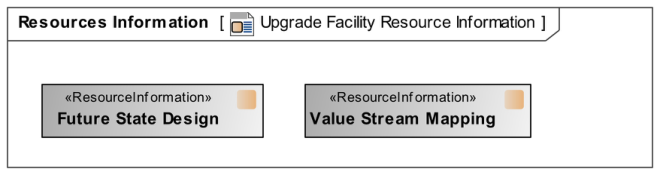
RESEARCH METHOD To model the enterprise architecture (EA) of the manufacturing company that owns the PLS, a higher-level view of the organization will be constructed within the same project. This demonstrates a bottom-up approach to EA while maintaining traceability and re-usability of model elements. In this fictitious example, there is a need for project management to improve the reliability of the PLS based on insufficient output. A new project is undertaken to upgrade the facility based on current- state analysis to deploy an improved manufacturing process. To support the construction of the UAF Project domain, updates were made to the Resources Information and Personnel Taxonomy viewpoints. Figure 1 shows ≪ResourceInformation≫items added to the Resources Information viewpoint. Figure 1 shows ≪ResourceInformation≫items added to the Resources Information viewpoint.
Figure 1: Resource information items.
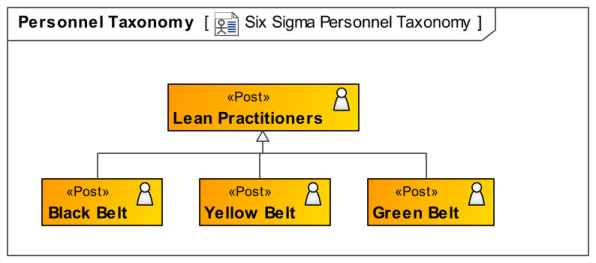
Figure 2 shows additional ≪Post≫elements added to the Personnel Taxonomy viewpoint that represent generic positions of the lean six sigma team that is tasked with increasing PLS output.
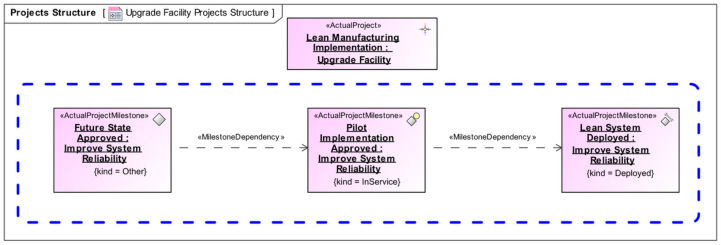
Project Domain This UAF Project domain describes enterprise endeavors along with their dependencies, activities, milestones, and timelines (OMG, 2022). Enterprise projects and milestones are captured within the Projects Structure viewpoint. ≪ActualProject≫and ≪ActualProjectMilestone≫elements represent instantiations of typical projects and typical milestones as illustrated in Figure 3.
Benefits of Integrating Resource Management Into an Enterprise Architecture 191
Figure 2: Six sigma personnel taxonomy.Figure 3: Projects structure diagram.
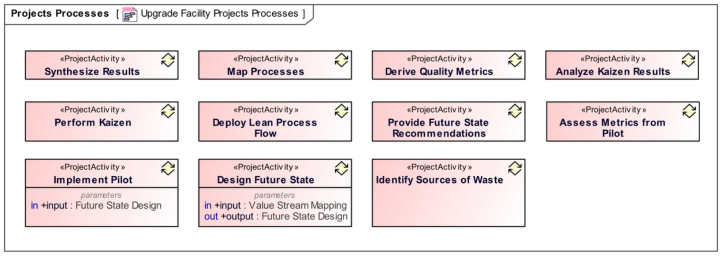
≪ProjectActivity≫ elements necessary to execute the “Lean Manufacturing Implementation” ≪ActualProject≫are captured in the Project Processes viewpoint shown in Figure 4.
Figure 4: Projects processes diagram.
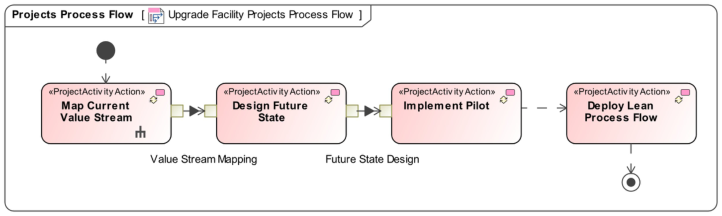
The Project Process Flow diagram uses ≪ProjectActivity≫elements to type each ≪ProjectActivityAction≫that must be executed to complete the process as illustrated in Figure 5.
192 Rudder
Figure 5: Projects process flow diagram.
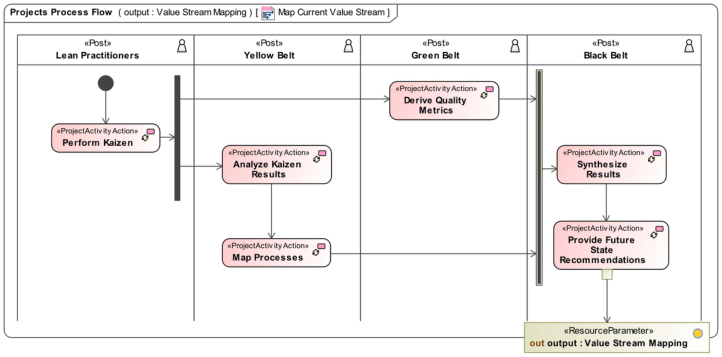
Figure 5 shows a sequential process that supports each ≪ActualProjectMilestone≫and demonstrates the connectivity between the Projects and Resources domains. The “Value Stream Mapping” and “Future State Design” ≪ResourceInformation≫items from Figure 1 are shown being exchanged in this view, connecting the Projects and Resources domains. Each ≪ProjectActivityAction≫shown in Figure 5 can be further elaborated to specify each responsible ≪Post≫with additional process flow diagrams. Figure 6 shows a white-box view of the “Map Current Value Stream” ≪ProjectActivityAction≫with a specific ≪Post≫allocated to each partition, indicating responsibility for the tasks.
Figure 6: Projects process flow of value stream mapping.
The output “Value Stream Mapping” ≪ResourceParameter≫directly aligns with the ≪ResourceInformation≫item from the “Map Current Value Stream” ≪ProjectActivityAction≫in Figure 5.
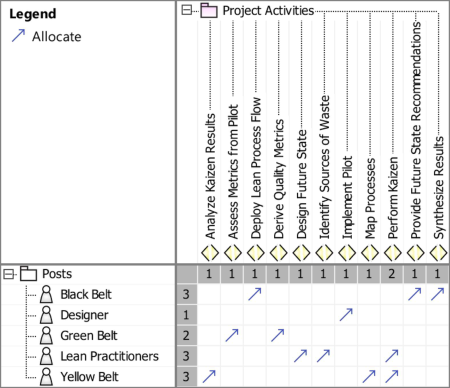
Figure 7 shows an example of a dependency matrix constructed to show activities in the Project domain that have been allocated to Personnel elements. Visualizing the cross-domain relationships within the EA aids in identifying potential gaps between all UAF aspects.
Benefits of Integrating Resource Management Into an Enterprise Architecture 193
Figure 7: Projects process flow of value stream mapping.
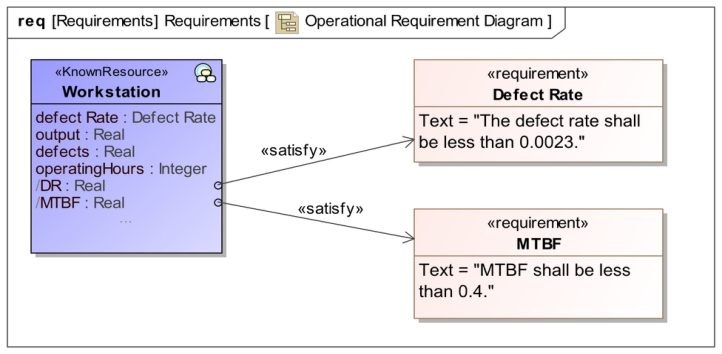
Operational Domain The UAF Operational domain describes the solution-independent logical architecture by capturing operational requirements (OR), behavior, structure, and exchanges that support strategic capabilities of the enterprise (OMG, 2022). Figure 8 shows two (2) ORs with arbitrary bounds meant to demonstrate the concept of automatic validation within the system model.
Figure 8: PLS operational requirements.
Figure available in the original PDF paper.
Figure 9 shows the ≪satisfy≫ relationship created between the “Workstation” ≪KnownResource≫value properties and the ORs that must be met in the production environment.
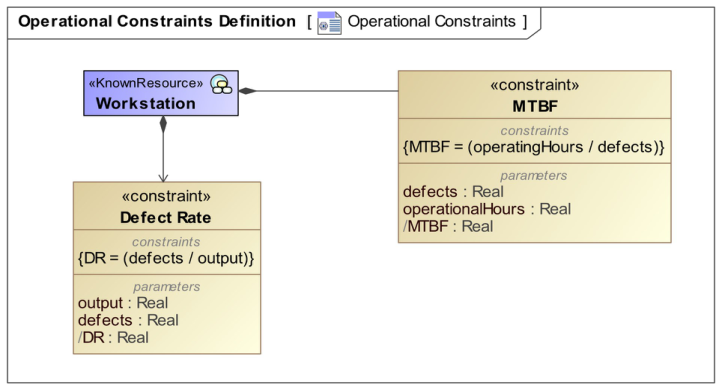
Figure 10 shows “Workstation” ≪KnownResource≫constraints and the associated parameters that correlate to each variable in the constraint expression.
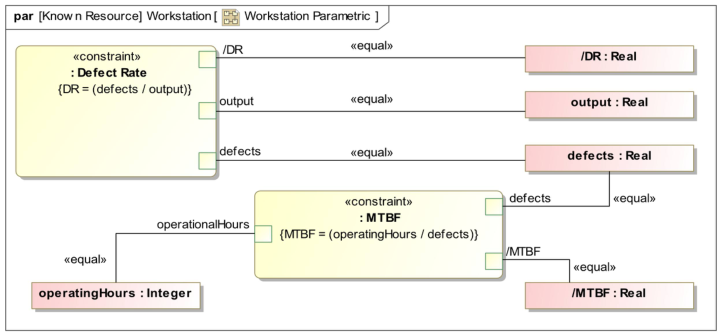
Figure 11 illustrates the “Defect Rate” and “MTBF” ≪constraint≫ calculations.
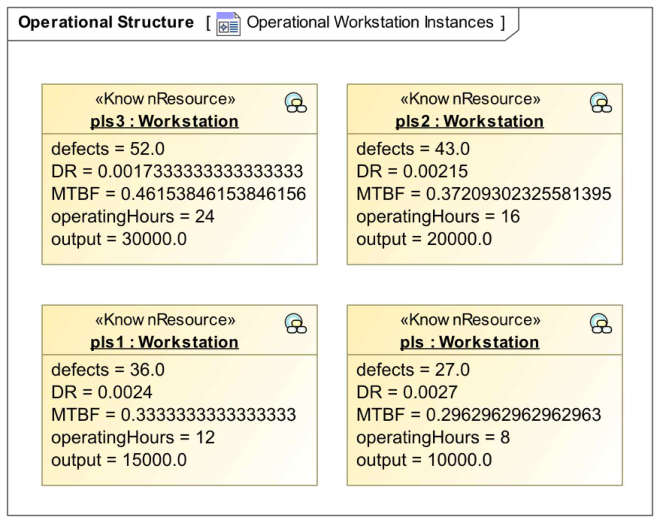
Figure 12 shows four (4) “Workstation” ≪KnownResource≫instances in the Operational Structure viewpoint and exemplifies the usage of Resource model elements within the Operational domain.
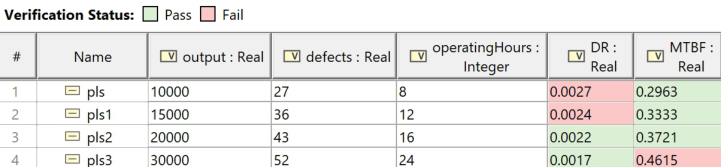
The traceability between UAF domains within an enterprise project allows for ORs to be automatically verified as shown in Figure 13.
194 Rudder
Figure 9: OR diagram.Figure 10: Operational constraints definition diagram.Figure 11: Parametric evaluation of workstations.
Benefits of Integrating Resource Management Into an Enterprise Architecture 195
Figure 12: Operational structure of workstation instances.Figure 13: Workstation OR verification.
CONCLUSION
Implementing a framework when architecting an enterprise assists typical project management activities. This fictitious performance improvement scenario of a manufacturing PLS exemplifies UAF capabilities regarding the Projects and Operational domains. By leveraging information previously captured within the model, traceability is maintained across stakeholder views to increase transparency and collaboration between disciplines. Future work will continue to build the EA by investigating the Services and Security stakeholder concerns.
Martin, J. & O’Neil, D. (2021). Enterprise Architecture Guide for the Unified Architecture Framework (UAF). INCOSE International Symposium, 31(1), 242–263. https://doi.org/10.1002/j.2334–5837.2021.00836.x Rudder, S. (2024). Using a model-based systems engineering framework for human-
centric design. 2024 AHFE International Conference on Human Factors in Design, Engineering, and Computing (AHFE 2024 Hawaii Edition). https://doi.org/10. 54941/ahfe1005598 Rudder, S. (2025). Optimizing Resource Allocation and Traceability in Human- Centered Design (HCD). Human Interaction and Emerging Technologies (IHIET- AI 2025): Artificial Intelligence and Future Applications, 3(3). https://doi.org/10. 54941/ahfe1005903
LISTED IN THE AHFE DIGITAL BOOKSTORE CATALOGUE
Explore the complete digital volume
Human Systems Engineering and Design (IHSED2025): Future Trends and Applications
Read this individual research paper free through the original publisher, or explore the full digital proceedings book.
ISBN 978-1-964867-74-8
Explore this ISBN in the AHFE Bookstore ↗Listed in the July 2026 bookstore catalogue; search by ISBN to confirm current availability · Digital book purchase optional