Vesa Salminen, Matti Pyykkönen, Ari Saarinen (2025). Disaster Situation Management by Using Common Ontology and Semantics. In: Human Systems Engineering and Design (IHSED2025): Future Trends and Applications. AHFE Open Access, vol. 198, pp. 1–17. https://doi.org/10.54941/ahfe1006756
This research examines the creation of common ontology and semantics aspects during nature disaster identification and management. The common ontological definition is important for various stakeholders and expert groups to understand disaster during its different stages for controlling and managing salvation and recovery. During this study has been used as case study environment, the MobiJOPA™ system created recently by the Start-up company Husqtec Corp., which is concentrating on situation and operational management. As the use case has been selected water flow disaster, which is quite common type of disaster because of the influence of climate change. During the research has been answered to the following research questions: - How is the common ontology and related semantics formed on the use case of water flow disaster? - How is human-based understanding and management of situation analysis, resource control, and operation command organized according to the common ontology and related semantics? - How could generative AI and AI Agent- technology be used in a common semantic infrastructure? This article introduces the problematics of common ontology to be configurable according to the variety of local, regional, and geographical stakeholders and experts based on characteristics of demographic population, nationality, culture, organization structure, weather conditions, and the diversity of nature and infrastructure. The study highlights the critical role of user-centered design, AI-driven decision support, and team cohesion in fostering effective emergency response. A case study prioritizes user-centred design to address the needs of diverse user groups, ensuring inclusivity and accessibility in disaster scenarios. Advanced technology integration by using Generative AI and AI Agent technologies improves decision-making and teamwork during crises. The study also introduces the need of cohesion within the team, managing the disaster situation and decision making. Modular and customizable features enhance the system's adaptability and user experience of various experts and groups involved.
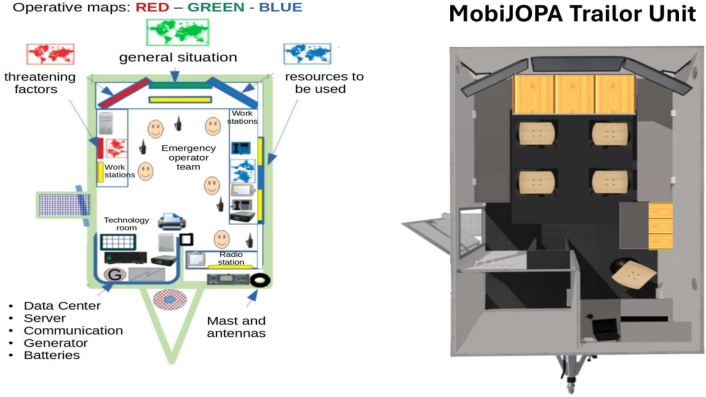
A shared understanding of the situation is critical as responders from different organizations (e.g., fire, medical, military, NGOs) must work in concert under high pressure. Recent research by Salminen et al. examined the creation of a common ontology and semantics for disaster identification and management, using a water flow (flood) disaster as a case study and the MobiJOPA® system as the test environment. MobiJOPA® – a portable situational and operational management system developed by Husqtec Corp served as a platform to explore how a common semantic framework can improve understanding of a disaster across its different stages (from early warning to recovery) (Figure 1).
The study addressed key questions on how to form a common disaster ontology, organize human-driven situation analysis and command using that ontology, leverage generative AI and AI agents on this semantic basis, and ultimately improve overall situation understanding and management. These questions highlight the central hypothesis: a shared semantic infrastructure can enhance interoperability and decision-making in emergency response.
The increasing frequency and intensity of natural disasters such as floods call for innovative, coordinated, and intelligent response strategies. Integrating semantic infrastructures into disaster management systems offers a promising pathway to improving interoperability, user inclusion, and service efficiency. This article synthesizes insights from research on home care services for aging populations and applies them to the MobiJOPA® disaster management framework.
Figure 1: MobiJOPA disaster unit- conceptual description of modular system.
Networked service environment involve multiple stakeholders, heterogeneous data sources, and critical, time-sensitive decision processes. A semantic infrastructure is underpinned by a common ontology, to ensure that data from various sources could be meaningfully combined and used in service processes. Principles of semantic modelling, ontology layering,
Disaster Situation Management by Using Common Ontology and Semantics 3
and system architecture can be applied to disaster management. We can achieve semantic interoperability between disparate emergency systems, align processes and protocols across agencies, design services that are user- centred for both responders and affected populations, and govern the use of advanced AI (such as predictive models or decision-support agents) in an ethical and transparent manner.
The theoretical foundations of semantic modelling and interoperability is created for situation and emergency management of disaster purposes and drafted a semantic infrastructure for disaster management, including ontology development and system architecture (interface layers). Then it is explored how semantic interoperability can improve data integration and situational awareness in emergencies, providing examples from literature and practice. We also highlight the importance of user-centred service design and process alignment, showing how a semantic framework can support established disaster response processes (e.g., incident command systems) and improve coordination. The integration of AI technologies, such as generative AI and autonomous agents, are examined to be used in emergency management. It is discussing how a common ontology enables these tools and what ethical AI governance measures must be in place to use them responsibly.
THEORETICAL FRAMEWORK In disaster domain, an ontology represents a shared vocabulary and set of relationships that model the key entities and processes of the domain. Chandrasekharan et al. (1999) famously asked “What are ontologies, and why do we need them?” – concluding that ontologies are critical for knowledge sharing, integration, and reuse in complex systems. In essence, an ontology encodes domain knowledge in a formal way, enabling computers and humans to operate on the basis of a common understanding of terms and data. In disaster management, this might include definitions of events (e.g. flood, earthquake), resources (e.g. water pumps, shelters), roles (e.g. incident commander, volunteer), and actions (e.g. evacuate, rescue). Ontology as a kind of method for knowledge representation is able to provide semantic integration for decision support in emergency management activities of meteorological disasters. A common ontology ensures that when different agencies or information systems refer to a concept like “casualty” or “flood zone,” they mean the same thing – a prerequisite for coordinated action. Prior research supports the value of this approach: Babitski et al. (2009) demonstrated that an ontology-based integration of sensor data in a flood scenario significantly enhanced situation understanding for responders, improving both interpretation of data and coordination among teams. Similarly, Elmhadhbi and Karray (2021) proposed a semantic framework for disaster management that enabled a holistic understanding of crisis information, resulting in better stakeholder coordination and decision- making in flood response case studies.
These studies validate the concept that a well-defined ontology can act as a lingua franca in emergencies, integrating heterogeneous data and
stakeholder perspectives into a unified situational picture. The concept of a service environment with semantic infrastructure originates in domains like healthcare, where multiple service providers (e.g., hospitals, home care, pharmacies, social services) must work together. Salminen et al. describe how in home care, the lack of a common ontology and semantic infrastructure was impeding the effective use of data gathered from digital devices and care processes. A semantic infrastructure model intended is introduced for social and health care services, highlighting that common ontology is essential as shared domain knowledge for all partners in a service network. Disaster response is also a networked service environment involving government emergency services, local authorities, NGOs, community groups, and increasingly digital contributors (crowdsourcing, social media). Just as in home care the semantic infrastructure had to accommodate health and social care data, in disaster management we must accommodate environmental sensor data, geospatial information, logistical data, and human welfare information. The goal is to create an ontology that different systems (early warning systems, incident management platforms, resource logistics tools, etc.) can all draw upon. Researchers in interoperability have long emphasized that semantic standards are key to enabling data exchange and coordination in heterogeneous environments. For example, Salminen & Pillai (2007) identified interoperability requirement challenges in collaborative systems, suggesting that future trends would demand standardized semantics for smooth communication between different organizations’ software. In summary, the theoretical foundation for our approach is that semantic modelling provides the backbone for interoperability. By formally defining the domain concepts and their relationships, we create a common reference point that all actors and technologies in the disaster response ecosystem can use to align their understanding and actions.
Designing such integrated semantic systems for disasters also calls for a systems thinking perspective. Disasters are quintessential complex, chaotic situations, and building a system to manage them requires simplifying complexity without losing essential detail. As Jamshid Gharajedaghi (1999) asserted, “System thinking is the art of simplifying complexity”. It enables us to see through chaos, manage interdependencies, and understand choices in design and strategy. Applying systems thinking here means considering technology, people, processes, and data as part of one large socio-technical system. Concepts and frameworks help explain the chaos and coordinate efforts. For example, in emergency management there is the notion of a Common Operational Picture (COP) – a system that aggregates information to present a unified view of the situation to all responders. A semantic infrastructure can be seen as a backbone to enable a COP: by ensuring that the underlying data from multiple sources is semantically consistent, the COP truly means the same thing to everyone. This approach ties into broader paradigms like Open Innovation and collaborative networks. Active and Effective Disaster Response, which is focusing on semantic modeling of crises is set up by uniting ontology theory, semantic interoperability principles, and systems thinking. By doing so, we can create a robust conceptual bedrock for building semantic infrastructure for disaster management.
Disaster Situation Management by Using Common Ontology and Semantics 5
RESEARCH QUESTIONS AND RESEARCH APPROACH This research has examined the creation of common ontology and semantics aspects during nature disaster identification and management. Situation management requires common ontology to be configurable according to the variety of local, regional, and geographical stakeholders and experts.
During the research has been answered to the following research questions:
- How is the common ontology and related semantics formed on the use case of water flow disaster? - How is human-based understanding and management of situation analysis, resource control, and operation command organized according to the common ontology and related semantics? - How could generative AI and AI Agent- technology be used in a common semantic infrastructure?
This research has an action-based approach and uses a method based on grounded theory (Glaser, Strauss, 1999). It is partly constructive, conceptual, and analytical. Data for this concept creation has been continuously collected from implementation phase of the case study application of MobiJOPA™, created by a start-up company, Husqtec Corp. This action-type research approach may be seen as a type of applied science.
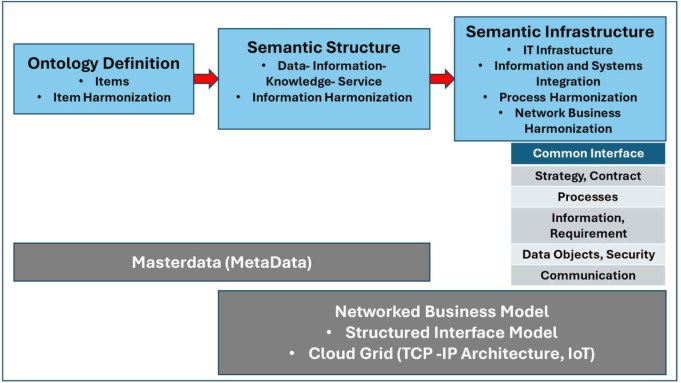
SEMANTIC INFRASTRUCTURE FOR DISASTER MANAGEMENT It is essential to build a semantic infrastructure for disaster management. The design involves ontology development, defining ontology layers or classes, and establishing a system architecture of interface layers that together ensure data and process harmonization across the emergency response network (Figure 2).
Developing a disaster ontology requires a methodical approach that involves domain experts from different fields (meteorology, emergency medicine, logistics, etc.) and iterative refinement. In the home care context, Salminen et al. structured the ontology around four structural classes or domains of information: health, social, process, and controls. This meant that data and knowledge were categorized into health-related information, social care information, process (workflow) descriptions, and control mechanisms (likely referring to management or governance aspects). A similar approach can benefit disaster management: one could define, for instance, environmental (hazard data, weather, geology), human/social (population data, social media inputs, shelter information), process (the sequence of emergency response actions, protocols like evacuation, relief distribution), and control (command and coordination structures, policies, and regulations). By explicitly separating these layers in the ontology, we ensure that the ontology covers not just the physical aspects of the disaster, but also human and procedural aspects. Indeed, the ontology must encompass everything from sensor readings (water levels, seismic readings) to resources and tasks (sandbagging, medical triage) to organizational roles and policies (who is in charge at which stage). Disaster management ontology
definition is the starting point in process harmonization for aligning how different agencies’ processes intersect.
Once developed, the common ontology serves as the backbone for semantic structure and information harmonization. In other words, all data that enters the system, whether from IoT sensors, GIS systems, databases, or human reports, is annotated or mapped to the ontology, enabling master data management in a consistent way. Salminen et al. (2018) describe that ontology with careful item harmonization enables information harmonization across the network. In practice, this could mean, for example, that various terms for a concept (“flash flood”, “rapid onset flood”) are linked to a single ontology entity, or that resources like “paramedic team”and “medical unit” are recognized as the same category for allocation purposes. The ontology thus becomes the pivot through which heterogeneous data is translated into a common representation.
Figure 2: From ontology definition to semantic structure and common semantic infrastructure (Salminen et al., 2018).
A database or knowledge graph can be built upon this semantic structure, automatically linking related information. For instance, sensor data indicating rising water levels can be semantically linked to the concept “FloodRisk”, which in turn might trigger processes defined in the ontology such as “IssueFloodAlert” that involve certain roles and communications. By querying the knowledge graph, decision-makers can see all information related to “FloodRisk in Area X” – including sensor readings, population vulnerabilities, available response units, etc. – because those relationships are encoded semantically rather than just scattered in separate systems.
A critical aspect of semantic infrastructure is that it doesn’t only model static data, but also processes and workflows. In disaster management we consider the disaster management lifecycle or specific emergency response processes (like the steps of the Incident Command System, or the phases of
Disaster Situation Management by Using Common Ontology and Semantics 7
disaster response: preparedness, response, recovery). By formally defining these processes in the ontology, we ensure that all agencies are literally “on the same page” regarding how the disaster unfolds and who is responsible for what at each stage. For example, the ontology can include an object “Evacuation” with properties linking it to “Region”, “Population”, “Transportation Resources”, and roles like “Evacuation Coordinator”. If every stakeholder’s system refers to the same “Evacuation” concept, then an order to evacuate a region can propagate through the system with all parties understanding the implications (shelters need to be prepared, transportation arranged, messages sent to public, etc.). Process harmonization means that even if agencies have different internal procedures, the semantic layer maps these to a common reference process. Salminen et al. (2018) highlight that this alignment of processes is key to harmonizing a networked business (or service) environment. In disaster terms, this is key to harmonizing multi-agency operations. Indeed, a common ontology could incorporate existing agreed frameworks like the Incident Command System (ICS) or humanitarian cluster system, ensuring that the technology reinforces the established coordination mechanisms rather than introducing new confusion. In summary, the semantic infrastructure embeds both data and process knowledge, enabling the disaster management system not just to share data, but also to coordinate actions effectively.
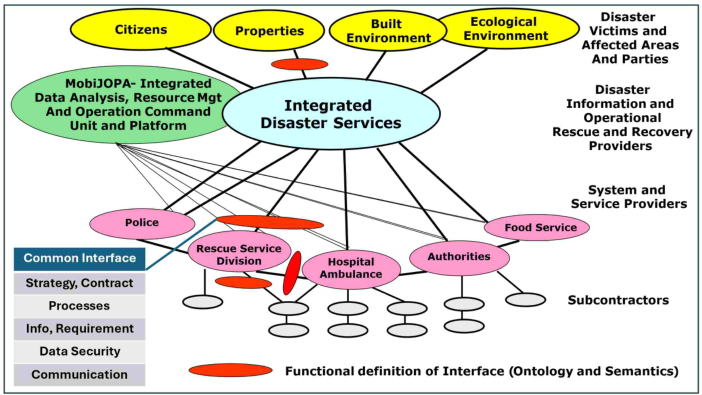
Beyond the ontology and semantic data layer, we must consider the overall system architecture required to implement this in practice. A valuable insight in MobiJOPA use case analysis was that in semantic infrastructure is needed multiple interface layers to integrate services on a common platform. Five interface layers were defined: Strategy, Process, Information, Data Ownership/Security, and Communication (Figure 3).
Figure 3: Common interface management for network operations by layered semantic definition.
These layers can be directly transposed to an emergency management context: (Figure 3)
Strategy Layer (Agreements & Policies): In disaster management, the strategy layer would include the agreements and frameworks that bind agencies, for example, mutual aid agreements between municipalities, international humanitarian guidelines, or high-level disaster response plans. A semantic infrastructure must respect and incorporate these strategic directives. Having a strategy layer interface ensures that any automated recommendations or data exchanges align with the overarching policies (e.g., data sharing agreements or humanitarian principles).
Process Layer: This corresponds to the workflows and procedures, as discussed. The interface at this layer ensures that systems interoperate in terms of operations. Aligning on process semantics prevents miscommunications like duplicate resource requests or conflicting orders.
Information Layer: Here lies the ontology and semantic data model itself, consisting the definitions of all key terms and data structures. Standardizing the information models (formats, schemas, ontologies) is the core of semantic interoperability. In practice, this might involve using or extending existing standards, as semantic web standards like OWL/RDF to encode the disaster ontology for all to use. For disasters, this could mean developing formal semantic standards for key data like casualty counts, infrastructure damage reports, resource statuses so that disparate IT systems can automatically exchange information with unambiguous meaning.
Data Ownership and Security Layer: Any integrated system across organizations must deal with questions of who owns the data, who is allowed to see or modify it, and how it is secured. The interface at this layer would implement authentication, authorization, and encryption according to a common policy. Semantic infrastructure can assist by tagging data with metadata about sensitivity or ownership so that the system can automatically enforce rules and only authorized roles see certain classes of info. This layer reflects the governance needed to build trust in the interoperability: agencies will only share data if they trust the system to handle it properly.
Communication Layer: This is the technical connectivity with the ICT platforms, networks, and protocols that physically link the systems. The best ontology is useless if agencies cannot connect their systems in real time. Thus, interface definitions at the communication layer might include agreements on using certain communication standards. It could be Common Alerting Protocol for warnings, or routing protocols for emergency telecoms. a new approach where the ontology provides a conceptual representation of the disaster response domain from the perspective of communication between the organizations involved (Khantong & Ahmad, 2020). In disasters, one can envisage IoT sensors (for weather, seismic activity, building integrity) streaming data into a common platform, and then disseminating situation updates
Disaster Situation Management by Using Common Ontology and Semantics 9
to responders’ devices, ensuring everyone has a consistent, up-to-date picture.
These interface layers work in concert. In the case of evacuation scenario in a flood, the strategy layer might enforce that the municipality leads and neighbouring cities support. The process layer triggers an “Evacuation” workflow across agencies. The information layer shares data on which neighbourhoods are affected and how many people are involved. The data ownership/security layer ensures that personal data (like names of evacuees or medical info) is only visible to medical teams and not broadly broadcast, whereas aggregate numbers are public. The communication layer ensures that all digital messages and analogue radio bridging are working to deliver the evacuation orders and updates. Without a semantic infrastructure, achieving this level of coordination is extremely difficult, because data might be lost in translation, processes might desynchronize, and security breaches or misunderstandings could occur. With it, the disaster management system becomes a cohesive whole. Designing a semantic infrastructure for disaster management involves:
Building a comprehensive ontology capturing all relevant domains (environment, resources, processes, stakeholders),
Using that ontology as the backbone for data integration and aligning it with process models of emergency management, and
Implementing a multi-layer system architecture (strategy, process, information, security, communication layers) so that all participating entities, human or machine, interface through standardized protocols and semantics.
This design ensures that semantic interoperability is baked into the system from the ground up, which is the foundation upon which user-facing services and AI tools can be reliably built.
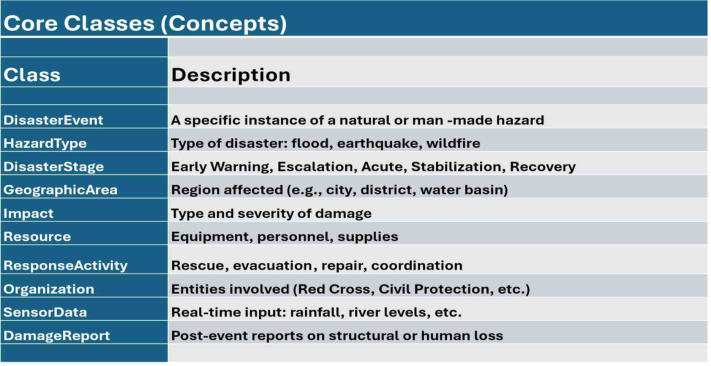
SEMANTIC INTEROPERABILITY AND DATA INTEGRATION A primary benefit of developing a semantic infrastructure is achieving true semantic interoperability among the multitude of systems and organizations involved in emergency response. Semantic interoperability means not just exchanging data but exchanging meaning: the receiving system knows exactly what the data refers to and can act on it appropriately. In a fast- moving disaster scenario, this can save precious time and prevent errors. Semantic interoperability, grounded in the ontology and design, enhances data integration, situational awareness, and decision support. In Figure 4 are introduced the main core classes and concepts to be understood during disaster situation management.
Disasters generate and require vast amounts of data: sensor readings (weather stations, river gauges, seismic monitors), geospatial data (maps of affected areas, satellite imagery), social media feeds and calls from the public, resource inventories, etc. These data are often siloed in different formats and systems. A semantic layer bridges these silos. For example, by
using ontology mappings, a flood sensor’s alert of “water level bigger than 5m can be automatically linked to a concept flood emergency which might then fetch related information like population data in the flooded zone and infrastructure at risk. Fan et al. (2020) demonstrated this advantage in a flood case study: by integrating sensors, social media, and weather reports through an ontology-based semantic middleware, responders can achieve improved situational awareness and faster decision-making. The ontology’s adaptability to local conditions can be crucial by covering unique local terms or data sources, reflecting the need for configurability that Salminen et al. (2018) also stressed so that the ontology must be configurable to local, regional characteristics of demographics, culture and environment.
Figure 4: Defining the core classes in flood disaster.
Situational awareness is about knowing what is happening, where, when, and what might happen next. Ontology-driven systems can improve this by enabling complex queries and reasoning that can be linked across data types. Babitski et al. (2009) highlighted how semantic frameworks improved not only data interpretation but also response times. Improved coordination with everyone seeing the same information, in a comprehensible form, means decisions like evacuation orders or resource deployments can be made and communicated faster.
When all parties operate on a shared semantic infrastructure, the coordination is inherently improved. Each agency’s system might have its own interface or specialization, but under the hood they are exchanging information in a common format and this can reduce miscommunication. Elmhadhbi & Karray (2021) showed that ontology-driven understanding leads to better holistic understanding so that essentially, everyone sees how their piece fits into the bigger picture. In the MobiJOPA case, the researchers noted the system needed to be configurable to local, regional and stakeholder differences. Semantic layers allow such configuration: you can have localized
Disaster Situation Management by Using Common Ontology and Semantics 11
extensions of the ontology for specific regional needs while maintaining overall interoperability.
Semantic interoperability isn’t just a theoretical benefit; it can have measurable impacts. Zhong et al. (2022) reported a 20% increase in response efficiency in a flood simulation when using a knowledge-driven approach combining ontologies and machine learning. This improvement was attributed to the ontology’s role in structuring data and providing context for machine learning models, which improved predictions and resource allocations. In concrete terms, a 20% faster response can mean the difference between life and death in fast-onset disasters. While that study was a controlled experiment, it aligns with the intuition that less time is spent on reconciling data or clarifying information when a semantic framework is in place.
This scenario shows that semantic interoperability is not an abstract benefit; it operationalizes the data in ways that closely support the real tasks and decisions of emergency management. It creates a common operating environment where each piece of information, no matter where it originated, is readily available to those who need it, in a form they can understand and trust. It moves the focus from low-level data wrangling to higher-level analysis and action. By building such interoperability requires understanding the real-world semantics, linking formal data to meanings that make sense to humans in their roles. In other words, the ontology must be grounded in the language and practice of emergency responders. This ensures the technology aligns with human thinking, further enhancing clarity and coordination. Semantic interoperability enabled by a common ontology and robust system architecture provides shared situational awareness and efficient coordination in disaster management. It reduces information fragmentation and miscommunication.
USER-CENTRED SERVICE DESIGN AND PROCESS ALIGNMENT Technology in disaster management must ultimately serve the people involved: the responders who use the systems under extreme stress, and the affected individuals who rely on timely, effective assistance. Therefore, user- centred design and process alignment are critical considerations. These ensure that the semantic infrastructure and tools built on it fit the workflows, needs, and limitations of their human users.
Salminen et al. (2025) emphasized in their disaster study the critical role of user-centred design for effective emergency response. This means that systems like MobiJOPA® was built and evaluated with the diverse end-users in mind, from incident commanders in a control centre to field firefighters, medics, volunteers, and even citizens receiving alerts. Ensuring inclusivity and accessibility in design is not just a matter of equity, but of practicality: disaster scenarios often involve users with varying levels of technical expertise and possibly impairments due to stress or environmental factors. A user-centred approach would involve iterative testing of interfaces in simulated emergency conditions, simplifying and tailoring the presentation of information. Service design in this context means designing the overall
service delivery of emergency response – how does a “customer”, the affected person, journey through the service? A semantic model that includes the disaster lifecycle and response processes helps ensure that the technology is aligned to these services.’ Salminen et al. noted that modular and customizable features enhance a system’s adaptability to various expert groups. In design terms, modularity means the system can be reconfigured or extended without overhaul. A semantic approach inherently supports this: one can add new modules (for a new hazard type, say pandemics) by extending the ontology and adding corresponding data sources, without breaking existing functionality. In disasters, this is valuable because every disaster can bring surprises and learning. If a post-analysis reveals that a certain concept was missing, one can extend the ontology to include that and update processes accordingly for future responses. The system is not a rigid one-size-fits-all product; it’s an evolving platform.
User-centred design in emergencies also overlaps with ethical design. Features must be designed not only for efficiency but respecting human values and rights, especially under chaotic conditions. In disasters, respecting autonomy translates to obtaining consent for data like location tracking of refugees or ensuring that technological interventions (like AI-driven alerts) do not override local community preferences or needs.Interplay between user control and system intelligence must be carefully designed to maintain trust.
Salminen et al. (2025) introduces that it is the need for cohesion within the team managing the disaster. Cohesion is partly a human factor (trust, clear roles) but technology can support it by providing platforms for communication and shared awareness. A semantic infrastructure can embed communication tools that tag messages or updates with semantic context (as earlier described, e.g., tagging a message with incident IDs or locations). This ensures that when team members communicate through the system, their communications are organized and viewable in context, avoiding fragmented channels. Additionally, by clearly defining roles and responsibilities in the ontology (like who is team leader, who is logistics chief, etc.), the system can channel the right information to the right people, which prevents overload and confusion so that each team member knows their scope and sees the information relevant to it, enhancing their ability to cooperate effectively.
LEVERAGING AI AND ENSURING ETHICAL GOVERNANCE Modern disaster management increasingly explores the use of Artificial Intelligence (AI), including machine learning models, predictive analytics, and AI agents, to assist with tasks like hazard prediction, decision support, resource allocation, and information processing. Integrating AI into an emergency management system built on semantic infrastructure offers powerful synergies: the ontology provides context and knowledge that can make AI more effective and trustworthy, while AI can automate and scale analyses of the vast data flowing through the system. However, with great power comes great responsibility: the use of AI in life-and-death situations mandates careful ethical governance, ensuring that AI is used fairly, transparently, and accountably. In this section, we examine how semantic
Disaster Situation Management by Using Common Ontology and Semantics 13
infrastructure enables advanced AI capabilities according the experiences of MobiJOPA and how to govern these technologies ethically in disaster contexts.
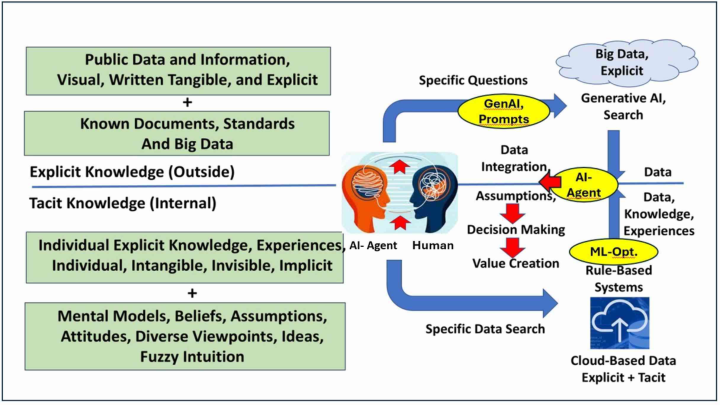
Generative AI can be valuable in emergencies for synthesizing information or forecasting scenarios. Shan and Li (2024) have introduced a framework that aims to leverage the advantages of generative AI in massive data processing, knowledge mining, strategy optimization, and other aspects, thereby enhancing the intelligence level and emergency response capability of the emergency response decision support system. It is also possible to generate summaries and reports. After a few hours into a disaster response, there may be hundreds of data points and messages; a generative model fine-tuned on disaster reports could produce an incident summary for situational briefings. Figure 5 is drafted according to the experiences on the use of AI in decision making in MobiJOPA environment.
Figure 5: The use of AI agents in decision making.
Generative AI is used in data search from open data according to prompt engineering and machine learning by making simulations with rule-based data. AI Agent integrates this data and knowledge for human interpretation when making decisions.
A new approach is the use of AI agents, which can perceive information, reason, and act within the disaster management system. When these agents are built on top of the common ontology, they can operate with an understanding of the domain that is consistent with human responders. Alshammari & Meziane (2023) recently demonstrated an autonomous flood management system where AI agents used an ontology to perform tasks like real-time data analysis and resource allocation. In their system, generative AI components produced predictive models for flood progression, while rule-based agents dispatched resources, all coordinated through a shared
semantic knowledge base. The result was a blueprint for how ontology- driven AI can automate critical tasks in a flood scenario. Translating this to our context: imagine an AI agent in the MobiJOPA system tasked with monitoring incoming data for signs of secondary crises (e.g., aftershocks after an earthquake, or disease outbreaks post-disaster). Because it operates on the ontology, it can, for example, reason that “after heavy rainfall and flooding, there is increased risk of water-borne disease” if such relationships are encoded. It might then alert medical teams proactively to prepare. Another agent might handle routine coordination: matching needs and offers of assistance. Humanitarian operations often involve repositories of needs (requiring water, food, medical aid in certain locations) and offers (available stockpiles, incoming aid shipments). An AI agent with access to this semantically normalized data can match and suggest allocations much faster than a human could, essentially functioning like an automated dispatcher. Crucially, because the agent “speaks” the ontology, its actions are transparent, and it can explain.
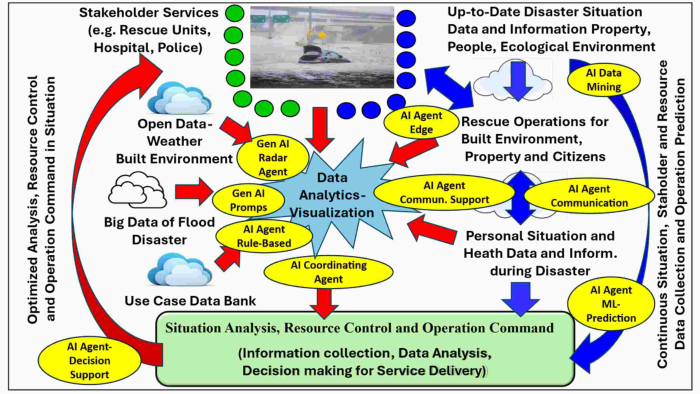
Figure 6 shows the overall future framework of AI in Situation analysis, resource control and operational command environment for disaster management.
Figure 6: The use of AI in situation analysis, resource control and operation command.
Ontology-trained generative AI models can be used for processing domain- specific data (like legislative texts), which suggests we could similarly train models on structured disaster knowledge to aid planning. However, generative AI’s tendency to produce plausible but not always accurate information means we must use it with caution: always in the loop with human verification and ideally using reinforcement learning with human feedback. The ITU’s Global Initiative on AI for Natural Hazard Resilience (2025) emphasizes developing standards and best practices to ensure AI
Disaster Situation Management by Using Common Ontology and Semantics 15
tools are reliable, responsible, and interoperable across regions. This includes ethical use across the disaster cycle, from risk reduction to response.
To effectively use AI in emergencies, trust is crucial. Responders must trust the system’s recommendations, and the public must trust the information they receive. Building trust requires that AI systems demonstrate reliability and that humans remain in the loop for critical decisions. Human oversight is key: AI should support, not replace, human decision-makers. The MobiJOPA study’s exploration of AI-driven decision support and AI agents was framed as improving human teamwork, not eliminating it. The system can provide suggestions (like a decision support system indicating which areas to prioritize) and even automate some tasks (like routine data aggregation), but a human commander might always confirm critical actions. Another ethical dimension is safeguarding the privacy of individuals during crises. Disasters don’t erase privacy rights, though there might be temporary relaxations for life-saving purposes. Our semantic data model included a layer for Data Ownership and Security. Implementing that is vital when AI is involved, because AI could potentially infer sensitive information (e.g., identify a person in need from data patterns). Responsible data handling builds trust and avoids causing additional harm to vulnerable populations.
The push for interoperable, ethical AI in disasters is ongoing. The integration of AI and the enforcement of ethical governance are two sides of the same coin in advanced disaster management systems. The semantic infrastructure we propose significantly enhances AI’s capabilities by providing structured knowledge and context (making AI more effective and explainable), and simultaneously provides a framework to implement ethical guidelines (through clear data governance layers and rule-based constraints).
The result is an intelligent system that can augment human capacity during disasters, analysing more data than humans can, suggesting novel insights, while still operating under human-informed rules and oversight to ensure that technology serves humanity, especially when humanity is in its most vulnerable state. As AI in emergency management moves from experimental to operational, such a semantically grounded, ethically mindful approach will be essential for its success and societal acceptance.
CONCLUSION
Disaster management is at a crossroads of innovation: the increasing frequency and complexity of disasters press us to improve how we respond, while advances in digital technology provide new tools such as semantic modelling, Internet of Things (IoT) sensor networks, and AI-driven analytics. This expanded article has articulated a vision for marrying these tools within a semantic infrastructure for emergency response. The aim has been to create emergency management systems that are not only technologically sophisticated but also intelligently coordinated, user-centred, and ethically governed.
This article has concentrated to show that developing a common ontology for disaster management is a foundational step for achieving shared situational understanding among diverse stakeholders. The ontology
harmonizes data from disparate sources and aligns the interpretations of various expert groups. In the MobiJOPA® case of flood disaster management, such an ontology was posited to configure to local and cultural specifics, ensuring relevance across different contexts. Ontology- driven semantic interoperability can dramatically improve the integration of sensor data, social inputs, and operational information, citing evidence of faster response and better decision-making. Furthermore, ontology layering and interface architecture is supporting the emergency realm: a multi-layer approach covering strategy, process, information, security, and communication ensures that technology aligns with human organizational structures and legal frameworks. This architecture not only fosters interoperability but also resilience and flexibility, as it modularizes the system and clarifies the points of interaction between agencies and their systems.
In the article has been discussed how the semantic infrastructure enables advanced AI while maintaining human control. Generative AI and autonomous agents can greatly amplify our capabilities – analysing streams of data in real-time, predicting emerging threats, optimizing resource distribution. Without a semantic backbone, their outputs could be erratic or opaque. With the ontology and knowledge graph in place, AI can reason in context and explain its conclusions using domain concepts that humans understand. In this article has been presented how ontology-linked AI has been used in flood management, and how similar methods could be deployed in systems like MobiJOPA® to provide decision support that is both powerful and trustworthy. Semantic infrastructure and AI in disaster management holds promise to significantly improve emergency response outcomes: better situation understanding, more agile coordination, more informed and faster decision-making, and ultimately saved lives and reduced losses. The measure of success for the integrated system will be its performance in real crises. Does it help responders make sense of chaos quicker? Does it get the right resources to the right place at the right time? Does it avoid mishaps like duplicated efforts or overlooked communities? And do the people using it feel empowered rather than encumbered? The evidence and reasoning presented here make a compelling case that a semantic infrastructure, enriched by the knowledge from other service domains and fortified with responsible AI, can indeed meet these objectives.
REFERENCES
Alshammari, M., & Meziane, F. (2023). AI Agents and Semantic Knowledge Bases for Autonomous Flood Management. Expert Systems with Applications, 213, 118945. Babitski, G., Bergweiler, S., Trinh, T., Atkinson, M., & Simonis, I. (2009). Ontology-
Based Integration of Sensor Data for Disaster Management. Journal of Intelligent Information Systems, 33 (3), 233–253. Chandrasekharan, B., Josephson, J. R., & Benjamins, V. R. (1999). What are ontologies, and why do we need them? IEEE Intelligent Systems, 14(1), 20–26. Elmhadhbi, L., Karray, M. H. (2021). A Semantic Framework for Disaster
Management: Towards a Holistic Understanding of Crisis Scenarios. Computers in Industry, 128, 103432.
Disaster Situation Management by Using Common Ontology and Semantics 17
Fan, W., Ding, Y., Lin, H., & Wang, J. (2020). Semantic Interoperability for Disaster Management: An Ontology-Based Approach to Improve Situational Awareness. Natural Hazards, 103(2), 1831–1852. Orlando, USA. Gharajedaghi, J. (1999). Systems Thinking: Managing Chaos and Complexity – A
Platform for Designing Business Architecture. Butterworth-Heinemann. Glaser, B., Strauss, A. (1999) Discovery of Grounded Theory: Strategies for Qualitative Research. Aldine Transactions. Global Initiative on AI for Natural Hazards – ITU News (2025). AI, standards, and
future disaster resilience, April 22, 2025. Khantong, S., Ahmad, M. (2020), An Ontology for Sharing and Managing Information in Disaster Response: In Flood Response Usage Scenarios. Springer Nature, Volume 9, pages 39–52. Salminen, V., Sanerma, P., Niittymäki, S., & Eklund, P. (2018). Ontology-Based
Service Environment Supports Successful Aging. In J. Kantola et al. (Eds.), Advances in Human Factors, Business Management and Leadership (AHFE 2018, Springer), vol. 594, 267–279. Salminen, V., & Pillai, B. (2007). Interoperability Requirement Challenges – Future Trend. In Proceeding of International Symposium on Collaborative Technologies and Systems (CTS 2007), Salminen, V., Pyykkönen, M., Salminen, K., Tian, O. (2025) Human Intelligence
and Artificial Intelligence Interaction in Start-Up Enterprise. 8th International Conference on Intelligent Human Systems Integration: Integrating People and Intelligent Systems (IHSI 2025), Sapienza Universita’ di Roma, Italy, February 24–26, 2025. doi: 10.54941/ahfe1005817. Zhong, S., Huang, Q., & Yuan, M. (2022). A Knowledge-Driven Approach to Flood Disaster Management Using Ontologies and Machine Learning. International Journal of Disaster Risk Science, 13 (4), 561–575. Shan, S., & Li, Y. (2024). Research on the Application Framework of Generative AI in Emergency Response Decision Support Systems for Emergencies. International Journal of Human–Computer Interaction, 1–18. doi: 10.1080/ 10447318.2024.2423335. Xu, H., & Nyerges, T. (2017). A geo-ontology-based approach to decision-making
in emergency management of meteorological disasters. Springer Nature, 13 Volume 89, pages 531–554, (2017).
LISTED IN THE AHFE DIGITAL BOOKSTORE CATALOGUE
Explore the complete digital volume
Human Systems Engineering and Design (IHSED2025): Future Trends and Applications
Read this individual research paper free through the original publisher, or explore the full digital proceedings book.
ISBN 978-1-964867-74-8
Explore this ISBN in the AHFE Bookstore ↗Listed in the July 2026 bookstore catalogue; search by ISBN to confirm current availability · Digital book purchase optional