Yafeng Niu, Yiyan Wang, Hongyang Zhang, Shatong Yang (2025). Impact of Pedal Design Parameters on Operational Efficiency and Usability in Foot Interaction Systems. In: Human Systems Engineering and Design (IHSED2025): Future Trends and Applications. AHFE Open Access, vol. 198, pp. 113–118. https://doi.org/10.54941/ahfe1006767
Foot-based interaction offers a valuable hands-free input method in complex multitasking environments. This study used a Halstead-Reitan tapping task to evaluate how pedal resistance (5.8N–28N), force method (forefoot and rearfoot), and angle (0° and 30°) affect interaction efficiency. Results showed pedal type significantly impacted performance, with 5.8N and 20N pedals yielding the highest tap rates and best user experience. While angle and force method had no significant main effects, their interaction with pedal type was notable. Findings provide ergonomic guidance for optimizing foot-controlled interface design.
In complex operational environments with increasing demands for multitasking and human-machine collaboration—such as industrial control, surgical procedures (van Veelen et al., 2003), and cockpit interfaces (Wu et al., 2017)—foot-based interaction is gaining attention in the fields of design and engineering as an auxiliary input method (Rajanna et al., 2022). Compared to traditional hand-based interaction, foot control can effectively complement hand operations in busy contexts, helping to reduce manual workload, lower cognitive interference, and improve operational fluency. It is particularly suitable for scenarios requiring continuous hand engagement (Wan et al., 2024). However, existing foot pedal systems still face significant challenges in terms of comfort and activation efficiency (Tanaka et al., 2009). In high- pressure, fast-paced environments, key design parameters—such as pedal resistance, foot placement, and actuation angle—have a marked influence on interaction performance (Sabnis et al., 2025). The lack of systematic and quantitative studies on these factors has become a major barrier to the broader application and optimization of foot-operated control devices in multitasking contexts.
To evaluate user experience effectively, the Halstead-Reitan tapping task, a classic neuropsychological test, is employed to assess users’ response speed and rhythm control (Reitan, 1958). This test helps gauge the adaptability
and load responsiveness of foot-based operation. In addition, the System Usability Scale (SUS) serves as a subjective evaluation tool to identify usability issues such as interface confusion (Deshmukh & Chalmeta, 2024), interaction frustration, or functional inconsistency (Brooke, 1996). Usability testing not only predicts user acceptance in target markets but also provides empirical support for design improvement (Zwakman et al., 2021), product comparison, and training assessment (Finstad, 2010).
This study aims to identify the optimal design parameters for foot pedal systems in tap-based interaction, offering an ergonomic foundation for developing multimodal foot-controlled systems and providing empirical evidence for the structural optimization and standardization of foot-operated devices.
Methodology
This study designed a foot-tapping interaction experiment based on a rapid foot tapping task to evaluate the interaction efficiency and performance of different foot pedal buttons under various control parameter combinations. Four types of pedal prototypes were used: a black plastic pedal (62×100 mm, activation force 5.8 N), a gray plastic pedal (80×83 mm, 8.5 N), a black iron pedal (67×102 mm, 20 N), and a green aluminum pedal (66×140 mm, 28 N). Combined with two force application angles (0
and 30
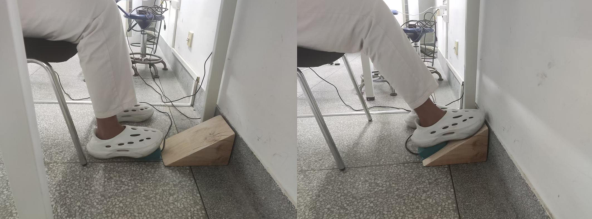
) and two foot placement methods (forefoot and heel) in Fig. 1, a total of 16 experimental conditions were formed using a 4×2×2 factorial design.
Figure 1: Examples of different angles and ways of applying force.
The experiment was conducted in a controlled laboratory environment. Each participant was required to complete the rapid tapping task under all 16 conditions. In each trial, participants were instructed to trigger the designated foot pedal as many times as possible within 10 seconds using the specified part of the foot. Before the formal trials began, each participant completed a Halstead-Reitan tapping task under a horizontal condition to establish a baseline measure of foot rhythm control ability.
During the experiment, each trial was initiated by pressing the spacebar. A fixation cross (180 px) was displayed at the center of the screen for 1000 ms to guide gaze and eliminate variability due to eye movement direction or distance. After a random interval of 2–4 seconds, the fixation cross was
Impact of Pedal Design Parameters on Operational Efficiency and Usability 115
replaced by a start cue and a 10-second countdown appeared at the center of the screen. Participants then performed the tapping task as quickly as possible. At the end of the countdown, the system automatically locked the pedal input, after which the participant completed the SUS (System Usability Scale) questionnaire and took a one-minute rest before proceeding to the next condition.
This procedure was repeated across all combinations to ensure comprehensive and comparable experimental data.
Results and Discussion
A total of 20 graduate students aged 24 to 26 participated in the experiment, including 10 males and 10 females. Statistical analysis was conducted using IBM SPSS Statistics 27.
Force Application Method The average tapping count for the heel group was 36.69, slightly higher than that of the forefoot group (35.20). The difference approached significance (Z = 1.886, p = 0.059), suggesting that the foot region used may have some influence on interaction efficiency, although the result did not reach statistical significance (p > 0.05).
Force Angle No significant effect was found for force angle. The average tapping count was 36.21 for the 0
condition and 35.68 for the 30
condition (Z = 0.75, p = 0.453), indicating that angle variation had minimal impact on foot- tapping performance under the current conditions.
Pedal Type Significant differences were observed among the four pedal types (p < 0.001). The pedal with 20 N resistance (Type I) yielded the highest tapping count (40.12), followed closely by the 5.8 N pedal (Type III, 39.66). In contrast, pedals with higher resistance (28 N for Type II and 8.5 N for Type IV) performed worse, with average counts of 30.98 and 33.03 respectively. These findings suggest that moderate resistance is more suitable for rapid repetitive tasks, balancing tactile feedback and operational comfort.
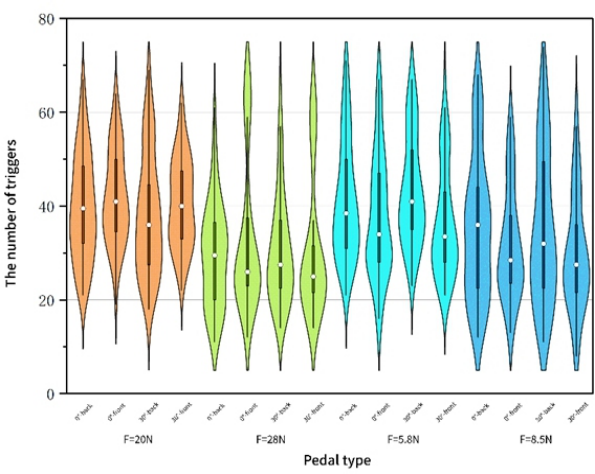
Parameter Combinations Further analysis revealed significant differences in performance across different combinations of pedal type, force method, and force angle (p < 0.001) in Fig. 2. The highest tapping count was observed in the combination of Type III pedal (5.8 N), heel pressing at a 30
angle (43.3 taps), followed by Type I at 0
with forefoot pressing (41.83), Type III at 0
with heel pressing (41.05), and Type I at 30
with forefoot pressing (40.62).
These results suggest that low-resistance pedals combined with natural foot motions can significantly enhance interaction efficiency in specific settings.
Figure 2: Comparison of different pedal combinations and tap operation in the next 10 seconds.
Subjective Evaluation (SUS Scores) The System Usability Scale (SUS) scores also showed clear differences in user experience across pedal combinations. The highest score was for Type I pedal at a 30
angle with forefoot pressing (79.88), followed by the same pedal and foot method at 0
(76.13), and Type III at 0
with forefoot pressing (71.00). These results further confirm that moderate resistance, paired with a natural angle and forefoot use, not only improves efficiency but also enhances the subjective user experience.
CONCLUSION
This study experimentally examined the effects of different pedal types, force application methods, and force angles on foot-tapping interaction efficiency. The results indicate: Although the heel-pressing group showed a slightly higher average tapping count than the forefoot group, the difference was not statistically significant, suggesting that the force application area has limited impact on performance and both methods can effectively trigger interactions. Similarly, no significant difference was found between the 0
and 30
force angles; while 0
showed a slight advantage in average performance, angle variation had minimal overall effect on single-tap efficiency.
In contrast, pedal type had a significant impact on performance, especially regarding resistance levels. Participants demonstrated higher tapping frequencies and better subjective usability scores under moderate to low resistance conditions (e.g., 5.8 N and 20 N), indicating that moderate
Impact of Pedal Design Parameters on Operational Efficiency and Usability 117
operational resistance is more conducive to rapid and continuous foot- tapping interactions.
Additionally, a significant interaction effect was found between pedal type and force application method. The optimal performance combinations were Type I pedal (20 N) with forefoot pressing, and Type III pedal (5.8 N) with heel pressing. This finding suggests that matching force application method with pedal structural characteristics is important to optimize both operational efficiency and user experience in foot-controlled systems.
In summary, pedal resistance should be the primary consideration in the design of foot-interaction systems, complemented by suitable force application methods for ergonomic matching, while force angle variations play a relatively minor role. These conclusions provide empirical support for human factors optimization of foot-controlled devices and facilitate their wider application in multitasking interactive systems.
ACKNOWLEDGMENT
This work was supported by National Natural Science Foundation of China (No. 72171044).
REFERENCES
Brooke, john. (1996). SUS: A “Quick and Dirty” Usability Scale. In Usability Evaluation In Industry. CRC Press. Deshmukh, A. M., & Chalmeta, R. (2024). Validation of system usability scale as
a usability metric to evaluate voice user interfaces. PeerJ Computer Science, 10, e1918. https://doi.org/10.7717/peerj-cs.1918 Finstad, K. (2010). The Usability Metric for User Experience. Interacting With Computers, 22(5), 323–327. https://doi.org/10.1016/j.intcom.2010.04.004 Rajanna, V., Russel, M., Zhao, J., & Hammond, T. (2022). PressTapFlick: Exploring
a gaze and foot-based multimodal approach to gaze typing. International Journal of Human-Computer Studies, 161, 102787. https://doi.org/10.1016/ j.ijhcs.2022.102787 Reitan, R. M. (1958). Validity of the Trail Making Test as an indicator of organic brain damage. Perceptual and Motor Skills, 8, 271–276. https://doi.org/10.2466/ PMS.8.7.271–276 Sabnis, N., Otaran, A., Wittchen, D., Didion, J. K., Steimle, J., & Strohmeier, P.
(2025). Foot Pedal Control: The Role of Vibrotactile Feedback in Performance and Perceived Control. Proceedings of the Nineteenth International Conference on Tangible, Embedded and Embodied Interaction, TEI 2025, 25. https://doi.org/ 10.1145/3689050.3704937 Tanaka, Y., Kaneyuki, H., Tsuji, T., Miyazaki, T., Nishikawa, K., & Nouzawa, T.
(2009). Mechanical and Perceptual Analyses of Human Foot Movements in Pedal Operation. 2009 IEEE International Conference on Systems, Man and Cybernetics (SMC 2009), VOLS 1-9, 1674-+. https://doi.org/10.1109/ICSMC.2009.5346943 van Veelen, M. A., Snijders, C. J., van Leeuwen, E., Goossens, R. H. M., & Kazemier, G. (2003). Improvement of foot pedals used during surgery based on new ergonomic guidelines. Surgical Endoscopy and Other Interventional Techniques, 17(7), 1086–1091. https://doi.org/10.1007/s00464-002-9185-z
Wan, T., Zhang, L., Yang, H., Irani, P., Yu, L., & Liang, H.-N. (2024). Exploration of Foot-based Text Entry Techniques for Virtual Reality Environments. Proceedings of the 2024 CHI Confernce on Human Factors in Computing Systems (CHI 2024). ACM CHI Conference on Human Factors in Computing Sytems (CHI), New York. https://doi.org/10.1145/3613904.3642757 Wu, Y., Boyle, L. N., McGehee, D., Roe, C. A., Ebe, K., & Foley, J. (2017). Foot
placement during error and pedal applications in naturalistic driving. Accident Analysis and Prevention, 99, 102–109. https://doi.org/10.1016/j.aap.2016.10.019 Zwakman, D. S., Pal, D., & Arpnikanondt, C. (2021). Usability Evaluation of Artificial Intelligence-Based Voice Assistants: The Case of Amazon Alexa. SN Computer Science, 2(1), 28. https://doi.org/10.1007/s42979-020-00424-4
LISTED IN THE AHFE DIGITAL BOOKSTORE CATALOGUE
Explore the complete digital volume
Human Systems Engineering and Design (IHSED2025): Future Trends and Applications
Read this individual research paper free through the original publisher, or explore the full digital proceedings book.
ISBN 978-1-964867-74-8
Explore this ISBN in the AHFE Bookstore ↗Listed in the July 2026 bookstore catalogue; search by ISBN to confirm current availability · Digital book purchase optional