Lang Xiao, Yafeng Niu, Tianyu Zhou, Wenjun Yang (2022). The Differences between Eye Control and Touch Games in Children's Learning. In: Intelligent Human Systems Integration (IHSI 2022): Integrating People and Intelligent Systems. AHFE Open Access, vol. 22. https://doi.org/10.54941/ahfe1001023
This study comparatively analyzed the effects of eye control and touch on the learning outcomes of children's educational games. According to the task completion time and performance, the article analyzes the performance of eye control and touch control on children's educational games through the method of ergonomics experiment. It is found that the performance of girls is generally better than that of boys, and the completion time of girls is shorter than that of boys. There is no obvious difference in ergonomics between the performance of eye control and touch control. The article also compared the results of the ergonomics experiment with the results of the summative test, In the results of the summative test, the improvement of the eye control group is higher than that of the touch group, which shows that the use of eye control in children's educational games is more effective .
Intelligent Human Systems Integration (IHSI 2022): Integrating People and Intelligent Systems https://openaccess.cms-conferences.org/#/publications/book/978-1-7923-8988-7
INTRODUCTION
Educational digitalization is one of the main concerns of future education reform and development, and educational games conform to the development of educational digitalization. Studies have shown that using games can achieve better learning results and learning motivation in the learning process than using non-game methods. Compared with adults, children have a lower cognitive ability to understand game content and rules. Therefore, the naturalness and effectiveness of the interactive methods in children's educational games are extremely important. The current domestic children's educational games mainly use traditional interactive methods such as a mouse, keyboard, and touch. Traditional interaction methods are easily boring and fatiguing, which reduces children's concentration and learning effects. Therefore, it is necessary to introduce new interactive methods for children's educational games and conduct research on the performance of traditional interactive methods and new interactive methods in educational games.
Psychologist Treichler found that in the process of acquiring knowledge, 83% of knowledge is mainly obtained through human vision. Currently, eye control interaction technology is becoming mature, and research shows that using eye control can enhance game immersion and improve the game experience. This study designed an educational game that can be based on eye control and touch to study the impact of eye control and touch interaction on children’s education. The behavioral performance and subjective evaluation of the students are analyzed in the study. METHODS The subjects in the experiment were 40 first-year students of Yuhua Foreign Language Primary School (20 boys and 20 girls). Students with similar academic levels were selected to ensure that the student's knowledge level was at the same level. The subjects were in the age range of 6-7 years old, all were right-handed, with normal or corrected vision (both above 1.0), and no color blindness or color weakness.
This experiment uses a Tobii 4C eye tracker. The display uses a NEW TAP touch screen model NT-24, a 23.8" full HD 1080P, and the best-supported resolution is 1920*1080 (16:9). The touch sampling rate is 120Hz, and the color gamut is sRGB96%. EXPERIMENT 1: EYE CONTROL/TOUCH ERGONOMICS EXPERIMENT OF CHILDREN'S EDUCATIONAL GAMES Experimental materials
The answering materials for the experiment are English word and mathematical calculation questions that designed based on the first grade textbook of Nanjing City, Jiangsu Province. There are 15 questions in English and mathematics. Among them, touch group and eye control group are different in content and similar in difficulty.
Intelligent Human Systems Integration (IHSI 2022): Integrating People and Intelligent Systems https://openaccess.cms-conferences.org/#/publications/book/978-1-7923-8988-7
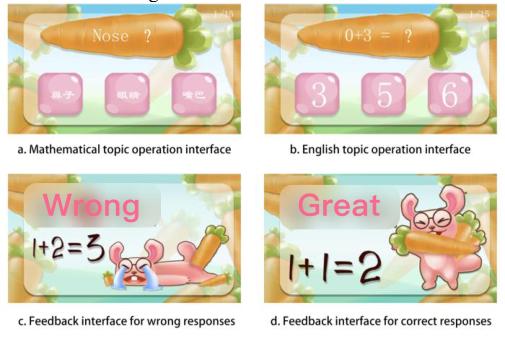
The educational game experiment material is shown in Figure 1. According to Li Lu's research, the area of children's buttons based on the PC interface should be at least 2cm×2cm. Because the trigger operation in this experiment requires eye control and touch, the size of the button is designed to be 2cm×2cm. The answer interface for math and English is shown in Figure 1-a/b, and the feedback interface for incorrect and correct answers is shown in Figure 1-c/d.
Figure 1. Educational game experiment material Experimental parameters
In this experiment, gazing is selected as the eye-control interaction method, and long- press is used as the interactive method of the touch. Research on the operation performance of target selection based on different gaze times shows that prolonging the gaze time can effectively reduce the selection error rate, and the long-press time is generally 2000ms. Both gaze and touch in this experiment set 2000ms as the trigger time to ensure the consistency of the trigger time of the eye control group and the touch group.
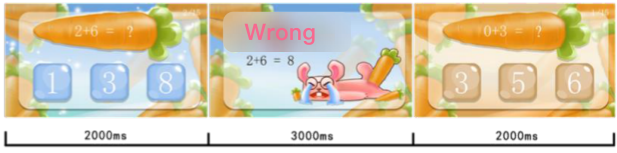
Experimental process Each participant needs to complete 30 questions by eye controlling (15 questions each in mathematics and English) and 30 questions by touching (15 questions each in math- ematics and English), the experimental process of a single trial is as follows as shown in Figure 2. The independent variables of the experiment are eye control and touch control, and the dependent variables are the answer score and completion time. The eye control group has a total of 30 (questions) * 40 (the number of subjects) = 1200 trials, and the touch group has a total of 30 (questions) *40 (number of subjects) = 1200trials.
Intelligent Human Systems Integration (IHSI 2022): Integrating People and Intelligent Systems https://openaccess.cms-conferences.org/#/publications/book/978-1-7923-8988-7
Figure 2. Flow chart of a single trial experiment (eye control/touch control) Participants in the eye control group stared at the answer button for 2000ms, and then the page jumped to the settlement page of the question. After 3000ms, the page automatically jumped to the next question. Participants have a 30-second break before entering next test. The task flow of the math and English was the same, and there was no time limit. The experiment content of the touch control group is the same as that of the eye control group.
Data analysis According to the experimental results, the average score of the touch group is 94.93, the average score of the eye control group is 94.54, the average completion time of the touch group is 1.77, and the average completion time of the eye control group is 1.83. Using the T-test method to analyze the difference in the scores and completion time of the eye control group and the touch group, it is found that the completion time of the eye control group and the touch group are not significantly different, and the scores of the eye control group and the touch group are not significantly different.
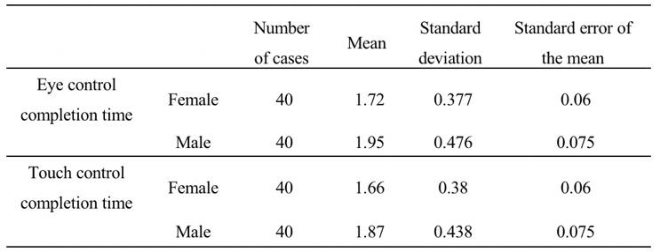
The T-test method was used to analyze the difference in gender between the eye control group and the touch group. As shown in Table 1, Table 2, and Figure 4, the eye control scores have significant differences in gender, t(78)=2.202, p=0.031, girls The scores are better than boys; there is a significant difference in gender of touch scores, t(78)=2.907, p=0.005, girls’ scores are better than boys. The difference in gender of eye control time is significant, t(78)=-2.404, p=0.019, the eye control time of girls is shorter than that of boys; the difference in gender of touch time is significant, t(78)=-2.294, p=0.025, the touch time of girls Shorter than boys.
Table 1. Gender differences in eye control and touch performance
Table available in the original PDF paper.
Intelligent Human Systems Integration (IHSI 2022): Integrating People and Intelligent Systems https://openaccess.cms-conferences.org/#/publications/book/978-1-7923-8988-7
Table 2. Gender differences in eye control/touch completion time
Table available in the original PDF paper.
Figure 3. Gender difference chart of eye control/touch performance and completion time
Discussion
Through data analysis, it is found that in the case of gender distinction, the final score and completion time of the eye control group and the touch group in this educational game is significantly different. The final scores of the girls in the two groups are significantly better than the boys, and the completion time is also shorter than boys. Based on Karlak Manuela's study of gender differences in learning motivation, it is found that girls in the same age are better than boys in motivation dimension and motivation intensity, and men's cognitive ability is lower than that of female’s.
All the children in the test are willing to participate in this educational game experiment and complete the experiment, which because of the naturalness of eye- control interaction. The children in the eye control group do not need to use their fingers for additional operations, ensuring that the eye control interaction and touch interaction have consistent high efficiency. This verifies Jacob's theory that the eye-computer interaction method can be widely used in general human-computer interaction as a substitute for the mouse, keyboard, finger click, and other instruction input terminals. The results of the use of eye control and touch in educational games show that there is no significant difference in the efficiency of the two interactive methods. As an interactive method of educational games, eye control are also viable.
Intelligent Human Systems Integration (IHSI 2022): Integrating People and Intelligent Systems https://openaccess.cms-conferences.org/#/publications/book/978-1-7923-8988-7
EXPERIMENT 2: EYE CONTROL/TOUCH SUMMATIVE TEST OF CHILDREN'S EDUCATIONAL GAMES Summative evaluation refers to the evaluation made to determine the degree of achieve- ment of the educational goal after a certain semester or teaching phase is over. To ex- plore the differences between eye control and touch in educational games, a summative test was used to test the learning outcomes of the children in different interactive meth- ods.
Experimental procedure Each participant will fill in the summative test papers after the end of the experiment 1, and a total of 40 test papers will be issued. The test questions are English word matching questions and mathematical calculating questions. The content and quantity of the questions are the same as those in Experiment 1. The question are all multiple-choice questions, and there is no limit to the answering time.
Data analysis To study whether the subjects have learned knowledge in the eye control/touch educational game, the difference between the answer correct rate of Experiment 1 and the answer correct rate of the summative test is analyzed. Table 3 shows the results of the summative test and the task 1. Figure 4 shows the difference between the results of the summative test and the task 1 test. According to the T-test analysis, the results of the first experiment are significantly worse than the results of the summative in touch, t(79)=-2.04, p=0.045; the results of the first experiment are significantly worse than the results of the summative in eye control, t(79)=-5.032, p<0.001.
To clarify how the subjects can achieve better learning results, the difference between the eye control group and the touch group in the summative test was analyzed. According to the results of the T-test analysis, there is a significant difference between the eye control and the touch of the summative test. The performance of eye control is significantly better than the performance of the touch in the summative test, t(79)=- 2.431, p=0.017.
Intelligent Human Systems Integration (IHSI 2022): Integrating People and Intelligent Systems https://openaccess.cms-conferences.org/#/publications/book/978-1-7923-8988-7
Table 3. Results of summative test and experiment one
Table available in the original PDF paper.
Figure 4. The difference between the summative test result and the test result of
Figure available in the original PDF paper.
Experiment 1
Discussion
From the perspective of the summative test, the traditional paper-and-pencil test is used to test the children's learning results. The results of the summative test objectively reflect the achievement the children had made in a certain stage of learning. It is found that both the eye control group and the touch group are significantly better than experiment 1. The scores of the same test item were improved in the summative test.
Intelligent Human Systems Integration (IHSI 2022): Integrating People and Intelligent Systems https://openaccess.cms-conferences.org/#/publications/book/978-1-7923-8988-7
From the perspective of the eye control and the touch in the summative test, the performance of eye control are significantly better than those of the touch. The children were more focused and engaged in the experiment when eye control was used, indicating that the use of eye control as an interactive method can strengthen the children’s attention stability during learning. Compared with touch, eye control requires gaze selection which can strengthen memory in a way of maintaining intentional attention. This is consistent with Klem and Connell’s discovery that students’ concentration, patience, and devotion in the learning process can significantly predict the student’s final academic achievement, those students with lower levels of devotion have poorer grades. At the same time, the well-known broaden-build theory is verified. The level of investment determines the state of their emotions. The state of high investment along with positive emotions will stimulate individuals to use a wider range of memory data. Making changes from understanding, memory, and cognition to improve performance.
ACKNOWLEDGMENTS
This work was supported jointly by National Natural Science Foundation of China (No. 71801037, 72171044), Aerospace Science Foundation of China (No. 20200058069002).
REFERENCES
Liu T Y , Chu Y L . Using ubiquitous games in an English listening and speaking course: Impact on learning outcomes and motivation[J]. Computers & Education, 2010, 55(2):630-643. Tlili A , Hattab S , Essalmi F , et al. A Smart Collaborative Educational Game with Learning
Analytics to Support English Vocabulary Teaching[J]. International Journal of Interactive Multimedia and Artificial Intelligence, 2021, In Press(In Press):1-10. L López-Faican, Jaen J . EmoFindAR: Evaluation of a mobile multiplayer augmented reality game for primary school children[J]. Computers & Education, 2020, 149:103814-. Walker Z , Mcmahon D D , Rosenblatt K , et al. Beyond Pokémon: Augmented reality is a
universal design for learning tool[J]. SAGE Open,7,4(2017-10-01), 2017, 7(4):215824401773781. Smith J D, Graham T C N. Use of eye movements for video game control [C]//ACM International Conference on Advances in Computer Entertainment Technology. 2006 Atsuo M. Eye-gaze input versus mouse:Cursor control as a function of age[J]. International
Journal of Human-Computer Interaction, 2006, 21(21):1-14 Istance H O, Spinner C, Howarth P A. Eye-based Control of Standard GUI Software[C]//HCI on People & Computers XI. Springer-Verlag, 1996 Druin A. Interaction Design and children[J]. Communication of ACM, 2005, 48(1) Karlak, Manuela, Bagaric M,et al. Gender difference in the use of learning strategies, motivation
and communicative competence in German and English as foreign languages[J]. Strani jezici:casopis za primijehjenu lihgvistiku, 2016(45):163-183 Koesling H, Zoellner M, Sichelschmidt L, et al. With a Flick of the Eye:Assessing Gaze- Controlled Human-Computer Interaction[M]//Human Centered Robot Systems. Springer Berlin Heidelberg, 2009:83-92 Jacob R J K, Karn K S. Commentary on Section 4-Eye Tracking in Human-Computer Interaction
and Usability Research:Ready to Deliver the Promises[J]. Minds Eye, 2003, 2(3):573-605
Intelligent Human Systems Integration (IHSI 2022): Integrating People and Intelligent Systems https://openaccess.cms-conferences.org/#/publications/book/978-1-7923-8988-7
Kobayashi Y. The role of gender in foreign language learning attitudes: Japanese female students' attitudes towards English learning[J]. Gender and education, 2002(14):181-197 Klem A M, Connell J P. Relationships matter:linking teacher support to student engagement and
achievement. Journal of School Health, 2004, 74(7):262-273 Fredrickson B L. The role of positive emotions in positive psychology:The broaden-and-build theory of positive emotions[J]. American Psychologist, 2001, (3):218-2264.
Intelligent Human Systems Integration (IHSI 2022): Integrating People and Intelligent Systems https://openaccess.cms-conferences.org/#/publications/book/978-1-7923-8988-7
LISTED IN THE AHFE DIGITAL BOOKSTORE CATALOGUE
Explore the complete digital volume
Intelligent Human Systems Integration (IHSI 2022): Integrating People and Intelligent Systems
Read this individual research paper free through the original publisher, or explore the full digital proceedings book.
ISBN 978-1-7923-8988-7
Explore this ISBN in the AHFE Bookstore ↗Listed in the July 2026 bookstore catalogue; search by ISBN to confirm current availability · Digital book purchase optional