Ana Alvarez Sanchez, Alexis Suàrez Del Villar Labastida, Anthony René Ango Venegas, Eric Martinez Tocoronte (2022). Modeling of the laminating machine based on ergonomic studies for the manufacture of marzipan handicrafts. In: Intelligent Human Systems Integration (IHSI 2022): Integrating People and Intelligent Systems. AHFE Open Access, vol. 22. https://doi.org/10.54941/ahfe100932
The value that the human resource represents within any organization, appears as an essential element with a strategic direction that, together with a machine, opens the way to productive efficiency. The objective of this research was the modeling of a semi-automatic laminating machine that allows to increase the homogeneity of the dough, optimization of the times from 10 to 3 minutes, and reduction of efforts that the elderly craftsman made to reduce the thickness of the dough, which is then used to make marzipan handicrafts (figures) in the parish of Calderón, Quito -Ecuador. These handicrafts are made manually in the country, this art being part of the culture and tradition. The modeling was carried out in the Solid-Works Software for Windows and the ergonomic studies were carried out using the OWAS method (Ovako Working Posture Analyzing System) and the OCRA Check List, evaluating the risk of repetitive work, considering risk factors such as: repetitiveness that present Medium unacceptable risk , forced postures for sequential postures the level of risk is low, forces lifting the mass of 3 kg and the lack of breaks in the handling of the raw material because it cools down in about 15 minutes. It is feasible to use an adequate technology within this production process because it is designed with special attention to the cultural and economic aspects of the community of marzipan artisans.
Ecuador is a multiethnic and multicultural country that has a variety of craft manifestations. The origins of marzipan go back to pre-Columbian times, when the ancestors of this region prepared food for their agricultural and death rituals, the tradition continued for years until in 1938 it went from being an edible bread to a decorative craft; using white glue to protect the colors and give them shine. These crafts have been declared as an intangible national heritage of Ecuador by the National Assembly in 2018 (Telégrafo, 2018). The legal framework that Ecuador has for occupational safety and health, which recommends the importance of preventing occupational accidents and diseases. This legal framework is part of the National Constitution (2008), which mentions Article 326, Numeral 5 "Every person shall have the right to carry out their work in an adequate and conducive environment that guarantees their health, integrity, safety, hygiene and well-being." (Reyes, 2017) The most common injuries due to repetitive movements that occur are at the lumbar and upper limbs level (Diaz, 2021) (Heredia, 2012), these injuries are generally produced by the periodicity, repetitiveness and speed of the movements with which work activities are carried out (Barrero, 2018). Continuous improvement is one of the most important tasks for management and production engineers of an organization; whether it is a large or a small company, the management will strive to improve the process, to increase production or to increase the level of safety and health at work. (Pacana, 2016) Reducing the effort made by artisans when working with marzipan is one of the objectives of the research and, in turn, to prevent occupational diseases generated by repetitive movements, by means of a semi-automatic mixer, which guarantees a homogeneity of the dough, optimization of times and the ease of use of the machinery, without losing the manual characteristic value of a craft. MATERIALS AND METHODS The material of the semi-automatic laminating machine is mainly used in the food and beverage industry because it is resistant to the corrosive effect of the environment, steam, water and acids (Naghizadeh, 2019), the material to be used is stainless steel with AISI 304 standard.
Intelligent Human Systems Integration (IHSI 2022): Integrating People and Intelligent Systems https://openaccess.cms-conferences.org/#/publications/book/978-1-7923-8988-7
DESIGN PROCESSES A market study of existing semi-automatic laminators was carried out, mainly valuing: materials, prices, installation, maintenance frequency, ergonomics, size and final disposition, see Fig. 1, taking into consideration the specifications and specificities required by the artisans as aspects of the height of 90 cm to 100 cm of the workstation, the homogeneity to which the marzipan must remain and the exposure time that they are standing of 20 minutes compared to the existing ones, the design is carry out concept for an adequate technology paying special attention to the rescue of this ancestral culture, after several sketches and work sessions with the study population of 14 artisans, the best alternative is taken for the well-being of all, the detailed design is developed in SOLIDWORKS in 3D CAD, until the final Design is obtained.
Specifications Market study of existing semi- Conceptual and specificities
Detail design design
Final design
required by
automatic laminators.
artisans.
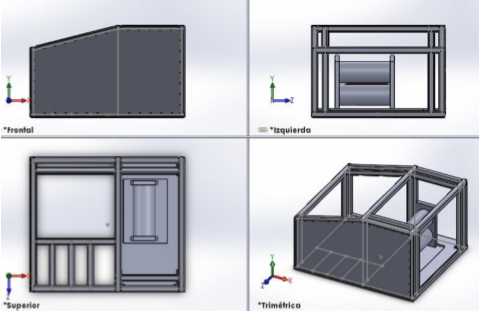
Figure 1: Descriptive model of the design process specifications Working principle of semi-automatic laminating machine The semi-automatic laminator performs its work by activating a button on the machine's control panel, which starts with the starting of a 0.75 hp single-phase motor equipped with a reversible starter, since it will be necessary that the bands run in two directions (Zea, 2019). The rotation of the motor rotor drives the system of belts linked to external gears that make the mobile (lower) laminating roller rotate, the two adjustable rollers according to the thickness of the required dough, exert pressure on the dough until a homogeneous flat mixture is obtained, the structure of the laminator is equipped to cover the demand of all its components. Desing parameters Base length between 500 and 600 mm, the width must be between 700 and 1000 mm, the structure of the machine must be supported by square steel tubes S2 EN 10219 20 x 20 x 2 mm, the external part must be covered by galvanized tol, the union of the external parts of the structure must be anchored by ½ inch bolts to be riveted, the supports of the laminating rollers must be fastened to the base of the structure. The structure has spaces for the installation of the motor and the machine control panel. The thickness of the dough should be adjusted between 10 mm and 3 mm, with a capacity of up to 4 kg of dough per cycle. The modeling is carried out under the specificities of the operator to reduce occupational diseases of a musculoskeletal nature in inadequate postures and of repetitive origin, without neglecting the characteristic manual value of a craft, see Fig.2.
Figure available in the original PDF paper.
Intelligent Human Systems Integration (IHSI 2022): Integrating People and Intelligent Systems https://openaccess.cms-conferences.org/#/publications/book/978-1-7923-8988-7
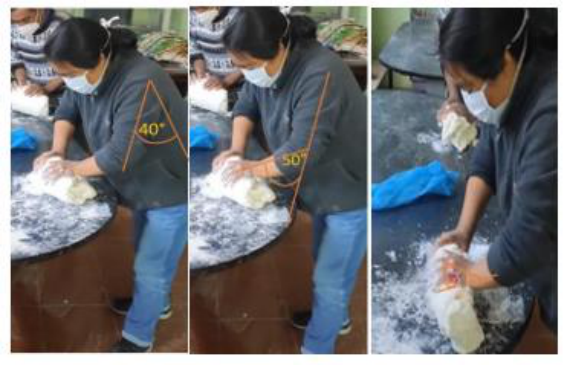
Figure 2: Semi-automatic laminator model, structure and position of the laminating rollers.Figure 3: Places of pressure in upper joints, with risk of affectation: shoulder, forearm and wrist.
One of the important factors to take into account when putting the machine into use is the height at which it must be located. The height of the work plane must be between 0.90 and 1 m from the finished floor level (NPT) to carry out precision work (Álvarez, 2019) EXPERIMENTS Y RESULTS The experimentation is based on the application of the Ovako Working Posture Analyzing System (OWAS) method. In this method, the analyzed workplaces are understood from a list of
Intelligent Human Systems Integration (IHSI 2022): Integrating People and Intelligent Systems https://openaccess.cms-conferences.org/#/publications/book/978-1-7923-8988-7 pre-established basic postures (Lima, 2019), see Fig. 3. 5 preliminary observations are made directly to the workplace, with the statistical method they are calculated that 16 observations satisfy the error, which are taken every 60 seconds, because the operator finishes the work cycle every 16 minutes and repeats it again as shown in table 1.
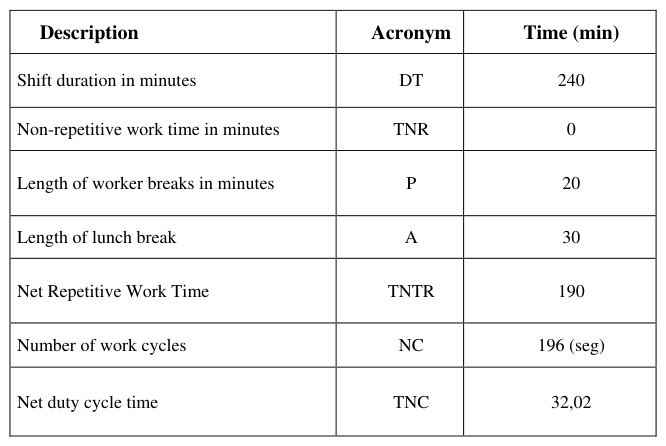
Table 1: OWAS method observationsTable 2: Elements for the OCRA Check-list method calculation Description Acronym Time (min)Equation reproduced from the original PDF.
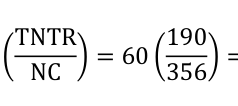
190 min (1)
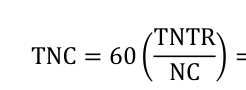
Calculation of net Duty Cycle Time
Intelligent Human Systems Integration (IHSI 2022): Integrating People and Intelligent Systems https://openaccess.cms-conferences.org/#/publications/book/978-1-7923-8988-7
Equation reproduced from the original PDF.Equation reproduced from the original PDF.Equation reproduced from the original PDF.
N of actions
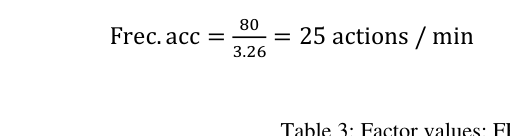
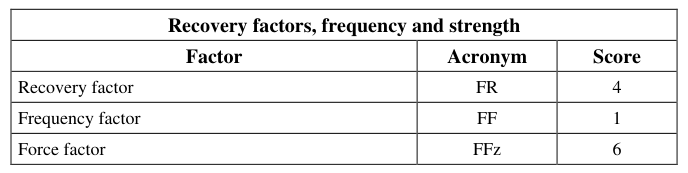
Action frequency The data of the recovery factors, frequency and strength are taken from the Table 3. Frec. acc =
cycle time in minutes (3)
Frec. acc =
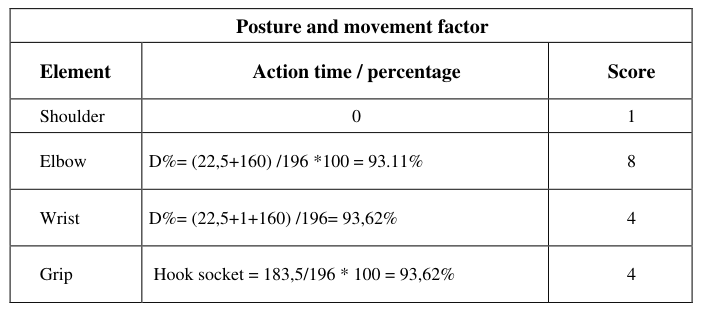
Equation reproduced from the original PDF.Table 3: Factor values: FR, FF and FFTable 4: Posture and movement factor Posture and movement factor
Intelligent Human Systems Integration (IHSI 2022): Integrating People and Intelligent Systems https://openaccess.cms-conferences.org/#/publications/book/978-1-7923-8988-7
Repetitive motion duration multiplication 190 min is in the range of 181 to 240 and the factor is MD equals 0.75 Calculation of the OCRA Check List index Risk level: unacceptable medium. It is recommended to improve the position with an appropriate technology designed with special attention to the economic aspects and cultural aspects in marzipan, in addition to carrying out medical supervision every six months to the artisans (Rivas, 2013) CONCLUSIONS The results of the ergonomic evaluation show that the level of risk to which arti- sans are exposed in the process of making marzipan figures varies according to the type of risk and job position. They present High Risk for forced postures in the kneading activity; in the evaluation of forced postures for sequential postures the Risk level is low; in terms of repetitive movements, they present a medium unacceptable risk (C. Muñoz Poblete, 2012) The control of the work cycle time is very important within any productive activity, that is why the semi-automatic laminator facilitates the artisans’ work by reducing the activity time from 10 min to 3 min depending on the thickness of the dough. In addition, it avoids exposing artisans to ergonomic risks such as repetitive movements and forced postures, since currently the process of kneading by hand is carried out, without taking away the value of artisanal from the process of making marzipan figures. ACKNOWLEDGEMENTS We must thank the authorities of the Indoamerica Technological University who have supported us to carry out this research, the Cordillera University Technological Institute and the MASARTE Association where women and men artisans from Calderon in Quito - Ecuador give us thousands of colorful figures made of marzipan and for agreements made with the “UTI” open spaces for community service practices, allowing these researchers to carry out this scientific article.
REFERENCES
Álvarez, C. ( 2019). Evaluación ergonómica de una línea de producción de masas de pizza en una empresa ubicada en la ciudad de Quito. Quito. Barrero, J. (2018). Factores de riesgo ergonómico por movimientos repetitivos en
extremidades superiores en el área de post cosecha de una empresa florícola. Cuenca: Universidad del Azuay.
Intelligent Human Systems Integration (IHSI 2022): Integrating People and Intelligent Systems https://openaccess.cms-conferences.org/#/publications/book/978-1-7923-8988-7
C. Muñoz Poblete, J. V. (2012). Factores de riesgo ergonómico y su relación con dolor musculoesquelético de columna vertebral: basado en la primera encuesta nacional de condiciones de empleo, equidad, trabajo, salud y calidad de vida de los trabajadores y trabajadoras de Chile(ENETS)2. Chile: Scielo. Diaz, J. (2021). Riesgo ergonómico en movimientos repetitivos superiores por
movimientos repetitivos en el área de pelado, corte y devenado de camarones en una empresa de mariscos . ElTelegrafo. (17 de mayo de 2018). eltelegrafo.com.ec. Obtenido de https://www.eltelegrafo.com.ec/noticias/cultura/1/mazapan-patrimonio- cultural Heredia, F. Á. (2012). Salud ocupacional y prevención: guía práctica. Bogotá:
Ediciones de la U. Lima. (2019). Análise ergonômica do trabalho: utilização dos métodos OWAS e RULA em uma indústria do ramo alimentício na cidade de Mossoró-RN . Gepros: Gestão da Produção, Operações e Sistemas . Muñoz, J. E. (2015). Ergonomía básica. Bogotá: Ediciones de la U. Naghizadeh, M. (2019). Effects of Grain Size on Mechanical Properties and Work-
Hardening Behavior of AISI 304 Austenitic Stainless Steel . Steeal research international. Pacana, A. W. (2016). Draft questions of 5S pre-audit with regard to health and safety standards for tires retreating plant. Production engineering archives. Reyes, J. V. (2017). La Metodología 5S como estrategia para la mejora continua en
industrias del Ecuador y su impacto en la Seguridad y Salud Laboral. Polo del conocimiento. Rivas, R. R. (2013). Ingeniería humana: aspectos ergonómicos en el diseño industrial y en la producción. Tomo I. Buenos Aires: Nobuko. Telégrafo, E. (17 de Mayo de 2018). El mazapán es parte del Patrimonio Cultural
Intangible del Ecuador. Obtenido de vol. Cultura, nº 10, p. 10. Zea, O. (2019). Desarrollo de un microinversor para la optimización del arranque en motores monofásicos . Cuenca: Repositorio Institucional de la Universidad Politécnica Salesiana.
Intelligent Human Systems Integration (IHSI 2022): Integrating People and Intelligent Systems https://openaccess.cms-conferences.org/#/publications/book/978-1-7923-8988-7
LISTED IN THE AHFE DIGITAL BOOKSTORE CATALOGUE
Explore the complete digital volume
Intelligent Human Systems Integration (IHSI 2022): Integrating People and Intelligent Systems
Read this individual research paper free through the original publisher, or explore the full digital proceedings book.
ISBN 978-1-7923-8988-7
Explore this ISBN in the AHFE Bookstore ↗Listed in the July 2026 bookstore catalogue; search by ISBN to confirm current availability · Digital book purchase optional