Iris Graessler, Alena Tusek (2025). Software-supported decision support for the foresighted planning of digital business models. In: Human Systems Engineering and Design (IHSED2025): Future Trends and Applications. AHFE Open Access, vol. 198, pp. 126–138. https://doi.org/10.54941/ahfe1006769
To remain competitive, companies must continuously adapt their value proposition, especially in response to increasing demands for sustainability and digitalisation. Small and medium-sized enterprises often struggle to implement future-oriented digital business models. The aim is to develop decision support to help companies plan ahead and assess their value proposition, with a focus on foresighted planning. Based on literature research, expert interviews and the analysis of existing solutions, an understanding of “sustainable value” and requirements of decision support are defined. Decision support is implemented in a software. The main contribution is the setup of functions and content such as a list of influence factors, analysing influences and evaluating ideas, control questions and support for the implementation of digital business models. Validation through expert interviews and workshops in mechanical and plant engineering shows that the software supports enterprises in foresighted planning of value proposition and the selection of a concept for digital business models. It makes them robust towards the variety of future scenarios.
To ensure their future competitiveness, companies must develop and continuously adapt their own value proposition (Glauner, 2015). The increasing demand for sustainability and digitalisation as well as the transformation of business models using digital technologies with service provision, requires an understanding of “sustainable value” on the one hand (Kiel et al., 2017) and the future viability of planned business models to be ensured on the other hand. These are prerequisites to successfully meet future market changes. In particular, small and medium-sized enterprises face a multitude of challenges and factors to consider when introducing digital business models (Lehmann and Dörr, 2022). This makes it difficult for them to identify the direct and indirect influence factors of their own value proposition and to plan, implement and continuously monitor suitable, digital business models based on those influence factors.
However, the switch to digital business models also presents companies with the challenge of deciding where to start. Choosing the right approach
Software-Supported Decision Support for the Foresighted Planning 127
for the company is made difficult not least by the variety of options offered by different key technologies. Just the gathering of information about advantages and necessary requirements as well as information about costs of individual concepts is time-consuming (Bouncken et al., 2021; Kinkel et al., 2023; Osterrieder, 2021). To provide support for this demand, the aim of the research presented in this paper is the development of decision support addressing the foresighted planning of digital business models. Decision support is based on an understanding of a “sustainable value” of digital products and services using a supportive software. The following research question sums this up: What content and functions must a software-supported decision support cover in order to help enterprises in foresighted planning of suitable product- related digital business models?
This paper is divided into five sections. The introduction (section 1) is followed by the research design chosen to answer the research question (section 2). Then the fundamentals and requirements for decision support are presented by the description of an understanding of “sustainable value”, an analysis of existing solutions and resulting requirements (section 3). Based on the requirements, decision support for the foresighted planning of digital business models is developed and validated (section 4). The validation of the decision support solution is carried out within a case study and expert interviews. Finally, the results are summarised and an outlook on further research perspectives is given (section 5).
RESEARCH DESIGN The research design is divided into five steps (Figure 1). With the help of a literature analysis according to the “Preferred Reporting Items for Systematic reviews and Meta-Analyses (PRISMA)” Statement (Page et al., 2021), a search for usable solutions is conducted. As no sufficient solution can be found, solution components and weaknesses in existing solutions of decision support for foresighted business model selection are identified and analysed in-depth (step one). In a second step, an analysis on the current understanding of “sustainable value” of digital products and services is conducted. It is based on literature analysis – based in overviews of “sustainable value” and research on value drivers, influence factors and success factors of digital business models are consulted – and experiences from experts of the field of mechanical engineering, e-Commerce, software development and from a legal department. In a third step, requirements for decision support are derived based on the analyses in step 1 and 2 to implement the understanding of values in a practice-oriented way. Based on these requirements, decision support for the foresighted planning of digital business models is developed in step four. In the final step, the developed decision support with the associated software is validated within a case study and in expert interviews.
128 Graessler and Tusek
Figure 1: Research design.
Figure available in the original PDF paper.
LITERATURE ANALYSIS AND REQUIREMENTS Business models are becoming increasingly service-oriented through the use of key technologies such as the Internet of Things (Paiola and Gebauer, 2020). The change from pure product sales to servitisation, i. e., the integration with services in the sense of product-service-systems requires a rethinking of the value a company can offer to a customer (Osterrieder, 2021). However, when considering the value proposition in business models, the understanding of value must always be in line with current circumstances, as reflected, for example, in the issue of sustainability. The generation of value and decisions on how to implement the proposed value in business models must be viewed with increasing foresight to be able to adapt to market conditions as quickly as possible. As a result, this chapter deals with the requirements of decision support for the foresighted planning of digital business models based on the analysis on foresighted decision support solutions and the understanding of “sustainable value” from literature and practice.
Analysis on Foresighted Decision Support The literature analysis revealed 115 sources to be analysed. According to the research question, the search terms consist of a combination of the terms business model, foresight and decision support and synonyms which are connected with boolean operators. The analysis was not limited to digital business models, to ensure broader adoption of relevant solution approaches and requirements. The literature analysis was based on the databases of ScienceDirect and Web of Science. After screening, research, and evaluation of suitability, 8 hits remained, which were analysed for usable components and weaknesses in terms of the derivation of requirements for decision support for the foresighted planning of digital business models. A direct reference to the planning of business models is only available in one source; the other sources found offer an indirect reference and the possibility of transferability to the planning of business models. The results of the literature analysis are shown in Table 1.
Table 1: Results of the literature analysis on existing solutions.
Table available in the original PDF paper.
Source Type of Decision Support Integration of Foresight simulation of future strategies (Yan, 2018) Simulation-based decision support for business model strategies
Continued
Software-Supported Decision Support for the Foresighted Planning 129
Table 1: Continued Source Type of Decision Support Integration of Foresight
Table available in the original PDF paper.
(Amezcua-Martínez and Güemes-Castorena, 2010)
different proposals for methods for carrying out foresight on technology trends
high-level Foresight Control System to identify current technology trends and develop business opportunities from them
(Flipse et al., 2015a; Flipse et al., 2015b)
simulation of KPIs in the future (factors that can be influenced)
a tool that can support interdisciplinary teams during on-going innovation practices to explicitly discuss and consider Responsible Research and Innovation -relevant aspects/Key Performance Indicators (KPIs) (Lee et al., 2021) integration of data- driven approaches with expert insights for technology and innovation roadmapping
indication of the possibility of prediction and foresight based on statistical and learning methods with the temporal data
future scenarios to derive various ideas for each scenario; trends for technologies out of e.g. patents (Nazemi et al., 2022) realisation of an explorative visualisation approach that makes it possible to graphically identify technology trends and their probable future potential, based on temporal data sets largely based on Delphi procedure and definition of future signposts (Paasi and Valkokari, 2010) framework for strategic decision-making with monitoring of ideas with the phases ‘Stop’, ‘Hold’ or ‘Continue’ and filtering of ideas through expert ranking and visualisation
visualisation of different scenarios
(Shavazipour et al., 2021) exemplary questions of decision makers in the context of multi- objective optimisation problems with the help of visualisations
integration of Scenario- Technique
(Stummer et al., 2021) combination of agenda- based modeling with scenario analysis
130 Graessler and Tusek
Understanding of “Sustainable Value” Companies should be put in a position to make strategic use of economic considerations across products and product lifecycles. And thus, also to take on social and ecological perspectives to develop digital products and services sustainably. With the help of a second literature analysis and expert interviews an understanding of the “sustainable value” of digital products and services is defined and visualised as a part of a collaborative research project. It considers sustainability in the economic sense – to place a product that is economically viable in the long term – and includes the other sustainability dimensions of ecology and social aspects through a list of influence factors for an influence analysis. For the list, existing lists of influence factors, such as those from (Graessler and Tusek, 2024) on sustainability criteria and digital value drivers from (Cigaina and Riss, 2016), were also collected in a list of influence factors. The list supplement the understanding, in order to clarify the levers of value and influence factors of all dimensions of sustainability. The key findings regarding the understanding of “sustainable value” are presented in Table 2 (cf. (Grässler et al., 2023).
Table 2: Key findings of the understanding of “sustainable value”.
Table available in the original PDF paper.
Key Findings The perspectives of customers and other stakeholders must be understood and considered, including the environment and society. Value is created by realisation, for example in form of value and delivery systems, using resources, activities and processes, and thus generates costs in monetary and non-monetary form. Value is created by a company or in a network that acts together and learns from each other, which is called the ecosystem. From the customer’s point of view, the service offered, and the resulting value of the ecosystem should exceed the sum of the individual contributions of the actors. Value should be aligned with customer’s perception of value to maximise revenue. The product offered is realised through performance. “Sustainable value” (esp. through digital business models) is changing from product orientation to a service orientation and to a combination of the two, a Product-Service-System (hybrid performance). Relationship is secured by a contract (legal view). Once the contract has been conclu-ded, there are correction mechanisms that can have both a legal and a business effect. “Sustainable value” is created by ease of use without complicated details and usage hurdles for the customer, e.g. by providing additional services with a tangible benefit. Value is influenced by different value drivers, these value drivers are levers that affect both the proposition and the realisation of value. When creating “sustainable value”, the value drivers of the three areas of economy, ecology and social affairs must be considered with the aim of integrating all areas.
Software-Supported Decision Support for the Foresighted Planning 131
Requirements of Decision Support Based on this understanding of value and on existing solutions, a workshop was held to derive requirements for decision support that builds on the understanding of “sustainable value”. The requirements particularly address the need to ensure that the understanding of value is applied in a practice- oriented manner within the company. The requirements are shown in Table 3.
Table 3: Requirements for decision support.
Table available in the original PDF paper.
Requirement Decision support must be able to answer the question of how expensive it is to convert to a product-oriented digital business model. Decision support must integrate a target group analysis to take into account the different perspectives on value. Decision support must consider the perspective of influence factors (esp. value drivers) of all fields of sustainability - economy, ecology and social. Decision support must represent the prerequisites of key digital technologies and concepts of digital business models. Decision support must take up and demonstrate existing concepts for digital business models and offer the option of adding further concepts. Decision support must be considered functional in industrial practice and consider needs and problems of enterprises when introducing digital business models. Decision support must help to select and understand the appropriate value drivers. Decision support must include a risk analysis. Risk analysis to support decision must consider future trends. Decision support must help define value propositions distinguishing between values assumed by customers and values offering additional benefits. Decision support must be compatible with familiar thought patterns and methods. Decision support must continuously integrate future perspectives. Decision support must include an explanation based on an example.
DECISION SUPPORT FOR THE FORESIGHTED PLANNING OF DIGITAL BUSINESS MODELS Based on the identified requirements, decision support is developed to support enterprises in the foresighted planning of their own value proposition and the appropriate product-oriented digital business models. Decision support is oriented on the Industry 4.0 technology classification according to (Hummel et al., 2018). According to this, a concept for a digital business model must be chosen before a concrete elaboration of the business model can take place. Such a concept is always associated with a specific type of technology. Decision support provides assistance at the concept level: Based on various alternative concepts, the most suitable one can be selected, which is then elaborated in detail in a business model.
A pre-defined list of concepts for digital business models, including descriptions of these concepts and their classification into phases of the customer journey and product life cycle, serves as the basis for decision support. This list of concepts can be supplemented by companies with further ideas for concepts. Firstly, a checklist with control questions and
132 Graessler and Tusek
prerequisites, including the competencies required for the introduction of digital business models and supporting methods is offered to support decisions. Secondly, a list of value drivers for digital business models and influence factors, similar to a list of main features in requirements engineering is provided. Additionally, support is provided for conducting future analyses: In particular, future analyses include conducting an influence analysis of the factors, generating future scenarios, and evaluating ideas based on future scenarios to make particularly resilient, future-proof business model decisions. The functions and content are combined in a software.
The given checklist and the associated software focus on combining various analyses necessary for selecting a concept for digital business model with the topics of task and target group, value, and foresight. Particular attention is paid to continuously taking foresight into account:
future scenarios are created using Scenario-Techniques based on a software tool (recommendation is an evaluation based on 3 future scenarios; (Graessler and Tusek, 2024; Gräßler et al., 2017),
a risk analysis is carried out based on the scenarios,
a separate influence analysis is carried out to identify the influences on and arising from the concepts under consideration, and
concepts with their associated technologies are evaluated based on future scenarios.
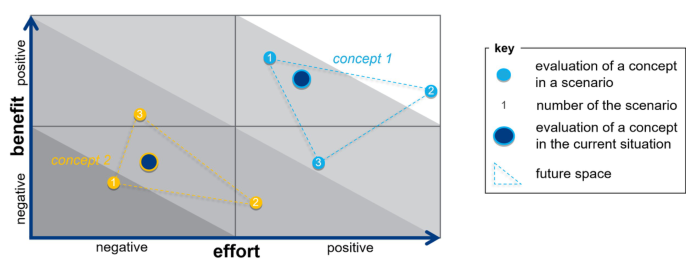
The analysis refers to an initial evaluation of concepts on the current market situation. Every concept represents a potential business model, so that this is already an intrinsic perspective on future potential. Based on this assessment without changes in the environments resp. influence fields, a future perspective is added to the evaluation by using the future scenarios in an additional evaluation step (evaluation in a portfolio). Evaluation is carried out based on evaluation criteria (as in (Gräßler and Koch, 2022)) which are clustered according to effort and benefit and presented in a portfolio. Each concept is evaluated at the current market situation and evaluated by taking the created future scenarios into account. Evaluation criteria are benefit and effort, which depend on internal and external factors, for instance, on different technological evolutions, market developments or infrastructure surroundings. While scenarios are always the same, the evaluation per concept typically differs. By evaluating a concept using scenarios and then connecting these evaluations with connecting lines, a future space (triangle) – referred to intersection area of the future funnel from (Reibnitz, 1992) – can be created (Figure 2). This future space shows how the future robust the individual concepts are. The smaller the future space triangle, the more robust the concept is in relation to future developments. Furthermore, a positive evaluation of the effort and benefit of the concept in all scenarios indicates a high degree of future robustness. Building on this, foresighted measures can be developed for each selected concept that should be taken if a certain scenario occurs to ensure the success of a company’s digital business models.
Software-Supported Decision Support for the Foresighted Planning 133
Figure 2: Portfolio evaluation of concepts with integrated future perspective.
Decision Support Tool The Decision Support Tool consists of the checklist and a supplemented software. Based on the contents of the checklist, the software offers two modes: A simple mode with questions and subsequent evaluation to discuss the suitability of the company’s own considerations for various business model concepts. A presentation of various concepts of digital business models with exemplary use cases and descriptions helps to gain an understanding of different concepts. The simple mode can be completed with an own evaluation of the concepts.
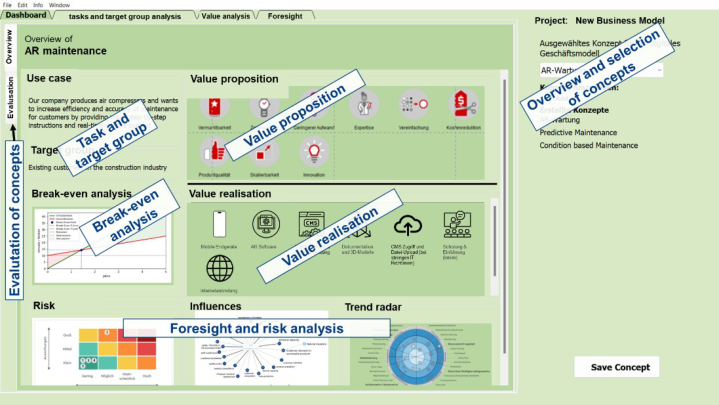
The advanced or expert mode is used for a more detailed, company-specific analysis of digital business model concepts. The software comprises analyses on the topics of task and target group, value and foresight in separate tabs. The individual analyses are consolidated in a dashboard, which, in addition to providing a foresighted assessment, serves as an individually configurable decision support in a visually prepared format. The software is used to support analyses that are carried out, for example, by applying methods in workshops. Results of the application of methods can be collected directly in the software or can be deepened in a workshop and then be entered into the software. After entering the results of all analyses, a dashboard is created as a summarised result suitable for management (Figure 3). The dashboard can be customised by the user so that the information the user considers as necessary can be displayed.
The software is fed by a database that contains, in particular, the list of influence factors from the checklist, and exemplary characteristics of the influence factors have been defined and already evaluated in an influence analysis. Various starting points can be selected in the task and target group analysis: the direct selection of a concept or by suggesting suitable concepts via the selection of predefined pain points or the selection of a step to be addressed in the customer journey – attached on the evaluation of the fit in simple mode. Based on the selected concept for a digital business model, a use case and the company’s target group can be described.
134 Graessler and Tusek
Figure 3: Exemplary structure of the dashboard of the decision support software.
The topic value analysis is divided into a benefit analysis – to consider the value proposition – and a cost analysis to consider the realisation. The benefit analysis focuses on the value proposition for the end customer. Based on the elements of value according to (Almquist et al., 2018), the value for the end customer is visually displayed. Elements can be selected for the respective concept in a first step. The value can also be supplemented by more detailed descriptions. In the cost analysis, the general requirements for the introduction of product-oriented digital business models are presented in a list. Each requirement is explained in a description, detailed with an example, and a cost framework is given for the respective requirement. Additional requirements are listed for the concepts for digital business models. In the software, the costs that would be incurred in the company when introducing the concept can be selected.
The first step in the foresight topic is an overview of the risk analysis, in which risks can be collected and evaluated. To support the risk analysis, influence graphs and future scenarios can be created using the Scenario- Technique by integrating a corresponding tool (Graessler and Tusek, 2024). In addition to the Scenario-Technique, a further trend analysis can also be used to consider megatrends and identify risks based on them. Analyses can be carried out for different concepts, enabling a comparison of several concepts. A separate overview is then created in the dashboard for each concept. With the help of guiding questions, the priorities of the company can be matched to the appropriate concepts, so that, the appropriate decision can be made based on e.g. capacity, speed of implementation or degree of novelty, and the time to implement the concept can be planned.
Validation Validation of the decision support is carried out based on expert interviews and workshops with companies in the mechanical and plant engineering
Software-Supported Decision Support for the Foresighted Planning 135
and software development sector. In the first interviews, the definition and visualisation of the key findings of “sustainable value” were queried with the result that the definition reflects an understanding of the “sustainable value” of digital performance.
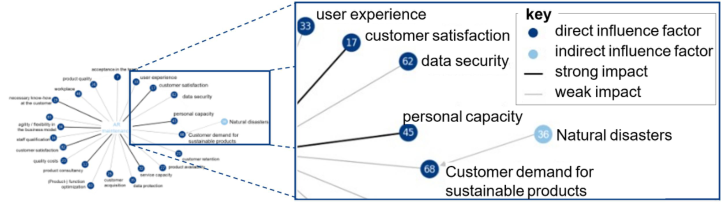
In preparation for the decision support interviews, the software’s database was filled with sample data and detailed using a case study. Figure 4 shows an excerpt from the influence graph for the “Augmented Reality for maintenance” concept from the case study, which shows the factors that are strongly and weakly influenced by the concept, as well as indirect influence factors. In the interviews conducted for decision support, the interviewees confirmed the added value of decision support and appropriate selection of content for planning suitable digital business models.
Figure 4: Excerpt of the influence graph of augmented reality for maintenance.
The decision support provides support in applying the understanding of “sustainable value” by planning and communicating value and understanding the value drivers and influence factors. The list of influence factors can be used to improve the value communication process as inspiration and clarification of values by working through all value areas step by step. In addition, integrating the list into the software’s database can facilitate the implementation of the Scenario-Technique and provide valuable input for the analysis block of foresight. Furthermore, the decision support tool is particularly helpful in selecting a digital business model concept that is tailored to the needs of the organisation and can also be prepared for decision-makers. The decision support tool assists with initial planning and can also help with the specific selection for implementation by enabling detailed analyses. The link to foresight also ensures that companies are prepared for various future scenarios and can thus take timely measures to ensure the success of their own business model. The foresight is therefore not a separate block but is embedded in the tool in such a way that the link to innovation management is clear.
CONCLUSION
The developed decision support for the strategic planning of digital business models helps to identify the conditions for introducing a concept for digital business models and to illustrate how it can be mapped to a company’s own
136 Graessler and Tusek
needs and circumstances. It supports foresighted decisions and provides a management-friendly view of risks on digital business models. To relieve the burden on small and medium-sized enterprises in particular and enabling them to make informed decisions with little time and information-gathering effort, the time required for analyses can also be reduced by linking to the database developed in the project.
The software also provides valuable input for the next step in business model development. For example, the integrated trend analysis and Scenario- Technique can be used to collect initial content for fields in a business model canvas like in (Gräßler et al., 2023). Also, the integration in a Scenario- Tool enables tool-based support for the implementation of the Scenario- Technique. At the same time, the integration of the Scenario-Technique into strategic product planning is focussed and the purpose of this method is clarified.
ACKNOWLEDGMENT
The results of this work were developed as part of the KLUG research project. This research and development project is/was funded by the German Federal Ministry of Education and Research (BMBF) within the “The Future of Value Creation – Research on Production, Services and Work” program (funding number 02K23A050) and managed by the Project Management Agency Karlsruhe (PTKA). The author is/The authors are responsible for the content of this publication.
REFERENCES
Almquist, Eric/Cleghorn, Jamie/Sherer, Lori (2018). The B2B elements of value. 3rd ed. Boston, Graduate School of Business Administration, Harvard University. Amezcua-Martínez, J. L./Güemes-Castorena, D. (2010). Strategic Foresight Methodology to Identifying Technology Trends and Business Opportunities. In: D. F. Kocaoglu/T. R. Anderson/T. U. Daim (Eds.), PICMET 2010: Technology Management for Global Economic Growth. Bouncken, Ricarda B./Kraus, Sascha/Roig-Tierno, Norat (2021). Knowledge- and
innovation-based business models for future growth: Digitalized business models and portfolio considerations. Review of Managerial Science 15 (1), 1–14. https:// doi.org/10.1007/s11846-019-00366-z. Cigaina, Marco/Riss, Uwe V. (2016). Digital Business Modeling. https://doi.org/ 10.13140/RG.2.1.3167.3368.
Software-Supported Decision Support for the Foresighted Planning 137
Flipse, S. M./van Dam, K. H./Stragier, J./Oude Vrielink, T. J. C./van der Sanden, M. C. A. (2015a). Operationalizing responsible research & innovation in industry through decision support in innovation practice. Journal on Chain and Network Science 15 (2), 135–146. https://doi.org/10.3920/JCNS2015.x004 Flipse, S./Vrielink, J. O./van der Sanden, M. (2015b). Building interactive communication tools to support interdisciplinary responsible innovation. Journal of Innovation Management 3 (4), 119–133. https://doi.org/10.24840/2183- 0606_003.004_0008 Glauner, Friedrich (2015). Werteorientierte Organisationsentwicklung. Sieben Thesen zu den ethischen und ökonomischen Grundlagen einer nachhaltigen Unternehmensorganisation. In: Brunhilde Schram/René Schmidpeter (Eds.). CSR und Organisationsentwicklung. Die Rolle des Qualitäts- und Changemanagers. Berlin, Heidelberg, Springer Berlin Heidelberg, 141–160. Graessler, Iris/Tusek, Alena Marie (2024). Case study on the software-supported
development of competences in Scenario-Technique. AHFE International 158. Available online at https://ris.uni-paderborn.de/record/56347. Grässler, Iris/Dattner, Michael/Ovtcharova, Jivka/Dietert, Tilko/Dietz, Patrick/ Elstermann, Matthes/Fayet, Celestin/Hauck, Andreas/Häuser, Frank/Fischer, Holger/Herzog, Michael/Köhler, Christian/Lachenmaier, Jens/Lachmayer, Roland/ Meussen, Bernhard/Mozgova, Iryna/Möser, Sebastian/Pottebaum, Jens/Schluse, Michael/Schneider, Jannik/Stetter, Ralf/Thurnes, Christian/Tusek, Alena/Wurst, Johanna (2023). Begriffe der strategischen Produktplanung und -entwicklung. Produkt und hybride Leistung. Düsseldorf, VDI. Gräßler, Iris/Koch, Anna-Sophie (2022). Evaluation Criteria in Product Idea Selection
Decisions. ISPIM Conference Proceedings. Gräßler, Iris/Pottebaum, Jens/Scholle, Philipp (2017). Integrated Process and Data Model for Agile Strategic Planning. In: Sandor Vajna (Ed.). 11th International Workshop on Integrated Design Engineering, IDE Workshop, Magdeburg, 05.04.–07.04. Gräßler, Iris/Tušek, Alena/Özcan, Deniz (2023). Entwicklung zukunftsfähiger
Geschäftsmodelle in der Automatisierungstechnik anhand von Megatrends. In: Automation 2023. VDI Verlag, 863–874. Hummel, Vera/Palm, Daniel/Ranz, Fabian/Guldin, Marc (2018). Geschäftsmodelle für die Industrie 4.0. Erfolgsfaktoren, Hindernisse und Anwendungsbeispiele. Stuttgart, Baden-Württemberg Stiftung gGmbH. Kiel, Daniel/Müller, Julian M./Arnold, Christian/Voigt, Kai-Ingo (2017). Sustainable
Industrial Value Creation: Benefits and Challenges of Industry 4.0. International Journal of Innovation Management 21 (08), 1740015. https://doi.org/10.1142/ S1363919617400151 Kinkel, Steffen/Fara, Dominique Rene/Beiner, Sebastian/Janeikis, Sonja (2023).
Organisatorische und personale Hürden bei der Entwicklung digitaler Geschäftsmodelle. Zeitschrift für Arbeitswissenschaft 77 (2), 270–286. https:// doi.org/10.1007/s41449-023-00361-x Lee, S./Jang, K. J./Lee, M. H./Shin, S. R. (2021). Roadmapping in the era of uncertainty: How to integrate data-driven methods with expert insights. Foresight and STI Governance 15 (2), 39–51. https://doi.org/10.17323/2500- 2597.2021.2.39.51 Lehmann, Claudia/Dörr, Luca (2022). Digital souveräne Gestaltung von Services – ein marktfähiger Mehrwert? In: Ernst A. Hartmann (Ed.). Digitalisierung souverän gestalten II. Handlungsspielräume in digitalen Wertschöpfungsnetzwerken. Berlin, Heidelberg, Springer Berlin Heidelberg; Imprint Springer Vieweg, 14–24.
138 Graessler and Tusek
Nazemi, K./Burkhardt, D./Kock, A. (2022). Visual analytics for technology and innovation management: An interaction approach for strategic decision making. Multimedia Tools and Applications 81 (11), 14803–14830. https://doi.org/ 10.1007/s11042-021-10972-3 Osterrieder, Philipp (2021). Servitization of Manufacturing Companies. In: Thomas
Friedli/Philipp Osterrieder/Moritz Classen (Eds.). Managing Industrial Services. From Basics to the Emergence of Smart and Remote Services. Cham, Springer International Publishing; Imprint Springer, 7–13. Paasi, J./Valkokari, P. (2010). Elucidating the fuzzy front end experiences from the INNORISK project. VTT Publications (743), 1–160. Available online at https://www.scopus.com/inward/record.uri?eid=2-s2.0– 78651076995&partnerID=40&md5=e6b09310c361f3744903db487f4507be. Page, Matthew J./McKenzie, Joanne E./Bossuyt, Patrick M./Boutron, Isabelle/ Hoffmann, Tammy C./Mulrow, Cynthia D./Shamseer, Larissa/Tetzlaff, Jennifer M./Akl, Elie A./Brennan, Sue E./Chou, Roger/Glanville, Julie/Grimshaw, Jeremy M./Hróbjartsson, Asbjørn/Lalu, Manoj M./Li, Tianjing/Loder, Elizabeth W./ Mayo-Wilson, Evan/McDonald, Steve/McGuinness, Luke A./Stewart, Lesley A./Thomas, James/Tricco, Andrea C./Welch, Vivian A./Whiting, Penny/Moher, David (2021). The PRISMA 2020 statement: an updated guideline for reporting systematic reviews. BMJ (Clinical research ed.) 372, n71. https://doi.org/10.1136/ bmj.n71. Paiola, Marco/Gebauer, Heiko (2020). Internet of things technologies, digital
servitization and business model innovation in BtoB manufacturing firms. Industrial Marketing Management 89, 245–264. https://doi.org/10.1016/ j.indmarman.2020.03.009 Reibnitz, Ute von (1992). Szenario-Technik. Instrumente für die unternehmerische und persönliche Erfolgsplanung. 2nd ed. Wiesbaden, Gabler. Shavazipour, B./López-Ibáñez, M./Miettinen, K. (2021). Visualizations for decision
support in scenario-based multiobjective optimization. Information Sciences 578, 1–21. https://doi.org/10.1016/j.ins.2021.07.025. Stummer, C./Lüpke, L./Günther, M. (2021). Beaming market simulation to the future by combining agent-based modeling with scenario analysis. Journal of Business Economics 91 (9), 1469–1497. https://doi.org/10.1007/s11573-021-01046-9 Yan, M.-R. (2018). Improving entrepreneurial knowledge and business innovations by simulation-based strategic decision support system. Knowledge Management Research and Practice 16 (2), 173–182. https://doi.org/10.1080/ 14778238.2018.1442994
LISTED IN THE AHFE DIGITAL BOOKSTORE CATALOGUE
Explore the complete digital volume
Human Systems Engineering and Design (IHSED2025): Future Trends and Applications
Read this individual research paper free through the original publisher, or explore the full digital proceedings book.
ISBN 978-1-964867-74-8
Explore this ISBN in the AHFE Bookstore ↗Listed in the July 2026 bookstore catalogue; search by ISBN to confirm current availability · Digital book purchase optional