Iris Graessler, Deniz Oezcan (2025). Graphical AI workflow modelling: Identifying relevant competencies in AI-based automation of business processes. In: Human Systems Engineering and Design (IHSED2025): Future Trends and Applications. AHFE Open Access, vol. 198, pp. 318–328. https://doi.org/10.54941/ahfe1006785
This research investigates how Artificial Intelligence (AI) can be systematically integrated into existing business processes by combining suitable competencies with graphical AI workflow modelling. While AI offers a high potential for automation and increased efficiency, its implementation often fails due to a lack of interdisciplinary competencies that bridge the gap between domain expertise and IT know-how. Low-code platforms and visual modelling tools are increasingly recognised as enablers, empowering non-programmers to intuitively create graphical AI- based workflows. Nevertheless, specific competencies are required to realise the full potential of AI, the domain specific knowledge and align technical understanding with AI capabilities. The paper reviews the state of the art in AI-driven business process automation and competencies for visual low-code approaches. It then presents a practical solution to identify and systematise essential competence areas. Based on this, a practical competence model is developed to support the design of user-friendly, AI-enabled workflows. This is tested in a practical application context — emergency management — where it supports critical decision-making processes and is validated through expert feedback. The study concludes by offering actionable recommendations to help organisations foster the necessary competencies and methods for competently integrating AI into their digital processes.
In today’s business world, Artificial Intelligence (AI) is becoming increasingly important. By using AI technologies, companies can optimise their processes and drive innovation to remain competitive (Baryannis et al., 2019). AI technologies have the potential to support a wide range of business processes by enabling automation and efficiency gains through their integration. In particular, modelling workflows that integrate AI algorithms is an essential step in increasing the scalability and effectiveness of business processes. Despite the high relevance of AI, implementing it in existing IT-systems often remains a challenge (Russell & Norvig, 2022).
Graphical AI Workflow Modelling: Identifying Relevant Competencies 319
A competence that is mostly lacking in companies is the link between programming, such as integration of AI technologies and the domain knowledge of the decision-makers within the business processes (Tekinerdogan et al., 2020). As a result, many companies struggle to fully exploit the potential of AI. In this context, low-code platforms and graphical modelling techniques offer a promising solution. They enable a user-friendly and accessible design of workflows that integrate AI technologies into business processes. By using visual tools and reducing code, companies can implement AI technologies faster and more efficiently, without the need for in-depth programming knowledge. Nonetheless, even such low-code tools need to be complemented by competencies at the intersection of AI modelling and domain-specific business processes (Hofmann & Klinkenberg, 2014).
This work examines how graphical workflow modelling can be used as a tool to integrate AI technologies into business processes. The focus is on required competencies for developing user-friendly workflows that enable non-programmers to create and optimise AI-based workflow models. The aim is to provide companies with a practical solution that helps them to efficiently integrate AI into their business processes and thereby increase their competitiveness (Graessler & Oezcan, 2024). Based on practical cross- industry and cross-domain challenges, the following two research questions are derived as a starting point of this research work: RQ1: What technical, organisational and professional challenges exist when integrating graphical AI workflows into modelled business processes?
RQ2: What areas of expertise are required to enable non-programmers to design and optimise graphical AI-workflows in business processes?
This paper is structured in four chapters. In the first chapter, the current challenges in the use of AI technologies in companies are analysed. In the second chapter, the state of the art is focussed. Chapter three presents the scientific approach of this research work. In chapter four, the main topic of competencies in business process automation and solutions for the integration of AI technologies are examined and evaluated, considering the necessary competencies. The fifth chapter presents a practice-oriented solution for the competence-oriented integration of AI technologies into business processes. Finally, the approach is applied for the case of critical decision making in selected emergency management organisations and validated through expert interviews with end users.
STATE OF THE ART The state of the art covers the three relevant sub-areas of this paper: AI in business processes, graphical workflow modelling and competencies in this context.
AI in Business Processes The present study explores the integration of AI within contemporary data analysis and interpretation frameworks within business processes. In
320 Graessler and Oezcan
comparison with conventional business processes, which are rule-based and deterministic, the integration of AI results in the potential for independent learning and pattern recognition (Baryannis et al., 2019).
The field of AI is broad, and can be divided into two main approaches: knowledge-based and data-based (Iris Gräßler et al., 2025). Knowledge- based AI includes, for instance, ontology reasoning while data-based AI includes specific types of Data Mining, Machine Learning and Deep Learning. The utilisation of this key technology is being promoted in numerous domains, with the potential to enhance decision-making processes within business operations. The utilisation of extreme data enables the formulation of decisions that are either informed by AI or rendered in a manner that is both suitable for human interpretation and comprehensible. The integration of AI components such as algorithms into business processes and existing IT and legacy system landscapes often proves to be complex and time- consuming (Nti et al., 2021).
Graphical Workflow Modelling In graphical workflow modelling, business or production processes are designed, analysed and executed using graphical visualisations such as flowcharts or activity diagrams. The use of a graphical user interface (GUI) has been proven to significantly reduce implementation effort. This improvement ensures the traceability and maintainability of workflows, enabling even non-technical users with limited programming skills to model and adapt processes directly using low-code or no-code methods (Deuse et al., 2024). Standardised languages and notations are necessary for the interoperability and formal consistency of such models. The most widely used of these is Business Process Model and Notation (BPMN). Regarding the modelling and execution of decisions, Decision Model and Notation (DMN) is a formalisation of business rules that complements Business Process Management Notation (BPMN). In addition, there are complementary standards that can be used (Eversheim et al., 2002).
The evaluation of suitable standards and tools must consider the requirements, the complexity of the domain and the integration requirements. Industrial platforms such as SAP Business Workflow, Camunda Platform, IBM Business Automation Workflow and Altair RapidMiner AI Studio offer mature environments for graphical modelling, simulation and automation (Hofmann & Klinkenberg, 2014).
Competencies Corporate competencies (also referred to as “core competencies”) are central skills, resources or areas of knowledge that give a company or divisions a competitive advantage (Bornewasser, 2018). A distinction can be made between strategic and domain-specific competencies. In this case, the focus is on the competencies of the decision-maker. A range of skills and competencies are highly pertinent in this context, including IT knowledge, domain expertise, and effective communication (Graessler & Oezcan, 2025).
Graphical AI Workflow Modelling: Identifying Relevant Competencies 321
Competencies facilitate decision-making through systematic and informed processes, thereby fulfilling the role of a decision-maker (Bellmann & Meyer, 2016). In summary, three pillars are essential for a competency: knowledge, ability and the willingness to apply knowledge in specific cases. This combination can be described as a competence. The capacity to apply concepts is a distinguishing factor that sets an individual, a company or an organisation apart from its competitors (Nyhuis et al., 2009).
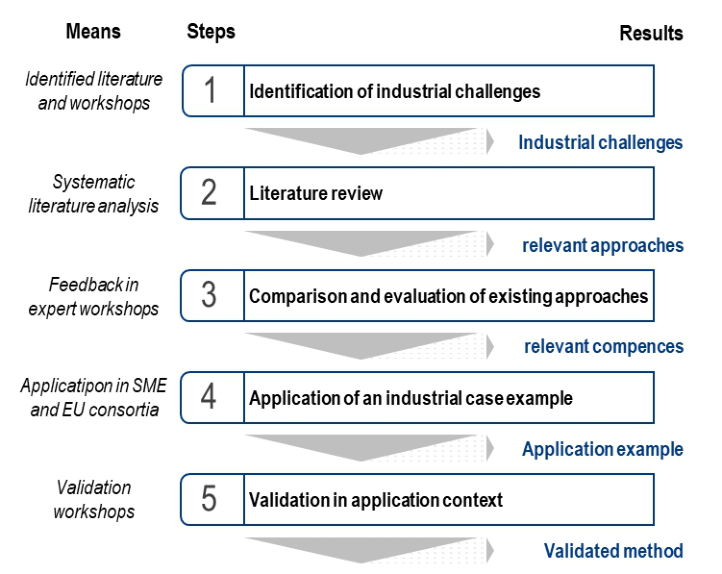
SCIENTIFIC APPROACH To answer the research questions, a five-step scientific approach is defined. In the initial step, practical challenges are identified in industrial workshops. In step 2, a systematic literature review is conducted, and relevant approaches are cluster to address these practical challenges. In step 3 the identified literature is used to capture relevant competencies in business process automation. Results of the identified competencies are used to define a practical solution to integrate AI-based business process models in step 4. In the last step, the relevant competencies are discussed and validated in validation workshops with domain specific experts. The scientific approach is illustrated in Figure 1.
Figure 1: Scientific approach of this research.
322 Graessler and Oezcan
COMPETENCIES IN AI-BASED AUTOMATION OF BUSINESS PROCESSES As part of the graphical AI workflow modelling, it is necessary to use all company competencies to get the most out of the process. A systematic literature review was conducted to identify obstacles in industrial implementation, and the necessary skills were identified and visualised.
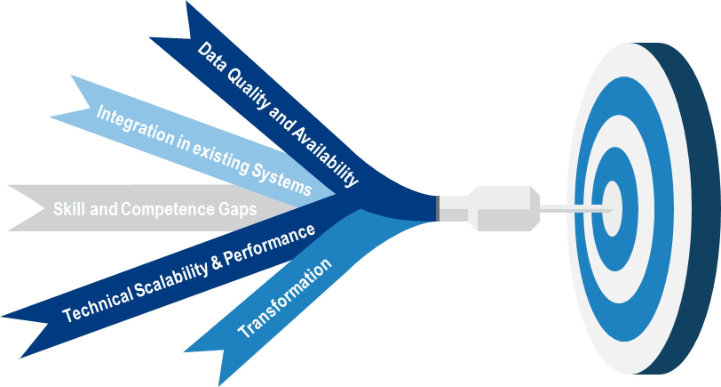
Industrial Challenges The practical challenges can be divided into five fields of challenge. An important area is the quality, availability and knowledge of existing data within the company (Wang et al., 2022). Most companies have a lot of data, which may be subject to legal restrictions, for example, as well as siloed data clusters whose availability and usability are unclear how to use by decision-makers. Technical scalability and performance are another hurdle, as continuous monitoring or improvement of workflows is necessary. Furthermore, integration into overall technical systems within the company ecosystem is difficult. Expanding such software solutions is not easy to achieve without considerable additional effort. In order to remain competitive in dynamic and rapidly changing markets, companies across a range of industries are increasingly adopting AI technologies. From predictive analytics to intelligent automation, AI has the potential to transform core business processes. However, despite its advantages, integrating AI into existing business environments remains a complex challenge. Two major areas of concern addressed in this paper are transformation, i.e. resistance to change in change management, and skills and competence gaps. The competence gaps manifest themselves in the form of an affinity for IT solutions, such as complex algorithms and hard coding. The business changes must be accepted and new technologies embedded into existing processes, as shown in Figure 2. From this, the skill and competence gaps, as well as the transformation difficulties, can be derived (Reitmeier & Paetzold, 2011).
Systematic Literature Review The systematic literature review is used to identify necessary competencies for graphical AI-workflow modelling. The research approach is based on the PRISMA process (Page et al., 2021). For research the databases of ResearchGate, Science Direct and Scopus were used to identify relevant literature.
Based on keywords workflow, competence, skill, AI and Process 157 relevant documents were identified. To filter the amount of literature, the publications were limited to those released after 2022, due to the release of open-source large language models and diffusion models. This reduction brings a manageable amount of 97 documents. Application of inclusion criteria reduce the number of relevant approaches to 9. Examples of criteria include application and technical implementation, as well as action in the domain of decision-makers and engineers.
Graphical AI Workflow Modelling: Identifying Relevant Competencies 323
Figure 2: Industrial challenges in AI-based automation of business processes.
These approaches provide a basis for identifying competencies and defining what is necessary for identifying success factors and defining the necessary competencies for business process automation.
Identification and Systematisation of Relevant Competencies Based on the literature found, competencies for the application of AI workflows can be determined. Four main areas could be defined in the literature. The four competency categories relate to the modelling of AI workflows, which require a great deal of cross-domain knowledge.
1. Technical process and domain expertise 2. Data Science (DS) and AI methodological expertise 3. Technical integration and modelling skills 4. Interdisciplinary communication and change management skills These four categories depend heavily on essential and comprehensive cross-domain expertise, as well as the methodological and social skills of the individual responsible for implementation, which addresses RQ1. As explained in previous chapters, necessary skills are lacking in the skills profile. It is not possible for a skills profile for a decision-maker to reflect deep integration and modelling skills, nor DS/AI skills alongside domain expertise (Gräßler et al., 2025).
PRACTICAL SOLUTION FOR COMPANIES In order to present a practical solution for companies, the identified competencies were analysed and categorised in Tables 1 and 2. It is possible to derive measures from this categorisation for the implementation of the company’s goals of incorporating graphical AI workflows into business processes.
324 Graessler and Oezcan
Table 1: Decision-maker’s area of competence.
Table available in the original PDF paper.
Area of Competence Description A - Process understanding Knowledge and analysis of existing business processes, identification of automation and optimisation potential. B - AI knowledge Understanding of basic AI concepts (e.g. classification, clustering, NLP) and their potentials and limitations. C - DS knowledge Ability to identify data sources, prepare data and interpret it critically in data streams. D - Modelling competence Ability to design graphical workflows (e.g. with BPMN, RapidMiner, Power Automate, Node-RED or similar). E - Low-Code / No-Code
Operation and application of visual development environments for implementing AI-supported processes. F - Change Management Supporting change, communicating with stakeholders, transferring knowledge to the organisation.
Table 2: Competence stages.
Table available in the original PDF paper.
Stage Description 1 – Beginner Basic understanding, can classify terms, requires guidance. 2 – Advanced beginner Can perform simple tasks with guidance. 3 – Competent Can independently model & evaluate smaller graphical AI workflows. 4 – Experienced Can analyse complex requirements and integrate suitable AI models. 5 – Expert Acts strategically, develops new approaches, can impart knowledge.
An organisation can define a target competence level for each of these roles and record the actual competency level of its employees. This allows targeted training measures to be derived, interdisciplinary teams to be built up and specific competencies for AI-based process innovations to be developed.
Low-code platforms offer individual blocks that contain embedded functions. These functions can include AI algorithms or mathematical operations. From an end user’s perspective, low-code and no-code platforms are highly appealing due to their drag-and-drop functionality, GUI editors and ready-made AI components and building blocks. Beispiele für Anwendungen in diesem Bereich sind Microsoft Power Automate, UiPath und Altair RapidMiner AI Studio.
Graphical AI Workflow Modelling: Identifying Relevant Competencies 325
Table 3: Role model for competencies.
Table available in the original PDF paper.
E - Low-Code/
No-Code
F - Change
Management
A - Process
understanding
B - AI knowledge
C - DS knowledge
D - Modelling
competence
Role / Competence Business Process Analyst # # H # Data Champion / Data Scientist # # # # Domain Expert # # # # # AI Project Coordinator H # H # H # H # H # H # Low-code developer # # # Strategic decision maker H # # # Tactic decision maker H # H # # #
It can be seen in Table 3 that (A) received the most mentions in terms of process understanding, followed by E, which is followed by low code know- how. For the target group of decision-makers, these two areas are therefore the most important intersections for a competence profile that should be developed.
APPLICATION The competence model was applied and tested in a practical context in crisis prevention and emergency management. The aim of the application is to review the competencies of decision-makers with no IT expertise. This requires application in a real environment in which decision-makers carry out graphical AI workflow modelling based on a predefined user group. The decision maker must use their own strategy to make decisions in a traditional way. The user group is defined by the competence model.
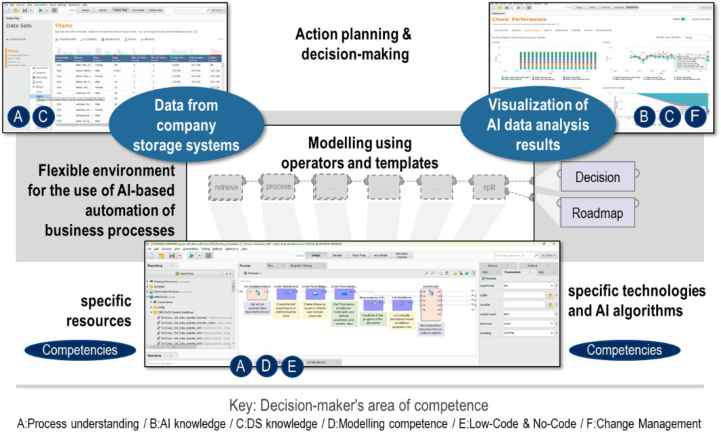
The application involves using the domain-specific knowledge of the decision-maker as well as the ability to select predefined blocks of the workflow. For decision-making, the aim of the design of a graphical AI workflow is to display the necessary information in a system. The task is successful if a data-based decision could be made on the basis of the decision support provided by the workflow and could be critically classified. During application by experts, the average completeness of the decision- making workflows was measured, as well as the number of errors in incorrectly positioned graphic blocks. This showed that the explanations of the individual connections, known as connectors, must be clearly defined so that users can recognise their domain-specific terminology, as illustrated in Figure 3 in the middle. For the Visualization of AI data analysis results (Competence B&C&F) is knowledge for interpreting DS/AI outputs useful. The representation of complex data pre-processing was viewed critically, with users requesting additional AI modules (Competence A&C). This functionality can be examined in more detail based on competence awareness, which answers RQ2.
326 Graessler and Oezcan
Figure 3: Graphical AI workflow modelling with specific competencies.
The validation highlights that the combined competence model with graphical AI workflow modelling enables non-programmers to create high- quality AI workflows. Efficiency gains based on a larger decision-making basis through larger amounts of data processed by AI. High usability underlines its practical relevance. At the same time, validation clearly showed that the competence model needs to be supplemented with details on data pre- processing and specific AI parameters. Furthermore, tailored metrics could be used to monitor and coordinate the processes (Graessler et al., 2024).
CONCLUSION
This paper examines the possibility of systematically integrating AI technologies into existing business processes through the use of appropriate skills and graphical workflow modelling. This study is based on the observation that, although artificial intelligence offers significant potential for automation and efficiency gains, its implementation in existing IT environments often fails due to a lack of interface skills between domain knowledge and programming skills.
Low-code platforms and visual modelling tools promise to remedy this situation by enabling even non-programmers to design AI-supported process steps quickly and intuitively. At the same time, specific skills are required in the interaction between AI modelling and technical process understanding in order to realise the full added value (Gräßler et al., 2023).
The first chapter highlights the current challenges in implementing AI in companies. Building on this, an overview of the current state of the art in business process automation, AI methods and graphical low-code approaches is provided. The third chapter describes the methodological approach for
Graphical AI Workflow Modelling: Identifying Relevant Competencies 327
identifying and systematising relevant areas of expertise. In chapter four, a practice-oriented competence model for designing user-friendly, AI-based workflows is developed on this basis. Finally, the approach is tested in the context of critical decision-making processes in emergency management and validated through expert discussions. This study provides concrete guidelines to support companies in the competence-oriented integration of AI into their process landscape.
ACKNOWLEDGMENT
The research leading to these results has received funding from the European Union‘s Horizon Europe Programme under the CREXDATA Project, grant agreement n
101092749. We extend our gratitude to all collaborators, partners, and contributors involved in CREXDATA for their dedication.
REFERENCES
Baryannis, G., Validi, S., Dani, S., & Antoniou, G. (2019). Supply chain risk management and artificial intelligence: State of the art and future research directions. International Journal of Production Research, 57(7), 2179–2202. https://doi.org/10.1080/00207543.2018.1530476 Bellmann, V. K., & Meyer, G. (2016). Prozess- und kompetenzorientierte Methodenauswahl. ZWF Zeitschrift Für Wirtschaftlichen Fabrikbetrieb, 111(1-2), 23–27. https://doi.org/10.3139/104.111456 Bornewasser, M. (2018). Vernetztes Kompetenzmanagement. Springer Berlin Heidelberg. https://doi.org/10.1007/978-3-662-54954-4 Deuse, J., Klinkenberg, R., & West, N. (2024). Industrielle Datenanalyse. Springer
Wiesbaden. https://doi.org/10.1007/978-3-658-42779-5 Eversheim, W., Klocke, F., Fallböhmer, M., Gräßler, I [Iris], & Trommer, G.
(2002). Workflow-basierte Technologie- und Prozessplanung: Zeitvorteile gezielt erschließen. io management(5), 32–37. Graessler, I., & Oezcan, D. (2024). Quality Key Figures for Developing Future Scenarios. Human Systems Engineering and Design (IHSED2024): Future Trends and Applications, -2(-2). https://doi.org/10.54941/ahfe1005553 Graessler, I., & Oezcan, D. (2025). Identifying future competence demands in
production companies for strategic decision-making. In R. Teti & D. D’Addona (Chairs), CIRP ICME 2025, Ischia, Italy. Graessler, I., Wiechel, D., Oezcan, D., & Taplick, P. (2024). Tailored metrics for assessing the quality of MBSE models. Proceedings of the Design Society, 4, 2545–2554. https://doi.org/10.1017/pds.2024.257 Gräßler, I, Özcan, D., & Preuß, D. (14 and 2023, September 15). AI-based
extraction of requirements from regulations for automotive engineering. In DS 125: Proceedings of the 34th Symposium Design for X (DFX2023) (pp. 163–172). The Design Society. https://doi.org/10.35199/dfx2023.17 Gräßler, I [Iris], Pottebaum, J., Stark, R., Nyhuis, P [Peter], Thoben, K.-D., & Wiederkehr, P. (2025). Hybrid Decision Support in Product Creation: Improving performance with data science and artificial intelligence. Industry 4.0 Science, 41(1), 18–25. https://doi.org/10.30844/I4SD.25.1.18 Hofmann, M., & Klinkenberg, R. (Eds.). (2014). Chapman & Hall/CRC data mining
and knowledge discovery series. RapidMiner: Data mining use cases and business analytics applications (1st edition). CRC press. https://permalink.obvsg.at/
328 Graessler and Oezcan
Nti, I. K., Adekoya, A. F., Weyori, B. A., & Nyarko-Boateng, O. (2021). Applications of artificial intelligence in engineering and manufacturing: A systematic review. Journal of Intelligent Manufacturing. Advance online publication. https://doi.org/ 10.1007/s10845-021-01771-6 Nyhuis, P [P. ], Denkena, B., Zoleko, F., & Koeller, M. (2009). Integrierte technologie-
und kompetenzorientierte Arbeitsplanung in soziotechnischen Systemen. ERP-Management 5 (4), 37–40. Page, M. J., Moher, D., Bossuyt, P. M., Boutron, I., Hoffmann, T. C., Mulrow, C. D., Shamseer, L., Tetzlaff, J. M., Akl, E. A., Brennan, S. E., Chou, R., Glanville, J., Grimshaw, J. M., Hróbjartsson, A., Lalu, M. M., Li, T., Loder, E. W., Mayo-Wilson, E., McDonald, S., . . . McKenzie, J. E. (2021). Prisma 2020 explanation and elaboration: Updated guidance and exemplars for reporting systematic reviews. BMJ (Clinical Research Ed.), 372, n160. https://doi.org/ 10.1136/bmj.n160 Reitmeier, J., & Paetzold, K. (2011). Evaluation of Data Quality in the Context
of Continuous Product Validation throughout the Development Process. In S. J. Culley, B. J. Hicks, T. C. McAloone, & Howard, T. J. & Dong, A. (Eds.), DS 68-9: Proceedings of the 18th International Conference on Engineering Design (ICED 11) (pp. 143–152). Russell, S. J., & Norvig, P. (2022). Artificial intelligence: A modern approach (Fourth edition, global edition). Pearson Series in Artificial Intelligence. Pearson. Tekinerdogan, B., Yagiz, S., Özcan, K., Yakin, I., & Shishkov B. (2020). Integrated
process model for systems product line engineering of physical protection systems. Lecture Notes in Business Information Processing, 137–151. https://doi.org/ 10.1007/978-3-030-52306-0_9 Wang, J., Xu, C., Zhang, J., & Zhong, R. (2022). Big data analytics for intelligent manufacturing systems: A review. Journal of Manufacturing Systems, 62, 738–752. https://doi.org/10.1016/j.jmsy.2021.03.005
LISTED IN THE AHFE DIGITAL BOOKSTORE CATALOGUE
Explore the complete digital volume
Human Systems Engineering and Design (IHSED2025): Future Trends and Applications
Read this individual research paper free through the original publisher, or explore the full digital proceedings book.
ISBN 978-1-964867-74-8
Explore this ISBN in the AHFE Bookstore ↗Listed in the July 2026 bookstore catalogue; search by ISBN to confirm current availability · Digital book purchase optional