Iris Graessler, Benedikt Grewe (2024). Importance of cultural change in Systems Engineering Transformation: A model for cultural assessment. In: Human Systems Engineering and Design (IHSED2024): Future Trends and Applications. AHFE Open Access, vol. 158, pp. 277–288. https://doi.org/10.54941/ahfe1005551
Systems Engineering is becoming increasingly important in the engineering of complex technical systems. Its introduction is forcing companies to undertake major transformation initiatives. As established change management approaches show, the corporate culture is an important key criterion for success of transformation. Therefore, when introducing Systems Engineering into an organization, transformation initiatives must be tailored to an existing corporate culture or the corporate culture itself must be changed in order to enable Systems Engineering. In literature and in industrial practice, different approaches for assessment of corporate culture exist. Within this research, a systematic literature review on methods and models for corporate culture assessment is conducted. Core elements are collected and combined with the fundamentals and success factors of Systems Engineering to develop a model for corporate culture assessment. The developed model is applied to the industrial practice of an ongoing Systems Engineering transformation of a large car manufacturer. The results of the assessment are compared with the emerging project challenges. Based on this model and its supporting tool and templates, organizations and transformation leaders are enabled to rapidly obtain an orientation of hindering or supporting currently established cultural aspects with regard to Systems Engineering transformation and to provide a decision basis for further measures.
Today’s technologically advanced world is characterized by complex technical systems. As a result, Systems Engineering is becoming an increasingly important engineering approach (Haberfellner et al., 2019). While Systems Engineering was essential in aerospace and defense industries for decades, an example of its current adoption is the automotive industry (Gräßler and Oleff, 2022). In particular, large car manufacturers face the challenge of adapting their engineering approaches to meet increasing requirements of highly complex features such as high connectivity and autonomous driving (Bretz, 2021; Davey, 2020; Gräßler and Oleff, 2022). Introducing Systems Engineering requires comprehensive transformation
initiatives in organizations that include technical aspects as well as cultural changes (Babinková et al., 2014; Hartwich, 2014; Oakland and Tanner, 2007). As studies, publications and practical insights have already shown, corporate culture is one of the key success factors for transformation initiatives (Babinková et al., 2014; Gibson, 2019; SEBoK Editorial Board, 2020). Especially when introducing Systems Engineering, it is crucial that the corporate culture harmonizes with the principles and requirements of this approach or is adapted accordingly (Gibson, 2019; SEBoK Editorial Board, 2020). First, this requires awareness of the characteristics of one’s own corporate culture. Second, aspects hidden in the corporate culture that hinder or contribute to the desired transformation must be identified and appropriate measures must be derived (Arnold and McKinney, 2022).
Within this research, a model for cultural assessment in terms of Systems Engineering transformation is comprised. It is complemented by including a supporting tool and templates. By integrating theoretical findings and practical experience, this research provides insights into the importance of corporate culture and cultural awareness in context of Systems Engineering transformation. In the following sections, the current state of art is explained, and the scientific approach is presented. Ongoing, a new model for cultural assessment is developed according to the scientific approach. In the last sections, the application of the model in automotive industry is proposed and the results are evaluated and discussed.
STATE OF ART Corporate culture refers to a multi-layered abstraction of fundamental values, norms, behaviors, and attitudes within an organization (Schein, 2010). According to Schein, corporate culture can be defined as “a pattern of shared basic assumptions that was learned by a group…” that shapes its values, beliefs, norms and behaviors (Schein, 2010). Schein distinguishes between three core aspects of corporate culture: visible aspects / artifacts, espoused beliefs & values and basic underlying assumptions (Schein, 2010).
Numerous studies have shown that a positive and supportive corporate culture can contribute significantly to the success of change projects, while an inappropriate or conflicting culture significantly hinders implementation (Denison et al., 1991). For example, a rigid, hierarchical culture can hinder the organization’s ability to adapt and innovate, whereas a culture based on openness, collaboration and experimentation can facilitate transformation (Denison et al., 1991). Hartwich and Cameron & Green emphasize that successful change processes require a cultural orientation that supports and facilitates change (Cameron and Green, 2009; Hartwich, 2014). An open, flexible and learning culture can help reduce resistance to change and promote positive attitudes towards new ways of working and processes (Hartwich, 2014).
Systems Engineering Systems Engineering is based on systems thinking and comprises a methodology for engineering complex technical systems by achieving an
Importance of Cultural Change in Systems Engineering Transformation 279 interdisciplinary optimum within a previously defined time and cost framework (Gräßler and Oleff, 2022; Haberfellner et al., 2019). The implementation of Systems Engineering requires fundamental changes in existing approaches and implementations of engineering of organizations (Bretz et al., 2019). The resulting transformation affects not only technical processes and methods, but also organizational structures, cooperation between departments and the corporate culture (Arnold and McKinney, 2022). Systems Engineering is an approach based on collaboration across departmental, organizational, and disciplinary boundaries (Gräßler and Oleff, 2022). An understanding of organizational culture as a channeling of national cultures is therefore essential for systems engineers to address their audiences at an appropriate level of abstraction (Arnold and McKinney, 2022; SEBoK Editorial Board, 2020). As pointed out in both practice and research, a lack of missing awareness of culture and a misalignment of culture have led to engineering failures in history (Gibson, 2019; SEBoK Editorial Board, 2020).
Approaches on Cultural Assessment In literature, different approaches on cultural assessment are present (Kennedy et al., 2020). Frequently applied approaches and models are: Competing Values Framework (CVF), Organizational Culture Assessment Instrument (OCAI), Cultural Dimensions by Hofstede and its further development by Schwartz.
Within the CVF, four different dimensions of culture are identified. Multiple approaches comprise further additions: Clan culture (cooperative), adhocracy culture (creative), market culture (competitor orientated) and hierarchy culture (controlled). The framework is used to identify and analyze cultural dynamics in organizations for further measures (Cameron and Quinn, 2006).
The OCAI builds up on the CVF and comprises an instrument for assessing and positioning of corporate culture within defined dimensions and patterns. A scoring system is used to assess the current state and the preferred characteristics of corporate culture (Cameron and Quinn, 2006).
Hofstede’s model for analyzing national cultures is originally based on four dimensions: Power distance, individualism vs. collectivism, masculinity vs. femininity and uncertainty avoidance. In a further development, two more dimensions were added: Long-term vs. short-term orientation and Indulgence vs. restraint (Hofstede, 1984; Kennedy et al., 2020).
Schwartz builds on Hofstede’s foundations but places a stronger focus on universal human values. Schwartz highlights ten types of values organized in a bipolar system, such as openness to change vs. preservation and self-enhancement vs. self-transcendence (Schwartz, 2012).
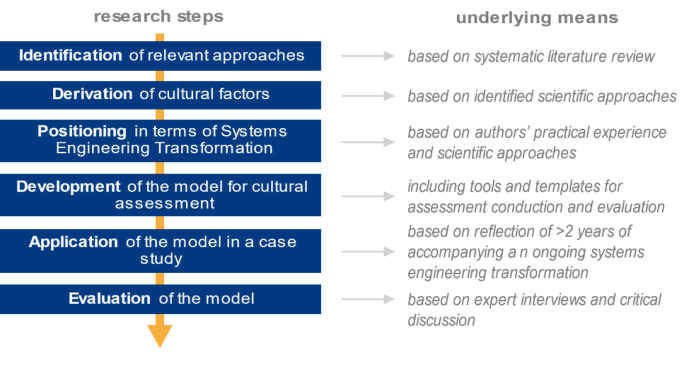
SCIENTIFIC APPROACH This research is based on a six-step approach based on (Ulrich, 1981) as illustrated in Figure 1. In the first step, a systematic literature review is conducted to identify relevant scientific approaches in field of cultural
280 Graessler and Grewe
assessment in organizations and corporates. Based on the identified approaches, cultural factors are collected and classified into six categories in the second step. In the third step, the identified factors are evaluated for their relevance to Systems Engineering transformation. At this point, the factors are complemented based on practical insights from consulting organizations in the application of Systems Engineering. Based on this, in the fourth step, a model for corporate culture assessment is developed including a supporting tool and templates. In the fifth step, the developed model, a tool, and templates are applied to Systems Engineering transformation of a large car manufacturer. The assessment result is evaluated based on comparison with addressed management reflection of current obstacles and advantages.
Figure 1: Scientific approach of this research work, inspired by (Ulrich, 1981).
MODEL FOR CULTURAL ASSESSMENT IN SYSTEMS ENGINEERING TRANSFORMATION First, a systematic literature review is conducted to identify relevant approaches in the field of cultural assessment of organizations and corporates. To identify relevant scientific approaches, three different databases with peer-reviewed publications are selected: SCOPUS, Web of Science and IEEE explore. Two different search strings are used: The first search string focuses on a broad range of results in the field of organizational and corporate culture, to identify overall fitting assessment factors. The second search string focuses on cultural assessment in terms of Systems Engineering transformation, to identify assessment factors, which impact Systems Engineering success in engineering organizations. The search strings including number of results and “in scope”reports are shown in the following table:
Importance of Cultural Change in Systems Engineering Transformation 281
Table 1. Search strings with hits and selected results by search engine (excl.
Table available in the original PDF paper.
duplications).
Search string SCOPUS Web of Science IEEE Explore All results / in scope All Scope All Scope All Scope
178 7 110 2 9 1
“organizational culture assessment” OR “organisational culture assessment” OR “corporate culture assessment”
80 3 38 0 69 5
(“organizational culture” OR “organisational culture” OR “corporate culture”) AND “systems engineering” Sum 258 10 148 2 78 6
Following, the identified approaches are shortly described. Multiple of these build up on the defined culture patterns by Cameron & Quinn (Cameron and Quinn, 2006) and conduct assessments in order to position the culture within these patterns or identify new patterns (Akano and Campbell, 72014; Hutchison et al., 2019; Manley et al., 1998; Sindakis et al., 2024). Therefore, evaluation factors and questions are used, which are described initially by (Cameron and Quinn, 2006). Further adaptations were made by Hutchison et al. who combine the CVF and Quality of Interaction Index into a web-based instrument for investigating cultural alignment in organizations implementing Systems Engineering (Hutchison et al., 2019). Akano et al. identify another cultural pattern for Green IT which is positioned and compared to the four patterns of Cameron and Quinn (Akano and Campbell, 72014). Hodgson et al. build up on Hofstede’s cultural dimensions to examine the impact of cultural differences, including organizational and national culture, on the team performance (Hodgson et al., 2011, 2013). Therefore, a methodology including a software tool for cultural assessment based on characteristics of team individuals is presented. Collins et al. address a gap in understanding what constitutes shared beliefs in Systems Engineering. Their approach moves beyond the generalizations of Hofstede’s and Schwartz’s work, resulting in a framework for empirical investigation into the human dimension (Collins and Callahan, 2009).
The systematic literature analysis shows that neither the identified scientific approaches nor fundamental works offer a practically applicable model for cultural assessment in terms of Systems Engineering Transformation: Key characterization of organizational / corporate culture are described and analyzed in fundamental works since the 1980s (Schein, 2010). Fundamental works on Systems Engineering (Gräßler and Oleff, 2022; Haberfellner et al., 2019; INCOSE, 2015; NASA, 2007) only address the aspect of corporate culture as a side topic. Nevertheless, the Systems Engineering community points out the necessity of cultural awareness for Systems Engineering success, but without defining concrete factors (Arnold and McKinney, 2022; SEBoK Editorial Board, 2020). Further research identifies specific cultural factors, which are compiled as part of this research (Arnold and McKinney, 2022; Gibson, 2019; Hutchison et al., 2019). In addition, factors are derived from the approaches identified in
282 Graessler and Grewe
the conducted systematic literature research and further transferability for Systems Engineering Transformation is covered with respect to Systems Engineering success factors defined in above-mentioned fundamental works. In a next step the 38 identified factors are classified in six categories, whereby the categories show parallels to the subdivisions shown in various approaches (Arnold and McKinney, 2022; SEBoK Editorial Board, 2020). The list of cultural factors including their allocation of categories is summarized in the following Table 2:
Table 2. Identified cultural factors for assessment of corporate culture including the allocation to categories.
Table available in the original PDF paper.
Category Factors Leadership promotion of expert knowledge, decision making, participative management culture, open-mind & out-of-the-box thinking, failure & error culture, openness for new approaches and technologies to try out, openness for innovation, flexible reporting structures, communication and information flows Morale, trust & engagement
interdisciplinary engineering, project management, evaluation of alternatives, hierarchy level, personal incentives, spirit of research Professional development & training
development culture, thirst for knowledge, career paths, future prospects Customer relation validation by customers, involvement of customers, awareness of customer needs Sense of engineering perfection
technical perfectionism, iterations, rapid prototyping, early and frequent validation, dealing with risks, thinking in alternatives, baselining
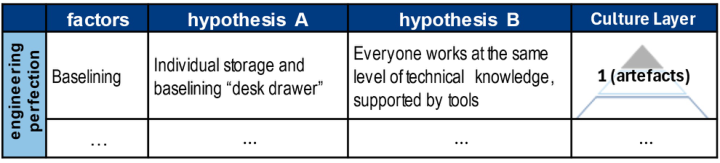
For an implementation of the assessment, each cultural factor is described in two heterogeneous hypotheses based on practical insights from more than five projects accompanying Systems Engineering Transformation in automotive industry. The hypotheses are derived and formulated based on the best characterization of a factor for Systems Engineering Transformation on one side. The heterogeneous, other side of the factor characterization is formulated as the opposite.
In the next step, the identified factors are mapped to the three layers of culture by Schein. The mapping is conducted based on the point of action of the particular factors, whereby an allocation to multiple layers is possible. It is noticeable that all categories allocate to all three layers within the included factors. An example of a factor with its describing hypotheses and layer allocation is given in Figure 2.
Importance of Cultural Change in Systems Engineering Transformation 283
Figure 2: Example hypotheses per factor and its positioning in the cultural layers.
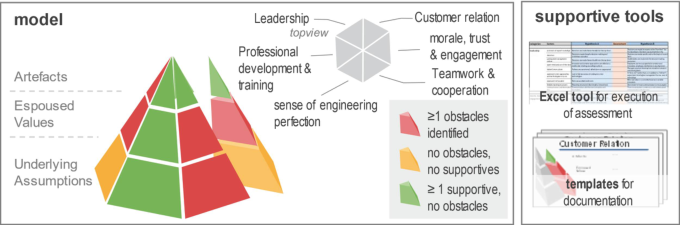
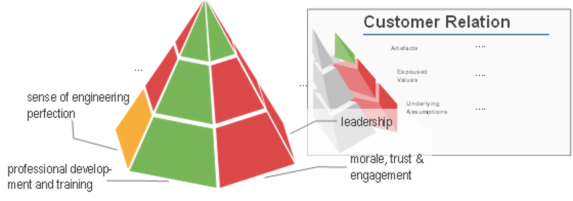
Model for Cultural Assessment Based on the available work mentioned above, the model for cultural assessment in terms of Systems Engineering is developed (see Figure 3). The model builds up on the three cultural layers by Schein. It comprises six perspectives (see Figure 3), which correspond to the defined categories. In each category, the three cultural layers are evaluated based on the assessment of the individual factors. Therefore, a color scheme is defined, which enables a fast positioning of the current corporate culture. In addition, a supportive Excel tool and templates are developed for practical execution of the assessment, which are presented in the following.
Figure 3: Visualization of the developed model including supportive tools.
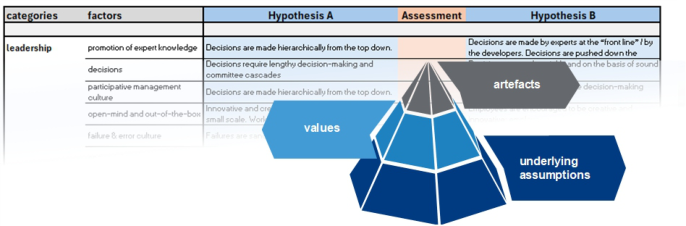
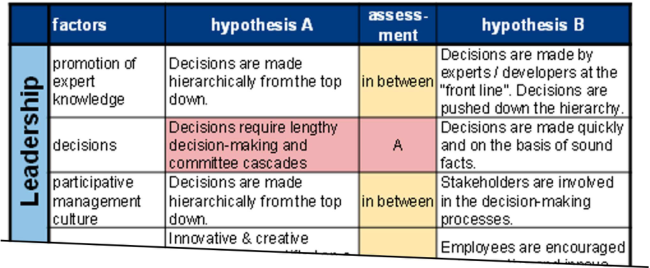
Supporting Tool for Cultural Assessment To support users in carrying out the cultural assessment with regard to readiness for Systems Engineering Transformation, an Excel tool is developed on the basis of the identified cultural factors (see Figure 3). For each factor, an individual assessment is made as to whether hypothesis A or hypothesis B applies, or whether the organization is currently in a position in between. It is important to note that a middle rating assumes a neutral position in the culture assessment, resulting neither in a positive nor negative influence on the outcome.
The cultural assessment is conducted by analyzing responses and comparing them with predefined hypotheses categorized as either beneficial or obstructive to Systems Engineering foundations. This evaluation specifically emphasizes identifying obstacles; therefore, a category is marked
284 Graessler and Grewe
as critical if at least one factor exhibits an hindering level. A category is marked as particularly beneficial if at least one factor is rated as beneficial, and no factors are rated as harmful.
Figure 4: Excerpt from the excel tool developed.
APPLICATION IN INDUSTRIAL PRACTICE The presented model was applied to a 2.5 years accompanied project of Systems Engineering Transformation at a large car manufacturer. Within the project, multiple workshops, working sessions and expert discussions were led and accompanied with focus on current challenges of Systems Engineering operationalization. Obstacles were analyzed on a recurring basis and presented to management in regular reports.
In terms of application of this research, the corporate culture was assessed based on the presented hypotheses in discussions with four experts who were involved in the project. Within the expert interviews the model was introduced and the hypotheses were discussed following their categorization. The assessment was conducted using the prior presented Excel tool. Finally, the assessments were discussed across the board so that an uniform evaluation and assessment of the established corporate culture was achieved among the experts. Due to the assessment hindering or beneficial cultural aspects became visible and were documented using the developed templates.
Evaluation In terms of evaluation, the assessment results are compared to challenges and obstacles which appeared during the aforementioned transformation project, which is documented in addressed management feedback and documentation. The hindering and beneficial aspects identified by the assessment were mapped to obstacles and positive aspects that arose during the project. Examples of obstacles and beneficial aspects from the three categories of leadership, moral, trust & engagement and professional development & training are explained in the following. Finally, a classification of evaluation and discussion for further use cases follows.
The assessment of the leadership category reveals four potential obstacles (compare Figure 4 and 5). The company has a complex structure of committees in which cascading decisions are made and the power to
Importance of Cultural Change in Systems Engineering Transformation 285 make decisions is clearly distributed. During the transformation project, delayed, inadequate, and missing decisions were observed, which repeatedly hindered the progress of the transformation. This is contrasted by irregular, inconsistent, and broken top-down communication in terms of Systems Engineering Transformation. In the project, this was particularly evident in the form of lost messages that did not reach the target group in terms of change communication. As a result, already achieved success was not visible and the organization was unsettled by a lack of information.
Figure 5: Excerpt from the evaluation in the leadership category.
The assessment in terms of morale, trust & engagement reveals five obstacles, which can be reflected to emerged challenges during the transformation project. As became apparent in various observations during the project, the organization shows a lack of resilience. This is expressed in particular by the fact that although the need for change is not denied, it does not result in active, intrinsically pursued action with visible facts. In addition, there are constant forces of inertia that do not perceive the change as necessary. This behavior is encouraged by the employees’ existing feeling of security, which is supported by the company’s current good situation, despite signs of future difficulties such as declining competitiveness. In addition, a strong silo mentality anchored in the organization leads to challenges in the implementation of the transformation. Silo structures exist not only across company boundaries within the group, but also within their own department, which is reflected in parallel, uncoordinated initiatives and solution approaches.
Within the category “professional development & training”, the positive influence of a strong culture of further development and openness to new methodological approaches could be identified as anchor for introducting Systems Engineering. This is expressed in the project through a wide range of qualification measures and training courses, which were taken up by a large proportion of employees. Another important factor is the strong identification of the employees with the company and the individual future prospects recognized by the employees in the company.
286 Graessler and Grewe
Figure 6: Result of the assessment with schematic profile per category.
The model, the supportive Excel tool and templates developed for its application do not represent a solution for changing the culture in favor of Systems Engineering, but they do draw attention to relevant aspects of the prevailing culture that could complicate and hinder Systems Engineering Transformation. This can result, for example, in a lack of willingness to change, resistance or complex interfaces in existing structures. As shown in the application and evaluation of this model, multiple obstacles are identified, which can be mapped to challenges emerged during a Systems Engineering Transformation project (see Figure 5). But also current strengths are visible in the project’s proceeding.
Based on the results, it is up to the user to independently evaluate the highlighted aspects, address them with suitable change measures or ignore them.
Due to the models’ detachment from type of product, applicability to other industries is likely, but requires further validation.
CONCLUSION
Within this paper, a model for cultural assessment based on established factors and fundamentals as well as an Excel tool and templates for documentation are comprised. The model, based on Schein’s 3-layer model, provides guidance on the starting point for Systems Engineering Transformation and focuses on cultural awareness. The application at an automotive manufacturer showed that the assessment carried out was able to identify harmful aspects of the corporate culture, which repeatedly led to discussions among project members and project delays. This shows that critical aspects can be identified through rapid application of this model and its supportive tools. Thereby, organizations and transformation leaders are enabled by a light-weight model to achieve rapidly an orientation of hindering or supportive cultural aspects with regard to Systems Engineering Transformation.
In further research, the model will be adapted with factor specific weights, to enable an estimation of the degree of harmfulness to the Transformation. Build on this, predefined measures can be derived to initiate specific cultural change. In addition, existing role models (Graessler et al., 2022; Gräßler and Oleff, 2022) will be enhanced to include the Systems Engineering Transformation aspects.
Importance of Cultural Change in Systems Engineering Transformation 287
REFERENCES
Akano, A. K. and Campbell, W. (72014) ‘A Cross-Cultural Survey of the Impact of Organizational Culture on Adoption of Green IT’, 2014. Arnold, E. and McKinney, D. (2022) ‘Enabling Systems Engineering in an Unsupportive Environment’, INCOSE International Symposium, vol. 32, no. 1 Babinková, Z., Melovi´c, B., Milisavljevi´c, S., Grubi´c-Neši´c, L. and Mitrovi´c, S.
(2014) ‘Manager’s assessment of organizational culture’, E+M Ekonomie a Management. Bretz, L. (2021) ‘Herausforderungen und Chancen bei der Einführung von Systems Engineering’, ATZextra, vol. 26, S6, pp. 12–15. Bretz, L., Kaiser, L. and Dumitrescu, R. (2019) ‘An analysis of barriers for the
introduction of Systems Engineering’, Procedia CIRP, vol. 84, pp. 783–789. Cameron, E. and Green, M. (2009) Making sense of change management: A complete guide to the models, tools & techniques of organizational change, London, Kogan Page. Cameron, K. S. and Quinn, R. E. (2006) Diagnosing and changing organizational
culture: Based on the competing values framework, San Francisco, Calif., Jossey- Bass. Collins, S. T. and Callahan, C. W. (2009) ‘Cultural differences in systems engineering: What they are, what they aren’t, and how to measure them’. Davey, C. (2020) INCOSE Automative Vision 2025, San Diego. Denison, D. R., Haaland, S. and Goelzer, P. (1991) ‘Corporate Culture and
Organizational Effectiveness: Is there a similar pattern around the world?’, The Academy of Management Review, vol. 16, no. 1, p. 203. Gibson, D. (2019) Factors affecting systems engineering rigor in launch vehicle organizations, Electronic Theses and Dissertations. Graessler, I., Thiele, H., Grewe, B. and Hieb, M. (2022) ‘Responsibility Assignment
in Systems Engineering’, Proceedings of the Design Society, vol. 2, pp. 1875–1884. Gräßler, I. and Oleff, C. (2022) Systems Engineering: verstehen und industriell umsetzen, Berlin, Heidelberg, Springer Berlin Heidelberg. Haberfellner, R., Weck, O. de, Fricke, E. and Vössner, S. (2019) Systems Engineering,
Cham, Springer International Publishing. Hartwich, E. (2014) Grundlagen Change Management: Organisationen strategisch ausrichten und zur Exzellenz führen, Stuttgart/München, Richard Boorberg Verlag. Hodgson, A., Hubbard, E.-M. and Siemieniuch, C. E. (2011) ‘Culture and the
performance of teams in complex systems’, 2011 6th International Conference on System of Systems Engineering. Albuquerque. Hodgson, A., Hubbard, E.-M. and Siemieniuch, C. E. (2013) ‘Toward an Understanding of Culture and the Performance of Teams in Complex Systems’, IEEE Systems Journal. Hofstede, G. (1984) Culture’s consequences: International differences in workrelated values, Beverly Hills, Calif., SAGE. Hutchison, N., Burke, P., See Tao, H. Y., Kothari, S. J., Makwana, D. and Luna, S.
(2019) ‘The influence of organization alignment on the effectiveness of systems engineers’. INCOSE (2015) INCOSE Systems Engineering Handbook: A Guide for System Life Cycle Processes and Activities, 4th edn, New York, Wiley. Kennedy, G., Shirvani, F., Scott, W. and Campbell, A. P. (2020) ‘Towards the
integration of organisational culture models into model-based systems engineering approaches for enterprise systems transformation’, Australian Journal of multi- disciplinary Eng.
288 Graessler and Grewe
Manley, T. R., Martin-Vega, L. A., Shaw, W. H. and Mighdoll, P. (1998) ‘Understanding organizational culture and its role in organization transformation and development’. NASA (2007) NASA Systems Engineering Handbook, Washington. Oakland, J. S. and Tanner, S. (2007) ‘Successful Change Management’, Total Quality
Management & Business Excellence, Taylor & Francis. Schein, E. H. (2010) Organizational culture and leadership, 4th edn, San Francisco, Calif., Jossey-Bass. Schwartz, S. H. (2012) ‘An Overview of the Schwartz Theory of Basic Values’, Online
Readings in Psychology and Culture, vol. 2, no. 1. SEBoK Editorial Board. 2024. The Guide to the Systems Engineering Body of Knowledge (SEBoK), v. 2.10, N. Hutchison. Hoboken, NJ: Stevens Institute of Technology. Sindakis, S., Kitsios, F., Kamariotou, M., Aggarwal, S. and Cuervo, W. J. M. (2024)
‘The effect of organizational culture and leadership on performance: A case of a subsidiary in Colombia’, Journal of General Management, vol. 49, no. 2, pp. 115–132. Ulrich, H. (1981) ‘Die Betriebswirtschaftslehre als anwendungsorientierte Sozialwissenschaft’, Die Führung des Betriebes, pp. 1–25.
LISTED IN THE AHFE DIGITAL BOOKSTORE CATALOGUE
Explore the complete digital volume
Human Systems Engineering and Design (IHSED2024): Future Trends and Applications
Read this individual research paper free through the original publisher, or explore the full digital proceedings book.
ISBN 978-1-964867-34-2
Explore this ISBN in the AHFE Bookstore ↗Listed in the July 2026 bookstore catalogue; search by ISBN to confirm current availability · Digital book purchase optional