kazuhiko yamazaki (2026). Implementing Vision in Society through Brand Experience: A Multi-layered Framework and Case Studies. In: Intelligent Human Systems Integration (IHSI 2026): Disruptive and Innovative Technologies. AHFE Open Access, vol. 200, pp. 814–820. https://doi.org/10.54941/ahfe1007141
Visions and purposes have become increasingly recognized as essential drivers that shape the future of organizations and society. However, visions are often articulated as abstract ideals, making them difficult for users to experience directly. While previous studies in design, marketing, and organizational theory have addressed visions, brand experiences, and culture separately, few have examined how visions are concretized as everyday experiences that influence both internal culture and external user interactions. This study aims to address this gap by proposing a multi-layered framework that enables the social implementation of visions through brand experience and by demonstrating its application through two contrasting organizational cases.This study adopted a qualitative, multi-case approach. First, an integrative framework was developed, conceptualizing the process of vision implementation as a chain: vision → brand experience → employee experience → user experience. This framework emphasizes how brand experience translates abstract visions into emotionally resonant narratives, employee experience internalizes the vision within organizational practices, and user experience manifests the vision through products and services. Second, two organizations from distinct domains were analyzed: Money Forward Inc., a fintech company in Japan, through a semi-structured interview with a key cultural leader and company documents; and Busshien, a Japanese social welfare corporation, through site visits, interviews, and literature review. The analysis examined how visions were expressed and experienced at each of the three experiential layers.The analysis revealed that both organizations successfully implemented their visions through multi-layered experiential strategies. At Money Forward, the vision of “Move money forward. Move life forward.” was translated into a brand experience of progress and optimism through design language and advertising, supported internally by employee behavior guidelines (e.g., “User Focus,” “Fairness”). Users experienced the vision through financial visualization tools that fostered security and empowerment. At Busshien, the vision of “creating an inclusive society” was embodied in open and culturally rich facilities, promoting brand experiences of inclusion and dignity. Employees internalized this vision through empathetic care practices, while users experienced respect, autonomy, and belonging in their daily interactions. Despite differences in their mediating elements—digital UX and corporate culture versus caregiving practices and community interaction—both organizations showed a shared structural pattern of translating abstract visions into concrete experiences.This study contributes a new framework for understanding how organizational visions can be socially implemented by cascading from brand experience to employee experience and finally to user experience. The framework clarifies the dynamic and cyclical nature of this process, in which user feedback and employee practices continually reshape brand experiences and visions. By highlighting the common structure underlying different domains, this study provides practical guidance for organizations seeking to embed abstract visions into everyday life and culture.
In recent years, the role of “vision and purpose” has drawn significant atten tion as a fundamental element directing the structure of society and organiza tions. For companies and organizations, a vision is not merely a philosophy or a set of words; it serves as the essential starting point for product devel opment, marketing, and the cultivation of organizational culture. However, since visions are often expressed in abstract language, they typically fail to provide a direct, tangible experience for the user. Consequently, the challenge in “implementing a vision in society” lies in determining how to translate this abstract vision into concrete experiences.
The concepts of vision and experience have been discussed across various fields. Design research has proposed frameworks such as “Speculative Design” (Dunne & Raby, 2013) and “Social Innovation” (Manzini, 2015), which outline the direction of future society and suggest that the creation of a vision stimulates people’s imagination. Marketing research has demonstrated that brand experience permeates users across sensory, affective, cognitive, and behavioral dimensions (Schmitt, 1999) and functions as a medium for cultural narratives (Pine & Gilmore, 1999). Furthermore, organizational the ory has pointed out that vision directs organizational culture and dictates the behavior and decision-making of its members (Schein, 2016).
However, these discussions often remain confined to their respective domains—design, brand, and organization. Specifically, the process connect ing “the presentation of a vision as a philosophy” with “its daily implementa tion in user experience and organizational culture” has not been theoretically formalized. To bridge this gap, a comprehensive understanding of the contin uous process—from translating an abstract vision into a concrete experience to embedding it in the organizational culture—is required.
Based on this awareness, this study proposes utilizing brand experience to achieve the social implementation of a vision. The paper introduces case studies from two organizations belonging to different sectors: Money Forward, a financial technology company, and Busshin-en, a social welfare corporation. The primary objective is to clarify the process through which a vision is deployed into a brand experience by analyzing these two examples.
Brand and Brand Experience Kawakami and Yamaguchi (2013) define a brand as “a comprehensive con cept where the ‘perceived value’ of a certain product or service is linked to the ‘identifier’ held in the minds of consumers.” For this study, a brand is defined as “a name, term, design, symbol, or other feature that identifies a product
816 Yamazaki or service and differentiates it from others for the consumer.” A strong brand can evoke specific images and emotions—such as reliability, quality, and val ues—in the minds of consumers. Branding or brand management refers to the marketing strategy employed by a company or organization to build a unique identity and strengthen its brand.
Brand experience refers to the sensory, affective, cognitive, and behavioral responses a user feels through all touchpoints with a product or service. This encompasses all direct or indirect interactions, including advertising, product usage, customer service, and social media interactions. The brand experience represents the “strategically desired experience a company intends for its customers,” while user experience (UX) or customer experi ence (CX) is the actual experience undergone by users. A strategy is needed to bridge the gap between these two, often called brand strategy or brand experience strategy.
Brand experience consistency is critical when developing brand strategy. Consistency is required across two dimensions: Temporal Consistency, ensur ing the experience remains unchanged over a long period, and Touchpoint Consistency, ensuring the experience is consistent across diverse touchpoints, whether they are direct or indirect, physical (real) or digital.
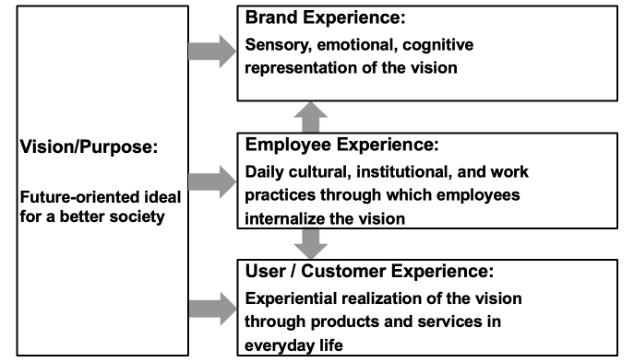
FRAMEWORK FOR VISION AND SOCIAL IMPLEMENTATION A vision is defined here as the “desired future state of the world to create a better society.” An organization’s vision indicates its existence and social direction. However, if a vision remains merely a statement of principles, it will struggle to exert a substantial impact on society. To implement a vision, it must be developed into a chain of multi-layered experiences. This research proposes a framework where vision is socially implemented through mediation across three layers of experience: Brand Experience, Employee Experience, and User/Customer Experience (Figure 1). The pro cess involves translating the abstract vision into experience to drive social implementation.
Figure 1: Framework for implementing vision into society.
Implementing Vision in Society Through Brand Experience 817 Brand Experience Deployment
Translating the vision into experience is positioned as Brand Experience (BX). It converts the vision into a narrative or emotional axis that users and employees can resonate with. An abstract vision is expressed as a concrete experience through the design of products, advertising, and spatial produc tion. This stage is the gateway for users and employees to “perceive the orga nization’s philosophy.”
Employee Experience Implementation Internally, the vision is implemented as Employee Experience (EX). This is the totality of culture, systems, and work experiences employees encounter daily. It forms the foundation for permeating the vision to employees. By internalizing the vision and making decisions based on it, employees ensure the consistency of the externally provided brand experience. Employee expe rience is the indispensable element that supports the “back side” of brand experience.
User/Customer Experience Realization Externally, the vision is implemented as User/Customer Experience (UX/ CX) through concrete products and services. UX involves comprehensively capturing the user’s experience, considering sensibility and emotions, and encompassing the entire flow from pre-purchase to post-use (Hasegawa et al., 2025). Considering brand experience is crucial, as it ensures the orga nization provides a user experience appropriate to its unique corporate iden tity, preventing services from becoming too similar to competitors’ offerings.
Framework Significance The framework systematically captures the social implementation process through the chain of “Vision -> Brand Experience -> Employee Experience -> User Experience.” This is not a unidirectional chain; it is cyclical, where user feedback influences brand and employee experience, prompting the reinter pretation or modification of the vision. Conversely, the employee experience can also lead to the updating of the vision. This framework highlights the dynamism of continuously transforming a vision from a “philosophy” into a “daily experience.”
CASE STUDY: MONEY FORWARD Money Forward, Inc., is a Japanese FinTech company providing cloud-based services for financial management. Its corporate philosophy is “Money Forward. Life Forward.” The analysis is based on a semi-structured interview with Ms. Keiko Kanai (VP of Culture) and company materials.
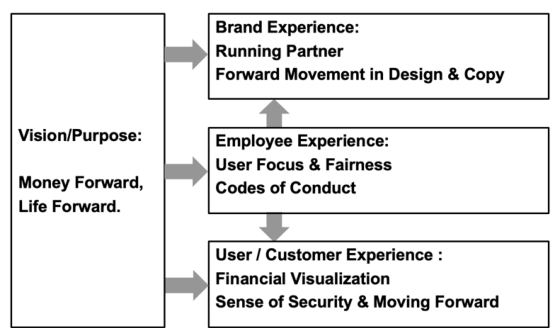
This corporate vision is translated into Brand Experience through a simple and positive design language and advertising. Elements evoking “forward movement” are used in user interfaces and copy, while advertising and events
818 Yamazaki promote the company’s stance as a “running partner,” providing users with a sense of security and hope. Internally, the vision is implemented as Employee Experience where employee codes of conduct (e.g., User Focus, Fairness) support this internal vision. Employees share the goal of “moving users’ lives forward” and embody this mission through daily decision-making and cus tomer interactions, which ensures consistency between the external brand experience and the internal employee experience. Finally, the vision is mate rialized as User Experience through products like the household budget app and cloud accounting software, where the company achieves “financial visu alization.” This process gives users a “sense of security” and “sense of moving forward” by empowering them to proactively grasp their economic situation and make positive decisions, thus materializing the vision in daily life. The application of the framework to Money Forward is illustrated in Figure 2.
Figure 2: Implementation of vision at money forward.
CASE STUDY: BUSSHIN-EN The social welfare corporation Busshin-en operates under the philosophy of realizing “A society where all people live with dignity” and aiming for “Creating a Society of Coexistence.” The corporation provides comprehen sive support to people facing various difficulties in living. The analysis is based on facility visits, interviews, and related publications.
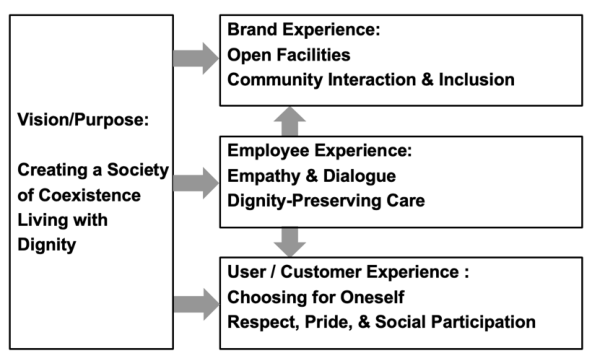
This core vision is translated into concrete Brand Experience (BX) through facility management and community interaction initiatives. By incorporating open facility spaces and cultural activities, the facilities create an environment where users and local residents can experience “coexistence” and “inclusion.” This brand experience is designed so that the philosophy of “welfare that protects dignity” can be felt daily. Internally, the vision is deeply implemented as Employee Experience (EX). “Empathy and dialogue” are emphasized through staff training and daily care practices. Staff internalize “dignity-pre serving care” as their mission and practice the vision in their daily work. This consistent practice of the vision by employees forms the firm foundation
Implementing Vision in Society Through Brand Experience 819 for the brand experience provided externally. For service users, the vision is materialized as a concrete User Experience (UX). The critical experience is having the process of “choosing and deciding for oneself” respected in meal and care settings. Users feel “respect,” “security,” and “pride,” and gain the sense of “being a member of society” through participation in community interactions and cultural activities. The vision is materialized in these daily, empowering experiences (Figure 3).
Figure 3: Implementation of vision at Busshin-en.
CONCLUSION
A comparison of the Money Forward and Busshin-en cases, based on the proposed framework, reveals a shared success in implementing vision in society through a multi-layered deployment, despite their differing domains. Both organizations mutually link Brand Experience, Employee Experience, and User Experience, originating from their core Vision.The main difference lies in the mediating elements: Money Forward utilizes digital UX and employee codes of conduct, medi ating the vision through technology and organizational culture.
Busshin-en translates the vision into experience through daily interactions in care settings and community exchanges.
This comparison confirms a universal structure for vision implementation: the translation of an abstract philosophy into a daily, tangible experience is the common process across different fields. This study clarifies the dynamism of this process, providing a theoretical foundation for organizations seeking to achieve social implementation of their core values.
ACKNOWLEDGMENT
The authors would like to acknowledge to Ms. Keiko Kanai (VP of Culture, Money Forward).
REFERENCES
Dunne, A. and Raby, F. (2013) Speculative everything: Design, fiction, and social dreaming. Cambridge, MA: MIT Press. Hasegawa, A., Matsubara, Y. and Yamazaki, K. (2025) Design in human-centered
design (HCD Library). Tokyo: Kindai Kagaku-sha. Kawakami, S. and Yamaguchi, Y. (2013) Platform branding. Tokyo: SB Creative. Manzini, E. (2015) Design, when everybody designs: An introduction to design for social innovation. Cambridge, MA: MIT Press. Pine, B.J. and Gilmore, J.H. (1999) The experience economy. Boston, MA: Harvard
Business School Press. Schein, E.H. (2016) Organizational culture and leadership (Revised Edition). Tokyo: Hakuto Shobo. Schmitt, B. (1999) Experiential marketing: How to get customers to sense, feel,
think, act, relate. New York: Free Press. Schmitt, B. H. (1999). Experiential marketing: How to get customers to sense, feel, think, act, relate. Free Press.
LISTED IN THE AHFE DIGITAL BOOKSTORE CATALOGUE
Explore the complete digital volume
Intelligent Human Systems Integration (IHSI 2026): Disruptive and Innovative Technologies
Read this individual research paper free through the original publisher, or explore the full digital proceedings book.
ISBN 978-1-964867-76-2
Explore this ISBN in the AHFE Bookstore ↗Listed in the July 2026 bookstore catalogue; search by ISBN to confirm current availability · Digital book purchase optional